Columbus McKinnon Corporation
Q2 FY2027 · Earnings Call TranscriptNovember 3, 2026
Operator
Good morning, and welcome to Columbus McKinnon's second quarter fiscal 2027 earnings conference call. My name is Anas, and I will be your conference operator today.
As a reminder, this call is being recorded. I would now like to turn the conference over to Alexandre Eldredge with Columbus McKinnon Investor Relations.
Alexandre Eldredge
Thank you, and good morning, everyone. Thank you for joining us for the CMCO second quarter of fiscal 2027 earnings call.
Joining me on the call this morning are President and Chief Executive Officer David Wilson and Chief Financial Officer John Linker. On today's call, we will be referencing our earnings press release and presentation, which are available on our Investor Relations website, investors.cmco.com.
Before David and John walk you through our operating and financial performance for the quarter, I would like to remind you that during this call, we may make forward-looking statements pursuant to the safe harbor provisions of the Private Securities Litigation Reform Act of 1995 in regard to our current plans, beliefs, and expectations. These statements are not guarantees for future performance and are subject to a number of risks and uncertainties and other factors that can cause actual results and events to differ materially from the results and events contemplated by these forward-looking statements.
I'd also like to remind you that management will refer to certain non-GAAP financial measures. You can find reconciliations for these non-GAAP financial measures to the most directly comparable GAAP financial measures on the company's Investor Relations website and in its filings with the Securities and Exchange Commission.
Please see our earnings release and our filings with the Securities and Exchange Commission for more information. Also on today's call, we will make reference to pro forma metrics, which adjust for both the Kito Crosby acquisition and the divestiture of the legacy Columbus McKinnon U.S.
power chain hoist and chain operations, as if each transaction had been completed prior to the beginning of the prior-year period to improve the comparability of results across different periods. Today's prepared remarks will be followed by a question-and-answer session.
We respectfully ask that you limit yourself to one question and one follow-up. With that, I'll turn the call over to David.
David Wilson
Thank you, Alexandre, and good morning, everyone. In Q2, we continued building on our strong start to fiscal 2027, advancing progress with the integration of Kito Crosby, and unlocking synergies while driving organic revenue growth and delivering margin improvement.
I am pleased with the progress we are making as our people, processes, and systems are coming together to enhance value, execute day in and day out for our customers through our scaled and better-positioned business and product portfolio. Turning to the quarter's results, orders exceeded $560 million for the second consecutive quarter, growing 13% on a pro forma basis, demonstrating the market's resilient demand for our intelligent motion solutions and providing visibility into future sales growth.
In the period, pro forma sales grew 7%, with growth across all geographies and at both legacy CMCO and Kito Crosby. This robust revenue growth is enabled by our scaled platform, enhanced customer value proposition, and business initiatives which are unlocking market share gains in targeted growth areas.
This growth is also supported by ongoing commercial initiatives and early revenue synergy wins. The team continues to make disciplined progress advancing our strategic priorities of operational excellence, commercial effectiveness, and customer experience, strengthening our foundation for sustainable growth.
Our broad-based demand strength is benefiting from diversified end-market exposure, with continued growth in targeted verticals, including energy, defense, mobility, e-commerce, and general industrial. We are also experiencing tailwinds from data center build-outs, which drive direct demand for lifting securing and hardware and permanently installed lifting solutions, while also driving meaningful upstream demand for the production of data center-related equipment that also requires our solutions.
Volumes are building in the Americas and Asia-Pacific, while EMEA has been a bit softer, consistent with what we're seeing in PMI and industrial production data. Inflationary pressures have been persistent, but our supply chain remains resilient, and we are not experiencing any noteworthy changes in our sourcing of raw materials and components.
We continue to lean on our pricing discipline to strategically realize price where needed to offset inflation, giving us confidence in our ability to manage price-cost headwinds. Additionally, we see opportunities to improve our cost position and drive further improvements in core productivity.
Adjusted EBITDA was $111 million in the quarter and increased 177% year-over-year. Adjusted EBITDA margin was 20.6%.
These results were stronger than anticipated, with sustained strength in the Americas and better-than-expected demand in both Asia and EMEA. Demand resilience was complimented by factors that are within our control and areas where we continue to improve, including strong operational execution, a focus on improving customer experience, and commercial initiatives that are leading to expanding market share.
Since closing the Kito Crosby acquisition, the feedback we are receiving from our customers has been quite positive. I am pleased with the results we have delivered in the first half of the year, and I am proud of how our teams are coming together across the combined business.
This early-stage post-acquisition success gives you a glimpse at the power we are unlocking within CMCO and strengthens our foundation for sustainable, profitable growth in the years ahead. Our confidence in our shareholder value creation potential continues to grow as we drive organic growth, expand margins, deliver increasing free cash flow, and delever the balance sheet.
On the integration front, we continue to make meaningful progress with agile execution and strong collaboration across the combined organization. Our teams have come together as one to support a common mission of providing innovative, intelligent motion solutions to our customers with unmatched safety, quality, and reliability.
While we just completed our second full quarter as a combined organization, we are moving swiftly to deliver meaningful synergies, and our initial integration priorities are firmly underway. We expect to meet or exceed our targeted net cost synergies, and increasingly we are sharpening our focus on the longer-term enablers and initiatives that will unlock the full potential of the combined business.
We are also advancing revenue synergy opportunities that we expect will be meaningful over time. While these items will take time to develop as we align sales force training, channel partnerships, and supply chain optimization, we are seeing early traction from both expanding market share and leveraging our broadened product portfolio across our combined channel reach with key customers.
Overall, we are advancing integration plans and building momentum to deliver sustained organic growth, capture synergies, expand profitability, generate cash, and reduce debt, unlocking substantial long-term value for all stakeholders. Thanks to the good work our more than 7,000 global team members are doing on behalf of our global business, we are increasing our full-year guidance across net sales, adjusted EBITDA, and adjusted EPS.
John will walk you through those details and provide more context regarding our financial performance shortly. Before handing the call over to John, I'd like to share an example of how our team is engaging outside of their normal work responsibilities to advance Columbus McKinnon's vision of moving the world forward for a safer, more productive tomorrow.
Last month, 10 of our global CMCO teammates traveled to Rwanda's Niyaruguru District, where they worked with [B2P?] , a non-profit organization dedicated to safe, reliable rural transport access, to support the construction of a suspended trail bridge.
This bridge will now provide for safer, year-round access to healthcare, schools, and economic opportunities for more than 6,700 people in nearby communities. We are proud that we were able to partner with [B2P?]
to support this construction initiative through both our on-site employee volunteer team and with an assortment of hoists and lifting hardware that enabled the construction of the new suspension bridge. On behalf of our entire organization, I'd like to extend an enormous thank you to all involved in this meaningful initiative.
With that, I'll turn the call over to John to walk us through our second quarter results.
John Linker
Thank you, David, and good morning, everyone. Through my first 4 months with the organization, I've visited multiple facilities, engaged with our teams worldwide, and met many of our equity and debt holders and research analysts.
It is clear to me that CMCO is well positioned to capitalize on megatrends driving demand, deliver organic growth through commercial initiatives, and improve margins through synergy realization and operational improvements. We expect this to lead to outsized free cash flow generation and debt reduction, which will in turn unlock shareholder value.
Our second quarter results represent just the second full quarter since closing the combination with Kito Crosby. These results show early traction on our strategic priorities with stronger-than-expected Q2 results, as we capitalized on broad-based demand for our expanded product portfolio of intelligent motion solutions and reflected disciplined operational and commercial execution.
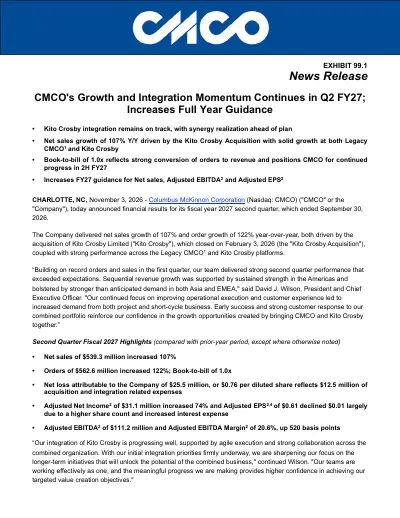
Orders of $562.6 million increased $308.9 million, or 122% from the prior year, largely driven by the benefit of the Kito Crosby acquisition. Normalizing for the acquisition and the divestiture, pro forma orders growth was approximately 13%, with continued strength in the Americas and a significant contribution from EMEA, including an approximately $23 million order tied to an energy customer in Saudi Arabia.
Excluding this order, the majority of which we expect to convert to revenue in FY28, EMEA orders were up high single digits. In APAC, our forward-looking pipeline remains healthy, but second quarter orders declined moderately on a pro forma basis, following the pull-forward of orders in Q1 linked to their July price increase.
Backlog of $556.2 million increased 2% sequentially, reflecting strong order intake and resulting in a 1.0 book-to-bill in the quarter. Current quarter backlog, which typically represents approximately half of the following quarter's revenue, was $264.9 million at quarter end.
We delivered net sales of $539.3 million, which increased $278.2 million, or 107% from the prior year, driven by the acquisition of Kito Crosby, volume, and pricing, partially offset by the divestiture and unfavorable currency translation. Sales growth was broad-based and positive across the Americas, EMEA, and APAC, reflecting mid-single-digit growth in the legacy CMCO portfolio and high-single-digit growth in the legacy Kito Crosby portfolio.
Normalizing for both the acquisition and divestiture, pro forma sales growth was approximately 6.6%, which we estimate was comprised of approximately 4 points of price and 3 points of volume, partially offset by unfavorable foreign exchange. Sales growth was strongest in APAC, reflecting the impact of recent pricing, broadened product portfolio, and the accelerated timing of a project delivery.
The Americas continues to show strength in both short-cycle and project businesses, with sales growth through pricing and execution against our commercial initiatives of expanding the reach of our newly combined product portfolio. Importantly, EMEA delivered modestly positive revenue growth on a pro forma basis, which was an improvement as compared to our expectations going into Q2, as industrial activity showed signs of returning, led by investments in infrastructure, energy, and defense.
Overall, demand driving Q2 sales was both broad-based and resilient. On a consolidated pro forma basis, project-related sales increased double digits and short-cycle sales increased mid-single digits, with benefits from both pricing and volume growth from a favorable demand environment.
Gross profit of $187.9 million increased $97.7 million, or 108% versus the prior year on a GAAP basis, reflecting the Kito Crosby acquisition, pricing, and volume, partially offset by the impact of the divestiture and material cost and diesel inflation in COGS. On a GAAP basis, our gross margin was 34.8%, while on an adjusted basis, our gross margin was 36.5%, an improvement of 120 basis points year-over-year, primarily due to favorable price versus cost and the accretion of the Kito Crosby acquisition.
Adjusted gross margins also improved sequentially when normalizing Q1 to exclude the net benefit of IEEPA tariff refunds. Our RSG&A expenses increased $51.9 million to $122.2 million on a GAAP basis due to the addition of Kito Crosby, integration costs, and increased incentive compensation expense, partially offset by cost-saving synergies.
Adjusted RSG&A, which excludes acquisition integration costs and other non-recurring expenses, increased by $51.9 million to $111.1 million. This is where we are seeing the majority of scale benefits from the acquisition and cost synergy realization.
Adjusted EBITDA of $111.2 million increased $71.0 million, or 177%, with an adjusted EBITDA margin of 20.6%. Adjusted EBITDA margin expanded 520 basis points year-over-year, reflecting accretion from the Kito Crosby acquisition, prudent cost management, and synergy realization.
When normalizing for the impacts of the Kito Crosby acquisition and divestiture in the prior period, Q2 adjusted EBITDA grew approximately 14%, and adjusted EBITDA margins expanded approximately 130 basis points on a pro forma basis. We continue to believe that based on actions taken thus far, we are well positioned to meet or exceed our net cost synergy target.
Net loss attributable to company in the quarter was $25.5 million, or 76 cents per share on a GAAP basis. Adjusted net income was $31.1 million, or 61 cents a share, down 1 cent versus the prior year, primarily driven by operating profit increases, offset by higher interest expense and a higher share count due to the inclusion of the common shares issuable upon conversion of the preferred shares.
Year-to-date, we delivered $4.6 million of free cash flow, an improvement from the prior year, reflecting our higher operating profits, partially offset by higher cash interest, higher cash taxes, and a higher use of working capital to support strong year-to-date sales growth. We expect this working capital investment to convert to improved cash generation in the second half of this fiscal year.
In the quarter, we opportunistically repriced our senior credit facilities, reducing the effective interest rate on both our Term Loan B and revolving credit facility, lowering the applicable margin spread on both by 50 basis points. On an annualized basis, we expect this to result in savings of more than $7 million.
As a reminder, our long-term debt structure is comprised of a $1.4 billion Term Loan B and $900 million of senior secured notes. The Term Loan B, after the repricing, bears interest at SOFR plus 300 basis points.
We have hedges in place on approximately $1 billion of this $1.4 billion, fixing SOFR at approximately 3.7%, with laddered maturities through fiscal 2031. The Term Loan B has no prepayment penalty for optional redemptions.
The senior secured notes bear interest at 7 1/8%, payable semi-annually. This debt structure, along with our recent repricing, positions us well to navigate the current environment of higher interest rates.
Our liquidity position remains healthy at $532 million, consisting of $110.9 million of cash and cash equivalents and $421.1 million of availability on our revolving credit facility. Given our strong Q2 results and increasing confidence in the year, we are raising our outlook for fiscal 2027.
This updated full-year outlook reflects strong orders and financial performance in the first half, and increased confidence and traction on our strategic priorities. The revised outlook takes into account the timing of our current backlog, increased interest rates, and updated foreign exchange rates.
Our guidance also incorporates confidence that in the second half of the fiscal year, we will sustain the strong adjusted EBITDA margin performance from the first half, when normalizing the first half to exclude the net benefits of the IEEPA tariff refunds from Q1. Our increased outlook for fiscal 2027 is: net sales of $2.13 billion to $2.17 billion, adjusted EBITDA of $425 million to $440 million, and adjusted EPS of $2.00 to $2.15 a share.
Additionally, we have updated our guidance assumptions, which incorporates some adjustments to our acquisition purchase price accounting, which was finalized in the quarter. These assumptions include: interest expense of $185 to $190 million, amortization expense of $130 to $135 million, depreciation expense of $80 to $85 million, capital expenditures of $45 to $55 million, a normalized effective tax rate, as used in the calculation of adjusted EPS, of 25%, and adjusted diluted shares outstanding of 52 million, reflecting our expectation to PIK the preferred share dividend in fiscal 2027.
Our first-half results give me increasing confidence in not only our integration of the Kito Crosby acquisition and synergy realization, but also that our scaled, enhanced customer value proposition is delivering value across intelligent motion solutions. We are making meaningful progress through our strategic priorities of operational execution, improved customer experience, and expanding market share.
I am confident that our strategy will unlock multiple avenues of organic growth, improve our margin profile, and generate significant free cash flow to fund debt reduction. Operator, we are now ready to take questions.
Operator
Thank you, sir. Ladies and gentlemen, we will now begin the question-and-answer session.
If you would like to ask a question, please press star followed by the number one on your telephone keypad. We ask analysts to limit themselves to one question and a follow-up.
If your question has been answered or you would like to withdraw from the queue, please press star followed by the number two. If you are using a speakerphone, please lift your handset before pressing any keys.
One moment, please, while we compile the roster. Our first question comes from James Kirby with J.P.
Morgan Chase. Please go ahead.
James Kirby
Hey, good morning, guys. Can you hear me all right?
David Wilson
We can hear you, John. James, sorry.
James Kirby
No problem. I appreciate the commentary there.
Maybe just starting, I'm trying to square the commentary from last quarter that this quarter would be the low point in EBITDA and sales, and you cited some one-time benefits last quarter. Just wondering, look ahead if the margin cadence you described last quarter is still intact, and maybe if you can parse the buckets of one-time benefits versus kind of sustainable, durable pricing power.
David Wilson
Right. James, let me start and ask John to jump in.
When we entered the quarter, we had had a performance in Q1 that included the benefits of one-time IEEPA tariff refunds that we knew came into that quarter. We also looked at the backlog that we had and how it phased, and anticipated that Q2 would be a low point for the year as you indicated and we were indicating at the time.
As the quarter progressed and demand patterns evolved, we had robust demand from a short-cycle perspective, were able to execute ahead of plan in a number of key areas, and we actually had the accelerated delivery of some project activity both in Asia and in Europe. The combination of those opportunities, projected or continued demand, and our ability to execute was what resulted in us being able to overdeliver in the period.
We also continued to make really good progress with our synergy initiatives and the integration of the two businesses, which was terrific. The combination of those factors resulted in us delivering a performance that was outsized related to expectations that we'd previously talked about.
As we raised price in Q1, our Q1, in addition to some price increases that went into effect in the prior fiscal year that had carryover benefits. We're starting to see the benefits of those come through as well.
As John indicated, in the quarter, we believe that pricing was about 4% of the growth, and volume was about 3% of the growth. I'll pause there and ask John to continue if there's something you wanted to add.
John Linker
Thanks, David. I would say there wasn't anything to call out of any magnitude in Q2 that sort of significantly skewed margins.
We didn't have any material IEEPA tariff refunds in Q2 like we did in Q1. I think it's just we overperformed as the quarter progressed.
We had a very strong September of sales throughput, and that has some nice operating leverage on it, and that allowed a nice margin for us in the quarter, and we're really pleased with how that panned out. As I tried to indicate in the prepared remarks, to simplify things, if you take the first half of the year, pull out the net benefit of IEEPA tariff refunds, you're at sort of little high 19%, 19.7% EBITDA margin, something in that ballpark, and if you look at our implied second half of the year in our outlook that we just gave, we're implying that the second half is going to look similar to that.
We're trying to signal that we're sustaining that strong margin performance, and there'll be quarter-to-quarter fluctuations in where margins land depending on the mix, but we're really pleased with sort of how things are coming together from a margin and synergy perspective.
David Wilson
Yeah. James, you'll recall on a pro forma basis, we ended last year at 18.5% pro forma EBITDA margins, and so this is a nice progression from that point.
James Kirby
Right. Thanks both.
That sounds great. Maybe, David, second question, you talked about the revenue synergies in the prepared remarks.
I know probably not ready to give or provide a flavor of kind of the size of the opportunity there, but just on the market share you're seeing or potential market share gains, maybe just any more color you can share there in terms of region or product that you're seeing potential for market share for maybe the top-line synergies you talked about?
David Wilson
Yeah. I think we're seeing it across the organization on a global basis.
We're seeing opportunities to sell our products that are legacy CMCO products into the Kito Crosby channels. We're seeing the same opportunities to sell Kito Crosby products into the legacy CMCO channels.
Our combined organization presents a more valuable combined offering to the market, which is creating opportunities for us to continue to grow and position ourselves well with customers. As I said in the prepared remarks, the feedback that we've been receiving from our customers post-acquisition and the way that we've been responding, both with our actions in the business as well as in the way that we've been responsive to customer needs, has received really favorable responses from customers.
We believe that the combined portfolio, the extended reach, and our focus on improved execution, improving on-time delivery and customer experience, is leading to the opportunity for us to grow the business and gain some share. We're seeing opportunities that we've realized in all geographies.
Perhaps if it were weighted slightly, it might be more weighted towards the Americas in the initial phases of this, just simply given our concentration and more fulsome position in that market.
James Kirby
Got it. Appreciate the color, guys.
David Wilson
You bet. Thanks, James.
Operator
Thank you. Our next question will be from Matt Summerville with D.A.
Davidson. Please go ahead.
Matt Summerville
Thanks. Can you talk a little bit about how we should expect free cash flow to cadence out for the balance of the year?
You mentioned some potential tailwinds from working capital. Then, can maybe also to the last question, talk about how much revenue and EBITDA may have ultimately been pulled forward if that's the right way to think about that project acceleration you mentioned in Asia and Europe?
John Linker
Thanks, Matt. From a cash flow standpoint, if you think about sort of year-to-date some of the bigger buckets that we've had, we've got $90 million of cash interest expense year-to-date, $26 million of cash taxes year-to-date.
We called out the $24 million of cash deal costs in year-to-date, and then CapEx of sort of $16 [million]. I think we've given guidance on sort of most of those elements for the full year.
The one outlier in that is that our working capital has definitely been a use of cash year-to-date. Some of that is just on a pro forma basis, our sales are up about 8%, if you kind of look at the blend of Q1 and Q2.
Ballpark, that's $80 million of sort of pro forma sales increase, and typically our working capital runs about 30% of sales, we've got some use of cash there of 30% of that $80 million of sales increase that is tied up on the balance sheet right now. In summary, we would expect the second half of the year, certainly to see some unlock on that working capital of converting the AR and particularly the inventory into cash flow in the back half of the year, and that use of cash would flip back to at least neutral, if not positive, for the full year, is kind of how we're thinking about cash flow generation.
The cash flow generation is significantly weighted in the second half. I'll pause there or I can go to your second question on sort of the second quarter.
Matt Summerville
Oh yeah, the second quarter's great, thanks. Yep.
John Linker
On the second quarter, we did call out one project in APAC. It was around $5 million that did get pulled forward based off of sort of customer needs, and that was a very high-margin project, and so it was enough to sort of skew our original outcome a bit in terms of some of the drivers from our original talking points for Q2.
Outside of that, I wouldn't cite any significant sort of pull-in type of activity that took place from a sales standpoint in Q2. It was just sort of normal course.
Just overall, we saw strong orders, and that translated into strong sales in the quarter. Certainly, as I indicated, it got better as the quarter progressed, and we exited the quarter with just a really nice September.
Our lifting hardware business in the US was particularly strong, which was in that short cycle, which we have less visibility to when we give comments at the beginning of a quarter. That business really progressed well as the quarter progressed into Q2.
Matt Summerville
Thank you. Then just as a quick follow-up, can you be a little bit more specific around where you were from a price-cost spread standpoint in Q2, and how we should be thinking about that spread in Q3 and 4?
Thank you.
John Linker
On a pro forma basis, we called out the 4 points of price for the combined business. We're not in a position to sort of quantify the specifics of the price-cost, but it was favorable.
We did see inflation in both material cost as well as diesel, it's not like all that price is dropping to the bottom line, but as of right now, just given where we stand with sort of integration and analytics, I'm not in a position to sort of quantify the exact price-cost benefit in this context. As we go through the back half of the year, we expect that price-cost relationship to remain favorable.
We're always going to be on our front foot, I should say, in terms of looking at other areas of inflation that might be of concern so that we can make further adjustments to pricing as needed, but based off where we sit today, we feel like we'll be able to maintain that favorable price-cost in the second half.
David Wilson
Thanks, Matt.
Matt Summerville
Thank you.
Operator
Our next question will be from Jon Tanwanteng with CGS. Please go ahead.
Jon Tanwanteng
Hi, good morning, thank you for taking my questions and congrats on a nice quarter. I was wondering if you could go a little bit more into detail on the end demand and the drivers of that outperformance, particularly in EMEA and Europe.
As you mentioned, data centers have been stronger in North America, there was an energy project in Asia that pulled forward, but what are the countries and the actual applications that are driving the stronger-than-expected demand that you're seeing in those regions? Thank you.
David Wilson
Thanks, Jon. I would say that it's been largely energy, general industrial demand, and as we called out, we did see some increased demand in defense.
From my perspective, those would be three primary drivers outside of normal economic activity that sort of showed up a little bit better for us in the period in Europe. We continue to execute in that region on a number of key initiatives, from cross-selling to market reach.
We did call out the very specific project in energy that we got with Saudi Arabia as John highlighted. The markets for the mobility market are percolating.
There's a lot of really interesting activity in our rail business notably, that is in the funnel. In the quarter, it would primarily be energy, general industrial, and I'd say defense, outside of the normal level of activity.
Jon Tanwanteng
Got it. Then just to clarify, on that last quarter you had highlighted that there would be some maybe headwinds getting things into the Middle East.
Has that bottleneck been cleared, and you can ship there now, or is that still in place?
David Wilson
Yeah. It remains challenging, but we've found ways to navigate.
While routes to delivering into that market have evolved, and the time to deliver might be a little bit longer, we're finding ways to execute and get our product to our customers, but it's not in as efficient a way as we had previously been able to.
Jon Tanwanteng
Understood, thanks. Then just a quick one for John.
It looks like you took down your CapEx by a little bit. Was something pushed out, or did you get more efficient or something else happened, just wondering what's going on there?
John Linker
No, nothing pushed out. We've just underspent, sort of our original budget so far year-to-date with other focuses on integration activities, and so it's just a pushout, there's no signaling there in terms of anything else, just lowering our expectations slightly.
David Wilson
Just timing.
Jon Tanwanteng
Great. Thank you very much.
David Wilson
Thanks, Jon.
Operator
Thank you. Our last question will be from Steve Ferazani with Sidoti.
Please go ahead, Steve.
Steve Ferazani
Morning, David. Morning, John.
Appreciate all the commentary this morning. Just wanted to touch on sort of longer-term, where you are on the leverage journey.
It sounds like I wouldn't have expected you to make progress in the first two quarters. Sounds like you made a little bit.
I think, John, you mentioned the expectation of a reversal of working capital, the typical second half. Can you walk us through where you think you are, and can you provide us any thoughts on the cadence of how you're going to get there in the next 18 months?
John Linker
Thanks, Steve. We continue to have confidence in hitting the 4 times by the end of FY28, based off of how we are reporting our leverage in these calls.
We are taking into account the run rate of the synergies, of the $70 million synergies in these ratio numbers that we're giving. That would imply in order for us to achieve the 4 times by FY28, we need to grow the core business EBITDA, as well as generate free cash flow fairly significantly.
As I just indicated, we do expect some free cash flow generation in the second half of the year, just from unlocking the temporary working capital investment from the sales growth. As we move into next year, I continue to see significant opportunities just to improve underlying working capital metrics themselves.
If you look at inventory turns and DSO and DPO, we absolutely see opportunity to move the needle on those metrics, and today we're at about 2.5 times inventory turns, and if we could get back to 3 times, for example, that would be a significant unlock in terms of free cash flow and a step change in generation. I'd say that is a big area of focus over the next 18 months is that discipline around the balance sheet and cash flow and making sure that we see that come through, and the whole organization is centered around making sure that we generate cash flow and delever.
Then, back on the core business, while we're not yet giving outlook for FY28 here, we certainly do that in the coming quarters, but in order for us to achieve the 4 times, it's not just going to be a free cash flow story, there's got to be some core business EBITDA generation. Given how orders are trending this year, we've posted a couple of good quarters of orders, some of that's already feeding FY28, and we have the visibility of the synergies that we're achieving that we know we're going to get the carryforward of into FY28, that's what gives us confidence to sort of say that EBITDA is going to continue to improve into FY28.
The combination of those two things is what gives us the visibility to say that 4 times by the end of FY28 is still what's the focus area and confidence in what we hope to achieve.
Steve Ferazani
That's really helpful. Now that we're a couple of quarters in, have you started to more fully explore what the opportunities to expand with Kito Crosby are in terms of cross-selling and other initiatives that could be a driver to growth and or margin in '28, '29?
If I can just sort of add on, how you think the macro needs to hold up to get you to your targets by the end of next year?
David Wilson
Yeah. We have, Steve.
We've been working on that since pre-acquisition and have been really deep into it since we've closed the deal. There are a lot of cross-selling opportunities, geography by geography.
We're doing work on sales training and development. We're doing work on channel development.
We're looking at our supply chains and the availability of product and materials in regions. We have identified a list of initiatives, basically region by region, which is how we're executing within the business today.
Are delivering on those in large part in the early innings. They build over time.
We haven't given a guidance number, but we do believe that there is upside potential from revenue synergies that have not been factored into our forward guide and in our synergy number overall that we've been communicating, which is more of a net cost synergy savings target. We're really pleased with the progress we're making, feel good about the way the early developments have unfolded.
We're not counting on a lot different in terms of the market dynamics. We know that there have been positive drivers, megatrends that we do think will continue, but we're not counting on something that's materially different going into '28 and '29 to support the trajectory that we have, more of a sustained level of activity at current levels to support what we're trying to achieve in the out-periods.
Steve Ferazani
Great. Thanks, David.
Thanks, John.
David Wilson
Thank you, Steve.
Operator
Thank you, Steve. That concludes the Q&A section of the earnings call.
I would now turn the call back over to Mr. Wilson for closing remarks.
David Wilson
Thank you, Anas, and thank you to everyone for joining us this morning. We're pleased with the strong start to the year and our progress that we are making across the combined organization.
We have significant opportunities ahead of us, and our confidence continues to grow in our ability to drive sustainable organic growth, expand margins, generate strong free cash flow, and reduce debt. Most importantly, I want to thank our more than 7,000 team members around the world for their continued focus on our customers and strong execution.
We look forward to updating you on our progress next quarter. Thank you very much for joining us today.
Operator
Ladies and gentlemen, this concludes today's conference call. You may now disconnect.