Corpay, Inc.
Q3 FY2026 · Earnings Call TranscriptNovember 4, 2026
Operator
Please note this call is being recorded. We are standing by if you should need any assistance, and it's now my pleasure to turn the meeting over to Jim Eglseder, Investor Relations.
Jim Eglseder
Good afternoon and thank you for joining us today for our earnings call to discuss the third quarter 2026 results. With me today are Ron Clarke, our Chairman and CEO, and Peter Walker, our CFO.
Our earnings release and supplemental materials for the quarter are available on the Investor Relations section of corpay.com. Please refer to these materials for an explanation of the non-GAAP financial measures discussed on this call, along with a reconciliation of those measures to the most applicable GAAP measures.
Our remarks today will include forward-looking statements about expected operating and financial results, strategic initiatives, acquisitions, and divestitures, among other matters. Forward-looking statements may differ materially from actual results and are subject to a number of risks and uncertainties.
Some of those risks are mentioned in today's press release and on Form 8-K, and can also be found in our annual report on Form 10-K. These documents are all available on our website and at sec.gov.
Now I'll turn the call over to Ron Clarke, our Chairman and CEO. Ron?
Ron Clarke
Jim. Thanks.
Good afternoon, everyone, and thanks for joining our Q3 2026 earnings call. Upfront here, I'll plan to cover three subjects.
First, provide my take on our Q3 results, share our Q4 forecast, and an early preview of 2027. Second, I'll cover our portfolio transformation and M&A progress.
Then lastly, I'll share just a few exciting developments since we last spoke. Let me begin with our Q3 results.
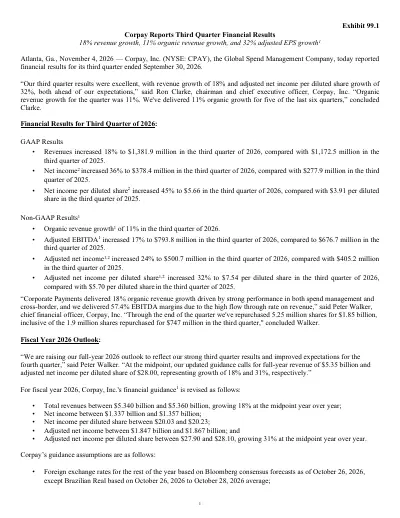
We reported Q3 revenue of $1.38 billion, that's up 18%, and cash EPS of $7.54, that's up 32%. These results better than expectations.
We had a slightly better macro in the quarter, and our spend management business overperformed. Overall organic revenue growth in Q3: 11%.
That marks six consecutive quarters of double-digit organic revenue growth. Inside that, our Corporate Payments segment accelerated to 18% organic growth, actually, 20%, excluding float.
Vehicle Payments segment grew 8%, right on expectations. Trends in Q3 quite good.
Sales or new bookings up 24% versus prior year. Retention stable at 92.2%, and improving same-store sales, +2% for the quarter.
We did continue to get meaningful earnings accretion from our two big deals, Alpha and Avid, in the quarter. Look, in summary, another very good quarter, very clean, and importantly, our Corporate Payments growth accelerating.
Let me make the turn to our Q4 outlook. We are raising Q4 revenue guidance at the midpoint to $1.37 billion, and cash EPS at the midpoint to $7.65, that would be up 27%.
We expect Q4 overall organic revenue growth of 10% at the midpoint, led by our Corporate Payments growth, which we expect to remain in the high teens, and that's consistent with what we've been delivering all year. We do have preliminary October results, and have incorporated those into this overall guide.
Assuming we achieve today's Q4 guidance, our full year 2026 results will finish as follows: full year revenue would finish up 18%, cash EPS would be up over 30%, and cash EPS of $28 for the full year would be a full $2 higher than our initial $26 dollar guide back in February. Look, a terrific year financially.
On to 2027 preview. We are again outlooking 9% to 11% organic revenue growth in 2027.
Corporate Payments segment again, we're expecting mid-teens growth or better there. Our Corporate Payments new sales this year, here in 2026, expected to top half a billion dollars.
That provides really an embedded revenue ramp for growth into 2027. We'll also put roughly $2 billion of free cash flow to work next year either on spend management acquisitions or buybacks, wherever we see the best return.
All right, let me make the turn to our portfolio transformation and M&A. Again, we're progressing our portfolio transformation to fewer bigger businesses, the portfolio becoming simpler, Corporate Payments becoming larger.
We have divested two non-core businesses here in 2026, receiving proceeds of about $1.2 billion. We used those proceeds to buy back over 3 million CPAY shares or roughly 5% of the company.
We have launched a couple additional divestiture candidates that are in the market now. We're also continuing to pursue new and meaningful corporate payment acquisition targets that can further accelerate our mix shift to more spend management.
In terms of performance, our two most recent deals, Alpha and Avid, exceeding our 2026 accretion targets. We expect together they'll contribute over $1.40 of cash EPS accretion this year versus our going-in $1 target.
We have migrated Alpha's cross-border corporate payments line of business off its IT platform and onto ours, along with its back-office compliance and ops functions. Avid doing well.
We expect Avid to double earnings here in 2026, and then materially increase them again in 2027. Maybe more importantly, Avid expects to exit Q4 this year with double-digit organic revenue growth, which would be the first in a long time.
These deals aren't just financially accretive. They're making our Corporate segment bigger, more profitable, and more important to us.
On the Brazil front, we did acquire two Brazil vehicle debt companies last year. Combined, these two deals will grow over 30% this year here in 2026, and those two deals will now represent about 20% of our overall Brazil consumer revenue, becoming significant.
It makes this vehicle debt adjacency a terrific add-on for us. It's really just another example of finding attractive adjacencies around businesses where we already have some kind of built-in advantage.
Look, the important point here is the rotation, it's working. We're simplifying the company, we're putting more capital behind Corporate Payments, and the assets we've bought, they're performing.
You should expect to see even further rotation again next year. Last up today, I do want to share just a few exciting developments since we spoke last.
First, on the AI front, we've made some real progress. AI for us is now providing some tangible client and productivity benefits.
We've launched conversational virtual assistants across a number of our businesses, being used to help automate our clients' work. We are incorporating the new AI tools into our client-facing IT development work, boosting IT productivity.
We've developed some really cool proprietary AI agents. I'll call out one, our Super Dealer Clone, in our Cross-Border business.
It analyzes and recommends hedging solutions across our global client base, and uncovers kind of new risk-mitigation opportunities that our dealers might otherwise miss. Really exciting.
Look, for us, AI isn't just about productivity. It's also about helping identify opportunities to serve our clients better.
Corporate Payments, you may recall that we entered the UK market earlier this year with our Corpay Complete spend management solution that leverages our US tech platform and our pretty big presence in the UK. This year with that platform, we've now grown the UK spend management volume to over $1 billion annualized, exiting Q4 with a $15 million revenue run rate.
It proves our US tech platform can travel internationally. We do have customers, distribution, infrastructure around the world, taking our Corporate Payments platform to new markets does create additional runway for us.
Last up, we dropped our new what we call Hidden Gem video ad on the Corpay website today. It touts CPAY's relative performance within the storied S&P 500 Index.
If you screen the S&P 500 for companies that grow revenue more than 9%, grow profits more than 15%, and have margins above 50%, there are 18, 18 companies. Corpay is one of them, joining other elite performers, the likes of Microsoft, Visa, Mastercard, NVIDIA.
Look, Corpay combines a pretty rare combination of growth, margins, and free cash flow. Look, to wrap today in conclusion, again, obviously pleased with our Q3 performance.
We put up some real growth versus last year, and marked again six straight quarters of double-digit organic growth. Our Corporate Payments segment, again, high-teens growth in the quarter.
We are raising our Q4 guidance based on the momentum, along with our preliminary view of October, excited about 2027. We're outlooking another year of double-digit organic growth, and again, roughly $2 billion of free cash flow to put to work.
Overall, we're building a simpler company with fewer, bigger, and faster-growing businesses. Lots of progress.
With that, let me turn the call back over to Peter, he'll provide some additional details on the quarter, and our outlook.
Peter Walker
Thanks, Ron, and good afternoon, everyone. We delivered another excellent quarter, with 18% revenue growth and 32% adjusted EPS growth year-over-year, both ahead of our expectations.
Organic revenue growth was 11%, our sixth consecutive quarter of double-digit organic growth. The quarter demonstrates the durability of our model.
We continue to benefit from strong execution across the business and a favorable macro environment. Sales grew 24%, same-store sales increased 2%, and retention remained healthy at 92.2%.
Those results reflect the focus and discipline of our teams as we continue to invest behind the opportunities with the strongest long-term returns. Now let's turn to our segment performance and the underlying drivers of our organic revenue growth in the quarter.
Corporate Payments delivered 18% organic growth in the quarter, accelerating from Q2. The performance was driven by continued strength in both Cross-Border and Spend Management.
We're pleased with the momentum in these businesses, driven by new sales growth and strong underlying customer activity, with organic spend increasing 24% to $95 billion. Cross-Border continued to deliver strong sales performance, with year-over-year sales growth over 25% on an organic basis.
The Alpha corporate system migration is substantially complete, and the global bank account integration on track for early 2027. Our Spend Management business, formerly referred to as our payables business, performed exceptionally well, driven by sales and volume growth.
We continue to be pleased with the strong performance of Avid, our minority investment, which is reflected as an equity investment in our financials. Avid continues to deliver sales growth, strength in volume and revenue, and EBITDA doubled year-over-year to a record level.
Vehicle Payments delivered 8% organic growth, consistent with Q2 and in line with our expectations. The business continues to execute well across the globe.
We remain focused on allocating our investments to the highest-return opportunities, including investing in Vehicle Payments to continue high-single-digit growth. Lodging delivered 3% organic growth, improving sequentially for the third consecutive quarter.
While there's still work to do, the direction of the business is encouraging and consistent with the progress we expected through the year. In summary, our 11% organic growth was broad-based across the largest businesses.
Corporate Payments and Vehicle Payments, which together represent over 80% of our revenue, delivered a combined 13% organic growth rate. These results give us continued confidence in the consistency and compounding of our model.
Now, looking further down the income statement. Operating costs increased 9%, excluding the impact of FX, M&A, stock compensation, amortization, and a prior-year other operating loss of $11 million.
The 9% increase reflects growth investments and the cost of supporting higher volumes. Adjusted EBITDA grew 17% to almost $800 million, and adjusted EBITDA margin was 57.4%.
The strong margin reflects the high flow-through of revenue growth, as well as continued operating discipline. Adjusted EPS grew 32%, driven by strong operating performance, accretive M&A, almost 5 million less shares from buybacks, and a lower adjusted effective tax rate of 23.4%.
The year-over-year decrease in the tax rate was primarily driven by excess tax benefits in the period related to grandfathered stock options exercised. Turning to the balance sheet.
We generated approximately $500 million of free cash flow in the quarter. We ended the quarter at 2.72 times leverage.
Following the November 2nd closing of the maintenance divestiture and application of the proceeds, pro forma leverage is approximately 2.47 times and decreased sequentially. Post-receipt of the maintenance divestiture proceeds, we had approximately $2.6 billion of total liquidity, including $1.7 billion of undrawn capacity under our revolving credit facility.
During the quarter, we repurchased $750 million of stock or approximately 1.9 million shares. Also, the board approved a $1 billion increase to our share repurchase authorization, bringing total remaining capacity to approximately $1.6 billion.
This is another example of our disciplined capital allocation approach: maintaining a strong balance sheet, investing in the business, and returning excess capital to shareholders when it represents an attractive use of capital. Now, let me share some additional information on our updated 2026 full-year and fourth-quarter outlook.
We are raising our full-year revenue guidance to $5.35 billion at the midpoint, growing 18% year-over-year. We're also raising full-year adjusted EPS guidance to $28 at the midpoint, growing 31% year-over-year.
As a housekeeping item, the $5.35 billion includes approximately $120 million from the two divestitures completed in 2026, which were neutral to adjusted EPS due to buybacks. This $120 million will not be included in our 2027 print revenue.
Our updated outlook reflects the flow-through of our third-quarter outperformance, raises fourth quarter due to favorable macro conditions and continued underlying strength in the business, and the updated closing date of the maintenance divestiture. For the fourth quarter, we expect revenue of approximately $1.37 billion and adjusted EPS of $7.65 at the midpoint.
Before I close, I want to put our midterm opportunity in perspective. We are clear on the direction of the company: build a simpler portfolio of scaled, advantaged businesses; expand our Corporate Payments platform; and deploy capital where it can compound value most effectively.
Our objective is to continue to be a top-quartile S&P growth compounder. The growth algorithm we outlined in our investor presentation can compound adjusted EPS at more than 20% annually from $28 this year to approximately $50 per share by 2029.
That objective is supported by sustained 10% organic revenue growth, cash profit expansion, and disciplined share repurchases and accretive Corporate Payments M&A. Over time, a larger Corporate Payments mix and continued investor confidence in our growth model could support a re-rating of our valuation.
Operator, that concludes our prepared remarks. Please open the call for questions.
Operator
Thank you. At this time, if you would like to ask a question, please press *1 now on your telephone keypad.
To withdraw yourself from the queue, you may press *2. Once again, to ask a question, that is *1 on your telephone keypad, and we'll pause for just a moment to allow everyone a chance to join the queue.
Thank you. We'll take a question from Ramsey El-Assal with Cantor Fitzgerald.
Your line is open.
Ramsey El-Assal
Hi. Thanks so much for taking my question this evening.
Another great quarter here. I want to ask about the sales growth of 24%.
That's a great outcome. Just curious if you can give us any more color on where you're seeing the strength in the business.
Ron Clarke
Hey, Ramsey. It's Ron.
Yes, another good sales number. I did want to point out a huge amount now in our Corporate Payments business.
I quoted in the thing, for the full year we're looking at probably $500 million plus of new business, and wanted to point out to people that that creates, because it gets booked obviously over the course of the year, right, some as late as November and December, that creates kind of a ramp of 7% or 8% revenue growth in 2027. Sometimes people don't appreciate the power of sales that we make in the prior year in terms of its benefit in the full year.
Also Brazil super good, in terms of sales blockbuster, including the vehicle debt thing that I mentioned. Those two would be best, and I'd say our international business maybe helped a little bit by fuel prices, also super good.
Those three, all high performers in the quarter.
Ramsey El-Assal
Awesome. One quick follow-up for me.
Are you seeing any downstream impact from higher diesel prices on credit performance or any other aspects of the fleet side of the business? I know the freight's got a role, and I know that freight prices don't necessarily correlate, but I was just curious if you're seeing any impact in the business from just this sustained higher kind of diesel price level.
Thanks.
Ron Clarke
I think it helps, Ramsey, a bit on sales, right? Higher prices creates more cost to control.
I'd say a smidgeon in the same-store sales softness, still probably a point or so, with prices being higher, people cutting back a little bit, but nothing significant. As I mentioned, our consolidated business was +2% in terms of same-store sales, two of the 11 points come from the client base getting healthy, so, yeah, fortunately, not much in terms of impact from the price.
Ramsey El-Assal
Got it. Thanks so much.
Operator
Thank you. We'll move next to Michael Infante with Morgan Stanley.
Your line is open. Please go ahead.
Michael Infante
Hey, guys. Nice results here.
Thanks for taking my question. Ron, you called out on your prepared remarks the M&A focus within Corporate Payments being on spend management.
Why is that relative to cross-border? Is that just a function of the portfolio being pretty well rounded out post-Alpha with the MCA product, and you sort of feel like incremental acquisition can sort of improve the value prop versus competitors in the core payables business?
Just any color there would be great.
Ron Clarke
That's a super good question. I would say it's really more timing, I don't want anyone to leave the call thinking we won't buy more in cross-border.
Mostly, it's just trying to digest what we've got. We've done a lot there.
We're still digesting Alpha, particularly the banking side, and so we turned our energy, starting in the spring, over to the spend management category, both here and abroad. It's really just that.
We want to keep building both of those categories, but the one up right now is spend management.
Michael Infante
Makes a lot of sense. Then just for a quick follow-up, I'm curious if there's any context you could share on the US-Canada corridor in Corporate Payments in the quarter.
Was there any notable rate pressure we should be aware of that maybe actually made the growth, which obviously incrementally accelerated, potentially be a little bit more depressed than it otherwise would have been? Then stepping back, as you sort of think about higher levels of FX vol being good for your hedging business, are there instances where customers, for whatever reason, are sort of choosing to wait for vol to reside a little bit before placing those hedging trades?
I'm just trying to think about the puts and takes between those two. Thanks again, guys.
Peter Walker
Hey, Michael. It's Peter here.
On your Canada-US corridor question, I would say nothing unusual happening within that corridor. You did ask about kind of the uptick in Corporate Payments, and so just wanted to share with you there's about 100 basis points of, call it, one-time monetization happy within Q3 that we don't know is necessarily repeatable into four.
Corporate Payments normalized is probably more like 17% and overall organic is more like 10%.
Ron Clarke
Hey, Michael. It's Ron, just to follow up.
That was a good question. We've studied what you said of, hey, when we look at the volatility index around FX, how does it affect things?
We've looked at that over longer periods of time. I'd say for our business, given the mix, it can have kind of up to a 10% help or hurt, but basically what happens is the timing that you spoke of, it kind of cleans up over a quarter.
To your point, if someone's kind of sitting still for a month and the tenor on some of their contracts is running out, they basically tend to get the thing cleaned up. I'd say over a quarter, and honestly over the year, it doesn't have that big an impact.
Michael Infante
Thanks, guys.
Operator
Thank you. We'll move on now to Sanjay Sakhrani with KBW.
Your line is open.
Sanjay Sakhrani
Thank you. Very nice acceleration in Corporate Payments.
I'm just curious, was there anything specific that drove that inside the business? Then, do we think that type of growth is sustainable as we move into next year?
Ron Clarke
Sanjay, very good question. It was kind of all things firing.
Volume was up crazy good because of my comment earlier about we've been making a lot of sales. The retention again in that business is above the line average, is closer to 95%.
I'd say some of the extra juices, we've gotten focused a bit more on the monetization front. We've got a couple more dances in our repertoire.
Instead of just virtual cards, we did launch earlier this year debit cards as a way to monetize, and we've advanced what we call kind of paid or ACH+, getting paid for ACH. It would be a mix of those things.
It would be volume from again continued good retention, crazy amount of sales getting online, and then a bit better monetization, particularly here in Q3.
Sanjay Sakhrani
Got it. Then, maybe just to go back to the questions on expense management.
I think it's the cross-border piece of your story is pretty well known now and appreciated. I guess when we think about expense management and then you layer in Avid as well to some extent, what's the kind of growth rate that business can see over a sustained period, maybe over the intermediate term, like the next three years?
I'm just curious if it's the same type of growth that the cross-border corporate payments business can deliver.
Ron Clarke
Yes, another good question. The TAM is obviously gigantic, right, all the domestic indirect spend of a business, and so it's really a function of sales investment there.
I think the biggest difference in the two businesses is our Cross-Border business is super global: 75% of the revenue of that business is originated outside of the US. Think Canada, UK, Europe, Australia, etc.
Whereas in the Spend Management business, even including Avid, it's predominantly a US business today, which is why I called out our interest in Europe, not only doing it ourselves by moving our tech over, but also looking at acquisitions. I'd say that it certainly has the TAM to be a beast in terms of the size of the business, and the focus that we're on is kind of opening up now additional markets where we can bring the product beyond the US.
Sanjay Sakhrani
Got it. Thank you.
Operator
Thank you. We'll move on now to Tien-tsin Huang with JPMorgan.
Your line is open. Please go ahead.
Tien-Tsin Huang
Hey, Ron and Peter and Jim. Just want to ask on the good quarter, of course, just thinking here about the visibility to double-digit growth next year.
How would you characterize that, the visibility part, maybe compared to last year, last couple of years?
Ron Clarke
Hey, Tien-tsin. Good to hear from you as always.
High is how I characterize it, and I was saying to people earlier that we keep talking about the growth algorithm in the company. Hey, 10, 13, 19, 10, 13, 19, and we don't spend enough time on the growth algorithm for revenue.
Hey, how do you get to 10%? I continue to say to you guys, hey, how are sales in the quarter, how is retention in the quarter, how are same-store sales?
That is the growth algorithm. The way we get to 10% is, hey, the base grows 2%, we sell a bunch, we lose 7% or 8%, and so the beauty, particularly as we rotate into Corporate Payments, is my comment earlier that we sell more of it in the prior period.
The example that I gave of if we sold, call it $500 million of corporate payments last year, we already know how much revenue we're going to get from the ramp in 2027 that we didn't get in 2026, and we also have a good sense of how much we get in the current year, like what will we sell. Like we're up 24%, if we're up 20%, how much of that will print in 2027?
It gives us a pretty wide band, if you think about it, to build the plan. The revenue exits and I keep 92% of it, the same-store sales inches up a point or two, I've already got the ramp in the bag, and even if I sell the same amount as the prior year, I know what we print.
The variables to get to a number, this is a business you can plan, I'll remind you of. We like that, and I say it's even more so in the Corporate Payments space than in the vehicle.
Tien-Tsin Huang
Sounds familiar to ADP in a lot of ways. I know you've said that to me before.
No, thanks for going through that.
Ron Clarke
That's how I got here, partner. That was the model I chased, you got it.
Tien-Tsin Huang
Been a durable one for two, three decades as I've tracked it. Just maybe as my follow-up, I'm just curious because coming off of some of these conferences, digital assets and tokenized deposits, blockchain rails, any change or surprise in activity there, movement there, Ron?
Ron Clarke
I just think, Tien-tsin, we feel clear. I don't know if the world has caught up to our view, but what I think we would say is we're pretty convinced that people should separate currencies, tokenized fiat from crypto or stablecoins, from the rails, from blockchain versus SWIFT or something else.
Our view on the world is the winner will be tokenized fiat because everyone's already got it, and it's what's worked. Then the blockchain is going to be a super interesting additional rail because it's programmable and it's 24/7.
As the banks, as you see the announcements, as they get ready to credit positions that come off of the blockchain 24/7, we see way increase in that rail being used. We're still kind of short on the stablecoin narrative, and believe in the blockchain rail coming on as the banks start to move that crediting to real time.
That's what we're behind. We're investing a lot in it.
We see it already. The mix of our business had moved from SWIFT, started to move on to these private blockchain rails and stuff, and so we think the lift in that is going to be quite substantial next year.
Tien-Tsin Huang
Good. Thank you.
Operator
Thank you. We'll move on now to Darrin Peller with Wolfe Research.
Your line is open.
Darrin Peller
Hey, guys. Thanks for the time and nice job.
You mentioned investing in the vehicles area to maintain high-single-digit growth. Is this just a specific geo or further in sales and marketing or product development?
Just help us understand a little bit more about where you're putting it towards and the outcome. Thank you.
Ron Clarke
Hey, Darrin. Again, the vehicle business is global.
It's here, it's in Europe, and it's in Brazil. I think we've said repeatedly we kind of love our competitive positioning, even more in Brazil and in Europe.
It's super dominant. We've got leading products and stuff, of the three geos, we tend to spend more kind of incremental new money, distribution money, in those places, and the margins are quite attractive and stuff.
Look, we're balancing, we've said it repeatedly, we're balancing, particularly the sales and tech investment in vehicle versus Corporate Payments with the target of trying to keep the vehicle business in all geographies in the high single digits, and put most of the money behind, obviously Corporate Payments. Really no change in approach there, and you should continue to see the best market, the best geography Brazil, the second best Europe, and the third, the US.
Darrin Peller
Okay. All right, Ron.
Thanks. Just a quick follow-up on the divestitures.
Again, I appreciate the announcement of another divestiture this quarter. Just help us understand how we should think about further divestitures.
Should we expect it to be in the vehicles business or, and as you focus on a few large businesses, could we see something more strategic? Just any more color you can give us to update us would be great.
Thanks, guys.
Ron Clarke
That's a good question, Darrin. As I did mention at the top that we've got a couple additional divestiture assets in the market now, think, call it $1.5 to $2 billion worth.
Yes, generally, the answer is you would find smaller, nichier vehicle businesses or other kind of non-core, non-corporate-payments businesses as the likely candidates. Basically it's either size, it's smaller, or b, it's TAM-constrained, we don't think we can grow it at a high rate.
We kind of apply that screen, we study the tax leakage and stuff, and pick candidates where we think we can keep simplifying the company, right, have fewer bigger businesses. It's not so much just category.
The only category we're not divesting obviously is Corporate Payments, where we're acquiring. You could see in the Lodging business and the Vehicle business, select pieces inside those businesses that don't make sense for us to hold long term, that make sense for someone else to own and be a better owner than us.
That's what we're focused on, and we're being smart, I think, and patient. We're not throwing them out of the plane at any price.
We're being thoughtful about the state of those businesses, and again the tax leakage on them, and selling things like this maintenance one where effectively it's a push. We can exit the business and get enough proceeds to kind of wash the thing from an earnings perspective.
My message to everybody is we're going to keep doing it. We're not in a super-duper rush.
We're going to keep doing it. You'll see more stuff sold in the next 14 months, and you'll see more stuff acquired in Corporate Payments.
When we're sitting here a year from today, in addition to the differential growth rates, you'll see the mix keep moving as we acquire in Corporate Payments and divest other realms.
Darrin Peller
Right. Okay.
Makes sense. Thanks, Ron.
Operator
Thank you. We'll move on now to Rayna Kumar with Oppenheimer.
Your line is open.
Rayna Kumar
Good evening. Thanks for taking my question.
I just want to ask on lodging. You had organic growth improve to 3%, but room nights remained down and revenue per room increased.
Could you just talk about how much of the recovery is pricing versus mix and if you think this recovery is sustainable and just the long-term plan for lodging? Thank you.
Ron Clarke
Hey, that's another good question. The rate and the volume is really just what you said, it's mix.
For example, we've talked about this emergency kind of client or FEMA that has sporadic kind of uneven volumes and is super-duper cheap. When that thing flexes up or down, hey, there's a lot of rooms that are cheap, or hey, there's no rooms that are cheap, that drives the average room rate up or down, there's really nothing other than that going on.
It's just it has a big swing because again it's so cheap. On the more important question, the recovery question, it is clearly better.
Let me point out something maybe more important. Hey, the Lodging business is in positive territory.
I think it's 1 + 3 for the quarter. Inside of that, the biggest business, which we continue to like a lot, we call workforce, which means we go to businesses that have kind of blue-collar people that stay in kind of blue-collar hotels, that workforce business is up double digit.
The other smaller, Darrin's question, nichier things like insurance or airline are doing less well. It's averaging to that 3%.
That business should do better, we think, again in Q4, on a combined basis. The headline is the bigger business in Lodging, the more important one, is doing significantly better than a couple years ago when it was a problem child, and yes, we do think we can make that.
It used to be for the first 10 years we owned it a terrific business, and we think we can make it a good business again. It's already a pretty good business here in Q3.
The other two, I'd say the jury's still out on those, of whether they're fixable or not.
Operator
Thank you. We'll move on now to Ken Suchoski with Autonomous Research.
Your line is open.
Ken Suchoski
Hey, good evening, guys. Thanks for taking the question.
I wanted to ask about Corporate Payments and the outlook there. You obviously growing high-teens to 20% ex-float year-to-date, 20% this quarter.
Is there any reason the underlying business wouldn't keep growing at these levels next year, right? You have the 7 to 8-point ramp from new sales, retention is great.
That was the first part of it. Then the second part was just on the reported Corporate Payments organic number, because you've been absorbing this 200-basis-point float headwind.
As you lap that and it turns neutral or possibly a tailwind, just help us bridge from where we are today to that mid-teens or better type of level. Is that just conservatism this early, or are there other offsets, like the one-time monetization this quarter, comps, or take rate, or anything like that?
Thank you.
Ron Clarke
Hey, Ken. That's another good question.
I'd say first and foremost, it's just early days. It's the 1st of November something here, and we're eagerly working on the plans and try to get precision, right?
We're trying to get whatever, $5 or $6 billion, there's a lot of details to do. We will get help, to your point, to the extent that the SOFR curves become true.
I think the thing ticks up kind of 25 basis points per quarter next year, kind of 75 for the total, that'll help. That may give us a point or so depending on our deposit balance.
The main answer to the question of, hey, are we at 15%, 17%, or 20% is just sales. Like the retention number, I keep saying, is super stable.
We have statistics, we have the clients, they like the product. That thing is super-duper solid.
It's really this level of investment that we put in and the production that we get. I'm making this up, if we sold $550 million instead of $500 million, you can do the math, that would add another point or two, right, to the growth in the following year.
The positive thing is we roll into the next year kind of partway already getting there, right? We've sold enough and we're retaining enough, yeah, we still have a decent growth rate heading into 2027.
The crème de la crème, the top of it's going to be just what level of sales production that we get: a good one, a little bit better than this year, or a great one, a lot more. That's why we're always like, oh, is it 16%, 17%, 18%?
What is it? It's really a function of that level of selling production.
Ken Suchoski
It seems like the Corporate Payments sales are becoming a bigger part of the mix as well by our estimates. Just one on Avid, because the results are really impressive there.
Doubling earnings year-over-year, I think you talked about growing double-digit organically exiting this year. Just maybe give us some detail on what's driving that.
Is it sales investment you put in, is it product changes, is it pricing? What's driving that, and how durable is that?
Ron Clarke
I think it's been great for them that you talked to the guys there. Getting out of the public thing so they could work on the business, I think has helped, that the management team there is focused.
We with our partner have been kind of super clear on, hey, these are the things and you're on, and we've way stepped up the sales investment in the business. We pushed some of the monetization things that we think were lay-downs, and we right-sized the cost structure to the thing.
A lot of that happened throughout 2026. I can't remember, we closed the thing in the fall about a year ago,
Ken Suchoski
right?
Ron Clarke
By the time we got the plan in place and going, we're kind of into '26. One of the reasons I say that the '27 numbers will be better is a lot of the things that Mike and Dan are putting in there got going during this calendar year, and so some of that will just literally roll into 2027.
They always had a really good business, like happy clients, high retention, and stuff. I think it hasn't been product, they got a good product.
It's really been on the economic side. We bring a way aggressive pricing and cost and economic profit lens to a business, and so they've kind of taken that thing and they're getting way better numbers, and they're going to get better numbers.
I think the '27 will be materially better, and we think even better after that. They've signed some significant new partners this year and stuff, and so the business is really performing well.
Ken Suchoski
Great to see the progress. All right.
Thanks, Ron.
Ron Clarke
Got it.
Operator
Thank you. We'll move on now to Dave Koning with Baird.
Your line is open. Please go ahead.
Dave Koning
Yeah. Hey, guys.
Thank you. I guess my question's on Brazil.
You give a nice disclosure about Brazil revenue dollars, and from looking at that, if I kind of back out currency, it looks like that accelerated a little bit in Q3, maybe to the higher teens, more mid-teens in the first half of the year. I guess you have that phenomenon, but then toll transactions decelerated just a bit.
Maybe just describe kind of what's happening, maybe the Google ad search data, all the Brazil stuff.
Ron Clarke
It's doing well, and the Google thing is still not working well, although the government and Google have agreed that it'll be back, they're just running through some paperwork, we think certainly no later than January 1 that thing will be back. The Brazil thing is doing well for a few reasons.
One, it's a Goliath in the core business, and that thing keeps chugging along. The two accelerants have been this vehicle debt thing that I named, which probably doesn't sound that clear, but we've got, I don't know, 7 or 8 million people that have accounts and have toll accounts and stuff, and so we literally go to them plus the 80 million people that don't go on the toll road, and we say, "Hey, look, we're connected to every DMV, which is 36 in Brazil, and can immediately re-register you on your phone and let you know if you have a ticket and when it's due, and pay it online and stuff."
That add-on thing is just crazy growing. We've got a 5% share of the business, it's compounding at 30%, it's got five times the TAM because you can drive anywhere and still need a registration and stuff.
I do want to point out that although it seemed like a bit of a sideshow when we entered, it's left the sideshow status, right? It's reached 20% of the business and compounding faster.
The second one is we're just killing it on the B2B side. This thing called Vale-Pedágio, which in English my paws of the translation, but basically, suppliers or shippers have to pay for drivers to go places, and so we came up with a super-duper electronic product that if you're a cereal manufacturer or shipper and you've got to pay 100 truckers to go somewhere, the product literally defines exactly where they can go and when so that it's optimized.
The shipper doesn't pay any more than they need and stuff, and so we are selling crazy amounts of that product, the sales growth is 40%. Those two things are going at crazy levels of growth on top of a pretty sound, solid business to begin with.
Dave Koning
Yep. Great job.
Thanks, guys.
Operator
Thank you. We'll move next to Mihir Bhatia with Bank of America.
Your line is open.
Mihir Bhatia
Hi. Good afternoon.
Thanks for taking my questions. I wanted to start first with just Corporate Payments.
You obviously have very nice spend growth there, I think, but there's a little bit of a gap to the revenue growth. I think the spend was 24%, revenue was 18%.
You did talk a little bit about better monetization, and I think you've talked in the past about signing bigger clients, but maybe just remind us what's driving the gap and how should revenue continue to grow, meaning should this gap increase as we get into '27 and '28? Thanks.
Ron Clarke
It's just mix. I think we said we signed a giant elephant and it took a while to eat, it's at a completely different kind of a rate, you move a ton of volume through the system and you move less revenue through.
There's nothing structurally between the spend levels and the revenue, we're obviously focused on revenue more than the spend. You do raise a good question, which is we have a lot of spend, I don't know what it is, 80%, 85% of the spend that we move, billions and billions, that is not monetized, and so as I mentioned earlier, that is the assignment we're on, trying to widen the ways that we can pay merchants that's useful to them beyond virtual cards.
We're seeing a lot of success, as I mentioned, with debit cards, that's another way to pay. We've got a lot more people to take this kind of reconned and fast instant kind of ACH product, and so we did get a lift, as I mentioned, in Q3 from that.
That would be the other thing. We keep selling a lot, like I mentioned earlier, in addition to what's already in the bag, and then basically try to push this monetization a bit higher with some of the merchants.
Mihir Bhatia
Got it. Maybe then just switching quickly to Avid.
You've given quite a bit of detail on it and progress they've made, but given you have the option to buy the rest of Avid, I believe, in 2028, does the progress you're seeing now make that increasingly likely? Should we just think about that as a remaining use of capital in 2028, and is Avid part of the $50 EPS guide?
Ron Clarke
That's another good question. Hey, I don't know, we have an option a couple years out.
We could buy it tomorrow, we could buy it up to whatever, two years plus from now, what we want is what you said, which is to see more progress, want to see more absolute profitability there so that when we send the capital, we're bringing more earnings into the company, and I do still want to see further acceleration in their revenue closer to our Corporate Payments book of business. We're kind of cheering and help directing from the sidelines to get the company's performance higher, but I would say yes to your question that the likelihood of us calling and buying the balance of that company is certainly higher than when we closed on it a year ago, but I'd still say not certain.
We'll obviously look at everything else that we can buy with that capital in a couple of years, and make the calls as we get closer.
Mihir Bhatia
Thank you for taking my questions.
Operator
Thank you. We'll move now to Chris Zhang with UBS.
Your line is open. Please go ahead.
Chris Zhang
Hi. Thanks for taking my question.
My first question is about your partnership or relationship with Mastercard and BVNK, and specifically focusing on maybe the cross-border business. As Mastercard and BVNK recently launched a Global Money platform, and we've been getting some questions on whether this is a potential opportunity for you to partner, whether this some of the competition to your multi-currency account business, and knowing your multi-currency account probably approaches clients from a different perspective in the form of a local bank account opening.
Maybe can you just talk to and maybe compare and contrast some of the differences between the Mastercard and BVNK partnership and your opportunities with them, specifically relate to the Global Money platform and multi-currency accounts, and whether, just in the market, you're seeing maybe some of the competition picking up because of some of the newer offerings out there?
Peter Walker
Hey, Chris. It's Peter.
Thanks for the question. Maybe focus on the Mastercard partnership first.
That partnership was focused on our Cross-Border business, and Mastercard made an investment in us as part of that. That is a go-to-market to partner with Mastercard with FIs and really sell our cross-border products into FIs.
What I'd say is that partnership's been going well in terms of full pipeline. We've signed quite a few clients, but what we are learning is that FIs are much longer to implement than our corporate clients.
I'd say it's going well, but it's going probably slower than we would ideally like it to be. The BVNK, which is now owned by Mastercard, is a different partnership where we partnered with BVNK to enable our stablecoin rails that we established earlier this year.
It's part of moving to tokenized currency, we wanted to make sure that we had stablecoins available, and we're doing that via BVNK as the partner there. Then we've also partnered with JPM using their Kinexys network for tokenized currency.
I'd say the Kinexys network has really been where we've moved majority of our volume, we're still not seeing a lot of volume on the stablecoin side. Hey,
Ron Clarke
Chris. It's Ron.
Just to add on to what Peter said about the competition. Our view is they're more of a platform kind of provider, and we're more a marketer.
For us, the competition or the opportunity is taking multi-currency accounts to the markets, to the accounts and prospects that we have. Obviously with Alpha, we've got a dominant position in the asset management group, along with all those fund administrators.
As we widen that product to new geographies, we already have built-in clients, right? I've got Bain Capital in Boston, I've got Bain Capital in the UK, I've got Bain Capital in Australia.
Then second, we've got a ton, I don't know, 30,000, 40,000 corporate clients, mid-sized clients, that we're signing up thousands every year. The idea of taking these products to the clients that we have as an add-on, don't mix kind of the supply of the products, if you will, from the marketing.
Yes, there's probably more competition in making of the products, but our real advantage is in the marketing or the selling of the products.
Chris Zhang
All right. Thanks a lot, Ron and Peter, appreciate the color.
My follow-up is on the organic growth in the Q4 guide, that's 10%. Maybe can you talk to some of the moving parts between that and the 11% delivered in Q3, and if you were to be more conservative in some of the areas, where would that be?
Specifically, I guess for lodging, do you expect some of the pickup, knowing it's a smaller piece, but I think basically it's trending a little lower than previously expected. Then for vehicle, what's kind of the outlook outside of Brazil, especially North America and the rest of the world?
Peter Walker
Chris, at the start of the call, I talked a little bit about Corporate Payments in the third quarter and the fact that we had about 100 basis points of, call it, monetization initiatives that we're not sure repeatable in 4Q, call that 100 basis points off of the 18% and off of the 11%. It's really a 10 to a 10, you're seeing really equal performance between the two quarters.
That's kind of the main takeaway that I would give you. Maybe the other point that I would add is Vehicle Payments is obviously a little bit of a tougher comp over Q4 of last year.
Ron Clarke
Hey, Chris. The other thing is just the history of Q3 and Q4.
We've got years, 5, 10 years that you guys have, they tend to be super comparable in terms of revenue. In fact, if you look at our guides, probably plus or minus $10 million, and so we do have a lot of stats based on days in which businesses are stronger in Q4 and stuff, and so to Peter point, it's kind of mostly a mirror image.
The print you see in Q3 will look super similar to that in Q4, probably with the one call-out Peter just made.
Chris Zhang
Yep. Super helpful.
Thank you so much.
Operator
Thank you. We'll move next to Madison Suhr with Raymond James.
Your line is open.
Madison Suhr
Hey, guys. Thanks for fitting me in here and taking the questions.
You touched on it a few times just around early traction in the UK with spend management, clearly a huge TAM to go after across Europe. Ron, you touched on the geographic expansion opportunity.
The question is really just how aggressive do you plan to be on rolling out into other countries, and should we think about this as an early 2027 event?
Ron Clarke
Madison. It's a good question.
I think we wanted to start with this market because it's our second biggest market and find out can we make it work, can the platform travel and be adapted to there, and can we get people trained up and leverage the customers we have and all that kind of stuff. We kind of went at it a bit modestly, but got to $1 billion, kind of from zero, I was like, that's good.
Now we're staring at the plans for next year and sitting in there's submission is to double again the selling investment in that thing. Also clearly we're looking at deals in those geographies.
I would say that you guys should expect to see more spend management revenue in more geographies that are outside of the US, both organically where we send our platform and stand up people, like we already have people in all these places, tons of sales people in these places, but also that we may acquire businesses that have customers or products in that region. Probably do both of those things.
Madison Suhr
That's helpful. Just real quick follow-up, just on the Brazil competitive environment, any meaningful changes to what you're seeing just around new entrants or pricing in that market specifically?
Ron Clarke
Not really, other than I think the banks are getting tired. I think the great idea of five years ago, "Hey, I give something away free and it's going to be great," I think that they're getting a little wary of the thing, and it's got to a place where now three or four of the banks are literally taking our product and we're wholesale selling it to them.
Look, I think at some point that they'll be tired of that and we'll look forward to that day, but our product is still so advantaged, has such broader networks than just the toll tag, and free flows the new thing, which we're on. We're the Häagen-Dazs, if you will, of that product, and so we'd like the banks to either charge or go away, but really nothing new right now.
Operator
Thank you. We'll move on now to Dominick Gabriele with Loop Capital.
Your line is open.
Dominick Gabriele
Hey, guys. Thanks so much for taking the question.
The business really has turned towards Corporate Payments, and so when we think about this mix shift over the long term, given it does feel like it could accelerate, I'm looking at your processing costs as a percentage of revenue and they've ticked down over the last number of years. I'm just wondering if there's a mix shift benefit across that line item in particular given the payments that folks may use or whatever it may be.
If you could help us understand some of the mix shift benefits of moving towards more Corporate revenue as a percentage of the total in the P&L, I'd really appreciate it. Thanks so much.
Ron Clarke
Dominick, it's Ron. That's a very astute observation.
The simple answer is you're right, the processing economics are better because there's fewer systems. If you think about like our vehicle business, which is in the US, the UK, and Brazil, we probably run six, six, seven platforms that are specialized, let's say, for the trucking business or the partner business or in Brazil or something.
Whereas in the Corporate Payments business, like Cross-Border, we run one one processing system, and we just closed Alpha's corporate processing system. In spend management, same thing.
The operating leverage, if you will, of effectively running one system with more volume on and the flow-through margins, to your point, against the processing costs are better. That is the main.
Now, again, there's other costs, obviously, we might spend more in selling because we want to try to grow faster and stuff, I don't want to imply the total margins are better. In fact, they're probably not because of the growth rate, but you're on the right thing.
It's really scale against the number of processing systems.
Dominick Gabriele
Great, thanks so much, and good quarter. Appreciate it.
Ron Clarke
Thanks, Dominick.
Operator
Thank you. This does conclude our question and answer session, as well as our call today.
You may now disconnect your lines, and everyone, have a wonderful day.