ROCKWOOL A/S Class A
Q3 FY2026 · Earnings Call TranscriptNovember 26, 2026
Kim Junge Andersen
Hello to everyone, and welcome to Rockwool's conference call regarding the results for the first 9 months of 2026. My name is Kim Junge Andersen, I'm the CFO of Rockwool A/S.
Today I'm pleased to present Jes Munk, CEO Jes Munk Hansen. For the first part of this call, all participants will be in a listening-only mode.
As a reminder, this conference call is being recorded. First, Jes will go through our presentation and give you an update of the results for the first 9 months and third quarter of 2026.
Afterwards, we'll be ready to answer all your questions. Before I hand over the word to Jes, I must ask you to notice slide number 2, which is a forward-looking statement.
Please be aware that this presentation contains uncertainties. Now we can go to the next slide, which is slide number 3.
Jes, I will now hand over the word to you.
Jes Munk Hansen
Thank you very much, Kim. Good midday.
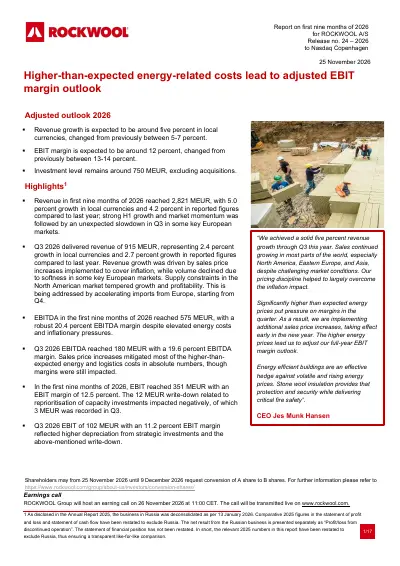
The group delivered a robust 5% revenue growth in the first three quarters, driven by a strong momentum in the first half of the year. Our EBIT margin came in at 12.5% for the first three quarters, pressured by inflation, especially in Q3.
Despite an improvement in cash flow from operations, free cash flow was negative €138 million for the first three quarters, primarily reflecting the significant investments we are making in capacity expansion and decarbonisation. To slide 4, our Q3 revenue.
Revenue grew 2%, supported by 5% price increases. However, we saw a lower than expected volume from softer markets, particularly in France, Italy, Poland, and the UK.
Part of this slowdown can be attributed to pre-buying in Q2 ahead of the 1st of July price increases, as well as the extreme summer heat in Southern Europe impacting outdoor construction activities. EBIT margin for the quarter was 11.2%.
Significantly higher than expected energy price put pressure on margins in the quarter. As a result, we are implementing additional sales price increases taking effect early in the new year.
The high energy prices led us to adjust our full-year EBIT margin outlook. I will come back to that later in the presentation.
Cash flow from operations improved in the quarter. Despite investments of around €200 million, free cash flow ended slightly positive.
Next slide 5. For the first three quarters of '26, we delivered solid revenue growth of 5% as I mentioned in a very difficult market environment.
Volume increased 5.4% from good volume growth in the first quarter, particularly in the second quarter. Sales price increases contributed mainly from Q3 and onwards with a total impact of 2.8% year to date.
However, this was partly offset by negative product and country mix of -3.2%, mainly related to the first half of the year. On slide 6, we're looking at our revenue where sales price increases of around 5% drove the revenue growth in the quarter, although slightly behind plan due to softer market conditions.
While we saw growth in many markets, we experienced reduced volumes from softness in key markets like France, Italy, Poland, and importantly, United Kingdom. In Southern Europe, the summer heatwave unexpectedly closed construction sites and delayed projects.
Poland faced renewed competitive price pressure from combustible plastic foam producers returning to the flat roof market, while the UK construction market continues and remains being very subdued. Additionally, in North America, growth was tempered by supply constraints.
On the flip side, imports from Europe are now progressing well. On slide 7 where we look at the segments.
First insulation segment, and looking at the insulation, revenue grew 3% in the quarter with good momentum in Germany, Romania, and North America, offset by the declines I mentioned in France, Italy, Poland, and mainly UK. The systems segment revenue increased 1% in the quarter where Rockfon West Europe and Rockpanel were impacted by the softness in markets, and Grodan North America continues to struggle due to overall difficult market conditions.
If we take a look at our geographic spread and performance, we'll start on the west side here with United States. We continue to see strong demand in all sales channels, and sales also stabilized in Canada in the quarter.
In North America, growth was tempered, as I said before, by supply constraints as supporting imports from Europe was just began to kick in. In Western Europe, demand in July and August was below the level last year, although it picked up again in September, but did not pick up sufficiently to secure growth for the quarter in the region.
We saw continued positive development in Germany and in the Nordics. Sales in East Europe was up 7%, continued strong performance in many parts of the region, especially Romania, partially reduced by the lower sales as I mentioned in Poland, and also in Hungary.
In Asia, most countries in the region are performing very well. Notable in the quarter, we successfully opened our second factory in India, this time in Chennai.
Now to profitability, slide 9. The year-to-date profitability was impacted by time lags between continued increased inflation and compensating with sales price increases.
Especially in Q3, we saw significantly higher than expected inflation on energy, on logistics, and certain oil-related raw materials. Let's break it down to EBITDA and EBIT.
EBIT for the first three quarters was affected by the time gap between the July implementation of sales price increases to compensate inflation in Q2 and significantly higher than expected inflation. While sales prices increased largely offset inflation in absolute terms, this of course leads to margin decline.
Beyond inflation, earnings were further impacted by persistent market challenges in the UK, and a difficult first half year in Canada, as well as factory refurbishment cost and upgrades in our Netherlands factory. EBIT for the first three quarters decreased 10% with an EBIT margin at 12.5%.
In addition to what we just mentioned, EBIT was impacted by higher depreciation related to investments and one-off €12 million write-downs related to our reprioritization of our large capital investment programs. Let's go to slide number 10, to the quarter specifically.
The EBITDA in the quarter, the quarterly profitability was impacted by significant higher than expected inflation on energy, on logistics, and certain oil-related materials. While implemented sales prices increases largely offset inflation in absolute terms, as I said before, it did decrease the margins.
Beyond inflation, earnings were further impacted by the market slowdowns in some high-margin European countries, as well as factory refurbishment cost in the Netherlands and the startup cost of the new factory in Chennai, India. In total, the EBITDA margin decreased 1.7 percentage points to 19.6%.
EBIT for the quarter decreased 19% with an EBIT margin at 11.2%. In addition to what just was mentioned, EBIT was impacted by higher depreciation related to investments and one-offs, the €12 million write-downs related to the reprioritization of capital investments I just mentioned, of which €3 million were recorded in Q3.
Let's go to slide number 11, looking at margins in the segments. Looking at insulation first.
Profitability by segment, EBIT margin in insulation ended at 11%. The result mainly reflects the higher than expected inflation on energy, logistics, and oil-related materials, and the slowdown in some high-margin European countries, as well as the €3 million write-down I just mentioned that fell in Q3.
In the systems segment, EBIT margin ended around 9%, down due to input cost inflation not fully covered by sales price increases, and a one-off debtor loss of €3 million in our Grodan business in North America. Slide 12, our investment programs.
In Q3, we invested across several strategic initiatives: a new factory construction in the United States, a new factory in France, and newly opened in India, a new technical insulation line in the US, and product expansion in Romania, and last but not least, a fully automated logistics center in Germany. Our Indian factory came online in late August and started shipping to customers in September, now with additional capacity to support the high growth we see in India.
On the sustainability front, we concentrated on electric conversions in the Netherlands and in our French factory. Slide 13 to our cash situation.
Operating cash flow improved by €27 million compared to Q3 last year, partially from collecting of trade receivables following the strong Q2 sales. Net working capital decreased €68 million during Q3 as a build-up in inventory was more than offset by the lower level of trade receivables.
Free cash flow ended slightly positive, impacted by the ongoing large capital investments. Our net position in debt increased to €473 million at the end of the quarter, and our leverage ratio ended at 0.6, which is well, well below our policy of maximum a ratio of 1.
Now we can jump all the way to slide number 15 to talk about the outlook for '26 and a little bit into '27. The significantly higher than—and I'm on slide 15—the significantly higher than expected inflation and market slowdown in some of our key European countries have led us to revisit and revise our '26 outlook for revenue growth and adjusted the expected full-year EBIT margin.
As previously mentioned, the strong Q1 revenue growth Q3 saw an unexpected slowdown in France, Italy, Poland, and UK. Also in Q3, we saw significant higher than expected inflation in energy, logistics, and these oil-related raw materials as prices continue to surge.
While compensating price increases largely offset this inflation in absolute terms, the margins did decline. The volume decrease in higher-margin countries further pressured earnings.
Based on all this, we forecast full-year revenue growth of around 5%, revised from our previous 5% to 7%, and an EBIT margin of around 12%, revised from previous 13% to 14%. We remain our outlook on our investments to hit €750 million for the full year '26.
Then we have an extra slide this time, looking a little bit into '27, as already mentioned, but just to repeat. As of now, we observe high forward-looking energy prices, which will put pressure on margin on the pressure also into Q1 in '27.
As a result, during the autumn, we initiated new sales price increases around 3%, most of which will take effect early in the new year. For '27, we expect investments to be €50 million to €100 million lower than '26, and this follows the progress on our major projects with the two major openings next year: the finalization of the insulation factory in Romania, and the finalization of the technical insulation factory in Mississippi, US.
These were the introduction slides, and I hand it back to you, Kim.
Kim Junge Andersen
We now go to questions, and I hope the operator will organize this.
Operator
Thank you. We will now begin the question-and-answer session.
To ask a question, you may press * then 1 on your telephone keypad. If you are using a speakerphone, please pick up your handset before pressing the keys.
If at any time your question has been addressed and you would like to withdraw your question, please press * then 2. Kindly limit yourself to two questions.
At this time, we will pause momentarily to assemble our roster. The first question comes from Ben Rada-Martinsen with Goldman Sachs.
Please go ahead.
Ben Rada Martin
Hi, thanks Jes and Kim for the questions this morning. My first question was just on the top-line guidance for the full year.
I think it implies a decent improvement in fourth-quarter growth relative to what you've seen in third in the third quarter. Can you talk about the areas that you expect to improve there?
I know you've flagged the India capacity has come online midway through the quarter, maybe US volumes, you've got a few more deliveries there, but is there anything else that you're seeing that gives you more confidence on the top-line growth into the fourth quarter versus what we saw in 3Q? My second question would just be on capex.
For 2027, you're now talking 50 to €100 million lower than '26. Could you talk to I guess the discretionary buckets that you expect to be lower next year between growth and sustainability?
I'm just asking about sustainability because I know the level of spend that you made in the third quarter was relatively low, just checking how you expect that 50 to €100 million to be split between the two buckets. Thank you.
Jes Munk Hansen
I'll start with the first question, thank you, Ben. It's correct we saw a significant slowdown right after summer in some key markets.
Some of them have picked back up and have good run rates now, the reason that we're guiding to the 5% in totality is that we see countries like France stabilizing. Then we see modest, but continuous growth in Germany now, and then our US markets will now be supported by our import programs that will fuel their growth.
I would say it was a dip after the summer, but a lot of it has stabilized and that's why we guide the 5%.
Kim Junge Andersen
Ben, on the capex side for next year, the lower capex amount, it is mainly the two openings of factories in Romania and the technical insulation factory in Mississippi that of course makes the overall amount smaller. We do envision next year that we will continue with the conversion of one of our lines in France together with the second line in Netherlands, my guess is sustainability investments will be more or less at the same level as they have been this year.
Fine.
Ben Rada Martin
Thanks very much.
Operator
Thank you. The next question comes from Daniel Khajenouri with Morgan Stanley.
Please go ahead.
Daniel Khajenouri
Hi. Thank you.
Thanks for taking my questions. Just moving on to pricing, this 3% increase for early 2027, is this an announced price increase or is this the expected realized pricing you expect to get?
If you can comment on whether this is sufficient to recover outstanding and expected price cost pressures at current commodity prices to restore the percentage margin, that'd be very useful. Then I just have a question on hedging and energy and commodity exposure.
How much of your 2027 gas and electricity requirements is hedged now, and is this around current commodities or below, if we sort of do a weighted average? We have,
Jes Munk Hansen
Daniel, thanks for your questions. These 3% price increases have already been announced in the market, and they have been announced to take effect also right after the new years.
There's of course nuances from market to market, but that has been announced, and we do expect them to stick, to say.
Kim Junge Andersen
It's clear—
Daniel Khajenouri
That's useful, thank you. And—
Kim Junge Andersen
I'll take the hedging also. You'll see from some of the websites available that we do, of course, target a bit higher in the markets, but we also have to be realistic about the sort of the impact on the group's accounts.
The 3% is something that we aim at, but of course, the markets will try to go for a bit more wherever they can. On the hedging side, as the main energy cost is still coke.
We have not seen a significant increase in prices for coke here leading into Q4. We do fix this on a quarterly basis, and the assumption for next year is also that there'll not be significant inflation on the coke prices.
On the other two energies that we are using, electricity and gas, here we have covered for the first half of next year about 70% of our expected consumption, and for the second half, about 25%. Of course, these forward hedges are expensive, more expensive than our current coverage, and I do expect, especially in Q1, that these two energies will increase a bit more than we see for the full year, and then they will drop a bit in the second from the second quarter onwards.
More nuances of this when we guide in February.
Daniel Khajenouri
It kind of sounds like more negative price cost in Q1, is that the right read?
Kim Junge Andersen
Yes, that's the right read.
Daniel Khajenouri
Thank you.
Operator
Thank you. The next question comes from Zaim Beekawa with J.P.
Morgan. Please go ahead.
Zaim Beekawa
Morning, thanks for taking my questions. The first is just a follow-up on the price increases announced for next year.
Do you think that will be enough to recover some of the margin losses of this year overall when you take the 3% and also the price increases from H2 of this year? Then you're accelerating imports into the US, can you maybe give us some color on the potential cost impacts that may have?
Then if I could squeeze one more of a strategic question, but given where the balance sheet is, you've got an anchor shareholder, and your investment horizon is over decades, but I think the market is more focused on quarterly execution, which is adding to a lot of volatility in the share price around results. Do you think that's at odds with being a public company, and is there a case for Rockwool to be private?
Thank you.
Jes Munk Hansen
I can start by saying there are no dialogues or speculations going in the direction of taking us off the market. I understand your question, and the underlying dynamics, but no, that's not a plan or a discussion.
Let me comment on the US import programs that we are executing on now and actually accelerating. In general, those programs are margin-neutral.
That's the best way I can share it with you. Then there was a question about—
Kim Junge Andersen
There was your question, Zaim, whether the 3% is sufficient to sort of recover margin. That is at least our ambition.
We will be a bit squeezed in Q1, but the ambition is for the full year that the 3% combined with the carry-forward pricing should be enough to recover the margin back to the pre sort of Iran crisis level. If not, then we have a chance still in 2027 to do additional price increases, but at least that was the ambition.
Zaim Beekawa
Thank you.
Operator
Thank you. The next question comes from Anna Schumacher with BNP Paribas.
Please go ahead.
Anna Schumacher
Hi everyone, and thanks for taking my questions. The first one is just on the energy cost impact.
Would you be able to quantify the higher than expected energy-related cost increase in Q3, and explain why the price protection measures implemented weren't sufficient to fully offset this impact? Secondly, on the free cash flow.
Free cash flow turned negative in the first 9 months. I'm wondering which cash flow items like working capital, capex, financings you plan to target to improve free cash flow next year.
Thanks.
Kim Junge Andersen
I can maybe say the free cash flow next year, I'll not comment. I think we gave you a little bit of hint by giving you some capex indication levels for next year, 50 to €100 million lower than this year, and then we will come back with other elements on the cash flow statement in February.
I think on the energy cost, I think we said that in the quarter, it was about another percentage point margin loss compared to what we had expected. We also had other items, the slower growth or the negative growth in some of the key markets that Jes has already alluded to, is also about a percentage points margin drag.
Then we have these nonrecurring items in the quarter. Also we have mentioned a few of those, and combined, they're also a percentage points margin drag.
That's all in all, quite a sort of a clear explanation for that. It's 1 percentage point drag on each of these three items.
Operator
Anna, was there a follow-up? Okay.
Thank you. The next question comes from Anders Christian Preetzmann with Danske Bank.
Please go ahead.
Anders Christian Preetzmann
Thanks very much, and hi Jes and Kim, and thanks for taking my questions. Just going back to the planned US imports here, I was wondering if you could reiterate your ambition of volumes being sent to the US, how much growth are we speaking here for potential, and whether this potential maybe has changed given a continued weak demand in some core markets in Europe?
That was my first question. Second of all, maybe some words on the new plant in India, how is it going?
Are you able to fill up capacity faster than expected given the strong net demand in the Indian market? Thanks.
Jes Munk Hansen
The 10% next year— Sorry, I was pushing—
Kim Junge Andersen
I think I can do this one here. The import into the US that we plan for next year could lead up to around the 10% of the sold volume that we have in the US already.
Of course, I expect the local team to be able to sell that, but again, let's see when we come into the new year. It is in that sense both significant and, you say, only 10%, but it is a meaningful volume that we import.
On India, for sure, there we are growing quite fast there. We had done a little bit of imports into the Indian market, again, to preload the factory, and the team out there is quite positive also leading into 2027 that we can fill up this plant within a relatively short period of time.
Anders Christian Preetzmann
Thank you very much.
Operator
Thank you. The next question comes from Kristian Tornøe with SEB.
Please go ahead.
Kristian Tornøe
Thank you. First question, you said that in Q3, 5% of growth came from prices, if I remember correctly.
Going back to the August call, as I recalled, you talked about 6% to 8% price increases as of July 1st, just curious what happened with this gap between the 6% to 8% and then 5%?
Kim Junge Andersen
Kristian, I don't know, the line was a bit broken up, but you're right that we have previously expected that this aggregated price impact after our 1st of July increases would be around the 6%. We saw that there was some carry-forward with commitments on projects, and some of the units were a bit slow in catching up to our ambition of getting that 6%.
For Q3, it was ended up around the 5%. I can see here in the months here, we are getting a little bit more pricing here in quarter 4, getting a bit closer to the 6% ambition.
Then, as I said, we get the 3% coming in from January 1st.
Kristian Tornøe
That's quite clear. Then my second question, you highlight that the market slowdown in high-margin countries impact your earnings.
Should we read that as particularly Poland and the UK are high-margin countries?
Kim Junge Andersen
It is primarily France and UK that are our high-margin markets, and that's the main sort of impact there.
Kristian Tornøe
Understood. Thank you.
Operator
Thank you. The next question comes from Arnaud Lehmann with Bank of America.
Please go ahead.
Arnaud Lehmann
Thank you very much. Good morning, Jes and Kim.
Thank you for taking my questions. Firstly, can you help us a little bit predict the depreciation and amortization for next year?
There was a few one-offs, I think €12 million you mentioned in 2026. At the same time, you've opened a new plant in India, I'm assuming there's incremental depreciation related to that plus the other capex.
Do you expect depreciation or D&A more broadly to go down or remain broadly stable next year? That's my first question.
My second question is more maybe a technical one. You publish relatively late in the calendar relative to other companies in the sector.
Sometimes you preannounce, sometimes you don't, and it doesn't seem to be related to a change of guidance. Do you mind reminding us what are the rules, if any, to preannounce or not preannounce in your equity market, or if it's just a management decision every quarter?
Thank you so much.
Kim Junge Andersen
Two technical questions. Yes, there are openings of new factories next year.
We will come back to the actual level of depreciation in February, you have to be a bit patient there. It is correct that we have scheduled for many years the quarter 3 announcement late.
It ties up, of course, or links up with the fact that we have our board always are scheduled a bit late in this season. Let's see if we can make any changes to that, but it has nothing to do with anything special, this announcement here.
There is, by the Danish business authorities, have in fact changed a bit their guidance, where previously they were a bit more firm about if you had changes to your full-year outlook, you should come up with these pre-profit warning announcements. I think after the second half year, there were some Danish companies that did not do that, and somehow, without having issued official guidance around it, somehow, I think that they have realized that they have been maybe a bit too strict about these things.
If there's nothing dramatically, and you can always talk about how you define that, then you can just do it in a normal course of business, i.e., when you have the board meeting and you have a sort of joint opinion about the revised outlook at the actual board meeting. That's what we did this time around.
Arnaud Lehmann
That's helpful, thank you so much. Can I squeeze just a last one, a more qualitative comment?
The COP31 in Turkey sort of failed to come to a positive outcome. Do you have a broad view on this?
Do you think energy efficiency and reduction in energy consumption and CO2 emission is still a driver, or do you see a risk that the topic has faded a little bit? Thank you so much.
Jes Munk Hansen
We don't think it will have any material change to the momentum we see in neither in Europe, very much driven by these EPBD programs, and also in North America, where it's not driven by policy or regulation, where there just is a very large interest in reducing energy consumption to drive competitiveness. No, we, of course, noticed what happened, but don't think it will influence our trajectory.
Arnaud Lehmann
Thank you so much.
Operator
Thank you. The next question comes from Claus Almer with Nordea.
Please go ahead.
Claus Almer
Thank you. Also a few questions from my side, and I'll do them one by one.
Also coming back to this price increases, just to be sure, so, yeah, you raised your prices by 5% in Q3, you will have another additional 3% next year. Will this be enough to recover your EBIT margin as we saw it in 2025, or is more to neutralize what has happened in 2026 in the latter part?
How should we think about this?
Kim Junge Andersen
I cannot predict, neither can you, Claus, I guess, how input costs are going to develop next year. For sure, we try to cover short term, first half, we have covered a bit more, but, of course, we cannot cover what is happening in, for instance, on our transport cost.
The thinking behind the price increase we do here from January 1st is that we will recover the EBIT margin back to the pre-Iran conflict. That has really been the thinking all along.
If we see things develop differently coming into 2027, we have time to react. It was just that we could not react for the autumn season here, what we saw in September, October, simply because we have this 2 to 3 months reaction time before we can actually execute price increases in the market.
Because it's simply, as I said, it's typically a price list increase mechanism we're using instead of these surcharges. Again, ambition is to recover margins in 2027, and then we have time to see how things are developing next year, and then we can still do another price corrections for the second half of next year, if needed.
Claus Almer
Sure, and I was not asking you to predict input costs next year. I guess that if you had that view or insight, that would be helpful, obviously.
But 3% in start of next year, should that really be enough to come back to what you were pre Iran war,
Kim Junge Andersen
given
Claus Almer
you are around 11% at the moment? That is what
Kim Junge Andersen
we assess. We will have, and I maybe we alluded to that already, we will have pressure on Q1, but for the full year, we believe that's sufficient.
Claus Almer
Okay. Then my second question, a bit confused about the comments about North America.
In the report, you're saying in Q3, Canada grew a double digit and North America grew 7%, meaning that US might even have seen a negative volume growth in the Q3 isolated. Is that the right math, or how to read US Q3?
I know all about this Q2 Q3 thing.
Kim Junge Andersen
The Canadian market was a bit low in Q3 last year, there was an easy comparable. We still saw growth in the US, but it was hampered by these supply constraints in Q4.
We see growth returning to a bit more normal in Q4 for the US with these imports from Europe. The Canadian market is really, even though there was high growth, but it was really a stable sales compared to quarter-on-quarter sales, there was nothing abnormal in the Canadian market for Q3.
Claus Almer
It's still North America grew 7%, and Canada, whether it's easy comps or not, double digit, then US must be growing less than 7%.
Kim Junge Andersen
For sure. It did.
It did.
Claus Almer
There must be a decent ASP impact in the US as well, volumes can't be that impressive in the quarter. No,
Kim Junge Andersen
no, for sure they weren't. That's part of the reason why we had to do the downgrade.
Claus Almer
Right, okay, but you knew about the maintenance in August, something negatively surprised you in the US in Q3?
Kim Junge Andersen
There were more operational constraints even at the factory side that we could not get the volume out of the factories as we wanted to during Q3. That has also since then improved, we see an improved situation in Q4 on the production output as well.
Claus Almer
Only internal issues, not a demand issue?
Kim Junge Andersen
Not a demand issue, no. There was at factory challenges in several of the factories.
Claus Almer
I think that was more than two questions, thank you so much, Kim and Jes.
Operator
Thank you. The next question comes from Alexander Craeymeersch with Kepler Cheuvreux.
Please go ahead.
Alexander Craeymeersch
Hey, good morning. Thank you for taking my questions, two like always.
First off, on Poland, you make the interesting comments on the return of plastic foams to the flat roof market, and that played a role in market share loss. Do you think this is a temporary pricing tactic, and or do you think it's as a structural share loss?
What do you think this could mean for other European markets? A second question I would have is that the delivery and indirect costs rose 12% year-on-year in Q3.
Just wondering how much of that is local transportation being trucks and their diesel, and how much of that is the overseas transportation from EU to North America, for example? Thank you for taking those questions.
Jes Munk Hansen
I will speak to the market situation in Poland and the combustible plastic products. We did see, because of the input cost for their production and even availability in the market, that there were significant effects for them to their ability to supply in Q2.
For certainly we won market shares based on that. We also observed that not just in Poland, but in Europe, because it's an oil-based product, EPS products, that they have raised their prices quite dramatically, much more than the numbers that we have announced.
In Poland, it was a little bit of a yo-yo. They couldn't deliver at all, and then came back after the summer.
It's been a short-term effect, and don't see any material long-term market share effects of that.
Kim Junge Andersen
Alexander, on the delivery cost in the quarter itself, there is no impact from the import yet into the US from Europe. It's all the normal transportation cost that has gone up.
Alexander Craeymeersch
Very clear. Thank you for that.
Operator
Thank you. The next question comes from Chase Coughlan with Kempen.
Please go ahead.
Chase Coughlan
Good morning, everyone, and thank you for taking my questions. I actually wanted to go back on Alexander's question just now regarding Poland.
I understand if that's sort of temporary, short-term, a normalization effect, but is there a risk that there's market share loss in surrounding European countries or Eastern European countries as well, or no?
Jes Munk Hansen
No, actually quite the contrary. We have fairly good insight into market share developments, not just in geographies, but by application, and in all major markets, we are gaining share these days.
No, the answer is no.
Chase Coughlan
Okay. Clear.
Then my second question on the capex. You spoke to a reduction in capital expenditure next year, and you said based on reprioritizations and the progress of your investments, but what exactly do you mean by these reprioritizations?
What programs is that referring to? Can you just elaborate a little bit on what that means?
Kim Junge Andersen
That was already talked about the last quarter as well. We, in connection with the building permit we gained for the factory that we're building in France, we decided to stop a project that we had initiated in Sweden.
It's simply this reprioritization that has then cost us a little bit of write-downs of some of the sunk costs that we had for that project.
Chase Coughlan
Okay. If I may squeeze one final quick one in, you mentioned data centers as a growth pocket in the US.
Could you quantify how large your exposure is today on a group level?
Jes Munk Hansen
We're not giving you the exact numbers, but it's not material. We do participate in quite a few programs, but it's not that our growth is driven by it.
Our growth in the US is driven by a general growth in both retail and the wholesale segments and direct sales to big projects. It's not material.
Chase Coughlan
Okay. Perfect.
Thank you, gentlemen.
Operator
Thank you. The next question comes from Yassine Touahri with Onfield Investment Research.
Please go ahead.
Yassine Touahri
Thank you very much for taking my question. Firstly, on the volume development in Western Europe, if I take the 5% price increase that you mentioned, and if I look at the sales growth in local currency, it implies that volume in Western Europe in the third quarter were probably down like 6%, 7%.
Does it sound about right? You also mentioned an improvement in Western Europe in September.
Are volume stabilizing, and could we see, let's say, for example, Q4 Western Europe volume up 5%, 6% in local currency? Just like to understand the volume development in Western Europe.
The second question on your energy hedging and margin. The hedges that you put for 2027, were they put in place before or after the outbreak of the war in Iran?
When you're mentioning that you hope to get to pre-Iran war margin after fully implementing the 2027 price increase, is it like the 14% level of EBIT margin that you reported last year?
Kim Junge Andersen
Two different questions, Yassine. Western Europe, for sure, we got a slow start of the quarter in Q3, and volumes were negative in both July and August, and came back a bit positive in September, but not enough to pull up the entire quarter to a positive volume impact.
Yes, there is a negative volume in the quarter. We also had negative mix in the quarter, so that also impacted the overall sales decline.
That it's a little bit of mixed and volume that dragged it down, then we had the 5% price increases. The second part, whether margins will recover, I said the philosophy behind the price increases or the thinking behind the price increases for next year is that we will recover the margins this margin pressure we saw here after the energy costs are starting to go up.
That's not saying that other things are happening in next year. Next year, we will open up a few new factories that will have some cost one-time cost implications as well.
In your modeling, you sort of had to take that into account. Again, I'll just have to say we'll come back with a lot more details on 2027 in February, and give you some details also of the impact, more impact on this US import that we're doing from Europe.
Yassine Touahri
I understand that it's impossible to predict margin for 2027, but I'm more looking at the midterm, I understand that you've got the ambition to recover the cost inflation. Is a margin of 14% something that you would hope to achieve midterm?
That was the question. On the first question as well, on the volume, like you mentioned that volume are back to positive in September.
Is it fair to assume that volume in Europe could be somewhat stable in the fourth quarter? Have you seen any development in October that are similar to what you've seen in September?
Kim Junge Andersen
Again, the midterm margins, we'll come back to that early next year as well. Volume has stabilized here in the fourth quarter, also if you do the math, you can see that if I get 5% price increase in fourth quarter, then volumes will be stable, so.
Yassine Touahri
Maybe the very last question, if I can squeeze it in. You've got this very large investment program.
I think you mentioned last quarter that at some point you were thinking about communicating about the return that you're expecting. Have you evolved in your thinking?
Would you consider to do a capital market day or to maybe update the market with the full-year results?
Jes Munk Hansen
We are working on that material and how we can give you some better insights into our large capital programs. You get a better understanding not just of the totality, but also some cases to show you, for instance, there were questions about India, how fast we fill the factory and generate positive cash flows from some of these investments.
We will come back to that and a couple of other insights.
Yassine Touahri
Any timing? Would it be with the full-year results, or you need to do more work and it could come back later in next year?
Jes Munk Hansen
We haven't set the exact date, but it will be during the spring that we come back with those subjects in detail.
Yassine Touahri
Thank you so much.
Operator
Thank you. The next question comes from Julian Radlinger with UBS.
Please go ahead.
Julian Radlinger
Yep, thanks very much, guys, for taking my questions. Two from me as well.
On the guidance cut, I don't actually think it was your costs that was the main driver of your Q3 EBIT being below expectations versus consensus. Delivery costs were a bit of a headwind, but you flagged that, and energy costs were actually surprisingly contained in the P&L.
It's really the weaker volumes and the mix that drove the miss. You upgraded the volume guidance in late August when you knew that July and August volumes were negative, and then September ended up being so weak relative to that upgraded guidance that you reversed that August guidance upgrade now.
My question here is, what drove you to raise your volume guidance in the summer given all of that? What would you say to investors who might be concerned about the visibility that you have or the process behind how you set a guidance?
My second question is, and I apologize for being quite direct about this, but in 2024, '25, the stock was trading at 8 to 9 times EV/EBITDA given all the growth you had at the time, etc. You're now at about 6 6 times.
Some of your most direct peers like Kingspan and companies like Sika have all re-rated. Is this something that management thinks about as something that needs to be addressed through better communication or execution or at all?
Or why do you think that's the case, and how would you intend to address it? Thank you very much.
Kim Junge Andersen
Thanks, Julian. For sure, I've also spent a lot of sleepless nights over this upgrade we did in August.
At that time, as we have relatively short outlook, 2, 3 months outlook. At that time, there was still a relatively good, strong outlook in some of our key markets.
It really did take a turn in September. We also have October and November now, we can see that this softness that is just a few percentage points softness in volume that has changed the narrative for the quarter.
We were, in that sense, a little bit surprised of this more weaker markets in the four countries that we mentioned here. The other question, whether we think about what other companies, how they're rated and so on, we, for sure, have a task in communicating some midterm views on both return on these investments and some margin ambitions.
As Jes said, we will come back to that in the springtime of next year. Yes, it is something, of course, we're thinking about, how to be a bit more transparent about these things.
Having said that, compared to some other companies that you had mentioned, we are more a capex-heavy company, and that means we are many times a bit more long-term thinkers than maybe other companies can do. Anyway, we'll come back to that in the spring.
Julian Radlinger
Thank you very much.
Operator
Thank you. The next question comes from Mikkel Løkkegaard with ABG Sundal Collier.
Please go ahead.
Mikkel Løgsted
Yes, thank you, and hi to both you, Jes and Kim. I have two questions and I will take them one by one.
The first one is, how many percentage points did the project delays from warm weather affect the Western Europe growth at -1.1%? Just to get an idea of the underlying demand.
Mikkel,
Kim Junge Andersen
we don't have that kind of details available for you. We just put it together with all other impacts.
Sorry about that, but that's a bit too nerdy for me.
Mikkel Løgsted
That's fair, Kim. The second one, that's on a bit of follow-up on the transportation of products from Europe to the US.
Just to get it right, US imports from Europe will come on top of current transportation cost, all else equal?
Kim Junge Andersen
That is true, and as I said, this year it's limited what we have been able to get in, but next year, for sure, that will come on top of our normal transportation cost.
Mikkel Løgsted
Got it. Maybe just one more follow-up on US and the North American market.
Given that the Canadian market has somewhat improved and the US is a bit slower on volumes, is it then fair to assume that you do not to the same extent serve the US market from Canadian factories?
Kim Junge Andersen
Yeah. No, the Canadian market has stabilized a bit.
There are available capacity from the factory sites that we have in Canada, we still sent quite a lot of products from our Canadian factory into the US market, and that'll continue into next year as well.
Mikkel Løgsted
Regarding tariffs, there will be no tariffs on stone wool imports, is that right?
Kim Junge Andersen
Tariff on our type of products between US and Canada.
Jes Munk Hansen
Or Europe.
Kim Junge Andersen
Or Europe, for that matter, yeah.
Mikkel Løgsted
Sorry.
Kim Junge Andersen
Or the imports from Europe into the US, there's also no tariff.
Mikkel Løgsted
Got it. Thank you.
Operator
Thank you. The last question comes from Alexander Craeymeersch with Kepler Cheuvreux.
Please go ahead.
Alexander Craeymeersch
Yes, hello, sorry, thank you for taking one final small question. I don't want to be the auditor here, just a quick question on definition.
What does material mean for you? For me, that would mean less than 1% of sales.
Maybe that's different definition for you. Thank you for that.
Kim Junge Andersen
We do not have that criteria yet. The Danish business authorities have not issued any guidance as such, but I think they mean more structurally, strategically changes.
We do not have anything, Alexander.
Alexander Craeymeersch
Thank you. Anyways.
Operator
Thank you. I would like to return to hosts for closing remarks.
Kim Junge Andersen
Thank you very much. Jes and I thank you for today's earnings call, and we would like to thank you for all the questions, and the audience listening into today's call.
We appreciate your interest in Rockwool. If you have further questions, please feel free to reach out to me.
You may find Rockwool's contact details in our investment sections on our corporate website. Thank you very much, and have a nice day.