Scandinavian Tobacco Group A/S
Q3 FY2026 · Earnings Call TranscriptNovember 12, 2026
Operator
Good day, and thank you for standing by. Welcome to the Scandinavian Tobacco Group Third Quarter Results 2026 Conference Call and Webcast.
At this time, all participants are in a listen-only mode. After the speakers' presentation, there will be a question-and-answer session.
To ask a question during the session, please press *11 on your telephone. You will then hear an automated message advising your hand is raised.
To withdraw your question, please press *11 again. If you wish to ask a question via the webcast, please type them in the question box and click submit.
Please also note that today's conference is being recorded. I would now like to turn the conference over to your first speaker, Torben Sand, Director of Investor Relations.
Please go ahead.
Torben Sand
Thank you, and good morning to everyone on the call, and thank you for joining us today. My name is, as said, Torben Sand, and I'm today joined by our CEO, Niels Frederiksen, and our CFO, Marianne Rørslev Bock.
Before we get started, I ask that you pay special attention to our disclaimer on forward-looking statements, which can be found on the next slide in this deck. With that, please turn two slides to slide number 3.
Let's have a brief look at our agenda. Niels will start with key highlights from the recent quarter and the nine-month period, and Marianne will then take you through the financial highlights for the third quarter and the first nine months.
We will then hand it back to Niels, who will take us through business highlights and progress made for our strategy, Focus 2030. He will also dive a little deeper into our product category data and trends we are seeing.
Marianne will then take us through relevant details to the financials and from our commercial divisions. Finally, Niels will conclude by walking us through the updated financial expectations for the full year.
Following their presentation, there will be a Q&A session where we'll be more than pleased to take any questions you might have. Now, let's begin.
Please turn to slide number 5, and I hand the word to Niels.
Niels Frederiksen
Thank you, Torben, and welcome to the call. Today, we're reporting on the results for the third quarter and the first nine months of the year.
Overall, I'm pleased with the both performance of the quarter, as well as the progress we continue to make in executing our Focus 2030 strategy. As we have discussed in previous quarters, our priorities remain unchanged.
We're focused on stabilizing earnings in our machine-rolled cigar and smoking tobacco business, growing our handmade cigar business, and accelerating our next generation products business led by XQS. Looking at the first nine months of the year, we made progress across all three priorities.
Firstly, in machine-rolled cigars and smoking tobacco, we continue to see encouraging signs of stabilization. The quality issue we experienced earlier in the year has now been resolved, and we are increasingly focusing on regaining lost market share.
As shown on the slide, the 12-months rolling gross margin for machine-rolled cigars and smoking tobacco combined has strengthened during 2026 and reached its highest level in several quarters in the third quarter. However, as indicated by the trend line, the third quarter was exceptional, as the quarter was positively impacted by timing of shipments from the fourth quarter being pushed forward to the third quarter.
Consequently, the margin is expected to decline in the fourth quarter, but with the long-term trend still showing stabilization. Secondly, our handmade cigar business continued to deliver growth.
We're seeing positive results from our power brand strategy, as well as continued momentum in our online and retail channels. Thirdly, we continue to expand our next generation products business, and despite investments in market positions impacting short-term net sales development and profitability, XQS continues to grow volumes, and during the quarter, we launched XQS chew bags in Germany, further expanding our presence in attractive markets.
During the quarter, we also completed the divestment of the fine-cut tobacco brands, Break and Morven. This transaction significantly strengthens our financial flexibility and supports the execution of our long-term strategy.
Combined with our strong cash flow generation, we now expect the leverage ratio to move to approximately 2 times by the year-end. Finally, based on the year-to-date financial performance and higher expected duty and tariff refunds, we are adjusting the ranges for our EBIT margin before special items and the adjusted earnings per share upwards.
The range for the reported net sales growth at constant currencies is narrowed to the low end of the previous guidance, now reflecting the exclusion of sales from Break and Morven, which I will return to later in this presentation. Now please turn to slide number 6, where Marianne will talk about financial highlights of the quarter and the first nine months.
Marianne Rørslev Bock
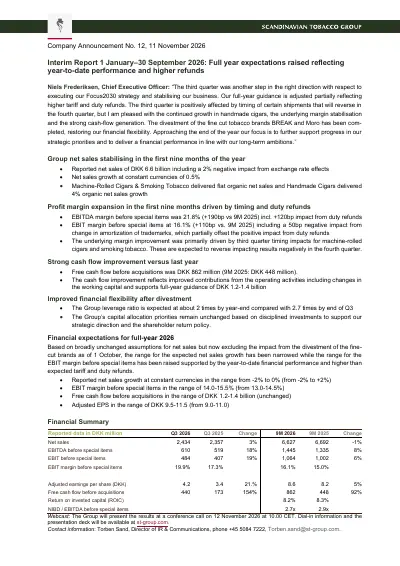
Thank you, Niels. Reported net sales for the first nine months was 6.6 billion kroner, broadly unchanged from last year and including a 2% negative exchange rate effect.
Organic net sales growth was slightly positive at 0.5%. In the third quarter, organic growth accelerated to 2.1%, driven by the timing of shipments.
EBIT margin before special items improved to 16.1% for the first nine months, compared with 15% last year. The third quarter margin increased to 19.9% from 17.3%.
The margin improvement was mainly due to third quarter timing impacts from machine-rolled cigars and smoking tobacco. We expect these to reverse in the fourth quarter, impacting results negatively.
EBITDA before special items increased by 6% to 1.4 billion, positively impacted by 116 million in other income, namely duty refunds. We continue to expect EBITDA before special items for the full year to be more or less in line with last year.
Free cash flow before acquisitions reached 862 million kroner for the first nine months, almost double last year's level. This reflects stronger business performance and the collection of receivables referred to earlier this year.
Adjusted earnings per share increased to 8.6 kroner for the first nine months and 4.2 kroner for the quarter. Finally, our leverage ratio improved to 2.7 times, compared with 3 times at the end of last year.
With the divestment proceeds now received and the fourth quarter cash flow expected, we expect leverage to be approximately 2 times by year-end. Overall, these results give us confidence in our adjusted full-year expectations and in the progress of Focus 2030.
With this, I'll hand back to Niels, who will dive a little deeper into our strategic business developments and strategy progress. Please turn two slides to slide number 8.
Niels Frederiksen
Thank you, Marianne. I will now briefly take you through a few important business developments that happened this year.
First, we successfully completed the divestment of Break and Morven on 1st October. This is an important milestone for the group, and reinforces our strategic focus while strengthening our balance sheet and financial flexibility.
As mentioned previously, an important element to the agreement is the contract manufacturing with JTI for the continued production of Break and Morven for up to 3 years, subject to a 6 months termination notice. The production agreement gives us valuable time to assess how best to optimize the manufacturing network and our efficiency at our two factories in Denmark for our mid-term needs.
Profit margins are obviously lower for contract manufacturing volume, which means that both gross profit and EBITDA will be impacted from 2027 onwards as a consequence of the divestment. We have informed that in the first nine months of the year, when we were still owners of Break and Morven, the two brands accounted for almost 4% of group net sales and slightly more than 6% of EBITDA before special items.
Second, we have established our own sales organization in Norway, and therefore Norway has moved from the North America Branded and Rest of World division into Europe Branded. This gives us direct control of commercial execution in the market and supports our broader ambitions in the region.
Third, the rare quality issue affecting machine-rolled cigars earlier in the year has now been resolved, and product availability has begun to normalize, and we are once again fully focused on improving execution and market positions in our key markets. Finally, the machine-rolled cigar brand Sail, previously Captain Black, will be reintegrated under our own distribution platform in Canada with full effect from the second quarter of 2027.
This transaction is in accordance with a long-term license agreement with a third party, which now expires. The inclusion of Sail will impact net sales and profit margins positively next year.
Please turn to slide number 9. Our key strategic priorities are to stabilize machine-rolled cigars and smoking tobacco business, grow our handmade cigar business, and accelerate nicotine pouches.
Financially, our priority for the near term has been to regain financial flexibility by reducing our leverage, and we made good progress with all our priorities just shy of 1 year since launching our strategy. Firstly, as I mentioned in my opening remarks, we have managed to stabilize profits from the combined machine-rolled cigars and smoking tobacco business, with the gross margin for the category increasing to 53.8% for the first nine months, compared with 50.9% last year, though including the mentioned timing impacts.
While market shares remain below last year's level, we see encouraging signs from our power brands: Signature, La Paz, Panter, and Mercator, despite the quality issue. The current performance supports our view that the strategy is moving in the right direction, and we remain focused on protecting profit and cash flow.
Secondly, our handmade cigars continue to deliver sales growth with stable margins, supported by the strong performance from our power brands: Cohiba, Macanudo, CAO, and Alec Bradley. We are seeing positive developments in both our online and retail channels, and we continue to see opportunities to gain market share in the US premium cigar market.
Despite continued competitive markets, we remain confident in the long-term potential of the category and our commercial execution. The third priority is to accelerate XQS, and XQS continues to deliver strong volume growth.
Net sales remain impacted by promotional activities and portfolio optimization, but the underlying consumer demand remains encouraging. During the quarter, we also launched XQS chew bags in Germany, representing another step in expanding the brand beyond its core markets and segments.
Overall, less than a year into Focus 2030 execution, I'm pleased with the progress we're making across all these three priorities. Please turn to slide number 10.
Let me now provide some additional detail on the development of our product categories. Machine-rolled cigars and smoking tobacco delivered net sales of 1.2 billion kroner in the third quarter, corresponding to an organic growth of 7%, while the gross margin increased to 57.4%.
Both the organic net sales growth and the margin improvement primarily reflects positive impacts from the timing of shipments, which will reverse in the fourth quarter, but the development also reflects the recovery from the quality issue earlier in the year, as well as the continued benefits from our commercial and operational initiatives. Handmade cigars continue to grow, delivering organic growth of 1% in the quarter and 4% for the first nine months.
Gross margins remain stable, reflecting the strength of our brands and improving execution across channels. Overall, competition remains intense, but the execution of our strategic agenda is delivering positive results for both sales and profit margins.
For next generation products, organic net sales declined by 6%, both in the quarter and year-to-date. However, if we look at total in-market volumes for the first nine months of the year in Sweden, Denmark, and the UK, they increased by 19%, with our brands growing 25%.
As we've mentioned previously, the development reflects investments in market positions, promotional activities, and portfolio streamlining. While these initiatives impact short-term margins and reported growth, they support our ambition of building a stronger and more scalable business over time, and we continue to see a satisfactory in-market performance.
Overall, the key takeaway from this slide is that we continue to see increasing sales in handmade cigars, good signs of stabilization in profitability in machine-rolled cigars and smoking tobacco, and continued investments to support our future growth within next generation products. With this, I will leave the word back to Marianne for a review of the financial plan.
Please turn two slides to slide 12.
Marianne Rørslev Bock
Thank you, Niels. Let me start by addressing the organic net sales in third quarter, which grew 2.1%, compared with 0.3% decline in the first six months of the year.
As explained, most of the increase in the net sales in the third quarter is driven by timing of shipments, which will reverse in the fourth quarter. It's not unusual that we experience that the timing of shipments can move net sales from one quarter to another, though the impact is somewhat higher than normal in this quarter.
This is one reason why the rolling 12-months trend often provide a better view to the underlying development. Importantly, the underlying business is developing as expected, which is reflected in our expectations for the full year, and which have the impact of the divested fine-cut brands.
EBITDA and EBIT before special items are, as in previous quarters, impacted by a couple of items which reduce visibility to the underlying performance of our business. First, as we announced with the release of our full-year expectations for 2026 in March, other income is positively impacted by duty refunds.
In the first nine months of the year, other income was 116 million kroner, and for the third quarter, it was 37 million. This income impacts EBITDA in the division NABROW.
Second, as we also announced in March, we increased the amortization of trademarks to reflect the new Focus 2030 strategy and its stronger focus on our power brands. The increase in amortizations has a negative impact on the EBIT margin for the group of about 50 basis points compared with last year.
Special items for the first nine months were negative 178 million kroner, compared with negative 146 million kroner in the same period last year. These costs mainly relate to Focus 2030 reorganization and our global SAP implementation, and to a lesser extent for the Mac Baren integration costs, and for a new service delivery organization.
We expect that special costs in 2026 will total approximately 250 million. The EBIT development is also reflected in a higher return on invested capital compared with the previous quarters, although return on invested capital is unchanged at 8.2% compared with the same quarter last year.
Finally, as Niels mentioned, cash flow improved our leverage ratio towards the end of the third quarter to 2.7 times. With the proceeds from the divestment of Break and Morven, we expect leverage of around 2 times by year-end.
Now please turn one slide to slide number 13. Now let me provide some color on our three reporting divisions.
In June, we established our own sales organization in Norway, whereby net sales and profits from the market going forward are reported in the division Europe Branded instead of the division North America Branded and Rest of the World. This does follow our reporting principles, where Europe Branded covers markets with our own sales organizations, while markets without are included in Rest of the World.
The move impacts the calculation of net sales growth, organic growth in net sales, and profit margins for Europe Branded and North America Rest of the World. In the third quarter 2026, Norway accounted for net sales of 55 million, gross profit before special items of 50 million, and an EBITDA before special items by 44 million.
For the first nine months, organic net sales growth was positive in North America Branded Rest of the World and in North America Online & Retail, driven by handmade cigars in both divisions, as well as smoking tobacco in North America Branded Rest of the World. In the third quarter, Online & Retail delivered organic growth, while North America Branded Rest of the World's growth was negative because of the move of Norway.
Europe Branded had a 3% negative organic growth for the nine months, but the third quarter benefited from the timing of shipments and the addition of Norway. For North America Branded Rest of the World, the gross margin before special items was 46.6% for the nine months, down from last year mainly because of Norway moving to Europe Branded.
Its EBITDA margin before special items increased to 35%, driven by other income. North America Online & Retail's gross margin improved thanks to the commercial strategy under Focus 2030, scale benefits from increasing net sales, and tariff refunds in the second quarter of the year.
For Europe Branded, both the gross margin and the EBITDA margin before special items were impacted by Norway joining the division in the third quarter, as well as organic growth in machine-rolled cigars and smoking tobacco. Now please turn to slide number 14.
Before I leave the word back to Niels, I would like to address the longer-term trends in the three key drivers behind our shareholder return policy, which are: the cash flow generation, EBIT margin development, and leverage ratio. The free cash flow generation is an essential pillar in our financial ambitions.
It funds the investments that support our business and strategic direction, as well as it is the foundation for our shareholder return policy. The cash flow can fluctuate a lot quarter to quarter, as it not only includes the operational cash flow, but also special cash payments, changes in working capital, and other items.
We have therefore illustrated the free cash flow before acquisitions and divestments on a 12-month rolling basis since the beginning of 2024, as it better reflects the underlying development. Although 2026 will be positively impacted by the recovery of the collection of receivables from last year, as well as the inventory impact from the divestment of the brand Break, I believe it is fair to conclude that the underlying cash flow remains solid and broadly in line with recent years.
We are well on track to deliver on ambition of a free cash flow before the impact of acquisitions and divestments of more than 1.2 billion kroner in 2030. Organic EBIT before special items is also an important KPI in our financial ambitions.
Throughout the strategy period, our ambition is to deliver low single-digit growth, which require us to stabilize and eventually improve profitability in our business. The group EBIT margin has been declining for several years, which is illustrated by the chart.
I'd like to make two observations. First, the margin decline appears to have started to stabilize since the launch of our strategy last year.
Second, assuming we meet the midpoint of the revised guidance range for the EBIT margin for the full year, we're basically back to the level of past quarters, which is what we have expected would be the case since the beginning of the year. The third key focus point is the leverage ratio.
Following the divestment of Break and Morven, we expect the leverage to be about 2 times by the end of the year, which is below our leverage target of 2.5 times. Let me reiterate our capital allocation policy.
The policy is anchored in the dividend policy with a target payout ratio of 40% to 60% of adjusted earnings per share, and in disciplined investment priorities, which must support our strategic direction and enhance return on invested capital over time. Further, our shareholder return policy states that the distribution of any excess capital is being continuously evaluated.
Currently, we are reviewing the capital allocation and intend to provide more clarity no later than in relation to our annual report announcement the 3rd of March next year. With this, I will now hand back to Niels, who will discuss our revised financial expectations for the full year.
Please turn two slides to slide number 16.
Niels Frederiksen
Thank you, Marianne. Based on broadly unchanged assumptions for net sales, but now excluding the impact from the divestment of the fine-cut brands on 1st October, the range for the expected net sales growth has been narrowed, while the ranges for EBIT margin before special items and adjusted earnings per share have been raised, supported by the year-to-date financial performance and higher than expected tariff and duty refunds.
Year-to-date developments suggest the decline rate in the consumption of handmade cigars in the US to be slightly less than our full-year assumption of -4%, while the total market for machine-rolled cigars in our core European markets is estimated to decline slightly faster than our full-year assumption of -3%. The expectation for the group's net sales growth at constant currencies is revised, and is now seen at -2% to 0%, reflecting that our assumptions for net sales are broadly unchanged, and that the divestment of Break and Morven will have full impact in the fourth quarter.
The previous expectation was net sales growth in the range of -2% to +2%, and the isolated impact from the divestment is around 1% on the full-year net sales for the group. We continue to expect EBIT margin before special items to decline for the second half of 2026, compared with the same period last year.
With the strong third quarter results being driven by timing effects, and with the divestment of the fine-cut brands from the fourth quarter, both EBIT and the EBIT margin will be lower in the fourth quarter compared with last year. Now in saying this, the year-to-date financial performance and higher than expected duty and tariff refunds supports an upward adjustment to the expected range for EBIT margin before special items by 1 percentage point to 14% to 15.5%, up from 13% to 14.5%.
Following the completion of the divestment of Break and Morven, the expectation to the free cash flow before acquisitions and divestments was revised to the range of 1.2 to 1.4 billion kroner, previously from 950 to 1.2 billion. This expectation is maintained, and includes, as previously communicated, about 200 million kroner in recovery of receivables during the first half of the year, and another about 200 million from the transfer of inventory in relation to the divestment of the fine-cut brands, being partly offset by special cash cost of about 250 million kroner.
The expectation to adjusted earnings per share is adjusted in accordance with the higher range for the EBIT margin to be in the range of 9.5 to 11.5 kroner, previously from 9 to 11 kroner. Our expectation is that the leverage ratio will move to be around 2 times by the end of the year.
The financial results for 2027 will reflect the divestment of Break and Morven, accounting for almost 4% of group net sales and slightly more than 6% of group EBITDA before special items for the first nine months of 2026. However, these impacts to net sales growth and profit margins is expected to be partially offset by the return of the Sail cigar trademark in Canada.
Now let me conclude our prepared remarks by emphasizing that the quarterly volatility seen between Q3 and Q4 does not reflect any changes to the underlying performance. We're on track to deliver on the guidance and then some, and we're fully occupied with executing well on our new strategy.
This concludes our prepared presentation for today's webcast, and I'll now hand the word back to the operator. Thank you for listening.
Operator
Thank you. As a reminder, to ask a question on the phone, please press *11 and wait for your name to be announced.
To withdraw your question, please press *11 again. Once again, to ask a question, please press *11 on your telephone and wait for your name to be announced.
To withdraw your question, please press *11 again. If you wish to ask a question via the webcast, please type it in the question box and click submit.
Thank you. We are now going to proceed with our first question.
The questions come from the line of Niklas Ekman from DNB Carnegie. Please ask your question.
Niklas Ekman
Thank you very much. I have a couple of questions.
I want to start if it's possible to quantify the phasing impact here in machine-made cigars and smoking tobacco. I noticed the sales grew 7% in the quarter.
What would that growth have been otherwise excluding the phasing effect? Would your group organic sales in Q3, would they have been negative or around 0 excluding this effect?
If there's any way to quantify, that would be appreciated.
Marianne Rørslev Bock
Hey, Niklas. Thank you for calling in and also for your question.
Let me first put a few words on this timing or phasing effect. You all remember our quality issue of machine-rolled cigars in the second quarter.
We have been able to solve the issue, and also produce new products that we have put into the market and kind of filled up the shelves again in Q3. That is part of the phasing here.
We also went live with a new wave in our SAP rollout, where we have loaded the market beforehand if anything should happen with that rollout, which fortunately was not the case. A couple of things on this phasing.
It's difficult to quantify, but we did try, we expected the question, and the way that we see it is that Q3 is probably impacted by around 70 million in net sales that we would call phasing.
Niklas Ekman
Excellent. Thanks for quantifying.
Secondly, on the guidance, flat to a 2% decline, that's still a fairly broad range given that it's just one quarter left. If I calculate backwards, that means anything from a decline of 1% to 10%.
I know you have the Break and Morven divestment there. I assume that takes away around 4 percentage points from your growth in Q4.
Is there any way to narrow that decline, or why would the decline be as much as 10%?
Marianne Rørslev Bock
Let me try here also, Niklas. You're right that it is 2 percentage points, it is a large range when we are two months from closing the year.
I think also Q3 shows some of these timing issues. If I should sort of try to guide you a bit here, then I would not look at the top of that range with the knowledge that we have now.
Niklas Ekman
Very clear. Thirdly, is it possible to quantify the duty tariff refunds?
You talk about other income here of 116 million and only 37 million in Q3, but as I understood it, most of this effect now comes in Q3, and you talk about 120 basis point margin impact, so that gives me a number of about 80 million in tariff refunds. Can you help us understand this?
Most of this, I assume, came in Q3, and are we talking about roughly 80 million in duty refunds?
Marianne Rørslev Bock
When the guidance that we have put out also with the increased EBIT margin, it is both impacted by we see a strong performance or good performance, where we expect to keep that momentum, and then it is what we call tariff and duty refunds. Tariffs is, as everyone know, the refund from the illegal tariff collection in US, and then we also see the duty refund.
There are timings here on shipments that are also difficult, but when we look into Q3, we are thinking around 50 million that will impact the Q3 on both tariff and duty refunds.
Niklas Ekman
Okay. Very, very clear.
Thank you.
Marianne Rørslev Bock
Oh, sorry, Q4. Sorry, Q4.
I think I said Q3. I meant Q4.
Niklas Ekman
Sorry, 50 million in refunds in Q4?
Marianne Rørslev Bock
Yes.
Niklas Ekman
On top of the refunds you've already gotten. How much was it in Q3 specifically?
Marianne Rørslev Bock
In Q3, it was 36 million.
Niklas Ekman
Very clear.
Marianne Rørslev Bock
Niklas, maybe just to clarify here, when we talk duty refunds, that is what you've seen in other income. If we get tariff refund, that will be in the gross profit that you cannot see directly.
Niklas Ekman
The tariff refund in Q3 was quite substantial, I assume?
Marianne Rørslev Bock
In Q3, we had no tariff refunds. We had it in Q2, and we expect a smaller part in Q4.
Niklas Ekman
Very clear. Excellent.
Thank you.
Marianne Rørslev Bock
Right.
Niklas Ekman
Also curious on the balance sheet now. You talk about net debt to EBITDA going to 2.7, but I assume it's already dropped more or less to 2.0 from the 1st of October when you received the proceeds for the divestment.
You're now talking about reviewing your capital allocation, and you're going to return no later than the annual report, but is there anything to prevent buybacks to resume before year-end, or do you think it's more likely that that's an issue for the full-year results?
Marianne Rørslev Bock
I think I'll stick to what we have been writing, that we will revert no later than in March. We are reviewing that right now, and we like to get our hands around 2027, how that is going, how we see momentum in 2027 before we say anything more about our capital allocation decisions.
Niklas Ekman
Very clear. Thank you so much for taking my questions.
Operator
As a reminder, to ask a question on the phone, please press *11 and wait for your name to be announced. To withdraw your question, please press *11 again.
If you wish to ask a question via the webcast, please type them in the question box and click submit. We are now going to proceed with our next question.
The questions come from the line of Damian Taurian from Deutsche Bank. Please ask your question.
Damian McNeela
Hi, Niels, Marianne, Torben. Thanks for taking the questions.
Just first on the MRC market share recovery, with availability now normalizing, what gives you confidence that the market share losses are recoverable rather than having resulted in some permanent switching to competitors, and how quickly would you expect that recovery to come through?
Niels Frederiksen
Thank you for that question. Again, you can say that it is clear from the report that we have lost market share due to the quality issue.
It is primarily centered around the Signature brand. If you have a quality issue, which is always bad, it's actually in my opinion better to have it on a brand that has good momentum, which Signature has had, which means that when we get product back, I think there's a higher likelihood that we will see trade responding positively to getting it back on the shelf, and hopefully also consumers returning to the brand.
This is, of course, where the risk is, and this is also why we say we have to be a little patient. First is around getting it back on the shelf, and then we're trying to activate it again versus consumers.
I think you have to go into 2027 before you start seeing whether we can successfully raise the market share back up again. It's certainly what we are aiming to do.
Damian McNeela
Perfect. Thank you.
Then on the HMC, just a bit of color on industry dynamics at the moment. I think in the statement you mentioned that the total market volumes declined less than the initial 4% anticipated.
Could you just get some color as to where you guys are relative to what the industry is seeing?
Niels Frederiksen
Let me start by saying that it is our assessment that we are gaining market share in 2026, so that's positive. I think it's also a fact that the US consumer continued to be affected by price increases on their, let's call it their full basket of products they need for a daily basis, and this does, in our opinion, affect the discretionary spend, where our category is also part of it.
It is tough conditions in the US right now, but I would still say that when I look at our performance, when I look at the market, there is a slight underlying positive momentum that we are watching carefully over Black Friday, Cyber Monday, and the holiday season because we really want to see stabilization in the US, and we are slightly more positive now than we were at the beginning of the year.
Damian McNeela
Awesome. Then one final one just on XQS, two things.
Firstly, in the UK, appreciate to keep the UK share stable, that means you're growing in line with a market that is doing about 40% volume growth. What do you need to do to start growing ahead of the market?
Then secondly, just some color on the chew bags. Is that just a name for nicotine pouches, or is it a slightly different product, and how does it work there given the sort of restrictions on pouches under its current regulation?
Thanks.
Niels Frederiksen
Let me start somewhere else by saying that Sweden continues to be strong performance, and last week we actually achieved all-time high market share in Sweden for XQS for 13.8%. That market is solid, if you want.
If we look at the UK, this has been a much more challenging market conditions. It's much more intense from a competition point of view, and we have protected the market share.
You can say that our focus right now is actually winning in the independent trade and with selected online companies. We believe that that is a better way for us to eventually get into the key accounts, but we can also see that right now the entry ticket, if you will, price-wise, to get in the key accounts is very high because there's a long line of companies willing to pay a price that we don't think is sustainable.
We are very much working with the independent trade. We are working with select online companies to get the brand to have more momentum, and that is what we need to succeed with.
Then let me, on the final question on chew bags, say that nicotine pouches is not legal in Germany, but the product of chew bags, in our opinion, is, and there are also competition in that segment. You should think about it like a nicotine pouch that cannot release flavor and nicotine without being gently chewed.
It is a product where you put it in your mouth, you chew it gently, and then you position it under your lip, and then you get the flavor and nicotine released. You can call it a technicality, but it's from a, let's say, a German perspective, what we believe is legal within the current legislation.
We're doing this not because it is a huge business opportunity, but because we want to be well prepared if the regulation in Germany opens up for nicotine pouches.
Damian McNeela
Perfect. Thank you.
That's all for me.
Operator
There are no further questions on the phone line, I'll now hand over to Torben Sand for any webcast questions.
Torben Sand
Thank you. There doesn't seem to be any questions on the webcast.
Basically, I think unless there should be more on the phone, I think that will conclude this third quarter presentation. Thank you for the questions, and thank you for attending.
Operator
This concludes today's conference call. Thank you all for participating.
You may now disconnect your lines. Speakers, please stand by.
Thank you.