Coupang, Inc.
Q3 FY2026 · Earnings Call TranscriptNovember 3, 2026
Operator
Hello everyone. My name is Ronnie and I will be your conference operator today.
At this time, I would like to welcome everyone to the Coupang 2026 Third Quarter Earnings Conference Call. All lines have been placed on mute to prevent any background noise.
After the speakers' remarks, there will be a question-and-answer session. If you would like to ask a question during this time, simply press star followed by the number five on your telephone keypad.
If you would like to withdraw your question, press star and the number five once again. Now I'd like to turn the call over to Mike Parker, Vice President of Investor Relations.
You may begin your conference.
Mike Parker
Thanks, operator, and welcome everyone to Coupang's third quarter 2026 earnings conference call. I'm pleased to be joined on the call today by our founder and CEO, Bom Kim, and our CFO, Gaurav Anand.
The following discussion, including responses to your questions, reflects management's views as of today's date only. We do not undertake any obligation to update or revise this information, except as required by law.
Certain statements made on today's call may include forward-looking statements, including statements regarding future financial and operational results. Actual results may differ materially.
Additional information about factors that could potentially impact our financial results is included in today's press release and in our filings with the SEC, including our most recent annual report on Form 10-K and subsequent filings. As we share our third quarter 2026 results on today's call, the comparisons we make to prior periods will be on a year-over-year basis, unless otherwise noted.
We may also present both GAAP and non-GAAP financial measures. Additional disclosures regarding these non-GAAP measures, including reconciliations of these measures to the most comparable GAAP measures, are included in our earnings release, our slides accompanying this webcast, and our SEC filings, which are posted on the company's Investor Relations website.
Now, I'll turn the call over to Bom.
Bom Kim
Thanks everyone for joining us today. I'll start by highlighting a few things upfront and then go deeper into the quarter.
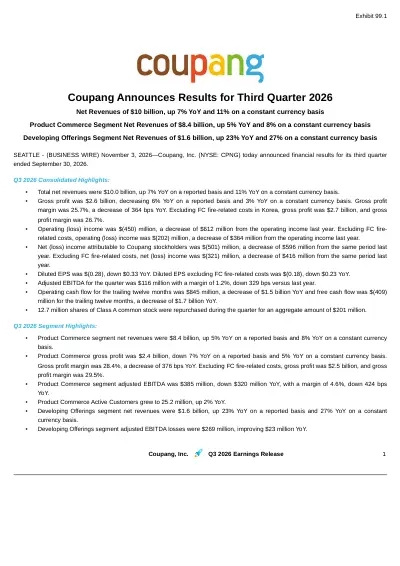
First, momentum continued to build across the business in Q3. Consolidated revenue grew 11% year-over-year in constant currency, exceeding the guidance range we provided, and a step up from Q2, even with the Chuseok holiday timing working against us this year.
Product Commerce grew 8% in constant currency, or about 9% adjusting for the holiday shift, an acceleration from Q2. Second, our WOW membership in Korea is at the highest level in our history, with strong growth both year-over-year and quarter-over-quarter.
Net additions are running above historical rates, driven by both returning members and strong new signups. We keep investing in expanding the value proposition for WOW members, which in turn drives higher retention and growth in membership.
This quarter, we began rolling out Try Now Pay Later, a new WOW benefit in fashion that lets members try items on for seven days before paying, one small example of how we keep expanding the value we provide. Our goal is to make WOW the best value membership program anywhere in retail.
Third, Product Commerce is tracking towards the mid-next-year recovery we laid out last quarter. The underlying customer behavior remains just as strong as what we spoke to last quarter, and we expect the reported growth and margins to approximate historical levels as we lap the affected periods next year.
Fourth, in Developing Offerings, growth accelerated to 27% in constant currency, and the customer signals we track most closely strengthened again. Taiwan and Eats continue to lead the way.
We're also excited about extending Eats into non-food on-demand delivery in Korea, more on that in a moment. Let me take each in turn.
On Product Commerce, the drivers of our momentum are the same ones that have powered our growth for more than a decade: our unwavering focus on wowing customers with the lowest prices, broadest selection, and unbeatable service. We're working to widen that experience gap quarter after quarter, which is the compounding engine behind this business.
The soft spot in reported growth this quarter remains the small cohort of members who left after the data incident and haven't yet returned. The members who did return, despite being away and allocating their retail wallets elsewhere for a period, have not only returned to their prior levels of spend, but they've continued to compound this quarter at normalized rates consistent with what we saw last quarter.
The members who never left are also spending at record levels and growing as fast as they were before the incident. These are among the clearest signs yet of where we stand competitively and the strength of our value proposition across service, price, and selection.
New members have been more than filling in the gap in member count, though they naturally begin at the early part of the spend curve. It takes time for them to climb it, as each cohort before them has.
As we lap the affected periods next year, the non-returning cohort drops out of the year-over-year comp, and our reported growth converges with the growth of the underlying customer base. That base continued to grow spend at normalized rates this quarter, consistent with the spend growth we spoke to last quarter.
Buyable selection is the lever our teams are focused on because it's the input that we see customers responding to most directly. Our assortment on Rocket grew at strong double-digit rates this quarter.
Giving customers more of what they need at low prices and with the best delivery experience is one of the clearest ways we compound growth over the long term. Fresh is a great example of the power of this cycle.
Rocket Fresh volumes grew more than twice the pace of overall Product Commerce this quarter. That's the result of years of investment to offer customers the best fresh selection anywhere, at low prices, and delivered free with dawn or same-day delivery nationwide.
Fresh is a category customers buy with high frequency, and the delivery experience we provide is deeply differentiated. It engages customers with Coupang in a way few other categories can, and we see a long runway here.
On Product Commerce margins, the three temporary items we described last quarter—supply chain headwinds, fixed cost deleverage against the pre-incident demand curve, and the elevated marketing investment we're making to accelerate the return of departed customers—continue to work through the P&L on the trajectory we expect. The mechanics are the same ones we laid out before: the supply chain dislocation normalizes as our volumes rebuild, and the volume-based savings we're missing this year come back.
Capacity utilization catches up as demand better aligns with the cost base we've built, and the marketing step up is already beginning to taper, which we'd expect to continue in the quarters ahead. We don't believe any of these items are structural.
Some are near-term investments we've chosen to make, while others are temporary headwinds. Our expectation in returning next year to Product Commerce margins approximating pre-incident levels is unchanged.
Underneath these near-term items, work continues on the long-term margin drivers. Process improvements and deeper automation across our fulfillment and logistics network are producing higher customer service levels and lower cost to serve at the same time.
This quarter, for example, we began deploying AI cameras in our packing stations to remove the need for manual scanning, paired with AutoBaggers that automatically size and customize packaging for each order, cutting both time and packaging waste. Each is small on its own, but they compound with the constant innovation, technology, and process excellence across our operations.
Turning to Developing Offerings, where in Taiwan, the response from customers is accelerating. Our owned last-mile network now delivers the vast majority of orders next day, seven days a week.
Dawn delivery, which we began rolling out last quarter, is already accessible to over 50% of the population. Our WOW membership program in Taiwan has grown more than 100% year-over-year and 14% quarter-over-quarter, an acceleration over the growth we saw in Q2.
Our differentiated Rocket Delivery experience combined with the value of our WOW membership program are helping drive strong adoption and retention in customers. This is remarkably similar behavior to what we saw in Korea at the same stage.
Beyond our fulfillment and logistics network, we're building what will ultimately enable the highest levels of value for our consumers through direct sourcing relationships with brands. The combination of deep selection, operational excellence, and a supply chain that enables everyday low prices and an owned delivery experience no one else matches is what has driven compounded growth for us in Korea for more than a decade.
That same combination is now taking shape in Taiwan. We're encouraged to see the trajectory in Taiwan accelerating and closely following the same path in Korea.
The signals we track most closely—customer adoption, cohort retention, service differentiation—are each tracking well. Our teams are focused on scaling the offering by building the foundation for the highest levels of customer experience, while simultaneously progressing towards profitability, not one at the expense of the other.
As we continue to execute with discipline, we expect Taiwan to be a meaningful contributor to consolidated cash flow in the years to come. Eats and Rocket Now, our on-demand food delivery offerings in Korea and Japan, continue to delight customers.
Our focus is the same as it's been from the start: providing the best combination of service, price, and selection. Customers continue to embrace them at increasing levels.
We're also rolling out non-food on-demand delivery in Korea, extending our Eats offering into product categories where customers can now get free delivery across a wide assortment in just minutes. It's still very early, but we'll continue to iterate on how to expand the value proposition for customers.
As always, we continue to take the long view on value for our customers and returns for our shareholders, and Q3 reinforces it. The long-term opportunity in Korea, in Taiwan, and across our Developing Offerings is as compelling to us today as it has ever been.
Now, I'll turn the call over to Gaurav to walk through the financials in more detail.
Gaurav Anand
Thanks, Bom. Our Q3 results reflect continued progress in our underlying business in line with the recovery trajectory we have outlined.
Consolidated revenues grew at 7%, or 11% in constant currency, above the 8% to 9% range we guided to. Before I walk through the segment results in detail, I would note that this quarter we recorded approximately $248 million in expenses relating to the fire at one of our fulfillment centers in July.
These expenses were recorded as $95 million in cost of sales and $153 million in OG&A. Where relevant, I will provide results with and without the impact of the fire.
Let me cover our segment performance and then move to consolidated results. In Product Commerce, segment net revenues were $8.4 billion for the quarter, growing 5% on a reported basis and 8% in constant currency.
The timing shift of Chuseok holidays we discussed last quarter negatively impacted both our Product Commerce and consolidated constant currency growth rates by an estimated one percentage points this quarter. Adjusting for this impact, Product Commerce constant currency growth accelerated versus Q2 to approximately 9%.
Product Commerce active customers were 25.2 million, growing 2% year-over-year and quarter-over-quarter. As Bom described, WOW membership continued to build on the recovery we outlined previously, with our current members compounding their spend at normalized rates consistent with the growth rate we spoke to last quarter.
Product Commerce gross profit for the quarter was $2.4 billion, and gross profit margin was 28.4%. Excluding the fire-related costs, gross profit margin was 29.5%, a contraction of approximately 260 basis points year-over-year and 100 basis points quarter-over-quarter.
The year-over-year contraction is driven primarily by the factors we discussed last quarter, supply chain headwinds, and elevated levels of promotional spend we have deployed to support the ongoing recovery in customers. The quarter-over-quarter contraction primarily reflects the weather-related seasonality we often see from Q2 to Q3, as well as timing of the Chuseok holidays.
We continue to view these dynamics as temporary rather than structural. We believe the long-term drivers of our margin expansion remain intact: operating efficiencies across our fulfillment and logistics network driven in part by continued investments in automation and technology, supply chain optimization, and the scaling of our margin accretive categories and offerings.
Segment adjusted EBITDA for Product Commerce was $385 million, which excludes the FC fire costs, resulting in an adjusted EBITDA margin of 4.6%. This represents a contraction of approximately 420 basis points year-over-year and 50 basis points quarter-over-quarter.
The year-over-year contraction reflects the gross profit dynamics I just described, as well as the headwinds created by the imbalance in our fixed cost structure related to the current demand, which remains a near-term impact from the effects of last year's data incident. The Chuseok timing shift also contributed approximately 40 basis points of year-over-year contraction to both Product Commerce and consolidated adjusted EBITDA margins this quarter.
Within Developing Offerings, segment net revenues were $1.6 billion, growing 23% on a reported basis and 27% in constant currency. This represents an acceleration from the 24% constant currency growth rate we reported last quarter, as we saw durable growth across each of our initiatives.
Developing Offerings generated $185 million in gross profit for the quarter, an increase of $29 million year-over-year, and segment adjusted EBITDA losses were $269 million for the quarter, an increase of $50 million over last quarter. The quarter-over-quarter increase in adjusted EBITDA losses was driven by incremental investments as we continue to scale these offerings.
Moving now to our consolidated results. Total net revenues were $10 billion for the quarter, growing 7% on a reported basis and 11% in constant currency, with the Chuseok timing shift I referenced earlier accounting for roughly one percentage points of year-over-year drag on the constant currency growth rate.
Consolidated gross profit was $2.6 billion with a gross profit margin of 25.7%. Excluding the fire-related expenses, gross profit margin was 26.7%, a contraction of approximately 270 basis points year-over-year and 150 basis points quarter-over-quarter.
The year-over-year contraction is driven primarily by the near-term headwinds in Product Commerce I discussed, combined with our continued investments in Developing Offerings. The quarter-over-quarter contraction primarily reflects the weather-related seasonality and Chuseok holiday timing we see from Q2 to Q3.
OG&A expense was $3 billion for the quarter, or 30.2% of total net revenues. Excluding the fire-related costs, OG&A expense was approximately $2.9 billion, or 28.7% of total net revenues, an increase of approximately 110 basis points year-over-year.
This increase was driven by deliberate step-up in marketing spend to support the Product Commerce customer recovery and the fixed cost base still carrying capacity sized for the pre-incident demand curve. Operating loss for the quarter was $450 million.
Excluding the fire-related costs, operating loss was $202 million. Loss before income taxes was $514 million, or $266 million excluding the fire-related expenses.
Our tax dynamics continue to reflect losses in our early-stage operations in Taiwan and Japan that do not generate offsetting tax benefits at the consolidated level. Net loss attributable to Coupang stockholders was $501 million, or $321 million excluding the impacts of the fire.
This resulted in a diluted loss per share of 28 cents, or approximately 18 cents excluding the fire. We generated $116 million in consolidated adjusted EBITDA this quarter, resulting in an adjusted EBITDA margin of 1.2%.
This represents a contraction of approximately 330 basis points year-over-year, in line with the 300 to 400 basis points range we guided to last quarter. The year-over-year contraction continues to be driven by the near-term items we have discussed previously: the imbalance of our fixed cost structure and current demand, the elevated marketing and promotional investments supporting the customer recovery, and the supply chain pressures that come with the lower volumes than planned.
In addition, there was an approximately 40 basis points negative impact from the Chuseok timing shift I noted earlier. On cash flows, on the trailing 12-month basis, we generated operating cash flow of $845 million, and free cash flow was negative $409 million.
The year-over-year declines reflect the lower profitability we have discussed this year, increases in capital expenditure, cash outlays relating to the fire, and an elevated levels of tax payments. During the quarter, we also repurchased 13 million shares of Class A common stock for approximately $201 million.
Turning now to our near-term outlook. For Q4, we expect consolidated constant currency revenue growth of 13% to 14%.
This reflects our expectation of continued progress in our recovery in Product Commerce. For consolidated adjusted EBITDA, we expect the margin to increase 50 to 150 basis points quarter-over-quarter in Q4, reflecting continued underlying progress in Product Commerce, as well as reduced levels of marketing spend.
We continue to expect Product Commerce adjusted EBITDA margins to return by mid-next year to levels approximating those we generated prior to the data incident. While margins may be uneven quarter-over-quarter, we believe the long-term drivers of our margin expansion beyond the recovery remain unchanged.
For Developing Offerings, we previously guided to full-year losses this year of $950 million to $1 billion. We are now increasing the top end of that range by $50 to $100 million.
This update is primarily driven by our Taiwan build-out, where we are accelerating infrastructure investments to support our differentiated delivery experience and to scale our supply chain. We continue to evaluate each investment in Developing Offerings against the same discipline we apply across the business: rigorous analysis, operational excellence, and our conviction to generating meaningful long-term returns.
Operator, we are now ready to begin the Q&A.
Operator
At this time, I would like to remind everyone in order to ask a question, press star, then the number five on your telephone keypad. If you would like to withdraw your question, press star and the number five once again.
Please limit your questions to two per person. We'll pause for just a moment to compile the Q&A roster.
Your first question comes from Eric Cha with Goldman Sachs. Your line is open.
Eric Cha
Yeah. Hi, thank you for the opportunity.
It was good to hear you reiterate your margin normalization by midpoint next year, but just had a question around the cadence of the margin improvement. Now with three quarters left and giving your guidance on the fourth quarter, it seems like within two quarters the margin improvement should be quite substantial.
Should we be expecting flattish margin throughout and then the margin stepping up all at once at the last quarter? Or should we be expecting a continuous improvement up to the second quarter?
Why would the dynamics work in such manner? If we were to understand the drivers of what causes that trend even in a high level, that would be most helpful.
The second question is just now during the prepared speech, you commented on the DO loss guidance, raising the top end by 50 to 100 million, driven by I think Taiwan investments. Would you be able to be a bit more specific about what sort of investment you are making in Taiwan?
What results you're expecting from this investment? I understand that you give full guidance in the fourth quarter earnings for next year, but it would be most helpful if you could share your view on the general direction of Developing Offering loss into next year, whether this year or even next year may be the peak.
Thank you.
Bom Kim
Hi, Eric. Thanks for the question.
On the margin improvement cadence question, let me start by providing some context and I'll address it more directly. As I mentioned, we expect Product Commerce adjusted EBITDA margins to return to levels approximating pre-incident levels in the middle of next year.
On a consolidated basis, for Q4, we expect adjusted EBITDA margins to improve 50 to 150 basis points quarter-over-quarter, driven in large part by improvements in Product Commerce. We've noted the various inputs or drivers of that margin compression, from incremental reacquisition marketing to the imbalance between the pre-incident demand curve and our fixed cost structure continuing to narrow, working through the dislocation in our supply chain.
Each of these items are temporary, not structural. We believe Q3 represents the low point for Product Commerce adjusted EBITDA margins.
The pace of improvement that you asked about, that may vary quarter-to-quarter given seasonal factors and the speed at which we work through each of these items. We expect to return, sometime in the middle of next year, to the Product Commerce margins approximating pre-incident levels.
That's really the most important thing from our view. On the second question, about Taiwan investments, some more color on that.
When we're at this early stage and when we're growing as fast as we are, a lot of the infrastructure investments that are required for the level of service that we're trying to provide, they do involve a lot of lead time. We do build ahead of demand.
What you're seeing now is an acceleration of much of that investment in infrastructure and supply chain, that really paves the path to continue the exciting acceleration that we're seeing in Taiwan. The strong adoption that we're seeing gives us a lot of confidence, gives us more confidence by the day to support that expansion.
We'll keep investing on that basis, and in line, as always, with our operating principles.
Operator
Your next question comes from Stanley Yang with J.P. Morgan.
Your line is now open.
Stanley Yang
Thank you for the opportunity. I have two questions.
The first question is related to the DO loss guidance. Out of your DO loss guidance raise, do you consider the Japan Eats investment increase?
Also I'm wondering if your funding dynamics will remain intact going forward, which means your domestic Eats cash flow will be used for this Japan Rocket Now expansion on a combined basis, like a break-even on a combined basis. Do you expect such funding dynamics to continue in '27?
My second question is about this user spending. You mentioned encouraging user spending trend for both existing and returned users indicating that the spend of the existing cohort shows second quarter-like growth of 16%-ish in third quarter as well.
Do you see such strong underlying spending growth to remain intact going into mid-next year? Or is it too optimistic to assume your Product Commerce GMV growth to exceed 16% by middle of next year in consideration of additional accretive impact from the new subscribers?
Bom Kim
Let me take on the second part of your question first, or second question first. The underlying customer base in Korea continued to grow spend as we've noted at normalized rates this quarter, consistent with the growth we spoke to last quarter.
We believe that the clearest indication about the durability of that or this continued strong growth comes from the behavior of the customers who are driving that growth. The customers who left us for an extended period and came back are spending at record levels and compounding at high rates.
The customers who never left, the majority of WOW members, are doing the same. As we lap the affected periods, the cohort that has not returned stops weighing on the comparison, and the Product Commerce growth as we've explained converges to the growth of our active customers mathematically.
What gives us a lot of confidence is that the growth that we're seeing we believe is driven by the exceptional value we provide across our offerings, and we continue to expand that value. That's really underneath the projections that we're making and the continued strong growth that we're seeing from our active customers today.
Gaurav Anand
I'll answer your first question, Stanley. The increase in a full-year Developing Offerings loss guidance primarily reflects the opportunity in Taiwan to accelerate infrastructure and supply chain investments ahead of the corresponding growth.
The customer response we have seen recently, including an acceleration over previous quarters, creates an opportunity to pull forward some of our investments to expand the gap in our customer value proposition. We measure these investments and related returns over long term, and at times, there'll be some unevenness in the pace of spend as we lean in where the evidence is strong.
Regarding Eats, our Korea and Japan offerings continue to operate at a break-even basis. We don't see that changing in the foreseeable future.
We will provide full-year guidance for Developing Offerings as part of our Q4 earnings release that we have been doing every year. We'll have more detail to share on our outlook for Developing Offerings next year when we report the next quarter.
Operator
Your next question will come from Seyon Park with Morgan Stanley. Your line is now open.
Seyon Park
Hi, can you hear me?
Bom Kim
Yes.
Seyon Park
Hi. Thank you for the opportunity.
I have two questions. The first is relating to the elevated marketing spend and telling that being targeting returning WOW members.
Of your WOW member base, I would assume there is a cohort which like myself that pay the WOW membership on a monthly basis, we're not the ones that are jumping in and out. Then I would assume there are transient WOW members who opportunistically come when they feel they have reasons to purchase for that certain month, and then some will kind of sign out.
Given some of the elevated marketing that you've targeted for this segment, I would assume that number has grown. As you kind of mentioned, if you start tapering off on that spend going into next year, is there some risk that those transient WOW members could see a bit of a decline as you do that?
That's, I guess, the first part of my question. Then secondly, I do get a lot of questions from investors where whether this elevated marketing spend has any relations with an overall increasing competitive landscape overall, and whether you are sensing any changes or impact from that or it's really kind of more focused on the WOW members and in general, whether it's a smaller part of the overall strategy?
That's my first question. I'll just go on to my second question if that's okay.
You mentioned a meaningful increase in the Taiwan WOW members and so just curious whether there have been any kind of specific marketing activities or events which led to that acceleration in members over there. Thank you.
Bom Kim
Hi, Seyon, thanks for the question. The elevated marketing spend in Korea really has been aimed at reacquiring the WOW members who left and really focusing on the WOW members who have been spending heavily on Coupang.
As we've mentioned before, not only have the majority of WOW members returned, but the vast majority of that spend has returned. It really hasn't been aimed at, I think, increasing the spend.
The spend growth, the return to the full wallet, the spend growth, really the things that are driving the vast majority of the spend on WOW, that's really driven by our customer experience, in our view. We're seeing that the incremental benefit of that elevated marketing spend, which has really been focused on reacquiring customers, diminish as we move further away from the incident, which is something that we anticipated.
That's why we've already started to bring our marketing spend down, the reacquisition spend down, and we expect that to continue. The marketing engine that's underneath remains the same as it's always been.
We invest where we see clear long-term returns, and let the customer experience do the heaviest lifting in bringing customers to Coupang and keeping them here. Hopefully that clarifies your question.
It really is not a competitive response. We don't think the core impact of that elevated marketing spend has been increasing some short-term spend from customers.
It's really been aimed at reacquiring the core customers, the core WOW members that left us during the data incident. Again, the vast majority of that spend has now returned to WOW, and not only returned, it's returned to its full spend and beyond, now spending record levels, compounding very fast at the rates that we spoke to last quarter.
That part, we believe, is really been driven by our customer experience, which we continue to invest in as well. On Taiwan, no, there hasn't been any specific marketing event that's really been driving.
I think we continue to build our core value proposition, which is increasing selection with differentiated service at low prices. As I mentioned, we are investing and accelerating investments in the underlying infrastructure and supply chain that provides the level of service that I think is driving that great customer acquisition and engagement.
Seyon Park
Thank you.
Operator
Your next question comes from the line of Jiong Shao with Barclays. Your line is now open.
Jiong Shao
Thank you very much for taking my questions. It's great to see your Product Commerce revenue growth has been accelerating for the last few quarters and will continue to accelerate at least in the fourth quarter.
I have two questions. One on Eats, one on the margins.
I'm going to ask one at a time. Firstly on the Eats, you talked about Eats now starting to deliver non-food items in Korea, but you also have the Rocket Delivery for the Fresh and all that.
Could you elaborate a bit on what are the use cases for Eats to deliver the non-food items that's not covered by the Rocket Delivery, the regular Rocket Delivery? Related to that, although I cheat a little bit, potentially do you think you need Eats in Taiwan, given you are basically using the same playbook for your e-commerce business in Taiwan, and you have Eats in Korea, you have Eats even in Japan?
Does it make sense for you to have Eats in Taiwan at some point? That's my first question.
Bom Kim
Sorry, is there a second question, Jiong?
Jiong Shao
There is a second question, but do you prefer I just ask a second question at the same time?
Bom Kim
Sure, why don't you give us a second question at the same time?
Jiong Shao
Sure, sure. Second question is really for the margins.
Going back to the margins, maybe this is more for Gaurav. Gaurav, you talked about earlier that the early Chuseok holiday had a -40 basis points impact in Q3.
I would imagine, by the same token, you should have a +40 basis point impact in Q4. That's an 80 basis point swing.
With the exception of last year, when you had a data incidence in Q4, which it was not typical, but in the past, your Q4 margins tend to go up 50 to 100 basis points just based on seasonality. I was just wondering if that math is more or less kind of in the right ballpark, is your 50 to 100 basis points sort of sequential improvement guide sort of is on the more conservative side?
Just want to see if you can elaborate a bit on that. That's my second question.
Bom Kim
Jiong. The first question, there's a lot of context there.
I'm not sure there's enough time, or it's the right context to go into all the details, but the non-food delivery that we're exploring in Eats is not necessarily about selection that we don't provide on Rocket Delivery. I think there's different value propositions.
It is a faster delivery time, and of course from an operational perspective, it's a smaller batch. I think we're exploring.
We continue to explore here now, how do we leverage our on-demand food delivery network to provide convenience on non-food items across a lot of merchants offline. We're incorporating a lot of partnerships with convenience stores and local merchants.
They do have different value propositions, price points will be different. The selection is not necessarily different.
In fact, the selection we provide on Rocket Delivery, in many cases, in many categories, could be broader even than what we're providing on on-demand food delivery. There is a shorter lead time to receiving the product.
All of this is at a very early stage, and we're approaching it thoughtfully, selectively. I think you'll see the same discipline approach that we've applied to new segments that we're exploring.
We start small, we test, we look for clear validation. Here, we see an opportunity to expand the customer value proposition that we're providing across all of our offerings, and we'll do that with a disciplined investment strategy.
I think on Taiwan, right now we're really focused on building out our retail offering, the fulfillment and logistics network, the supply chain, and our operational teams and culture. That's where our teams are focused today, and that's where the results you're seeing are coming from.
Jiong Shao
Thanks, Bom.
Gaurav Anand
On your second question, we are guiding to 100 50 to 150 basis points improvements in Q4, which is a quarter-over-quarter improvement. Now this reflects continued improvements against the three drivers that you have discussed that will continue over the next several quarters to get back to the historical PC margin levels.
There are a lot of puts and takes in every quarter, but we hope to get back to our entitled margins by Q2 of next year as we have guided to.
Jiong Shao
Thanks, Gaurav.
Operator
We will now take our last question from Wei Fang with Mizuho. Your line is now open.
Wei Fang
Oh, thank you very much. I have two.
First one on Taiwan. I think I noticed that you guys have been introducing more global selections to Taiwan recently.
Just curious, which side of the flywheel right now is becoming more important for the near-term engagement and growth? Is that bringing Korean and global selections to Taiwan?
Or you continue to building a deeper local Taiwanese marketplace? Then related to your investment in Taiwan, since you are guiding it up, how do you distinguish the portion of investment that is building ahead of the demand and the portion of investment that's responding to more near-term demand?
My second question, a quick one, on your new Try Now Pay Later. I was curious, what metrics will you be looking at, right, to help you determine whether you want to scale it?
I guess, do you need to see a positive incremental contribution profit before you want to expand more broadly? Thank you.
Bom Kim
Hi, thanks for your question. On Taiwan, I think that's not the way we think about providing our service and selection, low prices, our value proposition, we're really looking at where the customer finds the most value.
I think whether it's looking at domestically produced products or internationally produced products, or products in a certain category or other category, we're really trying to provide a wide array of selection, and we respond to where customers find the most value. That's always been our philosophy, and I think we're trying to provide our differentiated service and value across all selection over time and the full wallet.
That's our general approach, and hopefully that answers the question. On investment in Taiwan, the infrastructure that is required to deliver the level of service we're trying to deliver does require a long lead time.
It's part of the design and it's part of our strategy to build a lot of that infrastructure not only for logistics and operations, but also for the supply chain well ahead of demand. When you're talking about the growth rates we're seeing and the acceleration that we're seeing in Taiwan, it's, I think, part and parcel of the strategy to carry some excess capacity, and that you're really optimizing to build a strong foundation for that growth over trying to maximize capacity utilization at the rates that, for example, we typically have in Korea.
Our priorities in Taiwan, just to perhaps give you some background, we're really focused, I should add, on building not only the physical, the operational infrastructure, but really also trying to build the discipline and culture in the organization as well, to drive both growth and margin improvement at the same time. Our priorities today have been the same that have shaped our business from the start.
It's wowing customers across selection and price and service, as I mentioned earlier. Specifically right now in Taiwan, we're focused on first identifying and working closely with the right brands and suppliers that are committed to building out the long-term partnership and the right experience for our customers.
Second, we're continuing to expand our owned fulfillment and last-mile delivery network, which now delivers the vast majority of our volume next day, seven days a week. Also, I don't know if you were able to catch it, but we're extending our dawn delivery service.
We just launched that a quarter ago, now it covers half of the population in Taiwan. Finally, we're building, as I mentioned, a culture of operational excellence, which enables us to execute with discipline and innovate with speed.
Those are the keys to delivering the best experience and generating attractive returns for our shareholders. It's really the underlying true infrastructure that allowed us for years in Korea, up to the data incident, to deliver both strong compounding double-digit growth and expanding margins.
That's our focus today and our priorities. We're really excited about the long-term opportunity in Taiwan, and we continue to invest with that long-term framework into a business that we believe will be a significant generator of free cash flow and a material contributor to our free cash flow in the near to midterm.
On Try Now Pay Later, that's just an example of one of many innovations that we're testing out. We have scores of these across our business, and it's in constant iteration.
We're testing now. Our philosophy is always to test small, to iterate on the defects, to look for validation on the consumer and our assumptions.
Yes, they have to be validated across a number of things. They have to be validated on the customer value proposition front, on the customer adoption front, customer engagement front, on the unit economics front, on the scalability front.
There are many assumptions here that we look for clear validation for, and of course, very importantly, whether this is going to generate the long-term cash flows, and the returns from a shareholder perspective that will justify the investment. We look for customer, operational, and shareholder ROI lens, we're looking for validation on assumptions across those types of lenses before we scale any investment in initiatives like Try Now Pay Later.
Operator
This concludes today's conference call. Thank you, and you may now disconnect.