Constellium SE
Q3 FY2026 · Earnings Call TranscriptOctober 28, 2026
Operator
Good day and thank you for standing by. Welcome to the Constellium Third Quarter 2026 Results Conference Call and Webcast.
At this time, all participants are in a listen-only mode. After the speakers' presentation, there will be a question-and-answer session.
To ask a question during the session, you need to press star one one on your telephone. You will then hear an automated message advising your hand is raised.
To withdraw your question, please press star one one again. Please note that today's conference will be recorded.
I would now like to hand the conference over to your first speaker, Jason Hershiser, Director, Investor Relations at Constellium. Please go ahead.
Jason Hershiser
Thank you, Rasia. I would like to welcome everyone to our third quarter 2026 earnings call.
On the call today, we have our Chief Executive Officer, Ingrid Joerg, and our Chief Financial Officer, Jack Guo. After the presentation, we will have a Q&A session.
A copy of the slide presentation for today's call is available on our website at constellium.com and today's call is being recorded. Before we begin, I'd like to encourage everyone to visit the company's website and take a look at our recent filings.
Today's call may include forward-looking statements within the meaning of the Private Securities Litigation Reform Act of 1995. Such statements include statements regarding the company's anticipated financial and operating performance, future events and expectations, and may involve known and unknown risk and uncertainties.
For a summary of specific risk factors that could cause results to differ materially from those expressed in the forward-looking statements, please refer to the factors presented under the heading Risk Factors in our annual report on Form 10-K. All information in this presentation is as of the date of the presentation.
We undertake no obligation to update or revise any forward-looking statement as a result of new information, future events or otherwise, except as required by law. In addition, today's presentation includes information regarding certain non-GAAP financial measures.
Please see the reconciliations of non-GAAP financial measures attached in today's slide presentation, which supplement our GAAP disclosures. With that, I would now like to hand the call over to Ingrid.
Ingrid Joerg
Thank you, Jason. Good morning, good afternoon, everyone, and thank you for your interest in Constellium.
I wanted to start by saying we're very pleased with our performance. We delivered record third quarter adjusted EBITDA, following record performance in the first half of the year.
Our strong execution and results this year have demonstrated our disciplined operational focus and cost control, and our agility to take full advantage of favorable market conditions as they arise. Looking at safety, our number one priority.
Our recordable case rate in the third quarter was 2.1 per million hours worked. While this was up from last quarter, our year-to-date recordable case rate is 1.65 per million hours worked versus 1.91 in 2025.
Despite this strong achievement, our safety journey is never complete, and we remain focused on this critical priority every day. During the third quarter, we benefited from favorable market dynamics, including aerospace and TID, automotive in North America, and can sheet in North America and Europe.
We also achieved improved price and mix in the quarter and strong recycling performance in both North America and Europe. Our recycling center in Neuf-Brisach continues to ramp up.
I'm also pleased to say that our third Airware casthouse in Issoire started up on budget and customer qualifications are well underway. Given our record performance in the first nine months this year and our current outlook for the remainder of the year, we're raising our outlook for the full year once again.
As we said previously, 2026 is a record year for the company, both in terms of adjusted EBITDA and free cash flow. Before turning the call over to Jack, I wanted to make a few comments regarding the expected impact from the conflict in the Middle East.
In terms of metal supply, we do source some metal from the Middle East today, both slabs and billets, but they represent a small percentage of our overall needs. As such, we believe the impact on metal supply for us is limited at this stage.
On energy, a majority of our anticipated energy needs for 2027 are already locked in at reasonable prices. In other cost categories, we are seeing some inflationary pressures in freight, lubricants and coatings, but we expect the net impact from this to be manageable.
We currently do not expect any impacts on our supply chain from the lack of freight capacity. In terms of other indirect impacts from the Middle East conflict, we have not seen much end market disruption at this stage, though we continue to monitor it closely.
To wrap up on this topic, the overall impact from the conflict in the Middle East appears digestable at this point. The longer-term impacts remain uncertain and difficult to predict, but we are confident in our ability to manage our business in any environment.
With that, I will now hand the call over to Jack for further details on our financial performance. Jack?
Jack Guo
Thank you, Ingrid, and thank you, everyone, for joining the call today. Please turn now to slide seven and let's focus our third quarter financial performance.
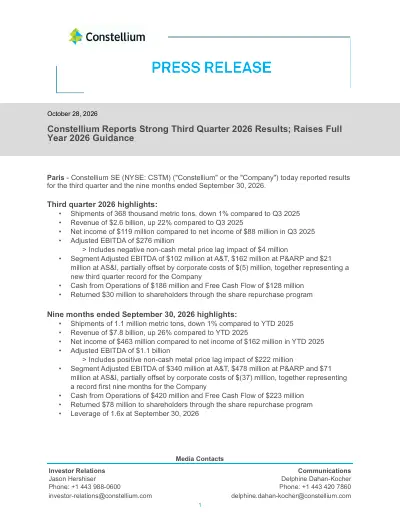
Our results this quarter were again ahead of our own expectations, despite ongoing macroeconomic and geopolitical uncertainties. Shipments were 368,000 tonnes in the third quarter, as higher shipments in A&T were offset by lower shipments in PARP and AS&I compared to last year.
Revenue of $2.6 billion increased 22% compared to the third quarter of 2025 due to higher revenue per tonne, including higher metal prices. Remember, while our revenues are affected by changes in metal prices, we operate a pass-through business model, which reduces our exposure to metal price risk.
Our net income was $119 million in the quarter, compared to net income of $88 million in the third quarter last year. The main driver of the increase was higher gross profit in the quarter versus last year.
Compared to the third quarter last year, adjusted EBITDA increased 17% to $276 million in the third quarter this year, though this includes a negative non-cash impact from metal price lag of $4 million. If we exclude the impact of metal price lag, which as you know is the way we view the real economic performance of our business, we achieved an adjusted EBITDA of $280 million in the quarter.
This represents a third quarter quarter record for the company and is up 43% versus the $196 million in the third quarter last year. Our free cash flow was $128 million in the quarter, and during the quarter, we returned $30 million to shareholders through the repurchase of 1 million shares.
We ended the quarter with leverage at 1.6 times. Now let's turn to slide eight and focus our A&T segment performance.
Adjusted EBITDA of $102 million increased 13% compared to the third quarter last year and represents a new third quarter record for A&T. Volume was a tailwind of $34 million due to higher shipments in both aerospace and TID.
Aerospace shipments were up 10% in the quarter versus last year as a result of improved demand. TID shipments were up 24% versus last year due to an improved market environment, including increased demand from onshoring in the US.
Price and mix was a tailwind of $20 million, mostly due to improved contractual and spot pricing in aerospace and TID. Costs were a headwind of $40 million, primarily as a result of higher operating and metal costs given higher activity levels.
FX and other was a headwind of $2 million in the quarter due to a stronger US dollar. Now turn to slide nine and let's focus our PARP segment performance.
Adjusted EBITDA of $162 million increased 98% compared to the third quarter last year, and also represents a new third quarter record for PARP. Volume was a headwind of $7 million in the quarter, as automotive shipments, higher automotive shipments were more than offset by lower packaging shipments.
Packaging shipments decreased 7% in the quarter versus last year, though underlying can sheet demand remained healthy in both North America and Europe. Automotive shipments increased 9% in the quarter as we benefited from the supply shortages in North America of aluminum automotive body sheet, though to a lesser extent than in the first half of the year.
Price and mix was a tailwind of $18 million as a result of improved pricing and favorable mix in the quarter. Costs were a tailwind of $70 million, which includes lower metal costs given favorable scrap spreads, higher aluminum price environment, and higher throughput and improved productivity in our recycling operations.
FX and other was a headwind of $1 million in the quarter. Now turn to slide 10, let's focus on the AS&I segment.
Adjusted EBITDA of $21 million decreased 36% compared to the third quarter last year. Volume was a headwind of $6 million on lower shipments of both automotive and industry extruded products.
Price and mix was a $23 million headwind in the quarter. As a reminder, the third quarter last year included a large net customer compensation for underperformance of an automotive program, which did not repeat this year.
Costs were a tailwind of $18 million primarily due to lower operating costs. FX and other was a headwind of $1 million in the quarter.
It is not on the slide here, but our Holdings and Corporate expense was $5 million in the quarter. Holdings and Corporate expense was down $4 million from last year, mainly due to timing of accrual of certain labor costs and favorable foreign exchange translation.
For the full year in 2026, we still expect Holdings and Corporate expense to run at approximately $55 million. It is also not on the slide here, but I wanted to summarize the current cost environment we're facing.
As we operate a pass-through business model, we're not materially exposed to changes in the market price of primary aluminum, our largest costing input. On other metal costs, which includes our recycling profits, we continue to benefit from the current market dynamics in the third quarter, including the highly favorable scrap and metal price environment in the US.
Looking at the remainder of the year, our scrap needs are locked in at favorable spreads, though metal prices have decreased compared to the elevated levels we experienced earlier in the year. It is important to bear in mind that recycling is core to what we do as it takes significant amount of investments and know-how, and we're focused on making the best out of the current favorable conditions and delivering exceptional returns on our recycling investments for our shareholders.
Moving on from metal costs, inflationary pressures continue today across multiple operating cost categories, including labor, energy, maintenance, and supplies, albeit at more normal levels. As Ingrid mentioned previously, we're seeing some elevated inflationary pressures in other categories, such as freight, lubricants, and coatings, as a result of the conflict in the Middle East, though we still expect the net impact from this to be digestable at this stage.
Regarding tariffs, our AS&I business is impacted today by CBP's current application of the recent Section 338 tariffs on aluminum coming to the US from Canada. As with the impact from the existing tariffs in place today, we will look to mitigate the impact from Section 338 tariffs to the extent possible.
We believe at this stage our direct tariff exposure remains manageable. The indirect positive impacts from the tariffs have continued, including higher demand for US domestically produced aluminum products, a more favorable pricing environment supported by expensive imports, and improved recycling profits in the US.
Put it all together, we continue to believe that the current tariff and trade policies are net positive for us. Wrapping up on costs, we have demonstrated strong cost performance in the past and we're confident in our ability to maintain a right-sized cost structure for any environment.
Now let's turn to slide 11 and discuss our free cash flow. We generated $128 million of free cash flow in the third quarter, bringing our year-to-date total to $223 million.
The year-over-year increase in the first nine months is a result of higher segment adjusted EBITDA and lower CapEx, partially offset by an unfavorable change in working capital and other, and higher cash taxes. Looking at 2026, we expect to generate free cash flow in excess of $300 million for the full year.
We expect CapEx to be approximately $330 million, unchanged from previous guidance. As a reminder, Cap- CapEx this year includes approximately $100 million of return-seeking CapEx, primarily related to key aerospace and recycling and casting projects we announced previously at Issoire, Muscle Shoals, and Ravenswood.
We expect cash interest of approximately $125 million and cash taxes of approximately $105 million, both in line with prior guidance. We expect working capital and other to be a larger use of cash for the full year than prior guidance, mainly due to the operating environment we are experiencing this year.
We expect to use the free cash flow generated this year primarily for debt reduction and for our share repurchase program. As mentioned previously, we continued our share buyback activities in the quarter.
During the quarter, we repurchased 1 million shares for $30 million, bringing our year-to-date total to 2.8 million shares for $78 million. Since we started the share repurchase program in 2024, we have repurchased 16.4 million shares for $272 million or around $16.60 per share.
As of the quarter end, we have approximately $257 million remaining in our current share repurchase program that expires in December 2028. Now let's turn to slide 12 and discuss our balance sheet and liquidity position.
At the end of the third quarter, our net debt of $1.7 billion was down $166 million compared to the end of 2025. We reduced our leverage to 1.6 times at the end of the quarter, which is near the low end of our target range.
We aim to maintain our target leverage range of 1.5 to 2.5 times over time. As you can see our debt summary, the earliest bond maturity we have is the 5.625% senior notes due June 2028.
As a reminder, in July, we proactively redeemed $100 million of those notes, leaving $225 million in aggregate principal outstanding. Our liquidity increased by $126 million from the end of 2025 and remains very strong at $992 million as of the end of the third quarter.
Last week, we amended our pan-US asset-based lending facility, which extended the maturity to 2031, reduced pricing, and increased the facility size from $550 million to $700 million, which should further enhance our overall liquidity position. With that, I'll now hand the call over to Ingrid.
Ingrid Joerg
Thank you, Jack. Let's turn to slide number 14 and discuss our end markets.
The majority of our portfolio today is serving end markets benefiting from durable and attractive secular growth trends in which aluminum, a light and infinitely recyclable material, plays a critical role. Turning first to the aerospace market, aerospace demand has improved this year and is running ahead of our expectations coming into the year.
Commercial aircraft backlogs are at record levels today and continue to grow. Major aerospace OEMs remain focused on increasing build rates for both narrow and wide-body aircraft.
This is evidenced by the higher plane deliveries year-over-year and rising delivery ambitions in the near term. As such, we believe that aluminum destocking in the supply chain is largely complete.
Demand for high-value-add products, which is one of our core focus areas, remains strong. We remain confident that the long-term fundamentals driving commercial aerospace demand continue to be intact, including growing passenger traffic and greater demand for new, more fuel-efficient aircraft.
In addition, demand for space and military aircraft is robust, and demand is growing in the business and regional jet market. We believe we are leading provider of proprietary aluminum solutions in the space and military aviation markets today.
As we are investing in additional capacities and capabilities, such as our third Airware casthouse in Issoire. We expect the casthouse to ramp up in 2027 and it will further strengthen our leadership position in the future.
Looking across our entire commercial and military aviation and space businesses, we believe our product portfolio is unmatched in the industry and we have industry-leading R&D capabilities for aluminum aerospace solutions. Turning now to TID, we believe TID markets in North America provide us with many opportunities today given the current tariffs make imports less competitive compared to domestic production.
You see this in our results so far this year. These include opportunities in land-based defense, semiconductor, infrastructure build, and commercial transportation, among other markets.
Defense is also beginning to ramp up in Europe while industry in Europe remains stable. As we are focused on niche, high value-added applications in most of these markets.
Turning now to packaging, demand remains healthy in both North America and Europe, and the long-term outlook for packaging continues to be favorable. This is supported by the growing consumer preference for the sustainable aluminum beverage can, capacity growth plans from the can makers in both regions, and the greenfield investments ongoing here in the US.
We continue to see aluminum gain share against other substrates in the beverage market, and the majority of new beverage products are launched in aluminum cans today due to its sustainable attributes. Aluminum cans are highly recyclable, and we are well-positioned to capitalize on the benefits from recycling packaging materials at our facilities in Muscle Shoals and Neuf-Brisach.
Packaging markets are relatively recession-resilient and stable growth, as we have seen in the past. Longer term, we continue to expect packaging markets to grow low to mid-single digits in both North America and Europe, providing a strong base load for operations in both regions.
Let's turn now to automotive, which continues to be a bit of a different story in North America versus Europe. In North America, demand is resilient despite uncertain macroeconomic and tariff environments.
Automotive demand in Europe remains weak, particularly in the premium vehicle segment where we have greater exposure. European markets are seeing increased Chinese competition today in the battery electric vehicle side, and European OEMs are also facing stiffer competition in Chinese auto markets.
Longer term, we believe electric and hybrid vehicles will continue to grow. Secular trends, such as lightweighting, fuel efficiency and safety, will continue to drive the demand for aluminum products.
As a result, we remain positive on this market over the longer term. Turning lastly to other markets in Europe, today we have a healthy outlook for select hard alloy extrusion markets and for rail, which for us includes power rail for mass transit and passenger rail cars.
Other specialties and soft alloy extrusion markets remain weak in Europe, and we are levered to the overall health of the industrial economy in Europe. To conclude on the end markets, we like the fundamentals in each of the markets we serve, and we strongly believe that the diversification of our end markets is an asset for the company in any environment.
Turning lastly now to slide number 15. I wanted to wrap up by giving you some color on what we see looking ahead to the rest of this year and into next year.
Even though the current macroeconomic and geopolitical landscape remains volatile, we have a strong track record of navigating and executing in any environment. Based on our strong performance in the third quarter and our current outlook, we are again raising our adjusted EBITDA guidance for 2026.
We are now targeting adjusted EBITDA, excluding the non-cash impact of metal price lag, in the range of $1.03 billion to $1.06 billion, and free cash flow in excess of $300 million. Our guidance assumes the recent demand trends in our end markets that I described earlier will continue, and the overall macroeconomic environment will remain relatively stable.
Our guidance also assumes normal seasonality in the fourth quarter, which was not the case last year, and includes typical plant outages and maintenance work across our facilities. Looking beyond this year, from a market standpoint, we expect growth in aerospace, TID and can sheet globally.
We expect automotive demand in North America to remain stable, and demand in automotive and other specialties in Europe to remain weak. On metal, we expect a healthy scrap environment in Europe and in North America, although potentially less favorable than record 2026, but difficult to predict at this stage.
We expect to harvest the benefits from our return-seeking investments, which are an important component of our growth for the next few years. As I mentioned previously, our recycling center in Neuf-Brisach continues to ramp up, and we expect to reach nominal capacity in the first half of 2027.
Customer qualifications are underway for our third Airware casthouse in Issoire, and we expect to begin commercial shipments in early 2027. We're making progress on the new casting center in Muscle Shoals, and expect it to start up mid-2027.
We are also investing in several debottlenecking opportunities where we see increased demand in the future, including additional plate capacity for aerospace, defense, and semiconductors, and coil capacity for transportation and packaging. Our Vision 2028 program is well underway, and we are focused on mitigating headwinds, such as inflationary pressures and tariffs.
Lastly, we are focused on balanced capital allocations, which similar to this year, include capital investments, [coughs] shareholder returns, and debt reduction. To conclude, we are extremely well-positioned for the long-term success.
I want to thank each of our Constellium team members for their relentless focus on execution, which continues to drive our strong performance. Our focus remains on executing our strategy and increasing shareholder value.
With that, operator, we will now open the Q&A session.
Operator
Thank you. As a reminder, to ask a question, please press star one one on your telephone and wait for your name to be announced.
To withdraw your question, please press star one one again. Once again, please press star one one and wait for your name to be announced.
To withdraw your question, please press star one one again. We are now going to proceed with our first question.
The questions come from the line of Corinne Blanchard from Deutsche Bank. Please ask your question.
Corinne Blanchard
Hi, good morning. Thank you for the time and taking my question.
Look, I know that you have actually unpacked quite a lot already in the commentary, but one thing I want to try to come back could be on the 4Q implied EBITDA, since a little soft versus consensus number out there. Can you go into more detail about what are the main drivers?
Then maybe what can play on the upside and then what can go wrong and even be a little bit more negative. Then the second question would be, how do we think about 2027?
Maybe focus on the core business. I know you will get a lot of questions on the scrap spray, but maybe if we just focus on the core business, especially aerospace, volume and pricing, and where you see opportunity for next year.
Thank you.
Ingrid Joerg
Thank you, Corinne. I start with Q4 and then I let Jack complete.
As our Q4 last year was exceptionally strong. If we think about Q4 this year, it's still an excellent quarter for us historically speaking.
We generally have 55% to 60% of our EBITDA in the first half of the year, and this year is no exception to that. I would say that rather last year was a little bit unusual.
We have our typical seasonality in our business. We have year-end maintenance work scheduled.
We also moved one of our recycling outages from the summer to Q4 this year because of the strong demand that we had in the third quarter. We also see that automotive benefits from the Oswego outage are tapering off in Q4 today.
Then we have additional headwinds on Section 338 tariffs in Q4 that were not or almost no impact in Q3. I think if you put all of that together, we think markets are still good.
Our performance is still very good. Our recycling performance from a volume perspective is going to be a little bit lower because we have outages and we will use less UBCs in the mix of scrap.
These are really the main drivers that we have in the fourth quarter and I think from a market perspective and customer perspective, it's still going to be a good quarter.
Jack Guo
The only thing I would like to add is we do have more headquarters spending planned for Q4 especially compared to Q3, and here you don't have to read too much into it. It's just timing of the spend.
We had always planned for the H&C cost to be $55 million for the full year.
Corinne Blanchard
Right, thank you. Then maybe going into '27, that question about the core business, and if you can touch on aerospace, destocking is done.
Do you see restocking happening? What do you see for volume and pricing?
This has been your strongest segment and I think where the market is excited about for next year for you guys. Maybe TID, if you get any color that you can give us, that would be helpful.
Ingrid Joerg
Yep, I will. Thank you, Corinne.
I start with markets and then also tie it to the investments that we have in the pipeline. From a market perspective, I start with aerospace.
We have commercial aviation, we have military jets, we have the business and regional jet segment. We are present in all segments of the market and really have a global presence in aerospace, which is why we can benefit from many different market segments.
If we listen to our customers and their ambitions to increase build rates, we expect next year to be significantly stronger than this year. We know that capacity is going to be tight next year, which is also supportive from a pricing perspective and we are going to reprice some of our aerospace contracts next year.
That is going to be a positive for 2027, I would say. Space continues to be strong.
Then, obviously, we have our new Airware casthouse coming. We expect to start commercial shipments at the beginning of 2027.
Customer qualifications are underway right now, and we expect to ramp that gradually throughout the year, which is also going to be supportive for higher value-add portion in our aerospace segment. On the TID market, particularly North America is doing well.
We expect finally recovery in the transportation segment. The build rates are projected to increase quite significantly for next year, and we see the much-talked-about semiconductor infrastructure build finally arriving.
Plate demand for semiconductor is going to be strong as well as of next year and will continue. We see the same impact in Europe, although the industry is obviously smaller than in the US.
European plate markets are also tightening now because of higher defense, a strong semiconductor, and good demand for the specialty products that we make in our European facilities. I think that's also a highlight on the European side.
Then packaging markets are expected to remain healthy both in North America and Europe. If you look at what our can sheet customers are reporting in terms of growth, it continues to be positive.
Then on automotive, as we said before, we have limited capacity in the US. We expect to be running at full capacity in the US, and then Europe remains weak, and I think it's unclear where this market is going to turn.
We'll have to continue to watch that. Also, some positives on the extrusion side in Europe, particularly for hard alloys extrusions, and then the rail business continues to grow on the European side as well.
I think from a market perspective, we feel pretty confident as we go into 2027. Then we will benefit from the investments.
We talked about Neuf-Brisach is going to fully ramp up, we will have more recycling volume next year. Airware is going to be a very nice growth project for us.
Then we have the new casting center in Muscle Shoals that will start up mid of 2027, which will continue to help us on increasing our recycling volumes. Then we also have debottlenecking activities.
Obviously, we want to follow our markets, we are planning for more plate capacity and also more coil capacity for transportation and packaging. I think from a market outlook, we feel pretty good about 2027 and I let Jack complete if he wants to add something to that.
Jack Guo
No, I think that was great.
Corinne Blanchard
Thank you so much.
Operator
We are now going to proceed with our next question. The questions come from the line of Katja Jancic from BMO Capital Markets.
Please ask your question.
Katja Jancic
Hi, thank you for taking my questions. Maybe going back to the prior question, more specifically, you talked about multiple return-seeking investments starting to benefit your results.
Can you talk a bit more about maybe providing some quantitative data on how much these investments could add over the next year or two to your EBITDA?
Jack Guo
Maybe I'll start. Katja, good morning.
I think the way to think about is we have a hurdle rate of 15% and our capital is scarce, right? We typically don't like to invest in projects unless returns are higher than our hurdle rate.
If you look at Airware investments, this is one of our highest margin products. You would expect the returns to be quite a bit higher than our hurdle rate.
Then the way to kind of think about the size of the benefits, we had disclosed previously the CapEx amount, which was 40 $45-ish million of CapEx. By the way, we do have quite expensive working capital needs for the startup.
That would be the total size of the investment for the Airware casthouse, and you can make your assumptions on what the return should be, and I think you'll get a pretty good directional indication on what the size of the benefit is. Similarly you can do that with the recycling center that continues to ramp up in Europe, as well as for the casting center which will start up at Muscle Shoals in the middle of 2027.
Katja Jancic
Maybe just to follow up on the recycling center, what is the current utilization or how much more does it have to ramp up?
Ingrid Joerg
I think we will exit the year around 80% of utilization, and then we'll gradually in the first half of the year get to full capacity.
Katja Jancic
Thank you.
Ingrid Joerg
I would just like to add, Katja, we also have the debottlenecking activities. Some of them are related to CapEx projects as well.
These tend to be smaller projects, which is why we're not spelling them out, but those are also going to happen between now and let's say the next few years. Don't expect everything to come in 2027, but they are quite attractive as well from a payback perspective.
Operator
We are now going to proceed with our next question. The questions come from the line of Bill Peterson from JPMorgan.
Please ask your question.
Bill Peterson
Hi. Good morning and thanks for taking the questions, and nice job on the quarterly execution.
Sorry to come back to the fourth quarter guide, but if I just look at it from a year-on-year basis, it's down $20 million I believe at the midpoint, high single digits year-on-year. Can you help us understand at least in areas things like shipments, taking into account the downtime you spoke to, as well as mix and of course the metal impacts.
I think last year you really started seeing the benefits of scrap spreads. Should we figure that as just effectively normalized in your year-on-year?
Just anything else you can help us understand from a year-on-year perspective.
Ingrid Joerg
I think I start. From a market perspective, I think you have an impact of lower automotive because some of the Oswego benefit is starting to go away, and then as we have quite significant seasonality in that business.
If you think about December being a half month of shipments, that's something that you have to take into account. I think the comparison to Q4 2025 is a little bit flawed in the sense that this was really an exceptional quarter for us.
We talked a little bit about the additional tariffs on Section 338 and the higher headquarter cost, which is really just a phasing issue. These are I would say the things that impact outside of the metal environment.
There's really nothing to be concerned about for the start into 2027.
Bill Peterson
All right, thanks for that. Then I think you spoke near the end of the prepared remarks about several debottlenecking opportunities, plate capacity, coil capacity, and so forth.
Can you discuss the associated CapEx or any costs with these investments as well as the potential uplift in terms of shipments, profitability, or other metrics?
Ingrid Joerg
I think we don't spell them out because they are many many small projects at the same time. I think there was one project that is a little bit larger that is actually already behind us from a CapEx perspective, which is a plate finishing line in Issoire, which is providing us with more capacity.
We are ramping that up already as we speak. I think if you put everything together, you're talking a couple million here and there, nothing really significant.
Nothing that you would see in our full CapEx forecasts.
Bill Peterson
Yes.
Ingrid Joerg
From a capacity perspective, I think about the next several years adding something like 20 up to a 20% additional plate capacity, split between aerospace, defense, semiconductor, and so on. Obviously, this will depend a little bit on the mix of products that we are selling, but that's the kind of range you should be thinking about.
Bill Peterson
Thank you.
Operator
We are now going to proceed with our next question. The questions come from the line of Timna Tanners from Wells Fargo.
Please ask your question.
Timna Tanners
Yeah. Hey, good morning.
I wanted to ask a little bit more, I know you referred to the restart of Oswego impacting of course the unusually strong auto environment in the US, but broadly speaking, between Oswego, Bay Minette, and ADA, can you give us an update on any impact you're seeing to scrap availability and any impact on your volumes beyond stated already?
Ingrid Joerg
Thank you, Timna. Hello.
Far we haven't really seen any impact. As I said, I think on automotive through this crisis, we have also gained additional qualifications.
We've broadened and diversified our customer base and the products that we can supply, we do not expect any negative impact on automotive from either Bay Minette nor ADA.
Timna Tanners
On scrap availability, are you still able to get pretty good amount of low-priced scrap to supplement your needs?
Ingrid Joerg
Yes, Timna. I think we see sufficient availability of scrap in the market, both in the US and in Europe.
Europe recycling rates continue to go up because of deposits and deposit legislation in many countries, and given that we will have more capacity next year, we'll also recycle more volume. In other words, if scrap spreads were less beneficial than the record 2026, we have other things to offset some of that potential change in pricing.
Timna Tanners
That's helpful. Thanks.
Then, I wanted to ask on packaging and auto. Packaging in the US, one of your competitors was talking about some destocking into year-end, but I didn't hear you mention that.
I just wanted to confirm that packaging demand was solid in the US. Then switching to auto in Europe, you didn't really tout the new restrictions on EV imports and I'm wondering if you think that that could be a positive from already pretty tough conditions on European automotive.
Ingrid Joerg
Yep, sure. Thank you.
I start with your last question. The restrictions of imports, it's really a cap on the number of cars battery electric vehicles and hybrid plug-ins that can come into the country.
It's set at 350,000 per year max. Then there is a small growth rate of 6% after the first four years implemented, and then there will also be a component of made in Europe which should potentially help the European market.
We also know that France and Germany have now agreed to extend the emission standards so that you don't need to be net zero by 30 2035, but you can be 90% of net zero, to speak. This is also going to help the European OEMs because they're heavily penalized for not reaching their CO2 rates.
I think all of that is positive. I think it's very difficult to predict of when we will see a positive impact from it, but it's certainly going to be positive because Chinese BEVs tend to have less aluminum content than other platforms do, and I think the made in Europe component is certainly going to be supportive for more European production.
I think all of this is completely new, it's difficult to put it into numbers of what could it mean for us. Okay.
Sorry, your first question was?
Timna Tanners
Just on the packaging, that's helpful.
Ingrid Joerg
Yeah. Packaging in the US, you know that during the Oswego outage, customers were quite concerned of not finding sufficient metal in the market because the market was strong and there wasn't sufficient supply.
If you look at import statistics for can sheet, we had a huge surge in imports. In fact, can sheet imports this year by the end of August were already 350,000 tonnes, and a big chunk of that came from South Korea, Germany, and China.
China pricing is absolutely unattractive at this point in time because of the tariff situation. The surge in imports is clearly an impact from the Oswego outage.
We saw July, August already coming down. You have to think that you have to order your metal well in advance, and when you have uncertainty in the market of whether you will get sufficient supply or not, you usually overorder a little bit.
I think what we are seeing right now is maybe a little bit of inventory overhang, but I think it should be digestible. We actually saw July and August import numbers already coming down, the peak is behind us and I just expect that to normalize pretty soon again.
Timna Tanners
Super helpful. If I could just a final one, I wanted to just ask high-level, the higher guidance, what was it that you didn't anticipate when you gave us last guidance, I guess on your Q2 call, that has come to light since then that led to the increases?
What was it that kind of caught you by surprise positively?
Ingrid Joerg
I think certainly we always knew that aerospace was and TID were going to ramp. Semiconductor has been talked about that for a very long period of time, defense has been talked for a long period of time, but the timing of that is always a little bit difficult to predict, and I think that was potentially a positive.
Jack Guo
Yes, so that's important factor. Aerospace business performed exceptionally well with favorable mix and so we had better price and mix out of A&T compared to our expectations coming into the quarter.
Then the other bucket, it's not actually better performance of metal results, believe it or not. They were very favorable, but within our expectations.
The other bucket is just focus on operational excellence, productivity, and cost control. When you operate well, when you have higher levels of productivity, where we actually set several production records in the quarter, it does help to optimize the cost structure, the variable cost structure, and we're super focused on incremental kind of fixed cost reduction.
That was better than what we had expected coming into the quarter.
Timna Tanners
Okay. Thank you, again.
Appreciate it.
Operator
We are now going to proceed with our next question. The questions come from the line of Richard Garchitorena from Barclays.
Please ask your question.
Richard Garchitorena
Great, thanks. Good morning, Ingrid and Jack, and congrats on the quarter.
First question, just wanted to ask on the cost guidance. You'd talked about basically locking in power contracts for 2027.
Maybe if you could talk about sort of what are the inflationary impacts we should be worried about or concerned that maybe could come up that could impact next year versus this year?
Ingrid Joerg
I start and then I let Jack help me. I think we see a little bit higher inflation at this point in time.
I think it's manageable. I think it's digestible.
It's a general inflationary pressure that we are seeing, I think both in North America and in Europe. Some of our contracts have pass-throughs or partial pass-throughs of inflation, we are not overly concerned about this.
Then I think from an energy perspective, we have our multi-year hedging program. Obviously we are fully hedged for '26, but we are also quite well-hedged for '27 and also beyond.
I think all of that cost pressure, I think is manageable for us.
Jack Guo
I completely agree. I think, outside of metal, our biggest cost bucket is labor and labor inflation is not going away, right?
It accumulates every year. One of the reasons why we launched Vision 2028 program is to kind of create cost savings to help offset the inflationary pressures.
Richard Garchitorena
Great. Thank you.
Then, yeah, just on that Vision 2028, just wanted to revisit in terms of how much of the improvement in the guide increase for this year is related to the efficiencies that you've been able to push through versus a stronger than expected market? Then the EBITDA guide of 900 million obviously you're above that.
How should we think about that? Is that something that needs to be raised or are there other puts and takes there?
Ingrid Joerg
I think in terms of cost for this year, you will not see much impact from Vision 2028. You see some cost reductions, structural cost reductions, particularly where markets are weak, like in our AS&I segment.
You will see some cost reductions from better efficiencies because when we are well-loaded, obviously we have a better cost position. Vision 2028 is really a program targeted at improving our asset utilization, not just fixed cost reduction.
It's broader than previous programs that we did, and I think we're well underway in terms of putting the action items in place, but I think in terms of benefits, you only see a partial benefit this year.
Richard Garchitorena
Great, thank you.
Operator
We have no further questions at this time, I'll now hand back to Ingrid Joerg, CEO, for closing remarks.
Ingrid Joerg
Thank you. Thanks everyone for your interest in Constellium and joining us today.
As you can see, the momentum from the first half continued in the third quarter this year. We delivered record performance in the first nine months and we again increased our outlook for 2026.
We look forward to updating you on our progress in February and thank you again. Have a nice day.
Operator
This concludes today's conference call. Thank you all for participating.
You may now disconnect your lines. Thank you.