Capital Southwest Corporation
Q2 FY2027 · Earnings Call TranscriptNovember 3, 2026
Operator
Thank you for joining today's Capital Southwest second quarter fiscal year 2027 earnings call. Participating on the call today are Michael Sarner, Chief Executive Officer; Chris Rehberger, Chief Financial Officer; Josh Weinstein, Chief Investment Officer; Amy Baker, Executive Vice President of Accounting; and Morganne Stewart, Director of Communications.
I will now turn the call over to Morganne.
Morganne Stewart
Thank you. I would like to remind everyone that in this call, we will be making certain forward-looking statements.
These statements are based on current conditions, currently available information, and management's expectations, assumptions, and beliefs. They are not guarantees of future results and are subject to numerous risks, uncertainties, and assumptions that could cause actual results to differ materially from such statements.
For information concerning these risks and uncertainties, see Capital Southwest's publicly available filings with the SEC. The company does not undertake any obligation to update or revise any forward-looking statements, whether as a result of new information, future events, changing circumstances, or any other reason after the date of this press release, except as required by law.
I will now hand the call over to our President and Chief Executive Officer, Michael Sarner.
Michael Sarner
Thanks, Morgan. Thank you, everyone, for joining us for our second quarter fiscal year 2027 earnings call.
We are pleased to be with you today and look forward to discussing our results for the quarter. Our portfolio continued to deliver consistent results during the second fiscal quarter.
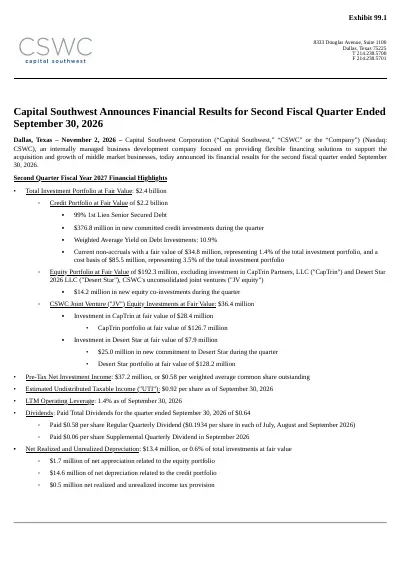
We generated pre-tax net investment income of 58 cents per share, which was supported by strong recurring earnings. Our undistributed taxable income balance remains robust at 92 cents per share, reflecting consistent realization activity.
We remain confident in our ability to continue covering both our regular and supplemental dividends through the earnings power of the portfolio. Our Board of Directors has declared a 58 cents per share regular dividend for the December quarter, paid out monthly over October, November, and December 2026.
They have also declared a quarterly supplemental dividend of 6 cents per share, payable in December, bringing total dividends declared for the third fiscal quarter to 64 cents per share. Deal flow in the lower middle market has been robust.
The quarter was exceptionally active on the origination front, driven by both the strength of our sponsor relationships and the continued growth of our investment team. We closed a record $391 million in total new commitments across 14 new portfolio companies and 16 existing portfolio companies.
Our new portfolio companies this quarter span 11 industries, reflecting our ability to source deals across the lower middle market. For the new deals that closed during the September quarter, weighted average senior leverage was 3.4 times debt to EBITDA, and weighted average loan-to-value was 33%, providing a substantial equity cushion beneath our debt.
Our recent origination success has been supported by the sizable growth of our organization. Over the past 18 months, we have expanded our team from 27 to 46 employees, significantly increasing our sourcing and underwriting capacity.
CapTran, our strategic joint venture with Trinity Capital, has also broadened the range of opportunities we can competitively pursue. Together, these efforts have helped us build a substantially larger pipeline.
In fact, over the last 12 months, we have screened approximately 1,600 opportunities, up from 1,200 in fiscal year 2026 and 1,000 in fiscal year 2025. While our pipeline has grown, we remain highly selective, with a close rate below 2%.
We believe this reflects both our disciplined underwriting process and the depth of our relationships and sourcing capabilities in the lower middle market. Looking at the current macro lending environment, it seems more likely than not that we're heading back toward a higher-for-longer rate environment.
In a recent article, I discussed how a renewed rise in base rates could affect BDCs. The short answer is that higher rates aren't simply good or bad for BDC earnings.
Higher rates will certainly increase portfolio yields, but they can also put pressure on borrower cash flows and raise a BDC's own cost of capital. I think if rates move higher, you could see greater separation across the industry, with credit quality, portfolio company leverage, funding costs, and balance sheet liquidity becoming increasingly important differentiators.
For Capital Southwest, we believe we are well-positioned if rates move higher. Our assets are predominantly floating rate, much of our debt is fixed rate, and our portfolio companies have conservative leverage of approximately 3.7 times.
We have also gained experience and insight from navigating the previous rate cycle, when SOFR rose above 5.5%, and saw firsthand how our lower middle market portfolio performed. While every rate cycle is different, we believe the combination of our asset sensitivity, liability structure, and conservative portfolio leverage positions us well if base rates move higher.
Beyond our core balance sheet activity, we continue to broaden the ways we access attractive investment opportunities. This quarter, we partnered with Trinity Capital to form Desert Star, our second joint venture together, with a $25 million equity commitment.
Desert Star gives us access to technology lending market, allowing us to gain exposure through a granular portfolio of investments in an area where we have not historically focused. We expect to deploy our equity commitment over several years, as we take a measured approach to investing in this area of the market.
Turning to our capital structure, we significantly strengthened our balance sheet during the quarter. We issued $350 million of five-year unsecured notes and amended, extended, and upsized our corporate credit facility.
This amendment meaningfully reduced our cost of capital while providing additional capacity and flexibility to support future growth. Following these transactions, we have no debt maturities until 2029.
In connection with the unsecured note issuance, we also entered into our first interest rate swap. Chris will provide more detail on these activities in his remarks.
Rounding out a solid quarter, we raised $67 million in gross equity proceeds through our ATM program. Our ability to access this program continues to be a meaningful competitive advantage for Capital Southwest.
In a market where fewer publicly traded BDCs are trading above book value, our improved price-to-book valuation gives us a differentiated ability to raise growth capital that is accretive to NAV and supportive of long-term shareholder value. I will now hand the call over to Josh to review more specifics of our investment activity.
Josh Weinstein
Thanks, Michael. As previously mentioned, this quarter, we deployed a total of $391 million across new and existing portfolio companies.
This consisted of $314 million of first lien senior secured debt and $13 million of equity across 14 new portfolio companies. Across 16 existing portfolio companies, we invested $63 million in first lien senior secured debt and $1 million in equity this quarter.
Additionally, during the quarter, we generated $74 million of proceeds from portfolio company exits at a weighted average IRR of 14.5%. Our credit portfolio ended the quarter at $2.2 billion, representing 28% year-over-year growth from $1.7 billion as of September 2025.
Importantly, 100% of new portfolio company debt originations were first lien senior secured, and as of quarter-end, 99% of the credit portfolio remained first lien senior secured, with a weighted average exposure per company of only 0.8%. This level of portfolio granularity reflects our disciplined approach to risk management as we continue to scale the balance sheet.
The vast majority of our deal activity continues to be first lien senior secured loans to private equity-backed companies. Approximately 92% of our credit portfolio is sponsor-backed, which provides strong governance, operational support, and when needed, the potential for junior capital.
In the lower middle market, we frequently have the opportunity to invest in our portfolio companies' equity. When the thesis is compelling, we take a minority position pari passu alongside the private equity sponsor.
As of quarter-end, our equity co-investment portfolio consisted of 102 investments with a total fair value of $192 million, representing 8% of our total portfolio. This equity portfolio was marked at 120% of our cost, representing $31.6 million of embedded unrealized appreciation, or 48 cents per share.
These positions continue to give our shareholders meaningful upside participation in growing lower middle market businesses, driven by both operational improvements and strategic add-on acquisitions. Our market remains competitive, with both bank and non-bank lenders continuing to pursue high-quality opportunities.
While that competition has resulted in tighter pricing over the past several years, we have begun to see spreads widen over the past few quarters. New originations this quarter had a weighted average spread of 6.5%.
Despite the competitive environment, the depth of our sponsor relationships and the continued growth of our investment team are expanding the opportunities we are able to originate. Since launching our credit strategy in 2015, we have completed transactions with more than 145 private equity firms nationwide.
Over the last 12 months alone, we have closed new platform investments with 22 sponsors with whom we had not previously partnered. We believe the breadth and continued expansion of those relationships position us well to source attractive opportunities while remaining highly selective.
Our portfolio now consists of 153 companies, comprised of 89.4% to first lien senior secured debt, 1% to second lien senior secured debt, 8% to equity co-investments, and 1.5% to joint ventures. The credit portfolio generated a weighted average yield of 10.9%, with a weighted average leverage through our security of 3.7 times EBITDA.
At origination, all loans are initially assigned an investment rating of 2 on a five-point scale, with 1 being the highest rating and 5 being the lowest. At quarter-end, 89% of the portfolio at fair value was rated a 1 or 2.
Cash flow coverage has also continued to improve, increasing to 3.5 times from a low of 2.9 times during the peak of base rates. We remain pleased with the overall performance of the portfolio and believe it remains well-positioned as we continue to grow.
I will now hand the call over to Chris to review the specifics of our financial performance for the quarter.
Chris Rehberger
Thanks, Josh. Specifics to our performance for the quarter: pre-tax net investment income was $37.2 million, or 58 cents per share.
For the quarter, total investment income increased to $67.2 million from $61 million in the prior quarter. The increase was primarily driven by a $4.6 million increase in cash interest income, coupled with an increase of $1 million in fees and other income.
The increase in fee income was driven by increased arranger fees due to larger origination volumes than in the prior quarter. Importantly, PIK as a percentage of total investment income decreased to 7.4% from 8% in the prior quarter.
On the expense side, G&A increased by approximately $400,000 from the prior quarter. This increase was driven entirely by proxy solicitation expenses related to our shareholder vote on increasing our authorized shares, which is a non-recurring item.
As of the end of the quarter, our loans on non-accrual represented 1.4% of our investment portfolio at fair value, compared to 1.1% at the end of the prior quarter. We continue to demonstrate strong dividend coverage, with 109% cumulative coverage since launching our credit strategy.
Our UTI balance increased to 92 cents per share this quarter from 87 cents per share in the June quarter. In addition, we continue to hold significant unrealized appreciation across our equity portfolio.
As a result, we remain confident in our ability to grow our UTI balance and continue paying quarterly supplemental dividends over time. LTM operating leverage ended the quarter at 1.4%, a meaningful improvement from the 1.6% observed a year ago in September 2025.
Notably, this improvement occurred despite adding 14 employees over the last 12 months. Going forward, we expect to continue to add resources to our team while maintaining operating leverage in the 1.4% to 1.5% range.
Our operating leverage remains significantly better than the BDC industry median of approximately 2.5%, underscoring the inherent efficiency of the internally managed BDC model. NAV per share increased to $16.64 per share, up from $16.61 per share in the prior quarter.
The primary driver of the increase in NAV per share was accretion from our equity ATM program, partially offset by net realized and unrealized depreciation on the investment portfolio. As Michael mentioned earlier, during the quarter, we amended our corporate credit facility, which increased total commitments to $595 million from $510 million, reduced our borrowing applicable margin to 2% from 2.15%, removed the incremental SOFR adjustment of 10 to 15 basis points, and extended the maturity to September 2031 from August 2028.
As a result, our earliest debt maturity is now in 2029, providing us with greater long-term funding certainty. Additionally, we raised $350 million in new unsecured bonds, bearing 6.75% fixed interest and maturing in September 2031.
In conjunction with the unsecured bond offering, we entered into an interest rate hedge, which effectively swaps the September 2031 notes to SOFR plus a 2.16% spread. Finally, we raised approximately $67 million in gross equity proceeds during the quarter through our equity ATM program at a weighted average share price of $24.50 per share, or 148% of the prevailing NAV per share, reinforcing our ability to raise capital efficiently and accretively.
Our liquidity position remains robust, with approximately $647 million in cash and undrawn commitments across our two credit facilities. In total, this represents more than 1.6 times coverage of the $394 million in unfunded commitments across the portfolio.
During the quarter, we also received approval to increase our available leverage in the SBIC II fund to $250 million, providing additional flexibility beyond our current $175 million commitment. The SBA program continues to be an attractive source of capital for us, offering both a competitive cost of funds and reliable, long-term liquidity to support portfolio growth.
Regulatory leverage ended the quarter at 1 to 1 debt-to-equity. We'll continue to raise secured and unsecured debt capital, as well as equity through our ATM program, in a methodical and opportunistic manner to ensure we maintain significant liquidity and a conservatively constructed balance sheet with adequate covenant cushions.
Finally, we continue to make meaningful progress with CapTran Partners, one of our joint ventures with Trinity Capital. The JV currently holds approximately $127 million in first lien securities in 14 portfolio companies, with a weighted average leverage of 1.3 times debt to EBITDA.
We expect to continue originating low-leverage, high-quality investments within this structure. I'll now hand the call back to Michael for some final comments.
Michael Sarner
Thank you, Chris, Josh, Amy, and Morganne, and all the employees who help us tell the story on a quarterly basis. Thank you, everyone, for joining us today.
This concludes our prepared remarks. Operator, we are ready to open the lines up for Q&A.
Operator
Thank you. To ask a question, you will need to press star one one on your telephone and wait for your name to be announced.
To withdraw your question, please press star one one again. Please stand by while we compile the Q&A roster.
Our first question comes from Mickey Schleien of Clear Street. Your line is open.
Mickey Schleien
Yes, good morning, everyone, and thank you for taking my questions. Michael, you recorded about $15 million of unrealized depreciation on debt investments, if I'm not mistaken.
Which individual investments were the main drivers, and was that primarily borrower-specific or indicative of some broader credit deterioration?
Michael Sarner
Thanks for the question, Mickey. There's essentially three companies that are on our watch list that had significant depreciation during the quarter.
One's a car wash business that you're probably familiar with that had gone through bankruptcy, has come out of bankruptcy, and I think cyclicality related to inflation is still harming that business. Probably the balance sheet's probably still a little overleveraged where it is, we'll see how that lands.
There's a roofing business that was a roll-up strategy. I think the execution on that has had some hiccups, and they're trying to course correct that.
Then the other one is an older name that's been on non-accrual for a while in the post-production CGI in the entertainment industry, and that's sort of a 2021 deal that had basically COVID issues that based on elevated EBITDA coming out of COVID. I think they're all fairly idiosyncratic from one another.
Those three, I think, had about $10 million of the depreciation for the quarter, and the rest of it was really immaterial.
Mickey Schleien
That's really helpful. I think in your prepared remarks, you talked about the potential for interest rate increases, and I agree that every cycle is different.
Could you give us a sense of how concerned you are about borrowers at the tail end of your portfolio? Averages and medians are interesting, but the problems are at the tail end if the forward curve turns out to be correct and the Fed tightens several more times.
Michael Sarner
I think I'd answer the question just kind of going back to where we were when rates were 5.5%. Our interest coverage across the portfolio, I understand we're talking about sort of an in detail perspective, it got down to 2.9 times, where it is 3.5 times today.
I also think the strength of the portfolio today where it was then, we have lower non-accruals than we did going into that cycle. I think our portfolio loan-to-values are lower.
You look at the deals we just did this quarter, which is almost $400 million that were at 3.4 times and 33% loan-to-value. I would just tell you, I think that our portfolio, on top of that, the granularity that resides in the portfolio at about 76 basis points, I think we're better prepared for a higher rate cycle now than we were going into the last cycle, and we came out of that pretty clean, I would say.
Mickey Schleien
Thank you for that. A couple more, if I can.
You had record originations, and balance sheet leverage is now 1.25 on a debt-to-equity basis. Given your current pipeline and available liquidity, how should we think about investment activity going forward, and what's your target debt-to-equity ratio on the balance sheet?
Michael Sarner
I think from an origination activity, I think we're historically before the growth in our investment team, which I think we cited on the call has grown 40% over the last 24 months, a lot of those are senior individuals. I think our total originations quarter, it's going to grow from where it was, $150 million-ish a quarter to something closer to 250 a quarter.
The other question was how much on the equity ratio?
Chris Rehberger
Mickey, I'll take the second question. Leverage, we typically look at on a regulatory basis, and so we've said in the past our target is 0.9 to 1 times regulatory, we're certainly at the top end of that range.
I wouldn't expect it to go above that. Part of the reason for that this quarter is obviously we were seeking shareholder approval for our authorized shares.
We didn't get that until September, actually, I think we did a really good job raising $67 million of equity in about a month. The other thing I would say is we are expecting a repayment cycle in this December quarter, which we hadn't seen in a few quarters.
You should think about leverage kind of moderating in the 0.9 to 1 times range, regulatory leverage going forward.
Michael Sarner
Over the last three quarters, I think we saw maybe $100 million of repayments, and we would expect that number to be maybe twice as much just in the 12/31 quarter alone.
Mickey Schleien
Okay. Lastly, and I appreciate your patience, with CapTran continuing to grow and now the launch of Desert Star, how meaningful could these JVs become to earnings over the next maybe year?
What returns are you targeting on your invested equity in those ventures, and how should we think about the timing of dividend income from them?
Michael Sarner
Sure. Let me reframe it.
These two different JVs probably for two different purposes. Obviously, CapTran is really a strategic venture, which allows us to be more competitive in deals that are sub-6%.
That fund, we think since it's originating our core assets, is going to grow over time. I think that we expect probably a mid-teens return as the manager in that fund.
I think the fund itself is about 13%, but we are getting scrape and some fees associated with it. Desert Star, on the other hand, whereas we are the sourcing, originating, and managing the assets for CapTran, the inverse is true for Desert Star, where Trinity is in that seat of originating the assets.
We've committed $25 million, which will be funded over the next three years, and we expect a return of somewhere in the same 14% to 16% return once that facility is fully ramped.
Chris Rehberger
For the earnings power, Mickey, what I would say is we've got $50 million in equity committed to the fund alongside Trinity's 50, 100 total. Probably going to take us 12 to 15 months to get that fully funded.
Ramp from what we have funded today, which is around $25 million, up to 50 over the next 12 months, generating, as Michael said, sort of a 13%, 14% return.
Mickey Schleien
That's really helpful.
Michael Sarner
The other thing I wanted to add, too, Desert Star, it's mostly going to be software deals. The question is, why are we doing that today?
If you look at what those deals look like in the market over the last two years, these are deals that were negative cash flow, negative EBITDA, they were being funded off of two to four times ARR. Not cash flow loans and not assets that we would frequent in.
That market has changed. I think since all the headline noise coming out of the last fall, there's less lenders in the market.
Deals today are all cash flow, I wouldn't say all, but the deals that we've seen are positive cash flow, positive EBITDA, they're one times ARR, full set of covenants. When we're thinking about the partnership, we believe we're pretty good at what we do is in the sponsor finance lower middle market, but we don't frequent with scale in software technology.
As underwriters, the more deals you look at, the better decisions you'll make. Our viewpoint is partnering with an expert in the field, which we consider Trinity an expert in the venture side, getting involved with them and having a small investment of granular size is a measured approach to investing in that industry without taking excess risk.
Mickey Schleien
If I could just follow up, you said those deals are going to be primarily cash flow positive. There's been a lot of talk about the impact of AI on these companies and the argument that small software companies are particularly at risk because it's just so hard for them to build a moat.
Can you give us a sense at least as to the scale of these businesses in terms of the EBITDA you're targeting?
Josh Weinstein
It's really across the board in the lower middle market to the middle market. Trinity typically in those deals are doing businesses that are in the $5 to $25 million of EBITDA.
Mickey Schleien
These software technology deals would still fall into that range?
Josh Weinstein
Most of the deals will be directly originated by Trinity, not bigger club deals and syndicated deals.
Mickey Schleien
Okay. I appreciate your time, thanks for taking my questions.
Josh Weinstein
Thanks, Mickey.
Operator
Thank you. Our next question is from Melissa Wedel from UBS.
Your line is open.
Melissa Wedel
Good morning, thanks for taking my questions today. When I listen to what you've talked about with regard to the second JV, it really seems like, just sort of reading between the lines, you really want to keep those two groups of assets separate, and that's the rationale for two separate JVs rather than combining into one.
Is that fair?
Michael Sarner
Absolutely. Like I said, CapTran is a very strategic vehicle.
It is adding value to this organization because maybe I'll reframe it again is that between $5 and $8 million of EBITDA in the lower middle market is where we have real specialty. When deals get slightly larger and these are safer companies, they tend to price sub-6%, and those deals don't fit perfectly into our target ROE.
Having this JV allows us to compete and win on deals where we think that the spread should be below 6%, and we are able to create a structure, a first-out, last-out structure that provides the necessary yield. That in and of itself is the strategic venture that we're focused on with growth.
As you said, the $25 million investment into Desert Star is really just that, considered a single investment which has granular risk relative to the number of companies that'll be embedded within it.
Chris Rehberger
Maybe more directly, generally speaking, there's not going to be any crossover between the two joint ventures. Today, there actually is one asset, but going forward, we do expect them to be separate strategies and separate asset allocations.
Melissa Wedel
Thanks for clarifying that. I also had a follow-up on the comment that you made about expecting more of a repayment cycle in the fourth quarter.
I was hoping you could elaborate on that in terms of what's driving sort of elevated repayments that you expect in 4Q, and is that something that might be matched on the origination side?
Michael Sarner
I'd say this, we've seen two large originations come back, and large to us is a $30 to $40 million, and we're expecting a third of the same size towards the end of the quarter. Originations are going to be closer, I would imagine, to what I stated earlier, like a normal quarter for the amount of professionals we have scouring the nation, which is probably $250 million.
I'd probably ask Josh if you want to chime in on that.
Josh Weinstein
I think the lower middle market M&A activity is actually pretty good right now. I know that the middle market and upper middle market has been a lot less activity, and so some of that's just timing of some of the sale processes of portfolio companies of ours.
Melissa Wedel
Thank you.
Operator
Thank you. The next question is from Chris Muller with Citizens.
Your line is open.
Chris Muller
Hey, guys, thanks for taking the questions. I guess on the growth of the investment team, is there more hiring that you guys expect to do there?
When you guys bring new people onto the platform, how long does it typically take for them to fully ramp up?
Michael Sarner
I think the answer to your question, I do expect us to continue to hire people. I think one of the areas of growth that we've had over the last 18 months is in hiring and building a operations team, to work on deals that end up in our watch list, and that's been huge value add within the organization.
That's been a number of people. I think Josh mentioned, I believe, that we've hired two senior people as originators, and there's others that have come up through our system that are now firing on all cylinders, if you will.
I would expect us to continue to hire in the mid to the lower end. We probably staffed up our infrastructure on the back office fully, and that'll probably grow at a slower clip at the moment.
Josh, how long would you
Josh Weinstein
I would say, obviously commenting on the time to ramp, it depends on the position. We hired an originator, a direct, dedicated originator earlier this year who had been in the lower middle market for the last 5 to 10 years, the ramp-up period was pretty short.
Then on the deal team front, the underwriting front, sort of depends on the position. We hired a principal-level and a VP-level underwriter, both of whom had lower middle market direct lending experience, the ramp-up period, again, very very very short.
When we hire a junior underwriter from either straight out of undergrad or investment banking, it's a little bit longer, but it's still within a few months they can get up to speed and significantly add value.
Chris Muller
Got it, that's helpful. Then, I guess, given the focus on tech in the Desert Star JV, will we see some equity positions in there, or is it going to all just be debt investments?
Michael Sarner
Desert Star is all debt inside the fund. I also want to kind of react to that, again, this is $25 million check over three years.
I do not want to overemphasize this is a change in strategy or over-allocation to technology and software. This is an opportunity to invest alongside someone that we respect in the industry and make a nice 15% return.
Chris Muller
Got it. That's fair, appreciate you guys taking the questions today.
Michael Sarner
Thanks.
Operator
Thank you. Our next question is from Robert Dodd with Raymond James.
Your line is open.
Robert Dodd
Hi, guys, and congratulations on another good quarter. Couple of questions.
First, on the ramp, obviously, head count, you've just talked about it and the amount of incremental pipeline you're seeing. When I look at pipeline, can you categorize it?
How much of it is now coming from, and the deal closings, is coming from kind of newer relationships versus more established? I just think the risk profile is different.
If you've known a sponsor for a decade, you know how they think, you know how they invest. If it's a sponsor that's a new relationship over the last 18 months, it might not be more risky, but there's more uncertainty.
Is there a different approach in terms of how you assess deal flow and pipeline that's coming from those newer relationships versus those longer-standing ones? Are those newer relationships the factor that's driving the increase in originations right now, and how should we think about the relative uncertainty of long-standing relationships versus newer ones?
Michael Sarner
Yep. The first thing I would answer on that is, our close rate has come down from 2%, closer to, I think, 1.7%.
By and large, your question, it's true. We're accepting a lot less deals because the people that join us do have to go through our process of learning us and us learning them.
I think, Josh, you want to give more detail on it.
Josh Weinstein
Look, I think it takes years to cultivate a relationship where you kind of touched on this, where you create that trust level and you kind of know each other very well. What I would say is the way that this generally plays is that you meet a new relationship or you get a new relationship, and you may not see a deal from them for a few months, or you see a deal and then you get to see how each other think, what kinds of deals they're looking at, how we think about the deal.
You likely don't win a deal from a relationship that you create for a year, two, maybe even three years. That's one of the reasons why our pipeline is growing, because we have one new originator who's driving a lot of growth, but we also have a couple of originators who have been doing it for three or four years, and some of those relationships that they created three, four years ago are coming to the forefront now.
You start to see, okay, maybe they saw zero or one deal the first year they sort of created that relationship, but then taking multiple trips to that specific city, or seeing them at conferences and getting to know people better, year three and four is when you start to see all their deal flow, that kind of thing. That's one of the real reasons why we're driving a lot more pipeline and a lot more deal flow right now from relationships that we started three or four years ago and have cultivated over that time period.
Michael Sarner
One anecdotal, too, Robert, is that we hired a business development professional MD in January, we're here in November now, and he's brought in sizable amount of traffic on deals, and we've closed two deals with him over this 10 months. Obviously, that deal flow is there, but his win rate will increase once again, once we get more comfortable with his deal flow and vice versa as well.
Robert Dodd
Got it, thank you. I got to go back to Desert Star.
It's small, you only allocating $25 million. What's your edge on reviewing those software deals?
Obviously, Trinity has one, long-established lender in that segment of the market. What do you bring to the table other than capital?
Because obviously it's your capital that's been put or shareholders' capital has been put at risk in principle. What's the value add that you bring on rejecting a deal if it's inappropriate when it's tech-specific?
You could have just bought $25 million of Trinity stock, to speak. I'm not saying I'm recommending that, but why this approach if it's not your area of expertise?
Michael Sarner
I wouldn't probably agree with that phrasing. I think first of all, yes, we bring cash to the deal, but in both joint ventures, we have 50-50 voting rights.
Robert Dodd
Right.
Michael Sarner
At the end of the day, these businesses are still lower middle market small businesses that our guys are experts in the field on underwriting. The reason why we don't focus on doing software deals ourselves is kind of what I said earlier.
If we see 100 deals and close two, you'd like to think that you forced ranked the best two deals, and those are going to be the best deals that you could have invested in. In our pipeline, we may only see 10 deals on software in a given year, and if we're investing two out of 10, now that's 20%, you have to assume those deals may not have been the best deal.
I think in this circumstance, we still bring the underwriting to the table, we certainly bring the cash, and we have all of the input similar to what they have with us on any particular deal to veto the deal if we don't feel comfortable. Josh, you want to add to that?
Josh Weinstein
The way that we think about it, it's a good way for us to deploy a small amount of capital into a strategy that we have not focused on in a very granular way. We get to approve the amounts in the deals, and we can see a deal and say we don't really like that one and don't want to put it in.
We get to kind of handpick the deals. You're right, they have a lot more expertise in tech investing than we do, and we want to leverage that.
We want to leverage their relationships with sponsors without taking a big bet in sort of software and tech lending.
Robert Dodd
Got it. Thank you.
If I can, one more. Your spillover or UTI, it's back approaching a dollar again.
It's a good problem to have to support the dividend. Is there any conceptual rule of thumb, right, how much you would be willing to accept?
If that keeps building, eventually, something has to be done about it, which obviously the special dividends or supplemental dividends are the way to deal with that. Is there a way we should think about that in terms of how much you would like to keep as a max or a minimum on that side.
This is obviously embedded in NAV as well. What should we be thinking about on how much UTI is acceptable in your view?
Michael Sarner
Sure. I would tell you that rule of thumb, we think $1 of UTI is a strong balance.
On the inverse side, we would tell you that anything 50 cents and below at a 6 cents per quarter would be too small. The other thing I would add kind of where you're going with the question is we've been talking over the last probably 18 months about some sizable exits that were going to occur, and we saw the UTI was going to jump considerably.
Actually, those companies are performing, but they pushed their sale processes. We've grown our UTI organically through under-distributing the dividend.
We've grown it through small, granular equity exits, and we still do expect probably one of those in 2027 and maybe the other one either 20, 2027 at the end or 2028. We could see that balance grow sizably.
What does that mean? I would tell you that we would look to increase the 6 cents over time once we get comfort where that UTI balance is.
You didn't ask, but I'd say on the regular dividend, look, we've done what we believe is a pretty strong job of managing NII down through a rate cycle that came down to three 3.5%, and maintain our dividend at 100%. With the strength of our deal team, with the strength of the originations this quarter, and with the likelihood of rates increasing, we're fairly bullish that it's possible that either or both the supplemental and the regular dividends will be growing probably in 2027.
Robert Dodd
Got it, thank you.
Operator
Thank you. Our next question is from Sean-Paul Adams with B.
Riley Securities. Your line is open.
Sean-Paul Adams
Hi, good morning. This was actually the second mention of car wash businesses this morning in the context of consumer-facing businesses feeling a pullback in spending.
With Wash and Wax and Apple Roofing getting added to non-accrual this quarter, I think Can-Am Roof is also marked below par, you guys now have two roofing businesses and a car wash kind of facing consumer pressure. Beyond those, which other parts of the portfolio are you guys seeing exposed to a slowdown in low-end consumer spending?
Josh Weinstein
It's interesting, I think that the consumer spending on car wash that we're in is part of the story, but a big part of it also is some of the execution and also an overbuild in car wash centers specifically. It's been specific to the geographies that this company's focused in.
Certainly consumer spending has attributed to the underperformance, but a lot of it was capital structure, overbuild in the specific geographies, and so that was a big part of the story as well. On the roofing side, I think it's pretty much across the board that roofing, you've had a couple of bad storm years, one of our businesses is heavily focused on storm.
You've had a couple of bad storm years, which happens, and that's driven some of the weakness there. Then a lot of it's been execution, too.
A lot of it's been execution on roll-up strategies across the board from what I've heard across the industry, not just our portfolio companies. Less than consumer spending, particularly on the roofing side, a lot of the roofing, for example, one of our businesses, it's specifically an insurance-driven business, there may be a little bit of consumer spending in there, but it won't be a lot.
Sean-Paul Adams
Got it, appreciate the color. Thank you.
Operator
Thank you. Our next call is from Erik Zwick with Lucid Capital Markets.
Your line is open.
Erik Zwick
Thanks. Good morning, everyone.
Appreciate all the commentary on the new originations of the quarter in terms of average spreads and leverage. I guess one thing I hadn't heard you mention, unless I missed it, was just any commentary you have on structure and covenants, whether there's been any changes there in the most recent quarter relative to maybe the past year or so?
Michael Sarner
No, honestly, the one thing you have to understand on every origination we do, they're going to have full set of covenants. If you're going to be in the lower middle market, our big advantage is the fact that we can get full covenants, that we can have low leverage and LTV.
We take advantage of that in each and every case. I guess, Josh, would you have anything to add on that?
Josh Weinstein
The structures have stayed really really firm. That's the bottom line.
Part of that's driven by our discipline, and part of that's driven by the market discipline in the lower middle market. The combination of both, I think, is driven us to have really strong credit agreements, really firm for a long time.
The more fluid dynamic in the lower middle market is pricing, and structures have not wavered all that much.
Erik Zwick
No, that's good to hear, thanks. Curious just in terms of the increased SBA capacity, what percentage of that pipeline today would be SBA-eligible?
We've
Chris Rehberger
been pretty consistent on this point. I think roughly 75% of the deals that we see or that come in for serious consideration are SBIC-eligible, and so SBIC II continues to ramp.
I think we're not quite at the point to take the additional $75 million of leverage just yet, but that will probably happen in the next quarter or so. Then
Erik Zwick
last one for me. You mentioned potential repayment cycle in calendar 4Q.
Curious on the equity realization side, I know it's sometimes a little bit harder to have an outlook out past more than a quarter or so there, but just any potential equity realizations towards the end of the year?
Michael Sarner
The capital that's coming back this quarter is primarily debt only. I can't think of any gain
Chris Rehberger
We have one small equity gain that we expect to come back later in the quarter, obviously, that's subject to the sales process.
Michael Sarner
Looking forward to early, could be as soon as the March quarter, we do have, again, one of the assets that we kind of discussed over time might have an exit that could be fairly sizable between $10 and $15 million.
Erik Zwick
Thank you for taking my questions today.
Michael Sarner
Thank you.
Operator
I am showing no further questions at this time. I would now like to turn it back to Michael Sarner, CEO, for closing remarks.
Michael Sarner
We appreciate everybody taking the time today to listen in, and appreciate all the questions. I thought that was pretty spirited conversation, and I appreciate it.
We look forward to telling the story again next quarter, and hope everybody has a good rest of the week.