Centuri Holdings, Inc.
NNYSE:CTRIQ2 FY2026 · Earnings Call TranscriptAugust 4, 2026
Operator
Hello everyone. Thank you for joining us, and welcome to the Centuri second quarter 2026 earnings conference call.
After today's prepared remarks, we will host a question-and-answer session. If you would like to ask a question, please press star one to raise your hand.
To withdraw your question, press star one again. I will now hand the conference over to Nathan Tetlow, Vice President, Investor Relations.
Nathan, please go ahead.
Nathan Tetlow
Thank you, and good morning, everyone. Today we issued and posted to Centuri Holdings' website our second quarter earnings release and investor presentation.
Please note that on today's call, we will address certain factors that may impact this year's earnings and provide some longer-term guidance. Some of the information that will be discussed today contains forward-looking statements within the meaning of the Private Securities Litigation Reform Act.
These statements are as of today's date and based on management's assumptions and are subject to several risks and uncertainties, including uncertainties surrounding the impacts of future economic conditions and regulatory approvals. A cautionary note, as well as a note regarding non-GAAP measures, is included in today's press release, in the investor presentation, and in our filings with the Securities and Exchange Commission, which we encourage you to review.
Also provided are reconciliations of our non-GAAP measures to related GAAP measures. These risks and uncertainties may cause actual results to differ materially from statements made today.
We caution against placing undue reliance on any forward-looking statements, and we assume no obligation to update any such statement except as required by law. Today's call is also being webcast live and will be available for replay in the Investor Relations section of our website shortly after the completion of this call.
On today's call, we have Chris Brown, President and Chief Executive Officer, and Greg Izenstark, Chief Financial Officer. I will now turn the call over to Chris.
Chris Brown
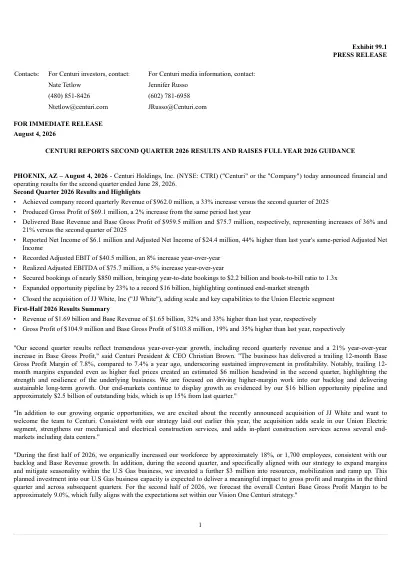
Nathan, thank you, and thank you, everyone, for joining our second quarter earnings call. We're proud to have delivered $962 million of revenue for the quarter, a new quarterly record for Centuri.
Adjusted net income for the quarter was $24.4 million, an increase of 44% from the same quarter last year. In terms of our base measures, which exclude storm work and, for this quarter, a one-time pre-IPO receivable write-off, second quarter base revenue was 36% higher than last year, and base gross profit was 21% higher.
For the first half of the year, base revenue was 33% higher than last year, and base gross profit was 35% higher than last year. This is remarkable growth and reflects the dedication of our teams across the US and across Canada.
I'll start with the recently announced acquisition of J.J. White, a leading provider of union industrial, mechanical, and electrical maintenance and construction services.
J.J. White has about 1,000 employees and will be integrated into our Riggs Distler business, adding scale and light construction expertise across several end markets, including data centers.
This tuck-in acquisition is consistent with our strategy that we laid out earlier this year. We increase scale in the Northeast and Midwest, expand in our core business, and add new customers in the electrical end markets.
We expect J.J. White to add more than $20 million of gross profit on a full-year annualized basis.
The total cash consideration paid was approximately $62 million, funded from existing balance sheet liquidity. We therefore see no change to our year-end leverage target of 2x.
We're very much excited to welcome the J.J. White team, and we look forward to the growth and their execution ahead.
Now for a commercial update, where we continue to see strength in our core and adjacent end markets, and more than ample opportunity to deliver sustainable growth at double-digit levels. Second quarter bookings were nearly $850 million, bringing our year-to-date bookings to over $2.2 billion.
Our book-to-bill ratio year to date is 1.3x. On an organic basis and on an organic basis for the full year, we are targeting a 1.2x book-to-bill, or approximately $4.4 billion of total bookings for 2026.
The successful negotiation and award of our largest data center project has demonstrated our ability to differentiate and secure complex, value-added contracts into our portfolio. The $125 million award covers electrical infrastructure and utility for a multi-building data center campus.
We continue to view the data center demand as robust, attractive, and growing. With the addition of J.J.
White, we will further increase data center backlog and the pipeline of opportunities for our company. At quarter-end, we had about $2 billion of data center opportunities in our pipeline.
Other big works in the quarter include the construction of an electrical transmission and substation project for Atlantic Canada, which was a very nice award for the Connect team, and also the assembly and installation of key components for gas infrastructure for a gas infrastructure company, and finally a large, significant electrical high-voltage transmission projects in the northeast of the US. On the MSA side, we booked approximately $250 million in renewals, which included gas distribution infrastructure upgrades and expanded scopes of work for a long-standing utility customer.
We also booked approximately $200 million between new MSAs and growth from existing MSAs. Demand for our core MSA work, including expanded scopes of work, remains very strong.
Core backlog stands at approximately $6.4 billion, which is up 21% year over year. Even more notable is the opportunity pipeline has increased to approximately $16 billion, which is up 23% from the first quarter, which demonstrates the strength of our end markets and our ability to position Centuri for backlog growth.
We have nearly 700 700 differentiated bid opportunities in the pipeline, which collectively represents 60% of the $16 billion. In the very near term, we have $2.5 billion of outstanding bids pending at the end of Q2, which represents a 15% increase from the first quarter.
This number has further increased as we've moved into Q3, another positive indicator of the strength we are seeing across our end markets. Over 2/3 of these pending bids are from our electrical segment.
It should also be noted that as we bid and and increased our volumes, our bid margins year over year have increased by more than 10%, which is fully in line with our long-term margin targets that we communicated earlier in February this year. As we've discussed over the recent months, we are focused on driving longer-term sustainability into our business through margin expansion, backlog, and greater coverage for the subsequent years.
Coming into 2026, we had about $3 billion of coverage for 2026 revenue. We are now forecasting to exit 2026 with more than $3.6 billion of revenue coverage for 2027.
This is a 20% in organic increase. This visibility and predictability provide the foundation for sustainable growth, allowing us to plan and execute for the future.
Lastly, to support customer demand and build for sustained growth, over the first six months of this year, we have organically added approximately 1,700 employees, representing an 18% growth in headcount so far this year. In the US Gas business alone, we've added over 1,200 employees, a 25% increase, to support client demand emanating from our strategy to mitigate seasonality in our business and expand our gross margins.
This significant capacity increase added near-term costs, which we estimate reduced second quarter gross profit by approximately $3 million. We fully expect these capacity investments to benefit Q3 2026 and the subsequent quarters as our resources generate revenue and margin expansion.
We forecast approximately 7.5% gross margin for our US Gas business in the second half of this year 2026. We were also affected by elevated fuel prices in the quarter relating to the ongoing conflicts in the Middle East.
The average per gallon cost was up 48% year over year, and the estimated cost impact within the second quarter was approximately $6 million. Higher fuel prices and the investment associated with additional gas resources together had a combined 95 basis point impact on the second quarter base gross profit margin.
The fundamentals of our business remain strong, and we continue to invest in the future guided by the priorities outlined within our Vision OneCenturi strategy. I'll now turn over to Greg to discuss the financial results.
Greg Izenstark
Thank you, Chris, and good morning to everyone. Second quarter 2026 consolidated revenues totaled $962 million, a new quarterly record, and was a 33% increase from Q2 2025.
Consolidated gross profit was $69 million, and gross profit margin was 7.2% in the quarter. In terms of base results, which exclude the impact of storm work and, for this quarter, a one-time write-off I'll discuss shortly, base revenue was up 36%, and base gross profit was up 21% compared to last year.
Base gross profit margin was 7.9% in the quarter versus 8.9% last year. On a trailing 12-month basis, base gross profit margin was 7.8% versus 7.4% a year ago.
Net income attributable to common stock in the second quarter was $6.1 million, or 6 cents per share, compared to a net income attributable to common stock of $8.1 million, or 9 cents on a per share basis, in the same period last year. In the second quarter, adjusted EBIT was $40.5 million, 8% higher year over year, and adjusted EBITDA was $75.7 million, a 5% increase over the same period last year.
Adjusted net income in the second quarter came in at $24.4 million, or 24 cents on a per share basis, compared to $16.9 million, or 19 cents per share, in the same period last year. As Chris mentioned, second quarter results were impacted by elevated fuel prices from the ongoing conflicts in the Middle East.
We estimate that the higher fuel prices in the quarter amounted to an additional cost of approximately $6 million, or approximately 60 basis point impact on margins. In the second quarter, the company wrote down all of its remaining accounts receivable and contract assets related to work that was completed prior to 2020 for the city of Chicago.
The write-down reduced US Gas revenue by $9 million in the quarter. We did not budget collection of this receivable in 2026, the write-down has no impact on our cash flow expectations.
We have excluded this one-time item from our non-GAAP measures, including our base measures. Now to our segments.
US Gas revenue was $489 million $489.5 million, an increase of 45% compared to the prior year. The growth was driven by increased bid work and MSA volumes, demonstrating the underlying strength of our customer relationships and market position.
Gross profit margin was 4.2% in the quarter, down from 7.8% last year. Base gross profit margin for US Gas was 5.9%.
As previously mentioned, second quarter margins for US Gas were impacted by approximately $3 million, or 60 basis points, from capacity added in the second quarter. While the timing of these additions impacted Q2 costs, we expect the results scale benefit to support stronger performance in the second half of 2026 and further improve seasonality during the first quarter 2027.
On a year-to-date basis, we've seen significant growth and improvement in the profitability of US Gas. Base gross profit has more than doubled from last year, and base gross profit margin improved by 36% over the same period last year.
Canadian Operations revenue was $81.4 million, up nearly 48% from the prior year period, primarily from the inclusion of Connect. Operational performance in this segment remains strong against the backdrop of sustained, favorable demand, as evidenced by the 16% gross profit margin in the quarter.
Union Electric revenue was $224.2 million, an increase of 23% year over year. Growth has been fueled by robust activity in projects serving industrial end use end user segments.
Gross profit margin for the Union Electric segment was 9% in the second quarter, ahead of the 8.4% reported in the same period last year. Non-Union Electric revenue in the second quarter was $167 $6.9 million, an increase of 11% year over year.
Base revenues in the Non-Union Electric was $157.1 million in the quarter, which is a 15% increase from last year. This growth reflects the significant expansion we've seen in MSA activity, building on the momentum we've discussed in recent quarters.
Gross profit margin in the Non-Union Electric segment was 9.1% in the current period, compared to 11% in the prior year period. Base gross profit margin was 8.4%, compared to 8.9% in the prior year.
Turning to cash flow and balance sheet. Net cash provided in operating activities for the second quarter was $20 million, and free cash flow was -$7 million, consistent with our expectations.
For the full year, we expect free cash flow to exceed $75 million, a 25% improvement over initial expectations. We ended the quarter with a net debt to adjusted EBITDA ratio of 2.6x, which was down from 3.7x a year ago.
We continue to forecast net debt to adjusted EBITDA of around 2x by year-end. Finally, turning to our 2026 outlook.
We have increased our full-year guidance and have included expected contributions from J.J. White.
The full-year guidance also includes approximately $5 million of forecasted incremental fuel expenses based on an assumption that higher fuel prices persist through the third quarter. As a reminder, base revenue and base gross profit are non-GAAP measures that exclude the impact of storm restoration services and the one-time write-down related to the city of Chicago.
For 2026, we expect base revenue of $3.5 to $3.7 billion, and base gross profit of $270 to $290 million. Revenue, adjusted EBITDA, and adjusted net income are measures that include storm restoration services.
Guidance for these measures includes storm restoration services using a three-year average of $88 million in revenue and $28 million in gross profit. For 2026, we expect revenue of $3.59 to $3.79 billion, adjusted EBITDA of $285 to $310 million, and adjusted net income of $60 to $75 million.
Lastly, we are reducing our net capex outlook to a range of $60 to $75 million following the sale-leaseback of select equipment early in the third quarter. I will now turn it back to Chris to wrap up with prepared remarks.
Chris?
Chris Brown
Thank you, Greg. As we wrap up today's call, I'd like to leave you with a few key thoughts.
We've demonstrated our ability to capture market demand and deliver growth. Over the course of the last year and again in the first half of this year, we've successfully identified and secured opportunities across our end markets, expanded our workforce to meet our customer demand, and continue to grow revenue, backlog, and the opportunity pipeline.
The focus now is not on only sustaining that growth, but leveraging the scale we are building to expand margins and drive stronger profitability over time. We're very pleased with our first half performance, and more importantly, encouraged by the trajectory of our business.
As we outlined last quarter in our Vision OneCenturi strategy, the path to achieving our '29 base gross profit margin target of 9.7% is built on three primary drivers: reducing the seasonality of our business, increasing the mix of higher-margin bid work, and delivering operational excellence. We've already begun to see these initiatives gain traction.
Our first quarter results demonstrated meaningful progress in seasonality, our opportunity pipelines and bookings continue to support growth in big work, and we are now advancing several operational excellence initiatives that believe will bring lasting value over time. We are increasingly confident that the right tools, processes, and leadership are in place to drive sustained progress.
Initiatives like our newly established PMO organization, fleet optimization efforts, working capital management, and enhanced job-level performance attribution and analytics are in early stages. These initiatives represent important building blocks in creating a more efficient, scalable OneCenturi model.
We are investing with intention, executing against our clear strategy, and are encouraged by the momentum we are seeing across the business. In short, the implementation of our margin improvement plan to deliver the 2029 targets continues in line with our expectations.
As we look ahead, we remain confident in our ability to deliver sustainable growth, achieve our long-term margin objectives, generate free cash flow, and create significant value for all our shareholders. We truly appreciate everyone's time today and the interest that you've shown.
Operator, let's begin the Q&A.
Operator
We will now begin the question-and-answer session. Please limit yourself to one question and one follow-up.
If you would like to ask a question, please press star one to raise your hand. To withdraw your question, press star one again.
We ask that you pick up your handset when asking a question to allow for optimum sound quality. If you are muted locally, please remember to unmute your device.
Please stand by while we compile the Q&A roster. Your first question comes from the line of Sangita Jain with KeyBanc Capital Markets.
Sangita, your line is now open.
Sangita Jain
Great, thank you. Good morning.
Can I start with the J.J. White acquisition and maybe you can discuss what your key goals are with this acquisition and what type of synergies are you hoping to achieve?
Chris Brown
Good morning, Sangita. I can cover that.
We've known J.J. White as an organization for a number of years, the cultural fit, the capability, and the relationship between our respective businesses were long-established.
This wasn't finding a business we did not know well. That was number one.
What J.J. White brings us is more scale, more capacity to be able to deliver on growth in the Midwest and the Northeast, primarily focused on in-plant, power, data-center-related activities.
The business has got a massive track record in developing talent within the business. It's currently 1,000 people.
We believe it can flex easily to 2,000 people, it brings capacity for us. Your question on synergy, we don't see cost synergy at all in the transaction.
J.J. White is currently mobilizing into our overall Riggs offices in the New Jersey area.
We see the synergy coming from their operational capability combined with ours to do more work for our customers. That that's where we see the synergy in the supply chain of people they have, supervisors as well as craft, giving us more capacity in that Northeast, Midwest to deliver for customers in both data centers and energy.
Sangita Jain
That's very helpful. Then maybe I can follow up for Greg.
You gave us a look into second half. You said you're factoring in $5 million on higher fuel costs.
Can you give us a sensitivity on how many basis points of margin that should mean for the second half?
Greg Izenstark
Good morning. Overall for the full year, fuel from the $7.5 million or $7 million in the first half and then the $5 million that I noted in the second quarter or in the third quarter, it's about 35 basis points of headwind for a full-year basis.
Sangita Jain
Okay. You're assuming just for third quarter, nothing for fourth quarter yet?
Greg Izenstark
Our assumption in our for our guidance assumes a $5 million headwind in the third quarter, and then back to some level of normalized increase year over year. Our guidance at the beginning of the year did assume some, normal increase that you would expect.
Sangita Jain
Got it. Thank you.
Thanks for answering my questions.
Greg Izenstark
Thank you, Sangita.
Operator
Your next question comes from the line of Manish Somaiya with Cantor. Manish, your line is now open.
Manish Somaiya
Thank you. Good morning, everybody.
Greg Izenstark
Hey, Manish.
Manish Somaiya
Greg, I had a question for you on guidance. Looks like revenue is up about $300 million at the midpoint.
EBITDA is up a little bit. Maybe if you can just help us understand, the conversion, the EBITDA flow-through, and then I have a follow-up.
Greg Izenstark
Maybe taking a step back, when you look at base gross profit, of the increase that we've assumed in our in our guidance, about 2/3 of it kind of relates to organic business, and then 1/3 of it kind of relates to the the incremental acquisition of J.J. White in the 5 5 or so months of contribution that we'll get here in the in the back half of the year.
From an adjusted EBITDA perspective, we've we've assumed, that that same level of base gross profit along with our our storm activity. Obviously, you you have the previously discussed kind of headwind from moving to a 50/50 split on on leasing, which we're on target with, and and have revised or or, finalized the the sale-leaseback of our existing fleet.
Any future purchasing will will be along those lines. The combination of all of that, gets you to a adjusted EBITDA, about 7.1% at the midpoint.
Manish Somaiya
Greg, I think in the slides you have fleet investments at 60% operating lease and 40% capex vis-a-vis the 50/50 split that we've talked about. I guess what is the incremental impact to EBITDA of that sort of 10 percentage point increase in operating lease this year?
Greg Izenstark
The full-year impact of our leasing is about a half a percentage point, or is about 55 basis points.
Manish Somaiya
On margin.
Greg Izenstark
On margin, on EBITDA margin, 55 basis points on EBITDA margin.
Manish Somaiya
Wonderful. I'll get back in queue.
I'll respect the instructions.
Greg Izenstark
Thank you, Manish.
Operator
Your next question comes from the line of Justin Hauke with Robert W. Baird.
Justin, your line is now open.
Greg Izenstark
Morning, Justin. How are you?
Yeah.
Justin Hauke
Hi. Good morning.
I've got two questions here. I'll start I guess first one, this one is really easy, and then I've got a question on the guidance.
The first question is just the J.J. White acquisition, I think you said $315 million of backlog and a $2.8 billion pipeline increase.
Is that pipeline increase already in the $16 billion number that you gave,
Greg Izenstark
or
Justin Hauke
is that something that No. Okay.
Greg Izenstark
Justin, it's not. We didn't close on J.J.
White until I think the third week in July, it's excluded from the numbers. It will be additive, mate.
Justin Hauke
Okay. All right, that's I figured that.
I just didn't know given that pipeline number and backlog.
Chris Brown
As Greg just said, the only element you'll see of J.J. White within our release is to guidance, where 1/3 of the guidance increase came from J.J.
White for that five-month period. That's the only thing I would stress.
Justin Hauke
That leads to my second question, because I guess this is what I want to understand a little bit better, because the organic, as you just discussed, the revenue is $200 million higher. You've got, another 100 from J.J.
White. You raised the EBITDA guidance by 5.
You pick up 9 or so from, the 5 months that you have with J.J. White.
You offset that with the $5 million headwind from the higher fuel costs. That basically just I guess I would look at that and say that it implies organically that there's no incremental margin on any of that acquired revenue.
I guess I just want to understand that dynamic and also just the confidence in the second-half base gross profit margin outlook, which is roughly 9% versus, just under 8 that you did here in 2Q. I know there's seasonality, but just, I guess help me understand some of those moving pieces a little bit better.
Chris Brown
Let me talk about second half, and then Greg can come to the overall guidance, just to help you map the numbers. We feel second half of the year very strongly about the volume of work and also about the 9% quoted margin.
We've got total visibility and pretty much everything that we need to deliver this year is under contracts. I think there's a slide within the deck that shows that to everybody.
We've added the capacity we needed to add in gas. I think everybody as said in my speaking notes, but everybody will recall, we had we have a massive drain on margins in our first quarter, even going into April.
Adding more volume into the gas business needed people to win work, put it into the backlog, which we did. You've then got to mobilize people, and we've added 1,200 in the quarter.
Those boys and girls will stay within the headcount, cuz we've now reached where we have to be on capacity standpoint. As we don't just look on you can't run the business on a just on a quarterly on a quarterly basis.
The business is not it it's just not linear like that because of the seasonality as well as the portfolio mix. What's the point?
The point is we added the capacity we needed in the second quarter. We've got full visibility of where we're going to be for the second half of this year.
We're really confident in the 9% margins as quoted. Our intent now is to drive very strongly to the end of the year.
Then if you look even into '27, which I know we're not into '27 yet, we've already built up the backlog for next year, which is really important when it comes to seasonality. The seasonality for the first quarter next year requires to win work now and have resources for that for next year.
The bottom line is very confident in the second half of the year. We've got pretty much all of the revenue under contracts.
We've added the capacity we need to, particularly in the gas business. We feel very confident that the investment in the first quarter will unwind in margins in the second half of the year and confident within that overall 9% for the second half of the year across the board.
Greg Izenstark
Specific to the guidance, we talked about in our release that the annualized revenue contribution profit gross profit contribution from J.J. White being, $20 million plus, with margins consistent with our Union Electric business or our business as a whole.
When you think about they also have a bit of G&A expense, and they're very capital light in how they operate their business, and so very little depreciation in within the business as they they're very efficient from that perspective. Taking into consideration lower depreciation within their numbers and then some level of G&A expense, you get to a EBITDA contribution that's, a little bit less than where we, what we said on a gross profit basis.
You also have to remember that our EBITDA guidance includes the fuel impact, it's about $12 million on a full-year basis that we've forecasted. You factor all that in, G&A expense still being, in line with what we've previously said, which is, 4% or better on a percentage of revenue basis.
Then the last thing I'd just point out on gross profit, gross profit margins, on a full-year basis is going to be in that, 7.8 to 8% range.
Operator
Your next question comes from the line of Zachary Schechtman with Wells Fargo. Zachary, your line is now open.
Zachary Schechtman
Hey guys, thanks for taking my question. I was wondering if you could give a little more color on that 9% for 2H, 3Q versus 4Q.
You mentioned the fuel headwind and US gas labor ramp delivers a meaningful impact. Just wondering if 3Q still hits around that mark or we're expecting to see a sizable step up in 4Q.
Chris Brown
Zack, I would apologize, the line was particularly bad. Were you asking us about Q3 over Q4 margins in gas?
Was that your question?
Zachary Schechtman
Yes, that's correct, and just total base gross margin.
Greg Izenstark
I think we said in our prepared remarks that the back half of the year for US Gas, we expect to have gross margins in the 7.5% range. From a total base perspective, gross margin in the second half of the year is going to be about 9%.
Zachary Schechtman
Got it. We should expect a sizable increase from 3Q to 4Q due to the headwinds you mentioned previously?
Greg Izenstark
The third quarter generally is the most active quarter that we have, just given weather throughout the United States and Canada. That and the fourth quarter, while comparable to that, you obviously get weather and holidays in the back half that could impact productivity, and but generally speaking, the third quarter is our strongest period.
Zachary Schechtman
Got it, understood. Just as a follow-up, I see really nice growth acceleration in bid work last couple quarters.
Could you just talk about how gross margins have been trending in that work, how they've been trending versus expectation, and how it compares to MSA at this point?
Chris Brown
Yeah. Zack, we laid out previously our desire to grow the business and the bid mix moving from 80% MSA, 20% bid work to probably long-term 65/35, 70/30.
We see, we are tracking bid margins as we are tracking now more closely as delivered margins, and bid work is between 1.1 and 1.5% higher than the MSA margins.
Zachary Schechtman
Got it. Thank you, guys.
Operator
Your next question comes from the line of Avi Jaroslawicz with UBS. Avi, your line is now open.
Avi Jaroslawicz
Thank you. Hi, good morning, guys.
I believe you already answered this, but just want to make sure. The $16 billion opportunity pipeline that you noted, that does not include J.J.
White. Is that correct?
Chris Brown
I can confirm that's the case, Avi. The $16.2 billion, to be precise, excludes any J.J.
White pipeline of opportunity, as does the backlog of $6.4 plus million we quoted. It's absolutely excludes.
Avi Jaroslawicz
Got it. The opportunity pipeline up about $3 billion, the mix of bid work in there is up about 5 percentage points, but the number of bid opportunities that you called out is about the same as last quarter.
Should we take that to mean that you're looking at meaningfully larger bid opportunities than previously, or is that just reading into it too much?
Chris Brown
Avi, there's you can't, and I it's the same conversation on the margin as it is with the pipeline. You can't look at it, it's not Swiss watchmaking, we can't look at it on a quarter-by-quarter basis.
We look at absolute data over a longer time horizon. What I will tell you is at the end of last year, December the 31st, we had $13 billion in the pipeline.
There's now $16.2 billion. A six-month time horizon is a fair view, direction of travel, for a number of things: broad pipeline as well as margins.
If you look at the mix of work over the same timeline, we've gone from $6.7 billion of the $13 billion at the end of December was project work, and $6.5 billion was MSA work. At the end of June, the quarter we've just closed, the project work is $9.664 billion, to be precise, and $6.56 billion is the MSA work.
We've seen just nearly a 50% increase in the bid work, which is totally consistent with the strategy we laid out in February. I will tell you the average size of the scope of work within that project has only moved up by a couple of million dollars.
We're not deviating from doing the services and the projects that we've always done. There's a $2 million increase from the average contract size within the pipeline at the end of the year to where we are at the end of June.
It's not materially different. The amount of work that is bid work has gone up by 46.5 or so percent, to be precise.
Avi Jaroslawicz
Appreciate that. I understand that, we're talking in approximate terms with the exact number of opportunities in there.
I wanted to ask also about slides note that you're evaluating opportunities to expand geographically and with electric transmission capabilities. Do you see those more as organic growth opportunities, or would they more likely be through acquisitions?
Chris Brown
I think you've got to decouple two things there. The primary basis of our business is organic growth.
We've got the capability to do more transmission work. We announced two awards in the quarter, one for Canada, which is and one for the Northeast.
We've doubled in the sales pipeline, we have doubled the amount of transmission electric transmission opportunities from the December to where we are in June. There is an absolute desire, as we communicated in February as part of our strategy, to drive organic growth into our transmission business across both union and non-union.
We're doing that. We're seeing that in the pipeline.
We're also seeing that in the recent awards. Your second question around M&A, I will stick to what I think we said in February and what I've been saying for a year.
We've got a very, very good platform to grow our business. We've got some evolution to do as we bring us together as one strategy, as one company, as one vision, mission, and values to deliver the sustainable growth.
There are areas in the business where we would like to acquire. We've essentially done two tuck-in acquisitions in my tenure here.
One was Connect in the North in Atlantic Canada, which was electrical transmission, distribution, substation. The recent acquisition for union in the North Northeast was electrical union to support the overall data center and utility clients.
As I said when we rolled out the strategy, I would anticipate, as time moves on, if we see businesses that look similar in size, similar in quality that we can pay the right price for, that complements our electrical business, especially our electric transmission, we would love to do those. That's how I answer the question.
Avi Jaroslawicz
All right, appreciate it. Thank you very much.
Operator
Our last question comes from the line of Manish Somaiya with Cantor. Manish, your line is now open.
Manish Somaiya
Thank you so much. Greg, I have one other question for you and then I'll move on to Chris.
Greg, if you can just kind of help us summarize all the puts and takes on the positive impact and the negative impact. I know we've talked about a lot of different numbers, and it's just been really hard to kind of make sure that I have what I need, and I'm sure that there are folks on the call who probably feel the same way.
Obviously the revenue uptake is positive, which is, I think, Chris, you have talked about, things that are happening. We're just trying to get a better sense as to puts and takes on some of the things that we've already talked about.
Maybe, Greg, if you can just help us figure out what the different line items are just so that we have a better feel for how we should be looking at the numbers. Then, Chris, I did have one other question for you.
When Greg
Chris Brown
just answers your question, I will just wrap up a little bit on the margin commentary, because it does get lost cuz it's a complicated business. I would just like to summarize where we are and how we look at this so the audience can understand it.
Let's Greg answer your question, then I'll just add something towards the back end of that.
Greg Izenstark
Maybe let me focus on kind of full-year gross margin base gross margin, cuz that's ultimately, one of the key drivers for the management team. When you think about gross a base gross profit margin, there's the contribution of J.J.
White, which is about 1/3 of the gross profit increase in the margin in the base guide that we discussed. You have fuel costs, which between what's already occurred in the first half of the year and what's, we have forecasted for the second half of the year is about $12 million of a full-year impact.
Then you have the ramp-up costs, which were already incurred in this first half of the year. They're already in our full-year numbers.
Obviously, that's about $3 million. Overall, gross margins are adjusted for fuel are, about 8.1% on a base versus the guide of 7.8, but that obviously doesn't add back the fuel.
Chris Brown
Manish, one one thing I would would talk specifically about on on the margins. We've got a reported margin, then we've got the impact of the Chicago, which was was pre-IPO and not even operationally were were were in the were involved in it.
It was just something that was on the balance sheet. We've then got the fuel cost, and then the the the Q2 capacity increase.
If you look at year year to date where we are on the margins and how we track it, our over- overall group margins '25 was 6.2%, and we're now at 6.3%. All that is doing is just excluding the the the Chicago the Chicago one-time event.
If you look on a trailing 12 months basis, last year we were at 7.4%, this year we're at 7.8%. The reason I look at the year to date and the trailing 12 months, it's not an excuse.
It's just our business at the moment is not linear. We don't we're not at 12 consecutive quarters that are all 1%.
Merely due to seasonality, the portfolio mix, and the type of work. We see our underlying margins if you just take out one thing, which is the city of Chicago, and you keep in there the fuel costs and the mobilization for capacity in the second quarter, on a year-to-date basis, we're up 6.2 to six from 6.2 to 6.3, and then on trailing 12, 7.4 to 7.8.
I think that's just getting lost a little bit because of the complexities of reporting. I would say if you look at the gas if you look at the gas margins where most of the seasonality is, year to date last year, we were at 2.2% gross profit.
Thi- thi- this year, we're we're we're at 2.9%. On a trailing 12 months, and well over 1 1 and 1/2% more than we were a year ago.
Everything's moving in the right direction from a margin standpoint, Manish.
Manish Somaiya
That's super helpful, Chris. Just kind of going back to our last meeting in June, Chris, we've talked about maybe $3.5 billion or so of '27 work that you expected to book by the end of '26, and 15%+ backlog increase.
If you can just give us a quick update on where that stands today, both excluding and including J.J. White?
Chris Brown
I can. We deliberately added a slide for readers, slide 12.
Greg may correct me, that basically addresses that very point, Manish. As you quite rightly said, 2025, we had $3 billion of coverage coming into '26.
We are round about where we sit now of with about $3.6 billion, we're up 20% in terms of expected coverage when we close out 2026 for 2027 revenue. That trajectory has continued.
You'll recall the end of '24, we only had $2 billion going into '25, budget 12 months. '25, as I say, we have $3 billion.
As on you'll see on slide 12, we're at $3.6 billion is where we forecast, and that excludes J.J. White.
What I will tell you on J.J. White, they have a similar level of coverage for both '26, and we are currently validating their coverage for '27.
I suspect that the J.J. White coverage for next year will look very comparable to what we have within Centuri.
I think the guidance that we show in slide 12 where we have $3.6 billion excluding J.J. White is very accurate and will drive 20 the 20% more coverage going into next year.
I think J.J. White will be of a similar mix.
Manish Somaiya
Okay. Great.
Thank you, Chris.
Operator
We have reached the end of the Q&A session. I will now turn the call back to Nathan for closing remarks.
Nathan Tetlow
Thank you, everyone, for your questions and for participating in today's call. Please feel free to reach out to me if you have further questions, and that concludes today's call.
Operator
This concludes today's call. Thank you for attending.
You may now disconnect.