Cognizant Technology Solutions Corporation
Q3 FY2026 · Earnings Call TranscriptOctober 29, 2026
Operator
Ladies and gentlemen, welcome to the Cognizant Technology Solutions third quarter 2026 earnings conference call. All lines have been placed on mute to prevent any background noise.
After the speakers' remarks, there will be a question-and-answer session. If you'd like to ask a question at that time, please press *1 on your telephone keypad.
A confirmation tone will indicate your line is in the question queue. You may press *2 if you'd like to remove your question from the queue.
For participants using speaker equipment, it may be necessary to pick up your handset before pressing the star keys. Thank you.
I would now like to turn the call over to Mr. Tyler Scott, Senior Vice President, Investor Relations.
Please go ahead, sir.
Tyler Scott
Thank you, operator, and good morning, everyone. Welcome to Cognizant's third quarter 2026 earnings call.
I'm joined today by Ravi Kumar, Chief Executive Officer, and Jatin Dalal, Chief Financial Officer. By now you should have received a copy of the earnings release and investor supplement.
If you have not, copies are available on our website, cognizant.com. Before we begin, I would like to remind you that some of the comments made on today's call and some of the responses to your questions may contain forward-looking statements.
These statements are subject to the risks and uncertainties as described in the company's earnings release and other filings with the SEC. Additionally, during our call today, we will reference certain non-GAAP financial measures that we believe provide useful information for our investors.
Reconciliations of non-GAAP financial measures where appropriate to the corresponding GAAP measures can be found in the company's earnings release and other filings with the SEC. With that, over to you, Ravi.
Ravi Kumar
Thank you, Tyler. Good morning, everyone.
Thank you for joining us. We delivered a solid third quarter while advancing our AI builder strategy.
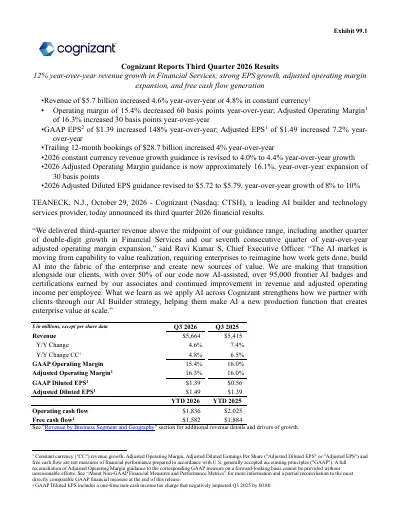
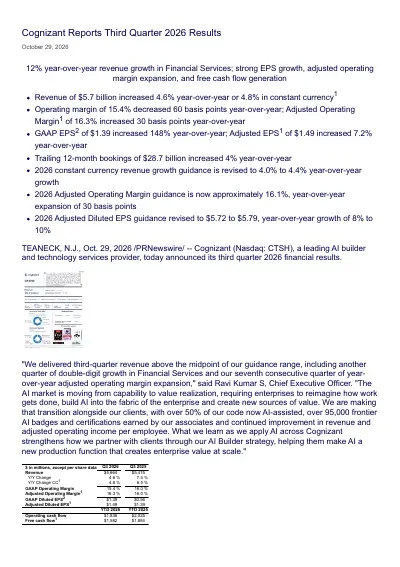
Revenue was in line with our expectations, and adjusted operating margin reached its highest level in four years, reflecting continued execution in a rapidly evolving market. We maintained strong momentum in financial services, where clients are increasingly using AI to accelerate modernization and address new areas of demand powered by AI-led innovation cycles.
We are building the deployment capacity and differentiated capabilities that we believe can help clients move AI into production at enterprise scale and capture more of its value, and we see an opportunity to capture more of that value through platforms as well as deployment services. Looking at the quarter's highlights: Revenue grew 4.8% year-on-year in constant currency, led by strong performance in North America, including contribution from our recent 3Cloud and Asteria acquisitions and our integrated offering strategy.
Financial services accelerated to 12% year-over-year constant currency growth, its third consecutive quarter of double-digit growth. Communications, Media and Technology also grew double digits, driven by inorganic contributions from Asteria and strong spending from technology clients.
Trailing 12-month bookings increased 4%, with the mix of new versus expanded business growing over 10 percentage points year-over-year to 60%. We signed three large deals with TCV of more than $100 million each, while the combined trailing 12-month TCV of large deals increased 9% year-over-year.
Adjusted operating margin increased year-over-year to 16.3%, the seventh consecutive quarter of year-over-year expansion. We also continue to see indicators that AI is changing our operating model.
Revenue and adjusted operating income per associate, excluding Gen Z trainees, increased more than 3% and 5% respectively. Through the end of Quarter 3, we estimate more than 50% of our software development was AI-assisted, and we have over 8,500 AI engagements.
We achieved these results in a complex demand environment. Although macroeconomic conditions were largely stable in the third quarter, we're seeing the macro uncertainty weigh more on discretionary spending in the fourth quarter, particularly in healthcare and consumer-facing sectors.
We have reflected these factors in our updated full-year guidance, which Jatin will cover in more detail. Despite these factors, we are still delivering revenue growth that ranks among the top of our peer group.
Against this backdrop, our strategy and actions are aimed at building the necessary capacity to deploy AI at enterprise scale, capturing more of the value between AI intelligence and the enterprise, and applying these capabilities to the areas where we see the greatest growth opportunities. Historically, major technology transitions required capacity to deploy new technology at scale.
We are building that capacity across our talent, engineering platforms, and partner ecosystem with leading frontier AI companies, hyperscalers, and enterprise technology providers. More than 45,000 Cognizant associates have earned more than 95,000 certifications across frontier AI platforms, and another 65,000-plus are in progress.
We recently expanded our Google Cloud partnership with a new Gemini frontier capability group, bringing together more than 18,000 dedicated Cognizant associates focused on legacy modernization, developer experience, autonomous business processes, and frontier cyber defense. We are also proud of the strong momentum created through our Gemini partner event, where more than 55,000 associates completed Build with Gemini, the largest Gemini partner workshop to date.
With this deployment capacity in place, we believe our larger opportunity lies in helping enterprises turn AI intelligence into differentiated business value. As AI moves into production, that value increasingly comes from reimagining how work gets done, providing the enterprise context AI needs to operate effectively, and build the trust and governance required to deploy it at scale.
Our AI builder strategy is designed to bridge this gap between AI capability and enterprise value through four connected areas: First, reimagining how work gets done. This starts with redesigning business workflows, operations, and roles around what AI now makes possible in new Cognizant proprietary methodology in agile pods engaged in reimagination and reinvention of business landscapes.
Work once handled by software systems and human teams will increasingly be performed by a new combination of systems, people, and AI agents. We have pioneered the discipline of context engineering to develop our associates' expertise in this discipline, and we believe we are building the specialized engineering capacity needed to build agentic systems at scale.
Second, engineering enterprise-grade AI. Putting reimagined work into production as bespoke agentic systems requires enterprise-grade systems, meaning governed, trustworthy, safe, and grounded in the enterprise context.
This is an area where we believe our platforms will play a critical role. This allows us to embed our capabilities and IP directly into delivery, scale them across clients, and increasingly bend the cost curve.
Our platform opportunity rests across two pillars: First, engineering platforms support the end-to-end engineering life cycle through AI-led engineering and modernization. Second, business platforms apply to repeatable business processes, particularly bounded workflows where AI can increasingly perform and improve the work.
The third area of our AI builder strategy is building the capacity to help clients absorb AI. Effective enterprise AI adoption requires the right skills, tools, and ways of working.
We are putting into this practice inside Cognizant through Skillspring, our AI-native learning platform, which is now used by approximately 315,000 associates. We're also making the platform available to clients and are building an active pipeline of opportunities.
Finally, compounding and protecting institutional intelligence. As AI is embedded in more workflows, enterprises need greater visibility into and control over how AI is used while protecting their institutional intelligence and sovereignty.
We recently launched Cognizant AI Nexus, a modular multimodal operating layer that helps enterprises govern AI quality, manage spend, coach in real time, compound repeatable patterns, and connect AI consumption to business outcomes across teams. It illustrates how we aim to help clients manage AI as an enterprise capability while learning from its use and making their institutional intelligence more valuable over time.
Together, these four elements of our AI builder strategy are designed to help clients turn AI capabilities into enterprise value, while positioning Cognizant to capture more of that value. Now let me discuss how our AI builder expands the opportunity for Cognizant in three areas: First, AI-led productivity and autonomous software engineering, which is increasingly becoming the baseline for how we deliver our traditional work.
Second, old things in new ways, which is using AI to perform existing work in fundamentally new ways, changing the economics of modernization and enterprise workflows. Third, new things in new ways: AI creates enterprise new services, platform, and operating model opportunities that were not previously possible.
Together, they increase our total addressable spend and create expansive opportunities on enterprise landscapes, yielding new avenues of growth for Cognizant. To capture these opportunities, we are evolving how Cognizant operates by reshaping our organization, talent, and commercial model for an AI-led market.
Notably, we have aligned our Software Engineering Group portfolio around AI-led software engineering and modernization. This shifts the group's focus from engineering disciplines to client outcomes, industry context, and frontier capabilities.
We expect this shift will improve how we build and deploy AI-native capabilities while giving associates clearer paths to develop frontier expertise. In parallel, we are evolving our workforce, building frontier roles around the capabilities needed to design, deploy, and operate AI-native solutions.
These roles combine engineering, AI fluency, and business expertise with greater accountability for client outcomes, and are complemented by our investments while leading frontier AI partners I discussed earlier. We're also adding capabilities through targeted acquisitions.
Last week, we announced our intent to acquire Australia-based Dyflex Solutions, an SAP platinum partner, to deepen our SAP expertise and strengthen our ability to help clients across Australia and New Zealand modernizing their core platforms. Our commercial model is also evolving.
As human and digital labor increasingly converge in delivery, we see more opportunities for outcome-based pricing, AI-infused rate cards, and platform monetization. More broadly, our mix of fixed-price and transaction-based work is steadily increasing.
In the third quarter, this mix was nearly 58% of our revenue, up 140 basis points year-over-year and more than 500 basis points since the third quarter of 2022. We are expanding the reach of these capabilities.
This month, we announced Cognizant Activate, which is designed to bring enterprise-grade AI transformation to emerging high-growth mid-market companies aspiring to reach the Global 2000 scale, with an operating model purpose-built for their size. Next, as we evolve our operating model, the AI disruption has created the immediate next wave of client opportunities, and accordingly, we have identified four strategic growth priorities that we believe can drive disproportionate growth: modernization, agentifying core business operations, secure AI, and data center and workplace services.
Together, we believe these represent a multi-billion dollar opportunity in the years ahead. We're focusing our investments and efforts in these areas, with partnerships playing an important role.
First, starting with modernization: AI is changing the speed and economics of modernizing legacy technology, data, and enterprise applications. For example, we expanded our decade-long relationship with Gilead Sciences through a new five-year agreement supporting the responsible application of agentic AI across selected programs, simplifying processes and improving software delivery.
At Travelport, we completed the first phase of the AI transformation we announced with Anthropic in May, establishing the platform's architecture and engineering practices needed to modernize its technology environment. At Odyssey Logistics, a global logistics provider, Cognizant used autonomous AI engineering to rebuild Odyssey's transportation management platform, resulting in a 37% net savings compared with the conventional approach.
The second strategic growth opportunity is agentifying core business operations. We see a significant potential to reimagine workflows with agentic AI and our platform strategy.
As I mentioned earlier, we will prioritize bounded workflows. Bounded workflows are primarily built on four principles: structured inputs, measurable outcomes, high transaction volumes, and short feedback loops.
Our investments in this space are based on our external market study, and we are initially concentrating on key areas where we believe we have the right to win with our domain strength, and thereby significantly create potential for frontier-enabled platforms. These include long-term care as an adjacency to our existing healthcare platforms, mortgage operations, drug safety and pharmacovigilance, insurance operations, and the frontier finance function.
We will start with these segments, and as we make progress, we'll continue to identify more segments for building frontier-enabled platforms and services. A few early examples are as follows: First, healthcare claims: We recently introduced agentic workflow processing for TriZetto that allows AI agents to automatically clear eligible routine pended claims while routing exceptions to human reviewers.
It is designed to reduce manual intervention while preserving human judgment where it's needed. At SITA, a global specialist in air transport technology, we are helping build a frontier finance function on a modern cloud platform spanning finance, procurement, and supply chain.
Cognizant will work with SITA to implement a cloud-based ERP and management platform. The goal is to move finance beyond reporting and transaction processing towards a more strategic role built around data, AI, and measurable business value.
Next, for the European Bank for Reconstruction and Development, we are applying AI across a complex, highly governed technology environment, combining AI-enabled delivery and platforms, including Neuro, Flowsource, and WorkNext, through outcome-led managed services and fixed-capacity services models. At Talcott, we helped modernize its corporate and bank-owned life insurance business operations by launching a next-generation policy administration platform.
We embedded governed AI across the delivery cycle from requirements and design to engineering, testing, and implementation, driving 30% productivity gains. Our third strategic priority is secure AI.
As AI is embedded more deeply across enterprise systems and workflows, trust and security becomes prerequisites for scaled adoption. While securing agentic systems unlocks new demand, we are equally excited about the ability to leverage frontier intelligence for vulnerability discovery, and remediating and refactoring existing landscapes with frontier intelligence being a much bigger opportunity.
Our cybersecurity business is our fastest-growing service line. We are building our capabilities through our Neuro AI Trust platform and frontier cyber defense workforce.
As an inaugural member of the OpenAI's Daybreak cyber partner program, we are combining advanced frontier AI models with our security expertise, governance, and human oversight to help clients identify vulnerabilities and validate fixes faster. We're deepening our work with CrowdStrike, bringing their Falcon platform into the Cognizant AI Factory and our managed cybersecurity services to help secure AI agents, models, and infrastructure.
Finally, the fourth strategic priority is data center and workplace services. The trillions of dollars being spent on AI infrastructure buildout creates opportunities across data center operations, networks, AI environments, and digital workplace services.
Our Asteria acquisition strengthens our ability to serve this market and show early momentum during the quarter, including an expanded engagement with Google. Beyond these four strategic growth priorities, we are building capabilities in the emerging area of physical AI.
We recently signed an agreement with one of North America's largest utility companies to deploy our flagship physical AI platforms, Cognizant Intelligence Spine and Autonomous All-Domain Awareness for Utilities. Together, we aim to fuse sensor, vision, and agent intelligence into single real-time view to enhance wildfire prevention and grid safety, and to accelerate multi-agent coordination and field response.
We see a healthy pipeline of similar opportunities in asset-heavy industries like manufacturing, life sciences, retail, and consumer sectors. We continue to keep this flywheel running on identifying new waves of demand by sensing, incubating, and scaling for the next set of opportunities unlocked by AI disruption.
In summary, we view agentic AI as the most significant enterprise opportunity since digitization, and clients are increasingly focused on converting their AI investments into measurable business outcomes. We believe our AI builder strategy expands the opportunity ahead and opens multiple avenues for growth, particularly across the four strategic priorities I outlined today.
We continue to strengthen our core business while investing in the capabilities, talent, and platforms needed to deploy AI at enterprise scale. We are doing this while delivering top-tier revenue growth, expanding margins, and EPS growth ahead of revenue growth, and we remain focused on disciplined execution and creating durable long-term value for our shareholders.
Thank you to our associates, clients, partners, and shareholders for your continued support. Now I'll turn the call to Jatin.
Jatin Dalal
Thank you, Ravi, and thank you all for joining us. We are positioning Cognizant for a rapidly changing market by deepening our technology partnerships, building new relationships across the frontier AI ecosystem, and evolving our go-to-market, commercial, and delivery models.
We are also pursuing targeted M&A to add capabilities to advance our AI builder strategy. Together, these actions strengthen our ability to help clients generate measurable business value from AI.
We believe our financial performance gives us the capacity to keep investing while remaining disciplined with capital allocation and capital returns to shareholders. We are delivering results today while strengthening the business for the future.
Now moving on to the details of the quarter: In Q3, revenue grew 4.8% year-over-year in constant currency to $5.7 billion. Organic growth was again led by financial services, supported by continued ramp of large deals.
Year-over-year growth also benefited from our investments in 3Cloud and Asteria, as well as higher third-party products revenue associated with our integrated offering strategy. We see integrated offering as an increasingly important opportunity as clients seek partners that can combine services, software, infrastructure, and security to deliver outcomes.
As AI moves further into production, we expect these models to evolve, including how inference and AI consumption are incorporated into our solution delivery. As Ravi discussed, we are concentrating investment and go-to-market activity in areas where we believe AI can expand the scope of work we address.
We are already seeing encouraging growth in several of these businesses, like BPO, infrastructure, cybersecurity, and industry solutions. Year-to-date, we estimate that service lines that are benefiting from AI tailwinds account for approximately 40% of our business and are growing at roughly two to three times the rate of our total organic services revenue.
Next, geographically, North America again led growth, and UK showed strength in public sector, while Rest of World improved sequentially. By segment, Financial Services led again, with heavy growth across banking and capital markets, recent new logos in insurance, and UK public sector growth I just mentioned.
Legacy modernization programs continue to gain momentum as clients advance their AI journeys to tackle significant technology debt. In Health Sciences, uncertainty caused by regulatory and funding changes continues to constrain discretionary spending.
During the quarter, we unified our payer and provider businesses to better align with a healthcare ecosystem that is increasingly integrated across traditional payers and providers. We believe our healthcare expertise, end-to-end ecosystem relationships, and experience with mission-critical healthcare workflows position us well to better serve our clients across these boundaries.
Our TriZetto business demonstrates the value of combining software, services, and deep domain expertise, and we see opportunities to apply that model more broadly across the healthcare value chain. Next, Products and Resources remains pressured as clients in retail, consumer goods, and travel and hospitality continue to contend with geopolitical uncertainty, supply chain disruption, and elevated oil prices.
However, we see good momentum in manufacturing, logistics, energy, and utilities, where physical AI, smart manufacturing, and cost-reduction initiatives, particularly among auto companies, are creating new opportunities for us. We also delivered strong sequential growth in Belcan, driven by the ramp of recent large deals.
In Communications, Media and Technology, clients in comms and media continue to face significant cost pressures and intensifying competition. Demand from technology clients remains strong, driven by AI engineering, digital operations, data, and cloud services for our top clients.
Asteria continues to show momentum and contributed to one of the three large deals we signed in the quarter. Turning to bookings: On a trailing 12-month basis, bookings grew 4% and represented a book-to-bill of 1.3.
We saw double-digit growth in our medium-sized deal band, and we are pleased that new and expansion bookings are up 16% year-to-date. We are also encouraged by momentum we see in Europe, which contributed one of the large deals during the quarter.
Annual contract value decreased modestly on a trailing 12-month basis, reflecting longer contract terms. Moving to margins: During the quarter, we incurred approximately $51 million in costs related to Project Leap program we initiated in the second quarter.
Excluding this impact, third quarter adjusted operating margin was 16.3%, up 30 basis points year-over-year. Project Leap savings and favorable currency more than offset higher compensation costs and investments we are making across our AI partnerships, integrated offering strategy, and M&A.
Now to details on EPS, cash flow, and capital allocation: Third quarter adjusted EPS was $1.49, up 7% year-over-year, driven by revenue growth, margin expansion, and lower share count. Growth was partially offset by higher interest and tax expenses.
DSO was 89 days, up five days year-over-year, primarily driven by a change in business mix. Third quarter free cash flow was $925 million, bringing year-to-date free cash flow to $1.6 billion.
During the third quarter, we deployed over $250 million on share repurchases and bought back 4.9 million shares at an average price of approximately $53 per share. Year-to-date, we have deployed $2.3 billion to shareholders through share repurchases and dividends, and remain on pace to deploy about $2.6 billion for the full year.
Finally, we ended the quarter with cash and short-term investments of $1.6 billion. Turning to our forward outlook: While demand was largely steady through the third quarter, the macro uncertainty has impacted healthcare and consumer-facing sectors more than we had previously assumed.
Financial Services and North America MLU performed better than our expectations, but it was not enough to offset the incremental areas of softness. These macro factors have led to additional pressure on discretionary spending.
Our fourth quarter and revised full-year guidance reflect these market dynamics. The guidance now assumes slightly lower contribution from third-party resales associated with our integrated offering strategy and higher impact from furloughs in the fourth quarter than previously expected.
For the fourth quarter, we expect revenue to grow 3.2% to 4.7% year-over-year in constant currency. This includes approximately 200 basis points from our recently completed acquisitions.
Our full-year guidance is now 4% to 4.4% growth in constant currency, compared to 4% to 5.5% previously. This updated range is within the initial guidance we issued in February, and we expect it will represent top-tier revenue growth this calendar year.
Our revenue guidance includes approximately 150 basis points of inorganic growth, which is unchanged. Our M&A pipeline remains active.
The Dyflex acquisition we announced last week is expected to close in the first quarter of 2027. We have also revisited our Project Leap estimates.
We now expect total cost of $180 million to $250 million, down from our previous estimate of $230 million to $320 million. This is driven by lower employee severance and other personnel-related costs.
We now expect to generate in-year savings of around $200 million in 2026, consistent with the lower end of our prior range. These updates reflect changes in the program's timeline, which is now expected to run through the first quarter of 2027.
They also include a modest reduction in scope enabled by our success in reskilling and redeploying our workforce. We are narrowing our adjusted operating margin guidance to approximately 16.1%, which is midpoint of our prior range and represents 30 basis points of year-over-year expansion.
We continue to expect free cash flow conversion to be 90% to 100% of net income for the full year. Our full-year tax rate guidance is around 25%, compared to prior range of 25% to 26%.
We expect our fourth quarter rate will be modestly above the full-year guide. Our full-year weighted average diluted share count guidance of approximately 460 million is unchanged.
We are narrowing our full-year EPS guidance range to $5.72 to $5.79, representing 8% to 10% growth. Now I will take a moment to address the Department of Labor's recently announced suspension of new PERM, or permanent labor certification, applications for some companies, including Cognizant.
Today, we are approximately 32,000 employees in the US, and we have invested significantly to scale our local talent base over the last several years. We do not expect the PERM suspension to have a material impact on our talent strategy or operations.
Finally, regarding our evaluation of a potential primary offering and secondary listing in India, we continue to work closely with all stakeholders. We are monitoring for proposed updates to the regulatory framework, which we understand may be made public in coming months as part of a required comment period.
Once that is available, we are prepared to complete our evaluation expeditiously and make a decision. Overall, we remain pleased with the progress and will provide updates as appropriate.
With that, we will open the call for your questions.
Operator
Thank you. We will now be conducting a question-and-answer session.
If you'd like to ask a question, please press *1 on your telephone keypad. A confirmation tone will indicate your line is in the question queue.
You may press *2 if you'd like to remove your question from the queue. For participants using speaker equipment, it may be necessary to pick up your handset before pressing the star keys.
In the interest of time, we ask that you limit yourselves to one question and one follow-up. Thank you.
Our first question comes from the line of Tien-Tsin Huang with J.P. Morgan.
Please proceed with your question.
Tien-tsin Huang
Hi, thanks a lot. Good morning, everyone.
Just maybe my first question just thought I'd ask on bookings and how it came in versus plan and how the backlog and the pipeline looks now given what you had last year at the same time, and any additional color there.
Ravi Kumar
Thank you, Tien-Tsin, for that question. Look, you should always look at it trailing 12 months, just because of the bumpy nature of how bookings are.
Our trailing 12 months is 4%. For more than $100 million deals, we actually did 9% trailing 12 months.
One of the things I've noticed now in 2026, earlier last quarter Jatin mentioned how renewals on productivity are almost on the tail end, if I may, because as last time we said 50% of our portfolio is re-baselined on productivity. Renewals are actually lower, and new bookings are higher now.
Our renewal percentage was roughly in the range of 48% our new bookings was roughly in the range of 48%, and now it's actually 60%. The good news is new bookings will quickly translate to revenue.
The book-to-bill still remains at 1.3, but the translation to the revenue will be faster because new bookings are now 12% higher in TTM basis over the last quarter. In summary, the large deals continue.
New and expansion is 12% more. Europe has built significant momentum.
I feel like as discretionary comes back, the smaller deals will also come back. Healthcare specifically, normally in quarter four, we expect enrollments on Medicaid and Medicare.
One of the reasons why our Q4 numbers are a little bit softer than what we thought is because there is regulatory uncertainty on Medicaid and Medicare. That is getting re-baselined as we get into 2027, 2027 will start to feel like healthcare is in a new spot.
In fact, healthcare will also start getting funding from states, or there'll be new leash of funding from states to cover that up, and hopefully the regulatory pressure will go away on healthcare. On financial services, we have done 12%-plus growth over the last three quarters, and our bookings has been on a historic high in financial services, it's one of our best.
I'm pretty optimistic about how bookings is going to look like for the future because we now have more proportion of new business, and as discretionary comes back, that'll fill up the smaller deals.
Tien-tsin Huang
That's great. That's good detail.
Just my quick follow-up then, just maybe can you elaborate on the 40% of business that's seeing the AI tailwinds, and I think you mentioned two to three times faster organic growth of services there? Just can you just confirm that, and then just what it implies or what we can infer for the remaining 60%?
Jatin Dalal
Sure. Tien-Tsin, I'll take the question.
Effectively, we have spoken about four services, which we can see are beginning to see some AI tailwind services and pick up. They are BPO, infrastructure, cybersecurity, and industry solutions.
Combined, this account for 40% of our portfolio, and they are growing faster. That of course assumes that the rest of the 60% is not growing as fast.
If you see it as a brick in the wall, there is one that is looking different than the rest of the business. That's the update that we shared.
Operator
Thank you. Our next question comes from the line of Jason Kupferberg with Wells Fargo.
Please proceed with your question.
Tyler DuPont
Hey, good morning, Ravi and Jatin. This is Tyler DuPont on for Jason.
Thanks for taking our questions. I wanted to start with the updated guidance and I guess its implications as we move through the rest of the year into '27.
Now, understanding that you guys won't provide any 2027 targets until the February call, but as we're trying to sort of unpack the expected organic constant currency growth, it looks like there's going to be some decel potentially into 4Q, how do we think about that relative to 2027? Should we use 4Q exit as a reasonable proxy for that metric into '27, just how are you thinking about a return to accelerating growth as we move through the balance of this year and into next year?
Jatin Dalal
Sure. If you see the guidance range for quarter four, it is 3.2% to 4.7%.
At midpoint, it is approximately 4%. For the full year, even at midpoint of 4.2%, we would be, both on total growth basis as well as on the organic basis, would be delivering a top-tier performance vis-a-vis rest of the players.
The first point I want to make is that this year, even with the reduction in guidance, we still firmly believe we are delivering a robust performance for 2026. Now to your question on the outlook for 2027, as you can imagine, it is a little early for us to comment for 2027.
Of course, the most recent data point that you have for 2027 is the exit, total and organic, of Q4, which is at 2% and 4%, and even at 2% organic, the number is higher than most other large companies and their exit 2026 number. Overall, we feel good that in a tough environment, Cognizant continues to perform well, is preferred choice for our customers, and we will see how we further accelerate when we go to '27, but this is the most latest data point that we are sharing.
Ravi Kumar
I might want to add just one thing here: Look, financial services, three quarters in a row, we are double-digit growth. Even quarter four of last year, we had 9%-plus growth.
It's literally four quarters back-to-back. Financial services will go into 2027 in a good spot.
It is 37%, 38% of our business. Healthcare will have more stability.
As you have seen, we didn't grow in healthcare. It'll have more stability because Medicaid and Medicare funding will stabilize, rather it has started to get stabilized.
Healthcare will pick some momentum. Then we are dependent on macro for consumer goods, because how the global macro works out on consumer goods, which is dependent on it.
Our business in industrial, manufacturing, energy, oil and gas in the US is starting to be one of our fastest-growing businesses, we think that will shape well. This is a new muscle we have built.
Technology has done very well. Comms as an industry is still coping up with a lot of cost pressure.
I think there are a lot of variables, but if you look at it, a large part of it is, you have to start to think about financial services as the pioneering industry which has pivoted from productivity to new growth imperatives using AI. I'm certain that the other industries will start to open that up as discretionary comes up.
Here we are now talking about 2027 no longer about whether AI is a tailwind or not. That question is already answered.
AI is a tailwind, there is no doubt in my mind. Now it is up to how are we going to get discretionary climbing back in every industry so that that money translates back to technology spend.
Tyler DuPont
Thanks. I appreciate all the detail there.
That's very helpful for us. I guess just as a follow-up, changing topics a bit, it was interesting to see the rescoping of Project Leap in the quarter.
Can you maybe just unpack the components there? I know severance was lowered, presumably you're keeping more people than originally expected.
Just sort of what's going on with that and the incremental cost savings expected for '27? I didn't see that anywhere.
I was wondering if there's any color you can provide on that.
Jatin Dalal
Sure. You are right.
I think the overall scope of lowered number has a reduction in personnel costs, and that is because we are beginning to see that the training investments, training keenness, and ability to transform ourselves is beginning to take effect, and therefore, we can repurpose and redeploy a lot more than what we originally anticipated. Ravi spoke about 95,000 employees who have gone through an advanced AI certification in Cognizant.
All of that has helped us—
Ravi Kumar
This is an external certification. From the frontier labs.
Jatin Dalal
Yeah. This has really helped, and therefore, we have taken a lower goal on the restructuring cost from $180 to $250 million, and of which roughly $160 will be spent in '26, and the rest on personnel side will come through in 2027.
We shared the 2026 savings goal of $200 million that we have achieved. That doesn't mean the program hasn't given its full benefit.
It only means when you are able to repurpose and redeploy, you are actually getting the benefit in a revenue line versus in the cost line. To that extent, we are very pleased with the way the program has been executed.
Lastly, to your question on 2027, we haven't spoken about it. We will bring that as part of our outlook for 2027.
Just as we see the benefits coming through from the program, there are different priorities in AI ecosystem where we need to invest these dollars. We will think through on that pluses and investments and come back to you in beginning of '27.
What you'd have also noticed is our gross margin has improved significantly. In fact, we will keep the gross margin expansion continue into quarter four, that's our confidence.
This is the seventh consecutive quarter where we have done an expansion of our margins since I've come on board. We're excited about the fact that it's an expansive margin opportunity as well as we go through this change.
Operator
Thank you. Our next question comes from the line of Jim Schneider with Goldman Sachs.
Please proceed with your question.
Jim Schneider
Good morning. Thanks for taking my question.
I was wondering if you could maybe comment on as we head beyond the current quarter, what do you think, you cited some of the headwinds clearly to discretionary spending, what do you think is required for those headwinds to get released? In other words, if there is clearance on either the geopolitical front or the Mid East conflict front, do you think those kind of temporary headwinds get released heading into the beginning of 2027, or do you think it might take a little bit longer for clients to sort of ramp that discretionary spending?
Ravi Kumar
That's a great question, Jim. Clearly the geopolitical macro needs to change.
That'll trigger a discretionary for sure. I'm absolutely sure about this, we did our annual Americas discovery event last week, I met 200-plus clients.
Clients actually know there is a lot of production value to be realized from the capability of AI. That gap has to be bridged by companies like Cognizant, who are on the forefront of this.
There's a ton of services attached to it. There are platforms we are building, which is a part of that journey.
In fact, I believe that not only are we going to build deployment capacity at scale and bend the cost curve, we are also going to own some of the layers of value, which is trust-related, responsible AI-related, accuracy of the models, context engineering, a whole bunch of them. I'm absolutely sure about that.
That's happening in financial services, and therefore you're seeing that double-digit growth. Financial services is not impacted by any macro.
There is interest rate pressure, but imagine if that interest rate pressure also starts to taper down, we're going to see more in financial services. Healthcare will follow because there is now some stability of the Medicaid and Medicare enrollments, and as that happens, that'll follow.
Other consumer goods and other sectors, which are normally powered on technology, they will follow as well. The pivot is switching from productivity to growth imperatives using AI, and the re-baselining of productivity has already happened to a large extent.
It's reflective in our bookings, because our bookings are more new, less renewal, because that is reflective of how customers are spending more on innovation related to AI. I would say the discretionary unlock is macro stability, and I see that happening in 2027 if everything falls in place, and that is 60% of the portfolio, because 40% of the portfolio is financial services, which is in good shape.
I'm excited about manufacturing industrial clients. We are seeing some exciting work there, because we have a small base on manufacturing and industrial, and that has actually grown very well.
Our Belcan business has got back to good growth rates. We've spoken about the four big bets we are making, and these are multi-billion dollar bets.
One is workplace services and data center services with the acquisition of Asteria. The second is agentic business operations.
We love that opportunity unlock, because agentic operations is almost seven times, 7x spend of software engineering, and we're seeing great work in frontier finance, pharmacovigilance, now we're going to make a foray into mortgage operations. Some of these businesses which were not served well with classical software will get a tailwind on it.
Modernization, we spoke about multiple examples. Modernization is going to be an unlock of spend which was done elsewhere to spend to tech services and powering it with intelligence is a unique opportunity.
Cybersecurity, the frontier intelligence used for vulnerability discovery and patching vulnerabilities, it's a 10x opportunity. Patching vulnerabilities is a Y2K moment because there is so much effort needed to remediate, refactor landscapes, take out tech debt.
It could be self-funded as well, and I see that as a huge opportunity, SAP modernization, SAP HANA migrations, mainframe migrations. A part of it is self-funded, a part of it is productivity-led, a good part of it, and that tailwind will come with discretionary is doing new things in new ways.
Jim Schneider
Thank you. Maybe as a follow-up, as you can predict, I'm asking a gross margin question, and relative to the prior question, it's good to see the solid gross margin progression, especially over the last few quarters.
I was wondering if you could maybe comment on your ability to sort of sustain gross margin expansion for the full year of 2027 relative to what you've executed on in 2026. Thank you.
Ravi Kumar
Sure. We mentioned this in our Investor Day, and I'll ask Jatin to comment after me.
We will keep our thesis intact: to be in the winner's circle on growth, to expand our margins, continue our expansion of margins, and to have our EPS growth run faster than our revenue growth. Those three will remain intact.
We have tailwind from Leap. Our volumes are not going down in Q4.
Our volumes are healthy. They are actually coming more offshore.
Of course, we are hiring aggressively in the US. We're doing a school graduate program in the US where we're hiring 1,500 school graduates.
The expansion of margins is coming from a hold up on our pricing, new AI services, the revenue mix being healthy enough for us to get more margins because it's more offshore, and now we are running also on a high utilization. We feel very confident about gross and operating margin expansion.
Jatin Dalal
Yes. Jim, for Quarter 3 to Quarter 4, we will definitely continue to make progress on positive trajectory on gross margin.
For full year of 2027, I would say we will come back with our guidance in beginning of the year, but our intention is to continue to make solid progress with everything that Ravi just spoke about. You will hear more from us in beginning of 2027 on the gross margin.
Operator
Thank you. Our next question comes from the line of James Faucette with Morgan Stanley.
Please proceed with your question.
James Faucette
Thank you very much. I wanted to ask about the resale revenue.
It seemed like that had been an increasing contributor to organic growth, and then you cited that as potentially slowing down a little bit in the December quarter, and that's part of the headwinds that we're facing. Can you just elaborate what that specifically is, and why there's some variance particularly as we go into the end of the year?
Then how do we think about that component, I guess, more strategically, especially as we think about Cognizant being able to deliver full solutions to customers?
Jatin Dalal
Absolutely. We can start there, which is delivering a full solution and an outcome to a customer.
As we continue to move towards that, we have seen that there are four components which, in addition to the traditional services, which is your infrastructure, your software, cybersecurity, and hopefully even AI, which we are all sort of working towards, to come together along with services to deliver a full-fledged solution to customer and a predictable outcome to customer. Towards that goal, this component of the business mix is continuing to make a good progress, and that is reflected in overall revenue growth of the company.
I'll speak about quarter four, and to your question on the strategic rationale, I request Ravi to add. From a quarter four standpoint, we see it in a similar range, probably not higher, directionally what you have seen so far in the year as a percentage to the growth.
Ravi Kumar
Just to add to what Jatin said, one of our strategies as an AI builder is to own the outcomes and deliver outcomes for our clients. That can manifest in multiple ways: bundling infrastructure, as Jatin said, software, cybersecurity platforms, and we are starting to see inference and pre-training to be a part of that value chain.
In fact, we now have a lot of deals where we are bundling Anthropic Claude, OpenAI Codex, and in fact even Cognition-related inference units into the mix. This is going to be an integral part of our strategy.
I think our input factor is not going to be anymore just human effort. It's going to be human effort and machine effort integrated.
It'll come in various forms, and it'll have a downstream services impact. We have to build that craft of integrating human and machine effort as we go forward.
In software engineering, it'll come as integration of inference and pre-training costs. In infrastructure, it'll come as infrastructure and devices and stuff like that.
In cybersecurity, which is now becoming very platformized, it'll come in a different way. In operations, it'll come as transaction-based platforms.
I spoke about bounded workflows. Bounded workflows are high-transaction volume systems, which clients today no longer want to buy software and services separately.
They actually want to bundle, and they want us to own outcomes. In fact, in TriZetto, we no longer do just transaction-based pricing, we actually do managing lives, because how your input factor could be anything, as long as you're managing the outcome, you should be able to deliver that service.
More and more, we're building that craft, and more and more, we feel like that is the future of technology services.
James Faucette
That's great. Then, appreciate that.
Then, be remiss if I didn't ask for any type of update on India listing and kind of what the thoughts there are, and where we should expect further progress or the ultimate fate of that intention and process. Thanks.
Jatin Dalal
Sure. As I shared in my opening remarks, we continue to make good progress.
We are awaiting the draft regulations to come through, which we expect in few weeks' time. We should be able to make the final decision once we see the draft regulations.
Overall, we are quite pleased with the progress that we have seen and towards the framing of the policy, and we will make a final call once we see the final draft regulations.
Operator
Thank you. Our final question this morning comes from the line of Jonathan Lee with Guggenheim Securities.
Please proceed with your question.
Jonathan Lee
Great. Thanks for taking my questions.
Last quarter, the outlook assumed a lighter furlough impact in 4Q. What's driving that change in that view?
How much visibility do you have into 4Q today? Can you unpack what's assumed across the high end and the low end of the outlook range for factors such as macro, furloughs, large deal ramps, and short-cycle work?
Jatin Dalal
Definitely. In fact, at the time when we guided in the beginning of quarter three, our expectation was for a lower furlough because we were seeing significantly higher demand from BFSI, which contributes to the furlough.
However, as we are at the end of the year and we have a greater visibility, that has actually remained more or less similar to previous years, we were expecting a better than every year furlough sort of result, but it is not so, as we see today. From the guidance range standpoint, and therefore we have baked in in our revised guidance range, and I don't think it will change materially from here on because we have a good visibility now.
On the guidance range, like always, we anchor our guidance at the midpoint. We think things have to really improve from here on at the upper end, and things have to fall off at the lower end.
Ravi Kumar
I just want to add one other thing. Look, volumes are not changing so much.
The mix is changing a little bit, because, as I mentioned in my earlier remarks. The second is normally in the fourth quarter, we also get a lot of open enrollment-related work, commercial, Medicaid, and Medicare.
Commercial is as good as the previous years, but Medicaid and Medicare has had some uncertainty because of regulation. That will taper off from next year.
Remember, our best quarters in our industry, at least for us, is Quarter 2 and Quarter 3. That's our best quarters.
As healthcare enrollments, especially Medicaid and Medicare, start to stabilize, that will come back as well. The quarter four is a little bit of a seasonality thing, and we're very hopeful that as we go forward, as discretionary unlock happens, the AI tailwind will allow us to continue on getting the same traction like we have in financial services in other industries as well.
Jonathan Lee
Appreciate that granularity. Just on the topic of seasonality there, can you remind us about normal seasonality going from 4Q to 1Q on an organic services basis?
Recognizing it may be early, but given the constructive dynamics you've sort of talked through on this call between new bookings and other drivers, why should 1Q follow that normal pattern rather than improve on it?
Jatin Dalal
I think, traditionally, we have seen a sort of a flattish or a similar performance on absolute basis between quarter four and quarter one. Too early to call right now as to what changes compared to previous years in quarter one.
We will sort of munch on it and come back as we do at the end of January, but right now it looks very similar.
Operator
Thank you. Ladies and gentlemen, that concludes our question-and-answer session.
I'll turn the floor back to management for final comments.
Ravi Kumar
Thank you so much for listening to us today. As Jatin and I spoke, we are excited about the fact that we still remain on the winner's circle in our industry, top-tier growth.
We're confident about being in the winner's circle as we go forward in 2027, expansive margins both at gross and operating margin, and we are excited about the fact that we're continuing this for seven quarters in a row now. We are projecting for the full year an expansion on margins.
We're excited about the fact that our EPS growth is amongst the best in the industry, between 8% to 10%, which we have forecasted. We continue on this journey to be that AI builder.
We are hoping that as we stay on the winner's circle, we at some point of time break away from that and be the top company in this sector. AI tailwind is coming behind us now, we are pretty confident that as discretionary unlock happens, that tailwind will spread from financial services to other industries as well.
Operator
Thank you. This concludes today's conference call.
You may disconnect your lines at this time. Thank you for your participation.