Civeo Corporation (Canada)
Q3 FY2026 · Earnings Call TranscriptOctober 30, 2026
Operator
Greetings, and welcome to the Civeo Corporation third quarter 2026 earnings call. At this time, all participants are in listen-only mode.
A question-and-answer session will follow the formal presentation. If anyone should require operator assistance during the conference, please press *0 on your telephone keypad.
As a reminder, this conference is being recorded. I would now like to turn the conference over to your host, Regan Nielsen, Vice President, Corporate Development and Investor Relations.
Thank you, sir. You may begin.
Regan Nielsen
Thank you, and welcome to Civeo's third quarter 2026 earnings conference call. Today, our call will be led by Bradley Dodson, Civeo's President and Chief Executive Officer, and Collin Gerry, Civeo's Chief Financial Officer and Treasurer.
Before we begin, we would like to caution listeners regarding forward-looking statements. To the extent that our remarks today contain anything other than historical information, please note that we're relying on the safe harbor protections afforded by federal law.
These forward-looking statements speak only as of the date of our earnings release and this conference call. We undertake no obligation to update or revise these statements, except as required by law.
Any such remarks should be read in the context of the many factors that affect our business, including risks and uncertainties disclosed in our Forms 10-K, 10-Q, and other SEC filings. I'll now turn the call over to Bradley.
Bradley Dodson
Thank you, Regan. Thank you all for joining us today on our third quarter 2026 earnings call.
I'll start with the key takeaways for the quarter, then summarize our consolidated and regional performance. After that, Collin will provide further financial and segment-level details, and I'll conclude our prepared remarks with our updated 2026 guidance and a preliminary qualitative look for 2027 by region.
We will then open the call for questions. There are four key takeaways for the call today.
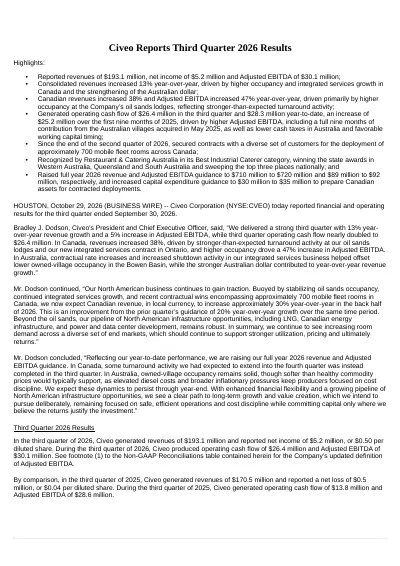
First, we had a solid third quarter, and we are raising our full-year guidance. Revenue grew by 13% year-over-year, adjusted EBITDA grew by 5%, and operating cash flow nearly doubled to $26.4 million.
On the strength of our year-to-date performance, we are raising our 2026 revenue guidance to $710 million to $720 million and our adjusted EBITDA guidance to $89 million to $92 million. The second key takeaway is Canada delivered.
Revenue in the region grew 38% year-over-year, driven by stronger-than-expected turnaround activity in the oil sands region and our integrated services contract in Ontario. Some of that turnaround work was originally scheduled for the fourth quarter and was completed in the third.
Adjusted EBITDA grew by 47%, outpacing revenue growth. The third key takeaway is available accommodation capacity in Western Canada is being absorbed.
Since the end of the second quarter, we have secured contracts with a diverse set of customers for the deployment of approximately 700 mobile camp fleet rooms across Canada. These are the first meaningful mobile fleet awards we have had in several years, and they follow a six-year lodge contract renewal we announced in July.
For the first time in several years, the conversation with customers in the region is shifting from price concessions to asset availability. The fourth key takeaway is Australia remains the cash flow foundation of the business and is operating in an unusual environment.
Metallurgical coal prices are above $250 a ton, yet our customers are behaving as they would at much lower prices because of elevated diesel costs, broader inflation, and higher royalties at these price levels are compressing margins. Our owned village occupancy is solid, just softer than we would have expected at these commodity prices.
We expect that to persist through the end of the year and into 2027, and we are managing the business accordingly. I'll start with our operational results for the quarter.
On a consolidated basis, the third quarter results exceeded our expectations, driven by Canada. Adjusted EBITDA was $30.1 million, up 5% year-over-year, with the Canadian improvement and a stronger Australian dollar more than offsetting softer occupancy at our Australian owned villages.
Going to the regions, in Australia, revenue increased 4% year-over-year in U.S. dollars entirely as a result of stronger Australian dollar.
In local currency, the revenue declined approximately 4%, reflecting lower occupancy in our Bowen Basin villages, partially offset by contractual rate increases across our integrated services contracts and increased shutdown activity. Our integrated services business continues to perform well and remains on track toward our goal of a run rate of A$500 million in annual services revenues by the year-end 2027.
The owned villages business is well-contracted and continues to generate strong cash flow, but we are not seeing activity levels that we would expect from customers at these coal prices, and I'll come back to why in the outlook section. Lastly, Civeo was recently recognized by Restaurant & Catering Australia in the Industrial Catering category, winning the state awards in Western Australia, Queensland, and South Australia, and sweeping the top three places nationally.
Taking care of people with a safe environment, welcoming service, and award-winning food sets Civeo apart. Moving to Canada, billed rooms increased 35% year-over-year.
Turnaround activity in our oil sands lodges was stronger than anticipated, and our Ontario integrated services contract contributed a full quarter of revenues. The cost structure we reset in 2025 is holding as volume returns.
Adjusted EBITDA was up 47% on 38% increase in revenue, even as our revenue mix shifted towards integrated services, which carries inherently lower margins. Now turning to the macro environment, in Australia, the met coal price is supportive, but customer behavior is being driven by costs rather than revenue.
In Canada, oil sands producers remain disciplined, but activity has been steadier than many expected, and infrastructure spending momentum in the country is increasingly tangible. LNG Canada's Phase 2 final investment decision was an important first step for projects of national interest in Canada, and we are optimistic that other infrastructure will similarly move forward in Canada and the United States.
That said, we are not in the business of forecasting FID timing. Our job is to put Civeo in the best position to support our customers when they do make those decisions.
Turning to capital allocation, we completed the April 2025 authorization to repurchase 20% of the company in July in conjunction with our convertible notes offering, and we are approximately 50% of the way through the subsequent 10% authorization. Year-to-date, we have returned $36.7 million to shareholders through repurchases, which more than satisfies our intention for 2026 under our framework of returning at least 75% of annual free cash flow.
With shareholder returns on track for the year, our capital allocation emphasis in the near term has shifted towards preparing our Canadian assets for deployment on contracts we have won and opportunities we see in front of us. That is reflected in our increased capital expenditure guidance, which I'll discuss in the outlook section.
We will remain opportunistic on repurchases, but our priority right now is putting assets to work at attractive returns. As a reminder, we have repurchased approximately 26% of our shares outstanding since the beginning of 2025.
Stepping back, the third quarter offers an early look at what this platform can do as demand returns in Canada. Adjusted EBITDA grew faster than revenue, and operating cash flow followed.
We have a well-contracted Australian business, Canadian business with a disciplined cost structure and improving utilization, and a growing opportunity set of North American infrastructure work and the balance sheet to support all three. We believe that combination of operational readiness, capital discipline, and balance sheet flexibility positions Civeo well to create long-term value as these opportunities advance.
With that, I'll turn it over to Collin.
Collin Gerry
Thank you, Bradley. Thank you all for joining us this morning.
Looking at the income statement, today we reported total revenues in the third quarter of $193.1 million compared to $170.5 million in the third quarter of 2025, an increase of 13%. Net income for the quarter was $5.2 million, or $0.50 per diluted share, compared to a net loss of $0.5 million, or a net loss per share of $0.04 in the prior-year period.
During the quarter, Civeo generated adjusted EBITDA of $30.1 million compared to $28.6 million in the third quarter of 2025, an increase of 5%. Operating cash flow was $26.4 million compared to $13.8 million in the prior-year period.
The $22.6 million year-over-year increase in consolidated revenue was driven primarily by Canada, which contributed $17.6 million of the increase on higher lodge occupancy and the Ontario integrated services contract. The remaining approximately $5 million came from Australia, where the stronger Australian dollar added approximately $9.6 million to reported revenues and more than offset a decline in local currency revenue.
Adjusted EBITDA increased $1.4 million year-over-year. Canada contributed $3.5 million of improvement, and the stronger Australian dollar added approximately $1.7 million.
These were partially offset by lower adjusted EBITDA in Australia on a constant currency basis, reflecting the lower occupancy on our higher-margin owned villages in the Bowen Basin that Bradley discussed. Let's now turn to the third quarter results for our two segments.
I'll begin with Australia. Third quarter revenues from our Australian segment were $129.5 million, up 4% from $124.5 million in the third quarter of 2025.
Adjusted EBITDA was $23.2 million compared to $25 million in the prior-year period. The stronger Australian dollar increased revenues and adjusted EBITDA by $9.6 million and $1.7 million, respectively.
In local currency, Australia revenue declined approximately 4%. Lower occupancy in our Bowen Basin villages was partially offset by contractual rate increases across our integrated services contracts and increased shutdown activity in that business.
Integrated services revenue was $73.1 million, up 11% in U.S. dollars and up approximately 2% in local currency.
Australian owned village billed rooms in the quarter were approximately 669,000 compared to approximately 763,000 in the third quarter of 2025. Our average daily rate for Australian owned villages was $84 compared to $77 in the prior-year period, with the increase primarily reflecting the stronger Australian dollar.
In local currency, rate was up approximately 2%. Turning to Canada, third quarter revenues were $63.6 million compared to $46 million in the third quarter of 2025, an increase of 38%, or approximately 40% in local currency.
Adjusted EBITDA was $11.1 million compared to $7.6 million in the prior-year period, an increase of 47%. The year-over-year increase in revenues was driven by higher occupancy at our oil sands lodges, reflecting stronger-than-expected turnaround activity and the new integrated services contract in Ontario.
Adjusted EBITDA grew faster than revenue, reflecting higher occupancy against the cost base we reset in 2025, partially offset by revenue mix that shifted towards integrated services, which carries lower margins by nature. Canadian billed rooms totaled approximately 516,000 compared to approximately 383,000 in the prior-year quarter, an increase of 35%.
Our average daily rate was $97 compared to $100 in the prior-year period, primarily reflecting the mix of turnaround-related volume at contracted rates. As Bradley noted, utilization in the region is improving, and we have now contracted approximately 700 mobile fleet rooms for deployment.
As available capacity tightens, we are approaching contract renewals and new awards with rate in mind, and we expect average daily rate to reflect that over time. Looking at our capital structure, as of September 30th, 2026, we had $126.9 million of availability under our revolving credit facility.
Total debt was $217.5 million, and net debt was $196 million, an increase of approximately $5 million from June 30th, reflecting the share repurchase completed concurrent with the convertible notes offering, partially offset by cash generated from operations. Our total net leverage ratio was 2.1 times.
As a reminder, in July we issued $115 million of 4.5% convertible senior notes due 2031. The notes replace higher-cost, floating-rate revolver borrowings with five-year fixed-rate, unsecured capital, lowering our near-term cost of capital and giving us the flexibility to pursue the growing global opportunity set.
The conversion price is approximately $40.51 per share. Our current intent is to settle the principal in cash, and together with the concurrent repurchase of approximately 660,000 shares, the transaction is not expected to result in net share dilution unless our share price is above approximately $53 at settlement.
Turning to capital allocation, capital expenditures for the third quarter were $5.4 million compared to $5.6 million in the prior-year period, and were primarily related to maintenance spending on our lodges and villages. Year-to-date, we have invested $13.2 million in capital expenditures, down 14% from the prior-year period.
As Bradley will discuss, we expect fourth quarter capital spending to step up as we prepare Canadian assets for deployment. In July, concurrent with the convertible notes offering, we repurchased approximately 660,000 common shares for approximately $22.3 million, completing the 20% authorization and bringing the subsequent 10% authorization to approximately 50% complete.
Year-to-date repurchases total $36.7 million. We will continue to take a disciplined and opportunistic approach to capital allocation.
Our framework of returning at least 75% of annual free cash flow to shareholders through repurchases is unchanged, and we have more than satisfied it for 2026. Going forward, our focus is on maintaining the balance sheet flexibility to fund high-return deployments as contracts are awarded, without compromising our strong balance sheet or our commitment to shareholder returns.
We remain comfortable operating with total net leverage in the 2 times range. With that, I'll turn it back over to Bradley.
Bradley Dodson
Thank you, Collin. I would now like to turn to our full-year 2026 guidance, our regional assumptions for the fourth quarter, and a preliminary look at 2027.
We are raising our full-year 2026 revenue and adjusted EBITDA guidance. Updated 2026 revenue guidance is $710 million to $720 million, up from $675 million to $700 million.
Updated adjusted EBITDA guidance is $89 million to $92 million, up from previous guidance of $85 million to $90 million. We're also increasing our full-year 2026 capital expenditure guidance to a range of $30 million to $35 million, which previously was $25 million to $30 million.
The increase relates to preparing Canadian assets for deployment on tangible near-term opportunities, including the mobile fleet contracts we have secured since the end of the second quarter. As usual, we expect the fourth quarter to be sequentially lower than the third, reflecting the end of turnaround season and holiday seasonality in Canada, along with normal December seasonality in Australia.
This year, some of the turnaround work we expected in the fourth quarter was completed in the third, which is reflected in our updated guidance. Our full-year guidance also includes approximately $1 million of make-ready and mobilization expenses in the fourth quarter for new customer contracts in Canada.
The related revenue will be recognized over the term of those contracts and largely in 2027. I will now provide the regional outlooks and corresponding underlying assumptions by region.
In Australia, metallurgical coal prices are above $250 a ton, which historically would translate into expanding production, more contractor activity, and higher occupancy in our villages. That is not what we are seeing.
Our customers are operating conservatively because their cost structure has moved against them. Diesel remains elevated, labor and other input costs are inflated, and under Queensland progressive royalty regime, a larger share of each dollar at these prices goes to the state.
The result is that producers are focused on cost discipline rather than growth, and occupancy in our owned villages, while solid, is lower than these prices would normally support. For the fourth quarter, we expect owned village occupancy to be modestly softer than the third quarter, reflecting normal fourth quarter seasonality.
Our owned village portfolio remains well-contracted, and we continue to focus on mitigating inflationary pressures in our own cost base. In our integrated services business, we continue to build on contractual rate increases and shutdown activity, and we remain on track toward our goal of a run rate of A$500 million in annual services revenue by the year-end 2027.
In Canada, we expect billed rooms in the fourth quarter to step down from third quarter levels consistent with the seasonal pattern I described, and we expect revenue growth in the back half of 2026 to be approximately 30% year-over-year in local currency, up from the approximately 20% we outlined last quarter. That revenue growth is driven by continued execution in our base business, the Ontario integrated services contract, and stronger-than-expected turnaround season.
On our mobile fleet, the approximately 700 rooms we have contracted are expected to deploy in late 2026 and the first quarter of 2027, with no meaningful contribution to 2026 revenues. The capital we are expending in the fourth quarter is what gets those rooms ready to go to site.
I will now provide a preliminary outlook on 2027. In Australia, our current view is that the dynamics we are seeing today will continue into early 2027.
We're not concerned about the health of the business. It is well-contracted, generates strong cash flow, and has a growing integrated services platform.
With inflation and royalty pressure at the current met coal prices, we are not seeing the customer activity we would expect, and that situation remains volatile. We may see more of the same, and we will be in a position to better characterize 2027 on our fourth quarter earnings call.
In Canada, we expect 2027 to be better than 2026. Oil sands activity has been steadier than many expected.
Our customers are increasingly focused on securing accommodation capacity. We expect lodge occupancy in 2027 to be up compared to 2026.
We also enter 2027 with contracted mobile fleet revenue for the first time in several years. As available capacity in the region continues to tighten, we expect rates to improve, and we are approaching renewals and new awards accordingly.
We are very busy, and the mix of projects continues to shift as some slow down and others accelerate, as is the way with large projects of this kind. Our bidding activity spans LNG, Canadian energy infrastructure, mining, and power and data center-related projects.
These opportunities remain dependent on customer final investment decision, and the timing of meaningful financial contribution remains out of our control. What we can control is being ready, and that is where we are spending our time and our capital.
What differentiates Civeo is the combination of our team, our assets, our operating résumé, and our financial flexibility. We have demonstrated that we can execute remote lodging and take care of people safely and reliably at scale, including in complex cold-weather environments.
We have approximately 2,000 mobile camp rooms strategically located in Western Canada that are readily available for deployment, along with approximately 6,000 to 7,000 oil sands lodge rooms that could be redeployed for the right project. These purpose-built assets are well-suited for projects in the Northern United States, Canada, and Alaska.
We also have the balance sheet strength and financial flexibility to tailor the right solution to each customer project, whether that requires deploying existing capacity, investing incremental capital, or combining combinations with integrated services. Regarding capital allocation, our framework is unchanged.
We intend to return at least 75% of annual free cash flow to shareholders through our share repurchases. We have more than satisfied that for 2026.
We will remain opportunistic. In the near term, our priority is funding the deployment of our Canadian assets on contracted work and preserving capacity to pursue the right projects as they advance.
We remain comfortable with our total leverage ratio of approximately 2 times net leverage. Overall, our outlook reflects a resilient Australian platform operating through a cost-driven soft patch, a Canadian business with real momentum and improving utilization, and a North American opportunity set that we are now converting into contracted work.
We remain focused on operating safely and efficiently, managing costs prudently, and allocating capital to the highest-return opportunities as we position Civeo for long-term growth and value creation. We will now open the call for questions.
Operator
Thank you. If you'd like to ask a question, please press *1 on your telephone keypad.
A confirmation tone will indicate your line is in the question queue. You may press *2 if you'd like to remove your question from the queue.
For participants using speaker equipment, it may be necessary to pick up your handset before pressing the star keys. To allow for as many questions as possible, we ask that you each keep to one question and one follow-up.
Thank you. Our first question comes from the line of Stephen Gengaro with Stifel.
Please proceed with your question.
Stephen Gengaro
Thanks. Good morning, everybody.
Bradley Dodson
Morning.
Stephen Gengaro
I like the evening release, by the way. It's efficient.
I think my first question, it's not surprisingly, but when you are looking at these incremental opportunities to put rooms to work, and you've kind of laid it out well in your presentations, what type of terms and kind of economic paybacks should we be thinking about? Is there any big difference between the different end markets when it comes to what you're seeing in the bidding process?
Bradley Dodson
Thank you for the question. I'll lead off and then ask Collin to add some color.
In terms of the economic returns, we mentioned that we increased the CapEx guidance. We have some expenses in the fourth quarter getting the mobile camps ready to go on the contracts that we've won.
All that expenditure, whether it be the mobilization costs that go through the P&L or the incremental CapEx to get the assets ready, will all be captured well within the contract with less than a one-year payback. The revenues typically come through on a pro rata basis over the term of the contract.
As it relates to term on the mobile camps, typically these are being mobilized for two to three years for most projects, although one of the projects we won is a short-term project. It's a nice little payback for a winter drilling program, but it has the opportunity that they may keep the assets for another year after that.
The economics on the initial drilling season project in Canada hold together, and we've got upside if the project gets extended. In terms of rate, I'll be quite honest, we're agnostic to the end market.
The mobile camps in particular, they're great for construction projects. They're great for remote construction projects where you need to house 300 to 1,000 people in a location where you don't have the housing infrastructure there.
Now the customer pays for the mobilization of the assets, the installation of the assets, they rent the assets for the term of the contract, they pay for the hospitality services while the people are staying there, and then they pay for the demobilization. For shorter-term projects, that can be expensive on a per-person, per-day basis.
I would say we're agnostic, as Collin put in his comments, that the market is tightening up. We've put 700 rooms, or will be putting 700 rooms to work.
We've got another 2,000 mobile camp rooms that we can and are ready to deploy. That first 700, it starts to tighten things up.
When you see things like the Coastal GasLink pipeline and its FID and that moving forward, there are other pipeline projects that are in play, whether it be PRGT or PacificLink. This will tighten up the market and it has to head towards new build pricing.
Other players in the market have said that from where we are today to new build pricing, prices need to double. I think they need to at least double.
There's upward bias to pricing on mobile camp rooms. In terms of the end market, I'll ask Collin to provide some color.
I don't see a material difference between pricing whether it's on a mining project or on a pipeline or on another infrastructure project, because the assets are fungible, we're going to price them accordingly. I'll let Collin comment.
Collin Gerry
Thanks, Bradley. I agree wholeheartedly.
We love all our customers and regardless of what the end market is, pricing is the same. I would say just a little bit of supplement to what you said is economics and pricing is a function of commitment.
Longer-term commitments are going to have better pricing and better economics from the customer perspective. Shorter-term work tends to carry higher prices.
The only other supplement I'd add is that as we mentioned, the first 700 beds have been contracted here. In all transparency, the underlying economics within those contracts are not reflective of where we think the market's going, rather a little bit closer where the market's been.
We are kind of in the middle of transition. We need demand to continue and utilization to continue to tighten to see that dynamic where you see economics improve that Bradley mentioned.
Stephen Gengaro
Great. Thanks.
I might have missed this, I apologize, but remind me, there's 2,700 mobile rooms, of which 700 just got contracted. Then what other incremental capacity do you have that's deployable?
Collin Gerry
Bradley, I'll take a shot.
Bradley Dodson
6
Collin Gerry
Yeah, go ahead, Bradley.
Bradley Dodson
No, go ahead, Collin.
Collin Gerry
I was going to say it's 6,000 to 7,000 installed lodge rooms that have a variety of different installation base. Some of those are single-story, or a small fraction of those are single-story that can be mobilized and kind of taken off the lodges.
Others are triple-story, which are more advantageous with projects that have footprint constraints. That's the additional capacity on top of the 2,700 mobile fleet beds that's kind of in the yard, to speak.
Stephen Gengaro
Great. Thanks.
I'll get back in line here. Thanks for the details.
Operator
Thank you. Our next question comes from the line of Jim Rollyson with Raymond James.
Please proceed with your question.
Jim Rollyson
Hey, good morning, everyone. Just following up with Stephen's questions.
Bradley, if new builds are double plus in pricing relative to kind of where you've been running, I presume the remaining couple thousand mobile rooms and the 6,000 to 7,000 lodge rooms would go at some price level in between today and double plus. Maybe just kind of help think through how you approach pricing as you scale the existing rooms out first, assuming all the demand actually comes through as we expect.
Bradley Dodson
It's a good question. I think Collin alluded to it, and made a very good addition, which is term matters.
If we've got a mobile camp opportunity where it is shorter term, that's going to be pricier. One, the mob and demob on a per-person, per-day basis is going to be a higher percentage of the total cost to the customer.
As we think about pricing, as we've said in the past, look, the sooner that customers commit to rooms, the better pricing they're going to get. As Collin alluded to, these are good pricing.
It's in line with what we've talked about before. The mobile camp work, typically in a softer market or kind of a middle market, is about a 20% margin.
If you look back at our historical results, particularly as the assets stay out on rent longer, in other words, the project takes longer to complete or has an extension, those margins can go to 35%. I can't predict exactly where pricing's going to go.
It certainly has an upward bias, and customers that come with longer-term opportunities in the near term are going to get better pricing. Look, as we've said in the past, the Coastal GasLink project is probably a 2,000 to 3,000-bed project in totality.
That's not to say that we're going to win all that. Obviously, we just said we only have 2,000 beds of mobile camps.
We can't win all that. I don't expect us to win all of that.
Just as that moves forward, that tightens up the market significantly, both us and our competitors. You look at PRGT, that needs 7,000-plus beds.
That in and of itself, based on what I think is out there publicly, absorbs all the available mobile camp rooms in Western Canada. Those two projects alone, before you even start talking about an additional pipeline or other infrastructure projects, will tighten up the market.
First in the door with term is going to get better pricing. Collin, do you have anything you want to add?
Collin Gerry
No, I would just supplement that it's been a long time, and quite frankly, I don't know if I can remember over the past 12 years an environment like this where we're kind of having to think along those strategic lines that we just described, Jim. As this market evolves, I think as Bradley was pointing to, if all these projects or kind of only a portion of the projects go at the same time, almost by definition, the industry is into a new build cycle.
It'll be really interesting to see how that plays out. We talk about it strategically a lot, like what is our strategy for pricing and seeking term and which projects are we going after, and we'll have more color for you on that as 2027 evolves.
At the end of the day, I do want to also highlight a lot of this stuff is FID-dependent, the demand does need to materialize in the way that many of us in the industry are seeing right now.
Jim Rollyson
The big picture trends from the way behavior in Canada has shifted would seem to be lining up for that to happen. Maybe the folks in Alaska need to get their act together or they're going to be looking at new build pricing.
Just switching gears for a minute, data centers in the U.S. haven't really been a big part of your business just because you haven't been down in the U.S.
much, and some of your competitors that have capacity there have been kind of soaking up all that work. As that runs out of capacity, just kind of curious to get an update on what you're seeing on that side, given that seems like that is also going towards new builds just because of capacity constraints.
Bradley Dodson
Collin, do you want to take the lead on this?
Collin Gerry
Sure. The U.S.
market has been exceptionally dynamic over the past, call it, nine months, going from kind of 0 to 120 miles an hour, then back to 30 and 90 and in between. Not a week goes by that we don't have some portion of our bidding and pursuits team laser-focused on a new U.S.
opportunity of material size. We're in the market.
We're talking to people about it. I would characterize the market though as a little bit chaotic, if I'm being totally honest.
I think a lot of the existing capacity was absorbed at good prices for the customers. The customers got a good deal, and so did the providers.
Now we're into a new build cycle, as you pointed out, Jim, in the U.S. I think there's also a lot more competition coming out of the woodwork.
It's very idiosyncratic to certain projects. We're seeing terms and conditions that might not meet our standards in some cases going around, but then in other projects they're very attractive.
As is very clear, we haven't won anything. We are in the market.
It would likely require us to build some new build capacity in the U.S., because I think our Canadian fleet's probably better left chasing the work that's in front of it in Canada. This has been the proverbial Lucy and the football for us for the better part of the year.
It's still exceptionally vibrant and very active. We're going to try to win some stuff here, but certainly no promises.
I don't know, Bradley, if you have anything to add to that.
Bradley Dodson
No, I think that's right. Look, our competitors that have won work have done a really good job.
Many of them had assets that were from a proximity basis either in the data center market or adjacent to, and mobilization of our assets while they're modular, putting them on a truck and shipping them thousands of miles is very feasible. It's very doable, but it has a cost.
We've been at a transportation disadvantage. As Collin mentioned, based on what we see, we think most of the available capacity, existing capacity, has been absorbed, and so the data center market is headed towards new build pricing.
Our assets, because of location and, quite frankly, the manner in which they're constructed and operated, are much better in colder climates. Our focus has been mostly on the Northern U.S.
We'll continue to bid on Texas work. As Collin mentioned, that may be new build assets for us.
We have relationships with the manufacturers to purchase those, should we get a contract, but it will be with a contract. We will not be doing it speculatively.
We continue to follow it. I think you've seen it in the press, there have been, for every 10 opportunities, probably eight of them have not materialized as it relates to data centers for one reason or another, whether it be permits, whether it be water availability, power availability, etc.
Then, obviously, we've got November 3rd right here upon us, and there are a lot of ballot items that are questioning whether the local municipalities want to have these projects. We continue to follow it.
It's a huge opportunity. I think from here it's going to move slower than anticipated, but it's a material opportunity for us, and we're pursuing it.
Jim Rollyson
Appreciate all the color, guys. Thanks.
Operator
Thank you. Our next question comes from the line of Greg Gibas with Northland Securities.
Please proceed with your question.
Greg Gibas
Hey, good morning, Bradley, Collin. Thanks for taking the questions.
Congrats on the results. Wanted to maybe just follow up quickly on the timeline for deployment for those 700 mobile fleet rooms that you secured contracts for, and wondering if you could perhaps discuss the puts and takes of the guidance increase, and then how that accounts for that incremental deployment versus maybe continued softness in Australia versus underlying strength with oil sands.
Anything you can kind of discuss there would be helpful.
Bradley Dodson
I'll lead off, and then ask Collin to correct and amplify my comments. In terms of third quarter to fourth quarter, as we put in the prepared comments, we did see some Canadian turnaround activity be pulled forward into the third quarter from what we had originally expected in the fourth.
In addition to that, in our prepared comments, we said we have about $1 million of expenses that are related to these mobilizations of the mobile camps. The fourth quarter is going to be softer than we thought 90 days ago.
That was really pulled into the third quarter, and is reason one. Reason two is a good reason, which is we're deploying mobile camp rooms.
In terms of the puts and takes in the fourth quarter and going into 2027, I think in the fourth quarter it's fairly locked in. I think as it relates to mobilization expenses, the team does a great job.
I'm not terribly worried about there's going to be additional costs we weren't anticipating of any material size. Those assets are going to work.
I can think of, Greg, one one in particular, it's mobilizing as we speak. A second one is mobilizing as we speak.
Some of them are starting in November, because that's when the, as I mentioned earlier, one of them is a drilling project. That's going to be one that will take advantage of the winter drilling season in Canada.
I expect that certainly by mid-first quarter, those 700 will be out and working. Puts and takes in the fourth quarter, I don't worry about occupancy at the lodge and village level of any material basis.
It could be plus or minus 3%, but I think we're pretty locked in on near-term occupancy. Going into 2027, puts and takes on the base of operations, in Canada, it's always turnaround activity.
Also in Canada, we do, as Collin mentioned, we mentioned in our prepared comments, the funnel of opportunities to put mobile camps to work is significant. It'll be a matter of, as we mentioned, when they reach FID.
Once they reach FID, accommodations is usually something that gets contracted fairly shortly thereafter, because it then becomes a fairly significant gating item to starting the projects. I think that will be key to Canada.
I think what it's really doing, particularly as it relates to some of these infrastructure projects, I see more wins in 2027. I think that they will have some revenue in 2027, but what it's really doing is setting up 2028 to be a stronger year.
As it relates to Australia, I think from where we are right here, we're going to see some continued softness relative to what you'd expect given met coal prices. That will likely continue certainly for the first half of 2027.
We'll continue to refine our picture as we give formal guidance on the fourth quarter call in February. Then in Australia, we've got the bidding activity on integrated services is very strong in terms of the opportunity set.
We do believe we're going to achieve our 5-5-5 plan and reach $500 million of annual run rate revenue in 2027. Then it's going to be controlling costs in Australia.
Unemployment is still tight. Inflation is still there.
We're a labor-intensive business. Getting people, retaining people is key.
That's what I see the puts and takes, and I'll let Collin add some color.
Collin Gerry
I'll add a little bit of color. In Canada, I agree with everything that Bradley said as it relates to the fourth quarter.
I'll just remind our listeners that December in both regions is a rough month for us. We have particularly in Canada where you have higher utility bills with the weather, and occupancy does go quite a bit lower over the holidays.
That's an annual issue. As I think about 2027, the only thing I would supplement is that as Bradley said in his prepared marks, we are expecting in Canada the lodges to be up.
I would characterize that as more of a baseline level of occupancy. That's not necessarily driven by turnarounds.
We had a pretty decent turnaround year this year. In fact, the strength in the third quarter of this year, as we pointed out, was largely turnaround-driven.
The lodges will be up, and that's driven by baseline occupancy. The variable and the unknown is what do turnarounds look like in Canada versus this year.
If they're similar in size and scope that we saw this year, then the lodge occupancy will be nicely up, if not, only modestly up. We'll refine that, and we're going to work with our customers to understand their plans as we go into 2027.
I think in almost all cases, we expect the lodge occupancy to be up, which is certainly a positive trend. In Australia, I agree with everything Bradley just said, particularly on our own villages, that kind of dislocation between met coal prices and our occupancy lingering a little bit longer than we had hoped and expected.
I would also point out that we've got a great team in Australia. They've been growing the revenue side on the integrated services side so well the last 45 4 to 5 years, and there's still a very robust market set of opportunity out there.
The awards that we just announced today speaks to the customer relationships and the operational kind of integrity and how we attack the market. I think that that is yielding a lot of results, and we're getting a lot of attention from customers.
We're really proud of that team, and really excited of where we're going to take that over the next 2 or 3 years.
Greg Gibas
That's helpful. Appreciate the details there.
You maybe beat me a little to it, but wanted to ask, just as it relates to the owned village occupancy in the Bowen Basin, clearly remaining softer despite what healthy commodity prices would dictate normally. Could you just maybe speak to what you're hearing from the customer base, kind of add some context to their thinking?
Perhaps remind us the nuances of timing as it relates to producer budget time frames in Australia, and perhaps how quickly you would expect these customers to move if there was a demand driver unlock like diesel prices?
Bradley Dodson
Good question. The what we're seeing right now in many cases is we're not losing work.
We're not losing market share in Australia. What you have as a hypothetical or an an illustrative example, we'll have a customer who's got a contract, a multiyear contract for 500 beds, and but they've been running at 600 because they have the need for it and they've been taking the extra 100 beds at at casual rates, which are higher.
You're seeing because of the inflationary pressure, maybe they cut back 20 or 30 or 50 beds out of out of that incremental 100 above their contracted level. That's what we're seeing.
They're not These these people are not going to a competitor. The customer's not going to a competitor.
They're staying with us. They are contracted in many cases on a multiyear basis.
They're just trimming on the edges. We've got a a bunch of great customers, and right now the the mentality is is everyone's trimming.
As many will know, Australia is on a June to June fiscal year. To your point, we'll start seeing what 2027 looks like as we get into March, April of next year as they finalize their budgets for their fiscal June 2028.
We'll have better color as we go into probably the the certainly we might have some color on the first quarter '27 call, certainly have better color on the second quarter call, our second quarter call. There are growth projects with our customers.
They are looking they're not putting pencils down, but right now I think it makes complete sense. It it's not the environment to to push the accelerator right now, because met coal prices are good, but that's a a printed rate for top-rate quality met coal.
Not all of them have that, not all of them not all of them realize that price. The the biggest pieces are are really a double whammy between inflation broadly defined, which is diesel is a huge piece of it, but there's also wage inflation, etc., that's impacting them.
The second piece is royalties. The royalty regime in Queensland was changed, which is where the Bowen Basin is, was changed back in 2022, if I recall correctly, and it it significantly increased the royalty rates, and our our customer base has been very vocal about that and how that's impacting them.
I think this is a soft spot. It will, as you pointed out, likely continues through the first half of the year.
Then we'll see if if the if there are other factors that that impact things. If inflation starts to come in in a little bit, that will be helpful.
If there's some relief on diesel prices, that would be helpful. That would be a big help if we can see some moderation in diesel prices.
I think that would And and and really it's not just, okay, diesel prices have come in, it's it's the customers believing that they're going to stay there is the other piece.
Greg Gibas
Yep, good to hear. Thanks, guys.
Appreciate it.
Bradley Dodson
Thank you.
Operator
Thank you. Our next question comes from the line of Steve Ferazani with Sidoti & Company.
Please proceed with your question.
Steve Ferazani
Morning, everyone. Bradley, covering you for a while, this is the most optimistic I've heard you on Canada, and that excludes even the mobile camp opportunities.
Obviously, the turnarounds were much healthier. I know you don't have a ton of visibility going into the quarter, but certainly much healthier than we were modeling.
It sounds like you're optimistic for occupancies next year. I can speculate on the obvious reasons for this, but I just want to hear from you in terms of how much is that higher oil prices driving greater activity?
They have more cash flow, they can go ahead with turnarounds, and maybe they were larger turnarounds they were pushing off previously. You have the other piece of clearly there's oil sands consolidation going on.
Can you talk about those two factors and how that might be influencing what you're seeing in terms of turnarounds and occupancy?
Bradley Dodson
I think the turnarounds this year, part of it is we had a strong turnaround with one customer in particular. Most of the customers are trying to extend their turnaround time, it used to be that everybody would do a turnaround every year of varying degrees.
Some customers would alternate between a big turnaround one year and a little bit smaller one the next. A lot of them are trying to push that out to either an 18-month cadence or a two-year cadence.
That's the piece, as we go into 2027, we've got to understand better. I think oil prices are certainly helpful.
It's certainly helpful to their P&Ls and their cash flows. I don't believe that that is something that is truly driving spending right now.
I think what's driving spending right now is renewed optimism in the overall industrial complex in Canada and reinvesting in Canada. While it's very early days to see if there's more egress capacity that can be constructed and implemented that really gives the oil sands customers comfort, belief that they can increase production and they will be able to get it to market, I think that's the next piece that will really drive things.
Near-term oil prices at higher levels are always helpful. I don't think that's necessarily what's driving things right now.
I think it's, again, trying to get prepared, increased optimism on the long term, and in some customer-specific things as they work to improve their production. I do think Collin really characterized it really well, which is a lot of this is baseline improvement, and then that gives us optimism on occupancy at least being modestly up from here in Canada next year.
Then if turnaround activity is equal to stronger next year than this year, then that would be additive.
Steve Ferazani
Got it. That's very helpful.
Flipping over to Australia, it sounds like there's two very different markets going on. I know that your integrated services is more tied to Western Australia, different commodities, but same inflationary pressures.
Clearly, you're way more optimistic and you're having more success in Western Australia. You mentioned the royalty structure impact.
Just why is Western Australia, you're getting the contracted rate increases, you see opportunities to grow that versus what you're seeing in the Bowen Basin?
Bradley Dodson
It's a good question, and we should clarify. We get annual rate increases related to CPI in both the services business and in our owned villages.
It was just our prepared comments were really hitting on that it was fairly notable in terms of that being part of the pickup in the services revenues. The opportunity set for the service business, you are exactly right, the majority of our services business in Australia does come out of WA, but we're starting to diversify that.
We had won previously and are operating in South Australia. We've won our first contract in the Northern Territory, we'll be entering into that market.
We recently won our first services contract in Queensland, which is working for a customer we've worked for for a long time on the owned villages side. The opportunity set is across that.
I would actually say that of the near-term opportunity set, most of it's outside of Queensland in terms of potential total contracted value. Continuing to diversify that business.
I think the catering awards are going to help, because we beat out the big guys. We beat them head-to-head on culinary capability.
There are kind of three or four things that we can do really well to take care of people: make sure they've got a safe, clean environment, they've got good food, and a service level and a safety level that the customer appreciates. This is a, if you will, a third-party validation of at least one component of that.
I think that's going to help us in the marketing going forward.
Steve Ferazani
On that side, it's not necessarily that activity has to increase. It's a lot of its market share gains and new awards and winning contracts.
Bradley Dodson
That's right. Certainly on the services side.
Steve Ferazani
Yeah. Thanks, Bradley.
Bradley Dodson
Thank you.
Operator
Thank you. Once again, if you'd like to ask a question, it's *1 on your telephone keypad.
Our next question comes from the line of Dave Storms with Stonegate Capital Partners. Please proceed with your question.
Dave Storms
Morning, and thank you for taking my questions. Just want to maybe start with the Canada integrated services and the margin profile there.
I know it increased quarter-over-quarter, but is still down compared to historical levels. Just curious as to how much of this is maybe still Ontario ramping, or if there's anything else in there that we should think about.
Bradley Dodson
It is Ontario ramping. We're working to get our feet underneath us there, and expect that by the first quarter we should see certainly improvement in the first quarter and better in the second quarter as we get our feet underneath us there.
It is specifically Ontario, and us not being our best. Some of it is contract-related.
Some of it is performance-related.
Dave Storms
Understood. Appreciate that.
Then maybe sticking with integrated services, but moving to Australia. Collin, I know you mentioned that you guys have a couple of initiatives that you want to roll out, but when we're just thinking about the mechanics to get to that 5-5-5 plan, is the priority there going to be on maybe higher spend per room?
Is it going to be more rooms taking advantage of the integrated services, as, obviously with room growth, you get closer to that goal? Just trying to think about the logistics that you hope to accomplish over the next five quarters to reach that.
Bradley Dodson
Sorry, go ahead, Collin. Oh,
Collin Gerry
I think we might need one point of clarification. The 5-5-5 plan is unique to the integrated services component of Australia, and does not include the owned villages.
With that, really it's about winning new work from existing and new customers who are either developing or retendering or growing their existing operations in the various parts of Australia. As somebody else pointed out earlier, our kind of bedrock of that business has been in Western Australia.
As Bradley was pointing out, we have been pretty successful here recently making inroads into other regions of Australia, including for the integrated services side, including our backyard in Eastern Australia, but also the South and the North. It's really about new contracts with existing and new customers.
The room count conversation is more something that is associated with our owned villages. I think I'm planning to answer your question correctly, but if I misinterpreted, maybe there's some clarification.
Dave Storms
No, that's perfect. Thank you for taking my questions, and good luck in the next quarter.
Operator
Thank you. Ladies and gentlemen, that concludes our question-and-answer session.
I'll turn the floor back to Mr. Dodson for final comments.
Bradley Dodson
Thank you. Thank you all for joining the call today.
We really appreciate your interest in Civeo, and look forward to speaking to you on the fourth quarter and full-year 2026 earnings call in early 2027. Take care.
Operator
Thank you. This concludes today's conference.
You may disconnect your lines at this time. Thank you for your participation.