CVRx, Inc.
NNASDAQ:CVRXQ1 FY2026 · Earnings Call TranscriptMay 11, 2026
Operator
Reminder, this conference is being recorded. It is now my pleasure to introduce your host, Mike Vallie from ICR Healthcare.
Thank you, you may begin.
Mike Vallie
Good afternoon. Thank you for joining us today for CVRX's first quarter 2026 earnings conference call.
Joining me on today's call are the company's president and chief executive officer, Kevin Hykes, and chief financial officer, Jared Oasheim. The remarks today will contain forward-looking statements, including statements about financial guidance.
These statements are based on plans and expectations as of today, which may change over time. In addition, actual results could differ materially due to a number of risks and uncertainties, including those identified in the earnings release issued prior to this call and in the company's SEC filings.
I would now like to turn the call over to CVRX's president and chief executive officer, Kevin Hykes.
Kevin Hykes
Thanks, Mike. Good afternoon and thank you for joining our first quarter 2026 earnings call.
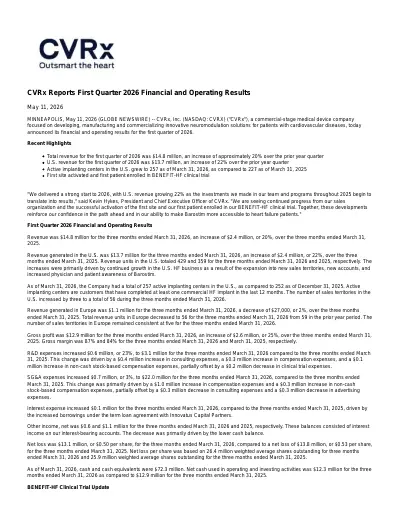
We delivered a strong start to 2026, exceeding the high end of our guidance range, driven by 22% growth in the United States. The investments we made throughout 2025 are beginning to positively impact our results.
Last year, we worked deliberately to strengthen our sales organization, refine our go-to-market approach, advance critical reimbursement initiatives, and to secure approval for our landmark clinical trial. This quarter shows early evidence that the foundation we have built is translating into results.
As we move through 2026, we remain focused on executing against the same three strategic priorities that have guided our work to date: building a world-class sales organization, driving deep adoption in targeted centers, and continuing to reduce the barriers to adoption of Barostim therapy. Starting with our sales organization, we're pleased with the progress we're seeing from the team.
We're seeing meaningful contributions from a broader and more experienced sales team, reflecting the quality of talent we've been able to attract, the discipline we've brought to onboarding and training, and the program-focused selling approach that the team is increasingly comfortable executing. We continue to expand both our active implanting center base and our territory footprint during the quarter, and we expect to maintain this cadence of expansion through the balance of the year.
Our second priority is driving deep adoption in the centers we've targeted. Our program-focused playbook emphasizes intentional targeting, building a redundant network of clinical and administrative stakeholders, and establishing a defined Barostim workflow.
In the accounts where all of these elements are in place, we're seeing Barostim becoming part of how heart failure is routinely managed, rather than an episodic consideration, resulting in higher utilization. This remains the foundation for the long-term growth of our business.
Our third priority is continuing to address the three fundamental barriers to the adoption of Barostim therapy: patient access, therapy awareness, and clinical evidence. We made meaningful progress on all three fronts in the first quarter.
Starting with patient access, the transition to Category I CPT codes, which took effect on January 1st, is the most significant reimbursement advancement in our company's history, and we're already beginning to see its impact. Our 30-day Medicare Advantage prior authorization approval rate for submissions managed by our in-house market access team was 46% for the first quarter of 2026, as compared to 31% in 2024 and 44% in 2025.
Within the quarter, our approval rate was 50% through the first two months before declining in March. While we are encouraged by the underlying year-over-year improvement tied to the new Category I code, the March softening reflects the impact of simultaneous changes in the broader reimbursement environment that are affecting our company and others across the medical device industry.
Effective January 1st, new regulations require Medicare Advantage payers to respond with a decision to a prior authorization request within 3 or 7 days, depending on urgency, as compared to the previous 14-day requirement. As a result, certain payers implemented new automated review processes beginning in late February in response to these compressed timeline requirements.
This has resulted in a higher rate of initial denials, particularly in March, on the basis of an experimental designation, even for therapies with established Category I codes and well-documented clinical evidence. Importantly, this is not a reflection of a change in the clinical or coverage rationale for Barostim.
This is a new administrative dynamic that is being seen broadly across the device industry, which is not unique to our therapy. We believe that this is simply a timing issue and not a change to the ultimate approval rates, because when our market access team appeals these decisions with additional clinical documentation, most of the initial denials are overturned successfully.
While the underlying coverage position for Barostim has never been stronger, our goal is to adapt to this changing environment and to ensure that every submission meets this increasing administrative scrutiny on the front end. Our market access team is implementing this approach with patients and providers through our in-house prior authorization service, as well as supporting physician practices with their independent prior authorization efforts to ensure that they effectively navigate this changing environment.
We believe the long-term trajectory for patient access remains strongly positive, and we expect these payer processes to continue to normalize as the industry adjusts to the new regulatory framework. As it relates to therapy awareness, we continued to expand our medical education efforts during the quarter, with a particular focus on the advanced practice providers who manage most of our indicated heart failure patients in the community.
We also had a meaningful presence at several important cardiology meetings during the quarter, including multiple presentations at the THT and ACC meetings that reflect the growing body of clinical evidence supporting Barostim. These engagements continue to drive strong interest in Barostim therapy among the clinicians who are best positioned to identify candidates for treatment.
Additionally, shortly after the first quarter, we piloted our first educational symposium focused on nurses in community cardiology practices, extending our outreach beyond advanced practice providers to the registered nurse coordinators who also play a key role in managing heart failure patients in the community. In terms of clinical evidence, the recently initiated Benefit-HF trial is a landmark randomized controlled trial evaluating Barostim in an expanded population of heart failure patients with ejection fractions up to 50% and NT-proBNP levels up to 5,000.
If successful, this trial would expand our prevalence-based addressable market from approximately 339,000 patients today to over 980,000 patients, effectively tripling our market opportunity to approximately $30 billion. I'm pleased to share that we activated the first site in our Benefit-HF trial in the first quarter and enrolled our first patient last week.
The feedback from the heart failure community on the rigor and scale of the trial design has been very positive. Beyond the clinical objectives of the trial, we're seeing meaningful engagement from centers that are interacting with us for the first time because of Benefit-HF, which we believe will contribute to broader awareness and visibility for Barostim therapy.
To wrap up, the first quarter reflects positive momentum across every part of our business. Our sales team is executing, the reimbursement environment is improving, and our clinical evidence program is advancing on schedule.
We remain focused on continuing to execute through the balance of 2026, and we're confident in the path ahead. Now, I'd like to turn the call over to Jared for a financial review.
Jared Oasheim
Thanks, Kevin. Unless otherwise stated, year-over-year comparisons are for the three months ended March 31st, 2026 compared to the three months ended March 31st, 2025.
In the first quarter, total revenue generated was $14.8 million, an increase of $2.4 million or 20%. Revenue generated in the US was $13.7 million, an increase of $2.5 million or 22%.
Revenue units in the US totaled 429 and 359 for the three months ended March 31st, 2026 and 2025, respectively. The increases were primarily driven by continued growth in the US heart failure business as a result of the expansion into new sales territories, new accounts, and increased physician and patient awareness of Barostim.
We ended the quarter with a total of 257 active implanting centers, as compared to 252 as of December 31st, 2025. We had 56 sales territories in the US at the end of the quarter, compared to 53 at the end of 2025 and 45 on March 31st, 2025.
Revenue generated in Europe was $1.1 million, a decrease of $27,000 or 2%. Total revenue units in Europe decreased to 56 from 59 in the prior year period.
The number of sales territories in Europe remained consistent at 5. Gross profit was $12.9 million for the three months ended March 31st, 2026, an increase of $2.6 million or 25%.
Gross margin increased to 87% compared to 84% a year ago. Gross margin was higher due to an increase in the average selling price and a decrease in the cost per unit, primarily due to an increase in manufacturing efficiencies.
R&D expenses increased $0.6 million or 23% to $3.1 million compared to the prior year period. This change was driven by an increase in consulting expenses, compensation expenses, and non-cash stock-based compensation expenses, partially offset by a decrease in clinical trial expenses.
SG&A expenses increased $0.7 million or 3% to $22 million compared to the prior year period. This change was primarily driven by an increase in compensation expenses and non-cash stock-based compensation expenses, partially offset by a decrease in consulting expenses and advertising expenses.
Interest expense increased $94,000 to $1.6 million compared to a year ago. This increase was driven by the increased borrowings under the term loan agreement with Innovatus Capital Partners.
Other income, net, was $0.6 million compared to $1.1 million. These balances consisted of interest income on our interest-bearing accounts.
The decrease was primarily driven by the lower cash balance. Net loss was $13.1 million or 50 cents per share for the first quarter of 2026, compared to a net loss of $13.8 million or 53 cents per share for the first quarter of 2025.
Net loss per share was based on 26.4 million weighted average shares outstanding for the first quarter of 2026 and 25.9 million weighted average shares outstanding for the first quarter of 2025. As of March 31st, 2026, cash and cash equivalents were $72.3 million.
Net cash used in operating and investing activities was $12.3 million for the three months ended March 31st, 2026, as compared to $12.9 million for the three months ended March 31st, 2025. Now turning to guidance.
For the full year of 2026, we continue to expect total revenue between $63 million and $67 million. We now expect full-year gross margin between 85% and 87%.
We continue to expect operating expenses to be between $103 million and $107 million. For the second quarter of 2026, we expect to report total revenue between $15.1 million and $16.1 million.
With that, I'll now turn the call back over to Kevin for closing remarks.
Kevin Hykes
Thank you, Jared. The first quarter reflects a strong start to the year and gives us confidence in the path ahead.
Our sales organization is maturing, the reimbursement environment is improving, and the initiation of Benefit-HF opens a meaningful new chapter for our company and for the heart failure patients that we serve. We have more work to do, and we remain focused on execution as we continue to advance Barostim toward becoming a standard of care for the treatment of heart failure.
Now, I'd like to open the line for questions. Operator?
Operator
Thank you. We will now be conducting a question-and-answer session.
If you would like to ask a question, please press star one on your telephone keypad. A confirmation tone will indicate your line is in the question queue.
You may press star two if you would like to remove your question from the queue. For participants using speaker equipment, it may be necessary to pick up your handset before pressing the star keys.
One moment, please, while we poll for questions. The first question is from Brandon Vazquez from William Blair.
Please go ahead.
Hey guys, it's Max on for Brandon. Thanks for taking the questions.
Kevin, I just wanted to start with one on the prior authorization stuff. Understand that the dip in March was due to some of the automation that you mentioned.
Can you just touch on how some of the practices you guys have put into place to address this have trended thus far and higher level, what's included in 2026 guidance for any potential ongoing headwinds in that case?
Kevin Hykes
Sure. Thanks.
Appreciate the question, Max. I'll let Jared address the guidance piece, but up front, as I mentioned, this was an unexpected and inadvertent effect of some new federal regulations that went into place on January 1st.
We first saw this in late February, and what we saw was a increase in kind of immediate denials often for, again, experimental reasons, but in fact, because of administrative gaps in the prior authorizations or effectively missing signatures, or they're using AI, as we can best tell, to find any missing data they possibly can to serve as the grounds for immediately denying a prior authorization request, which then buys them the additional time they now need under the new rules to properly evaluate. We have responded working closely—obviously, we have an in-house team that does this day in and day out, we have lots of physicians who do it themselves—but have begun using our own AI tools to ensure that every possible T is crossed and I is dotted in these very lengthy prior authorization requests so that we can defeat this attempt to buy time, which is what we believe it effectively is.
Importantly, what we're seeing—and this has been corroborated with partners across the industry through the back channels—we see a very healthy overturn rate. We think this is really, if it's a surprise, it's that these are taking a little longer than we thought they would, but the ultimate approval rates we think will be as good or better as the prior chapter under Category III.
I think it's a temporary situation, we're all working our way through it, but I think it's something that will not affect ultimately the approval rates for the therapy. Jared, do you want to cover the second part of the question?
Jared Oasheim
Happy to. Max, just to clarify as well, one of the things that we're watching really closely is that 30-day approval rate, and so, we just received that 30-day approval rate for March at the end of April, noting a slight decline from what we had seen in the January and February data.
I just wanted to clarify that piece. Then as for the guidance, we didn't really know what was going to happen with Category I.
We assumed it would lead to more or higher approval rates for our prior authorizations that we're supporting in 2026, but we didn't want to bank on that as we were setting up the guidance for 2026. To hit the numbers that we had put in the initial guide, we assumed very consistent 30-day and 60-day approval rates for cases that required prior authorization support.
I think Kevin mentioned it in the prepared remarks, last year we saw 30-day approval rates of roughly 44%. Far in Q1, we're at 46%, doing slightly better year to date.
If that continues, then we shouldn't see any issues as far as hitting the guide that we had initially set. Although, I'll just add, Kevin mentioned longer term, we're still expecting this to just be a timing issue.
We do expect the appeals approval rate to be greater for these Category I cases as the documentation is refined. We still expect there to be a greater final or terminal approval rate for these prior authorizations under Category I, but we're not going to bake that into guidance until we actually see it play out.
That's helpful. Then just for a follow-up, congrats on enrolling the first patient, Benefit-HF.
How should we think about that progressing as the year moves on? Kevin, I believe you mentioned in your prepared remarks that it was helping you guys get your foot in the door with some new centers that may not have been familiar with Barostim.
Can you just talk to us about that dynamic specifically and then broader, how we should think about the ramp of the trial throughout the rest of the year? Thanks.
Kevin Hykes
Sure. I'll maybe cover the second part first and let Jared cover your initial question, but as we've mentioned, this is a landmark trial in heart failure.
It's a landmark trial for our company, the largest, we believe, therapeutic device trial ever done. There's kind of two ways to think about it.
If you think about the barriers to the adoption of therapy, which are awareness, evidence, and patient access, this trial touches on all three of those. It's driven significant awareness for us.
It will be a foundational element of our long-term evidence portfolio. Number three, the Category B designation effectively creates a national coverage decision for patients enrolled in this trial, and that's a population that's three times bigger than our current population.
It sort of checks all three boxes in terms of helping us further reduce barriers. On a more practical level, it is indeed, for those ultraconservative centers that perhaps haven't yet been ready to adopt Barostim, it is an excellent engagement tool, and many of them are, in fact, willing to implant Barostim under the auspices of a trial like this.
For those that have already adopted Barostim, it's an equally interesting engagement tool because it allows them to treat many, many more patients, often patients they're turning away for Barostim today. I think there are a number of different tailwinds.
We've not necessarily baked those into our data yet, but we think and have already seen evidence that this is seen as a leadership, confidence-boosting signal from the company and a project that many of our physicians want to be part of.
Jared Oasheim
Max, to address the ramp question, we are really happy to see the first couple of sites activated, that first patient enrolled in the trial so early in the year. We are still being a little cautious as far as what we're going to bake into expectations for 2026.
We're going to need a little bit more experience with our site activation process before we start setting expectations on how many new sites could be activated each month and therefore by the end of this year. We're starting to think about this in terms of multiple quarters, maybe multiple years to get all of these sites up and running.
It could take 12 to 24 months to get to that target of 150 sites activated and fully starting to enroll this trial.
That's helpful. Thanks, guys.
Jared Oasheim
Yep.
Operator
The next question is from Jon Young from Canaccord Genuity. Please go ahead.
Jon Young
Hey, Kevin and Jared, thanks for taking the question and congratulations on the quarter. I just wanted to start off on the reiteration of the revenue guidance.
You guys had a solid Q1 beat, and I'm just wondering the reiteration itself, is that just Q1 conservatism or are you seeing anything maybe beyond the reimbursement dynamics you already highlighted as we sit here in May?
Jared Oasheim
Happy to take that one, John. One quarter in at this point, this is a year where we are reaccelerating our growth rate after doing a lot of team building and rebuilding kind of the ground floor of the company over the last couple of years.
We just simply didn't want to get ahead of ourselves from a guide perspective with updating the full-year number after just the first quarter. We're really happy with the results of seeing that reacceleration, get back to 20% growth, but just don't want to get ahead of ourselves by updating guide too early in the year.
Jon Young
Great. Thanks, Jared.
Also just touch on the MA prior authorizations. When they get close to 50%, can you just remind us again of willingness of MA payers to create policies?
Can you also remind us again, do you need prior authorization for patients enrolled in Benefit-HF?
Kevin Hykes
Sure. Thanks, John.
I'll take the second one first. The short answer is no, we don't, which is obviously a benefit.
Patients that are eligible and enrolled in the trial will be treated almost as traditional Medicare patients: no prior authorization required. That's a positive.
As it relates to the first question, can you remind me—
Jared Oasheim
What if you get greater than a 50% approval rate, yep.
Kevin Hykes
Yes. Thank you.
Jared Oasheim
Yeah.
Kevin Hykes
No, so, John, the way this works, and we've described it sort of as a war of attrition, but effectively roughly 10% of all denials are ever appealed. Those that are appealed, across the spectrum, 80-plus percent of them are ultimately approved.
It's about not giving up and being tenacious in the way that we appeal each and every denial. Then the number we've quoted, if you push it all the way to the end of the process, which is the administrative law judge review, the industry data would suggest once the payers begin losing not even 50% of those, for high 40 percentages, they will then begin to approve without having to go to ALJ, because the ALJ process is expensive and they bear that cost.
That's maybe the number you're referring to. It's about 48% from what we understand.
Jon Young
Just to follow up on that then, is there any expectations on your end of when we could approach that number?
Kevin Hykes
We are starting to see we're in that neighborhood with a number of payers already. I guess I didn't answer the part of your question: once you cross that threshold, you then ideally move into a situation where you often have silent coverage, they don't yet have a written policy, but they are in fact approving.
Eventually, then you move on to a written coverage policy through a number of different mechanisms. That's still some years away, but we're pleased with what we're seeing as we move through this process, and we're pleased with the number of these administrative law appeals that we ultimately win.
Jon Young
Great. Thank you.
Operator
The next question is from Matt O'Brien from Piper Sandler. Please go ahead.
Hi, this is Sam on for Matt. Thank you so much for taking our question.
I guess first we just wanted to touch on the ASP in the quarter, which looked really nice, it's a little bit different than historical seasonality where we see a dip in Q1. Can you talk about your expectations for ASP the rest of the year and is this related to the Cat I code and any other details there would be great.
Jared Oasheim
Happy to take that one, Sam. I think we're seeing close to $32,000 ASPs on the US business for the first quarter, a nice step up again from the average that we saw in 2025 closer to 31.5.
I'm still a little reluctant to bake that into expectations throughout 2026 at this point in time, kind of expecting that number to be around $31,000 or maybe $31,500 throughout the year. We are incentivizing the sales team to go out and capture as high of an ASP as possible.
The team will continue to push on that to see that number potentially grow over time, just not baking that into expectations for '26.
That's helpful. Thank you.
Then also going back and touching on Benefit-HF, how long do you anticipate this trial to enroll, and any expectations on ultimately when you think potentially the TAM could triple?
Jared Oasheim
It's a good question. As we laid out this trial, we talked about a timeline of 5 to 7 years knowing that once we fully enroll the trial, there's going to be a 2-year follow-up period for that final patient.
If we kind of hit the middle of that target, it would take about 4 years to enroll the 2,500 patients and then 2 years afterwards to follow them up. You're talking 6 years from the beginning of the trial this year out into the early 2030s before we could potentially see that FDA approval.
Got it. Thank you.
Operator
The next question is from Frank Takkinen from Lake Street Capital Markets. Please go ahead.
Frank Takkinen
Great. Thank you for taking the questions.
I was hoping to start with a conversation around some higher-utilization sites. I think previously you've spoke to top 20% of sites averaging in the neighborhood of 1.5 procedures per month.
Can you speak to that top 20% cohort, what their utilization rates are looking like today, and then any commentary towards kind of the opposite of that question of more sites graduating into that 1.5 per month rate?
Jared Oasheim
Appreciate the question, Frank. We were trying to draw a line in the sand for investors and the outside community to understand what is possible with these centers.
We pulled that as an ad hoc analysis in the fourth quarter for our top 20% of centers to note that they were doing more than one patient per center per month to show what is possible for these centers as we continue to build out our programs. I don't think it's going to be a metric that we're going to share on a quarterly basis because we do know that there is some seasonality that plays in as we look to the results from Q4 then going into Q1.
Maybe on an annual basis, doing a reflection of how many more of those centers are now reaching that threshold of hitting one patient a month, maybe giving a refresh on that number in Q4 this year.
Frank Takkinen
Fair enough. Then maybe I'll try another one that you may be reluctant to answer, but can you speak to prior auth rates in April by chance?
Just trying to understand if we had 50% in the first two months and then ended at 46%, I think that implies that March was maybe high 30s, and just curious if it was kind of up or down from that prior auth rate.
Jared Oasheim
I don't think March was quite that bad, Frank. There is a little bit of just how many prior auths were being processed in the month of March compared to January and February.
We did have a bit of a bolus coming through in the month of January that helped drive that rate a little bit higher. As for April, we are seeing it bounce back, but again, we don't have 30-day rates yet for the month of April.
All we have is about 11 days' worth of data for all of the prior authorizations that were submitted in the month of April at this point in time. What we are seeing in those early rates is seeing a little bit of a bounce-back closer to the January/February approval rates than what we saw in the month of March.
Again, we're expecting this to be a little bit of up and down as we implement new tools and other payers implement new tools to adapt to this new regulation that was issued at the beginning of the year. We are seeing it bounce back a little bit in the early data for the month of April.
Frank Takkinen
Got it. That is helpful.
Thank you.
Operator
The next question is from Chase Knickerbocker from Craig-Hallum Capital Group. Please go ahead.
Chase Knickerbocker
Great. Thank you for taking the questions.
Maybe just to follow up on the dynamic here with Medicare Advantage. Can you just remind us the mix between Part B and Medicare Advantage as far as within your Medicare business?
Jared Oasheim
I think I can take that one, Frank. Chase, the traditional Medicare patients represent about a third of our overall patient population.
Medicare Advantage patients represent another third. The remaining third of the patient population are private payers, VA, maybe uncovered patients included in that population.
Two-thirds are covered by Medicare, but it's split 50/50 traditional Medicare and Medicare Advantage.
Chase Knickerbocker
That reflects your kind of current business mix?
Jared Oasheim
Yeah. We're basically in line, if not a little bit heavier weighted towards these Medicare patients.
Chase Knickerbocker
Got it. Just to follow up on Frank's question, your guidance assumes that kind of approval rate that you saw in '25.
Can you kind of just maybe speak to your comfortability? Is it what you've seen in April as far as kind of that rate in March kind of recovering, or did it really not impact revenue trajectory in March?
Just maybe speak to kind of the comfortability around that trend.
Jared Oasheim
It's the latter, Chase. We're feeling good about the guidance that we provided top-line.
We're at a point where we believe the MA approval rates at 30 days or even the terminal rates are going to be as good or better than what we've seen in 2025, but we want to see this play out a little bit further before we would tighten the range on the guidance.
Chase Knickerbocker
Got it. Just last one for me.
As we just think about July approaching and the OPPS proposed rule, have there been any conversations that are notable or any sort of anything you can share as far as any conversations that have happened around your APC placement or any additional thoughts that you guys have there?
Kevin Hykes
Sure. Thanks, Chase.
I'll take that one. It's time for Groundhog Day, I guess, again.
The good news is we've been working on this as we have in past years since January. Very constructive engagement with CMS.
Our data is better than it's ever been, as is the combined data of this coalition of five companies. Importantly, all five companies this year are starting in 1580, which has not been the case in the past.
We think that bodes well for this year's cycle, and we're hopeful that this will be the year that we can finally put this issue to bed. No specifics right now or commitments obviously from CMS, but lots and lots of engagement.
Chase Knickerbocker
Got it. Thank you.
Kevin Hykes
You bet.
Operator
The last question comes from Robbie Marcus from JP Morgan. Please go ahead.
Hi, this is Allen on for Robbie. Thanks for the question.
I just had a quick one on your expectations for center adds this year. I think you had previously talked to an average of say high single-digit centers per quarter.
I think first quarter was, relative to our expectations, a little bit on the lower side. I was curious about the commentary that you had said about the trials potentially bringing in new centers that hadn't historically been CVRX customers.
Understanding that the onboarding process for these centers is a longer process, how should we think about that expectation for high single digits? Could there be potentially some upside pressure as some of these newer accounts are brought in through the trials rather than maybe the standard base commercial efforts?
Jared Oasheim
Hi, Allen. Happy to take that question.
Thank you. Our expectation is that the vast majority of the centers that will be activated in Benefit-HF will have experience with Barostim already.
We don't believe that this is going to be a significant driver to the new center adds near term. Over time, as we engage some of those new centers and they start to treat patients, they will be included in the active implanting center totals.
I don't think that that's going to have an impact over the next few quarters throughout 2026. As far as expectations go for the new center adds on a quarterly basis, we are still setting the expectation for high single digits on a net basis on a quarter to quarter, but we may see some variability like we did in the first quarter where we were plus five here in the first quarter.
Maybe one quarter we get to low double digits, other quarters we're hovering around five or six new center adds on a quarterly basis.
Got it. Then just a quick follow-up on the Medicare Advantage dynamic.
When we think about having to have your market access team appeal these decisions and, in light of your, I think, reiterated operating expense guidance, is there a chance, does this factor in potentially having to expand that team to have to address this higher rate of denials, potentially invest a bit more to make sure that you are continuing to go on the offensive while also addressing these denials? Or is that something that it's something you think you can handle with your current team as is?
Kevin Hykes
Yeah. Thanks, Allen.
That's a great question. The short answer is no, we do not.
We are deploying AI to respond to AI, in effect, and so we don't believe that our team will be any less efficient or that the burden on them will change dramatically. We're sort of responding to a new tool or trick that's being deployed against us, and we're confident we can respond appropriately and that that team can continue to support prior auths with the same efficiency that they have historically.
Operator
This concludes the question-and-answer session. I would like to turn the floor back over to Kevin Hykes for closing comments.
Kevin Hykes
Thank you, operator, and thanks to everyone for joining us today. We appreciate your continued support and look forward to updating you on our progress next quarter.
Thank you.
Operator
This concludes today's teleconference. You may disconnect your lines at this time.
Thank you for your participation.