Curtiss-Wright Corporation
Q3 FY2026 · Earnings Call TranscriptNovember 5, 2026
Operator
Welcome to the Curtiss-Wright Third Quarter 2026 Earnings Conference Call. At this time, all participants have been placed on a listen-only mode and the floor will be open for your questions following the presentation.
If you would like to ask a question at that time, please press *1 on your telephone keypad. If at any point your question has been answered, you may remove yourself from the queue by pressing *2.
In the interest of time, we ask that you limit yourself to one primary question and one follow-up. Lastly, if you should require operator assistance, please press *0.
I would now like to turn the call over to Jim Ryan, Vice President of Investor Relations.
Jim Ryan
Thank you, Madison, and good morning, everyone. Welcome to Curtiss-Wright's Third Quarter 2026 Earnings Conference Call.
Joining me on the call today are Lynn Bamford, Chair and Chief Executive Officer; Kevin Rayment, Executive Vice President and Chief Operating Officer; and Gary Ogilby, Senior Vice President, Interim Chief Financial Officer and Corporate Controller. A copy of today's financial presentation and the press release are available in the Investor Relations section of our website.
A replay of this webcast will also be available on our website. Our discussion today includes certain projections and forward-looking statements that are based on management's current expectations and are not guarantees of future performance.
We detail those risks and uncertainties associated with our forward-looking statements in our public filings with the SEC. As a reminder, the company's results and guidance include an adjusted non-GAAP view that excludes certain costs in order to provide greater transparency into Curtiss-Wright's ongoing operating and financial performance.
GAAP to non-GAAP reconciliations are available in the earnings release and on our website. Now, I'd like to turn the call over to Lynn to get things started.
Lynn Bamford
Thank you, Jim, and good morning, everyone. Today, I'm pleased to be joined by Kevin Rayment and Gary Ogilby, both of whom are long-tenured executives at Curtiss-Wright who have each played a critical role in driving our Pivot to Growth strategy and long-term financial performance.
You will have an opportunity to hear from each of them shortly. Momentum continues to accelerate at Curtiss-Wright, as strong execution drove third quarter results that exceeded our expectations.
The team continues to excel in aligning with customers, winning new business, growing our backlog to record levels, and expanding margins through operational excellence. Our business fundamentals are strong.
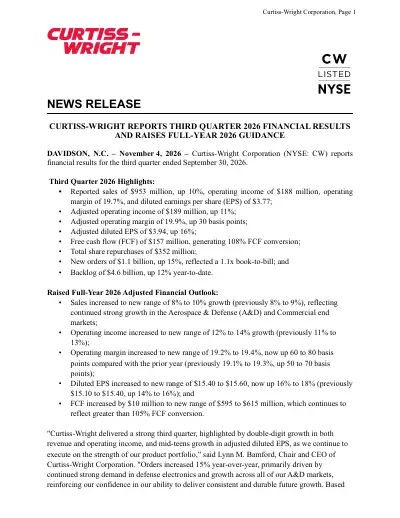
Based on our solid third quarter performance and our continued optimism heading into year-end, we confidently raised our full-year guidance across all major financial metrics, and we remain committed to delivering exceptional results for our shareholders. With that, and turning to the highlights of our third quarter results, sales of $953 million increased 10% year-over-year, reflecting overall strong growth across our A&D and commercial markets.
Operating income once again exceeded our sales growth and resulted in 30 basis points of operating margin expansion to 19.9%. Diluted earnings per share of $3.94 increased 16% and was slightly ahead of our expectations, primarily driven by our strong operational performance.
We generated nearly $160 million of free cash flow, achieving a strong cash conversion rate of 108% while continuing to accelerate investments across our organization to support our long-term objectives. New orders increased 15%, resulting in a book-to-bill of 1.1 times, reflecting continued positive momentum across the portfolio, particularly in our A&D and general industrial markets.
To give you more color, I'll start in Defense Electronics, which once again delivered a strong performance with orders up 27% year-over-year, following our record second quarter bookings. We experienced higher orders supporting fighter jet and helicopter programs, various modernization programs, as well as several development contracts supporting next-generation programs such as CCA.
We also received solid tactical communications equipment orders supporting US Air Force programs, as well as rugged, small form factor mission computers for the IFPC program. The substantial growth in our order book this year underscores Curtiss-Wright's broad product portfolio, ranging from MOSA-aligned embedded computing modules to advanced software solutions supporting soldiers in the battlefield, including tactical networks.
We remain well-aligned with the strategic growth priorities of the US and its allies. Within the A&I segment, we experienced strong demand for commercial aerospace products supporting the long-term production ramp across the major OEM platforms.
Building on that, we continued to experience solid demand in our general industrial order book, contributing to our more positive outlook in this market as we enter 2027. Lastly, within the Naval & Power segment, in naval defense, we saw higher orders for nuclear propulsion equipment on US Navy aircraft carriers and solid demand for aircraft handling equipment supporting various international programs.
Within our commercial nuclear market, we experienced solid demand for aftermarket equipment supporting plants globally, in addition to development and prototype contracts supporting leading SMRs. Overall, Curtiss-Wright's robust and strengthening pipeline of new orders adds to an already strong backlog, which is now up 12% year-to-date to a new record of approximately $4.6 billion.
Our team continues to generate meaningful growth opportunities that position our businesses for success well into the next decade. Turning to our full-year guidance, we now project sales to increase 8% to 10%, driven by continued favorability and strong demand in our defense and industrial markets.
We continue to expect year-over-year margin expansion across all three segments in pursuit of an overall record operating margin of 19.2% to 19.4%. Based on those increases, diluted EPS is now projected to grow 16% to 18%.
We also raised our free cash flow guidance and continue to expect strong cash conversion in excess of 105%. Lastly, following our increased second-half share repurchase activity, we are on pace to complete a near-record $460 million in share buybacks under our disciplined and strategic capital allocation strategy.
Now, I would like to turn to the recent leadership transitions, and I want to begin by congratulating Kevin on being named Curtiss-Wright's next Chief Executive Officer. As we announced last month, Kevin will become CEO effective January 1st and I will move into the role of Executive Chair.
Kevin's appointment is incredibly well-deserved. It reflects the culmination of our robust succession planning process that's taken place throughout the past year with our board to ensure a successful transition.
Since joining Curtiss-Wright in 2004, Kevin has established himself as a respected leader with a longstanding track record of execution and success. In recent years, he has played a significant role in shaping Curtiss-Wright's Pivot to Growth strategy.
He has been a driving force behind our accelerated organic growth, as well as our pursuit of commercial and operational excellence, resulting in continued operating margin expansion and substantial value to shareholders. We expect Kevin's transition to CEO to be seamless and provide stability for our employees, customers, investors, and all stakeholders as we maintain our operational momentum.
Next, I would like to thank Chris Farkas, who stepped down from his role as CFO last month and will retire from the company at year-end. During his tenure, Chris was a key contributor to our strong financial performance while also supporting our disciplined approach to capital allocation to help create value for our shareholders.
I valued his partnership in executing the Pivot to Growth strategy and in our engagement with the investment community. We wish him well in his retirement.
I would also like to thank Gary Ogilby, a 17-year veteran of the company, who is serving as Interim Chief Financial Officer. He previously served as VP of Finance in one of our divisions, where he led numerous operating margin improvement initiatives before being named in his current role as Corporate VP and Controller.
Gary has been an integral part of our finance organization and has been closely aligned with the management team in delivering on the Pivot to Growth strategy. He continues to be a key partner to Kevin and our leadership team in advancing the company's financial discipline and performance.
We are grateful for his leadership and for the continuity that Gary brings to our finance team. Overall, these recent announcements highlight one of the company's greatest strengths: our deep bench of talent and leadership, and our commitment to developing and promoting leaders from within.
Now, I would like to turn the call over to Kevin to provide some additional color on his leadership transition.
Kevin Rayment
Thank you, Lynn, and good morning, everyone. I'm privileged to be named Curtiss-Wright's next Chief Executive Officer.
It is an exciting time to step into the CEO role based on the strength of our fundamentals, record backlog, and the momentum that we're experiencing across our end markets. Since we launched the Pivot to Growth strategy back in 2021, I've had the opportunity to work very closely with Lynn, our senior leadership team, and our board to help steer Curtiss-Wright's operational journey and deliver profitable growth in excess of our expectations.
I would very much like to thank Lynn for her leadership, guidance, and partnership over the years, and I look forward to continuing to work closely with her as she steps into a new role as Executive Chair. Earlier this week, we announced a new structure for our operational leadership team by naming three new presidents to manage our Aerospace & Industrial, Defense Electronics, and our Naval & Power segments.
This seasoned leadership team brings deep-rooted knowledge of our customers, operations, and industry, and I have the utmost trust and confidence that these leaders will continue to advance our strategy, capture significant future growth opportunities, and deliver strong operational results. Together with the announcement appointing Gary Ogilby as our Interim CFO, we have a reshaped corporate leadership team that's excited to build upon our established growth strategy and drive the next phase of Curtiss-Wright's journey.
Since being named CEO, I've engaged with our leadership team to discuss my strategic vision for Curtiss-Wright's future and our long-range financial objectives. Several key priorities will help sustain our strong momentum, including: continuing to drive execution velocity by streamlining our processes and increasing our market responsiveness; and utilizing our strong free cash flow position to fuel the expansion of our operations globally across both existing and new facilities to enhance our alignment with customers.
I'll share more specific details during our Q4 earnings call and provide a more comprehensive overview at our next Investor Day in May 2027. I look forward to building on Curtiss-Wright's successful strategy, sustained profitable growth in 2027 and beyond, and continuing to deliver long-term value for our shareholders.
Before I turn the call over, I want to thank Gary for stepping in as Interim CFO. I've appreciated his support over the years and look forward to continuing to work closely with him.
With that, I'll turn it over to Gary to provide a more in-depth review of our financials. Gary Ogilby (Senior Vice President, Interim Chief Financial Officer and Corporate Controller): Thank you, Kevin.
Before we dive into the financials, I just wanted to take a moment to say how honored I am to be named Interim CFO for Curtiss-Wright. I appreciate the opportunity to lead our finance organization and to continue to work closely with our leadership team and the board to ensure a seamless transition of our strategy as we deliver strong, profitable growth.
I'll begin on slide 4 by reviewing the key drivers of our third quarter 2026 performance by segment. Starting in Aerospace & Industrial, sales increased 14%, which exceeded our expectations.
Beginning with the aerospace defense market, we experienced higher-than-anticipated sales of actuation and sensors equipment supporting various US fighter jet programs, which were partially offset by the timing of EM actuation equipment sales supporting ground-based mobile launcher systems. Within the commercial aerospace market, we experienced solid OEM sales growth supporting increased production on both narrow-body and wide-body platforms.
In the general industrial market, our results reflected the continued positive inflection in our order book, which contributed to strong double-digit growth in sales. Regarding the segment's operating performance, a combination of favorable absorption and mix of products on higher revenues, as well as restructuring savings, drove operating income and operating margin growth of 19% and 80 basis points, respectively.
We continue to experience improved profitability in this segment while maintaining solid investments in development programs. Next, in the Defense Electronics segment, sales increased 2%, exceeding our expectations, due to the timing of tactical communications equipment revenues within ground defense as some revenues accelerated into the third quarter.
We're pleased to see stability in tactical communications equipment sales and anticipate sequential growth into the fourth quarter. Growth in the aerospace defense market was driven by higher sales of embedded computing equipment supporting various domestic helicopter programs and international fighter jet production.
We also experienced higher revenues supporting next-generation development programs. Regarding the segment's operating performance, operating margin of 27% was lower year-over-year, as expected, as favorable absorption on higher revenues was more than offset by unfavorable mix.
Moving to the Naval & Power segment, sales growth of 12% was driven by strong growth in our naval defense market associated with the timing of production on submarine programs, along with steady growth in aftermarket revenues supporting the CVN-75 overhaul project. In power and process, we experienced double-digit revenue growth primarily driven by increased revenues in the commercial nuclear market supporting advanced small modular reactors.
Operating income grew 25%, generating 200 basis points in operating margin expansion, reflecting favorable absorption and mix of products on higher revenues. To sum up Curtiss-Wright's third quarter results, double-digit growth in both revenue and operating income resulted in strong operating margin of 19.9%, driving 30 basis points in year-over-year operating margin expansion.
Turning to our full-year 2026 guidance, I'll begin on slide 5 with our end market sales outlook, where continued improvement in expectations for both our overall defense and general industrial markets has enabled us to confidently raise the upper end of our guidance. As a result, we now anticipate total sales to grow 8% to 10%.
Starting in aerospace defense, we raised our full-year outlook to a new range of 14% to 16%, reflecting improved expectations for sales of actuation and sensors equipment supporting both domestic and international fighter jet programs. Our outlook is supported by our continued alignment to Department of War priorities, including next-generation platforms and aircraft modernization, which is a catalyst for fourth quarter sequential growth in Defense Electronics.
Within ground defense, strength in the pipeline and growth in the 2026 order book for our tactical communications equipment provided us with confidence to modestly increase our full-year outlook. In naval defense, we now project full-year sales growth of 9% to 11% due to expectations for higher production revenue on submarine programs and increased aftermarket revenues, while we continue to expect solid revenue growth on the CVN-81 carrier program.
Based on these updates, we now expect total aerospace and defense sales to increase 8% to 10%. Moving to our commercial markets, in power and process, we maintained our full-year outlook for sales growth of 13% to 15%, primarily driven by strong growth in commercial nuclear.
Lastly, in general industrial, we now anticipate full-year sales growth of 3% to 5%, driven by the continued market improvements and steady growth in our industrial vehicles order book. Wrapping up our commercial markets, we continue to project that total sales in these markets will increase 8% to 10%.
Moving on to our updated full-year 2026 financial outlook by segment on slide 6, I'll begin in Aerospace & Industrial, where we increased our revenue guidance to a new range of 10% to 11%, driven by the improved outlook in this segment's aerospace defense market and continued optimism in general industrial. Operating income is now projected to grow 17% to 19%, while we continue to expect operating margin expansion of 110 to 130 basis points, ranging from 18.5% to 18.7%, based on more favorable absorption and mix on higher sales, balanced by increased R&D investments.
Moving to Defense Electronics, where we continue to anticipate sales growth of 4% to 6%, we expect a strong finish to the year driven by the strength of our order book, as well as the team's advance planning and exceptional management of its supply chain to deliver continued operational efficiency. We continue to expect operating income growth of 5% to 7% and operating margin expansion of 20 to 40 basis points as we deliver industry-leading margins, reflecting a range of 27.5% to 27.7%.
Lastly, in Naval & Power, we now expect sales to grow 11% to 12%, reflecting our increased naval defense market outlook and overall strong backlog, which provides long-term visibility and overall solid growth across this segment's commercial markets. We now expect operating income growth of 16% to 18% and operating margin expansion of 70 to 90 basis points, driven by the stronger revenue outlook and more favorable naval aftermarket mix.
To summarize our 2026 outlook, we now anticipate total Curtiss-Wright operating income to grow 12% to 14%, driving operating margin expansion of 60 to 80 basis points to a record range of 19.2% to 19.4%. Continuing with our financial outlook on slide 7, we increased our full-year 2026 adjusted diluted EPS guidance to a new range of $15.40 to $15.60, up 16% to 18%, driven by the strong third quarter performance.
Also note that the ramp-up in share repurchase activity resulted in a reduction in other income due to lower year-over-year interest income and a lower share count. Overall, we continue to compound earnings at a mid-teens pace over time.
Lastly, turning to free cash flow, we raised our full-year outlook by $10 million to a new range of $595 to $615 million. As a reminder, our confidence in achieving record free cash flow incorporates increased capital expenditures to support ongoing growth investments, particularly within our Naval & Power segment.
As we've maintained throughout the year, we expect to deliver a free cash flow conversion rate in excess of 105%. Now, I would like to turn the call back over to Lynn.
Lynn Bamford
Thank you, Gary, and turning to slide 8. As we demonstrated today, Curtiss-Wright continues to build momentum across the portfolio and we remain well-positioned for a strong finish in 2026, providing confidence to deliver record financial results across all major metrics.
In addition, we remain on track to exceed the three-year objectives provided at our 2024 Investor Day, as shown at the bottom of the slide. As a reminder, since the launch of the Pivot to Growth strategy in 2021, one of our primary commitments has been accelerating Curtiss-Wright's top-line growth organically, supplemented by strategic acquisitions.
Our focus and execution on driving strategic investments, innovation, and collaboration have fueled our success by further elevating growth opportunities across our markets. As we've grown, we have leveraged the company's increased scale in many ways, providing better value to our customers by enhancing our sales channels and technologies, and driving internal investments to advance our talent, maximize shop floor efficiency, and expand our infrastructure.
We have a strong track record of operational and commercial excellence and are on track to deliver nearly 200 basis points in overall margin expansion since 2023, while growing R&D at a faster pace than sales. Lastly, we are driving record levels of free cash flow and expect to generate 110% average free cash flow conversion over the three-year period.
Our team continues to do an exceptional job in executing our Pivot to Growth strategy. Next, looking across the A&D and commercial markets, our teams remain relentlessly focused on strengthening the backlog and building durable revenue growth.
We are accomplishing this through thoughtful and targeted investments in capital equipment and capacity expansion aligned with the strongest medium and long-term growth vectors globally. Organic growth continues to accelerate across our markets, and I'll highlight two key growth opportunities in greater detail, beginning with defense.
Curtiss-Wright is well-aligned with the strategic Department of War's funding priorities highlighted within both FY '26 and FY '27 base budgets, where we typically generate the majority of our defense revenue. Some key examples include naval shipbuilding, legacy fleet modernization, enhancing capabilities at the tactical edge, and advancing next-generation platforms, all of which are expected to receive increased funding and support Curtiss-Wright's long-term growth.
More broadly, in addition to the US, we expect the trend supporting increased spending by NATO allies to continue providing strong tailwinds for Curtiss-Wright and the broader industry. Within commercial nuclear markets, we maintain a comprehensive portfolio of technologies supporting the entire lifecycle from the development and construction of new large reactors and SMRs to the aftermarket.
The momentum and increased pace of global investments continue to accelerate, reinforcing our confidence in the future growth of our business. Last week, we announced a $30 million expansion of our Round Rock, Texas facility, part of our instrumentation and controls business acquired in 2024.
This expansion positions us to satisfy growing customer demand for our critical temperature and pressure sensors supporting existing and new build commercial nuclear reactors. This announcement follows the $80 million expansion of our Cheswick, Pennsylvania facility announced in July, which further demonstrates our commitment to invest alongside industry to solidify our positions as a critical long-term commercial nuclear supplier.
Regarding the AP1000, Westinghouse continues to generate strong interest across the US, Poland, and other countries for new nuclear power plants. They are requesting supply chain readiness to support a potential global pipeline of 91 reactors, and our recent investments are part of Curtiss-Wright's response to that challenge.
We remain aligned and confident that we will receive an order for our reactor coolant pumps supporting AP1000 plants in 2026. Meanwhile, SMR developments continue to evolve globally as we work to enhance our relationships and solidify our content across the leading 300-megawatt-plus SMR designs.
In recent news, we are excited to continue our partnership with Rolls-Royce SMR by announcing the award of a significant contract and signing of a design services framework agreement to design, qualify, and manufacture the specialized nuclear valve package for the global fleet of Rolls-Royce SMR plants. As a result, we now estimate our current content on the Rolls-Royce SMR plant to be in excess of $100 million of revenue.
These active valves perform safety-critical functions within the power station and require proven nuclear capability and qualification. Curtiss-Wright will be providing these critical function valves and other equipment from our global operations within the UK and US in support of this SMR technology.
The expansion of this and other partnerships reinforces the strategic alignment of our technologies with the considerable opportunities ahead in this market. Overall, as we've shared throughout the year, we continue to see strong tailwinds across all our markets and have significant momentum as we head into 2027.
As I wrap up my prepared remarks and reflect upon my career at Curtiss-Wright, I'm reminded of how fortunate I am to have been part of such an iconic institution only a few years away from its 100th anniversary. It has truly been a rewarding experience for me over the last 22 years to be part of Curtiss-Wright's transformation into a stronger, high-growth company.
I'm particularly proud of the team's perseverance and success under the Pivot to Growth strategy to deliver consistent results and record financial performance. The relationships that I have built with the investment community during my tenure as CEO have been extremely rewarding to me personally.
I would like to thank our analysts and shareholders for your confidence and trust in our leadership team and for your consideration of Curtiss-Wright as an investment. I look forward to serving as Curtiss-Wright's Executive Chair and am excited for the opportunities that are still ahead for this historic organization.
On behalf of the board, I'm confident that we are in great hands with Kevin as our next CEO to guide the organization to new heights and continue to deliver long-term value for Curtiss-Wright shareholders. At this time, we would like to open up today's conference call for questions.
Operator
The floor is now open for questions. At this time, if you have a question or comment, please press *1 on your telephone keypad.
If at any point your question is answered, you may remove yourself from the queue by pressing *2. We ask that you pick up your handset when posing your question to provide optimal sound quality.
Again, we ask that you please limit yourself to one question and one follow-up, and then queue again with any additional. Thank you.
Our first question is coming from Peter Arment with Baird. Please go ahead.
Peter Arment
Hey, thanks. Good morning, everyone.
Nice results, and congrats to everyone on the team on the new roles and to Chris on his retirement. Thanks for all the help over the years.
Maybe just to start within Defense Electronics, the growth was a little stronger than we had modeled for this quarter, and the fourth quarter kind of implies another big step-up. Just confidence levels around that, what you're maybe seeing in any specific drivers that you would call out.
Thanks.
Lynn Bamford
I'll just kick it off, Peter, and it's always been wonderful engaging with you and appreciate your support over the years, for starters. Defense Electronics is in a great position, and we did pull some revenues out of Q4 into Q3, and so that was good.
I'll ask Gary to speak to the Q4 specifics, but overall, this business is in great shape. I think the order book reflects a lot of the strength of what we've brought to market over the past several years, the breadth of our product offering.
We monitor the pipeline of new opportunities and bookings in this business, and the future is just outstanding for this business. With that, I'll turn it over to Gary, maybe just to put a little more color specifically on Q4.
Gary Ogilby (Senior Vice President, Interim Chief Financial Officer and Corporate Controller): Sure. Thanks, Lynn, and thanks for the question, Peter.
I'll start with a reminder of our prior sub-guide, where we said that Q3 operating income and margin were expected to be down sequentially from Q2, as favorable H1 mix would normalize into year-end, and we expected a higher level of second-half R&D investments. That would be followed by a strong finish to the year here in Q4, which is what you're seeing.
By and large, the second half of 2026 is largely playing out how we expected it. On the top line, it's really supported by our order book.
In Q2, we had record orders, Q3 near-record orders. With regards to Q4, when you step back and look at this, we've experienced this type of ramp before, particularly in 2022 and 2023.
Overall, we're really confident in our ability to execute and expect a strong sequential growth, both in aerospace and ground defense into the fourth quarter. If you look at it from the supply chain side, we saw early warning signs of component shortages last year and quickly took actions to secure component parts.
As we head into the fourth quarter, we feel that situation is well in hand for 2026, and these challenges are not expected to impact our Q4 revenue or margins. On the margin side, as mentioned, H2 is largely playing out as we anticipated it.
That's really due to that favorable mix in H1, which drove higher profitability in the first half of the year, and the investments in R&D were a little more weighted to H2. Both of those items are weighing on the second half margins, particularly in Q3.
Overall, if you step back and look at the year, we're guiding 30 basis points of operating margin expansion at the midpoint, adding to our industry-leading margins and solid sales growth in this tough macro environment. Overall, we feel really good about the year and really proud of the team's execution.
Kevin Rayment
Point I would add--
Peter Arment
Go ahead.
Kevin Rayment
Point I would add is just that we're also very confident from a Q4 point of view from a bookings perspective. We've certainly started the Q very strong as well, which is encouraging as we push towards the end of the year.
Peter Arment
Appreciate all the color and the details. Just as a follow-up, I'll ask a question you probably never got before: AP1000.
Obviously we're tracking the construction permits in Poland and IHI's kind of started on the long-lead. How are you seeing kind of progressing, kind of the timing?
You're kind of near the end of your kind of three-year objective of expecting an order. What can you say on that, Lynn?
Thanks.
Lynn Bamford
I'm trying to figure out how that's a follow-up to Defense Electronics, but setting that aside, [laughter]
Peter Arment
I said it was a question you never got before, so, yeah.
Lynn Bamford
That's just true. No, we've said the same thing consistently and we do still expect an order in 2026.
We surely realize where we are in November and that runway is getting shorter, but we are so deeply engaged with Westinghouse. We take our guide from, and that is our expectations in the year.
You're right, you can see some of the press that's out there and a lot of questions with midterm elections and different things, but Poland has been marching at a very steady pace, and we do anticipate that will be the leader at this point. For a while, we had thought it would be DOE.
DOE does continue just to keep making progress, and we don't see any disruptions to that in spite of everything going on in Washington, and feel that we will have an order this year.
Peter Arment
Appreciate it. Thanks.
I'll jump back in the queue.
Operator
Thank you. We will move next to Myles Walton with Wolfe Research.
Please go ahead.
Myles Walton
Thanks. Good morning, and congratulations on a great tenure, Lynn, and Chris, if he's listening, and welcome Kevin and Gary.
Maybe focus on the Defense Electronics for a moment. You're sounding really confident about where you're going to end up at a fourth quarter run rate.
I think Kevin, you alluded to orders remaining solid here in the fourth quarter. Sometimes with continuing resolutions, we encounter air pockets.
Just want to clarify, it doesn't seem like you're signaling a prospect of an air pocket given you're in a CR, and I'm also curious what you expect for the resolution of the fiscal '27 budget.
Kevin Rayment
Sure. Let me take that question.
I think just to add to what Gary said in terms of our Q4, our bookings have been strong, Q2, Q3, and we're running into sort of Q4 with a CR at the 11th of December, that sort of gets us into a good position in the sense of we're getting towards the end of the year and bookings are continuing to be strong. As I said, the beginning of Q4 has been good for us, we're pretty confident about our position from a bookings perspective into this year.
The other thing I would sort of add is if you look back over last year in '25, where we had CR, and a government shutdown, and some changes in the administration, that caused us a bit of a sort of slowdown at the beginning of this year. I think in this situation with this CR at the 11th of December, and sort of where we've seen our bookings, it's kind of setting us up nicely for '27.
Myles Walton
Okay. On that, you opened the can of worms for '27, how well do you think it is setting up?
Do you expect that you could have as good of an organic growth profile in '27 as you do in '26, with maybe Defense Electronics acceleration playing out?
Lynn Bamford
We're not going to give any specifics on 2027, but in my prepared remarks, talked about the strong tailwinds across our businesses and the prospects for '27 are very good. I think these two gentlemen sitting next to me are going to have a great opportunity to share that guidance in February and then move towards Investor Day and share even the bigger picture.
Things are very good.
Myles Walton
That's good. I just want to give Kevin an early test, Lynn, that's all.
Lynn Bamford
[Laughter]
Kevin Rayment
Thank you.
Myles Walton
Thanks.
Operator
Thank you. We will move next to Justin Long with Morgan Stanley.
Please go ahead.
Justin Long
Hi, good morning, and Lynn, just want to say it's been a pleasure interacting with you over the past few years, and Kevin and Gary, congrats on your new appointments. I wanted to ask one maybe broader just on the political regulatory environment.
Clearly some shifts here in the landscape with the midterms, as Lynn, you alluded to, and you're obviously operating in a number of highly regulated industries. Just curious if you're thinking any differently about the backdrop for defense and commercial nuclear end markets given some of the more recent changes afoot.
Thanks.
Kevin Rayment
Sure. I think we all sort of feel to the point where it's a little bit difficult at this stage to determine what's going to come out, but I think earlier comments around sort of certainly our defense business from a CR perspective, as I mentioned earlier, I think we feel a reasonable position as we go into the end of this year.
I think the other piece, too, is if you think about a lot of our sort of main drivers across the organization, there's a great level of support from a navy shipbuilding perspective. As you can see into '27, that sort of growth in budget to $66 billion, and with the NIP funding sort of increasing up to nearly $9 billion, we've been very successful moving from $10 million up to nearly $100 million of NIP funding.
I think we feel like the underlying sort of main part of the businesses is very strong and we're part of that main base budget, I think that's encouraging. If I think about the nuclear side, Lynn and I were on the Hill this year spending quite a bit of time talking around sort of the nuclear side of the business, and it broadly has bipartisan support, both from sort of an energy security point of view and obviously from an environmental perspective, we're encouraged by that, and I think both parties are very supportive of the nuclear industry.
Justin Long
That's great. Then maybe a quick one for Gary at Naval & Power.
The margins this quarter were up over 100 bps sequentially, but on a pretty comparable level of sales. Just curious if you could talk a little bit about the drivers of margin performance at the segment this quarter and where you saw some of those mixed benefits.
Thanks. Gary Ogilby (Senior Vice President, Interim Chief Financial Officer and Corporate Controller): On the mix side, we did see some really nice mix in the naval aftermarket, as well as on the valve side, particularly on the MRO side, and overall, we're really happy with those results.
Great. Thanks.
Operator
Thank you. We will move next to Michael Ciarmoli with Guggenheim Securities.
Please go ahead.
Michael Ciarmoli
Hey, good morning, guys. Nice results, and congrats to all.
Lynn, it's certainly been a long time, and Kevin, Gary, looking forward to it.
Lynn Bamford
Thanks, Mike.
Kevin Rayment
Thank you.
Michael Ciarmoli
Just maybe to stay on defense and kind of the budget situation. How are you guys thinking, I know you talked about the base budget, but if we don't get any reconciliation funding, as you guys look at the portfolio, maybe thoughts on how some of those tough decisions, which programs or platforms or branches might be bill payers and how that might impact you.
I guess what I'm asking, can you accomplish your growth plans with just a base budget?
Kevin Rayment
I think that's a good question. I think that, as I said earlier, I do believe from a sort of electronics perspective, we're into a lot of the major existing sort of base programs, and I think we feel confident in that from a continuous resolution perspective.
Then, obviously, from a reconciliation point of view, there are pieces in that which are sort of associated with things like Golden Dome investments. Underlying it, I think we still continue to supply into many sort of ground programs, like our IFPC project, which we mentioned in our opening remarks.
I think, again, we feel pretty confident that we got orders this year moving into next year. We mustn't forget, too, is obviously we have a great sort of centralization around sort of where we are in the US, but we have good foreign sales, direct foreign sales, roughly about 10% of our portfolio, so that's encouraging as well from a defense point of view.
Michael Ciarmoli
Got it. Helpful.
Then just maybe back to the AP1000. If you do get this order before year-end, how should we be thinking about how long that translates into hitting the P&L from long-lead materials?
Then I guess one maybe outlier we get from investors: is there a scenario where some of these international AP1000s, the reactor coolant pumps can be purchased from China, since they are manufacturing their own pumps? Gary Ogilby (Senior Vice President, Interim Chief Financial Officer and Corporate Controller): Mike, I'll start with the first one.
This is Gary here on to the 2027 revenue profile. We've mentioned in the past that the revenue profile here follows a bell curve, and we would expect to see revenues here in 2027 on that order.
Obviously, I can't give you the specifics just yet. A lot of that will kind of come down to the timing here, but we do expect, based on receiving the order in the fourth quarter here, that we will have revenues associated with it in 2027.
Perfect.
Kevin Rayment
I think just following up on the China question, obviously we supply the pumps in with AP1000 into China. I think we feel very confident with the relationship we have with Westinghouse, again, sort of from a US supply perspective, and we're scaling and sort of making sure we have the capacity to meet those regulatory issues associated with that.
As I'm sure you've heard from Westinghouse, they very much want to make sure that the design stays exactly as it is going forward, which, I think, for us is very good for us.
Michael Ciarmoli
Got it. Perfect.
Thanks, guys.
Lynn Bamford
Thank you, Mike.
Kevin Rayment
Thank you.
Operator
Thank you. We will move next to Pete Skibitski with Alembic Global.
Please go ahead.
Pete Skibitski
Good morning, everyone. Nice quarter, and yeah, congrats to all.
I'll echo that. Maybe this F-35 agreement, guys, that Lockheed announced, obviously that has to be finalized, but a 10-year agreement would provide a lot of visibility for your F-35 exposure.
Could you maybe walk us through kind of revenue-wise, OE versus aftermarket on F-35 for you guys, and then kind of what this agreement might allow you to do? Would it be helpful to margins?
Would you have to give up some price? Just your thoughts on that.
Kevin Rayment
Sure. I think we end up going through sort of multi-lot agreements and sort of negotiations as we go through that sort of process, but the sort of recent press that was out there for that sort of 10-year profile, we very much agree that it was sort of in line with our sort of plans of 156 aircraft a year, which incorporates both foreign sales as well as US sales.
We always go through a negotiation perspective as part of that exercise, but, again, I'm not anticipating any things of deviation from that. We do a lot directly with them on the F-35, and I feel good that we're in a good position.
Pete Skibitski
Sounds good. I just want to follow up.
I'd just be interested to learn how CW can play into this Army NGC2 program. I know it's fairly new, but Anduril seems like it has a pretty big role on it.
I don't know if you guys have already booked a position on that project, but I'd like to know specifically kind of how you guys think you could play a role there in terms of the tactical communications.
Kevin Rayment
That actually fits quite well with us. In fact, on the two programs that are in the sort of trial process, we actually have hardware that we've worked with on NGC2 out of our PacStar business, and so it fits into both of those two respective programs.
We work closely with Anduril on that sort of component, so, I think we're in that program.
Pete Skibitski
Great. Thank you.
Operator
Thank you. We'll move next to Scott Deuschle with Deutsche Bank.
Please go ahead.
Scott Deuschle
Hi, good morning. Lynn or Kevin, is Curtiss-Wright's content on the APR1400 reactor the same as it is on the AP1000?
Kevin Rayment
For the APR1400, it's different. It's a different size, as a 1400 versus the 1000.
Scott Deuschle
Is the content higher or is it less?
Kevin Rayment
No, we're on the AP1000--
Lynn Bamford
We have content on the AP4-- 1400, but it's lower. It's around $20 million per plant, we'll have content and we continue to engage on it, but it's not in the ballpark of AP1000, which we always mention $110-plus for the RCPs.
Again, reiterate that on top of the RCPs, we've been awarded other work and think that on top of the RCPs, we'll have $50, $60, $70 million of incremental content, which is quite meaningful on top of the RCPs, so.
Scott Deuschle
Okay. Given that Korea is building, I guess, some of these reactors in the US, is that a bit of a threat to how much content you ultimately can get on the build-out, or do you think you guys still get a very strong, sharp position here?
Lynn Bamford
As Kevin just said, Westinghouse has said, you can find it in very many places, that they are determined to build a stable plant design and not change things to help assure that Nth-of-a-kind cost-down that is what the nuclear industry seeks. With that, our content on the AP1000, we don't take it for granted.
We have to earn it every day and be a great supplier to Westinghouse. We have engaged, I mentioned things like the $80 million investment in our Cheswick facility to make sure we're ready to ramp.
We're doing our part. I've had comments on supply chain readiness in the prepared remarks, and we engage every day with Westinghouse to be a great supplier.
I think the AP1000 will be the winner in the US, and as a US design, and I think we are well-positioned to support Westinghouse on that. If an AP1400 gets built, be it, but it's the AP1000's the Gen III+ safety profile that I think is what people are going to want.
Kevin Rayment
The only other thing I would add, just to reiterate, both Cameco and Brookfield are still signaling nearly 91, so that's a pretty significant piece of work.
Scott Deuschle
Great. That's really helpful.
Thank you. Then just Kevin, can you provide an update on what you're seeing across your own supply chain, both in terms of availability, supply, and any constraints you're still facing?
Then just broadly, what are you seeing in terms of supply chain inflation these days?
Kevin Rayment
Very good. I can answer that.
I think sort of the area on the sort of supply chain side, if I sort of just take our electronics piece, which is, in a way, we've seen sort of similar types of issues surrounding sort of electronic components, and that sort of dates back to like we did when sort of we were coming out of COVID. When we went through that process last time, we learned a lot from that sort of exercise.
As we started to see some issues in our supply chain this year, certainly around memory and some sort of allocation for processors, we got ahead of the curve. We had a tiger team put together.
We've been advance buying, obviously, those materials to overcome that. We've also been doing things like pushing forward with our DPAS ratings, which actually gets sort of guarantee of secure for us.
We've been looking at second sourcing, and again, a number of initiatives to really make sure that we're getting ahead of the cycle. Some of that sort of flowed over a little bit into our industrial piece, which was again on the memory side, but in that sort of industry, it's a lot easier for us to sort of look at sort of dual sourcing.
Again, I feel like in a good position as we go to the fourth quarter, that we've sort of built up around that sort of experience and knowledge to basically manage that and manage that process. Yes, we've seen some pressure from, obviously, as everybody knows, energy prices have been going up, but we've been managing that with our suppliers and managing that with our customers.
Scott Deuschle
Thank you.
Operator
Thank you. We'll move next to Louie DiPalma with William Blair.
Please go ahead.
Louie DiPalma
Lynn, Kevin, Gary, and Jim, good afternoon. Lynn, it was a pleasure working with you, and congrats on your tremendous success.
Chris, I'm sure you're listening, it was great working with you as well. Kevin, congrats on the big appointment.
My question, for Defense Electronics, you guys discussed the negative mix in the quarter, but over the long term, and putting aside the quarter-to-quarter lumpiness, should the margin consistently increase further on an annual basis, or should investors expect the margin to stabilize here in the high 29% range? Gary Ogilby (Senior Vice President, Interim Chief Financial Officer and Corporate Controller): I'll comment on that, Louie.
We're obviously very happy with the margins. They're industry-leading margins.
When we think about the margin profile and we look out to the next few years, we do balance that and the investments that we need to make to grow the business for the medium and the long term. That's something we have a lot of internal discussion about, reviewing the R&D pipeline and where we want to make those strategic investments to be successful 5 years out from now.
It's top of mind for us, and overall, it's a really, really healthy margin profile. The mix headwind that you discussed in the quarter, are you able to share what products within Defense Electronics have a lower margin than the overall core portfolio, and should this be a long-term headwind, or is this something that was just temporary?
Gary Ogilby (Senior Vice President, Interim Chief Financial Officer and Corporate Controller): No, it's temporary. I would say when you span the year, it tends to wash out.
It was a little bit more than it normally was in Q3, but two things. One of the main things that we see in the Defense Electronics portfolio is, something we've mentioned in the past, is the margin profile on the COTS versus the systems, that can impact the quarterly lumpiness.
Also, it wasn't just the mix, it's also some of those investments we mentioned in CRAD that really help us on the next-generation aircraft modernization platforms that we're looking to continue to be in content and gain share over the long term. It was a combination of mix as well as some of those CRAD investments.
Great. For those next-generation aircraft platforms, does that include the CCA as well as the two next-gen fighters that were awarded to Boeing?
Kevin Rayment
I'll take that. Yes, we're working closely on F-47 and FA-XX.
Obviously, we don't declare sort of where we are on our content for that. Again, is fueled by both our Defense Electronics businesses and also our Aerospace group in sensors and actuation.
We're working on those specific platforms. Also, B-21, again, we actually have content on that platform, which is, obviously, our accident crash recorders with our sort of program there.
From a CCA perspective, yes, we're on both Increment 1, with both Anduril and the General Atomics both platforms, and again, we have content in our Defense Electronics piece in both of those particular pieces. We're working hard because of Increment 2 is coming, and there are a number of other sort of additional players in that, and we're working very closely with them to ensure that we get positioned in the US.
Around the world, there are other CCA-type programs that are going into Europe, which we're again actively pursuing.
Louie DiPalma
Cool. Thanks, everyone.
We also cover some defense electronics companies that have margins as high as 45%, and so I just wanted to get clarity on the continued margin expansion, and it seems like you guys are heading in the right direction. Thanks, everyone.
Look forward to talking in the next quarter and analyst day.
Kevin Rayment
Thank you. Gary Ogilby (Senior Vice President, Interim Chief Financial Officer and Corporate Controller): Thank you.
Lynn Bamford
Thank you, Louie.
Operator
Thank you. Once again, if you do have a question, you may press *1 on your telephone keypad at this time.
We will move next to John Godin with Citi. Please go ahead.
John Godin
Hi, this is Bradley [Meisenheimer?] on for John Godin.
Thanks for taking my question. I just want to touch base on the SMR side of the equation for commercial nuclear.
Just curious what your thoughts are on demand expectations. High needs power, you see businesses trying to generate and capture power as quick as possible, through any means necessary, it seems.
I'm just curious if you can kind of level set expectations, how you see this market evolving, and the opportunity you see here for Curtiss-Wright, and maybe provide some color and thoughts on the speed of the market for SMRs to meet these power needs. Thanks.
Lynn Bamford
Just maybe I'll talk a little bit on the big picture. That's one of the strengths, which we say over and over, is the strength of seeing Curtiss-Wright as an investment is we play across the nuclear power industry, whether it's keeping the current plants online, doing restarts, bringing back old plants that have been shuttered, to building AP1000, to building SMRs.
As but just to reiterate for anybody on the phone, we're not trying to pick winners and losers across the SMR landscape. Where our goal has been mostly focused on the 300-plus megawatt reactors, and targeting meaningful content, it was fun to be able to announce $100 million of content-plus with Rolls-Royce so far with the awards we have, and we're not necessarily stopping there.
Where we are in AP1000, we've said we're at about the $120 million mark with X-energy, and continuing to work across the landscape. We do work below the 300 megawatt, we're working with targeted microreactors where our value proposition matches how the plants are going to be built.
How the SMRs are going to be folded into the overall picture for providing energy in the country, that continues to evolve, but I think there really is broad understanding, not just here in the US, but overseas, that there are places for the large gigawatt reactors, and there's a place for the small modular reactors in more remote communities and such. I think just broadly speaking, this is such an exciting part of our portfolio that is going to provide growth through the next decade for Curtiss-Wright in really a meaningful way.
John Godin
That makes a lot of sense. Appreciate the color.
I also want to touch base on possibly the M&A side. You guys have pretty strong free cash flow generation.
Just want to get your latest thoughts on M&A. Is there any kind of opportunities, capabilities, content on existing platforms, securing the supply chain?
Just any color here that you can provide would be appreciated. Thanks.
Kevin Rayment
Sure. I can cover that, and then if Gary wants to add anything else in addition, you can.
Just I would say is again, the pipeline remains healthy. We're obviously always looking at multiple different books that are coming in across the organization.
It is certainly for me, again, and to reiterate, it has been for a while, is it is our number one sort of priority from a capital deployment perspective. Again, across all our sort of core markets, we constantly look at that.
I think you'll also seen, back from Curtiss-Wright's view is that we take a very disciplined approach in the way in which we've done that. The entire team are involved right down to the business unit levels.
If we have a specific property, we do a lot of diligence, a lot of work on it, and we're also comfortable in that disciplined approach in saying no if it doesn't fit either strategically or financially. We're still very much wanting to drive that forward.
I'm going to talk a little bit more about Investor Day, some sort of evolution in some of our M&A piece to sort of assist us going forwards, but I think that's a good position. Gary?
Gary Ogilby (Senior Vice President, Interim Chief Financial Officer and Corporate Controller): Sure. Thank you, Kevin.
I'll just kind of add in, as you mentioned, we do generate a lot of free cash flow, and we have a very healthy balance sheet. When we approach acquisitions, from a financial lens, we are looking at those targets to see if they're going to be accretive to some of our core KPIs over time.
Revenue, operating margin, EPS, and ROC. We look at that, and we are evaluating that through that financial lens to see and make sure they're going to be accretive to our key KPIs over time.
As Kevin mentioned, it is one of our top capital allocation priorities.
John Godin
Perfect. Appreciate all the color.
Thanks, everybody.
Operator
Thank you. There are no further questions in queue at this time.
I will now turn the meeting back to Lynn Bamford, Chair and Chief Executive Officer, for any additional closing remarks.
Lynn Bamford
I'd say thank you to everybody for joining us today, and we look forward to speaking with some of you on the road in the coming weeks and the release of our fourth quarter results. Have a great day.
Kevin Rayment
Thank you. Gary Ogilby (Senior Vice President, Interim Chief Financial Officer and Corporate Controller): Thank you.
Operator
Thank you. This concludes today's Curtiss-Wright Earnings Conference Call.
Please disconnect your line at this time, and have a wonderful day.