Dragonfly Energy Holdings Corp
NNASDAQ:DFLIQ3 FY2025 · Earnings Call TranscriptNovember 14, 2025
Operator
Good afternoon and welcome to Dragonfly Energy's Third Quarter 2025 Earnings Call. At this time, all lines are in listen-only mode.
Following the presentation, we will conduct a question-and-answer session. I'll now turn the call over to Simon [Syrewieski?]
, Investor Relations. Please go ahead.
]
Thank you, operator. Appreciate joining us for today's call.
Joining me here today, Dr. Denis Phares, Dragonfly Energy's Chairman, President, and Chief Executive Officer, and Wade Seaburg, Chief Commercial Officer.
Tyler Bourns, Chief Marketing Officer, is also available for Q&A. Before I turn the call over to Denis, I'd like to make a brief statement regarding forward-looking remarks.
During this call, the company will be making forward-looking statements within the meaning of the United States Private Securities Litigation Reform Act of 1995 based on current expectations. These forward-looking statements are subject to risks, uncertainties, and other factors which could cause actual results to differ materially from those expressed or implied by such forward-looking statements.
Actual results may differ due to factors noted in the press release and in periodic SEC filings. Management will reference some non-GAAP financial measures.
Reconciliations to nearest corresponding GAAP measure can be found in today's release on the company's website. Please note, all comparisons that will be discussed today are on a year-over-year basis unless otherwise noted.
I'll now turn the call over to Denis.
Denis Phares
Thank you, Simon, and thank you, everyone, for joining us on this Friday afternoon. We know this is an unusual time for an earnings call, but as many of you have seen, we have had an exceptionally busy and productive period leading up to today's announcement.
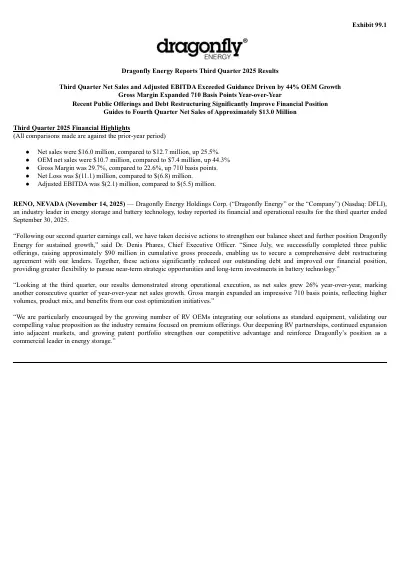
In the third quarter, we continued our return to strong year-over-year revenue growth, with sales increasing 26% to $16.0 million. Our gross margin expanded by over 700 basis points to nearly 30%, driven by operational improvements and positive product mix.
Together with disciplined cost control, this led to a $3.3 million improvement in adjusted EBITDA. Just as importantly, this was a quarter defined not only by financial performance, but by business execution.
Beyond our financial results, we successfully executed a comprehensive capital raising and debt restructuring that fundamentally reshaped our balance sheet and greatly improves our liquidity. Since July, we raised approximately $90 million in gross proceeds through three unstructured common equity offerings.
Then, in early November, we finalized a transformative restructuring of our term debt. This restructuring of our debt included a $45 million prepayment, $25 million of debt converted into preferred equity, and the forgiving of $5 million outright.
As a result, our total debt principal now stands at only $19 million, which carries a significantly lower interest rate and extended covenant flexibility through 2026. Achieving this level of balance sheet improvement in just a few months reflected strong execution and confidence from both our lenders and investors.
These decisive actions represent an important inflection point for Dragonfly Energy. In addition to the financial benefits, we believe our improved balance sheet sends a strong signal to current and potential customers about the company's stability and long-term financial health, as our previous financial condition influenced some customers' decisions and adoption timelines.
With these actions behind us and a strengthened balance sheet, we can now dedicate more time and resources to business growth. In short, we have established a much stronger financial foundation and significantly enhanced our capital structure.
We are now positioned to allocate resources toward near-term revenue opportunities, strategic investment in our proprietary technology, and continued expansion into adjacent markets. For the first time as a public company, we feel we are playing offense.
Now I'd like to turn the call over to Wade to discuss our activities and accomplishments in our key end markets. Wade?
Wade Seaburg
Thanks, Denis. I'd like to focus on the strong momentum we are building in our OEM business and how our strategic approach is driving results in our key markets.
In the RV market, we expanded our OEM footprint through several notable partnerships. Our partnership with Airstream, which we announced on our last call, continues to gain momentum.
Battle Born Batteries are now standard across Airstream's 2026 motorized models, reinforcing our position as a trusted supplier in the premium RV segment. We also announced two new important partnerships during this quarter.
In August, we announced our partnership with Awaken RV, a newly launched manufacturer founded by industry veteran Scott Hubble. Awaken selected Battle Born Batteries as the standard lithium power solution across their entire debut lineup of molded fiberglass trailers, recognizing our ability to deliver the safe, reliable, and long-lasting power that off-grid travelers demand.
Then in September, we expanded our long-standing partnership with Ember RV, making Battle Born Batteries standard across its 2026 Overland Series, with factory-installed systems delivering up to 7 kilowatt-hours of power. Ember has relied exclusively on our batteries since their founding in 2021, and this latest expansion demonstrates their continued confidence in our technology and our ability to adapt to continuously evolving OEM needs.
Our RV partnerships span premium brands like Airstream, innovative new entrants such as Awaken RV, and established partners like Ember RV, underscoring our position as a leading provider of high-performance lithium power solutions across all market segments. Importantly, while the overall industry remains challenged, we are consistently gaining market share through deepening integration with existing partners and wins with new manufacturers.
Turning to heavy-duty trucking, we continue to gain traction in a market where current capital investment remains constrained. Several fleets that completed pilot programs have expanded into additional units after experiencing measurable gains in idle reduction, fuel savings, and driver comfort.
In particular, we recently began receiving production orders from a large nationally recognized fleet following a long-term pilot of our lithium power systems designed for idle reduction and hotel load support. These orders reflect the continued expansion of our solutions into real-world operations, with meaningful customer validation emerging from pilot programs.
We expect to make an announcement soon. Our collaboration with PACCAR, one of the most respected commercial truck manufacturers in the world and the only American-owned Class 8 truck manufacturer, is another important milestone in this segment.
Earlier this year, PACCAR completed independent testing of our lithium power systems at their technical center. The systems were evaluated under the worst-case idle reduction conditions, and the results formed the basis of a jointly co-authored white paper focused on practical lithium power solutions that reduce idling, fuel costs, and maintenance for Class 8 fleets.
We debuted the white paper at the Battery Show, where it was reviewed by industry technology leaders and has continued to attract attention across the sector. At the ATA MCE conference in October, it became a frequent topic of discussion among carriers and system integrators who are searching for commercially viable electrification solutions that can withstand real fleet demands.
We believe this collaboration provides credible third-party validation of our technology under demanding conditions, and it has increased our visibility with large fleet operators who are exploring practical and cost-effective paths to electrification. As we have said before, we believe this significant adoption in heavy-duty trucking is a matter of when, not if.
With growing validation from respected OEMs and leading fleets, we believe Dragonfly is well-positioned to capture meaningful share as this market turns. Now I will turn the call back to Denis to discuss key technology developments, third quarter financial results, and our fourth quarter outlook.
Denis Phares
Thanks, Wade. Our commercial traction aligns with continued advancements in our technology platform.
During the quarter, we expanded our intellectual property portfolio with two newly granted United States patents. The first strengthens our proprietary Dragonfly IntelLigence platform and enables more robust data exchange, improved system reliability, and advanced performance across mobile and stationary applications.
The second patent advances our Wakespeed charge control technology and supports high-power vehicle-to-trailer charging and broader system integration. With approximately 100 filed, pending, or granted patents, our IP portfolio reinforces our evolution into a complete power systems provider.
I also want to reinforce our domestic manufacturing capabilities, which continue to differentiate Dragonfly in today's volatile trade environment. With final assembly completed at our Nevada facility, we maintain greater control over quality, cost management, and production timelines.
During the quarter, we received recognition of our domestic manufacturing capabilities through a $300,000 grant from the Nevada Tech Hub. This non-dilutive capital is supporting modernization initiatives, including upgrades to key manufacturing lines, and is expected to generate six-figure annual savings while enhancing efficiency and scalability.
As a Nevada-based company with a 400,000-square-foot manufacturing facility in Reno, we are proud to contribute to the state's vision of building a complete lithium loop from domestic battery manufacturing to recycling. Now, turning to our third quarter results, net sales grew 26% year-over-year to $16 million, reflecting a 44% increase in OEM net sales.
Within our OEM segment, adoption trends in our core RV market remain healthy. Existing partners are integrating our solutions across additional model lineups, while we continue to add new manufacturers to our customer base.
Net sales to DTC customers totaled $5 million compared to $5.2 million, reflecting continued macroeconomic headwinds. Third quarter gross profit increased an impressive 65% to $4.7 million, with gross margin expanding 710 basis points to 29.7%.
This substantial margin improvement reflects increased volumes, product mix, and operational efficiencies achieved through our corporate optimization program. Operating expenses decreased to $8.5 million from $8.9 million.
Net loss was $11.1 million versus a net loss of $6.8 million, and net loss per share was 20 cents compared to a loss of 98 cents per share. Adjusted EBITDA improved to -$2.1 million from -$5.5 million, reflecting continued strength in the OEM segment and gross margin expansion.
Turning to our outlook for the fourth quarter of 2025, we expect net sales of approximately $13 million, representing a growth of approximately 7% year-over-year in our seasonally slowest quarter. We are forecasting adjusted EBITDA of approximately -$3.3 million.
While we had initially targeted adjusted EBITDA break-even by year-end, we have made substantial progress towards this objective against a much more challenging backdrop than we anticipated, characterized by a volatile tariff environment that extended the freight recession, macroeconomic uncertainty, and the government shutdown that impacted our industrials customers, some of which rely on government funding. Despite these challenges, we have fundamentally strengthened our balance sheet and expanded our OEM footprint, providing a solid foundation for execution in 2026.
We remain confident in our ability to achieve profitability as we continue executing on our growth initiatives. To summarize, this was one of the most strategically important quarters in our company's history.
We strengthened our balance sheet, secured meaningful validation in heavy-duty trucking, expanded OEM penetration, and improved our margin profile. These achievements reflect disciplined execution across our commercial, operational, and financing strategies.
With a stronger financial foundation and real momentum across our end markets, we are well-positioned to capture the opportunities ahead. We remain focused on operational discipline, margin expansion, and executing against a clear strategy that moves us toward profitability, and we are confident in our ability to create long-term shareholder value.
Operator, we would like to open the call to questions.
Operator
Thank you. Ladies and gentlemen, we will now begin the question-and-answer session.
Should you have a question, please press *1 on your touchtone phone. You will hear a prompt that your hand has been raised.
Should you wish to decline from the polling process, please press *2. If you are using a speakerphone, please lift the handset before pressing any keys.
One moment please for your first question. Your first question comes from George Gianarikas of Canaccord Genuity.
Your line is already open.
George Gianarikas
Hi, everyone. Good afternoon.
Thank you for taking my questions. Maybe to focus first just on the guidance a little bit for Q4 as to which segment of the business is dragging down sequentially the revenue, is it the OEM business that's sort of impacting the Q4 outlook?
Thank you.
Denis Phares
Hi, George. Thanks for the question.
It's an interesting economic environment we're in right now, and I would say in terms of our OEM business, Q4 is always the slowest quarter by seasonality. We've got a number of days off on the holidays, so that's not unexpected.
There may be a little bit less of than what we expected in the OEM segment, but really what's happening is we don't have as much visibility in the DTC segment, and DTC is typically strongest in the fourth quarter. We got the Black Friday sales coming up, and given the macroeconomic conditions now and the low consumer sentiment, we're just trying to be cautious because we really don't have a lot of visibility there.
Also included in the DTC segment, we have a number of industrials customers that have basically shut down due to the government shutdown. Just a number of things really led to us being a little bit more cautious with our guidance.
George Gianarikas
Right. Maybe assuming a return, not asking for '26 guidance necessarily, but assuming a normalization from the consumer, is it fair to say we can look for significant growth in 2026?
How are you thinking about that year for the form and shape of 2026?
Denis Phares
We're pretty confident about 2026. Not only do we expect more of a return to normality, but we're also expanding into these new segments.
For example, the trucking business that we're starting to break into right now is going to be the primary growth driver in 2026 for us. Obviously when you're growing from a very low number into a completely new big business segment, that's where we expect to be the most tangible growth.
George Gianarikas
Got it. Could you help us sort of right-size our mind in terms of where the cash sits today after these transactions, where the share count sits today?
Just trying to understand how to sort of have a real-time snapshot of your assets and your share count.
Denis Phares
My goodness, it's night and day [laughter] from where it was. Our balance sheet, quite frankly, was a significant hindrance to us in terms of business growth, and I'm not even talking just our inability to invest as much as we wanted in near-term growth opportunities, but new customers that are these large fleets, they're public companies, and obviously they're going to look at our balance sheet and that's going to influence their decision.
Everybody likes the products, everybody knows we're an innovative company, and it's really difficult for them to really commit the way that it has been. Now with this turnaround, for the first time as a public company, we've been able to alleviate the going concerns.
It really puts us in a completely different situation, allows us to really invest in the growth that we've been expecting over the last, honestly, 12 months.
George Gianarikas
Maybe just to understand the numbers though, Denis. How much cash do you have on the balance sheet now, because these transactions happened after the end of the quarter.
Can you just sort of update us on proper share count for our models, proper cash for our models, etc.?
Denis Phares
There's about 125 million common shares, 121 million shares, and a pro forma cash balance after the debt paydowns and everything is on the order of $30 million.
George Gianarikas
About $30 million, okay. Right.
Maybe just to talk about my last question, what are some of the growth initiatives that you're able to put in place now that the balance sheet has been fixed essentially? What are the sort of things that you are able to do from a customer perspective to accelerate your growth in 2026?
Denis Phares
For example, we've had a pretty lean outside sales team, and we've been trying to expand into these large markets, the trucking market, for example. Also, we talked a lot about the oil and gas market for a long time.
We have we believe the only Class I, Div 2 lithium-ion battery certification on the market, and we have not been able to invest in growth into that segment, which we believe is an enormous opportunity. There were changes in how natural gas is treated, but nevertheless, even though that affected what we were doing in terms of methane reclamation, there's still large opportunities for storage in that segment because it's primarily dominated by lead-acid batteries.
There's a ton of meat on the bone that we really haven't been able to invest in in terms of specifically manpower. Also, we've been able to invest more in product development as well, and that's really where we put a lot of our cash this year to really try to get that new OEM business and try to accelerate trucking.
Our product development will also be able to accelerate with new resources.
George Gianarikas
Thank you so much. Congratulations on all the good work you've done over the last couple months.
Denis Phares
Thank you, George.
Operator
Your next question comes from Chip Moore of ROTH Capital. Your line is already open.
Chip Moore
Oh, hey. Good evening.
Hey, Denis and Wade. Thanks for taking the question.
Denis Phares
Hi, Chip.
Chip Moore
Hey, Denis. I wanted to echo congrats on the debt restructuring, right?
Clearly understandable that that's been a hindrance on the commercial side, maybe just expand on your comments about facing some headwinds there. I know it's early, right?
It's only closed a week ago, how are you thinking about early feedback from potential customers, whether it's fleets or OEMs? It's just more so think about capital budgets for next year and with this comfort that really helps, or just what are the conversations you're having?
Denis Phares
It was like a flip of the switch, really. We're starting to get POs now.
You've got to consider the fact that as a vendor, our balance sheet is going to be a large part of what customers look at. It's not just the product and the benefits of the product, but also our long-term viability as a company.
I think that what we've been able to accomplish in a very short period of time has basically taken that out of the conversation, and now the focus is on the product itself and on the ROI and driver comfort and the ability of fleets to operate more efficiently now. It really is a game changer in terms of the fact that the conversations have completely changed over now to how do we get going with these projects.
Chip Moore
That's great. A follow-up there, Denis, maybe you talked about EBITDA break-even, obviously you need some more volume, but it sounds like the outlook here for next year is getting better.
You'll also have quite a bit of lower interest expense as well, right? Just any more thoughts there, and then as you do hit break-even, how are you thinking about some of the other growth areas, dry electrode and some of those, any update there?
Denis Phares
You're right, we need more volume to get back to where we anticipated we would be, but the stage is set because we are getting better gross margins, we're operating more efficiently, we've gone through an optimization program to really set the stage for our ability to be profitable again. All these things are very, very good things, and driving volume is our number one priority, and that's how we get back to profitability.
Of course, we continue to make progress on the dry electrode and even on the solid-state chemistries, but the top priority is getting back to profitability, and we're not going to jeopardize the long-term health of the company by overspending on those initiatives, but we are making progress. We continue to make progress, and of course with the extra resource that we have, that progress will be accelerated.
Chip Moore
Very clear. Thank you.
Maybe just the last one, just the government shutdown impacts, right? I imagine it's not massive, but has that abated here as things have opened up?
Hopefully we don't get another one shortly, but yeah, thanks.
Denis Phares
I think it's a little early to see what the overall ramifications are since we just opened up again, but we do have important customers that were unable to follow through with some relatively meaningful projects because of the government shutdown. We're keeping an eye on that, and obviously we've taken that into consideration with the guidance for this quarter.
Chip Moore
Perfect. Okay.
Thanks very much. Appreciate it.
Denis Phares
Thank you, Chip.
Operator
There are no further questions at this time. I would hand over the call to Denis Phares for closing remarks.
Please go ahead.
Denis Phares
Thank you for everyone joining us today. We look forward to sharing additional details with all of you in the coming quarters.
Have a great day.
Operator
Ladies and gentlemen, this concludes today's conference call. Thank you for your participation, and you may now disconnect.