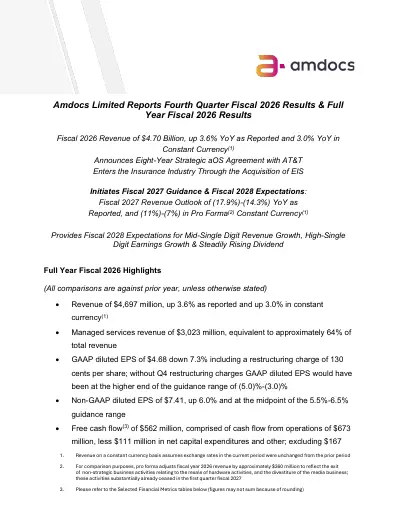
Amdocs Limited
Q4 FY2026 · Earnings Call TranscriptNovember 3, 2026
Operator
As a reminder, today's program is being recorded. Now I'd like to introduce your host for today's program, Matthew Smith, Head of Investor Relations.
Please go ahead, sir.
Matthew Smith
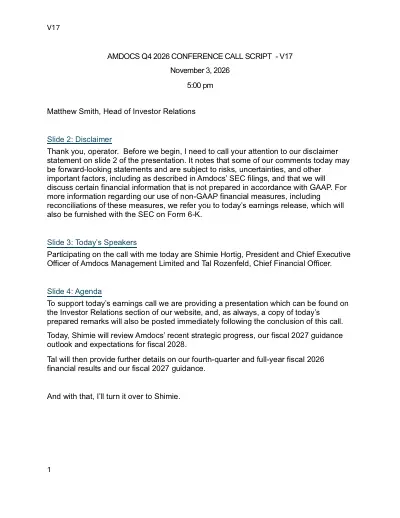
Thank you very much. Before we begin, I need to call your attention to our disclaimer statement on slide 2 of the presentation, in which that some of our comments today may be forward-looking statements and are subject to risks, uncertainties, and other important factors, including as described in Amdocs's SEC filings, and that we will discuss certain financial information that's not prepared in accordance with GAAP.
For more information regarding our use of non-GAAP financial measures, including reconciliations of these measures, we refer you to today's earnings release, which will also be furnished with the SEC on Form 6-K. Participating on the call with me today are Shimie Hortig, President and Chief Executive Officer of Amdocs Management Limited, and Tal Rozenfeld, Chief Financial Officer.
To support today's earnings call, we're providing a presentation which can be found on the Investor Relations section of our website, and as always, a copy of today's prepared remarks will be posted immediately following this call. Today, Shimie will review Amdocs's recent strategic progress, our fiscal 2027 guidance outlook, and expectations for fiscal 2028.
Tal will then provide further details on our fourth quarter and full year fiscal 2026 financial results and our 2027 guidance. With that, over to you, Shimie.
Yeah.
Shimie Hortig
Thank you, Matt. Good afternoon, everyone.
I'm happy to join you from our New Jersey offices. Today, we announced solid fourth quarter and full year fiscal 2026 results, consistent with our guidance, and I'm grateful to our employees around the world for their hard work, focus, and commitment in making it happen.
My plan today is to cover our recent strategic progress, our fiscal 2027 guidance, and our expectations for fiscal 2028. I took over as CEO two quarters ago with a clear mission to prepare the company for the agentic revolution, which I believe represents an amazing opportunity for us.
The telco industry will need to transform and change the operational model to realize the benefits of the AI revolution. For them to be successful, they will need a trusted partner to transform their mission-critical systems, one with deep industry expertise, engineering pedigree, and transformation capabilities, who can help them adopt disruptive technologies in a responsible manner.
We believe that Amdocs is uniquely positioned and will be this strategic partner. To make this happen, we have moved fast to develop a new overall strategy for the company, which we've been busy executing.
The core pillar of this strategy is aOS, Amdocs Agentic Operating System for telco, which is quickly gaining traction in the market. Today, I'm delighted to announce a major milestone for our aOS strategy.
We signed an eight-year strategic agreement with AT&T, our largest customer. The strategic agreement is designed to accelerate the transformation of their business by adopting our agentic technology in combination with AT&T's leading AI capabilities.
Building on decades of trust and our long-term partnership with AT&T, we are proud to embark on this first-of-its-kind journey that we believe should be the leading approach for AI adoption in the telco market. In this partnership, we are bringing together the shared expertise of AT&T and Amdocs to simplify complex work, improve efficiency, and bring new products and experiences to customers faster.
AT&T and Amdocs will work as one delivery team, combining AT&T's technology environment and business priorities with Amdocs's telecom and engineering expertise. We will share responsibility for delivering projects faster while reducing the total cost of modernization and operating critical systems.
AT&T's forward-looking approach to AI and its ambition to rethink technology delivery and operation is exactly the kind of journey Amdocs aOS was built to support. On top of AT&T, we are also happy to announce another three major strategic aOS deals this quarter across Europe, Eurasia, and Southeast Asia.
We signed a 10-year agreement with VEON, a global digital operator. Amdocs will leverage aOS to agentify VEON's operations, customer experiences, and digital services.
This strategic collaboration deepens the relationship with the VEON Group and presents an opportunity to further expand our business with them and across the Eurasia region. At Globe in the Philippines, we signed a multiyear agreement to modernize core business platform and strengthen IT operations by leveraging Amdocs aOS.
This agreement also expands our scope of work to include agentifying Globe's business workflows. In the UK, Vodafone Three selected Amdocs to support upgrade of its B2B business support systems on a new agentic enterprise platform powered by aOS.
The program will consolidate and upgrade multiple legacy systems onto a single Amdocs enterprise technology stack and deliver agentic capabilities across delivery and operations. These key aOS deals with AT&T, VEON, Globe, Vodafone Three, and the 10-year deal announced with Liberty Latin America last quarter are great examples how aOS is enabling Amdocs to expand its activities and become the trusted partner of choice for our customers.
They also demonstrate the large-scale potential of aOS as a leading solution for telco market all around the world. In addition to these large aOS deals, we also see healthy demand and strong sales momentum across Amdocs's broader product and services with customers globally.
In the fourth quarter, we won many significant deals. To highlight a few: Comcast renewed its multiyear managed services agreement with Amdocs across Xfinity Mobile and Comcast Business.
We signed a multiyear managed services agreement with Millicom Chile, designed to simplify technology operations and increase business agility. We expanded our collaboration with Airtel in India to modernize its enterprise B2B monetization and billing operations.
In Hungary, Magyar Telekom selected Amdocs to deliver billing transformation and catalog modernization. As I shared a few months ago, one of the pillars of our new strategy includes diversification into a new vertical.
After thorough review, we decided that insurance is the right vertical for Amdocs. Insurance is a large and growing market and shares many of the same characteristics that have defined Amdocs's success in telecommunication: highly regulated operating environments, complex and mission-critical platforms, and data-intensive workflows.
Similar to telco, insurance providers will also need to transform and adapt AI capabilities across their core operations and business workflows. We intend to become their partner of choice, leading them in this agentic journey.
In order to do that, we are planning to create a differentiated offering leveraging Amdocs aOS technology, Amdocs's scale, our unique transformation capabilities, and our well-proven accountability business model. Executing on our strategy, I'm pleased to announce today that Amdocs has acquired EIS for $340 million in cash.
EIS is a leading provider of agentic insurance core systems platform, spanning policy, billing, claims, and customer engagement. The company has multi-line expertise in both life and annuities, and property and casualties.
Headquartered in San Francisco, EIS serves dozens of leading insurance carriers globally, including household names such as Aflac, Allstate, AAA, BNP Paribas Cardif, and more. This acquisition is an important step into the insurance software industry and represents a strategic move to develop new growth engines for the company.
We are planning to combine EIS's advanced technology, deep vertical expertise, and strong customer base with Amdocs aOS technology, scale, engineering pedigree, transformation track record, and accountability model. Overall, I'm very excited about this acquisition and believe that our strategic move to the insurance software vertical will significantly expand our addressable market, creating a great long-term growth opportunity for Amdocs.
Moving to slide 12. Focus strategy is also about deciding what not to pursue.
In the past six months, as part of our strategic process and formalizing our new strategy, we conducted a comprehensive review of our business and products offering. The purpose was to focus and to rationalize the company's activities, align them with the new agentic growth strategy, and reallocate our budget and investment accordingly.
This review resulted in the following: optimizing our product and services portfolio, and decided to end or minimize our investment in certain legacy products. Some of these products are results of acquisition executed over many years and still exist within the company, while some are no longer relevant given our new strategy.
We further ceased certain non-strategic business activities that cannot be converted into the new agentic offerings, such of the resale of the certain hardware. We sold our media business, which was no longer part of our strategy, selling Vubiquity to Premiere Digital.
Finally, we decided to cease or minimize our business and operation in certain territories. These initiatives are all designed to focus the company and to build a healthier, strong, new base for the agentic strategy.
To reflect some of these changes, we are providing full year fiscal 2027 revenue growth guidance in pro forma constant currency so that you have a base for comparison with the prior year. As to our own internal transformation to become an agentic organization, we have made meaningful progress over the last six months, advancing agentic SDLC across our development and operations units with secured context, harness, and workflows.
We already see significant productivity gains. As part of this, we completed the rollout of the new agentic way of working, which has reached 10,000 employees and 800 hubs, putting AI-enabled practices into use across our teams.
We are building an agentic culture and DNA with hands-on expertise, training, certification, and knowledge sharing. On token economies, we have established the foundations for allocating AI usage and optimizing consumption.
We are also extending the program to knowledge work beyond engineering, starting with early adopters in other parts of the business. Together, these initiatives support a broader change in our operating model.
Our objective is a more productive and agile Amdocs, with AI embedded in everything we do. All together, we are seeing great momentum in our strategy, and with the progress we've made to date, I'm confident that we are on track to generate significant new business and expand our footprint across both telco and the new insurance vertical.
At the same time, we are facing a major headwinds due to the situation we have with T-Mobile. This is an isolated situation with a large customer, resulting in a significant decline in our revenue profitability outlook for next year.
As you are aware, we have seen revenue decline due to T-Mobile's reduced discretionary spending with us. In fiscal 2026, we've also completed a large-scale, one-time integration project of the U.S.
Cellular customers into T-Mobile. Moreover, we are also facing a dispute concerning the recently signed agreement with T-Mobile, which escalated into a legal dispute during the last quarter.
Due to the confidential nature of the dispute, I'm not going to get into details, other than to say that we are prepared to fiercely defend our positions, including in arbitration. These circumstances have been taken into consideration in forming our conservative guidance assumptions for fiscal 2027, which reflect our best estimate as of this date, including in case of termination of our agreements with T-Mobile by either party.
This is an isolated situation involving one customer. As clear from my previous remarks, this does not reflect on the rest of the business, which is expected to grow in the mid-single digit this year.
Given the size of the challenge at T-Mobile, and despite the great momentum we have in the rest of the business, we expect fiscal 2027 to show a decline in revenue profitability. After adjusting for the sale of the media business and the exit of certain non-strategic business activities, we are guiding revenue to decline between 7% to 11% in pro forma constant currency this year, incorporating our conservative best assumptions for the T-Mobile situation as of this date.
Outside of T-Mobile, the rest of Amdocs's business is robust and expected to grow mid-single digits in fiscal 2027. The T-Mobile situation will also significantly impact profitability this year.
We therefore expect non-GAAP operating margin to decline by roughly 200 basis points in fiscal 2027 at the midpoint of our guidance, and non-GAAP diluted earning per share to decline by between 26% and 30%. As to our dividend, our board has today authorized a 3% increase in the quarterly cash payment, subject to shareholders' approval.
Overall, although 2027 will be financially challenging, it will also be a year of strategic transition, setting us for long-term success and growth. As we look into 2028 and beyond, we believe the growing momentum behind large-scale aOS wins in telco, insurance with its sizable addressable market and strong potential growth, and our internal transformation efforts will put us on track to return to growth and stronger profitability.
Based on that, we expect to enter fiscal 2028 positioned for mid-single-digit revenue growth, high-single-digit growth in non-GAAP diluted EPS, and steadily rising dividend. Moreover, I'm confident Amdocs will be an even stronger, more focused company and well-positioned to lead in the agentic era for years to come.
With that, I will hand it over to Tal for the financial review. Tal, over to you.
Tal Rozenfeld
Thank you, Shimie, and good afternoon, everyone. Starting on slide 18, we delivered a solid fourth quarter financial performance.
Q4 revenue was approximately $1.194 billion, up 3.8% year-over-year as reported, and in line with the midpoint of our guidance on a constant currency basis. In constant currency, revenue was up 4% from a year ago.
Non-GAAP operating margin was 21.6%, unchanged from the previous quarter. Interest and other expenses amounted to roughly $40 million in Q4, consistent with recent quarters.
Non-GAAP diluted earnings per share was $1.98, a cent above the guidance midpoint. Diluted GAAP EPS of $1.35 was below the guidance range of $1.48 to $1.56, primarily due to restructuring charge of roughly 22 cents per share resulting from the acceleration of our internal transformation and our strategy to become an agentic-first organization.
Adjusting for this change, GAAP diluted EPS would have been above the guidance range. Demonstrating consistent operating execution in core business, earnings to cash conversion was also healthy this quarter, reflecting healthy free cash flow generation of $202 million before restructuring payments.
Summarizing our full fiscal year 2026 performance on slide 19, revenue of $4.697 billion was up 3.6% as reported and 3% in constant currency at the midpoint of our guidance. Geographically, North America grew approximately 0.6%, while Europe was up approximately 8%, and rest of the world up approximately 11%.
Non-GAAP operating margin of 21.6% improved by 20 basis points for the year, consistent with the midpoint of our guidance as we balanced our agentic growth investment with internal cost and efficiency gains in the year. Free cash flow before restructuring payment was $729 million, in line with the high end of our guidance of $710 million to $730 million.
On the bottom line, non-GAAP diluted earnings per share grew 6%, in line with the midpoint of the original guidance we provided at the beginning of the year. Turning to slide 20, revenue from managed services increased by approximately 1% in fiscal 2026.
Q4 included several key managed services deals. Notably, the major aOS wins with AT&T, VEON, Globe, and Liberty Latin America were secured as part of a multiyear managed services engagement under which Amdocs takes full accountability for delivering measurable business outcome to the customer.
As a key highlight, we signed a multiyear managed services agreement with Millicom Chile, which will leverage Amdocs's full-stack BSS and OSS to streamline technology operation and respond faster to evolving business and customer needs. Additionally, we've signed managed services agreements under new multiyear agreement with Comcast and Airtel India.
Moving to the balance sheet and cash flow highlights, DSO of 83 days increased by 9 days from a year ago and 5 days sequentially. Unbilled receivable net of deferred revenue increased by $95 million versus a year ago and by $61 million sequentially in Q4, aggregating the short-term and long-term balances.
As a reminder, the net difference between unbilled receivables and deferred revenue fluctuates from quarter to quarter in line with normal business activities, as well as our progress on multiyear engagements. As mentioned, free cash flow before restructuring payment was $729 million in fiscal 2026, in line with the higher end of our guidance.
Including restructuring payment of $167 million, reported free cash flow was $562 million for the year. Overall, we ended Q4 with a cash balance of approximately $197 million and aggregate borrowing of roughly $950 million, including our $650 million senior notes maturing in June 2030 and $300 million outstanding notes under the commercial paper program.
After the quarter, we completed the divestiture of Vubiquity for cash proceeds of roughly $66 million. We secured two term loans for an aggregate amount of $500 million, and in November, we completed the acquisition of EIS for $340 million in cash.
Now, turning to revenue outlook on slide 22, we are continuing to closely monitor the prevailing level of macroeconomic, geopolitical, business, and operational uncertainty, including our customers' spending behavior in the current business environment. The first quarter and full fiscal year 2027 financial guidance reflects what we consider to be most likely outcome based on the information we have today, but we cannot predict all possible scenarios.
With that, let me take you through the revenue outlook for fiscal 2027. To begin, as Shimie mentioned, after a thorough review of Amdocs's business and offering over the past six months, we've taken some action to focus and rationalize the company's activities.
Therefore, to help calculate our fiscal 2027 revenue growth versus fiscal 2026 in a comparable manner, we are providing an adjusted pro forma number based on our assessment that revenue from the exit of the non-strategic business activities relating to the resale of hardware activities and the divestiture of the media business were roughly $360 million in fiscal 2026. These activities substantially already ceased in Q1.
Turning to the guidance, we expect revenue to decline by between 14.3% and 17.9% as reported in fiscal 2027, roughly 760 basis points to reflect the exit of non-strategic business activities relating to the resale of hardware activities and the divestiture of the media business. Adjusting for this, we expect revenue to decline by between 7% and 11% in pro forma constant currency this year, the midpoint of which is well supported by our 12-month backlog.
The pro forma outlook incorporates conservative assumptions to reflect the unique situation at T-Mobile based on what we know today. Isolating for T-Mobile, the rest of Amdocs's business is expected to grow mid-single-digit growth in fiscal 2027.
As to the first fiscal quarter, we expect revenue within a range of $955 to $995 million, which assumes a favorable sequential impact of $1 million from foreign currency fluctuation as compared to Q4. Moving to slide 23, 12-month backlog was $3.5 billion at the end of Q4.
Adjusting for Vubiquity and the exit of non-strategic business activities I just referenced, 12-month backlog was down 9.6% both sequentially and compared to a year ago. The decline in 12-month backlog on a pro forma basis primarily reflects an adjustment for the major headwinds we are seeing at T-Mobile and the conservative best estimate revenue assumptions we've taken based on the situation with this customer on this date.
Isolating for T-Mobile, fourth quarter 12-month backlog for the rest of Amdocs's business grew by mid-single digits from a year ago on a pro forma basis, led by the aOS-related awards we've announced and robust win momentum across our core portfolio of product and services. Looking ahead, 12-month backlog equates to roughly 90% of our fiscal 2027 revenue growth outlook and thus remains a good measure of our forward visibility.
Turning to profitability, the T-Mobile situation is significantly impacting our fiscal 2027 outlook. We expect non-GAAP operating margin within a range of 19.2% to 19.8%, the midpoint of which is roughly 210 basis points lower year-over-year.
At the same time, our decision to accelerate the internal implementation of agentic capability is already driving significant productivity and efficiency gains in our business, which we expect to continue. Profitability this year will also benefit from the sale of our media business and the exit of the non-strategic business activities.
We are also continuing to invest in R&D, sales, and marketing to accelerate aOS, our agentic growth strategy, and our investment to expand in the insurance vertical. To provide some additional color to help with your modeling, we expect non-GAAP operating margin will begin the year well below the 19.5% midpoint of the annual guidance, but will consistently improve as the year progresses, such that by Q4, our profitability will be at the higher end of the annual guidance range.
Turning to capital allocation, we returned $142 million to shareholders through share repurchase and dividends in the fourth fiscal quarter. Looking at fiscal 2027, we expect free cash flow before restructuring payment in the range of $440 million to $500 million.
Our free cash flow outlook equates to a conversion rate of 85% relative to non-GAAP net income, which primarily reflects the timing of milestone payments in connection with large deals we've recently won. Regarding our capital allocation plan for fiscal 2027, we expect to return the majority of our free cash flow to our shareholders.
We remain committed to a dividend growth, and are pleased to announce a proposed 3% increase in our quarterly cash payment to a new rate of 58.6 cents per share, subject to shareholders' approval at the annual meeting in January 2027. We continue to believe in share repurchases as a mechanism for returning cash to shareholders, but we expect a slower pace of buyback activity in fiscal 2027 as we prioritize our investment to support our long-term growth strategy.
Bringing it all together, we expect non-GAAP diluted earnings per share to decline by between 26% to 30% in fiscal 2027, as shown on slide 26. The outlook assume higher financing costs in fiscal 2027 resulting from our M&A activity and a non-GAAP effective tax rate within a range of 16% to 19%, which is unchanged from the prior year.
Looking ahead to fiscal 2028, while we aren't providing formal guidance at this point, we believe our strategic momentum will position us for a return to growth and improved profitability. With aOS for telco showing momentum and increasing pipeline of significant customer opportunities, and expansion of our addressable market to the insurance industry, we have expectation for mid-single-digit revenue growth in fiscal 2028.
Moreover, our internal transformation initiative should support significantly better profitability, underpinning high-single-digit growth in non-GAAP diluted earnings per share and a steadily rising dividend. With that, back to you, Shimie.
Shimie Hortig
Yeah. Thank you, Tal.
I think we are ready to take your questions. Operator?
Operator
Certainly. As a reminder, ladies and gentlemen, if you do have a question at this time, please press star 1 1 on your telephone.
Our first question comes from the line of Shlomo Rosenbaum from Stifel. Your question, please.
Shlomo Rosenbaum
Hi, thank you for taking my questions. This thing with T-Mobile is extremely unfortunate.
Not something that I think anybody was anticipating here. I guess it would be helpful to segment the breakdown of that headwind over the year between T-Mobile going away potentially, the Vubiquity being sold, and then how much of this hardware resale that you're getting out of.
Then just on that hardware resale, it feels like deja vu, because two years ago, we saw Amdocs talk about exiting $600 million of low-margin business that was also described as some kind of hardware resale. I'm trying to understand how much of this business do you have and why wasn't this exited two years ago when you were doing that initially?
Shimie Hortig
Yeah. Hi, Shlomo.
How are you?
Shlomo Rosenbaum
Great.
Shimie Hortig
You mentioned a few points, I will try to address all of them. As we mentioned, the current situation with T-Mobile, we had to take it into account in our conservative approach for the guidance for the 20 2027.
If you isolate the case, and this is an isolated case with one customer, the rest of the business, as we said in our prepared remarks, is planned to grow at mid-single-digit growth in 2027. All the reduction that you see and everything else is coming from the situation in T-Mobile, which again, we had to take a conservative approach for our guidance for this year.
Now, the growth that we're talking about, mid-single-digit growth is coming based on some great momentum that we see right now outside of T-Mobile. Look at the new deal that we signed with AT&T, a landmark, first-of-its-kind deal that we signed with AT&T to leverage aOS together with the AI capabilities of AT&T to join forces and to do something that was never done in our industry.
It is fueled by the wins in VEON, the win in Globe, the win with Vodafone Three, and just to remind you, just three quarters three months ago, we announced aOS deals with Liberty Latin America. All together, the accelerated growth that we could have had this year due to all this amazing deals that we signed would have been at the mid-single digit for this year.
However, the conservative approach with T-Mobile is driving the guidance that we shared. Now, with regard to your other question, you talked about the strategic process, what we did over the last six months.
We went over every activity in the company as part of trying to refocus our strategy. The new strategy that we laid out for the company is comprised of four main pillars.
First is the aOS, which we have seen a lot of momentum. Two is to expand to new vertical, and today, we are announcing the entrance to insurance and buying EIS and making the first major step in our journey for this new vertical.
The third growth area was about new growth horizons that we are developing right now, new ideas and new opportunities that we see, again, riding on the AI revolution. The fourth pillar was about our internal transformation.
On the same time, we decided that there are other things that are happening in the company that we don't want to do anymore, that are not part of this strategy. Therefore, you see us selling the media asset of Vubiquity to Premiere Digital.
We minimized investment in all kinds of legacy products. We optimized the product and the portfolio.
We stopped all kinds of activities, including reselling of hardware and some other activities. We minimized some of our operations and business in certain territories around the world.
The whole idea was to come up with a very focused, forward-looking strategy, and things that we don't believe that it can convert to future agentic offering, we don't want to do anymore going forward. That's the process that we've been doing over the last six months.
Operator
Does that answer your questions?
Shlomo Rosenbaum
I guess we could go back. T-Mobile was how much of revenue in 2026 and how much in 4Q 2026?
I guess I'll just ask that straight.
Shimie Hortig
We cannot get, Shlomo, to the details of the specific numbers right now. I can just tell you that right now in our assumptions for next year, it's a major reduction.
Without it, we could have shown a significant growth in the business of the company.
Shlomo Rosenbaum
Okay. All right, thank you.
Operator
Thank you. Our next question comes from the line of Tal Liani from Bank of America.
Your question, please.
Tal Liani
Shimie, what a way to start a career as a CEO.
Shimie Hortig
Hey, Tal. How are you?
Tal Liani
How are you? I'm going to ask you the question that investors are going to ask me tomorrow, and I'm going to ask it in the way that I'm going to get the question, because I want to hear your response.
The question is, what is the risk? There are fundamental issues behind T-Mobile.
It's a customer that decided to do things in a different way. Then it started a few quarters ago and it progresses.
I'll ask you the question in a simple way. What is the risk that another customer, a big customer you have six big customers overall, but what's the risk that some other customers will go through the same process and terminate the relationship also with Amdocs?
How do you view the position of other customers with the company? You don't have to talk about T-Mobile, your probably limited, but maybe you can talk about the others.
Shimie Hortig
Yeah. Just to clarify, there was no termination of the agreement.
We are just sharing that it escalated to legal dispute, but we continue to support T-Mobile as we speak, and to support their business. The reason that we think that it's isolated, and touching and discussing right now only with T-Mobile, specifically about the contract that we signed with them earlier this year, is that we see the amazing momentum that we have all over the world.
Just think about the AT&T agreement that we signed this quarter, a landmark, first-of-its-kind deal that we signed with AT&T to leverage aOS together with the AI capabilities of AT&T, to join forces and to do something that was never done in our industry. Think about the Liberty Latin America deal that we just announced.
Think about what we see right now with Globe in the Philippines, in Vodafone Three in UK. All over the world, it's not only that we don't see the challenges that we have with T-Mobile, we actually see completely the other direction, where customers are partnering with us and would like us to be their main partner to support the agentic journey.
The proof point is just on what we see and the deals that we are signing, the momentum and the growth that we see. Therefore, we believe that T-Mobile is an isolated case.
Again, I cannot get to the details of this case, but I can tell you that it's an isolated case and the rest of the business is growing very nicely.
Tal Liani
I had three questions. My second question is why did you make the acquisition?
What is the strategic fit for the company? What's the vision overall?
What's the strategy behind it?
Shimie Hortig
Yeah. As we discussed a quarter ago and even before, we believe that to expand into additional vertical is the right move for Amdocs.
As we've been discussing it for years, but the time is right. We think that insurance is the right industry.
It's a growing industry. It's an industry that has very similar characteristic to what we are doing in telecommunication and been very successful in telecommunication in terms of the complexity, mission-critical systems, and so on.
The time is now, because they are looking for partners that will help them to transform. They are looking for customers that will help them enjoy and leverage the AI technology that exists today.
I think there's no one better than Amdocs to partner with them. Now, what we had to do is to get into the market.
We found the right company that has the right technology that we can build on, that has the insurance knowledge and expertise, that has the right set of customers. We are planning on top of it to bring the entire agentic offering and portfolio of Amdocs from telecommunication to combine it together with the assets that we acquired, EIS, and to deliver to the market something that they don't see today, a unique differentiated offering that do not exist today in the insurance market.
Again, we've been studying this industry for a while and we think that what we're coming right now to the industry is very unique and we'll open the door for us for significant expansion of our addressable market. Got it.
Tal Liani
If I look at the history of the company, some acquisitions were phenomenal, transforming acquisitions. Some acquisitions, like Vubiquity, that you're trying to sell today, or you sold it, were not that great.
How do you make sure that this asset is integrated properly? It's a different business.
It's a different line of business altogether. What do you have on the operational side that makes sure that you're making the best effort to integrate it?
Shimie Hortig
Yeah. First, I think it's not like a regular acquisition that we have done over the years.
We went to media many years ago because we thought the telco customers are going to use media. This is, Tal, the first time that we are making an intentional, well-planned, strategic move into additional industry.
We are getting ready accordingly. We have established a new unit, reporting directly to me, that will incorporate the new company, EIS, together with all the offering that we've built and prepared for insurance.
We are allocating all the right leaders in terms of technology, sales, services, and all the other support from the company, and we plan to monitor it very carefully. It's not another acquisition.
It's an entrance to another vertical of Amdocs, something that we have never done in the history of the company.
Tal Liani
Got it. The last question I'm getting on Amdocs, and I'm just going to use the opportunity here to ask you this: AI as a risk and opportunity.
I know it's a big question, but that's exactly the question we're getting from investors. I want to understand your strategy evolved in AI, how to benefit from AI.
Can you talk about both sides of the equation and how you turn AI into a tailwind and not a headwind?
Shimie Hortig
Yeah. We see AI as an amazing opportunity for us.
It's an opportunity for the telecommunication industry to fundamentally change the way they operate. Our vision for this industry is that going forward, in the domains that we are supporting them today, they will be able to run their operating systems in a fully agentic, autonomous manner, business-to-machine, transforming significantly the way they operate today.
Better time to market, reduced cost structure, and fundamentally change the way they operate today. They're starting from a starting point that is much different from what we're envisioning for them for the future.
They will need a trusted partners to go with them to this journey. Amdocs is the right partner to help them.
There's no one that has a better technology, domain knowledge than us in this industry. Combined with our aOS technology, we will be the one that will help them in this journey to go from wherever they are right now to the future and get the benefits of this amazing opportunity.
Now, we have done it in the past when they were trying to do digital transformation. We have done doing it helping them to go to the cloud, and so on and so forth.
I think now it's even a bigger opportunity. Probably the biggest opportunity that we have had.
If we can find ourselves supporting now 400 customers all over the world with agentic journeys, taking them from whatever they are right now to this future, fully agentic, fully autonomous business-to-machine concept, it's a huge opportunity for Amdocs. Now, what we are doing with AT&T and what we announced today with AT&T is exactly what I'm talking about.
This is exactly the representation of such strategic journey between two companies trying to fundamentally change the way AT&T is operating.
Tal Liani
Got it. Great, thank you.
Shimie Hortig
Thank you, Tal.
Operator
Thank you. Our next question comes from the line of Devin Au from KeyBanc Capital Markets.
Your question, please.
Devin Au
Hi, thanks for taking my questions. Congrats on the eight-year agreement with AT&T.
Wanted to start there, maybe just elaborate that a little bit. How should we think about maybe the pace of the expanded scope ramping from here?
How important was aOS in helping you win that incremental work, and any way to frame the potential revenue contributions from that expansion?
Shimie Hortig
Yeah. Thank you, and you're right.
This is a flagship agreement, probably the best we can think of. It's built of many, many years of trust and partnership between AT&T and Amdocs.
We're going to bring in the entire aOS portfolio of Amdocs, all the new aOS offering Amdocs is going to be married with the AI of AT&T. AT&T by themselves are very advanced in their AI technology and their future-looking view.
We're going to join forces. We're going to bring together everything that we have together with what AT&T is going to have, and we're going to accelerate significantly the transformation of AT&T.
We're going to work as one team. It's going to be a new business model in the way we operate.
Their expectations from AT&T board and their leadership is to do something fundamentally different from everything that they've been doing in the past. That's exactly the great excitement that we have with this new engagement.
It's also going to involve more revenue for Amdocs, growth in the revenue. Again, I mentioned that without T-Mobile, we could have grown mid-single digits.
Some of it is definitely related to the new deal in AT&T and other deals that I mentioned. That's exactly probably the best example of a strategic partnership and a strategic journey between a leading company like AT&T and Amdocs aOS.
Devin Au
Understood. Maybe just a quick follow-up.
Appreciate you giving us the mid-single-digit growth outlook ex-T-Mobile for '27, and it's an acceleration from where you ended in '26. Could you maybe speak to how much of that is from some of the recent aOS deals that you have signed or expected to ramp, and maybe kind of speak to how much EIS is kind of adding to that growth algorithm?
Thank you.
Shimie Hortig
Yeah. As you said, we are very encouraged from the momentum with aOS right now.
All the deals that I mentioned—with AT&T, with VEON, with Globe, with Vodafone Three, and the one that we signed three months ago with Liberty Latin America—are all contributing to the growth that you see right now. EIS is just at the beginning.
We are starting, we're entering a new market. There's some revenue that's back into our plans.
We look at it as a mid-term, long-term great opportunity for the company. The main growth engine right now that is driving the growth for 2027 is the aOS that we do with the telco customers.
Operator
Thank you. As a reminder, ladies and gentlemen, if you do have a question at this time, please press star 1 1 on your telephone.
Our next question comes from the line of George Notter from Wolfe Research. Your question, please.
Taran Katta
Hey, guys. This is Taran Katta on for George.
Shimie Hortig
Hey.
Taran Katta
Can you talk a little bit about your plans to break into other verticals, potentially in the near term? I was also wondering how you will drive further penetration in the insurance industry.
Does it insinuate further acquisitions as well, or would you grow off your current acquisition? Thank you.
Shimie Hortig
Yeah. As we said when we lay out the strategy, we don't have any intentions to go multi-vertical.
We are adding one industry. We've been focusing on telecommunication and now we're adding insurance as a new vertical for the company with a mid-term, long-term, a new growth engine for the company.
We don't have any plans to expand beyond that. We're going to make all the focus right now to execute based on our strategy.
We believe we have a lot of room to grow. We acquired a very good asset, EIS, with very good technology, customers, insurance knowledge, and we're combining it with everything that we are doing very successfully right now with the telecommunication industry.
Our entire aOS offering, Amdocs pedigree and our knowledge in transforming large carriers in telecommunication that we now want to do with insurance, our services, our managed services, all the portfolio of offering that Amdocs has, we want to bring to this new industry, and this will drive the growth of the company this year and for many years to come.
Taran Katta
Got it. Thank you.
Operator
Thank you. Our next question is a follow-up from the line of Devin Au from KeyBanc.
Your question, please.
Devin Au
Hey, thanks for letting me ask another question here. Maybe just one.
It seems like you're doing a lot in driving internal efficiencies, you're further optimizing the portfolio with these additional divestitures, but those initiatives aren't really showing up in the results or in the guide, just given the headwinds that you kind of pointed out. Is there a way to help us think about where would margins be, excluding kind of these headwinds, and any details you can share on kind of the margin profile of T-Mobile or the impact to the margins there?
Thank you so much.
Shimie Hortig
Yeah. You're right.
We are making a lot of internal transformation and we are seeing productivity gains. The only reason that you don't see it in the guidance for 2027 is the fact that we took a conservative approach with our guidance for 2027 given the situation right now with T-Mobile.
More than that, if you look into the plans that we have for 2027 quarter-over-quarter, we are planning to grow in our profitability quarter after quarter. You see the progress that we're going to make.
Again, we will isolate over time the T-Mobile situation and you're going to start to see quarter-over-quarter how we continue to grow. We're going to end up 2027 with a much better entry point into 2028, which makes our forecast right now that we shared with you and our expectations for 2028 to be very credible from our perspective, because we know that we're going to end 2027 in a much better place than we start 2027.
When we told you that we believe that in 2028 we're going to be mid-single-digit revenue growth and we're going to have high-single-digit EPS and dividend, it's based on this productivity and improvement that you're going to see quarter-over-quarter coming from the internal transformation of the company.
Devin Au
Appreciate the additional context, Shimie. Thank you.
Shimie Hortig
Thank you. Thanks, Devin.
Operator
Thank you. This does conclude the question-and-answer session of today's program.
I'd like to hand the program back to Matthew Smith for any further remarks.
Matthew Smith
Thanks, everyone, for joining, and if you have any additional questions, please reach out to us here in the IR department. With that, have a great night.
Thanks.
Operator
Thank you, ladies and gentlemen, for your participation in today's conference. This does conclude the program.
You may now disconnect. Good day.