DPC Holdings PLC
NNYSE:DPCQ3 FY2026 · Earnings Call TranscriptNovember 12, 2026
Operator
Hello, everyone. Thank you for joining us, and welcome to the DPC Holdings reports third quarter 2026 results.
After today's prepared remarks, we will host a question-and-answer session. If you would like to ask a question, please press *1 to raise your hand.
To withdraw your question, press *1 again. If you have logged in via the webcast, please submit your questions using the Q&A button.
I will now hand the conference over to Lucy Sharma, Head of Investor Relations. Please go ahead.
Lucy Sharma
Good morning, and welcome to DPC Holdings third quarter 2026 results conference call. I'm Lucy Sharma, responsible for Investor Relations, and I'm joined by Mike Quinn, Chief Executive Officer, and David Egan, Chief Financial Officer.
Mike and David will run through a presentation outlining our results, strategic updates, and outlook. We will then open the call for questions.
Before I hand over, I'd like to note that today's discussion will include forward-looking statements regarding our future performance, plans, and expectations. Information about factors that could cause actual results to differ materially from these statements can be found in today's presentation, our earnings release, and our SEC filings.
During the presentation, we will refer to certain non-GAAP financial measures, with reconciliations to the most comparable GAAP measures available in the earnings release issued today, as well as in the appendix to the presentation. Unless otherwise indicated, all performance comparisons are on a year-over-year basis, and all numbers will be in US dollars.
With that, I'll hand the call over to Mike and slide four.
Mike Quinn
Great. Thanks, Lucy.
Good morning, everyone, and welcome to DPC Holdings third quarter 2026 earnings call. We've a lot to cover today.
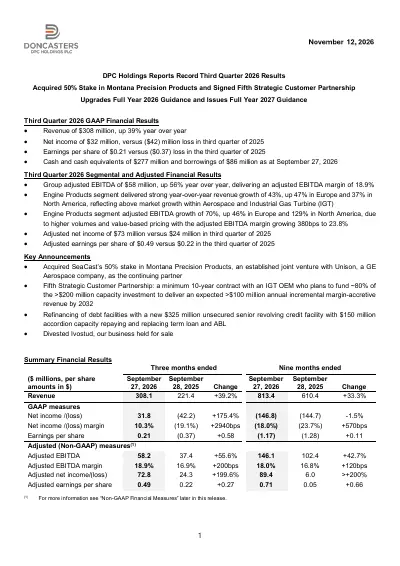
We've had a very strong quarter, both financially, beating consensus expectations, and strategically. Revenue grew 39% year-on-year to a record $308 million, with engine products growing 43%.
Adjusted EBITDA increased 56% to a record $58 million, with the margin increasing 200 basis points to 18.9%. Engine products adjusted EBITDA grew 70%, with the margin increasing 380 basis points to 23.8%.
Alongside these strong results, we've made significant strategic progress during the quarter. We acquired C-Cast's 50% stake in Montana Precision Products, MPP, through an established joint venture with Unison, a GE Aerospace company.
We signed our fifth strategic customer partnership, our largest to date. This is a minimum 10-year contract expecting to generate over $100 million of annual revenue when fully ramped, with the customer providing funding support for over 80% of the capital cost.
We refinanced our debt facilities with a new $325 million revolving credit facility, replacing the existing term loan and ABL, and have also exited our Evostart business, which was held for sale. Reflecting the strength of the business and the visibility we have, we're upgrading our full year 2026 guidance and introducing 2027 guidance.
In summary, it has been a busy and successful quarter, which demonstrates clearly that we are delivering against our plan to generate significant value. Turning to slide five, first, I'd like to detail the Doncasters casting portfolio, where we play and our growth opportunities.
Within the aerospace end market, we manufacture largely nickel-based superalloy structural castings, accounting for over 80% of our aerocasting revenue. These include products such as the turbine center frame, shown in picture one.
Aero airfoils account for less than 10% of our aerocasting revenue currently. However, our first strategic customer partnership, which includes significant customer-funded capital expenditure, is to develop and supply aero blades and vanes from 2027.
We already do this, including single-crystal technology, but not in volume. Once this expanded production capacity is up and running, this could lead to opportunities with other players within a consolidating market.
Our turbo wheels business, which currently serves the transportation end market, makes small, high-volume castings. These are similar to castings required for UAVs and drones.
We believe we can utilize our turbo wheel capability and capacity for UAVs, and I'm delighted to report that we've won our first supply contract within this market. It's relatively small financially at this stage, but is significant in terms of our ability to win this type of business.
Moving to our IGT offering, we make turbine airfoils mainly for heavy-duty gas turbines, i.e., those that are producing over 100 megawatts of power. The turbines have extremely high blade complexity and are used for utility-scale generation.
They're differentiated from small to medium industrial gas turbines, where we're seeing new entrants moving into the market, such as those players looking to internalize their own supply. The smaller turbines and aero-derivative variations have a faster installation and setup, and so many are being installed in tandem to power data centers until larger, more efficient heavy-duty frame turbines can be supplied.
The benefits of heavy frame versus smaller turbines are better economies of scale, higher fuel efficiencies, increasingly important to generate significant dollar savings, provide stronger grid support, and have lower maintenance complexity. I've said Doncasters specializes in heavy-duty frame gas turbines, accounting for approximately 85% of our IGT casting revenue.
This is where we have significant demand, and so we're planning to double our heavy frame capacity, given our contracted LTAs and strategic customer partnerships. I'd like to clarify that, especially on the IGT side, our strategic customer partnerships all have customer funding and volume commitments, including a take-or-pay clause, meaning that capacity growth and earnings opportunity is supported by large OEMs.
Our capacity expansion and estimates are demand-led, based on base power generation and associated order books. Now I'd like to talk about our end markets of aerospace and IGT.
They both continue to benefit from strong structural growth drivers, significant supply backlogs, constrained capacity, and high barriers to entry. Turning to slide six, in aerospace, the structural drivers we have discussed previously remain firmly in place: rising air travel, record aircraft backlogs, aging fleets, and long-term engine platforms.
All of this is driving demand for newer, more fuel-efficient aircraft. Research forecasts continue to point to significant growth of nearly double-digit commercial aircraft deliveries through the end of the decade.
The chart on the top right of the slide shows the requirements for new engines. Over 84,000 new engines are required between now and 2045, highlighting the visible backlog.
Moving to slide seven, in IGT, we base our growth assumptions upon record demand and backlog we are seeing from our customers due to increasing electricity demand and growing energy needs, driven by energy transition from coal and oil to gas, security of supply, climate change, and reliability and renewables integration, and also from growing replacement parts demand. OEM customer order books are sold out now to 2031, 2032.
Most importantly, with over 2 terawatts of industrial gas turbines installed globally and growing, which require maintenance and servicing, and so driving increase in demand for replacement parts. Heavy frame turbines, where we play, has seen meaningful growth since 2015, 2016 and is now entering into the early stages of the blades and vanes replacement cycle, with the installed base growing from 140 gigawatts to 350 to 400 gigawatts by 2035.
These turbines have long asset life cycles, which deliver recurring service demand. We expect this to underpin significant OEM replacement parts volume growth over the coming years.
The right-hand side of the slide highlights the significant capacity growth quoted by some major OEMs. On our IPO roadshow, we said our base case long-term revenue growth in IGT, excluding AI-related growth, was based on 7% to 9% CAGR to 2035 based on independent research, and I'm pleased to say it has come in at the high end of those estimates.
Moving to slide eight, against that demand backdrop, the industry supply environment continues to remain constrained. Demand is coming from multiple end markets: commercial aerospace, defense, electrification, space, data centers, and AI-related power demand, and UAV applications.
There are a limited number of independent scaled casting suppliers which have the technical capability, customer qualifications, and capital-intensive assets required to serve this huge demand. Doncasters remains well positioned within a consolidating market.
We are a trusted independent scaled supplier. We are providing OEMs with committed capacity through our long-term strategic customer partnerships.
We are expanding our aero airfoils capacity, and following the IPO and refinancing, our balance sheet gives us the opportunity to invest in disciplined bolt-on acquisition opportunities to increase capacity further. These markets have significant barriers to entry: technical expertise, metallurgy, customer qualifications, and large-scale capital equipment cannot be replicated quickly.
We believe that makes scarce, qualified capacity increasingly valuable and places Doncasters in a strong competitive position. Moving to slide nine, let's explain our new JV.
We have acquired C-Cast's 50% stake in Montana Precision Products, an established joint venture with Unison, which is a GE Aerospace company that designs and manufactures specialized engine components and systems for aerospace. MPP manufactures small structural castings and tubes and duct assemblies for aerospace applications, with GE Aerospace accounting for the majority of MPP's revenue.
Given the ongoing changes within the casting industry, we are excited about building a partnership with Unison and strengthening both our aerospace proposition and opportunities and our commercial relationship with GE Aerospace. We currently make large structural castings for GE, accounting for less than 5% of Doncasters' group revenue.
We plan to use our specialist technical expertise and advanced foundry capabilities to support MPP's capacity growth and product expansion through contracted LTAs and a committed investment plan. Also, we see the potential opportunity to supply MPP's alloy from Doncasters' capacity.
We acquired MPP for cash on October 30th, with the transaction anticipated to be earnings accretive within the first year. This acquisition is in line with Doncasters' inorganic growth strategy.
We're super excited about the opportunity to work in partnership with Unison in growing MPP further and the value creation opportunity. Moving to slide 10, our fifth strategic customer partnership is another major milestone.
It is our largest to date. We have signed with a major IGT OEM a minimum 10-year contract with extension provisions to manufacture some of the largest, most complex DS single-crystal IGT blade and vane castings in the world.
To support the contract, we expect to invest more than $200 million in additional capacity. Crucially, the customer's plan is to contribute funding that covers approximately 80% of that $200 million-plus investment.
By 2032, the partnership is expected to generate more than $100 million of incremental annual margin-accretive revenue. There are a few points worth emphasizing.
The duration of agreement gives us significant long-term visibility. We are securing margin-accretive revenue and generating strong returns on our capital investment.
Most importantly, the level of customer funding support demonstrates the strategic importance for the OEMs to secure qualified capacity within the supply-constrained casting market. Moving on to slide 11, this details our five strategic customer partnerships signed to date.
Each contract is bespoke in nature, and due to this, takes time to negotiate. However, we thought it would be helpful to provide some details, showing the length of the partnerships through multi-year LTAs, what we are supplying—for example, we're moving into volume production of aero airfoils in the first partnership, but making more of the same parts we already make with the others.
We have provided the associated capital investment and how some is supported by customer funding, and the protections we have put in place to ensure that we can reuse the invested capacity if needs be, although we would expect OEMs to prioritize utilizing capacity they have invested in rather than going elsewhere. Although the individual structures differ, the benefits to Doncasters are consistent: securing earnings visibility through contracted long-term margin-accretive revenue, driving market share growth, and providing customer support for the capital required to increase capacity, and further deepening our technical and commercial relationships with major OEMs.
Across the five strategic customer partnerships, we now expect more than $300 million of annual incremental revenue by 2031, and of that investment associated with our partnerships, approximately two-thirds is supported by OEM investment, delivering an enhanced return on invested capital. This shows the vote in confidence the OEMs have in Doncasters.
We see our pipeline of strategic customer partnerships continue to strengthen and grow as the market becomes increasingly constrained. I'll now hand over to David to take you through the third quarter financial performance.
David Egan
Thank you, Mike, and good morning, everyone. Moving to slide 12.
Quarter three was a record quarter for Doncasters, with revenue and adjusted EBITDA ahead of our expectations. Revenue grew 39% year-on-year to $308 million, with strong growth in our end markets of aerospace and IGT.
The third quarter revenue growth included approximately 6 percentage points of growth from metal cost inflation pass-through year-on-year. The adjusted EBITDA grew 56%, with the margin improving by 200 basis points to 18.9%.
Metal cost inflation pass-through, which does not affect our EBITDA dollars, led to a 90 basis point dilution of the margin in the quarter. Engine products in both Europe and North America grew revenue by 43% and EBITDA by 70%, a 380 basis point improvement in margin to 23.8%, and this was due to higher volumes and value-based pricing.
We delivered $111 million of adjusted free cash flow through the quarter through a combination of higher adjusted EBITDA and customer contributions, ending the period with an adjusted net cash position of $192 million. On slide 13, we show strong revenue growth of 39% across our end markets.
In the third quarter, we have delivered revenue growth through a combination of higher volumes, value-based pricing, and metal cost inflation pass-through. Specifically, aerospace grew by 45% and IGT by 43% for the reasons just mentioned.
Transportation grew by 21%, benefiting from new automotive contracts won in prior years ramping up in 2026. Moving on to our segments, slide 14 reports our engine products business in Europe.
Gross segment revenue grew 47%, driven by strong growth in the IGT end market, which accounts for nearly 80% of the segment's revenue, including OEM build rate, metal cost inflation pass-through, and value-based pricing. Segment adjusted EBITDA increased by 46%.
The margin decreased by 20 basis points to 23.9%, with operating leverage and value-based pricing benefits offset by dilution from the pass-through of metal cost inflation. We are investing in expanding our capacity, especially within our German and UK sites, to support increased customer growth and the IGT strategic customer partnerships.
On to slide 15 and engine products North America. Gross segment revenue grew by 37% to $97 million.
Third-party growth, which excludes last year's superalloy sales sold internally to turbo wheels, increased 45%. This reflects strong growth in the aerospace end market, which accounts for 80% of segment revenue, and increased output following capacity investments.
The EBITDA margin grew 950 basis points to 23.5%, reflecting the operating leverage impact of the revenue increase and value-based pricing, but also assisted by weaker Q3 comps from 2025. We are continuing to invest in capacity to support increased customer demand and the delivery of the two aerospace strategic customer partnerships, including deposits paid for equipment for our greenfield superalloy facility in Alabama.
On slide 16, our turbo wheels segment, which accounted for 17% of revenue and 4% of EBITDA during the third quarter. The segment was negatively affected from Evostart, which was sold on October 23rd, 2026.
Excluding Evostart, revenue grew 20% due to the ramping up of new automotive contracts and the growth in Asia and Americas offsetting a flat market in Europe. Segment adjusted EBITDA, excluding Evostart, grew 12% and delivered a margin of 10.2% in the quarter.
Turning to slide 17 and capital expenditure. In the last 5 years, to the end of 2025, we have invested over $170 million in the business, adding both capacity and equipment upgrades.
Looking forward, we plan to continue to add capacity in both aerospace and IGT, including a greenfield superalloy facility in Alabama. These investments are supported by our strategic customer partnerships, including capital contributions.
The chart on the slide shows our capital expenditure for 2026 and 2027 based on our agreed plans of today, aligned to the five strategic customer partnerships signed and the capital requirements of our recently acquired joint venture of MPP. The gray blocks at the bottom show our normalized maintenance and growth capex, which is broadly 2% of revenue relating to maintenance and approximately 3% to 5% of revenue on growth expenditure in the ordinary course.
Then we have split out capex related to each of the strategic customer partnerships, including adding in our fifth partnership announced today, which, as Mike said, involves over $200 million of total capex, more than we have spent during 2020 through to 2025. The majority of our strategic customer partnerships have customer funding or asset investment supporting our capacity expansion and heightened capital expenditure.
The customer funding results in enhanced return on invested capital. We believe that the investment by the OEMs in our capacity provides longer-term security and earnings opportunities, and continues to demonstrate their confidence in Doncasters.
While the capital investment has an impact on our free cash flow in the near term, this is expected to drive future cash generation, growth, and value creation over the longer term. Moving on to slide 18 and our outlook.
We have raised our full year 2026 guidance due to strong business performance in quarter three. We now expect full year 2026 to deliver revenue between $1.115 billion and $1.13 billion.
We expect EBITDA in the range of $204 million to $207 million, giving an adjusted EBITDA margin of approximately 18%, including dilution from the higher metal cost inflation pass-through we've seen in the second and third quarters. We've also introduced full year 2027 guidance, which includes a 100% contribution from MPP, given our accounting controlling interest, capital expenditure relating to our fifth strategic partnership, and the exclusion of Evostart following its divestment.
For the full year of 2027, we are guiding to revenue between $1.23 billion and $1.33 billion, with a midpoint of $1.28 billion; adjusted EBITDA in the range of $240 million and $260 million, with a midpoint of $250 million, and at that midpoint, that is generating growth of 22%, and giving an adjusted EBITDA margin of approximately 19.5%, assuming no change in metal cost pass-through. We've provided some key assumptions on the bottom of the slide to help with financial modeling.
With that, I'll hand it back to Mike.
Mike Quinn
Great. Thanks, David.
Moving to slide 19, I'd like to talk about the medium term and our drivers of revenue growth and margin expansion. Starting on the left-hand side of the slide, and as David just outlined, you can see our upgraded 2026 revenue.
From that, we have a significant number of visible growth drivers: market growth from two strong long-term structural growth markets of aerospace and IGT; approximately 70% of our revenue is under contracted long-term agreements, which typically span 5 years or longer, the majority of which have been renegotiated within the past 2 years; our strategic customer partnerships, with five to date, which are contracted multi-year long-term agreements anticipated to deliver over $300 million of annualized revenue as they ramp up to 2031; and inorganic opportunities, given our net cash position, with many smaller bolt-on targets in our sights. We have already started deploying our capital, with the acquisition of a 50% stake in MPP.
On margins, we continue to see a clear pathway from the approximately 18% adjusted EBITDA margin we're guiding to delivering this year. We have three main margin drivers of roughly equal-sized opportunities: higher operating leverage from higher volumes; value-based pricing, including the benefit of our margin-accretive strategic customer partnerships; and operational efficiencies as we improve our margin drop-through.
When we look forward, we see a business with increasing visibility in our revenue growth and multiple identifiable drivers of continued margin expansion. That gives us considerable confidence in the medium-term opportunity ahead and in our ability to deliver against the value creation plan.
Moving on to our final slide, slide 20, and our long-term value creation model. The model is not new, but has been driving the business since 2020.
As you will have seen during Q3, we delivered across all four areas of the model: through organic growth, with strong growth outperforming our two end markets; the addition of a fifth customer partnership; and the strengthening of a key customer relationship with our new joint venture partner, GE. Our order book, which equates to contracted purchase orders only, is approximately $1 billion.
Given approximately 70% of revenue is covered by LTAs of 5 years duration, this provides greater long-term visibility. On margin expansion, we added 200 basis points of EBITDA margin in the quarter.
On cash, we continued to improve our cash generation, supplemented by customer funding and a refinanced balance sheet. On investment, we divested of our non-core Evostart business and acquired a 50% stake in a business supplying a key OEM within the aerospace end market, consistent with our capital allocation priorities and focused bolt-on opportunities.
In summary, this has been an exciting quarter for Doncasters, with strong financial performance and significant strategic progress. Our visible growth has never been stronger or clearer, and we're excited about our strengthened positioning within a changing industry and the opportunities it presents for Doncasters to continue capturing profitable market share and generate significant long-term value creation.
Before I finish, I would like to take the opportunity to thank the employees of our company and the new ones who have just joined at MPP. They show up every day and do a brilliant job for our customers and our company.
With that, I'd like to thank you for your interest in Doncasters, and hand the call back over to the operator for Q&A.
Operator
We will now begin the question-and-answer session. If you would like to ask a question, please press *1 to raise your hand.
To withdraw your question, press *1 again. We ask that you pick up your handset when asking a question to allow for optimum sound quality.
If you are muted locally, please remember to unmute your device. If you have logged in via the webcast, please submit your questions using the Q&A button.
Please stand by while we compile the Q&A roster. Your first question comes from the line of Sheila Kahyaoglu from Jefferies.
Your line is now open. Please go ahead.
Sheila Kahyaoglu
Thank you so much, and good morning, guys, and way to crush it, the first year out of the gate from your IPO. Lots to digest with your prepared remarks, but maybe I'll just start off with the '27 guidance, which is coming well ahead of our expectations, 13% growth at the midpoint, 20% plus EBITDA.
Can you just walk through some of the underlying assumptions that put that forecast forward, whether it's underlying markets, new capacity, pricing, and the partnerships that are weaving into that growth? Thank you.
David Egan
Sure. Good morning, Sheila.
With regards to guidance for '27, with regards to revenue, no material assumption change with regards to metal cost, in terms of the metal cost assumptions year-on-year. We are excluding Evostart in '27.
We've got the MPP, which is also the new acquisition, which we will be then incorporating as 100%, even though it's a joint venture, we do have controlling interest, we will be consolidating MPP. Then from a volume and price perspective, we see continuation, it would be more pronounced in volume, although we are sort of beginning to reach their capacity, which is also then linked back to the capacity partnerships that we are introducing, but they start to come online at the back end of 2027.
Overall for guidance for '27, it's driven by more pronounced volume, some pricing, and then the acquisition of MPP, with Evostart coming out.
Sheila Kahyaoglu
Okay. If I could perhaps follow up on MPP, can you tell us just the size of it, the revenue contribution, and what the business adds?
Is there an opportunity to extend beyond GE programs, or is this just getting you guys more embedded with GE? Thank you.
David Egan
I'll let Mike talk about the strategic side of the acquisition, and then I'm happy to cover the numbers.
Mike Quinn
Yeah. Good morning, Sheila.
Obviously, we're very excited about this acquisition. It's bang in line with our M&A strategy.
It's a digestible bolt-on for us. It's castings.
It leans into our core capabilities. Obviously, it's contracted, partnering with one of our aerospace customers.
It's got significant growth opportunities in line with the build rate increases. We don't supply the superalloy there today, but obviously, that's a synergy play for us now that we're involved in the business.
It's earnings accretive. It ticks every single box we want in our M&A strategy.
We've been working on it for a while. We got the clearance, and we closed at the end of October, very excited.
David Egan
In terms of the numbers, we paid $73 million for our 50%. We've also, off the back of that, acquired the freehold of the building.
It's a low double-digit EV to EBITDA multiple. In terms of the contribution, it's a very low double-digit millions of EBITDA at 100%.
Sheila Kahyaoglu
Really appreciate it. Thank you, guys.
Congrats.
David Egan
Thank you.
Operator
Your next question comes from the line of Kristine Liwag with Morgan Stanley. Your line is now open.
Please go ahead.
Kristine Liwag
Hey, good morning, everyone, and congrats on a very strong quarter, plus these announcements that you've made. Maybe pivoting to the balance sheet, Mike, David, you paid cash for MPP, and the initiatives announced today with the strategic partnership expansion imply higher 2027 capex than what you guys had previously provided.
Now how do we think about the liquidity buffer that you want to maintain through this investment cycle, especially when we look at 2027, and the midpoint of free cash flow is around breakeven? How do we think about the timing of customer funding when you look at that spend?
Is there a timing that you're assuming for when the customer investments will come through? Will that flow through working capital?
Ultimately, what leverage are you comfortable operating within, and how much flexibility does that leave for additional acquisitions as you look out here?
David Egan
Sure. Thanks, Kristine.
In terms of our overall liquidity, our cash position at the end of Q3 was net cash of $192 million. Just bear in mind that that was pre the payment of the acquisition of MPP, so that is a Q4 payment that took place at the end of October of this year.
As we look forward, our capital allocation priorities are very much organic growth and continuing to invest in the business through capital expenditure and working capital. Then, secondly, looking down the path of the inorganic, with MPP being the first acquisition for Doncasters post-IPO.
In terms of overall leverage, we haven't set a leverage target as a group, but certainly, we have the ability within our covenants to have leverage just above 3 times. We wouldn't look to be pushing it anywhere near that sort of number, somewhere around the 1 to up to 2 is probably where we would feel most comfortable in terms of the overall leverage of the group.
In terms of the customer funding contributions, they are very much driven based on milestones through the build process. There was customer funding that took place in Q3.
There's no additional customer funding in Q4, but there will be some funding during the course of 2027, and then '28, and then '29.
Kristine Liwag
Great. Super helpful.
As a follow-up, I'm not sure if I just missed it, but how much was the purchase price for the 50% of MPP that's going to come out in 4Q? Also just to confirm, for the free cash flow guidance that you gave in 2027, could there be contra accounts from customers to offset some of your cash outflows?
David Egan
Sure. The cost of MPP was $73 million, so that's a payment made in Q4.
Then, in addition, we've also made a contribution towards the freehold. The cost of the freehold was $15 million for 100%, we paid half of that.
Then in terms of the free cash flow guidance, we've provided free cash flow guidance including customer funding from the OEMs, and also including the gross or the total capital expenditure cost through 2027. We are guiding to, at the midpoint, free cash flow at zero, and that's incorporating all of the funding, all of the capex through '27.
Kristine Liwag
Great. Thank you.
Operator
Your next question comes from the line of Maggie Schooley with Rothschild & Co Redburn. Your line is now open.
Please go ahead.
Maggie Schooley
Good morning, everybody. Thanks for taking the question.
I just had one. Earlier in the presentation, you touched on the 7% to 9% CAGR in IGT out to 2030, which clearly is very supportive of your long-term demand.
IGT has historically been quite a cyclical sector. If we think very long term on the immense growth in the installed base, on a through-cycle basis, when we get to really focusing just on aftermarket, can you give us some indication about what you think that growth rate would be much longer term?
Mike Quinn
Yeah. Thanks, Maggie.
Look, on the install base, as outlined in the presentation, our main focus is the heavy frame. 85% of our casting revenue comes from there.
The growth in the heavy frame really has taken off since 2015, 2016, and has accelerated in recent years. We talked about 140 gigawatts growing to 350 to 400 gigawatts, but just in terms of units, that's somewhere between sort of 320 and 350 units at the moment, or two, and that'll grow to 2035 to sort of somewhere between 750 and 800 units.
It's interesting to listen to some of the earnings calls of our main customers, right? They're pretty much aligned on saying that every gigawatt of installed capacity generates about half a billion dollars of service revenue over the life cycle of the asset, which is somewhere between 20 and 25 years.
A significant portion of that goes to blades and vanes replacement. Not to get too technical on the call, but there are four stages in the turbine, and those blades and vanes, particularly in stages one and two, which run at 1,500°C, they need to be replaced multiple times, three to four times during the life cycle of the engine.
When you go out to the cooler sections, stage three, maybe three or four, two to three times, and stage four twice. That's a very long-term recurring revenue stream once these units get installed.
Of course, that's great for Doncasters, because we don't differentiate between an OEM and an aftermarket, or a replacement spare part that goes into these turbines. Just because we ship one set when we ship the turbine, we know we're getting these repeat orders for many, many years to come.
Because the fleet is so new, we're just at the very start of those replacement cycles. We expect the replacement parts demand from sort of 2030 to 2035 and onwards to be very, very significant and growing far above our OE shipments.
Maggie Schooley
Excellent. Thank you so much for that.
Good results.
Operator
Your next question comes from the line of Ken Herbert with RBC Capital Markets. Your line is now open.
Please go ahead.
Steve Strackhouse
Hey, good morning, guys. This is Steve Strackhouse on for Ken Herbert.
I was hoping if we could touch on the pipeline for incremental customer agreements and kind of what that looks like. Then should we expect incremental ones to also have the majority of the capex funded by the customer, or are you potentially trading off any pricing for the customer-funded capex?
Mike Quinn
I'll take the easy one first. Absolutely not trading price for this capacity, right?
That's an easy one. Just on what's ahead of us, we've done five of them.
If you'll recall from our investor roadshow, we had a gate process, sort of one going through the construction stage and then into ramp, and as one went into ramp, we wanted to bring another one in the front end. We've done that.
Look, we've been very fortunate with the scale of the one where we've just done. We also outlined, because these are very large projects, they take many months to negotiate, somewhere between 6 and 12 months.
We need a constant pipeline of these. What I can say is, five done, pipeline is full and getting fuller of further opportunities on these strategic partnerships, both on aerospace and IGT.
We've added to the pipeline. We completed one, and I think we added more than the one we've completed into the pipeline.
I'm pretty excited about what's to come on that. Each one is bespoke.
I think David's touched on this in prior discussions. Where it makes sense, we'll fund the capex ourselves.
We have done on strategic partnership number four. Obviously, we've got some decent pricing around that.
Depends on the contract. Every single one of them has a different characteristic, right?
You can see in the slides in the deck what we've actually structured. If it makes sense to take in customer funding, we will absolutely do that.
If it's a better option for us to fund it ourselves, we will absolutely do that. We don't have a hard and fast criteria for how we construct these projects.
Steve Strackhouse
Sounds good. Then maybe if I could squeeze in one more.
I wanted to touch on your aerospace airfoil production and how that's ramping. I guess to what extent do you see GE's pending acquisition of CPP as an opportunity in terms of kind of gaining work from CPP's non-GE work today?
Mike Quinn
Look, I was in the facility about 3 weeks ago. We remain fully on track.
It's very impressive. The build-out that's happening in our Oxford, Alabama facility, we remain on track to schedule, which we've talked about again today.
We start to ship the first parts sort of the third quarter and ramp from there through '28 and into '29. I would say that there are significant amount of RFQ activity from the OEMs.
We have a very executable opportunity list. In terms of whether we can win stuff from CPP because of the acquisition of GE, GE are on record at saying that that's business as normal for them.
They're going to continue to serve the market. We will focus on our own opportunity pipeline, right?
I can tell you, long before CPP deal was announced, Steve, we had a very long list of airfoil opportunities across multiple engine OEMs, and that's the list we're working off, right? We have to focus on what's available to us today.
I can tell you that the opportunity that's there would fill far beyond what our capacity is in Oxford, and that's an opportunity for future growth.
Steve Strackhouse
Really appreciate the color. Thanks, guys.
Operator
Your next question comes from the line of Anthony Valentini with Barclays. Your line is now open.
Please go ahead.
Ryan Capozzi
Hey, good morning. This is Ryan Capozzi on for Anthony.
Thanks for taking my question, and I just had one. It's exciting that you announced your first deal in the drone market.
What can you tell us about the end product you're supplying into, and whether there's potential to take more share with the customer over time? Ultimately, how big do you think the drone market can be for you?
Mike Quinn
Good morning, Ryan. Thank you for the question.
Look, as I mentioned on the last earnings call, this is an area that I've been reading into over the last sort of 6 months or so. Got a lot of insight to it at the Farnborough Airshow.
Lots and lots of folks there in this sector. We're very excited about this sector, right?
From a production manufacturing capability, it's right in our sweet spot in our transportation division. The products are very, very similar.
We've also got the added benefit for those customers of being able to supply the superalloy, right? That's very important when you're supplying defense parts.
We've got our factory in Sheffield in the UK for European manufacturers, and we've got our factory in Long Beach plus our new capacity coming on stream in Auburn in Alabama for our US customers. The types of end markets we're looking at, primarily defense at the moment.
It's a very hot market. There's lots of established players.
There's lots of startups. One of the challenges we're working on right now is to try and figure out who the winners are, because we can't serve everybody.
We're making great progress. We've got a very large pipeline of opportunities.
We're doing lots of prototyping. We've obviously been very successful on that first order.
I think yes, to your question, is there more market share there? Absolutely.
The more I read into this, Ryan, the more I thought this sector was just sort of well into the ramp phase. In fact, when you look at it, it's not.
It's still very, very early doors in this sector. There's lots of volume to come on stream.
Just on that transportation business, we make 14 million of these wheels that we make for the turbochargers every year, we're very used to high volume. The other thing I'll say about the UAV sector is the volumes are high, right?
They don't really suit our traditional casting plants, for example, the structural casting plants. I think we're very well positioned.
I had said that we will give an update really after the end of the year to whether we're going to be successful or not. That first order we booked was sort of ahead of schedule, very excited about that, and I'd be very hopeful that we're going to close more orders this side of the end of the year, and at the next earnings call, I'll be able to give you an update on sort of the scale of the opportunity.
Ryan Capozzi
Perfect. Thanks for the color.
Mike Quinn
Thanks, Ryan.
Operator
Your next question comes from the line of Jiten Sanghai with Core Partners. Your line is now open.
Please go ahead.
Jiten Sanghai
Hey, Mike, David. Thanks, and congrats on a good quarter.
Two questions here. Is it possible just to understand the aftermarket content a bit more on IGT?
I think you mentioned H-frame ramping, I'm just trying to figure out what happens in a world where data center production slows and you have less production. How does your 2030 number change?
Then separately, on the aerospace side, how is the OEM aftermarket content different on the aerospace side of your business? Thank you.
Mike Quinn
Yeah. Just on the we let's start with the data center AI thing first, Jiten, right?
Firstly, good morning. We've been very clear on this and consistent on this the whole way through our IPO roadshow cycle, right?
Our our growth assumptions, the 7% to 9% CAGR that I spoke about, excludes data center AI growth. It's It was never in our base case scenario.
It's interesting listening to the the CEOs of the big IGT OEMs over the last number of weeks. In fact, the CEO of Siemens came out yesterday at their results and said that in their backlog, 10% or less of their backlog is associated with data centers.
We've got to Yes, it's an element of it, for sure, and an important element of it. It's not the main driver of the growth that we're seeing in the IGT sector today, right?
It's it's a broad number of factors. I think we touched on some of them during the the call, in terms of electrification, industrial growth, we've got the climate change, HVAC, you've got the renewables integration, and you've got baseload supply.
They're important data data points, I think. The second point then, I think Maggie asked the question in relation to the replacement spares, right?
The H-class fleet is is pretty new. It's the meaningful turn in in sort of of installed base started in 2015, 2016, obviously, been growing every year.
We've got significant growth that's taking place from now until 2030, right? You talked about our 2030 numbers.
We feel very confident in those, right? If you if you look at the likes of the the IGT OEMs, they're booked out now to 2031, 2032.
They give us great visibility. I think I talked about this before.
They've given us multi multi-year contracts, oh, sorry, visibility in their forecasts. We've been very, they've come they've come absolutely come through on those forecasts.
In the last 3 years, we've had 100% conversion from forecast to actual purchase orders. We feel very good about that from an OE perspective.
Then because of the age of the fleet, the fact that it's it's just starting to enter to that replacement cycle, Jitin, we'll see orders for the long term out into the 2030s, well past 2035 for these replacement spares that I spoke about earlier on, these replacement parts. From an IGT point of view, we're we're very comfortable with the outlook, both to 2030 and indeed beyond.
I suppose the biggest validation, that's my view, the biggest validation is these strategic customer partnerships that we're, that we're securing. One we announced today, the the scale of that and the confidence that that OEM has in the long term, the long-term order profile or demand profile in IGT really validates what I'm saying in terms of that long-term demand.
Hopefully, that answers your first question. On the second question, in terms of our aerospace aftermarket, we we primarily operate today in in structural castings.
They tend to go into the aircraft engine and and don't not really get replaced during the life of the engine. Obviously, we're getting into aero airfoils at scale, over time, you'll see an increase in our aftermarket content from the airfoils, blades and vanes.
That's that's part of that that sector, right? Again, if you we we talked on one of the slides about the the structural demand drivers in aerospace.
We're going to have a lot of new engines coming into the the sector over the next out to 2044, 2045, I think it's around 84,000 engines, but you've also got a very significant growing fleet, right? Lots of opportunities for aftermarket.
That is a growth area for us because we're not in that today, but as we ramp up, as I said, on airfoils, you'll see our aftermarket content increase.
Jiten Sanghai
That makes sense. Thank you, Mike.
Appreciate it.
Operator
There are no further questions on the audio Q&A. I will now turn it back to the management team to address any webcast questions.
Lucy Sharma
Thank you very much, Alexandra. We've got some coming in.
First one is another one on GE CPP potential acquisition. Does it change the competitive landscape for Doncasters in terms of our castings pricing power, our share, and or other factors, and have competitors to GE source additional business from Doncasters because of the pending acquisition?
Mike Quinn
Yeah. Thanks, Lucy.
Just on CPP for a minute. We mentioned earlier on in the call that GE is around 5% of our annual revenue at the moment, and obviously, that will grow now with the partnership with MPP and some of the other pipeline opportunities we're working on with GE.
When I look at CPP, my view of that business is it's a lot different than we are, right? It makes airfoils at volume today.
It's been doing that for a period of time, which we don't do. It also has titanium structural castings, again, which we don't do.
It also has sand castings at scale, which we don't do. I think somewhere between sort of around the 70% mark of their products, we don't compete in, right, in terms of their annual revenue.
Then on the other 30%, Doncasters makes very large structural castings. Our main competition is really PCC.
We very rarely bump up against CPP and competitive processes. We're seeing the fact that GE has bought CPP with their current product profile is having no impact on Doncasters.
We expect GE to be a long-term customer for Doncasters. We're good at what we do.
We deliver on time, and they were very happy that we took the 50% of MPP, very supportive of that transaction. That's one thing.
In terms of opportunities to pick up work from CPP based on their acquisition by GE, we have our own pipeline already ready, and we have massive opportunity long before the CPP-GE thing happened. We've got more than enough on our table and in our opportunity pipeline to deliver the growth that we've shown you guys going out in the medium to long term.
If we end up getting work from CPP over time, that's just the way the market operates, right? We'll review those opportunities if and when they happen, and if they don't, it's going to have no bearing whatsoever on our long-term growth forecast.
Lucy Sharma
Thank you. Got a question on strategic customer partnerships, asking what is the logic of entering into 10-year contracts, how fixed is the pricing over that term, and what protections does Doncasters have against cost escalations, or even if something like another COVID happened?
Mike Quinn
Again, let me address the easy one. I'm really hoping COVID doesn't happen, because if it does, it's aerospace and IGT.
Look, the easy one to knock off first, the protections, for those of you that have been with us on the journey since 2020, our commercial contracts were pretty poor back then. We have really strengthened our contracts, right?
All of our contracts have inflation escalators, and they cover things like transportation costs, labor costs, energy costs, etc., etc. I think we're in pretty good shape on that, and those inflation adjusters happen on an annual basis, right?
I think we're in pretty decent shape on the protection side. Why the length of the contracts?
Look, we're in this to generate long-term visibility of our growth. These contracts, 10, 15 years, the strategic partnership number one is a 15-year contract on aerospace airfoils.
These customers are putting their balance sheet behind Doncasters. They've got great trust in us, and in exchange for that sort of capital contribution, they want to make sure that we're partners for the long term.
That really suits us, because as they grow, we grow. It's locked in for the long term.
We talked about this long-term revenue visibility that we see, and these contracts are great for that. In terms of the pricing mechanisms, some of the longer contracts have 5-year pricing resets.
We get an opportunity to reset back to market pricing. That's in keeping with our normal contracts, right?
These strategic partnerships are the long ones, there's five of them now, but you must remember, we have multiple of the long-term agreements with our customers that are still in the normal cycle of LTA renewals, which is those 5-year periods. Again, we've been very careful about how we structured these long-term contracts, and I think they're fairly commercially robust.
David Egan
The other build is that we've said in the past that one of the key margin drivers for us is operational efficiencies. It's something that we're continuing to ramp up, investing in the business, improving our efficiencies, reducing our scrap rates, etc.
That is also margin for us to maintain and keep from each of the customer partnerships, and also the duration of them.
Lucy Sharma
I think many of the other questions that have come online, we've already answered. If you don't think you have, then please come back to me.
One last quick one: is the Auburn superalloy facility partnership for MPP/GE, or is that just excess capacity and the partner is someone else?
Mike Quinn
Great question, but one I'm not going to answer, right? Look, just on that, superalloys becoming very prominent in the casting world these days, right?
It's become a very serious constraint. We're in a very fortunate position to have our own in-house superalloy capacity.
We see huge demand from the market. The facility business case has been underwritten by strategic partnership number four.
I'm not going to disclose who that customer is. What I will tell you is, if you go there today, lots of activity on site, the furnace has been ordered, it's on schedule, and the overall project remains on schedule.
Again, pretty excited about that. It's our first greenfield since I've been involved, and everything remains on track.
Lucy Sharma
Thank you.
Mike Quinn
Okay. Thanks, Lucy.
That is the end of our earnings update today. Again, I'd just like to thank you all for your interest in Doncasters, and thanks for attending our call today.
Thank you.
Operator
This concludes today's call. Thank you for attending.