Dream Office Real Estate Investment Trust Class A
Q3 FY2026 · Earnings Call TranscriptNovember 6, 2026
Operator
Good morning, ladies and gentlemen, and welcome to the Dream Office REIT Third Quarter 2026 Conference Call for Friday, November 6, 2026. During this call, management of Dream Office REIT may make statements containing forward-looking information within the meaning of applicable securities legislation.
Forward-looking information is based on a number of assumptions and is subject to a number of risks and uncertainties, many of which are beyond Dream Office REIT's control, that could cause actual results to differ materially from those that are disclosed in or implied by such forward-looking information. Additional information about these assumptions and risks and uncertainties is contained in Dream Office REIT's filings with securities regulators, including its latest annual information form and MD&A.
These filings are also available on Dream Office REIT's website at www.dreamofficereit.ca. Later in the presentation, we will have a question-and-answer session.
To queue up for a question, press *1 on your telephone keypad. Your host for today will be Mr.
Michael Cooper, Chair and CEO of Dream Office REIT. Mr.
Cooper, please go ahead.
Michael Cooper
Thank you very much, and welcome, everybody, to our third quarter conference call. I'm here today with Derrick, Kingsley, and Jay, who will speak in that order.
Just before I turn it over to them, I would say that the last five quarters have been really good for the office market in Canada, especially in Toronto. We've been seeing significant leasing volume, reduction of sublease space, reduction of vacancy, increase of occupancy.
It looks good. Obviously, it's started with the highest, most expensive buildings, and it is working its way down.
We're pretty pleased with the progress we've had throughout this period. Each lease is still a lot of work.
It's not like falling off a log. It's generally been in one direction, which is positive.
I think we're starting to get more momentum, and Adelaide Place is almost full. 30 Adelaide is in great shape.
Most our buildings are great. The ones that are a little bit behind are catching up, we're feeling quite positive.
The punch to the gut was finding out that ILAC had ceased operations. Even the senior management didn't know about it.
We had worked with them on a lot of things. We knew that because of the business they were in, it was slower, but we've been working with them the last two or three years.
We helped facilitate some sublease of their space, but we were quite shocked. The guys will talk about it, but other than that, we're very pleased with how things have been going, and I think the team's doing a great job making progress across the board.
With that, Derrick, do you want to start?
Derrick Lau
Sure. Thank you, Michael, and good morning.
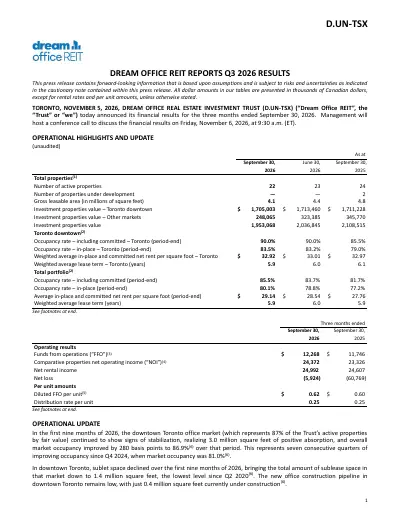
The Canadian office sector experienced positive momentum in Q3 2026. National vacancy decreased by 40 basis points quarter-over-quarter to 16.7%.
Of note, downtown Toronto vacancy decreased by 90 basis points to 13.1% and experienced 709,000 square feet of positive absorption over this period. In addition, national sublease space fell 1.3 million square feet, representing the largest quarterly drop since 2005.
This space currently sits below 9 million square feet, marking the first time since Q2 2020 and is down approximately 50% from its peak. In Q3 2026, Dream Office completed 43,000 square feet of new leases and 49,000 square feet of renewals.
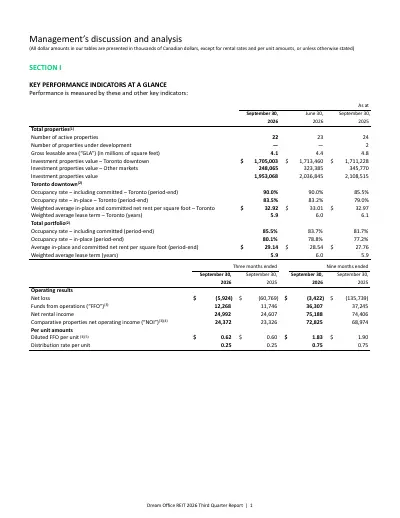
Toronto committed occupancy was 90% at the end of the quarter and was flat compared with Q2 2026. Other markets committed occupancy was 74.9%, representing an increase of 300 basis points quarter-over-quarter.
The increase was due to new leasing, representing 140 basis points of the increase, and the reclassification of Sussex Centre into a joint venture, representing 160 basis points. Jay will speak on the recast later in the call.
On September 18th, International Language Academy of Canada, or ILAC, filed for bankruptcy and ceased operations. ILAC previously occupied 132,000 square feet across our Toronto portfolio.
The leases were disclaimed in October. At 655 Bay Street, we have backfilled 53,000 square feet, immediately offsetting approximately 40% of the total vacated area by ILAC.
Kingsley will provide additional color on ILAC as well as our progress on backfilling this space later on the call. At 606 4th Street in Calgary, our conversion from office to residential remains on track.
The old office windows, building envelope, and facade have been removed and replaced with a new, energy-efficient window wall system. Interior electrical, mechanical, plumbing, and finishing work is progressing as planned.
Project timelines and costs remain in line with expectations. All major construction packages have been tendered, which enhances the predictability of project costs.
First occupancy is targeted for Q3 2027. For the quarter, comparative properties NOI increased by 4.5% year-over-year to $24.4 million.
The increase was due largely to new leasing in Toronto as well as higher step-ups in rent in other markets. For Toronto, comparative properties NOI increased by 4.1% year-over-year to $20.3 million.
Through Q3 2026, we were trending ahead of our prior committed and in-place occupancy guidance. However, as a result of the ILAC departure, which occurred post quarter-end, we are updating our year-end Toronto committed occupancy target to 85% to 87% and our in-place occupancy target to 82% to 84%.
These revised targets reflect the impact of ILAC's departure, partially offset by tenants taking occupancy under contracted leases. Higher NOI from other properties and portfolio in the fourth quarter is expected to mitigate the net impact of ILAC's departure.
As a result, we are maintaining our 2026 comparative properties NOI growth targets of 3% to 5% for downtown Toronto and 1% to 3% for the total portfolio. Overall, Q3 2026 was a strong operational quarter.
While we are disappointed by ILAC's departure, we're pleased to have converted a sizable footprint of the former subtenant's occupancy to a head lease. We remain confident in our ability to re-lease the remaining space and recover income over time.
I'll now turn the call over to Kingsley for more color on our leasing progress and what we're seeing on the ground.
Kingsley Fforis
Thanks a lot, Derrick, and good morning, everyone. Q3 was another positive leasing quarter for Dream Office.
Tenant retention in Toronto was strong at 71%, and with our new leasing, we maintained committed occupancy at 90%. In-place occupancy also continued to climb, increasing 30 basis points from last quarter to 83.5%.
Occupancy growth in Toronto has been strong. Since the start of the year, committed occupancy is up 260 basis points, and in-place occupancy is up 410 basis points.
Importantly, we've maintained strong deal economics alongside that growth, and performance continues to improve. Year-to-date, Toronto NERs averaged $22.56 per square foot, which is 11% above our 2025 average.
We're also converting more of our committed leases into rent-paying tenants. With leases starting throughout the year, the gap between committed and in-place occupancy has narrowed from 8% at the start of the year to 6.5% today.
We expect it to tighten further, landing between 3% and 3.5% by year-end. As Derrick introduced, we did face a setback in Q3 with ILAC announcing bankruptcy, and I'd like to address that now.
On our last call, we set a committed occupancy target in the high 80s for Toronto and an in-place target in the mid-80s. Before ILAC's announcement, we were on track to exceed both of those.
However, at the start of October, ILAC ceased operations and has since disclaimed its lease. As this occurred after quarter-end, it's not reflected in our Q3 occupancy.
ILAC occupied 132,000 square feet across two buildings: 81,000 at 655 Bay and 51,000 at 425 Bloor. The team has moved quickly to limit the impact.
This week, we signed a 53,000 square foot lease with a subtenant that already operates in the space. We achieved a low $20 NER on the deal, recovering about 40% of the space that ILAC vacated within three weeks of them leaving.
Net of that lease, approximately 80,000 square feet came back to us that was not in our plan. That represents about 2.7% of occupancy and about $4.3 million of annual gross rent beginning in Q4 of 2026.
As Derrick noted, we are lowering our year-end committed occupancy target to 85% to 87%. However, the impact on the in-place occupancy is smaller.
We've adjusted that target to 82% to 84%, supported by leases at 74 Victoria and 30 Adelaide that commenced earlier than planned. Our CP NOI growth in Toronto is also unchanged at 3% to 5%.
Outperformance earlier in the year from higher revenue-share income and lower opex more than offsets the ILAC impact on our full-year NOI. We have a clear path to hit our new occupancy targets, and we've already hit our renewal goals for the year.
To reach our committed occupancy, we need about 17,000 square feet of additional leasing on vacant space. That's concentrated at Adelaide Place with about 15,000 square feet and on Bay Street with about 2,000 square feet.
All of those deals are in advanced negotiations. Adelaide Place continues to perform very well.
It's 97.5% committed, deal costs are stabilizing, and NERs are up approximately 5% year-over-year. In our Class B assets, costs remain elevated and rents have been relatively flat, but demand is there.
Committed occupancy on Bay Street has improved to about 85% this quarter. That's up nearly 10% since the start of 2025.
Our priorities for the portfolio are backfilling the remaining ILAC space and leasing up 74 Victoria. Both sites have been active with tour velocity.
We know where our opportunities in the portfolio are, and we're focused on capturing them. With that, I'd like to thank the team for their continued hard work, and I'll turn it over to Jay to walk through the financials.
Jay Jiang
Thank you, Kingsley. Good morning, everyone.
I will walk through our third quarter financial results and provide an update on our outlook for the balance of 2026. For Q3, we reported diluted funds from operations of 62 cents per unit.
This compares to 65 cents per unit last quarter and 60 cents per unit in the third quarter of 2025. Year-over-year, the 2-cent increase reflects 10 cents of higher straight-line rent, 5 cents of higher comparative NOI, and 2 cents of lower G&A.
That was partially offset by 10 cents of lost income from assets sold over the past year to reduce debt and improve our liquidity, and 3 cents of lower nonrecurring lease termination income. Relative to last quarter, the 3-cent decline was primarily attributed to the percentage rent arrangement for certain tenants that was recognized and collected in the second quarter of each year.
Comparative properties NOI was up 4.5% year-over-year and 4.1% in downtown Toronto, as leases we signed over the past 18 months turn into cash rent. At the same time, straight-line rent remained strong at $2.1 million this quarter, as several larger tenants took possession of their space to start fixturing.
Straight-line rent continues to be a good leading indicator of income and value growth. As those leases reach rent commencement, straight-line rent comes down and cash NOI goes up, and we expect to see this trend continue in Q4 and 2027.
Concurrent with the growing our occupancy and NOI, we have made progress reducing operating expenses and managing our buildings more efficiently. Most of our operating expenses are recoverable, our tenants share in those savings.
However, we will need to cover the operating costs on any space that is vacant, those savings directly improve our NOI. Lower operating costs also let us recover more of the capital we've invested in common areas, washrooms, and amenities.
The tenant pays the same additional rent and gets a better building, and we recover more of our capital investment. You will be able to see this in our margins.
Excluding bad debt provision, our NOI margin this quarter was about 55%, up roughly 130 basis points from the same quarter last year. Turning to our outlook, as Kingsley mentioned, temporary revenue exposure of ILAC is approximately $4.3 million per year, or just over 5 cents per unit of FFO starting in Q4.
Despite the decline, we are still maintaining our 2026 FFO guidance of $2.35 to $2.40 per unit, as we have benefited year-to-date through our operating cost savings, accretive asset sale of 212 King, and higher straight-line rent. We're at $1.83 through nine months, we are currently on track to deliver the high end of our guidance.
Both 655 Bay and 425 Bloor have a long track record of leasing well, and the capital we put into those premises stays with the buildings. We expect to replace that income and will know more over the next few months.
We look forward to giving everyone a more wholesome picture in February when we provide our 2027 guidance. On the balance sheet, liquidity remains strong, and as a secured lending market, has been improving for good quality office buildings.
We ended the quarter with about $102 million of cash and undrawn revolver capacity. During the quarter, we refinanced our last remaining 2026 maturity, upsizing a mortgage in Calgary from $8 million to $11 million for a five-year term.
We have already started to make progress on our 2027 maturities, with about $200 million across our four mortgages remaining at our share, and we're already in discussions with our lenders for some of those renewals. Our net asset value per unit was $48.64, down 59 cents or 1.2% from last quarter.
The decline was mainly driven by $24 million of fair value losses, which includes a valuation adjustment to reflect ILAC insolvency at 425 Bloor and 655 Bay. As we re-lease the space, we expect the value of those two assets to recover.
In other markets, we recorded a $4.4 million fair value loss on an office property in Calgary, reflecting appraisal cap rate of 10.25%. As a result, our weighted average cap rate in other markets is now over 9%, which is more conservative than it has been in the past.
Overall, our NAV reflects a weighted average cap rate of 6.3% on the total portfolio, including 6.1% in downtown Toronto. Partly offsetting the fair value loss on income portfolio, our interest rate swaps gained about $7.9 million, or 42 cents per unit, due to an increase in benchmark yields in the quarter.
These swaps reduce our variable interest rate exposure as a percentage of our debt stack to 11.4%, and also helps to mitigate the impact of increasing interest rates. Lastly, a note on Sussex Centre.
Starting this summer, we began the process to reorganize our 49.9% interest in Sussex from a direct co-ownership into a limited partnership to align with the other PAG ownership structures that we have. Our economic interest hasn't changed, but Sussex is now equity accounted, which means it is no longer included in our reported occupancy, debt, or assets.
For full transparency, we laid out the impact in our press release and MD&A. On our financial metrics, it has reduced our level of debt by about 120 basis points to 53.3%, and our net debt-to-EBITDA by about 0.6 times, to 10.9 times.
It also added about 1.6% to our other markets committed occupancy. On a like-for-like basis, debt-to-EBITDA was flat to last quarter, and leverage would have increased 30 basis points.
There was no change to the interest coverage ratio as a result of the reorganization. To wrap up, Q3 operating and financial performance was solid and in line with our expectations.
The leasing we've done is turning into cash income. We're running our buildings more efficiently, and our balance sheet remains in good shape.
ILAC is expected to be a temporary setback, which we intend to address promptly, and our focus remains on improving occupancy, income, and value. We look forward to updating you on our progress in future quarters, and now I'll turn it back to Michael.
Michael Cooper
Thank you, Derrick, Kingsley, and Jay. At this point, we'd all be happy to answer any questions you might have.
Operator
We will now begin the question-and-answer session. To ask a question, press * then the number 1 on your telephone keypad.
To withdraw your question, press *1 a second time. If you are using a speakerphone, please pick up your handset before pressing any keys.
We'll pause for a moment as callers join the queue. Our first question will come from the line of Sairam Srinivas with ATB Cormark Capital Markets.
Please go ahead.
Sairam Srinivas
Thank you, operator. Good morning, guys.
Congrats on a good quarter outside of the ILAC development. Just looking at the impact of ILAC on 2027, while the guidance hasn't changed as much for 2026, how should we be thinking about building that into our 2027 numbers?
Jay Jiang
Hi, Sai. Good morning.
This is Jay. Thanks for the question.
It's a fair one. The simple way to think about it right now is at our AGM in May, we gave guidance to 2028 about $3 a share, which would imply that next year, the midpoint is about $2.55.
We quantified the impact of ILAC simply, which is about 22 cents. That's the starting point.
One thing to note that that is a full annualized impact, and as we re-lease the space, the numbers will recover. The other thing is because we have more space to lease now, there's more opportunities to recover that income.
Michael Cooper
Sai, does that help?
Sairam Srinivas
Jay, Yeah. Sorry, Michael, go on.
No,
Michael Cooper
I just want to make sure that helps. What Jay's saying is, on its own, ILAC is 22 cents annualized.
Since we have more space, we expect that whether it's the ILAC space or some other space, we should lease more space than we would have otherwise planned for. For the fourth quarter, we'll have more information, and in February to provide a little bit more information, but generally, we're just saying, with more space, we should lease a little bit more, it should be less than 22.
We don't know how much, and we're working hard on it now. We might have actual leases or certainly a sense of the flow of tenancies.
Sairam Srinivas
That makes a lot of sense, Michael. Thanks, Jay, for that.
Maybe just comparing the rents you've been getting, when you look at the subleases on 655 Bay and you compare it to the head lease, how would you say the net rent differential has been there?
Kingsley Fforis
Are you talking about the sublease that we just did, Sai, at 655?
Sairam Srinivas
Yeah.
Kingsley Fforis
The rent that we're going to be collecting from this tenant is the same as what we were getting from ILAC on that individual space.
Sairam Srinivas
All right. Okay.
That answers my question.
Michael Cooper
Then maybe— Just to be clear, Sai, in addition to the space that they were using, they took on just under another 10,000 feet. That space, we had to provide a cash inducement for.
I would say this as well, we had a very narrow window to make sure we tied in a 50,000 square foot tenant. We're very glad that we did.
I think they wanted to be there. The terms are probably fair, but it was very important for us to secure that tenant.
Sairam Srinivas
Oh yeah, I totally agree, Michael. In the current situation, it's definitely a positive development as far as that lease is concerned.
Maybe then shifting to the committed occupancy numbers, just looking at downtown Toronto, it's been consistent at 90%. When you look at the assets that have opportunities ahead, there are basically about five of them, 74 Victoria leading it.
When you think about leasing efforts from here on to push from that 90% level committed, do you think the cadence of leasing slows on as it becomes more challenging or is it essentially a more interplay of incentives coming in and a longer duration of leasing going there?
Kingsley Fforis
I would actually almost say the opposite, Sai. Obviously, we've done very well at Adelaide Place and at our A-class assets.
They're essentially full. The trickle-down effect to the lower-class assets is definitely real.
I think I mentioned at the start of 2025, Bay Street was about 70% occupied. Now we're at 85% occupancy, so as those A-class assets have filled up, we've really been benefiting at the other assets.
I look at 74 Victoria. We toured more than 100,000 square feet at 74 Victoria over the last two months.
Touring has been very strong, we feel good about getting those assets leased, and the space shows very well.
Sairam Srinivas
That is great color, Kingsley. Thank you for that.
I shall turn it back.
Michael Cooper
Thank you, Sai.
Operator
Our next question will come from the line of Sam Damiani with TD Cowen. Please go ahead.
Sam Damiani
Thanks, and good morning, everyone. I'll just echo the congratulations on the good quarter outside of ILAC, and also securing that subtenant as a direct tenant, good to see that happen quickly.
Maybe just to drill into the Sussex Centre change. That restructuring, does it affect the nonrecourse nature of the mortgage?
Does it in any way limit the REIT's exposure to that asset versus—
Michael Cooper
It has no effect on the relationship between Dream Office REIT and the lender.
Sam Damiani
Okay. Then that mortgage comes up next year, I think.
Is that right? What are the plans on that?
Michael Cooper
Next August, we're working with the lender. We've had a tour with them, but I don't think we'd be talking specifics for quite some time.
Sam Damiani
Okay.
Michael Cooper
This is one of the lenders that we have a great relationship with, and we're quite curious to see what they say, but we've got a plan for the asset, and that's why we had a tour in August. Do you want to Kingsley, explain what we've been doing with the leasing there?
Kingsley Fforis
We've built out a lot of really nice space at Sussex, Sam. We've done a couple model suites.
We've improved some other suites that already had good bones to them. That represents about 50,000 square feet of space that we've improved at Sussex Centre.
It's in really good shape. The touring on it's been good, and it's led to a number of deals that we've gotten this year.
Whether they sign on that individual space, it's a showcase for the asset that markets very well, and it's really been helping the leasing efforts out there.
Michael Cooper
The idea is to try to spur on more leasing at Sussex to be in better shape for the renewal.
Sam Damiani
Makes sense. Okay.
Then with it now being in equity accounted, were the operations and interest costs in the third quarter fully in equity accounted?
Jay Jiang
Yeah. It was actually signed at the end of the quarter, the operations are still in NOI and interest expense.
Going forward, I think what you'll see is NOI on a top line will come down, but so will the interest expense, and it will be in the line called net income from JVs. Okay.
Okay.
Sam Damiani
Got it. Okay.
Then, yeah, you referenced those 20 2028 targets from the AGM. I know you don't have to update that and maybe it's too early, but any thoughts on that just given the ILAC development there?
Jay Jiang
It's a fair question, Sam. I think our goal is still the same.
At the AGM, we said that if the business gets to 90% in-place occupancy in Toronto, we could achieve the $3 FFO, and also get to 10 and 1/2 debt-to-EBITDA. Those targets are still within range.
ILAC's income is a delay. We will recover it, and by middle of next year, I suspect we'll be able to give a better indication on the timing, but we feel confident we can get back to that number.
Sam Damiani
Great. Lastly for me, just on the transaction market in downtown Toronto, would you say there's been a noticeable change in discussions or indications?
Michael Cooper
Are you talking leasing or investment?
Sam Damiani
Sorry, no, investment.
Michael Cooper
Okay.
Sam Damiani
Just investment. Just it's been a very volatile interest rate environment, etc.
Just curious if things have evolved since August. Oh,
Michael Cooper
actually, it's a great question, and I've said this before. When we look at the assumptions that are necessary for the buyer to justify what they're paying, ours are much more conservative than what they're using.
We've looked at it then to say, well, how would our NAV change if we used what the buyers are using? What I would say is we saw Citibank, which is at the foot of University.
It traded at a pretty high price per square foot. It's beside Union Station.
I was a little higher than what I would have thought, and I'd say generally when we see buildings trade, they trade for a little higher. I would caution, though, that there are still not a lot of trades in office.
I think we can all name every single one of them, and it's a fairly narrow group. They're in the core.
They're pretty plain vanilla, but kind of decent buildings. They're not as good as Adelaide Place.
Maybe you could argue one one the Citibank building is. The thing I would say is it may be hard to sell a large volume because it doesn't look like there's that many buyers right now.
I don't know if that's against our interest or for them, but it's been improving. The leasing had improved more than the investment, but we are seeing people stepping in to buy office buildings.
It's still not a huge amount. If you say since August, the answer would be there's no data.
Sam Damiani
Okay. Thanks.
Thanks, Michael. Thanks, everybody.
I'll turn it back.
Michael Cooper
Thank you.
Operator
Our next question will come from the line of Mark Rothschild with Canaccord. Please go ahead.
Mark Rothschild
Thanks. Good morning, everyone.
Hey, sort of just following up on what you were talking about, can you just talk a little bit about capital strategy and what you're thinking, with the balance sheet where it is, are you looking to perhaps sell more assets to bring leverage down? Are you comfortable with the portfolio as it is?
Obviously, some properties have been leased up as there's been some improvement in occupancy.
Michael Cooper
A couple things. Firstly, I don't think at this point in our core portfolio Toronto, we're looking to sell anything.
We're pretty happy with the sale of 212 King, which was at a very high dollar value per square foot, and so I don't think we're looking at that right now. I think that the main driver we're looking at is to reduce our debt-by-EBITDA by growing our EBITDA.
When Jay talked about the numbers, I think that's the real drivers how we're getting those numbers down. I guess look, we're looking at EBITDA, debt-by-EBITDA, and that will become better as we grow the NOI and EBITDA.
Mark Rothschild
Great. Thanks, Michael.
That's helpful. Thanks.
Operator
Our next question will come from the line of Alexander Leon with Desjardins. Please go ahead.
Alexander Leon
Hey, good morning, everyone. My first question, maybe on these ILAC properties, I'm just wondering, when you think about potentially releasing them, is there any type of user or tenant that you think these buildings would be ideal for?
Michael Cooper
Just before I turn over to Kingsley, 655 Bay is uniquely situated where it's very desirable to the province, and it's in the hospital district, and lots of governments like it, so that we've got a lot of choices there. 425 Bloor is right on top of a subway stop at Sherbourne.
It's a great building, and it's got a lot of advantages, but it wouldn't have as many potential prospects. Then I guess, Kingsley, do you want to go into a bit more detail?
Kingsley Fforis
For sure. We've gone and we've walked all of the space that we're getting back from ILAC.
It's obviously in school condition. The number one user we would want in there to limit the amount of money we would need to spend to release it is another school.
Our team is aggressively marketing to all the school users in the city. CBRE is reaching out to all of them.
We've had a number of tours, and we're talking to a few users right now. That's kind of the obvious one, obviously is another school user.
If we do get another office tenant, I think I would echo what Michael said, 655 Bay definitely caters to the government. We have a lot of government tenants in there right now, and we're speaking to all of the tenants in the building who would be interested in expansion.
That's kind of the take. Obviously, candidly, it's going to be more expensive to lease to if we don't lease to another school.
The space is in very good condition. We like the floor plates.
As Michael said, 425 Bloor has direct transit access, which is meaningful, and it's going to offer a bit of a lower price point to any tenants compared to a core downtown asset. It'll be attractive for them at that front.
Michael Cooper
The only thing I'd add is this is an international language school, and clearly, that's not a growth industry, but there's a lot of growth in trade schools and other schools. There is a population of businesses that are schools that are growing and that could be interested in the space as is.
Alexander Leon
Really appreciate that. That's great color.
My next one maybe to Jay. You had mentioned some operating cost efficiencies.
I'm just wondering if you can maybe expand on that a little bit.
Jay Jiang
Sure. It comes in two parts.
You think about it in terms of labor and supplies. On supplies side, we were able to work with various vendors to get some savings, and those trickle through over the course of the year.
The other is really just managing the buildings a bit more efficiently. We have a smaller portfolio now than before, so as opportunities open up and we have departures, instead of backfilling them, we elevated some of the more junior building operators, and they are familiar with the buildings.
We are able to manage the portfolio, which is mostly in the central CBD area of downtown Toronto, with a small team, and they're very familiar with the buildings.
Alexander Leon
Great. Thanks for that.
Next one maybe on the lease incentives. The incentives were quite a bit higher this quarter compared to the last few quarters.
I'm just wondering if you could maybe give us some color on when those leases would have been executed, and then whether there was anything specific relating to those buildings that would require higher spend, and maybe lastly, where you see incentives right now on your current leasing discussions.
Kingsley Fforis
For sure. Just to clarify, you're talking about the $5 to the $10 increase in the
Alexander Leon
NER? The $10.38 per year.
Kingsley Fforis
Gotcha. Most of those deals would have been signed about 12 months ago, in a bit of a higher-cost market.
I think the big takeaway there is those are leases that have just commenced on space that needed improvement. It's a blend between every quarter between our renewals and our new leases.
In this quarter, it was just a deal that the space that the tenants went into needed more work, it's a bit more expensive. These are also long-term deals, we're upwards of 5 to 10 years on the agreement.
We're happy putting the money into the space knowing that it's going to be used well and we own the fixtures. Actually, one more piece I would say about that front is the $10 that you're looking at, if you bake that into an NER, it's still representing north of a mid-20s NER.
That's something that we've been guiding towards and something that we've expected. With regards to incentives today, I would say they've come down.
That's been a big piece of why our NERs have been going up. For a new lease, it's probably in the realm of what you see there, close to $60 per square foot inclusive of commissions on a five-year deal.
Then for a renewal, it's probably $15 to $20 per square foot. At the end of the day, it's going to really depend on the quality of the space.
Some new deals we'll do at 30 bucks a foot if the space is in good shape, and then a lot of the renewals we push to just turnover at existing rates with the existing condition. It'll depend on the space, but to answer your question on why it's gone up from 5 to 10, it's because the space that got leased in this quarter was on space that needed improvements.
Alexander Leon
Perfect. That makes sense.
Then maybe last one for me, an easy one on the debt refinancing. Just wondering where you see refinancing rates on the $135 million of mortgages that are maturing next year.
Michael Cooper
Just before Jay answers that, the rates have retreated quite a bit in the last month. I find it interesting that everyone thinks the rates are high, but I think they're probably 20 basis points higher now than they were at the beginning of the year.
It's a little higher, but it's not too bad. The other thing I would suggest is we're seeing lenders who have more appetite for office than they did, I think the margins are coming in a bit from what was a couple years ago.
Jay, what do you think they are in refinance?
Jay Jiang
Right now if we're looking at it, we typically look at five-year GOC plus about somewhere between 150 to 200 basis points depending on the quality and location of the buildings. In our internal forecasts, we're assuming something in the very low 5s, which approximates the maturity weighted average interest rate for those mortgages.
Next year, we don't anticipate refinancing to be a headwind against FFO. In fact, if rates move a little bit better or spreads come down, that could be an opportunity to get savings there.
Alexander Leon
Perfect. Appreciate it.
That's it for me. I'll turn it back.
Michael Cooper
Great. Thank you.
Operator
As a reminder, to ask a question, press *1 on your telephone keypad. Our next question will come from the line of Matt Kornack with National Bank of Canada Capital Markets.
Please go ahead.
Matt Kornack
Morning, guys. Maybe if we could just quickly go back to the leasing cost discussion or the TIs at 60 bucks a square foot for a five-year deal.
Could you give us a history lesson as to how bad that would have got during the height of the pandemic, and where it would have been pre-pandemic so we get a sense as to where it potentially could go to?
Kingsley Fforis
For sure. The first thing I'm going to say, Matt, is it's really going to depend on the space that you're looking at.
If you have a space in good condition, you're going to have to put in less money. If you have a space in bad condition, you're going to have to put in more money.
In terms of what we were looking at during COVID, in the height of the pandemic and the height of the leasing costs, we had to spend a lot more money to lease up space. I would say we basically had to do turnkey units in a lot of our assets.
Those turnkey units come in, I would say an average of $90 per square foot for deals that we need to get done on new space. That was kind of the height of it.
We would still do deals at $50 TIs during that period, but in order to get a new lease on vacant space, that would be kind of the number I would point to. Pre-COVID, it's definitely lower, but $60 is definitely getting a lot closer.
We're bridging the gap. I would say pre-COVID, we were probably closer to 30 bucks to do a new lease, it's almost like we're at the midpoint of where we were at that peak and the trough, if that makes sense.
Matt Kornack
That's very helpful. Then just maybe following up on that, you mentioned some of the leasing dynamics in downtown Toronto, but can you give us a sense as to the nature of the types of tenants that are looking at space at this point, and if that has changed at all over the last little while?
Kingsley Fforis
We we always get this question. I always find it hard to answer because it's such a wide range of tenants that we see all the time.
In terms of recurring users, like I would say there was a huge flood, obviously, in the like 18 months ago of, banks and financial services. It feels like those groups are a little bit more settled than they were, call it, 12 to 18 months ago, we're seeing a bit less activity in that realm.
In terms of like mid-sized and small financial services, I would say that continues to pick up, which are very good tenants for our Bay Street assets. They tend to like, the 5,000 square foot floor plates that they can individually tailor to their needs.
That continues to be active. Tech continues to be active.
Obviously, we did the large deal with Cerebras at 67 Richmond last year. We're continuing to see tech tenants start to flood in.
Then, just this week, we've actually I would say over the past two months, we've had a couple overseas users really start to come into the market. Just this last week, we toured a group from South America for a very big pocket of space, they'll be coming to the Toronto market.
Hopefully we can take a swing to get them at one of our assets. It's a wide breadth.
The government's still active. Government-adjacent groups are still active.
It feels like their push to return to office is very, very real now, we're seeing some activity there. I wouldn't say there's one group that's really leading the charge.
It feels like the whole market is coming back, Matt.
Matt Kornack
Makes sense. Maybe last one on leasing.
You mentioned that a lot of the leases that are kind of coming into effect now were signed a year ago. How has that evolved in terms of the time between signing leases and tenants taking possession?
Is it static, or is it contracted at this point?
Kingsley Fforis
I think it's faster. We're getting a lot of deals done a lot quicker, especially on Bay Street where we've built out a lot of model suites.
We've built 150,000 of those. We've leased 85% of them, and it's been within six months of them coming into space.
Overall, it's definitely tightened. One thing that we're seeing as well, Matt, that I would point to is the retention's getting better.
We're having less downtime on space that would have vacated the portfolio. Our retention rate this quarter was, I think, in the low 70s in terms of percentage.
Over the past few years, it's ranged between 50% to 60%, we're seeing that it's not necessarily deal-related, but we're facing less downtime generally because we're retaining more tenants.
Matt Kornack
Sounds good. Michael, maybe quickly, you mentioned that you have a conservatism gap relative to maybe some of the private buyers, albeit a few of them that are looking at assets.
Where do you think that conservatism ultimately is? Is it on occupancy, on rents, TIs, cap rate?
Michael Cooper
Oh. In office over the last six years, it's really been in the trenches.
There's been a lot of days of really hard work and nothing happened. We're a little bit skeptical, and have been, on the recovery.
We're saying, yeah, the recovery's there. I think we had an incredible first quarter.
Since then, with actually excluding the one bankruptcy, we've had minor increases in occupancy. It's not as if there's just a line up of tenants.
My hope is that the people with fresh eyes who are looking to invest are more right than we are. That would be an incredible outcome.
On our view on occupancy is probably we'd be thrilled at 92% or 93% within the next three years, three, four years.
Matt Kornack
Okay. That sounds reasonable.
Then last one for me. Jay, just on straight-line rent, I know it's hard to predict, and it's going to come down and convert to cash rents.
Although I'm not sure how ILAC ultimately will impact that, but can you give us a sense as to how we should think about the trajectory on straight-line rent?
Jay Jiang
Yeah. For ILAC, we rolled off the straight-line rent when the lease was disclaimed, so that was cleaned up at quarter-end.
For next quarter, I think this quarter, we were running about $2 million, next quarter, our estimate right now is probably in around $1.5 million. Then for 2027, it's a lot of variables in there, when we get the lease signed.
The key there is when the tenant takes physical possession and control of the space, it's hard to predict. For us, it's really about securing the commitments, and we'll be able to pin down a number, or a better estimate by February.
Matt Kornack
Fair enough. Thanks for all the detailed answers, guys.
Operator
This concludes the question-and-answer session. I'd like to turn the conference back over to Mr.
Cooper for any closing remarks.
Michael Cooper
I don't really have closing remarks, just thank you for joining us, and as always, feel free to call any of the speakers on this call if you have follow-up questions. Thank you very much for your time.
Operator
This concludes today's conference call. Thank you all for joining, and have a great day.
You may now disconnect your lines.