DarioHealth Corp.
NNASDAQ:DRIOQ3 FY2026 · Earnings Call TranscriptNovember 12, 2026
Operator
Good morning, ladies and gentlemen, and welcome to the DarioHealth third quarter 2026 results conference call. At this time, all lines are in listen-only mode.
Following the presentation, we will conduct a question-and-answer session. If at any time during this call you require immediate assistance, please press *0 for the operator.
This call is being recorded on Thursday, November 12th, 2026. I would now like to turn the conference over to Zoe Harrison, VP, Accounting and Corporate Development at DarioHealth.
Zoe, please go ahead.
Zoe Harrison
Thank you, operator, and good morning, everyone. Thank you for joining us today for a discussion of DarioHealth's third quarter of 2026 financial results.
Leading the call today will be Erez Raphael, Chief Executive Officer of DarioHealth. He'll be followed by John Palumbo, Chairman of the Board; Lara Dodo, our Chief Operating Officer; and Chen Franco-Yehuda, our Chief Financial Officer.
An audio recording and webcast replay for today's call will also be available online as detailed in the press release invite for this call. For the benefit of those who may be listening to the replay or archived webcast, this call is being held on Thursday, November 12th, 2026.
This morning, we issued a press release announcing our financial results for the third quarter of 2026. A copy of the release can be found on the Investor Relations page of DarioHealth website.
I'd like to remind you that on this call, management will make forward-looking statements within the meaning of the federal securities laws. For example, the company is using forward-looking statements when it discusses expected revenue growth and contributions from signed accounts; the timing and extent of revenue recognition under existing customer agreements; the company's revenue outlook and financial performance expectations; its path to profitability and positive cash flow; the continued reduction in operating expenses and losses; its expansion of channel partnerships and distribution; expected revenue and scaling from partner-led opportunities; expected onboarding, implementation, and enrollment of large enterprise accounts; expected conversion of contracted annual recurring revenue into recognized revenue; expected expansion into care delivery, claims-based, and outcomes-based models; expected benefits from care delivery partnerships; expected growth in recurring revenue and operating leverage; expected advantages and future impact of DarioIQ and proprietary data assets; expected improvements in member engagement, retention, and outcomes; the anticipated benefits of artificial intelligence across the company's commercial operations and internal operations, including expected cost savings, productivity improvements, and potential incremental revenue opportunities; the anticipated expansion of existing customer relationships into additional chronic conditions; the expected timing and contribution of new product offerings; the company's ability to increase revenue per customer through its multi-condition strategy; the expected benefits of provider-backed clinical care; the expected timing of revenue acceleration and of activation under health plan ASO agreements; beliefs regarding the convergence of consumer and payer-funded healthcare and the replatforming of chronic care management; the expected delivery of GLP-1 and other therapies within payer programs and marketplaces; the expected contribution of women's and men's health programs; and beliefs regarding competitive positioning and market opportunities.
Forward-looking statements are subject to numerous risks and uncertainties, many of which are beyond the company's control, including the risks described from time to time in its SEC filings. The company's results may differ materially from those projections.
These statements involve material risks and uncertainties that could cause actual results or events to materially differ. Accordingly, you should not place undue reliance on these statements.
I encourage you to review the company's filings with the SEC, including, without limitation, the company's annual report on Form 10-K, which identifies specific factors that may cause actual results or events to differ materially from those described in the forward-looking statements. With that, I'll hand it over to Erez Raphael, Chief Executive Officer of DarioHealth.
Erez Raphael
Good morning, everyone, and thank you for joining us. Before we get into the quarter, I want to start with a leadership change I'm very excited about.
We recently announced that John Palumbo has become Chairman of our Board. John joined our Board in April of 2026, and since then he has worked closely with our management team week after week on our commercial strategy, execution, and on where this market is going.
On his first call as Chairman, John will share the Board's view on the market and the Dario's position in it. In the second quarter of 2026, we described how Dario compounds across four drivers, each acting on a different part of the economics: account depth, distribution efficiency, AI leverage, and value chain participation.
Let me give you a quick update on each one of them. Account depth means more revenue from the customers we already won.
Healthcare purchasers want fewer vendors and one integrated platform across conditions, and that is how we build Dario. More than 80% of our contracted and late-stage recurring revenue is now multi-condition.
Every additional condition has the potential to generate 2 to 5 times more revenue on the same account through the same implementation and the same relationship. Members managing multi-conditions on our platform achieve better outcomes than those managing one.
Better clinical results and more revenue from the same client are a rare alignment in this industry. Distribution efficiency means more accounts faster for less.
Our channel partners continue to open large populations for us, including our third state health plan, this one in New Jersey, who enrolled this quarter without proportional increase in our sales organization. AI leverage means more revenue per member at a lower cost to serve.
We are fully vertically integrated from our own FDA-cleared devices to more than 13 billion proprietary data points to DarioIQ, the AI engine that leverages our proprietary data and technology infrastructure. Every new member deepens the data set, and every advance in AI raises the value of the data we own.
That advantage compounds. This quarter, DarioIQ moved from individual engagement program to an integrated system that predicts which members are about to disengage and act before they do.
Lara will share more about those results. Value chain participation means access to more of the healthcare dollar.
During the second quarter of 2026, we said this fourth driver was just beginning. Since then, the market has moved even faster than we expected toward payers funding the therapy itself and not only the digital engagement program around it.
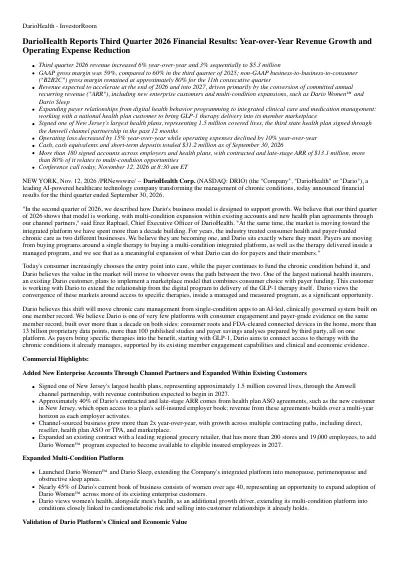
John will speak to that in a moment. We believe that this quarter shows the model is working, with revenue up 6% year-over-year, existing customer expanding into additional conditions, and a new state health plan signed through our channel.
Lara and Chen will take you through the details. We continue to expect revenue to accelerate at the end of 2026 into 2027, driven by the conversion of contracted and late-stage annual recurring revenue.
At the same time, something bigger is happening in our market. For years, the industry treated consumer health and payer-funded chronic care as two different businesses.
We believe that they are becoming one, and Dario sits exactly where they meet. John Palumbo, our new Chairman, has spent his career inside the payers, providers, and health services organizations that are shaping this shift.
I've asked John to walk you through this change. John?
John Palumbo
Thank you, Erez, and good morning, everyone. Before I go further, I want to thank Yoav Shaked for his service as Chairman.
Yoav helped guide this company through a formative period, and I am glad he continues to serve on the board as we move into this next chapter. I want to start by telling you why I accepted the role.
I have spent more than 40 years in healthcare, from early-stage companies to Fortune 50 enterprises. I led the provider business at AmerisourceBergen, I served as Chief Operating Officer of Allscripts, and I sit on the boards of companies across care delivery, medical device and diagnostics, conversational AI, and digital health.
I have seen a lot of platforms. Very few have what Dario has built, and the market trends now underway are moving toward what Dario already does.
When I joined the board in April of 2026, I expected to help with commercial strategy. What I found working alongside Erez and this team was a company that had built over more than a decade the capabilities the market is now moving toward, and a strong team with a culture focused on execution, consumer experience, and trusted outcomes.
I am confident in this leadership team, the company's capabilities, and the direction it is going. Let me explain what I mean by where the market is going.
For a decade, consumer-paid health and payer-paid chronic care were separate markets, served by separate companies, with separate economics. The consumer companies won the consumer's choice.
Point solutions won a place in health plan's benefit. Almost no one did both.
That wall is coming down, and I see four forces pulling it down at the same time. First, consumers now choose their own front door.
Consumers are increasingly using digital tools, including AI-enabled services, to access health information and navigate care options before engaging with healthcare providers. At home, people have easy access to self-diagnose and self-care.
Easy access has never been more essential in health and care management due to our growing shortage of caregivers. Second, pharma is going direct to consumers.
Manufacturers now sell branded GLP-1 health and weight therapies straight to consumers. Third, payers are redefining how they engage the members and redesigning benefit plans.
Several of the largest insurers are launching plan designs with fixed upfront costs instead of deductibles, and those plans need proven programs to attract, navigate, and retain members, and to optimize care resources. Fourth, payers are bringing consumer choice inside the benefit.
We see this directly, with one of the largest national insurers has publicly repositioned itself as a consumer health company. Across our health plan relationships, we are in active discussions about extending from behavioral digital programming into clinical provider services, including access to FDA-approved branded GLP-1 prescription medications prescribed by licensed healthcare providers.
The Dario platform has been built to support this market model convergence and that all the major players are moving toward. That last point is the one I would ask you to remember.
The convergence of business-to-consumer, B2C, and business-to-business-to-consumer, B2B2C, is accelerating and bringing two large, previously separate markets together. Payers are moving from buying programs that sit around a therapy to buying the therapy itself, delivered inside a managed and measured program.
For Dario, that translates into a much larger share of the healthcare dollar, and we are already seeing it in our own results. In the third quarter, consumer revenue grew approximately 48% year-over-year and represented 53% of total revenue, compared with 38% a year ago.
Here is how I think about it. The consumer picks the door, the payer pays for the chronic condition behind it, the value moves to whoever owns the path between the two.
Owning that path requires two things at once: you have to be chosen by the consumer, and you have to be trusted by the payer. Consumer telehealth companies have proven the demand, but most lack consumer acquisition, retention assets, validated payer-grade evidence, and a chronic care engine in front of and behind the prescription.
Point solutions have the payer contracts, but consumers rarely choose them. Here is what is essential to understand: Dario has both.
It started as a consumer company, selling FDA-cleared connected devices directly to people living with diabetes. It grew into an enterprise platform with 184 customers as of September 30th, 2026.
It holds more than 13 billion proprietary data points and more than 100 peer-reviewed published studies. An independent third-party analysis estimates meaningful healthcare cost savings for our users.
That is very hard to replicate, and it becomes more valuable as AI improves. Dario is also multi-condition by design: one platform and one member experience across diabetes, hypertension, weight management, musculoskeletal, and behavioral health, and more recently, sleep and women's health, all supported by an evidence base built across our established cardiometabolic and behavioral health programs.
That is exactly what payers consolidating their vendors are asking for, and it is what makes Dario a natural partner as payers bring specific therapies into the benefit. This is why I believe chronic care management is being reshaped so that it is reachable from either the consumer door or the payer door.
Dario did not pivot into this model. It built it before the market asked for it, and it is the expansion the platform is built for.
It also changes how I look at new categories. Women's and men's health are not lifestyle side bets.
They are chronic care in disguise and can be early indicators across multiple conditions, including cardiometabolic risk. They are natural consumer entry points into the conditions Dario already manages.
These also sell into the employer and health plan relationships Dario already holds. Dario Women is the first example.
Let me say a word about how the board approaches this. Our focus is on converting the contracts Dario has already signed, scaling through channel partners, and building the capabilities that let payers fund what consumers choose.
Our job is to make sure the company captures the full strategic value of the position it has built. For more than a decade, the industry treated consumer health and chronic care as two different businesses.
They are becoming one. The convergence flywheel is our differentiated value, and I believe Dario is built for exactly that moment.
This is a large and growing area of need. According to the Partnership to Fight Chronic Disease, chronic disease is projected to cost about $2.2 trillion a year in medical spending, roughly 40% of the nation's more than $5 trillion in annual healthcare spending, and 93% of Medicare spending goes to beneficiaries with chronic conditions.
I look forward to sharing our progress with you. With that, I will hand it to Lara to walk you through our commercial execution.
Lara Dodo
Thanks, John. At Dario, we have more than 180 signed accounts across employers and health plans, 5 are Fortune 50 companies, and approximately 25% of our B2B2C client base comes from Fortune 500.
I want to focus on four areas we are refining in our strategy to accelerate revenue: winning new accounts, growing existing accounts, converting health plan agreements into revenue, and bringing new capabilities to market. First, let's discuss new account growth.
Channel partners continue to account for about 75% of our new accounts, expanding our access to self-insured employers and health plan populations, with shorter sales cycles and lower customer acquisition costs than a direct sales model. Importantly, we now have multiple sales teams supporting this strategy, rather than relying on a single team.
A good example of this traction is our in-quarter win through Amwell channel partnership. We were selected by one of New Jersey's largest health plans, representing about 1.5 million covered lives.
This is our third state health plan signed through Amwell in the past 12 months, following Arizona and Florida. Other significant channel wins during the third quarter of 2026 include a commercial opportunity covering more than 100,000 lives and a regional health plan administrative services only opportunity representing approximately 250,000 lives.
Launch plannings is expected to begin in mid-Q1 2027 and will extend through 2027. These opportunities serve geographically dispersed employer populations, potentially nationwide.
Our channel model is designed to repeat. In fact, our channel market revenue is on track to deliver two times growth or 2x for year-over-year, with the potential to replicate that performance again in 2027.
We are actively developing additional innovative channel partnerships and expect channel distribution to remain the primary engine of our growth into 2027 and beyond. We have also made Dario easier to buy.
Self-insured employers can contract with us directly, through a reseller, through their health plan or TPA, or through a marketplace. By simplifying selection and contracting, and with automated SSO implementations already established with various channel partners, we are making it easier for consultants, brokers, and clients to activate Dario.
This is one of our most practical growth levers. A second focus is growing the accounts we already have.
This is where our multi-condition strategy is most evident. We grow accounts in two ways: we land with one condition and expand, and increasingly, we win multi-condition contracts from the beginning.
Most of our new enterprise opportunities now involve multiple conditions. These results are reflected in the composition of our business: more than 80% of our contracted and late-stage recurring revenue is multi-condition.
This demonstrates how the strategy is compounding. An in-quarter example is a leading regional grocery retailer, an existing self-insured employer client, which expanded its contract to include Dario Women, our program supporting women navigating perimenopause and menopause.
A third focus area is converting health plan agreements into revenue. We ended the quarter with approximately $13.1 million in contracted and late-stage annual recurring revenue, approximately 40% of which comes from health plans' ASO agreements.
An ASO, or administrative services only agreement, gives us access to a health plan's self-insured employer book. Revenue builds as individual employers activate, their members enroll, and eligible populations expand.
While conversion takes longer than a direct employer contract, it provides access to a substantially larger population and the potential for a stickier revenue stream. To accelerate this process, our channel sales efforts are increasingly moving towards co-selling, working alongside our health plan partners to engage local employers and consultants directly and drive ASO activation.
The fourth area of focus is our speed to market, turning new capabilities into commercial opportunities. Our integrated GLP-1 program spans three channels: our direct-to-consumer shop, employer programs, and health plan marketplaces.
Going beyond digital health support for members taking GLP-1 medications, it provides a digital front door to clinical providers and medication access and management, alongside innovative employer program designs. These include narrow networks, GLP-1 carve-outs, and alternative employer subsidies that extend beyond traditional PBM carve-out models, including approaches that provide access to directly sourced FDA-branded medication.
In the second quarter, we also launched Dario Women and Dario Sleep. Both were designed as add-on programs to our existing cardiometabolic platform, which addresses diabetes, hypertension, and weight management.
With 1 in 3 women developing metabolic syndrome during the menopause transition, and nearly 45% of our book of business represented by women over the age of 40, this represents a relevant market opportunity and a natural cross-sell opportunity within our existing customer base and the broader commercial market. Dario Sleep enables eligible members to complete a one-night, clinical-grade home sleep test, with real-time data transmitted directly to licensed healthcare providers for evaluation.
Data shows that cardiometabolic patients with obstructive sleep apnea generate approximately 50% higher annual medical costs. This creates a logical opportunity for existing cardiometabolic customers to add our sleep program, with the potential to enhance in-year medical cost savings while addressing a broader commercial population.
Technology and clinical evidence also further strengthen our commercial opportunity. DarioIQ, our proprietary AI layer built on more than 13 billion real-world data points, advanced this quarter from individual engagement programs to an integrated system that predicts which members are about to disengage and acts before they do.
The early results are strong. Members that it flags as at risk for disengagement are disengaging at nearly three times the rate of other members.
This gives us time to act. Members we reach early in their lapse come back within a week at 1.7 times the rate of those members that we do not reach.
We have also started a randomized trial of AI behavior agents, with encouraging early signals. Last quarter, we said DarioIQ could add 10% to 15% to our B2B2C annual recurring revenue from existing customers.
The results we measured this quarter now support that, up to approximately 14% in engagement-based ARR. Last quarter, it was an expectation; today, it is built on measured results.
DarioIQ is now deployed across the organization and is one of the several contributors to an approximately 10% year-over-year reduction in operating expenses. Clinical evidence and in-year medical cost savings also contribute to strengthen our commercial position.
Dario now has more than 100 studies and scientific publications, including 27 through the American Diabetes Association. Additionally, we announced in October 6th a press release of a third-party analysis that evaluated 17 published Dario studies and showed an estimated 2.5% to 7.2% annual reduction in total healthcare costs across a covered population.
We will continue to use real-world health outcomes and claims-based data to demonstrate how Dario delivers in-year savings and clinically significant health improvements. Finally, I want to leave you with one broader market observation.
We are increasingly hearing from our health plan, employer, and marketplace clients that employer-sponsored benefits are moving toward a hybrid model, combining traditional benefits with direct-to-consumer access for services and medications that may be better suited to a carve-out offering. The objective is to help offset payer costs while providing members with quality, alternative care options and greater flexibility.
Dario is well-positioned to address this opportunity, with an established direct-to-consumer channel that has served more than 1 million consumers, alongside our growing B2B2C business. At the core of this model is strengthening member self-agency, helping individuals take greater ownership of their health through behavior change, while ensuring appropriate escalation to care when needed.
That is precisely the platform that Dario has built. With that, I will turn the call over to Chen to review our financial results.
Chen Franco-Yehuda
Thank you, Lara. Our third quarter results reflect continued progress in building a more efficient business.
Revenue for the quarter was $5.3 million, up 6% from $5 million in the third quarter of 2025, and up 3% from $5.2 million in the second quarter of 2026. Gross margin was 59%, compared with 60% in the third quarter of 2025, and 62% in the second quarter of 2026, primarily reflecting the lower tariff refund benefit in the third quarter and a higher direct-to-consumer mix, partially offset by lower hosting costs.
Our non-GAAP B2B2C gross margin remained at approximately 80% for the 11th consecutive quarter. Operating expenses were $11.2 million, down 10% from $12.5 million in the third quarter of 2025.
Sequentially, operating expenses increased, primarily reflecting higher stock-based compensation, mainly in general and administrative expenses. Operating loss improved 15% year-over-year to $8 million, and net loss improved to $8.8 million, compared with $10.5 million in the third quarter of last year.
Non-GAAP operating loss narrowed to $5.3 million, compared to $6 million in the third quarter of 2025. A reconciliation of GAAP to non-GAAP measures is included in our earning press release.
For the first nine months of 2026, operating expenses declined 17% and operating loss improved 22%, compared with the same period last year. We continue to apply AI inside our own operations, and it is one of several contributors to lower operating costs, alongside lower headcount, lower stock-based compensation, and post-merger integration savings.
As of September 30, 2026, we had $31.2 million in cash, cash equivalents, and short-term deposits, following our July 2026 registered direct offering priced at the market under Nasdaq rules. We believe we have the resources to execute on our priorities as contracted revenue is recognized and our new programs are implemented.
From a financial perspective, we believe that what matters most is the operating leverage in our model. The platform, the commercial infrastructure, and the clinical evidence are already built.
As signed accounts activate and existing customers add conditions, we expect each additional dollar of B2B2C revenue to carry a high gross margin and to contribute to narrowing our operating loss and cash burn. With that, I will hand it back to Erez.
Erez Raphael
Thank you, Chen. Let me close with two things.
First, the model we described last quarter is working. Account depth, distribution efficiency, and AI leverage are compounding in the business today, and the fourth driver, value chain participation, is moving faster as payers bring therapies into the benefit.
We remain on track, as we said, for revenue acceleration in 2027 as late-stage and contracted ARR across our accounts converts. Second, the market is moving toward us.
Payers are bringing consumer choice inside the benefit, and they are moving from buying programs around therapy to buying the therapy itself, delivered inside a managed program. Very few companies can serve both the consumer and the payer on the same platform.
Dario can. I want to thank our employees for their dedication to our members and to each other, our channel partners for their trust, and our shareholders for their continued support.
I want to thank John for stepping into the chair, and Yoav Shaked for his years of leadership as a Chairman. I will now turn the call to the operator for a Q&A session.
Operator
Thank you. Ladies and gentlemen, we will now begin the question-and-answer session.
Should you have a question, please press the star key followed by the number 1 on your touch-tone phone. You will hear a prompt that your hand has been raised.
Should you wish to decline from the polling process, please press the star key followed by the number 2. One moment, please, while we assemble the queue.
Your first question comes from Charles Rhyee of TD Cowen. Please go ahead.
Charles Rhyee
Thanks for taking the questions. Erez, just wanted to understand a little bit about, I think last quarter, I I guess, I'm sorry, let me start this way.
In the press release, you you talked about contracted and late-stage ARR of $13 million. Can you talk a little bit about sort of the timeline for how we should expect that implemented?
I think last quarter, you noted we should start converting, to some of this to revenue in the fourth quarter. Is that still the right trajectory, and and maybe give us a sense for, how how much of a step-up we should see, going into fourth quarter and then into fourth and the next year?
Thanks.
Erez Raphael
Yeah. Thank you, Charles.
As we mentioned on the earning call, we think that this $13.1 million would be converted into 2027 and also some of it in 2028. What we disclosed is that some of the $13.1 million is an ASO business, and usually the ASO business is something that is taking longer to build and to implement.
More than 50% is not an ASO business, we think that what we're going to see is gradual ramp-up toward the end of the year, mainly the beginning of next year, and then during 2027 and into 2028. We did have more wins this quarter, the Jersey is one of them, but we didn't counted it on top of the $13.1 million for now, because it is also an ASO business and we wanted to play conservative with the total contracted ARR that we are counting in.
When we are looking into the consensus of the analyst for 2027, we think that it's aligned with the statement that I just provided.
Charles Rhyee
If we look at where consensus is for '27, you feel that's a comfortable range to think of based on what you're seeing right now?
Erez Raphael
Yes, the answer is yes.
Charles Rhyee
Okay. Then obviously, expenses, you've managed that very well.
Maybe talk about sort of are we still on track for reaching break-even as we get into 2028?
Erez Raphael
Yes. If we are looking into the contracted ARR plus additional business that [cough] bless you, plus the additional things that are getting in, including what we signed this year, I think that we are in the trajectory to hit break-even in 2028.
Yes. Then
Charles Rhyee
maybe a question around sort of this GLP-1 support. Can you talk about so what are your clients looking to do?
Maybe either on the health plan side in terms of covering GLP-1s, because a lot of the anecdotes and discussions when we speak with consultants is that employers are slowly actually pulling back from coverage. Just want to understand what you're seeing right now in terms of GLP-1 coverage overall and what that kind of means for sort of a GLP-1 support program.
Lara Dodo
Lara, would you like to take it? Hi, it's Lara here.
I'll take that. The first thing is the space is changing.
It's a consistent change of flux. What we're seeing and we're hearing, and from some of the largest consulting houses, is that there's almost a divide of about 50% in the market, 50% of employers in more traditional industries like financial services, who are choosing to actually move away from traditional PBM structure, be hit by the rebate change in that, but to pursue a different strategy for the GLP-1, versus the I would say industries that have higher turnover, high-tech, as an example, where they are staying with more the traditional structure for those who are keeping reimbursement.
Then there's a whole nother group as well who are choosing not to reimburse and what they're wanting to do, and this is where the space is really interesting, is they're looking to Dario for alternative strategies of saying, as an example, we want to provide some kind of employee funding, and looking to either a direct-to-consumer offering or bringing in alternative ways of subsidizing that could include subsidizing or incentivizing members to do a behavioral-based program and then go with more of a hybrid PBM, which is emerging as well, that would have more direct access to FDA-branded drugs. There's a lot going on.
There's not a conversation we have with a existing client that doesn't include looking at their strategy. Those are three things: either having more gated access to the drug through traditional PBM, carving it out with no reimbursement, but having some type of a subsidy support, or looking at a hybrid opportunity that could go as creative as direct-to-consumer.
Charles Rhyee
Can you talk about how then the Dario, how you guys would support customers if they are choosing more of a direct-to-consumer approach? I know, John, you had mentioned that one of the trends that you're seeing is obviously the shift to direct-to-consumer, and we are seeing pharma in their development of new drugs also looking not increasingly, but starting to look at a direct-to-consumer approach in their development plans as well.
Maybe talk about how Dario could be supportive in that shift.
Erez Raphael
Lara, would you like to take it?
Lara Dodo
Absolutely. From that end, what we're seeing is so when the discussions come in, a lot of it has to do with the subsidy of or how they're going to subsidize it.
There's a couple of flavors. For the employer who is wanting to say, they could even be talking in discussion of narrow network.
It could be a case of they're wanting to have direct access to branded drug, but they actually want to make sure there's a really rigorous clinical protocol in place. Dario is stepping up, creating a rigorous clinical protocol that would have an employee or member go directly to a narrow network of providers through Dario, that would then script through to Lilly or Novo, so that the employee is benefiting from rigorous care, appropriate care, and a discounted drug at that point going direct to the brand.
That's one pathway. The other pathway is in a marketplace where we're working through various solutions, where member would come in through a marketplace, and have the option through that provider care to send scripts to a retail pharmacy of their choice.
We're answering that call in a few ways. It's providing rigorous care for those who want to make sure that protocol's in place, providing choice of access of where the member can get their drugs from, whether it be their pharmacy or direct to branded group.
There are emerging new groups that we'll be talking about in the next several weeks on hybrid PBMs who have other options for the types of employer arrangements.
Charles Rhyee
If an employer doesn't cover, is there anything that you can work with them, or that's the
Lara Dodo
one
Charles Rhyee
area where then
Lara Dodo
No, not at all. In fact, that's a great question, because that's exactly where we're stepping up.
For those employers, and we know now statistically it's about 50%, there's a few things. Number one, the price differential on going direct to Lilly or Novo is quite substantial.
For the employee who wants to take on that option by funding a program like Dario, it's already worked on the behavioral side, as in allowing Dario to work with either a designated provider works through the employer, or through the member's own practitioner. Those scripts can be sent directly to Lilly or Novo.
That often time is actually a far less expensive route for a member than through any deductible they may be accountable for. These employers are also then able to provide other savings, HSA, FSA savings through alternative PBM arrangements, or direct buy through a Dario direct-to-consumer channel.
We absolutely are working very much so with those employers who are saying we want to carve it out. That's probably about 80% of our commercial conversations at the moment.
Does that make sense, or I'm happy to go into more detail if needed. Are we still connected?
Operator
Yes, I don't see any action on his line. I think he might have dropped the call.
Lara Dodo
Okay. Got it.
I was like, oh dear, have I not answered sufficiently? Anyway, if anyone has any more follow-up questions on that, it's a passion topic, it's a hot topic, and we've a lot of details to share on that.
Operator
All right. Your next question comes from David Grossman from Stifel.
Please go ahead.
Aidan Conniff
Hi, all. Good morning.
This is Aidan Conniff on for David. Thanks for taking my questions.
I wanted to start with the new women's and sleep solutions you're adding to the multi-condition platform. How should we think about the incremental revenue opportunity coming from those?
Is it primarily just larger eligible populations can use the solution, or an increase in revenue per member, and when should we start seeing those kind of contributions hit the model?
Lara Dodo
Right. Another two really exciting chapters in Dario's evolution.
The first thing, David, just to ground it, is we are firmly rooted in cardiometabolic health, and it is our thesis based on data that perimenopause and menopause, as well as sleep disturbances like obstructive sleep apnea, compound to really worsen, if you will, cardiometabolic outcomes. It basically makes care more expensive.
Our fastest track to be able to help those members and to add revenue to Dario is to look within our existing book of business. We in a very early go-to-market strategy already have two early adopters going live 1/1/27.
The opportunity is as follows: existing book of business, it's an easy rooted pathway to add on women and sleep to the existing cardiometabolic program. It's a very simple process for us, for enhanced programming, that also has a bridge to move those members to appropriate care.
Appropriate care meaning a woman who may be candidate for hormone replacement therapy, or on the sleep side, folks who are at risk for sleep apnea, likely obstructive sleep apnea. From a revenue perspective, the opportunity is an existing book of business, as either a retention tool, which we've seen actively happen, or as an expand, a part of our land and expand strategy.
For net-new clients, there's a tremendous demand out there, both on to bucket for just simplicity, unaddressed women's health, where we know that 1 in 3 women who are at that stage of middle-life change, menopause, perimenopause, are at risk of metabolic diseases. There's a tremendous call to get involved to again avert the cost curve.
On the sleep side, just one data point as an example, CPAPs, approximately $2,500, have a very low adherence rate, very, very low. For our plan members or payers out there who are providing CPAPs that are going unutilized, you're getting hit on unutilized equipment, and then worsening cardiometabolic outcomes.
It's just a lose-lose versus having an at-home, really easy to experience sleep test, and having a therapeutic that's appropriate that the member's part of selecting. That could be a GLP-1 drug, it could be an oral device, it could be a positional pillow, all significantly less expensive than a CPAP, and will have a higher adherence rate.
Then scripting CPAP where it's absolutely appropriate. These are the pathways we've designed.
We will be actively taking them to market in Q1 for sales cycle. We're ready on the back end, and early indications, discussions through existing clients where we kind of trial-socialized it have come back with tremendous enthusiasm about the offering.
Aidan Conniff
Great. Thank you.
I appreciate the kind of incremental detail there. Then just on a follow-up on the channel partners business.
How much of the growth opportunities coming from existing channel partners and versus adding new relationships, and then is there a way to quantify how much implementation time is needed in the time to ROI landing from different clients versus just direct sales motion?
Erez Raphael
We already have the channel partners strategy in place and also the partners themselves in place, and we keep disclosing the names. It's Solera, it's American Well, and we are expanding through existing channel partners.
To make long story short, we do have them in place, and this is why the time is going to be sooner than later. We do have another big channel partner that is just about to be signed, and that one is going to add more.
That one is going to be signed alongside with a health plan that is going to be announced alongside this channel partner. In general, all the channel partners agreements are in place.
With all of them, we already have clients that we won, and it's just a matter of getting more clients and implementing it. As we disclosed on the earning call, on the script, we have 75% of our clients are coming from the channel partners, and this is why we think that it's going to be fast and scalable.
Aidan Conniff
Great. Thank you for that.
Erez Raphael
Thanks, Aidan.
Operator
Your next question comes from David Larsen of BTIG. Please go ahead.
David Larsen
Hi. Congratulations on the inflection to year-over-year revenue growth.
That's great to see. Can you talk a little bit about this health plan win in New Jersey?
That looks pretty big to me. Typically, what percentage of lives, if they have 1.5 million lives, what percent would typically convert onto the platform or perhaps be good members to basically get benefit from the platform?
Thanks.
Lara Dodo
Thanks, David. As Erez indicated, we're taking a conservative approach.
We really are trying to work more on our preciseness and predictability, I really want to underscore that. It's a administrative services only opportunity, the upside is tremendous with 1 1.5 million members.
The time frame, realistically, we aren't anticipating a lot in the first two halves of '27. It's probably in the back half of 2027, because the full socialization with the employers has not begun yet.
That's the first part. The second part, our pathway we're going to take is very much on the full cardiometabolic bundle.
We are aware that some of the existing employers have I call it old-school point solutions in place, and so we really are working on our strategy to make sure that we are exact in positioning the value contribution we bring with compounded savings to those employers by activating what they can with a very simple, literally just activation through American Well, the full cardiometabolic offering. I would be cautious to make any prediction right now on what the revenue will be.
I think if we chat about this in Q1, by the end of Q1, we'll have much more indication of where the upside will be on this account.
David Larsen
Okay. When you say ASO, I would think an ASO account would have more incentive to basically use Dario, because the employer group is paying their own healthcare bills for their employees.
If you can improve trend, I would think that there would be more incentive to get on the platform. Just I guess another quick one for direct-to-consumer, the revenue growth in the quarter, can you just remind me what is the difference between your direct-to-consumer growth versus, I guess, B2B2C, and why was it so significant this quarter?
Lara Dodo
Can I just quickly answer your comment first? I'm sorry, can we just quickly on the comment of the ASO, then I'll hand to Erez.
I wanted to just say, David, before handing over, we, Dario, 1,000% agree that these employers should definitely be looking into the savings from a Dario. That is probably what keeps us up at night is that we know we have the antidote to their cost situation, and that's a big part of the value prop of how we're trying to figure out exactly how to best communicate with each of these various accounts in their ASO, because that's 100% the case.
We do represent cost savings reduction. We do bring about innovation for them.
I just wanted to underscore we're 1,000% aligned, and that's the strategy for the ASO. Erez, over to you.
Erez Raphael
In terms of direct-to-consumer versus what we are calling B2B2C, some terminology. At the end of the day, Dario started as a direct-to-consumer, and we are very consumer-centric company.
At the end of the day, we do the best for our consumers, the best experience, and eventually we help them to be engaged. With engagement, we are improving outcomes, and eventually we're also saving money to payers.
When we are saying direct-to-consumer is what we are selling them directly through multiple platforms like Amazon, Meta, and others. When we are saying B2B2C, we refer to clients that are insuring members, which is self-insured employers or health plans or health systems that eventually are buying the solution from us.
Then we are getting the opportunity to enroll members through multiple channels that we are getting from the payer. Today, Dario have around 11 different payers and somewhere around 175 different self-insured employers that bought our solution for their members.
David Larsen
Congrats on a nice quarter. Thanks very much.
Erez Raphael
Thank you, David, and welcome to our earning call.
Operator
Your next question comes from Scott Henry of Alliance Global Partners. Please go ahead.
Scott Henry
Thank you. Good morning or afternoon, depending on your location.
Appreciate John with his opening remarks, as well. That was really helpful to hear that outlook.
I guess starting in the GLP-1 category, obviously, GLP-1s have many indications well beyond weight loss. Do you think, for your platform, would you be more involved with, say, the sleep apnea, the cardiovascular, the women's health overall patient conditions as opposed to weight loss, or would you do both?
Thank you.
Lara Dodo
Hi, Scott. It's Lara.
Thank you so much. Yes, the short answer is yes.
Going back to our grounding, we are being very deliberate about how we take on expansion. Again, everything we're doing is rooted in cardiometabolic, but with appropriate extenders.
The sleep apnea, GLP-1 has shown excellent indication of appropriateness for treatment there. Obviously, there's weight.
There's a lot more coming up on some other topics, as well. For sure stay tuned.
We're working closely with that clinical team to make logical expansion, and GLP-1 is part of that.
Scott Henry
Great. At the risk of oversimplifying it, but we've heard a lot about this channel.
Could you just walk through how this procedure will work in as simple as possible from the patient, I assume they're already a member of your portal, and then do they go to the physician and then go back to the portal, just connecting from the patient to receiving the GLP-1? Thank you.
If you could talk about where your value-add comes into the equation. Thank you.
Lara Dodo
I would describe this configurable, again depending on each payer's request of Dario. I would think of it in the thinking of before GLP-1, during GLP-1, and post GLP-1.
We have some employers who want Dario to be a part of that before a member is rooted to care for GLP-1, looking to see appropriateness, or having some kind of behavioral programming component before they will essentially approve reimbursement. There's before care.
During, we have many employers and payers who work with us to ask to support their members who are already taking a GLP-1. In fact, we're in discussion with a group on quite a large study to demonstrate members who are taking GLP-1 with a digital health program exhibit better outcomes than those that don't.
There's this whole support component. Then there's also the offboarding for folks who may be due to cost, side effects, or various other pieces want to come off the GLP-1, working with them to lock in weight loss, if you will, that they've had, to make sure that's sustainable when they stop the drug.
There's kind of three pathways. On the pure access to prescription, again, different ways to do it.
We can bring a narrow network, where all members who want to be reimbursed will be pushed to a Dario network. There are other options where it could be Dario, we're going to carve out reimbursement.
Can you bring an opportunity again of your prescribers or anyone, and have access directly to Lilly or Novo. The protocol that I think you're angling at, I'll share with you an example of where we are doing the digital front-dooring.
Members access Dario through a digital front door. They are screened as eligible by FDA guidelines.
They are offered the option of course going through behavioral route only, but should they meet the clinical guidelines that are appropriate, they would then be rooted onto our provider network. Providers would then have a session with them to then go through their medical history and all other relevant topics.
Should they be appropriate, they would then provide a script. It's a whole dosage regimen.
It starts at a certain dosage, and it has a whole titration route. They'll work with that member directly on where to send the script, if there's a preference of a brand of medication, or maybe based on, again, their medical history.
Then that script is routed off to the pharmacy. What Dario is doing in the back end, from our digital perspective, is we are continuing on reminders of appointments, we are continuing on education digitally, coaching where is desired, to really again support and give wrap-around services on their GLP-1 journey.
We are offering behavioral support, there's always support to our provider networks care team for medical reasons, and to make sure that if there's any side effect, it's correctly and clinically managed. I hope that
Scott Henry
answers
Lara Dodo
the question.
Scott Henry
Yeah. That was great.
Thank you for that color. If I could just shift gears, when we think about modeling for 2027, how many account adds would one expect to have in that year?
Obviously, there are different size accounts and they're not all valued the same, but just from a sense of sheer number.
Lara Dodo
It's a bit of a nebulous question because it depends on the size of the win, right? We've got a couple of accounts coming on boarding next year that could be, once you add in the dependents, up to 200,000 folks.
You don't need as many of those, and with some of our accounts are coming in at 5 to 10,000. A bit of a nebulous question, but we are anticipating that there'll be a significant coming and through.
Again, as we get into these ASOs, some of the ASO networks have a larger average employee size than others. Again, a question I think's better asked in Q1 when we have our arms around more what the final-stage launches are going to look like.
Scott Henry
Great. Thank you.
Thank you for taking the questions.
Lara Dodo
Of course, thank you.
Scott Henry
Thank you, Scott.
Operator
There are no further questions at this time. Ladies and gentlemen, that concludes today's conference call.
Thank you for your participation. You may now disconnect.