Discovery Mining Ltd.
Q3 FY2026 · Earnings Call TranscriptNovember 10, 2026
Mark Utting
[Executive?] team.
Speakers for today's presentation will be Tony Makuch, our President, CEO and Chairman; Alison White, our CFO; Duncan King, our Co-COO; Gord Leavoy, our Co-COO; Dawid Myburgh, our Senior Vice President of Timmins Operations; Eric Kallio, our Executive Vice President, Exploration and Growth; and Jose Jabalera, our Senior Vice President, Corporate Affairs and Sustainability for Mexico. Tony will then, after everyone here speaks, Tony will have some concluding remarks and that will be followed by our Q&A.
Before we begin, I'd like to remind you that during today's call, we'll be making forward-looking statements. These statements are based on current expectations, assumptions, and projections about future events.
These forward-looking statements are subject to risk and uncertainties that could cause actual results to differ materially from those included in the FLI. For more information, please refer to the information on slide two as well as the cautionary language on our website.
In addition, we'll also be making reference to a number of non-GAAP measures during the presentation. These measures do not have standardized meaning prescribed under GAAP, and therefore may not be comparable to other issuers.
I refer you to slide three in our slide deck for more information as well as other cautionary language on our website. Finally, all amounts discussed today will be in US dollars unless otherwise specified.
With that, I'll turn the call over to Tony Makuch, President, CEO and Chairman of Discovery Mining.
Tony Makuch
Hey, good morning, everyone. Thanks, Mark.
Everyone, thanks for joining us today. I'm going to start on slide four.
The the third quarter, it was was a quarter of significant accomplishments for Discovery. The quarter when three key strengths were clearly demonstrated.
First, we have an exploration and development story emerging in Timmins that is uns- unsurpassed, I think, in our industry in terms of value creation potential. Second, we have received key permits required for Cordero and are now in a position to advance it towards development.
We believe Cordero is the world's leading silver development project, which has the vel- tremendous value creation potential. Jose on the line will provide more information on Cordero later in the presentation.
Our third strength is that everything we are doing is supported by existing operations, which in Q3 2026 generated solid earnings and substantial cash flow. Going to slide five, focusing on Porcupine, the slide looks at two key emerging stories in Timmins.
They involve our two open-pit projects, the Pamour and Dome. On last quarter's call, we talked about Pamour and the potential we see to transform it into one of Canada's largest open-pit gold mines.
We have since released additional drill results that continue to demonstrate that potential. The other story, the more recent story, involves Dome.
In October, we issued excellent drill results that suggest that Dome, like Pamour, has potential to become much larger and more valuable than previously envisioned. Eric will get into the details of the recent results at both Dome and Pamour, but at Dome, we have identified new zones to the north, extended mineralization to the 600 meters to the south, and determined that the new zones to the south follow the Dome Fault, which extends through the Paymaster property.
Remember, our our our resource we put out last year for this was was was already at 11 million ounces. Then Dome remains open to the north, to the south, to the west.
We own 100% of Paymaster, which supports a very exciting potential that exists for Dome to grow much larger towards this area. Turning to slide six, very important a competitive advantage for Discovery is that we are pursuing growth with the benefit of profitable operations cap- capable of generating solid cash flow.
Alison will get into the details, but I'll touch on a few key points. We had record production and sales in Q3.
Unit costs were higher than the previous quarter quarter, which largely related to inventory movements, but both our mining and milling costs per ton improved quarter-over-quarter. Going to slide seven, you can see that we recorded solid earnings in Q3 2026.
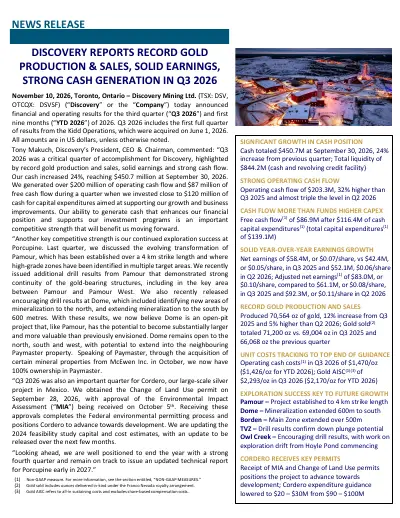
We generated $87 million of free cash flow in a quarter when cash used for capital expenditures increased and reached close to $120 million, increased from the previous quarter. Our cash position increased 24% to $450 million as of September 30th.
When we talk about com- competitive strength, one that is critically important is that we are moving into a period of investment for growth with a very strong balance sheet and a business that is capable of generating significant cash flow and funding itself. With that, I'll turn the call over to Alison White, our CFO.
Alison White
Thanks, Tony, and good morning, everyone. I will start on slide eight with a few financial highlights that we're proud of and that will continue to propel the company forward through its period of investment and growth.
It was another solid quarter, reflecting the continued momentum that we built in the first half of the year, much of which has improved each and every period over the past year and half of our operations. We had record revenues during Q3 of $371 million, an increase of 16% quarter-over-quarter, primarily reflecting 8% more ounces sold at our Porcupine operations and a full-quarter impact of the Kidd operations since the June 1st acquisition of the site.
This marked our fifth consecutive quarter of growth driven by increased production from all of our operations. EBITDA continues on a positive trajectory with $181 million in EBITDA this quarter, also a record and an increase of 7% from Q2 and 49% higher than Q3 of last year.
Compared to Q2, the increase was driven by our first full quarter of results from the Kidd operations, which contributed $72 million of revenue, combined with an 8% increase in gold ounces sold at Porcupine. Together, these more than offset the decrease in average realized gold price during the quarter.
We've continued to carry strong EBITDA momentum from last year with year-to-date EBITDA of $529 million, more than three times the $171 million compared to the same year-to-date period last year. The uplift in gold prices thus far through the year has increased royalty expense, and in turn, our cash costs were raised from the royalty increase as well as the processing of higher-cost tons through inventory, resulting in higher cash costs of $1,470 per ounce sold for the quarter.
All-in sustaining costs averaged $2,293 per ounce sold, reflecting expected higher sustaining capital expenditures as we continue to reinvest in our business. The ramp-up of sustaining capital reflected mobile equipment purchases, further investment at the Dome mill, and work to buttress the tailings facility.
Free cash flow was $87 million, as higher operating cash flow was offset with a ramp-up of our capital program cash spend of $116 million in the quarter. Compared to the $11 million outflow in Q2, free cash flow improved by about $98 million from strong operational performance and sales throughout this quarter.
This change mainly reflected a change in working capital as payables normalized following the accelerated payments processed during Q2 that occurred in advance of the quarter-end ERP implementation, which is partially offset by higher receivables at Kidd, where concentrate sales are collected during the month following sale. We move to slide nine.
Let's review our performance against guidance. We are on track to meet our key cost, production, and capital guidance ranges for the year.
The item of note that we did have a modification to guidance for is Cordero capital, as that is lower than our initial anticipated guidance, and as a result, we are lowering the range of capital spend at Cordero to $20 to $30 million for the year. At Cordero, we paid the change of land use permit fee of $12 million in the third quarter.
This amount was well below the amount assumed in our original fees and growth capital guidance of $90 to $100 million due to a change in the rate for the fee. As a result, we have lowered 2026 Cordero guidance to $20 to $30 million, as we completed Q3 with $18 million in year-to-date capital spend.
As planned and communicated throughout 2026, our production profile is weighted to the second half, and we anticipate that we will end the year within range for all key metrics, with capital and cash costs at Porcupine coming in towards the higher end of the range. If we move on to slide 10, we'll review adjusted net income.
On an adjusted basis, earnings were $83 million or 10 cents per share, compared to $92 million or 11 cents per share in the prior quarter, and up 36% from $61 million or 8 cents per share in Q3 2025. The primary differences between net income and adjusted net income in Q3 2026 included the exclusion of $19 million of share-based compensation costs related to the company's approximate 45% mark-to-market share price appreciation, from $8.48 to $12.28 per share during the quarter.
Remaining items are nominal impacts that combined to a penny for purchase price adjustments, foreign exchange loss, and transition service agreement fees. Let's turn to slide 11 to touch on our capital for the year, as we continue to invest in our assets to drive future growth.
At Porcupine, we planned $195 to $235 million in growth capital, plus an additional $25 to $35 million in capitalized exploration spend. On top of that, we expect $120 to $165 million in sustaining capital.
That spend is focused on three priorities: replacing equipment, expanding mill capacity, and building future production through exploration and conversion drilling work that continues at a rapid pace across the business and has picked up as the year has progressed. Second, we are strengthening our balance sheet.
As we look to expand our operations and grow organically, our financial strength will be fundamental towards our future success. On the next slide, we'll look at our total liquidity and how that will serve as a base for those future plans.
Discovery's total liquidity at the end of the quarter was $844 million. Our cash balance of $450.7 million at the end of the quarter was up $86 million from the end of Q2, with the remaining liquidity funded from the undrawn portion of the $400 million revolving credit facility.
Our strong operating performance generated $203 million of operating cash flow, which more than funded our continued $116 million of cash capital as we advanced our investment program. This strong balance sheet provides the financial flexibility to fund our capital programs and advance our strategic priorities that underpin our vision with confidence as we look to the future.
I'm now going to pass it over to Duncan King, our co-chief operating officer.
Duncan King
Thank you. I am on slide 13.
I'll discuss our mining performance and then ask Gord Leavoy to review our processing and production numbers. Mining rates increased in the third quarter, reaching over 1.2 million tons.
We ended the quarter with 1.7 million tons in stockpile. As Tony mentioned, mining costs per ton improved compared to both last quarter and Q3 2025.
In fact, they improved by over 10% from Q2 this year and over 20% compared to the same period last year. The improvement came from lower mining costs per ton at both Pamour and Borden.
Site-level operating cash costs average $1,470 per ounce versus $1,387 in Q2. Site-level all-in sustaining costs increased to $2,123 per ounce, somewhat higher than $2,028 per ounce last quarter.
The increase in all-in sustaining costs was largely related to the impact of inventory movements on operating cash costs and higher sustaining capital expenditures related to mobile equipment purchases at Borden, investments at the Dome mill, and work to buttress the number six tailings management area. I'll now call on Gord Leavoy, Co-COO, to talk about the milling.
Gord Leavoy
Thanks, Duncan. Good morning.
We milled 943,000 tons in Q3 2026. That was up 4% from the previous quarter.
Compared to the same period in 2025, tons processed increased by 135,000 tons, or 17%, reflecting the progress we have made with the investments at the mill over the last year. We exceeded 11,000 tons per day on 48 days in Q3 and exceeded 12,000 tons per day on 16 days.
Based on both mining and milling performance, we achieved record production of 70,564 ounces in Q3, 5% higher than the previous quarter. Gold poured and gold sold both increased 8% quarter-over-quarter.
The higher tons processed mainly accounted for the increased production. There are also positive impact compared to last quarter from an increase in the average grade.
As you've heard, our milling costs per ton improved. They averaged $20.10 per ton in Q3, better than both $21.50 per ton in Q2 and $21.20 per ton in Q3 2025.
I'll now turn the call over to Dawid Myburgh, Senior Vice President, Timmins Operations, to discuss the Kidd operations.
Dawid Myburgh
Thanks, Gord. Good morning.
I will be speaking through slide 14. Overall, Kidd operations had a solid performance in Q3 of 2026.
This is the first full quarter of results since it's acquisition on June 1st. Revenue in Q3 2026 was $72.3 million versus $29.7 million for the month of June in Q2.
Production costs totaled $45.1 million versus $18.9 million in the month of June in the previous quarter of 2026. We had a small loss from operations after depreciation.
We did, however, generate positive cash flow. Looking at capital, sustaining capital mainly related to infrastructure upgrades and paste holes at the mine.
Kidd's growth capital primarily related to tailings buttressing and mill plant modifications to support the processing of Borden ore, which is targeted to begin in 2027. Now I'd like to turn the call over to Eric Kallio, EVP Exploration and Growth.
Eric Kallio
Thank you, Dawid, and good morning, everyone. I'm on slide 15.
Happy to say it's been another good quarter for exploration, excellent progress at all our projects, including the Pamour and Dome, which is what I'll focus on here today. Starting with Pamour, just quickly point out that the project is 18 kilometers east of Timmins and centered on the historic Pamour Mine.
It's also in an ideal geologic position, covering a 6-kilometer strike length on a northeast-trending band of volcanics, just north of the Destor-Porcupine Fault. In terms of the new drilling, what we have is a continuation of programs from 2025, being done in preparation for an updated resource in early '27, focused on three main areas, including the main pit in the center of the image, Pamour West along strike to the west, and the north contact zone sitting to the north.
Results for each are shown on the image and is indicated extremely positive, with some of the best being from the east and west sides of the main pit, with holes to the east targeting the lower and east sides of the deposit, including multiple strong intercepts to extend it further to the east and to depth, and holes to the west targeting the west limit and extending mineralization here as well. Looking through the list of holes from these areas, there's quite a few highlights, but one of the main ones I'd like to point out is from hole PAM-29, which intersected three solid intervals with three 4.58 grams per ton over 20.7, 7.39 over 18, and 1.8 over 29 meters on the north side of the phase one pit.
Not only does this show impressive grades and widths, but from our initial work, intercepts are from new structures branching from the main trend, remaining open to the northwest. Additionally, we continue to see very strong results from the Pamour West and north contact areas, with holes at Pamour West obtaining multiple strong intercepts nearby the historic pit, as well as an extensions of mineralization up to 900 meters to the east.
Holes at the north contact continuing to confirm and expand new results reported in Q2. Now turning to my next slide, which is number 16, we see the first of two images providing some different angles for the new intercepts, with this first being a view from the south, looking to the north.
The key things to know here are the historic main pit and Pamour West pits, which were in the center and the left sides of the figure, as well as all the new results shown in the white text. Also notable is the overall strike length, which is now approaching 4 kilometers, and the large area still remaining to be tested both below and between the two pits.
Turning to slide 17, we see a second view, which is from the opposite side, providing a slightly better view of holes at the north contact and the Pamour West areas. As before, new assays are shown in white and indicated showing very promising results in both areas and along strike.
Given all the above, we're very pleased with progress to date at Pamour, and drilling's continuing with four drills. Work is now well underway on the new resource update, and on track for early 2027.
Now turning to slide number 18, we see the Dome, where we also continue to see some very exciting things happening. As previously described, Dome is a historic mining property which already has over 17 million ounces mined, and where we already have a 11 million-ounce resource, but also now working to upgrade and expand for an updated estimate later this year.
Geologically, the mine's on the south limb of the Porcupine Syncline, just north of the Destor-Porcupine Fault, with the core of the historic mining being centered on two main structures, including the Greenstone Nose and the Dome Fault, which are located in the center of the various pit outlines. Looking at the new drilling, we can see that all of this is in the immediate pit area, but focused into the north and south sides.
The results here continue to look very encouraging in both. Drilling to the south included 22 new holes targeting the southwest extension of the Dome Fault from the current pit, and has indicated continued to indicate excellent grades and widths between the south edge and up to 600 meters southwards, with some of the highlights being 3.41 over 17.3, and 1.42 over 17 in Dome 46, and 3.56 over 21 in Dome 44.
Important to note is the shallow depths of the new intercepts, and that all remain open for expansion. Additionally, we had another 14 holes on the north side of the property which targeted vein systems surrounding the Greenstone Nose under the north wall of the resource pit, and were also very successful, with multiple strong intersections both within and north of the current resource.
Additionally, as with the area to the south, I'd point out that several of the new zones are at shallow depths and remain open for expansion. Turning to my next slide, number 19, we have another image related to the Dome, providing two different views across the target area and slightly more detail on the results, with one on the top covering the south part of the pits, looking northeast, and the other covering the north and looking to the southwest.
Key things to know here would be the red and green outlines, which represent the current pits, pit shells, and underground workings, as well as the shallow depth and excellent grades and widths in both areas, which remain open for future testing and expansion. Especially striking, I think, is the large gap in resources in the upper image south of the main pit and below the new intercepts.
Considering all of this, I think it is safe to say that as with Pamour, we're very pleased with drilling here, and continuing with two to three race rigs in both the north and south. Also now well underway with our new resource update, and on track for completion in early 2027.
With this, I've come to my last slide, which just like to close off by saying that it's been a very good year for drilling at all our projects. We're now working hard on new resource updates for all of these.
Very excited to announce and talk about the full potential of these projects more fully early in the new year. With that, I'll pass over the call to Jose Jabalera, our senior VP Corporate Affairs and Sustainability, Mexico.
Gord Leavoy
Where's Jose? He was on the line.
He was on the line.
Mark Utting
Jose? Jose has patched in the presentation remotely, and we may be having some connectivity issues.
I'll just quickly speak to—
Operator
Please stand by. I believe we've reconnected Jose.
Not connected. We have lost connection with Jose at this time.
Mark Utting
I'll just quickly speak to slide 20, and you've heard fair bit of the information on the slide. Obviously, we're very excited to have received both the MIA approval as well as the change of land use, and which effectively completes the federal environmental permitting process.
There's been a real benefit in well announcing that and that our change of land use fee, as you've heard, it came in considerably lower than what had initially been included in our guidance, which allowed us to reduce that. With the permits in hand, we are moving forward with updating the feasibility study, capital, and cost estimates.
That work is progressing well and should be completed around the end of the year, and we're looking forward to bringing that information to the market. We think it's going to again highlight what an outstanding project Cordero is and how important it is quite frankly to the future supply in the silver industry.
I'll leave it at that and turn the call back over to Tony.
Tony Makuch
Hey, thanks, Mark. Sort of missed you, Jose.
Thanks, Mark, for filling in there. I'm now just going to conclude, and I'm now on slide 21.
Q3 2026, as you get, was a peak quarter of accomplishment for the people of Discovery. Our geology and exploration group continued to prove the immense exploration upside.
They released outstanding exploration results at Porcupine, which highlight the tremendous growth potential that exists in our Canadian gold business. Both Pamour and Dome increasingly look like they are destined to become large-scale, highly valuable open-pit mines located in Timmins.
You can say what you want, that is not a forward-looking statement. Keep listening.
Then our people in Mexico were very successful in completing the federal environmental permitting process at Cordero and are now working to move this industry-leading silver project forward. Again, stay tuned.
I think that there is a lot of positives here with this project. Our people, not least, our people in Porcupine and throughout the company achieved strong operating and financial results, with the operations clearly showing how they can help support the successful execution of all of our extensive growth plans.
With that, I want to thank you again for participating in our Q3 call, and we'd be happy to take any questions.
Operator
We will now open the line to questions. If you would like to ask a question, please press star one to raise your hand.
To withdraw your question, press star one again. We ask that you pick up your handset when asking a question to allow for optimal sound quality.
If you are muted locally, please remember to unmute your device. Please stand by while we compile the Q&A roster.
Your first question comes from Cosmos Chiu with CIBC. Your line is open.
Please go ahead.
Cosmos Chiu
Thanks, Tony and team. First off, congratulations, Tony, on your induction into the Canadian Mining Hall of Fame.
Then maybe my first question is on Pamour, as Eric mentioned. For me to confirm, is a new resource update coming out in Q1 2027?
If that's the case, areas like Pamour West, is that going to be a part of it? How much more drilling is going to be included in this resource update that's coming up?
Eric Kallio
Yes. The plan is to do the new resource update for Pamour and announce it early in Q1.
That's going to be in conjunction with all the other projects that we have as well, TVZ, Dome, Borden, and Hoyle Pond. We will be including new drilling that was from '25 and '26, which is approximately 100 holes or so.
The new update is going to encompass a much larger area than what it did the first time. It was focused mostly in the main pit, now it will encompass the Broulan, Pamour West area, and also areas to the north where we have the north contact.
Keep in mind all those areas, we'll be doing the study with only the holes we have, which does have historic and new, but there's still going to be large areas that need more testing in the future. It is going to encompass all those areas.
Tony Makuch
The answer there is there's still more drill holes to release. They're continuing to drill extensively in 2027, both infill and to grow, right?
Cosmos Chiu
More forward-looking statements, eh, Tony? Then maybe good to see the exploration results out of Dome as well.
Could I maybe ask about potential sequencing of how the Dome pit and also potentially Pamour getting larger, it's called the Pamour expansion, and as you mentioned, both of them are looking like they could be large-scale open-pit assets. How should we look at sequencing?
Then on top of that, you also made a smaller acquisition this past quarter in Paymaster. Could you maybe talk about the significance of that acquisition and the land package that you've acquired through Paymaster?
Tony Makuch
Maybe I'll just start talk about a little bit about the sequence. I think first and foremost, we're continuing to focus, and our priority is advancing Pamour.
We're mill-constrained at this point in time, and that's our focus with Pamour. We are looking now at as we discussed previously in terms of adding some mill capacity through transferring the Borden ore through one circuit at the Kidd met site.
Also, though, we are looking as we discussed to building a new gold circuit at Kidd, which will then be allowed to that Pamour go there. Once Pamour is going there, then it gives us the ability to advance Dome.
Then there could be further expansions over time, but then in terms of the land position, it gives us geography, it gives us place to do other things. Maybe, Eric, you can give us a little bit of color on the geological significance of this area.
Eric Kallio
Yeah. The new lands are contiguous with the west boundary, and they contain the extension of the geology structures that we're testing now.
There's been quite a bit of exploration drilling, and there's been a number of different targets with significant drill holes already identified, and some of them are actually extensions of zones that we have at the Paymaster already. Allows us to explore the areas between them, but also develop potentially new resources that would be in very close proximity to the Dome mill.
Tony Makuch
Part of our goal, I think we might have outlined it sometimes, we have the Dome mill there, and when you do see some of the things of where the previous Dome resource is and where it isn't in relation to the mill, part of this drilling helps us to find a way to keep that mill operational for an extended period of time if we can, right? Again, a lot of work to do, a lot of positives, and a lot of forward-looking statements, but we expect significant positive results coming out of here over the next few quarters.
Operator
Your next question comes from Jake Savage with Agentis Capital. Your line is open.
Please go ahead.
Jake Savage
Hi, everyone. Congrats on another strong quarter at Porcupine and on the Cordero permits as well.
I'm wondering if you can share any more detail on the operating performance at Borden, any mining physicals in particular, as well as any updates on the growth capital projects at Borden.
Tony Makuch
Mining costs at Borden, Duncan.
Duncan King
Oh. We transferred from the contractor and we hired most of their production people, sorry.
The development is still being done by a contractor. In that way, we've changed it up quite a bit and we're getting a lot more footage per man shift.
Tony Makuch
There's also that, yeah, we transitioned from the contractor in operations and we bought a lot of new equipment, so that's having some work in his period of time. We think there's significant upside at Borden and in terms of what we can accomplish here.
Were you asking about all the growth plans or the growth at Borden?
Jake Savage
Any updates on the major projects would be great.
Tony Makuch
We're working on a technical report still, which we expect to come out in early 2027. It is to be incorporating the updated resource estimates for Pamour with the drill results, updated resource estimates for Dome with the drill results that we're talking about, encompassing some of the work on the mill expansion, the mill expansions or changeovers for Borden, as well as new mill expansions, that as we talked about for Kidd for a new gold circuit and how that should fit.
All this work is being done coming up, like I say, to Q1 next year. Similarly, as we talked about for my growth plans, we're completing an update to the feasibility study, capital cost estimate, etc.
for Cordero, and we expect to have this coming out towards the end of this year, early in Q1. That should help to outline a pathway where as we can continue to advance these projects.
There's significant exploration upside, which drives our need for development and investment in mills and mines, and then how that leads into growth in production and lower costs and basically increasing value.
Operator
Your next question comes from John Tumazos with Very Independent Research. Your line is open.
Please go ahead.
John Tumazos
Thank you for taking my questions. First, for the purpose of the generalist or distant American, could you explain how the 43-101 rules impact Porcupine as one property?
Do you have to update everything, and does that discourage you from updating one pocket at a time, like Owl Creek or bits and pieces? Do you have to do a unified total report?
Tony Makuch
Because they're all feeding to a central mill, we have to be updating them all collectively, right?
John Tumazos
I sympathize with Dawid and Gord and all your team doing this mega study. I'm thinking ahead, Tony, maybe to January '29 or '28 when you have your third NI 43-101.
I guess that there's going to be parts of the Pamour open pit that don't get into the pending second study because the spacing is too wide, parts of Dome, parts of Paymaster, Owl Creek might not be in, Kidd might not be in, Hoyle and McIntyre you haven't begun the drilling. It feels like something like half of the good news is going to be in January and that's going to be very good, and then there's another half of the good news or something like that coming a year or two later.
Excuse me for thinking ahead.
Tony Makuch
No, good points, and really thank you for bringing that up, because that's true. We're going to come up, and we're putting out a PEA now because we have to collectively bring all these projects forward and try to advance them as we're going.
Definitely there'll be differences when we start processing stuff at the Kidd met site versus at Dome at the mine site, then it'll give us some ability to advance projects a little bit differently once that happens. Effectively, this is a first phase of PEA per se in 20 beginning of 2027.
We expect it to be redone in 2028, probably redone in 2029, some further updates in 2030. If I see it would progress from PEA to PFS and maybe to further on than that as we continue to grow on and get more detailed engineering and get more information, right?
It's
Operator
only,
Tony Makuch
you said half the story, it might only be a quarter of the story, John. Excuse me.
Operator
Your next question comes from Rabi Nizami with National Bank of Canada. Your line is open.
Please go ahead.
Rabi Nizami
Thank you, and thanks for taking my question. Congrats on the quarter so far and the year so far.
Just a couple of quick ones. Most of my questions have been answered.
On the Dome mill, it's nice to see that we're seeing stable, rising throughput, unit costs coming down for tons milled. Do you have any commentary on how you expect those unit costs for milling to continue to improve perhaps in Q4 and into next year?
With that, do you envision that a lot of the improvement that you're working on in the next little while is coming from the mining cost side, or is there a lot more to do on the milling cost side as well? The
Gord Leavoy
most of the cost reduction is through the throughput, and that's through the ongoing repairs and rebuilding we're doing in the mill. We're still not completely finished, but carrying on, we still have months left to do.
As
Tony Makuch
we're making investments into the plant, fixing things or are modifying things, which and we're getting throughput up. We know the biggest thing that can happen and over time from cost savings is then you're going to have less and less downtime, more and more availability, less and less upset conditions, which cause us to have had to repair or do things that bring in extra costs that are there.
It's an investment, we see improvements in unit costs coming from increased throughput, as Gord mentioned, and then lower costs just because of you not having these unexpected events that happen. A part of our goal is not just to get the throughput up and not just to get the cost down, it's actually to get metallurgy recovery up as well.
Rabi Nizami
Sounds good. That's good to hear.
There's a trend. There's more to that trend coming up ahead.
Moving on to Kidd, you mentioned that some of the CapEx being spent there is already anticipating Borden to start integrating into the met site next year. Is there any color you can give us on the nature of the work you're doing there in anticipation of that currently?
A second question, somewhat related, is that for the Kidd base metal site, now that you've been operating it for a full quarter, do you have some greater understanding of how you envision that asset continuing into 2027 and beyond? I noticed you had a drill rig active in your Kidd Creek as well, two questions there.
Dawid Myburgh
First question around the capital linked to the Borden processing at the Kidd met site, there's two parts to it. We are going to accept the Borden ore at the Kidd mine site where we have the surface crusher and the load-out facilities onto the rail, which is linked to the Kidd met site.
We did a bit of work on the bins, the crusher, to be able to accept Borden ore and do it sustainably, into the future. Then at the met site itself, there's a few changes we had to do around the circuits.
Not much, because we're floating sulfides really, so that's what we do. A few modifications at the met site, and that's the majority of the capital spent at Kidd linked to the Borden ore processing.
Then I'm not sure I understood the second part, but we do have the capacity to process the base metal ore separate from the Borden ore, we do anticipate running those circuits. We can run them simultaneously.
The way the Kidd met site's designed, it's got four separate circuits which we have the ability with the bins we have to treat those two ore types completely separately, if that was the question.
Tony Makuch
Then the other part of the question was what is our plans for Kidd. We've been in Kidd, we're not promising how much longer we would keep Kidd operational.
Our main performance here is really try to understand what's going on, making sure it is safe and productive. We have a lot of growth in our gold business in Porcupine, and even as we talked about with the met site, etc.
We're going to be working over the next while to figure out what the best path is for everything, for people and for Discovery as we move forward. We are exploring there.
It is a significant area of exploration over the next while, and we'll see what happens as we go forward. It's a deep mine.
It's been operated extremely effectively, and we've got the same people that have been operating it for a long time, and the operational performance and the ability to meet according to plan and the safety, etc., is second to none, I think no mine in the industry globally. Like I say, it's still safer to work there than probably work at home.
Rabi Nizami
So. Thank you for answering my questions, and congratulations again.
Operator
Your next question comes from Cosmos Chiu with CIBC. Your line is open.
Please go ahead. Your next question comes from John Tumazos with Very Independent Research.
Your line is open. Please go ahead.
John Tumazos
Can I direct to Eric? Eric, what are some of the areas for 2028 that you might drill—2027, excuse me, that you might drill that we haven't drilled yet?
Do you plan to drill Kidd, Hollister, McIntyre area, Paymaster, Fuller? Where are the new theaters of opportunity?
Eric Kallio
We're going to have continuation of work at some of the same areas, but adding in some new. The combination of the two.
We might have discussed a bit earlier, there's still going to be a lot of drilling to do at Dome and the Pamour, just based on the new success. We've expanded the limits quite a bit, but there's still large gaps in there and extensions, so that'll be a big part of the projects going ahead.
We'll have continuation of work at the mines again, Hoyle Pond, Borden. Borden will be looking at trying to further extend the zone.
This year we drilled out to the limit of the inferred resource and a little bit beyond, but we'll be continuing to take some big step-outs and look at the overall size of the resource. We've got the new properties from McEwen Mining, there at Paymaster, just to west.
We'll be looking at some of those areas there. Then around the Kidd mine site, we've started some work this year, we're going to continue with that.
Looking at even other targets on the Kidd package to the north of Timmins. A lot of the same things, but big focus on Pamour, Dome.
John Tumazos
Eric, a decade ago, the nice people at Goldcorp would make presentations, and they talked about TVZ and Paymaster. Are there resources or data from the Goldcorp era for TVZ, Paymaster, Hollinger pit, or from McEwen for Fuller that you can plug into your 43-101 without doing it from scratch?
Or is there any data like that that helps with the process?
Eric Kallio
There is drilling at TVZ, we've talked about that before, but the spacing of the holes is still too wide to be called even an inferred resource. It does define a broad target model, which we've shown goes all the way from 900 to about 1,600.
A lot of success in there, but still, we're talking about holes 100 to 150 meters apart, wouldn't be able to convert them immediately. We'll have portions of that as part of this update, and then we'll be continuing to drill on that area there.
There's some internal studies that was done at the Paymaster, but none of those, again, as qualify for 43-101 at this time. We'll have to study them, and plus we might reinterpret them because different gold prices that we have now and that sort of thing as well.
Hollinger, it's still we feel that there's some good opportunities to expand the pit at the current Hollinger pit to the south. We'll start looking at the model for the other areas.
We've got so much other work on the go right now, we'll focus more on the other things.
Tony Makuch
I think it's safe to say that TVZ is one area where we're advancing, but it's still a lot of work to do at TVZ. The Paymaster in that whole region and how it ties in, I think that'll come over time.
Same with Hollinger. We've got extensive amount of work to do at Pamour and Dome, and then Hoyle Pond to keep Hoyle Pond operational and keep that thing running, and same as Borden.
Some of these we are just going to, they'll be the next ones. That's why, over the next three to five years, you're going to see significant exploration updates year over year over year, right?
John Tumazos
Thank you. Thank you for your service to the shareholders.
Operator
Your next question comes from Cosmos Chiu with CIBC. Your line is open.
Please go ahead.
Cosmos Chiu
Hi, can you hear me now, Tony?
Tony Makuch
We can hear you now. Now we can.
Cosmos Chiu
Cool. All right, I think the operator doesn't like me too much.
Tony Makuch
It's a pleasure to have you back, Cosmos.
Cosmos Chiu
Maybe a follow-on question here. I know Jose is not on the line, but, Tony, I'm sure you're capable of answering all these questions.
Could you maybe talk through some of the different alternatives in terms of potentially realizing value at Cordero, be it building it, or finding a partner for it? In terms of timing of when that could come out, will we not find out until you have some kind of updated numbers on an updated feasibility study?
Maybe if you can touch on that, Tony.
Tony Makuch
Good questions. The first thing we needed to do in terms of advancing Cordero and where we want to go with it, definitely we need to get our permits, and we've been working towards updating our feasibility study mostly on capital cost estimates, and looking at a few minor things.
We're not changing the mine plan or the process plant design that's in the feasibility study. We're just filling some of the holes up to areas.
We expect that to come out, like I say, towards the end of this year, early Q1. From that, then our goal next year is to probably advance to more detailed engineering and continuing to advance the project in that way, while we can look at alternatives and in terms of what is the best avenue for advancing this project for our shareholders.
We think the best thing we're going to do is we have an updated feasibility study, then we have the detailed engineering. Our shareholders and we all know what the true value of this project is, and then we can make a look at a lot of the different options, whether we build it ourselves, and it's a buildable project, to working with partner or looking at other ways to advance this project.
In the silver space, this is probably one of the best silver projects globally, and don't think that the zinc part of this project is strong as well. We know it's a valuable project, and we're going to advance it.
It's really going to be a lot of stuff, starting from beginning of next year towards the end of next year. We expect to have a lot of these things sort of looked upon and answered, and see where we're going to go,
Cosmos Chiu
right?
Tony Makuch
Does that answer your question?
Cosmos Chiu
Did
Tony Makuch
that answer your question? Good.
Cosmos Chiu
Yes, that did. I just, yeah, maybe another question just quickly and following on on the the cost guidance for the year.
A great to see that you've maintained your cost guidance, $1,950 to $2,250 an ounce, which is commendable in today's environment where everyone's talking about inflation and we've seen some others in your peer group actually increase their cost guidance. It's very good that you've maintained it.
On that, Tony, can you actually talk about inflationary pressures in the Timmins area, inflationary pressures in terms of input costs? On that, I see that you're building a camp at Borden.
Is that part of the strategy in terms of retention? Is that, what are you trying to do as part of the holistic package of getting workers in the Timmins camp?
Tony Makuch
First, there are significant cost pressures, right? Fuel costs, you're seeing diesel costs have significantly increased, and there's this pressure on people and access to, pressure on equipment purchases and parts.
There's pressure there, but we're also working on other areas in terms of how we spend money and try to find other places that sort of bring the value back that's there. It's a combination.
We do have cost overruns in some areas, we have costs under runs in other areas, and then the net is we're trying to work hard on understanding those things. One area you hit it on the head, part of it are reinvestment back into the operations and where you make the mill more efficient, or reinvestment and building a camp at Borden, part of it is to reduce operating costs.
Operating costs aren't just unit costs you pay for people or unit costs you pay for parts. We practice a lot of loss control.
It's about spending a dollar and getting $3 of value from it versus getting $2.50 of value from it, or losing money on the money we spend. We do a lot of that, and the camp is going to help us in terms of attraction and retention for people.
Right now, it is a basically drive-in, drive-out operation. I don't mean to be chauvinist, but you send a bunch of men up there to work 12 hours a day, come home and cook and clean for themselves, I think if it's after 7 days, I don't think it'll be long you're going to get the best productivity.
I think it's going to pay for itself in terms of productivity for people, safety for people, and just overall positive attitude into the workplace. Those are the kind of investments we're trying to make, investments in people, investments in equipment, investments in the assets to get more productivity and improvements in operational performance.
There's cost pressures all the time, but we can't control the cost pressures by the unit we can't control the diesel prices, but we can control the other things that we do, and that's what we're working on.
Cosmos Chiu
Great. Thanks, Tony.
Congrats again on a very strong Q3, and those are all the questions I have. Thank you.
Tony Makuch
Thanks.
Operator
There are no further questions at this time. I will now turn the call back to Mr.
Utting for closing remarks.
Mark Utting
Thanks very much, operator. Again, thanks everyone for taking part in the call.
As you've heard, we have some very, very important catalysts coming in the next little while, both updating the cost and capital estimates at Cordero, and a resource update and PEA for Porcupine. I can tell you we're very much looking forward to bringing that information to the market.
Just it's appropriate to end with a forward-looking statement that we think these things are going to highlight just how much value there's yet to create at Discovery Mining. Thanks again for joining us, and we will talk to you again next quarter.
Operator
This concludes today's call. Thank you for attending.
You may now disconnect.