Dynatrace, Inc.
Q2 FY2027 · Earnings Call TranscriptNovember 3, 2026
Operator
Greetings, welcome to Dynatrace's second quarter fiscal 2027 earnings call. At this time, all participants are in a listen-only mode.
A question-and-answer session will follow the formal presentation. If anyone should require operator assistance during the conference, please press *0 on your telephone keypad.
Please note, this conference is being recorded. I will now turn the conference over to Noelle Faris, Vice President of Investor Relations.
Thank you, you may begin.
Noelle Faris
Good morning, and thank you for joining Dynatrace's second quarter fiscal 2027 earnings conference call. Joining me today are Rick McConnell, Chief Executive Officer, and Jim Benson, Chief Financial Officer.
Before we get started, please note that today's comments include forward-looking statements, such as statements regarding revenue, earnings guidance, and economic conditions. Actual results may differ materially from our expectations due to a number of risks and uncertainties discussed in Dynatrace's SEC filings, including our most recent annual report on Form 10-K and subsequent quarterly reports on Form 10-Q.
The forward-looking statements contained in this call represent the company's views on November 3rd, 2026. We assume no obligation to update these statements as a result of new information, future events, or circumstances.
Unless otherwise noted, the growth rates we discuss today are year-over-year and non-GAAP, reflecting constant currency growth, and per-share amounts are on a diluted basis. References in our remarks to the Dynatrace standalone business refer to Dynatrace's core business excluding Arize, which we acquired on October 1st.
We will also discuss other non-GAAP financial measures on today's call. To see reconciliations between non-GAAP and GAAP measures, please refer to today's earnings press release and supplemental presentation, which are both posted in the financial results section of our IR website.
With that, let me turn the call over to our Chief Executive Officer, Rick McConnell.
Rick McConnell
Thanks, Noelle, and good morning, everyone. Thank you for joining us for today's call.
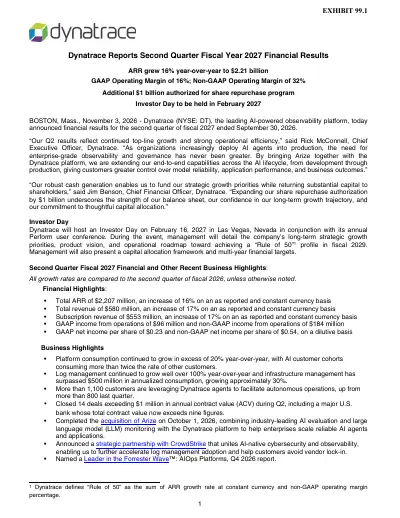
Our Q2 results reflect the ongoing durability and strength of our financial model, including top-line growth as well as continued operating leverage. Total ARR grew 16%, total and subscription revenue grew 17%, and non-GAAP operating margin was 32%, resulting in a Rule of 48 when combined with ARR growth.
At the outset, I want to reiterate our confidence in our FY '27 guidance. Q2 net new ARR came in flat year-over-year, following 41% organic net new ARR growth in Q1, reflecting the timing of a number of large enterprise deals that shifted to the second half.
These opportunities remain active, and several have already closed. Importantly, the underlying growth drivers remain unchanged.
Overall platform consumption continues to grow in excess of 20%, with AI customer cohorts consuming more than twice the rate of other customers. Logs consumption continues to grow at well over 100%.
Infrastructure monitoring hit a milestone; it is now over $500 million in annualized consumption, growing approximately 30%. More than 1,100 customers leverage the public preview of Dynatrace Agents to facilitate autonomous operations, up from 800 last quarter.
The Arize acquisition has broadened our access to developers and brought more than 30 AI-native customers. These trends reinforce our confidence in the growth opportunity ahead.
Jim will cover the Q2 numbers and our full-year guidance in more detail. Let me turn to the AI opportunity and why I believe Dynatrace is positioned to win.
We are no longer on the cusp of the agentic era; we are in the middle of it. AI is writing code, agents are operating software, and the growth of telemetry volumes and complexity is accelerating.
Our own research shows that AI workloads drove a 93% increase in log volume in the past 12 months alone. As AI systems become increasingly autonomous, enterprises need greater visibility and control over how their applications operate and how AI agents behave.
This is reinforcing the importance of unified observability platforms and creating a significant opportunity for Dynatrace. Customers continue to choose Dynatrace because of an architectural advantage that other observability platforms and point solutions cannot easily replicate.
Our key points of product differentiation include: Grail, our unified data lakehouse; Smartscape, our real-time context graph; and Dynatrace Intelligence, which fuses deterministic and agentic AI. Together, these three integrated components deliver a single, end-to-end observability platform across all data types and domains, accessible by all personas.
Our integrated architecture grounds AI-driven actions in precise context, with guardrails set by customers. We are an open platform throughout, with full root cause on open telemetry data and no proprietary agents required.
Our differentiated architecture positions us well as customers increasingly consolidate tools and standardize on fewer, more strategic platforms. Customers want one platform that can support teams and agents across their environments instead of many disconnected point tools, and we saw this in several strategic customer wins and expansions during the quarter.
We continue to see external validation of our strong competitive position. Last week, Forrester named Dynatrace a leader with the highest score in the current offering category in AI ops platforms.
We're seeing that differentiation translate into customer buying decisions. Here are a few examples from the quarter.
We signed a seven-figure expansion with a leading UK semiconductor and software design firm. This customer's annualized consumption was growing more than 60%, and after trending above its commit for three consecutive quarters, they increased their DPS commit by 65%, 15 months ahead of their renewal.
One of the world's largest banks expanded its commitment by seven figures, bringing total contract value to nine figures. They have made Dynatrace their global observability standard with the intention of replacing their existing cloud observability vendor and moving logs to Grail.
One of our largest new logo wins was a large US public sector organization that selected Dynatrace to consolidate legacy monitoring across highly secure, mission-critical operations. We secured a seven-figure expansion with a large nonprofit, which standardized on Dynatrace for all applications and replaced its 20-year log vendor.
We signed a seven-figure expansion with a Canadian public sector organization, where annualized consumption grew more than 100%, leading the customer to double its commitment as it consolidated more tools onto Dynatrace. A major Mexican public sector institution selected Dynatrace for a seven-figure new logo win, displacing an incumbent vendor in an end-to-end observability takeout, including logs.
These examples highlight the opportunity to expand existing customer relationships as they consume more, displace incumbent solutions, and continue to attract new logos. We are already seeing AI translate into meaningful platform consumption.
More than 1,100 customers now use Dynatrace to observe AI and LLM workloads. As I mentioned earlier, consumption growth in AI cohorts is growing at more than twice the rate of other customers.
The architectural advantage of a fully unified platform is even more relevant in an AI-first world. Looking ahead, we see three ways AI can drive incremental growth for Dynatrace.
First, AI workloads generate far more telemetry, which increases consumption. Second, as of the beginning of Q3, we are now monetizing our own AI capabilities and agents, and have the opportunity to convert the more than 1,100 preview customers into paying customers.
Every time Dynatrace Intelligence answers a question or an agent acts autonomously, it drives DPS usage. Third, Arize provides deep observability and continuous evaluation across AI applications and agentic systems, while Dynatrace connects the behavior to the broader technology stack and business context.
This enables customers to improve accuracy, efficiency, safety, and reliability across the entire AI system. Let me expand on the Arize acquisition, which we closed on October 1st.
Arize is the category leader in AI observability and evaluations, a market we expect to exceed $10 billion by 2030. By combining Arize's capabilities in model evaluation and observability with Dynatrace's contextual intelligence and full-stack observability, we can help customers monitor and control the full AI lifecycle.
Importantly, Arize creates a strong position for us with AI developers. Its open-source Phoenix platform has millions of monthly downloads, providing an incremental pipeline source to introduce Dynatrace to customers building AI applications.
We will continue to support this developer-first approach, with Phoenix remaining open source and both Arize AX and Dynatrace available as standalone offerings. At the same time, we are integrating the Arize and Dynatrace solutions so customers who use both gain even greater value, connecting AI observability and evaluation with the full-stack context of Dynatrace.
We are already seeing the potential of this combination. A large healthcare company is using Arize and Dynatrace to scale an AI assistant that helps customers navigate their care.
Arize evaluates the quality of the model's responses, while Dynatrace provides full-stack observability, enabling teams to trace issues from the model through the application and infrastructure to root cause. Together, they give the customer confidence to expand AI to more users and workflows, with the governance and oversight that healthcare demands.
While it's still early and just a month since we closed the acquisition, we already have several dozen cross-sell opportunities underway to bring Arize's capabilities to Dynatrace customers. We're excited to have brought our teams together, and we're working to deliver on the opportunity ahead.
I am also thrilled about the strategic partnership that we jointly announced yesterday with CrowdStrike, enabling us to further accelerate log management adoption and help customers avoid vendor lock-in. With BindPlane as the intelligent telemetry layer, we can bring together Dynatrace's logs and observability data with CrowdStrike's leading AI-powered cybersecurity.
Turning to the CFO transition, as we shared in August, Jim plans to retire by the end of this fiscal year. We have several candidates who are in process, and I look forward to updating you once we have made a decision on his successor.
Jim has been an exceptional partner, and I remain deeply grateful for his ongoing leadership. Finally, we announced today that we will be hosting our Investor Day on February 16th, 2027 in Las Vegas as part of our Perform customer conference.
We look forward to sharing our long-term strategy, our AI vision, and our financial framework with you. The IR team will provide details on registration in the coming days, and we hope to see you there.
To wrap up, we see a significant growth opportunity ahead. Consumption trends remain strong, our market is expanding with AI, and Arize further strengthens our opportunity to capture that demand.
Jim, over to you.
Jim Benson
Thank you, Rick, and good morning, everyone. Our second quarter delivered strong revenue growth and profitability, with total revenue growing 17% and a non-GAAP operating margin of 32%.
Net new ARR was below our expectations, reflecting timing of enterprise deals shifting into the second half. We remain confident in our full-year ARR targets, supported by the fundamental demand drivers that Rick outlined, as well as favorable competitive win rates and healthy customer retention.
Let me now review our second quarter results in more detail. Unless otherwise noted, all growth rates are year-over-year and in constant currency.
Starting with ARR, we ended the quarter at $2.21 billion, up 16% year-over-year. Q2 net new ARR was $70 million, adjusted for foreign exchange movements.
While growth was flat year-over-year, this result was impacted by deal timing for an elevated number of large enterprise opportunities. We have already closed several of these deals in early Q3, and we are actively progressing the remainder through our pipeline for potential second half conversion.
While the timing of large enterprise transactions can create quarterly variability, first half organic net new ARR grew 17% year-over-year, reflecting continued momentum in our core business. Turning to new customer acquisition, we added 120 new logos to the Dynatrace platform in the second quarter.
Importantly, the strategic quality and scale of these wins continue to trend higher. Trailing 12-month average land size exceeded $200,000, up from just $140,000 in Q2 of last year.
This sharp increase underscores our success in landing large enterprise accounts with substantial long-term expansion potential. Once on the platform, customers expand their deployments over time.
Average ARR per customer continues to climb and is now well over $500,000, reflecting broader platform adoption and highlighting the mission-critical value we deliver daily. Even with our strong cross-sell and upsell execution, significant runway remains across our base.
Looking long term, we believe the average ARR per customer potential could exceed $1 million. Turning to retention, Q2 gross retention rate remained steady in the mid-90s, further proof of how deeply embedded Dynatrace is for our enterprise customers.
Net retention rate, or NRR, was 109% on a trailing 12-month basis, down a point sequentially. This modest movement was driven by late-stage expansions pushing into the second half.
With roughly 70% of our full-year renewal activity ahead of us in half two, we anticipate more expansion opportunities in the back half. Platform adoption continues to deepen across multiple capabilities, led by log management, our fastest-growing offering, which continues to grow well over 100% year-over-year.
We expect log management to remain a durable growth driver alongside expanding adoption across our broader platform. Increased capability usage continues to drive overall consumption, paving the way to future ARR expansion potential as customers commit to larger multi-year contracts.
Turning to revenue, total revenue was $580 million, and subscription revenue was $553 million, both growing 17% and topping the high end of our guidance by 100 basis points. Moving to profitability, non-GAAP operating margin reached 32%, exceeding the high end of guidance by nearly 200 basis points.
This outperformance was driven by top-line upside flowing to the bottom line alongside favorable quarter-to-quarter expense timing. Non-GAAP net income was $162 million, or 54 cents per diluted share, beating the high end of our guidance by 5 cents.
As a reminder, our August issuance of $1.4 billion in convertible notes added 10 million shares to our diluted weighted average share count for the quarter. Turning to cash flow, Q2 adjusted free cash flow was $42 million.
As a reminder, quarterly cash flow varies significantly with billing seasonality and payment timing. We believe looking at our trailing 12-month performance provides a clearer, more normalized measure of our cash generation.
Over the trailing 12 months, we generated $593 million in adjusted free cash flow, delivering a strong 27% margin. On a pretax basis, our adjusted free cash flow margin was 33%, reflecting a 600 basis point cash tax impact.
Moving to capital allocation, supported by our strong free cash flow, our priorities remain clear: funding innovation and growth, both organically and through strategic M&A, while returning capital to shareholders. Following the Arize acquisition announcement, our zero-coupon convertible offering strengthened the balance sheet ahead of closing, preserving financial flexibility to opportunistically pursue strategic investments and continue share repurchases.
Demonstrating our commitment to disciplined capital allocation and confidence in our long-term growth trajectory, our board authorized an incremental $1 billion for our share repurchase program. During Q2, we repurchased 5.2 million shares for $246 million.
Including the new authorization, we currently have approximately $1.3 billion in total remaining buyback capacity. Looking ahead, we will maintain a thoughtful approach, balancing high-return growth opportunities with meaningful capital return.
We will share more details on our capital allocation framework at our Investor Day in February. Moving to guidance, our second half outlook is underpinned by strong business fundamentals, including robust observability demand and healthy baseline consumption, and further supported by expansion potential across a large upcoming renewal cohort, alongside tailwinds from tool consolidation, AI, and our recent Arize acquisition.
With that backdrop, let me summarize our full-year guidance as detailed in this morning's press release. We've also posted supplemental financial information on our investor relations website regarding the expected impact of the Arize transaction on our outlook.
For ARR, we are maintaining our full-year Dynatrace standalone constant currency ARR growth guidance of 15.5% to 16.5%. The acquisition of Arize added approximately $25 million in ARR at close, and is expected to reach $40 million by fiscal year-end.
This contributes 200 basis points of growth, bringing our total fiscal 2027 ARR growth to 17.5% to 18.5%. Excluding the $25 million impact of acquired ARR from Arize, we expect second half net new ARR will skew more towards Q4 than historical seasonality, aligned with our Q4 renewal concentration and expected momentum with Arize.
Moving to revenue, we are raising our Dynatrace standalone constant currency outlook for both total revenue and subscription revenue by approximately 50 basis points at the midpoint, reflecting the operational outperformance in Q2. In addition, Arize is expected to contribute $16 million, or 80 basis points, of revenue growth in fiscal 2027.
Factoring both in, we now expect total revenue and subscription revenue growth of 16% year-over-year. With the US dollar strengthening since our last call, we now expect full-year FX headwinds of $20 million on ARR and $6 million on revenue.
Compared to prior guidance, this represents an incremental headwind of $6 million to ARR and $2 million to revenue. Turning to margins and profitability, full-year non-GAAP operating margin is now expected to be 28% to 28.25%.
This includes roughly 175 basis points of dilution from the Arize acquisition, consistent with what we shared when we announced the deal. Excluding Arize, our Dynatrace standalone business continues to show expanding profitability, with our updated guidance reflecting 25 basis points of incremental leverage.
Non-GAAP EPS is now projected at $1.88 to $1.90 per diluted share, down 9 cents at the midpoint. This adjustment is primarily driven by the convertible bond transaction, which increases our full-year diluted weighted average share count by roughly 14 million.
On cash flow, we now expect adjusted free cash flow margin of 26% and pretax free cash flow margin of 31%, down 50 and 100 basis points, respectively. This adjustment reflects the impact of the Arize acquisition, partially offset by favorable cash taxes.
Looking at Q3, we project total revenue and subscription revenue growth of 15.5% to 16.5%, including approximately 130 basis points from Arize. We expect non-GAAP operating margin of 26%, reflecting roughly 350 basis points of Arize dilution, and non-GAAP EPS of 44 to 45 cents per diluted share.
To wrap up, our core growth drivers remain intact, and we believe our differentiation and value proposition have never been stronger. We have confidence in our execution and conviction in our guide for the back half of the year, and are excited about the long-term opportunities ahead.
With that, we'll open the line for questions. Operator?
Operator
Thank you. If you would like to ask a question, please press *1 on your telephone keypad.
A confirmation tone will indicate your line is in the question queue. You may press *2 if you would like to remove your question from the queue.
For participants using speaker equipment, it may be necessary to pick up your headset before pressing the star keys. We ask that you please limit to one question.
Our first question is from Samik Chatterjee with J.P. Morgan Chase.
Please proceed.
Samik Chatterjee
Hi, thank you, thanks for taking my question. Maybe if I can just start with the 2Q timing differences that you saw in relation to the net new ARR, and if you could flesh out a bit further what probably led to some of these delays in closing out the contracts.
Was it anything to do with sort of more footprint expansion with those customers or consolidation across tools? Maybe a bit more color on what drove those delays would be helpful.
Are you seeing any more further delays with the existing pool of customers that you're working with for the second half? Thank you.
Rick McConnell
Thanks, Samik, it's Rick. I'll start, and then Jim can comment further.
First, let me just repeat some of the comments that we made in the prepared remarks, that the fundamental growth drivers we see as really remaining quite intact. Robust demand environment, we have a large renewal cohort, tool consolidation continues, we have a differentiated platform, AI tailwinds are there, Arize is a very strong addition to the company, which now occurred as of October 1st.
We see a number of tailwinds in the business. It really just comes down to a number of these larger enterprise deals slipping from one quarter to the next and into the second half.
Hopefully that will come to pass with this renewal cohort as we end up in the second half. Jim?
Jim Benson
I'd just comment on a couple further items. That certainly timing variability is something we've actually talked about, I think, on every call, and it is a bit of the nature of enterprise selling.
We have been fortunate that we have been on the positive side of deal timing variability; Q1 is a good example. We just crushed it with Q1 with deals that were on the cusp of Q1 and Q2 that closed in Q1.
It is a bit of the nature of enterprise selling. To Rick's point, these deals aren't lost, these deals are still in the pipeline.
Several of these deals have already closed, as I mentioned in the prepared remarks, and we expect many of the remaining pipeline to close in the second half. If you look at it on a kind of half basis, that you look at net new ARR, that we did 41% growth in net new ARR in Q1, flat here in Q2, 17% growth for the half.
A very solid growth rate in net new ARR. As Rick said, we have confidence in the back half of the year, and that we can deliver against the guide that we just outlined.
Operator
Our next question is from Sanjit Singh with Morgan Stanley. Please proceed.
Sanjit Singh
Thank you for taking the question. I just had a follow-up on the slipped-deal dynamics.
Is there anything from a profile of these deals, or are these deals concentrated in particular regions? Just give more color on if there's any sort of commonalities with these slipped-deal dynamics.
A little surprised just given that I know you guys have moved to a semiannual compensation structure for sales, there's seems to be a high degree of incentives to get these deals closed in the second half. I just want to understand if there's any sort of extenuating factors, whether these deals were in lower growth, economic regions or anything around the profile of these deals.
Thanks.
Jim Benson
Thanks for the question, Sanjit. That, I would say that every deal is unique, but I'd say to kind of characterize the deals that slipped, one of the things that we've commented on is, call it, there is a big tailwind, and there is a very prevalent sales play with large enterprise customers around end-to-end observability.
Those deals tend to be large, those deals tend to be complex, and those deals tend to force the customer to look at different relationships they have with other vendors. The timing of them can be challenging.
I would say there is a weighting of that phenomena that occurred. Again, sometimes it's difficult to peg when that happens.
You are 100% right, there certainly was sales motivation to close the deals, because reps get paid more if they closed them in September versus closing them in either Q3 or Q4. There's only so much you can do to influence the customer from a timing perspective.
I'd just characterize it more as it's very consistent with the theme we've seen of customers that are interested in consolidating fragmented tools, and those decisions are complicated and require kind of figuring out how do you sequence different vendors before you make final purchasing decisions.
Rick McConnell
I would just add, Sanjit, that at the current run rate of expansions and some of the larger deals, what we're really talking about here is net new ARR that's in the range of high-single-digit millions of dollars lighter than we had expected. That really comes down to just a handful of deals at this size.
Wanted to make sure that we quantified that for you.
Operator
Our next question is from Matthew Martino with Goldman Sachs. Please proceed.
Matthew Martino
Hey, yeah, thanks for taking the question. Jim or Rick here, I appreciate there can be some variability around the timing of large enterprise deals, but platform consumption still above 20%, AI customers consuming at twice the rate of the broader base, and then several of those deals that slipped in the quarter have closed already in Q3.
Given those positives, I guess the question here is what kept you from raising the organic second half ARR outlook? Thank you.
Jim Benson
I'll take that. That, I would say we're trying to be balanced.
We have very strong confidence and conviction in the back half guide, but we want to make sure that we make a balanced approach to the guidance. You're right, you can look at kind of the opportunities that are in front of us.
There's a lot of reasons to believe that there's going to be a good back half, and we do believe in the back half. We believe that we have a large cohort of customers coming up for renewal.
70% of our annual renewals are going to happen in the back half of the year. Significant opportunity to do expansions.
Yes, there's a lot of opportunity. We just want to make sure we're balanced, that we don't want to get ahead of ourselves.
I don't want you to think that not raising the guide does not mean we don't have conviction in delivering to the guidance that we just outlined. will have to see how Q3 does.
One probably data point, at least to let because I think it does factor in our thinking, that of the renewals in the back half of the year, 65% of those renewals are weighted to the fourth quarter. You have 35% in the third quarter.
Obviously, with the weighting of renewals kind of to the fourth quarter, one of the things we mentioned in the prepared remarks, we think we will be a little bit more weighted than historical levels for net new ARR seasonality, if you exclude the $25 million of acquired revenue from Arize, a little bit more to Q4. We got to see how the Q3 renewal cohort does.
It's a large renewal cohort, but the bigger renewal cohort is in Q4.
Operator
Our next question is from Radi Sultan with UBS. Please proceed.
Radi Sultan
Awesome. Thanks for taking the questions.
Now that you have a month of Arize in the platform, can you just speak to how Arize is impacting the DPS renewals that occurred in the month of October? Were customers waiting for the Arize deal to close and be added to the Dynatrace platform a factor at all in any of these pushouts?
Thank you.
Jim Benson
I'd say to put it simply, Arize had nothing to do with customers delaying on a decision. Arize had nothing to do with that.
I would say we're one month in to the Arize acquisition, and I'd say Rick mentioned a few comments in his prepared remarks that there's already pipeline being exchanged amongst the various teams. It's very early, very early for Arize.
They did not have an impact on deal timing. We do expect that over time, between cross-sell and upsell in our installed base and in their installed base, that we can get good traction with Arize in the back half of the year.
Maybe
Rick McConnell
the only additional point I would add is just what I mentioned earlier, which is that we already have several cross-sell opportunities in the Arize pipeline that are Dynatrace customers, that now are already being actively worked. We see very good synergy there.
The example I would give you is I was on a call with the CIO of a large semiconductor company. They were presenting their AI strategy to their board.
Arize was late stage in the pipeline. They're already a Dynatrace customer today, and that Arize transaction already closed in early October.
Probably would have closed anyway, but certainly the combination of Dynatrace as their strategic observability platform and Arize as their expected AI observability and evaluation platform made that decision much easier and probably accelerated the outcome. It's very early days, but we're very excited about the opportunity to come with Arize from a number of different perspectives.
Operator
Our next question is from Keith Bachman with BMO Capital Markets. Please proceed.
Keith Bachman
Hi, thank you very much. I wanted to ask about the net retention rate, and you highlighted it was down a point, which was a little bit surprising.
Rick, I think you said high-single-digit millions of deals were involved in the push. Could you just talk about how you expect net retention rate to unfold for the year, and including the dynamics of all the heavy renewal opportunity in the back half?
Then B, on Arize, I think you said it was going to grow from $25 million to $40 million in ARR. Just talk a little bit about the dynamics of the net retention rate as you look out over the next two quarters.
Thank you.
Jim Benson
I'll take that, Keith. That, yeah, it came in a little bit lighter than we expected, and it's what I said in the prepared remarks, that there were certainly some expansions that pushed out.
It's probably important to highlight, and I think I mentioned it last quarter, that the half one renewal cohort is pretty light. Actually, the renewals in half one, that's usually when you do expansions, are actually lighter than they were in half one of '26, and so you have a lighter renewal base for which to kind of drive expansions.
If you look at our mix of new logos versus expansions, we usually have kind of a 1/3, 2/3 mix, and for the first half, we've been more like 40/60. We do expect significantly more expansions in the back half for the reasons that you just have a larger renewal cohort.
That I'd say beyond that, nothing else has changed relative to the thesis. We do believe that these opportunities will exist in the back half of the year, and to the extent the mix profile continues to weight more towards a 1/3, 2/3, you will see a lift in NRR in the back half of the year.
Operator
Our next question is from Ryan MacWilliams with Wells Fargo. Please proceed.
Ryan MacWilliams
Hey, thanks for taking the question. You mentioned agents are driving a lot more telemetry data and usage of observability broadly.
How do you think agents best drive monetization on the Dynatrace platform? Is it logs or otherwise?
Where do you think we would see that first, at renewal or in NRR? Would love to hear your view there.
Thank you.
Rick McConnell
I'll start with that, Ryan. On agents, the expectation that we have is, first, we're going to monetize those agents directly.
Dynatrace Agents, as of October 1st, are monetizable. Prior to that time, we had 1,100 customers in a public preview.
Those customers are now being given the opportunity to essentially rotate over, and as they continue to use agents, we're monetizing that by charging them essentially AI units for that usage. That is a direct monetization model.
Second is agents, whether it's agents or AI observability workloads, drive more data, and in particular, more logs, more traces, more observability telemetry, and that drives additional usage, which effectively results in a DPS drawdown. Then thirdly, as I mentioned, with Arize coming on to the platform with regard to AI observability and evaluations, we would expect that more of those AI observability workloads will include Arize as we look ahead, and then we'll monetize Arize directly also.
There are multiple different avenues toward monetizing, beginning with the first one, which is the monetization of the agents effective as of October 1st.
Operator
Our next question is from Fatima Boolani with Citi. Please proceed.
Oh,
Fatima Boolani
good morning. Thank you for taking my questions.
As you prepare for the meaningful and material renewals and expansionary opportunity in the back half, and appreciate the sales cycles and the discussions are long here because these are largely very complex deals with multiple solutions and capabilities that your customers are expected to deploy. I'm wondering, Jim or Rick, if you can comment on the type of pricing yield or, in other words, volume discounts that you're starting to talk to your customers about, especially in relation to some of the very outsized and pretty consistently outsized levels of consumption that are being driven on the platform.
Naturally, I don't think you're going to see 60% price uplift, which is a one-for-one linear relationship with some of the consumption growth, but just curious how we should think about some of the pricing yield in your ability to monetize some of this very consistently outsized level of consumption. Thank you.
Jim Benson
I'll take that. That, if you're thinking about it, I'd say generally the right way, Fatima, that when someone does an expansion because they're consuming at a rapid rate, by definition, they're going to warrant a better unit price.
That's the broader premise. They certainly will get a incremental discount if they increase their volumes.
That discount will vary depending upon how much they increase their volume. It's very bespoke to the customer situation, and it's very bespoke to the pricing that the customer has going into it, and what their baseline pricing is.
I can't give you kind of a broad assumption, because I think it's very customer-specific. I will tell you, I wouldn't necessarily think of it as, hey, we're going to give them a 60% increase in the discount because of their 60% volume increase with consumption.
It's nothing like that. That growth in consumption, you'll have incremental discounting for that, but it's not going to be kind of one-for-one or even close to that.
Rick McConnell
The only thing I would add, Fatima, is that pricing is certainly one of the levers that we can look at for NRR and NRR expansion, and we are doing exactly that. In particular, we have with DPS, with no penalties on overages, a very customer-friendly model for pricing.
These are some of the elements that we're looking at as we anticipate the future as to potential changes we might make to assist ourselves in accelerating ARR in the future.
Operator
Our next question is from Koji Ikeda with Bank of America. Please proceed.
Koji Ikeda
Hey, guys, thanks so much. A two-parter here.
Does the standalone ARR guide assume full recovery of the Q2 deals that shifted, or can you hit the guide without all of them closing? Then what specifically changed over the last 90 days that led to your comments in the prepared remarks for a stronger seasonal Q4?
Thank you.
Jim Benson
I'll take them in order. That, when I look at the standalone guide, that as Rick said, if you do the math, one of the things we said we came in a little bit lighter in Q2 than we were expecting, kind of high single digits.
I'd say the majority of deals that we see there, we do believe there's an opportunity to close them in the back half. They're not all going to close in Q3 necessarily, even though some of them already have.
This is not like a hey, everything that pushed, we think it needs to close. We don't need that to be able to deliver to the back half guide.
Then relative to your Q3 versus Q4, I'll try to clarify it again, which is the reason we think we're going to be a little bit more weighted to Q4 than Q3 in historical seasonality, and you've got to pull out the $25 million of acquired Arize ARR, because that's going to show up in Q3. If you pull that out, the reasoning is that expansions tend to happen close to a renewal.
We have very weighted for our renewal activity to Q4 versus Q3. Yes, you might be able to pull in a renewal into Q3, but generally speaking, we would expect to be a little bit more weighted to Q4 just because of the renewal base.
Then I'd say on top of that, when you think about the Arize acquisition, we expect the Arize business to continue to build, we would expect to be a little bit more weighted in Q4 as you get the teams working together and driving pipeline, and that pipeline is then going to actually close more in Q4 than in Q3. Those are the two drivers of why we would expect maybe a more seasonal Q4 uplift.
Operator
Our next question is from Eric Heath with KeyBanc Capital Markets. Please proceed.
Eric Heath
Hey, thanks for taking the question. Just to continue on the pushouts from 2Q, Jim, did all these deals have a term date that ended in 2Q, or were some of them expected to renew early?
I ask partially because I'm curious how they impact ARR if they do move to a month-to-month agreement. Then maybe just a second question if I could.
The deals that did close in 3Q, did they expand as you anticipated? Thanks.
Jim Benson
I think what you're getting at is, did we have some customers that had a contract end date in, say, the second quarter that didn't renew their contracts because there were still discussions and negotiations? The answer is no.
They were customers that were considering doing an early expansion, their contract was not up for renewal. That's kind of the general kind of profile of kind of how things happened.
Operator
Our next question is from Mike Cikos with Needham & Company. Please proceed.
Mike Cikos
Hey, thanks for taking the questions here, team. I just wanted to confirm just because it's so important to the bull thesis here, but the DPS renewals, just to confirm, at this point, there is not been a meaningful benefit to the year-to-date results here, is the first question, if you could confirm that.
Then the second, what gives you confidence here that deals don't push out of the second half of the year? I'd just love to get what you guys are doing, whether it's specific sales initiatives to help underscore, hey, these targets that we have for full year are fully intact because of X or Y or Z, right?
What is it you guys are doing to ensure we don't have additional slip-outs? Thank you.
Jim Benson
I'll start with your DPS renewal question. We've certainly had some benefit from DPS contracts, customers doing early expansions.
I don't want to say it's had no benefit. I would say it's been smaller in the first half of the year, largely because the renewal cohort is significantly smaller.
I don't want to suggest that DPS has not resulted in kind of NRR expansion. As a matter of fact, one of the things we've talked about is that customers that are on a DPS contract expanded at a much more rapid rate than people that are not.
I would agree that it is more modest in the first half, and we would expect to see it uptick in the back half, commensurate with the kind of renewal activity. I'd say, your point about what gives us confidence in the back half, I think we outlined a fair amount of it.
One, the demand environment is pretty robust. Two, we have a very large renewal cohort.
We did mention that the consumption is growing at a good rate. We have seen customers that are certainly interested in consolidating tools.
We think we are at a good position to win if you look at our win rates relative to how we're doing on new logos. Continue to make good traction in that area.
There's continued AI tailwinds. We think Arize is going to be a benefit.
We think an opportunity to sell logs to customers that are coming up for renewal. There's a lot of reasons why we believe that.
Having said that, you're right, when you are weighted to large deals, you have to figure out when is the timing of those deals. We do admit that the timing of them can be more varied than a smaller expansion.
We'll have to see. I think we were balanced in the guide, Mike, to make sure we didn't get ahead of ourselves.
We want to make sure we see how Q3 lands, given that I mentioned it's 35% of the renewals will be in Q3 and 65% in Q4. I think we try to be balanced, but we certainly have confidence and conviction that we can deliver against the back half guide.
Rick McConnell
The only thing I would add, Mike, is that, as Jim mentioned, we do have 70% of the renewals in the back half of the year. Those renewals are expected in the combination of Q3 and Q4, and so we would expect the expansions to occur inside the second half as a result of that.
Operator
Our next question is from Matt Hedberg with RBC Capital Markets. Please proceed.
Matt Hedberg
Great, thanks for taking my question. Kind of building on Mike's question just previously, I guess is the timing of these deals, is it just an issue with enterprise spending priorities, or is it just the raw complexity of just how complex these consolidations are?
Maybe just thinking this through further, last week ServiceNow noted they're going to start to deploy some additional forward service resources to help close some of their strategic AI deals. Are there other things that can be utilized to accelerate or just kind of smooth out how these deals kind of work through the pipeline?
Thanks.
Jim Benson
I'll take that, and then Rick can maybe offer some additional comments. All enterprise customers, all customers in general are conscious of spend.
You start with that. I would say that has not really been the driver of why a deal has been delayed, necessarily.
I'd start with This is not a question of, hey, they're not spending money on observability. It really is not that.
It is largely when you look at the complexity of what they have in their environment, and they're trying to determine, especially if they're doing something that is oriented around consolidating fragmented tools, there is complexity. There is complexity in those decisions and the timing of those decisions, because there isn't necessarily a compelling event.
They don't need to do something by a certain date in many cases. The timing of them can be varied depending upon how quickly they want to move on an initiative.
Then your point around services, we do sell services. Many of our large customers have services as an enabler to the software, obviously our mix is 5% of our revenue is related services.
I don't know if we're going to do anything more there, but I'd say we're going to continue to do what we've been doing, which is ensuring that customers get services to help them drive faster enablement of the technology, and to share best practices around how they broaden their observability footprint and deliver a better outcome.
Rick McConnell
I would only add that, as you can imagine, there's a huge amount of budget scrutiny right now to compensate for the large token spend that is happening really throughout the enterprise space. The positive side of that equation is that we believe very strongly that AI is a tailwind for observability, not a headwind.
Ultimately, we expect that spend to have to come through, because you actually need more observability to oversee probabilistic workloads. It's a double-edged sword in some ways, that you have more budget scrutiny, but ultimately that budget scrutiny should benefit observability.
Operator
Our next question is from Will Power with Robert W. Baird.
Please proceed.
Will Power
Great, thanks. Maybe just shifting gears for a moment, one of the I thought interesting updates was the kind of the milestone on infrastructure, passing $500 million in, I think, annualized consumption, growing 30%.
Be great to get color as to what you view as kind of the key current drivers that's enabling that 30% growth, which is obviously nicely above the company average. I'd love to just kind of understand where AI fits in that today and what the opportunities look like there.
Rick McConnell
Thanks for that question, Will. On the infrastructure piece, this is obviously a core element of an easy on-ramp to observability that doesn't require full-stack, end-to-end observability deployment.
It is a way to get into the market quickly, and we're seeing this being an on-ramp for many customers. In fact, a lot of the very large AI natives and LLMs, or frontier models, are actually principally using infrastructure monitoring.
It is good to see that we have multiple different sales plays: one being full-stack, end-to-end observability; one being infrastructure monitoring; one being log management, as an example. These areas provide multiple on-ramps for customers for us.
You mentioned AI, and I would just say that, for AI natives, the infrastructure monitoring approach is, in all likelihood, the simplest onboarding, and so we see that coming together with that infrastructure monitoring growth rate.
Operator
Our next question is from Miller Jump with Truist Securities. Please proceed.
Parag Ahn
Hi, this is Parag Ghani for Miller. Thanks for taking our questions.
I wanted to ask, you mentioned logs are growing well over 100%, and you pointed to logs converting into ARR in the second half. Is that still the timeline, and could you update the annualized consumption figure versus the $200 million last quarter?
Thank you. Yes,
Jim Benson
my comment on logs is that, again, it continues to be the fastest-growing product category. I think we said last quarter that we're at the roughly $200 million mark.
I would say we continue to progress rapidly towards the $250 million milestone, logs continues to be rapidly adopted, and we expect that to continue to be a source. That, at the end of the day, we don't have nearly the penetration of logs, and customers spending a lot of money on logs, and so it's a huge opportunity in the back half of the year, as customers go through a renewal, those customers that are not leveraging logs to be considering logs as part of an expansion, and even for those customers that are leveraging logs, expanding their footprint on logs.
One thing I'll do kind of an add, and Rick can kind of comment as well, that we also believe that there's going to be an incremental tailwind for logs, which is the partnership that we just announced with CrowdStrike. That we provide observability logs for customers, and we provide a kind of a holistic view of their logs relative to other metrics and traces, etc.
We have not provided a SIEM log. That obviously is something that CrowdStrike does.
This partnership actually allows us to use our acquisition of BindPlane to route logs to either CrowdStrike for SIEM, to Dynatrace for observability. Customers that are looking for kind of an integrated solution, we can provide something with CrowdStrike.
There have been cases at times where customers want to make sure that there's not vendor lock-in, because you potentially have some legacy vendors that basically require you to have both security and observability logs with one vendor, or they're going to charge you more if you decide to have your logs bifurcated. This is an opportunity to avoid that, we're excited that this will also, we think, be an opportunity for both companies to have a broader penetration of logs both on the security side and the observability side.
Rick McConnell
That was well stated, but let me just highlight the importance of the CrowdStrike partnership. We see as really quite seminal to log management acceleration as we look ahead, for all the reasons Jim described.
Think about it that, with BindPlane, we collect the telemetry, we intelligently route it, we can leave the data where it makes most sense to analyze, whether in CrowdStrike or in Dynatrace. We can federate queries across those platforms, and this enables us to combine security with operational context.
Very excited about that.
Operator
Our next question is from Howard Ma with Guggenheim Securities. Please proceed.
Howard Ma
Hey, thanks. I have two questions, they're brief, I'll just ask them together.
The first is the high-single-digit million of net new ARR that pushed relative to your expectations, were those mostly Q2 renewals? In other words, is the expansion opportunity weighted over 70% rather than just 70?
Then my other question is, did you see a material pick up in overages in the quarter that serve as a leading indicator for the back half guide, or is the confidence rooted really more so in DPS expansions happening very close to renewal? Thanks.
Jim Benson
I'll take that, Howard, that was a good question. As I think I mentioned earlier, just to clarify, that the pushes out of the quarter were not related to Q2 renewals.
These were customers that had been rapidly consuming, and may not have even had a renewal in the third or fourth quarter. This is just customers that are just rapidly consuming, it could be earlier in their contract.
It's not related to Q2 renewals. Relative to overages, there was nothing unique in overages in Q2.
I'd say our overages were consistent Q1 to Q2.
Operator
Our next question is from Joshua Tilton with Wolfe Research. Please proceed.
Joshua Tilton
Hey, guys, thanks for sneaking me in at the end here. I just have two clarifications.
The first is the comments on the call around or in the Q&A to answer to another question about greater budget scrutiny because of token spending, is this a hypothesis of yours, or is this why you saw deals slip from 2Q into the second half? Then the other thing I'm trying to understand is in that high-single-digit millions, how can you both be not up for renewal, but also be a renewal that slipped into the second half?
I'm just trying to understand, was there an anticipation that because they were overconsuming, that they would early renew and they didn't? Any more clarity around that would be helpful, thank you.
Jim Benson
I'll start with the last one, and then Rick can comment on the token spend. It's not a renewal that pushed into the back half, it's an expansion that pushed into the back half.
Rick McConnell
Right, and on the token spend, I would just clarify the statement to say we did not see any evidence of delay of a Dynatrace deal as a result of token spend. There was no CIO, CTO, CFO that gave us any feedback of which I'm aware, directly or indirectly, that token spend led to a delay of the deal.
I'm just looking at the universe overall. You look at, of course, Anthropic's revenue numbers that they reported this week, you look at the expansion in ARR across the frontier model universe, you look at Microsoft's actions relative to early retirement, and you would see obviously that there's just a substantial amount of budget scrutiny across the tech universe.
The result of that is that organizations broadly are managing budget, and they are scrutinizing overall spend, and that's what we are just looking at and watching carefully to make sure that that doesn't impact us. We have not seen that have any direct impact on our deal slippage thus far.
Operator
Our final question is from Andrew Sherman with TD Cowen. Please proceed.
Andrew Sherman
Oh, great, thanks. Hey, guys.
Jim, wondering if there are any go-to-market changes made mid-year, and how sales rep retention and productivity are trending versus your expectations, especially out of the newer rep cohort that I think last was 30%, but any update on that. Thanks.
Jim Benson
No fundamental changes in the back half of the year. Again, we kind of have the two six-month plans for the reasons we've stated before, where you can make small adjustments, and I'd say really no changes from half one to half two.
Relative to rep productivity, obviously we came in lighter in Q2 than we expected, rep productivity for Q2 was down, but rep productivity for the half was up. We feel pretty good about rep productivity in aggregate.
Again, the weighting of these enterprise deals kind of will impact a rep's productivity from one quarter to the next.
Rick McConnell
All right. Thank you all for your engagement and support, and for attending today's call.
We are in a market strongly benefiting from an AI tailwind. We are continuing to see very strong consumption of the platform, especially including our logs management capabilities.
We remain confident in the value and differentiation of our architecture, and we continue to have conviction in our market opportunity ahead. We look forward to connecting with you at several upcoming IR events this quarter.
Thank you for attending, and have a great day.
Operator
Thank you. This will conclude today's conference.
You may disconnect at this time, and thank you for your participation.