DTE Energy Company
Q3 FY2026 · Earnings Call TranscriptNovember 5, 2026
Operator
Hello everyone, thank you for joining us, and welcome to the DTE Energy Q3 2026 earnings conference call. After today's prepared remarks, we will host a question-and-answer session.
If you would like to ask a question, please press *1 to raise your hand. To withdraw your question, press *1 again.
I will now hand the conference over to Matt Krupinski, Director of Investor Relations. Matt, please go ahead.
Matt Krupinski
Thank you, and good morning, everyone. Before we get started, I'd like to remind you to read the safe harbor statement on page 2 of the presentation, including the reference to forward-looking statements.
Our presentation also includes references to operating earnings, which is a non-GAAP financial measure. Please refer to the reconciliation of GAAP earnings to operating earnings provided in the appendix.
With us this morning are Joi Harris, President and CEO, and Dave Ruud, CFO. I will turn it over to Joi to start our call this morning.
Joi Harris
Thanks, Matt. Good morning, everyone, and thank you for joining us.
I'm happy to be with you today. We have very exciting updates to share today.
DTE is exceptionally well positioned to deliver long-term growth while making investments that will have a meaningful impact for our customers and communities. That growth is underpinned by substantial investment opportunities across our utility businesses, which drive significant affordability benefits for our customers, support economic development in Michigan, and continue enhancing reliability and service for our customers.
Data center development is a key driver of this growth and the associated benefits it creates for our customers and communities in Michigan. In October, the MPSC approved our contract to supply Google's 1 GW data center.
Together with the 1.4 GW Oracle transaction approved last year, these projects will provide unprecedented customer bill benefits by spreading system fixed costs across a larger base of electric sales to help keep bills more affordable for existing customers. The timing of these customer load ramps also creates an opportunity to delay our next electric rate case filing.
Combined with a constructive outcome in the current electric rate case, the significant affordability benefits from the Oracle project support our ability to stay out of rate cases through at least 2028, and the Google project offers the opportunity to extend that stay-out period even further. This would allow us to continue investing in system reliability for our customers without increasing base rates.
Beyond these two agreements, we continue to see strong demand for new large load development. We currently have a pipeline of approximately 5 to 6 GW of additional opportunities, including roughly 2 GW in advanced discussions.
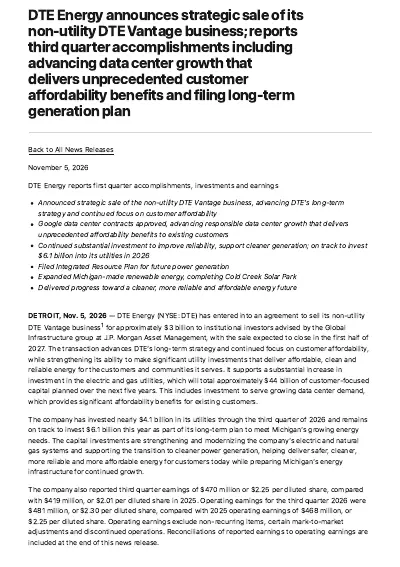
We're encouraged by the continued level of customer interest and remain focused on securing an additional agreement by year-end. As we look to support the significant utility investment and deliver these meaningful affordability benefits for our customers, today we're announcing the strategic sale of the DTE Vantage business.
The transaction further sharpens our focus on regulated utility operations, supports our ability to execute on these significant utility investment opportunities, and strengthens our position as a high-growth premium utility. Importantly, the proceeds from the transaction will be invested in our utility businesses, reducing our future equity and debt needs, providing additional financial flexibility to fund our significant utility investment plan.
I'll cover the transaction in greater detail in a few moments, including describing how it creates significant value for both customers and shareholders. We remain highly confident in our financial outlook.
For this year, our 2026 operating EPS guidance represents growth of 6% to 8% over the 2025 guidance midpoint, and we remain well positioned to achieve the high end of that range, supported by RNG tax credits. Looking forward, we are also providing an improved long-term growth outlook through 2031.
Our updated plan calls for an annual operating EPS CAGR of greater than 9% as we increase our utility investment by approximately 30% to deliver significant affordability benefits from data centers and continue to drive reliability improvements and advance cleaner generation for our customers. This growth is measured from the midpoint of our 2027 pro forma operating EPS baseline of $7.59 to $7.73, which is calculated as if the Vantage transaction closes at year-end 2026.
We are using this pro forma method to normalize the impacts we will experience due to discontinued operations accounting treatment and the actual timing of the close of the sale of Vantage, which is expected to take place in the first half of 2027. Regardless of the potential timing and one-time items, the $7.66 midpoint of the pro forma operating EPS range in 2027 will remain the baseline for our long-term operating EPS growth, reflecting the Vantage asset sale and the associated loss of temporary RNG tax credit benefits.
We expect the operating EPS CAGR to be well above 9% in 2028 and 2029 as the utility investments supporting data center developments begin to ramp, followed by an EPS CAGR of at least 9% in 2030 and 2031. Over the long term, our operating EPS is positioned to exceed the high end of our prior plan's EPS, with growth now driven by a stronger utility investment profile that delivers affordability benefits for our existing customers.
The Vantage transaction and the associated rotation of capital toward our expanded utility investment plan, combined with the continued momentum in large load development, support this stronger long-term growth trajectory while maintaining a solid balance sheet. Overall, DTE is exceptionally well positioned with a focused regulated model, significant utility investment opportunities, and the ability to deliver long-term value for customers and shareholders.
Let's move to slide 5 to review our significant utility investment plan. At the core of our plan is significant customer-focused investment that will strengthen our infrastructure, improve reliability, and support long-term affordability.
Our five-year utility investment plan now totals approximately $44 billion, representing an increase of nearly $10 billion compared to our prior plan. These investments are designed to deliver the outcomes our customers expect, which includes improving reliability, modernizing our infrastructure, supporting economic growth, and continuing the transition to cleaner energy.
At DTE Electric, we plan to invest approximately $39 billion over the next five years. This includes approximately $23 billion of cleaner generation investments, supporting cleaner and more affordable energy for our customers while meeting demand growth, including the significant new data center load.
The plan includes 7.6 GW of new solar and wind resources, 2.1 GW of new combined-cycle natural gas generation, and 2.7 GW of energy storage. Together, these investments provide the generation portfolio needed to support customer growth, replace retiring coal generation, maintain system reliability, and meet the requirements of the Michigan clean energy law.
We are investing approximately $12 billion in our electric distribution system. These investments continue to build the grid of the future by strengthening and hardening the system, expanding automation, and improving resiliency against increasingly severe weather.
They remain critical to continue our progress toward achieving our goal of reducing customer outages by 30% and cutting outage duration in half by 2029. We are also investing approximately $4 billion in electric base infrastructure to support the continued safe and reliable operation of our existing assets.
On the gas side, we continue to make significant investments in infrastructure modernization. Our plan supports ongoing main renewal work, transmission and distribution upgrades, and compression and storage improvements, all with a focus on ensuring safety, reliability, and affordability.
We have renewed more than 2,100 miles of gas main infrastructure since the inception of the main renewal program, delivering tangible benefits for customers and communities across our service territory. As I stated earlier, the sale of DTE Vantage supports our ability to execute on these significant utility investment opportunities.
Let's move to slides 6 and 7 to provide an overview of the transaction and the benefits it provides. As I noted, this transaction represents a valuable outcome for DTE.
DTE Vantage has been a strong business and a valued part of DTE Energy for more than 30 years. The exceptional Vantage team has consistently delivered for all of their customers while delivering solid earnings and cash flow and building a strong foundation for continued growth.
This transaction provides an opportunity for DTE Vantage to further build on that success and enter its next phase of growth while allowing DTE to direct capital and resources toward the significant growth opportunities at our utilities and continue to deliver meaningful benefits to our customers. The approximately $3 billion transaction with institutional investors advised by the Global Infrastructure Group at J.P.
Morgan Asset Management includes the sale of essentially all DTE Vantage assets except EES Coke. Proceeds will reduce future equity needs and support the reduction of parent company debt.
We are targeting to close the transaction in the first half of next year. At its core, this transaction further sharpens our strategic focus, positioning DTE as a premier, regulated electric and gas utility focused on delivering affordable, cleaner, and reliable energy for customers and communities we serve.
The transaction enhances our positioning to execute the substantial increase in customer-focused investments at our electric and gas utilities, which requires approximately $44 billion over the next five years. As I mentioned, the transaction also significantly strengthens our long-term growth profile, as we now expect long-term operating EPS growth of greater than 9% after 2027, with the EPS CAGR well above 9% in 2028 and 2029 as investments to support data center developments begin to ramp.
It also enhances our capital financing strategy by reducing the amount of equity needed to fund our increased investment plan. Our business will be centered exclusively on our regulated utility operations, which translates into a lower risk profile and greater earnings visibility supporting a premium valuation.
When you step back and look at the full picture, this transaction further transforms DTE into a simpler, more focused, faster-growing utility. It enhances our ability to make customer-focused investments needed to support growing data center demand and deliver meaningful affordability benefits for our existing customers.
It also strengthens our long-term growth outlook and further improves the quality of our earnings stream. Together, these benefits position DTE to deliver substantial value to customers and shareholders.
Let's move to slide 8 and take a closer look at the progress we're making with data centers. Data centers provide meaningful affordability benefits for our customers while also creating substantial long-term growth opportunities for DTE.
Michigan has some of the strongest protections in the country to ensure these large customers pay their own way, and that's the principle behind every agreement DTE considers. We have secured agreements representing 2.4 GW of load, with strong customer protections and affordability benefits embedded in each contract.
This includes provisions and contract structures that are designed to ensure data centers pay the cost needed to serve them without shifting those costs to existing customers. This is supported by in-depth regulatory review that ensures affordability, reliability, and fairness across the customer base.
The 1.4 GW Oracle project is fully approved and construction is advancing as scheduled. We recently achieved another important milestone with MPSC approval of the 1 GW Google agreement, with this agreement underpinning a significant portion of the increase in utility capital investment from the prior plan.
These projects demonstrate that Michigan is an attractive market for large-scale economic development and that DTE has the infrastructure, regulatory framework, and customer protections needed to successfully serve this demand. Importantly, these agreements are expected to generate meaningful affordability benefits for our existing customers.
As I mentioned earlier, those benefits support a rate case stay-out through at least 2028 with the Oracle load, and the Google load offers an opportunity to extend the stay-out even further. Looking ahead, our data center development pipeline remains robust.
We continue to see approximately 5 to 6 GW of additional opportunities, including 2 GW currently in advanced discussions. Our goal remains to reach at least one additional agreement by the end of 2026 while continuing to advance longer-term opportunities as we head into 2027.
We are also making progress on the large load tariff filed earlier this year, which establishes a clear framework for serving future large load customers. Like the terms in the Oracle and Google agreements, the tariff is designed to ensure that new large load customers support the incremental infrastructure and generation costs needed to serve them and that existing customers are protected from subsidizing any costs related to data centers.
The large load tariff also provides a transparent framework for future projects, with appropriate safeguards around large load ramp timing, cost recovery, and reliability planning. It should also provide a more efficient pathway for future data center agreements.
Overall, we continue to see substantial runway for future growth, supported by a strong, expanding pipeline. As projects in the pipeline move forward, we see opportunities for both incremental growth and related affordability benefits for our customers.
Let me wrap up on slide 9 and highlight our continued focus on customer affordability. One of the things we're most excited about is the affordability opportunities for all customers that is created by data center growth.
As new large load customers come onto the system, we can sell excess capacity that already exists on our network, spread fixed costs across a larger customer base, and create meaningful affordability benefits for existing customers. The contracts and tariff structures are designed to protect existing customers from bearing costs tied to new large load demand and to ensure that the benefits of growth are shared across the system in a way that supports long-term affordability.
Additionally, we remain intensely focused on disciplined cost management to further support customer affordability. Our distinctive continuous improvement culture continues to drive productivity and cost management across the company, helping us deliver more for customers while maintaining financial discipline.
We also continue to see benefits from the ongoing transition of our generation fleet. As we move from coal generation toward renewables and natural gas resources, we expect lower fuel costs, reduced operating and maintenance expenses, and a cleaner generation portfolio.
Importantly, our diverse energy mix provides flexibility, allowing us to adapt as technologies continue to evolve while maintaining reliability and affordability for our customers. Finally, provisions in the Inflation Reduction Act continue to support our clean energy transition.
These incentives help lower the cost of new investments, support customer affordability objectives, and allow us to advance our cleaner energy goals in a cost-effective manner. Taken together, these affordability efforts are delivering meaningful benefits for our customers.
You can see that reflected in our affordability metrics, with customer bill increases remaining significantly below the national average. The typical Michigan residential electric bill represents less than 2% of the median household income, and our residential bill growth since 2021 is 17% below the national average.
We also continue to support our most vulnerable customers through expanded energy assistance, including millions of dollars in direct assistance and continued support of nonprofit organizations across Michigan. When you put it all together, this plan demonstrates that affordability and investment can go hand in hand.
We are making the necessary investments to improve reliability, modernize our infrastructure, support cleaner energy, and enable economic growth while continuing to keep customer bills affordable and deliver long-term value for shareholders. To wrap up my remarks, we are excited about the opportunities in front of us.
The strategic sale of DTE Vantage, combined with our growing utility investment opportunity, positions DTE for stronger, more durable long-term growth. Most importantly, we believe we can deliver that growth while maintaining a strong focus on affordability, reliability, cleaner generation, and creating value for our customers and shareholders.
With that, I'll hand it over to Dave. Dave, over to you.
Dave Ruud
Thanks, Joi, and good morning, everyone. Let me start on slide 10 to review our third quarter financial results.
Operating earnings for the quarter were $481 million. This translates into $2.30 per share.
You can find a detailed breakdown of EPS by segment, including a reconciliation to GAAP reported earnings, in the appendix. I'll start the review at the top of the page with our utilities.
DTE Electric earnings were $468 million for the quarter. Earnings were $73 million lower than in the third quarter of 2025.
The main drivers of the variance were timing of taxes and higher rate base and storm costs, partially offset by rate implementation and warmer weather. On the timing of taxes, we experienced a $104 million quarterly variance relative to last year, primarily driven by large positive timing variance in the third quarter of 2025 as a result of when a renewables project was placed in service.
The large negative timing variance experienced this quarter relative to last year will reverse in Q4. Starting in 2026, the impact of investment tax credits on renewable projects at DTE Electric is being recognized more evenly throughout the year, which will reduce quarterly volatility and make the underlying earnings trend more visible going forward.
Moving on to DTE Gas, operating earnings were $8 million higher than the third quarter of 2025. The earnings variance was driven by IRM revenue, partially offset by higher rate base costs.
Let's move to DTE Vantage on the third row. Operating earnings were $110 million for the third quarter of 2026.
This is a $69 million increase from 2025, driven by higher earnings from RNG tax credits and investment tax credits. The RNG tax credit increase reflects updated federal guidance and the resulting models that provided greater clarity on how carbon intensity scores are calculated.
The ITCs are driven by new onsite energy projects being placed in service. With year-to-date earnings for this segment already above the full-year guidance range and with strong performance expected in the fourth quarter, earnings for 2026 are expected to be above the guidance range for DTE Vantage.
This allows us to continue to unwind one-time, lean operational measures and absorb higher storm costs in 2026 at our utilities while remaining on track to deliver against DTE's 2026 EPS guidance. On the next row, you can see energy trading earnings were $34 million in the third quarter of 2026.
This is $11 million higher than the third quarter of 2025, primarily driven by timing in the gas and power portfolios. These solid third quarter results give us continued confidence in achieving the high end of our energy trading guidance range this year.
Finally, corporate and other was unfavorable $2 million relative to the third quarter of 2025, primarily due to higher interest expense, partially offset by timing of taxes. Overall, DTE earned $2.30 per share in the third quarter of 2026, which positions us well to achieve the high end of our guidance range in 2026.
Let me move to slide 11 to discuss our balance sheet and equity issuance plan. Our strong balance sheet provides a foundation to support our robust customer-focused investment agenda, and it is underpinned by the consistent healthy cash flows of our utility businesses.
The Vantage transaction that we are announcing today further strengthens our financing position and provides additional flexibility to fund our investment plan, which includes allowing us to delay the settlement of the equity that we had previously sold under forward contracts from 2026 into 2027. Looking ahead, we are targeting approximately $1 billion of average annual equity issuances from 2027 through 2031.
The additional equity, relative to our previous plan, supports the significant utility investment growth, which has increased by nearly $10 billion over the next five years, primarily to support data center load growth and the generation investments needed to serve that demand. Our financing plan may also include additional junior subordinated debt, which provides another tool to support our balance sheet and credit metrics.
We are proactively managing our debt maturities as well, and we continue to maintain solid investment-grade credit ratings and target approximately 15% FFO to debt. The Vantage sale reduces our parent company borrowing needs, which significantly reduces our exposure to refinancing risk and interest rate fluctuations.
Importantly, the strength of our cash flows and our financial position supports our commitment to shareholders, with a 7% increase to our dividend in 2027. Let me wrap up on slide 12, and then we'll open the line for questions.
DTE is very well positioned for the future, with significant opportunities to invest in our utility businesses for the benefit of our customers. The Vantage transaction further sharpens our focus on our regulated utilities and provides additional flexibility to fund our $44 billion five-year capital plan.
Our plan supports data center development, cleaner generation, and improved reliability while delivering significant affordability benefits for our customers. As Joi mentioned, our 2027 pro forma operating EPS baseline of $7.59 to $7.73 reflects the Vantage asset sale and the associated loss of temporary RNG tax credit benefits, and is calculated as if the Vantage transaction closes at year-end 2026.
Vantage earnings in 2027 will be treated as discontinued operations, which will create a timing impact on earnings as we exclude Vantage earnings before we realize the benefit of the sale proceeds. While our 2027 outlook will change based on the timing impacts of the Vantage sale, we remain confident in using this baseline as a foundation for our projected growth in 2028 and beyond.
Importantly, as utility investments supporting data center developments begin to ramp, we expect operating EPS growth to be well above 9% in the 2028 and 2029 timeframe and to be at least 9% from 2029 through 2031. Over the long term, the updated plan provides a higher EPS growth outlook, supported by a strong utility investment profile that drives significant affordability benefits for existing customers.
We also continue to remain confident that additional data center opportunities in our pipeline provide further upside to the long-term plan. With a strong balance sheet and disciplined financing plan, we are well positioned to execute on these opportunities and deliver premium total shareholder returns.
With that, I thank you for joining us today, and we can open the line for questions.
Operator
We will now begin the question-and-answer session. If you would like to ask a question, please press *1 to raise your hand.
To withdraw your question, press *1 again. We ask that you pick up your handset when asking a question to allow for optimum sound quality.
If you are muted locally, please remember to unmute your device. Please stand by while we compile the Q&A roster.
Your first question comes from the line of Shahriar Pourreza with Wells Fargo. Your line is open.
Please go ahead.
Shahriar Pourreza
Hey, guys. Good morning.
Joi Harris
Good morning.
Dave Ruud
Hey, Shar.
Shahriar Pourreza
Morning. Congrats on Vantage.
I know that's something you guys have debated for some time, good to see that you've made a decision. Just, Joi, on the rebased earnings path that takes you somewhere sort of in the 2030 timeframe to catch up with the old trajectory, I guess as we are thinking about the levers that could accelerate that path, would a third data center customer by year-end accelerate the earnings recovery or mainly kind of extend the growth runway beyond it?
Thanks.
Joi Harris
Let me first clarify. We actually, when you look at page 4 in our package, you'll see that the capital is ramping up pretty quickly after 2026.
If you look at the charts, you can see that we revised our EPS target. Essentially, it passes that 7% growth by 2029, which should give you an idea of our targeted growth rate in 2028 and 2029.
You asked about would another data center help accelerate that progress? Any data center that we sign after the two that we have is incremental; it would add to the plan.
We continue to have a strong pipeline. We're making great progress.
We are still on plan to sign an additional deal before the year is out. We've got the 2 GW that we're working, and I can give you more color on that, but suffice it to say, in answer to your question, it does accelerate.
Shahriar Pourreza
Got it. I guess the impetus of the question was the ramp schedule of this other customer that you're negotiating with.
You envision that ramp schedule to be in a way where it could accelerate sort of the trajectory in the near term? I guess that's the question, yeah.
Dave Ruud
I think the way the capital comes in, Shar, it would come in and would both help in the near term, like help with that 2030, and help extend it as well.
Shahriar Pourreza
Okay. Perfect.
Then just, I know you mentioned sort of the funding plans are kind of being obviously finalized, but I guess there's a few moving parts here. I guess how do we think about the equity needs when we think about the Vantage sale plus the cash flow profile of these large load customers?
I guess, I know you mentioned the funding plans are being finalized, but how do we think about sort of the moving pieces with the cash flows that these customers are going to bring with them, as well as sort of the Vantage sale?
Dave Ruud
In our equity plan that we laid out, which was now $1 billion per year through the plan, that assumes the cash flows coming in from the large load projects that we have now. Because of the Vantage sale, we were able to reduce the equity that we would have otherwise needed to bring in the plan by about $1 billion.
That includes that $500 million that we were going to settle this year from our ATM. We'll move that out to 2027.
Shahriar Pourreza
Got it. The 2 gigs that you're in conversations with that are in advanced stages could potentially provide additional downside to the equity needs?
Dave Ruud
For some of the capital that would come in, we would probably need some equity to provide for that in the short term. Then over time, as we see the cash flows from these start to come in, we do see the equity needs go down.
Shahriar Pourreza
Okay. Perfect.
I appreciate it, guys. Congrats.
See you in a couple of days. Thanks,
Dave Ruud
Shar.
Operator
Your next question comes from the line of Ross Fowler with Bank of America. Your line is open.
Please go ahead.
Ross Fowler
Morning, guys. Again, congrats on the Vantage sale.
I know you guys have been talking about that for a long time. As I kind of look at where you are today versus the prior sort of 8%.
I'm looking at that slide 4 and maybe following on to some of Shar's questions here. Looks like you would have been sort of in an $8.20 range in 2027, and now you're kind of saying you're on a flat range of the $7.59 to $7.73.
That's sort of, as I think about it, you're taking that $0.50 of kind of upfront dilution, and now we have a higher growth rate off of that to the back end. How do I think about why you're doing this now?
Because you seem to not be able to deploy the $3 billion of proceeds fast enough to get back to your earnings trajectory, as you said, to sort of 2029, 2030. Then how do I think about valuation accretion in this, right?
The earnings trajectory still kind of gets back to where you were at the high end by '30, '31, if I'm looking at that chart. Joi, is some of the argument here that you believe that the capital deployment and the growth at the regulated utility should be capitalized at a higher multiple than what the Vantage growth was inside the business?
Joi Harris
You spot-on. This is a win-win across the board if you look at what it means for DTE, for our customers, and for the new owners.
Why now, you asked? The data center growth is just providing substantial investment opportunity for our utilities, once-in-a-generation opportunities, quite honestly.
It's delivering real affordability benefits for our customers. Selling Vantage just allows us to sharpen our focus on the regulated utility, and it helps us execute on those investments.
Then it reduces clearly our equity and debt needs to fund them. If you want to put it very simply, DTE becomes a higher-growth, premium utility with long-term operating EPS growth of more than 9% a year after 2027 and just better earnings visibility and just a simpler business construct.
We have become a very focused utility, and then we have opportunities for upside that come by additional data center developments. That's the why now.
Ross Fowler
Joi, maybe on that point, really, it's about the $3 billion of proceeds enabling you to capture those upside opportunities, right? I don't want to put words in your mouth, but that's what I'm hearing.
You're at or above the trajectory in '29, at least at the midpoint, kind of achieve the high end by '31. What I should be thinking about really is I have $3 billion of proceeds now to sort of execute further growth opportunities that could push that even higher, sort of following on to Shar's question.
Joi Harris
Yes. I think, yes, you've described it well.
Also, when you look at Vantage, where Vantage the team was at with their portfolio, this was a good time for Vantage as well. We had a strong portfolio for Vantage, which would attract the right price for a divestiture.
The combination of the two made this the right strategic decision for DTE at this point. Then,
Ross Fowler
Dave, maybe one for you, right? You're going to get $3 billion of proceeds coming in the door, if I understand there's no delay in that in '27.
You're going to have that sitting there. You're not going to necessarily deploy that all at once into the regulated utility.
How do I think about do you pay off some debt with that now and then reissue debt later? Obviously, I don't think the cash is just going to sit there.
How do I think about the timing of using those proceeds and redeploying the capital at utility?
Dave Ruud
You're exactly right. This transaction does support these investments that Joi is talking about, and they really drive in customer affordability and lead to our stronger growth.
We'll do it by continuing to have a really strong balance sheet. The proceeds from this will be used to reduce future equity requirements and parent company debt needs relative to our status quo plan.
When you look at the two, equity will be reduced by about $1 billion relative to our status quo plan. Right now, that means deferring $500 million of equity that we sold under forward contracts this year that's now going to be settled in 2027.
In '26, we'll have very minimal equity issuances. Then we're going to also reduce parent company debt by about $2 billion.
There was debt maturing in 2027 that we're going to retire. That's going to lower our interest expense and really reduce our exposure to any refinancing risk in the next year.
We'll effectively have no refinancing interest rate exposure for '27. Ross, you're right.
We're going to put this to use quickly and start to see the benefits of those proceeds quickly.
Ross Fowler
Okay. Makes sense to me, Dave.
Thank you.
Dave Ruud
Yep.
Operator
Your next question comes from the line of Michael Lonegan with Barclays. Your line is open.
Please go ahead.
Michael Lonegan
Hi, good morning. Thanks for taking my questions.
Pro forma the Vantage sale, you said obviously you're expecting to grow well above 9% in '28 and '29. Just wondering if you could help us understand more about the magnitude of growth in each of those years, like maybe north of 10% potentially?
Would the growth be linear? Is the data center ramp expected to be fairly consistent?
Joi Harris
It's not linear. I'll answer it that way.
We don't typically give guidance for future years, but suffice it to say, if you think about how these data centers are ramping, particularly Oracle and Google, Oracle is scheduled to come online next year, which means we've got to bring those assets on shortly thereafter, and we're already beginning to construct them now. Then Google will follow, and so that will be another large chunk of capital that will come into the plan to support the Google build-out.
Then if you go further into the plan, we get to the point where we're bringing on CCGTs to, again, address the retirement of Monroe and also to address the increased load that comes from the Google contract. At the end of the day, what you get to is a 9%-plus CAGR over that 2027 to 2020 2031 timeframe.
Michael Lonegan
Great. Thank you.
Then, in contemplating the transaction, was the expectation that the Vantage segment, I think you said in the past, would grow earnings $15 to $20 million per year until the RNG tax credit expires and then deliver $150 to $160 earnings in 2030? Was that still the expectation there?
Yes. Yes.
Joi Harris
Yes.
Michael Lonegan
Great. Thank you for taking my questions.
Joi Harris
Okay. Thank you.
Operator
Your next question comes from the line of Jeremy Tonet with J.P. Morgan.
Your line is open. Please go ahead.
Diana Niles
Hi, good morning. This is Diana Niles on the line for Jeremy today.
Thank you for taking our questions.
Dave Ruud
Hello.
Joi Harris
Hi, Diana.
Diana Niles
Thank you. I hear you saying that this new plan can exceed 7% from the 2026 midpoint.
If I'm not mistaken, you've previously spoken to Google potentially pointing you to the 8% side of your prior 6% to 8% range. If you're able to, could you speak to the exceeding 7% expectations to where this new plan could compare to those prior 8% expectations?
Joi Harris
What we said was the Google contract will get us to 8% CAGR. This plan now is above that, this takes us to 9%-plus.
Dave Ruud
That 8% CAGR was from the 2027 midpoint, too. When you look out to 2030, 2031, particularly in 2031, this is particularly better than what we had thought we were going to be putting out today.
Joi Harris
You cross over in 2029 above our prior plan.
Diana Niles
Okay. Thank you.
I understand there's been
Operator
Your next question comes from the line of Steve Fleishman with Wolfe Research. Your line is open.
Please go ahead.
Steve Fleishman
Okay. Thanks.
Good morning.
Joi Harris
Good morning, Steve.
Steve Fleishman
Good morning, Joi, Dave. I'm going to ask, I guess, a couple of unrelated questions to Vantage.
Just I think a few weeks ago you ended up not filing a gas rate case that you had initially said you might file. Could you maybe just give some more color on kind of what drove that decision?
Joi Harris
Sure, absolutely. If you recall, we got the order, and then we put the notice on the very same day just to preserve the option.
That we typically file our gas cases every couple of years. We are reverting back to that every couple of years cycle.
We unpacked the order. Much of the capital in the gas business is covered by the IRM.
We saw some incremental adds to the IRM, and then there's some large projects that we are strengthening the planning for, we're continuing to work on the design and then work on our gas delivery plan that we will include in the forthcoming rate case for gas that will likely occur toward the end of next year.
Steve Fleishman
Okay. Then maybe just any election takeaways from Michigan, and more specifically, how much momentum are we seeing toward multiyear rate plan legislation either late this year or next year?
Joi Harris
First let me just congratulate Governor-elect Benson and all the elected officials. We have a strong and have maintained a strong relationship with both sides of the aisle over our history, and we are expecting nothing different with this cycle.
We are continuing to have discussions with the commission on multiyear ratemaking in anticipation that there will be some legislation taken up likely toward the end of '27, if I could be frank, because the legislature has to get seated into committees, and that likely won't occur until maybe the second quarter, early second quarter. They've got to get organized before they take on something as complex as energy legislation.
There will likely be other priorities that they want to address. We're continuing to work on making sure that there is a constructive outcome, that we're influencing the thinking of the commission, and certainly preparing to educate the legislators that are new to this policy framework along the way.
Steve Fleishman
Okay. Great.
Thank you.
Dave Ruud
Thanks, Steve.
Operator
Your next question comes from the line of Ivana Ergovic with Jefferies. Your line is open.
Please go ahead.
Ivana Ergovic
Hi, good morning. Thank you.
Joi Harris
Good morning.
Ivana Ergovic
I'll go back to the CAGR question once more. If I'm thinking about it correctly, you were previously guiding off midpoint of '26, and kind of being at the high end, and rebasing every year from the midpoint, which is kind of like 7.2% CAGR.
Using that, I would be at $10.84 in '31. If I'm thinking about it from what you put on that slide today, you should be in that ballpark of $10.84 by '31 with this new plan, right?
Joi Harris
We were at 8%, not 7%, with the Google contract. That's what I've communicated previously.
Now we're going to be north of that. We'll be north of that at 9%-plus essentially, better than 9%.
Ivana Ergovic
Yes, 9 9%-plus from '27, right? Basically compounding at 9%-plus from the midpoint of new '27, right?
Is that the right way? Okay.
That's right. Yeah.
That's the way to see it. Okay.
No,
Joi Harris
thank you.
Ivana Ergovic
I actually wanted to ask another question. I know it's also related kind of to the rate case which is pending, and the new government in the state.
Is there any potential for settlement, or just waiting for the proposed decision in December? I know you put out the fact that there is a stay-out beyond '28 with Google, could you give any kind of guidance, like when we'll have more clarity on that?
Joi Harris
Sure. Not likely to get a settlement in this current rate case.
Just too many intervenors. We've got over 30 intervenors.
We expect to get an order in February. The staff was generally supportive of our large load transition mechanism, which allows for us to stay out to essentially 2028 with just the Oracle contract.
It did not comprehend the Google contract. The Google contract could offer additional opportunities to extend that stay-out to, say, another year, if not more.
We are waiting for the order to understand the commission's position on the stay-out, but suffice it to say, the early indications are quite positive in that regard.
Ivana Ergovic
Okay. Thank you.
Thanks. Thank you.
Operator
Your next question comes from the line of Paul Fremont with Ladenburg. Your line is open.
Please go ahead.
Paul Fremont
Thank you very much, and congratulations.
Joi Harris
Hey, Paul.
Dave Ruud
Paul, thanks.
Paul Fremont
Just maybe some details on the Vantage transaction. What are you expecting as the after-tax proceeds on the sale?
Dave Ruud
The tax drag on this is a couple hundred million, and with the fees as well, just a little over a couple hundred million on that. Expect to get somewhere between the $2.7, $2.8 billion on that.
Paul Fremont
Great. Then the next question.
What would be sort of the EBITDA of the piece that you sold? Cuz, obviously, some of this would be the EES Coke EBITDA.
Dave Ruud
Right. The multiple on the sale is a little complicated because of the tax credits, like the RNG and investment tax credits that are in there.
When we adjust for those, we do see good valuation with both the EV to EBITDA multiple and the PE multiple, and they're above the utility. The EV to EBITDA, if you look at '26 or '27, it's like 12 to 13 times, and the PE is about 19 to 23 times after adjusting for tax credits.
Paul Fremont
Right. Are you able to sort of just break out the EBITDAs?
Dave Ruud
Oh, we haven't broken that out or given that, no.
Paul Fremont
Okay. You're obviously getting close to $3 billion in terms of cash proceeds, but you're saying that the equity need only goes down by $1 billion.
Is that because of the pickup in the capital spend at the utility?
Dave Ruud
Partially. We're using a lot of those proceeds to also pay down debt that was maturing in 2027 as well.
So $1 billion goes towards equity versus our prior plan or versus our status quo plan, and then $2 billion goes to pay down debt. Then again, we'll be going back into investing a lot more capital, we'll be issuing equity and debt to support that going forward.
Sort of
Paul Fremont
the paydown of the debt, what type of a improvement do you get in FFO to debt out of that?
Dave Ruud
As we go through this, we're still targeting 15% FFO to debt as our internal measure, and we'll consistently hit that throughout the plan.
Paul Fremont
Got it. Then sort of last question, sort of a clarification on growth.
You had talked about well above 9% growth through '29, and then 9% from '29 through '31. That 9% for '29 through '31 is off of sort of the higher level that you're at in '29, or is that 9% off of the '27 midpoint?
Dave Ruud
Now, that's off of the '29. We grow higher through '29, and then from that point, 9% on through 2031.
Paul Fremont
Got it. Which is why you end up with 9% plus off of the '27 midpoint, right?
Dave Ruud
Yes.
Paul Fremont
Okay. Sorry for that confusing question.
Thank you very much,
Dave Ruud
and congratulations. Oh, thank you, Paul.
Oh, thank you for the clarification. That was helpful.
Paul Fremont
Great.
Operator
Your next question comes from the line of Sophie Karp with KeyBanc. Your line is open.
Please go ahead.
Sophie Karp
Hi. Good morning.
Thank you for taking my question, and congratulations on the transaction.
Joi Harris
Thanks, Sophie. Good morning.
Sophie Karp
Yeah. If I can go back to Shar's question, ask it maybe a little differently.
I guess what I'm wondering is, are data center customers under the current agreements you have with Google and Oracle, or under the proposed tariff, right, would they come with a different cash flow profile compared to other industrial load that you have now, maybe with more frontloaded cash flows or other cash recovery that's upfront that can help fund capital needs, or is the cash flow profile exactly the same basically, just kind of ramped with load?
Joi Harris
It's different. It's better, quite honestly.
We did some of that with Google. Google paid for some of the long-lead items that we had to secure to support them, and we're examining those frameworks going forward.
That would not be the case if this was just a normal industrial load customer.
Sophie Karp
Okay. Having more of those contracts on the system would help reduce your equity needs kind of moving forward, correct?
Joi Harris
Depending on the timeline,
Dave Ruud
because we'll invest the capital earlier with data center customers than we would for normal industrial customers, I would say. We'll need to fund that capital.
As Joi said, we work to find ways to offset that through the contracts we put together, but I would say they're pretty bespoke in how they come together.
Sophie Karp
Okay. Thank you.
Another question is on the MYRPs, right, like multiyear rate plans. It looks like you're able to now go back to gas cases every two years and stay out on electric because of data center ramp.
Do you even need the MYRP? Because it seems like you're doing well and can reduce the frequency, as it stands right now, of rate cases, and in the MYRP, usually you give something up, right?
Companies give something up, like maybe it's ROE, maybe it's something else. Do you even need that framework formalize, or can you just reduce this cadence of rate cases organically and maintain kind of the status quo otherwise?
Joi Harris
That's what we're doing, Sophie, is reducing it organically. From that perspective, no, we don't need it.
What is giving rise to the majority of the anxiety is the frequency of filing. To address frequency of filing going forward as a state, not just as DTE or some other entity, but as a framework for the state, the legislature would have to make changes to the law to accommodate multiyear ratemaking.
Sophie Karp
Yep. All right.
Thank you so much. That's all for me.
Operator
Your next question comes from the line of Travis Miller with Morningstar. Your line is open.
Please go ahead.
Travis Miller
Good morning. Thank you.
Joi Harris
Morning. Morning, Travis.
Travis Miller
I just had a couple quick ones, and then one more conceptual one. One quick one: any regulatory approvals needed for Vantage that would potentially delay?
Oh,
Dave Ruud
there's just a couple that we'll need to get through in the first quarter of next year, but there's nothing that's expected to delay it.
Travis Miller
Okay. MPSC doesn't need to rule on it, right?
Joi Harris
No. No.
No. No.
No.
Travis Miller
Okay. Another quick one here.
The potential for the stay-out extension, would that be part of the negotiations going up to the February decision or in the order, or is that something you decide on later next year, or even in 2028?
Joi Harris
No, the stay-out, we filed it as part of the case. If it's approved, then that would be the mechanism that we would use to stay out.
Essentially, what that means is that we would take the excess margin from the Oracle load, provided they come on at the end of 2027 as planned, and let me just say construction is progressing as planned, we have every expectation that they will come on in '27. We would take that excess margin, hang it on the balance sheet, and then seek an accounting order afterwards.
We get an approval of the case to leverage the mechanism in February, one way or another.
Travis Miller
Sure. I was actually thinking more about that Google contract, now that you have it approved.
Sorry.
Joi Harris
Oh, the Google contract. The Google contract, there is no mechanism necessarily.
If the LLTM is approved, then the Google contract would just allow for us to not file. There's nothing else that the commission would have to approve in order for us to stay out.
Travis Miller
Okay. Perfect.
No, that's, yeah, that's what I was asking, too. Okay.
Joi Harris
Yeah. Okay.
Sorry about that. Okay.
Travis Miller
Then one larger conceptual question. When you look at the IRP, how much of that plan is essentially, and not details, but how much of that plan will be paid for by Google and Oracle or the extra customer that you've talked about or customers that you talked about?
Again, just high level.
Joi Harris
Just high level? The Google contract is roughly $5 billion of the renewables, and then the Oracle contract is like $2 roughly $2 billion, a little over $2 billion for the Oracle.
Roughly $7 billion.
Travis Miller
Perfect. That's renewables and the battery storage that you have with Oracle, right?
Joi Harris
Yes. Battery storage for Oracle.
Just battery storage. Renewables is for Google.
Travis Miller
Renewables. Yep.
Okay. Great.
That's all I got. Thank you.
Operator
There are no further questions at this time. I would like to turn the call back over to Joi Harris for closing remarks.
Joi Harris
Okay. Thank you, everyone, for joining us today.
I'll just close by saying we continue to execute in 2026, and we are well positioned to achieve our goals for the year. I'm really excited about our long-term plan and the opportunities ahead, and I look forward to seeing many of you at EEI in just a few days.
Have a great morning. Stay safe, and stay healthy.
Take care.
Operator
This concludes today's call. Thank you for attending.
You may now disconnect.