Duolingo, Inc.
Q3 FY2026 · Earnings Call TranscriptNovember 3, 2026
Debbie Belevan
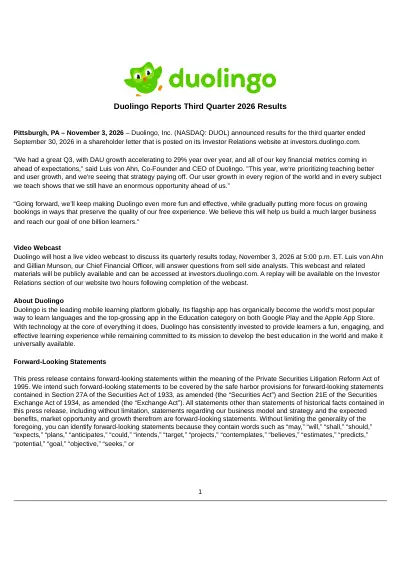
Good evening, everyone, and welcome to Duolingo's Q3 earnings webcast. Today, after market close, we released this quarter's shareholder letter, a copy of which you can find on our website at investors.duolingo.com.
On today's call, we have Luis von Ahn, our co-founder and CEO, and Gillian Munson, our CFO. They will begin with prepared remarks before we open the call for questions.
Analysts may ask a question by using the raise hand feature. Please note that this call is being recorded, and all participants are currently in a listen-only mode.
Before we begin, please note that we will make forward-looking statements regarding future events and financial performance. These statements are subject to risks and uncertainties described in our SEC filings and are based on our assumptions we believe to be reasonable as of today.
We undertake no obligation to update them. We will also discuss both GAAP and non-GAAP financial measures.
Reconciliations between the two can be found in our earnings materials, and we encourage you to review them when evaluating our performance. Now, I will hand it over to Luis.
Luis von Ahn
Thanks, Debbie, and thank you all for joining. We had a great Q3.
Daily active users has accelerated for a second quarter in a row to 29% year-over-year growth, up from 23% in Q2. Bookings, revenue, and profitability were also ahead of expectations.
At the beginning of the year, we laid out a plan to prioritize teaching better and user growth, knowing it would take time to see results. We're now seeing the user acceleration we hoped for, and I'm proud of how our team has executed against our strategy.
We expect this momentum to continue with year-over-year DAU growth in Q4 similar to Q3, and Q4 bookings slightly ahead of our previous guidance. Every new learner expands the audience we can monetize over time.
While teaching better and user growth remain our top priorities for this year, we're gradually leaning more into monetization in ways that preserve the quality of our free experience. Our ambition is to ultimately reach 1 billion learners and build a much larger business over time.
The more people we can teach, the bigger that opportunity becomes. With that, I'll turn it over to Gillian.
Gillian Munson
Thank you, Luis, and glad you're all here this evening. We started the year with an ambitious plan to reaccelerate our growth, and our Q3 results show we're executing well.
The numbers from the quarter are pretty straightforward, I'll double-click on just two items. First, a look at how broad our DAU and bookings growth was.
Year-over-year DAU growth accelerated across eight of our 10 largest countries. Additionally, year-over-year subscription bookings growth was in the double digits in the majority of the regions we serve.
Secondly, Q3 operating expenses include an $11 million bonus accrual. This bonus rewards our team for reaccelerating user growth.
We're on track to hit the targets, we've begun to record the expense. A second portion of the bonus is included in our Q4 guidance, and we expect to pay the full bonus in early 2027.
Turning to Q4, we expect year-over-year bookings growth of 13%, revenue growth of 14%, and an adjusted EBITDA margin of 26.1%. To help you build your models, I want to give you just a couple items to consider.
We expect gross margin to fall slightly from Q3 as we roll out Video Call to all paid subscribers. Operating expenses will likely grow faster than revenue because of our continued investments and the second portion of the bonus I just mentioned.
As a result, we expect adjusted EBITDA to be roughly flat year-over-year at $84 million. For the full year, we expect to deliver 12% year-over-year bookings growth and 18% revenue growth, paired with a 26.5% adjusted EBITDA margin.
We plan to provide our full outlook for 2027 in February. We are encouraged by the momentum we're seeing in our business and look forward to answering your questions.
Back to you, operator.
Operator
We will now move to our question-and-answer session. At this time, if you would like to ask a question, please click on the raise hand button, which can be found on the black bar at the bottom of your screen.
You may remove yourself from the queue at any time by lowering your hand. When it is your turn, you will receive a message on your screen asking to be promoted to a panelist.
Please accept, wait a moment, and once you have been promoted, you will hear your name called, and you may unmute your video and audio and ask your question. Your Zoom application may disappear momentarily.
This is expected, and your window will reappear. We are allowing analysts one relevant follow-up to their main question.
We will now pause a moment to allow the team to gather and assemble the queue. Your first question comes from Ygal Arounian.
Please unmute your video and audio and ask your question.
Luis von Ahn
Hi, Ygal.
Ygal Arounian
Hey, good afternoon, guys. Thanks for taking the questions.
I guess I want to maybe start with the MAU growth that you guys are seeing and expect to continue into 4Q. A number of levers you guys are pushing here, and maybe if you could just kind of quantify or qualify what the biggest drivers are between the new partnerships and the games and the Juniors toy hunt and those kind of engagement features that you're driving.
Then, just a second part of that question, any difference in terms of monetization or retention or other KPIs that you're seeing from these partnerships, and should we expect to do more of those? Thanks.
Luis von Ahn
Yeah. Thank you for the question.
The majority of our growth for this year comes from product improvements. We've in the past discussed our notion of the green machine, which is basically an optimization system that we have that just makes the app better over time.
Basically, every week, the app has hundreds of new A/B tests that make it a little better. That's the vast majority of our improvement in active users comes from improvements in retention because of that, the product's getting better.
Now, over the last few months, we've had a few events that are also very important and important to call out. One of them was the streak revival last quarter.
This quarter, we had the partnerships with Brawl Stars and also Eggy Party, and they did bring users. I really want to emphasize that we just believe that the majority of it is from improvements to the app, which is why we think that this is going to continue going forward.
In terms of the users that we get from these partnerships, they retain very well, and part of the reason for that is because we did some product work to make it so that the way these partnerships work is that you're a player of Brawl Stars or whatever the game that is partnering with us is, you come to Duolingo to get rewards for that game, for Brawl Stars, for example. In order to get the rewards, we get you to stay multiple days on Duolingo, and what that does is it builds a habit.
We see that these players that are coming in have very good retention.
Gillian Munson
I think as you think about both DAU and bookings, I think what we've been talking about is how broad-based the growth was in the quarter, both from a geographic perspective, in terms of how the product's working. We're feeling really good about the broadness of the growth we're seeing in the business across both DAU and monetization.
Luis von Ahn
We're basically growing across all regions, and we accelerated across eight of our top 10 markets in terms of DAU growth, we're very happy with that.
Ygal Arounian
Great. Thanks so much for taking my question.
Luis von Ahn
Thank you.
Operator
Your next question comes from the line of Wyatt Swanson with D.A. Davidson & Co.
Please unmute your audio and video and ask your question. ):
Wyatt Swanson
Hey, thanks, guys,
Luis von Ahn
for taking
Wyatt Swanson
the question. Could you guys give some color on the paid subscriber additions relative to daily active users?
Paid subs growth has continued to slow year-over-year despite DAUs picking back up. Is that predominantly a function of extended free trials, or could you give any additional color on that, and whether you expect those trends to change at all?
Gillian Munson
I'll cover the subs numbers, and then maybe you can talk a little about the trends in there.
Luis von Ahn
Wyatt,
Gillian Munson
the way to think about subs numbers is they largely follow the revenue, they're kind of an average in there. The subs numbers tend to follow that revenue growth, in terms of subs growth, probably that bottoms in a couple quarters as we work through the bookings from prior to this quarter.
As we rebuild the bookings growth, that revenue growth will come after it, and those subs growth numbers will come as well. It's sort of a math thing, mostly.
Then, Luis, maybe you'll talk a little bit about sort of how bookings are going near term.
Luis von Ahn
Yeah. We started the year with a very clear strategy to prioritize teaching better and user growth, and it's very hard to reaccelerate user growth, and we're very proud of the fact that we have done that.
We also at the beginning of the year, we said, look, our bookings are going to fall within this box of somewhere like 10% to 12% year-over-year growth. We're in the higher end of that.
We feel pretty good about that. We just have not been concentrate very much on monetization.
What we have done in monetization this year is try to invent new ways of monetizing that are more DAU-aligned. The good news is that we have found a number of them.
One of them is longer free trials, like you mentioned. There are others, for example, monetizing the avatar suits like we talked about.
That does really well with IAPs. There's just a number of other things that we're going to be doing, and we're slowly starting to monetize more that way.
Another thing that we're really excited about is chess is completely undermonetized. We're going to be monetizing it.
Chess, we're very proud we just hit 10 million daily active users in chess. It's now a relatively significant amount of our users are doing chess, and we think there's a lot of low-hanging fruit there.
):
Wyatt Swanson
Got it. Thanks, guys.
Operator
Your next question comes from the line of Ryan MacDonald with Needham & Company. Please unmute your audio and video and ask your question.
Luis von Ahn
Hi, Ryan.
Ryan MacDonald
Hi. How's it going?
Thanks for taking my questions. Luis, just wondering if you could kind of provide a little more color on sort of in the early days of the testing of moving Video Call to Super Duolingo, what you're seeing in terms of user engagement there or even conversion, and then how that sort of informed your view about the decision to sunset Duolingo Max here?
Luis von Ahn
Yeah. It's a great question.
When we first started Duolingo Max, a higher subscription tier, we had to start it because we had some AI features that were just very expensive to serve. The cost of these AI features was high.
We did say back then that if we managed to bring the cost down, we may put these features in other tiers. What happened was that the premium feature of Duolingo Max, which was Video Call, when we first launched it, it was costing about 30 cents per call, just generally on AI inference.
We've managed to reduce that cost to well under 1 cent per call, and that's mainly by moving to open source models or open weight models. We feel really good about that, and that allowed us to put Video Call in Super.
That was actually a really good thing. When we A/B tested that, it's good for revenue, but also it allows us to give Video Call to about 10 times as many users because we just have many more Super subscribers than we have Max subscribers.
That's good because that means 10 times as many people are learning better, they'll tell their friends, etc., etc. We just view this as very positive.
Because of that, we actually just tested sunsetting Max, it was very clear that the right decision was to sunset Max, we've started doing that. In the short term, we don't think this is going to have a major bookings impact.
It's slightly positive. It's not a major bookings impact.
In the long term, we think this is really going to help us because more and more people are going to get Super. This is one of the main reasons why people are going to get Super, we feel pretty good about that.
Gillian Munson
I think what's interesting about the process we've taken here is that we've worked down the exposure to Max fairly significantly. The vast majority of our bookings now is not Max, it's single digits both in terms of the number of paid subscribers and the bookings there, it's become a very small thing that we're going to manage.
We've obviously shown this year that we can manage these things quite well.
Ryan MacDonald
Gillian, maybe just assumptions for sort of churn as you're going through the process, and is this something that you're going to push out sort of all at once to existing Max subscribers, or are you just going to do it gradually upon renewal? Thanks.
Gillian Munson
We have essentially stopped selling Max to new users. We will be moving Max individual to Super family at similar price, they will be getting the ability to add their friends and family, and all the great features that you have in Max moving over to Super.
Then that will just leave us with Max family, which we will be ending the year with, which is the smaller portion of bookings and paid users that I mentioned before. We've really managed down that process.
Again, kind of to what Luis point is as we go test this, it ends up being net positive for us. Then in the short term, we manage through it, but you've seen we've really managed down the exposure there, and we feel really good about our ability to manage it.
Ryan MacDonald
Awesome. Thank you.
Operator
Your next question comes from the line of Shweta Khajuria with Wolfe. Please unmute your audio and video and ask your question.
Hi, Shweta.
Luis von Ahn
Hi, Shweta.
Shweta Khajuria
Hello. Good to see you both.
Thanks for taking my questions. Can I please try two?
One is a follow-up on bookings growth. How do you think about this lag between DAU growth and bookings growth as we think about bookings growth catching up?
How should we be thinking about it as we think of '27? Then the second one is on gross margins.
Is 72% the guidance that you provided, Gillian, a good run rate now that Video Call transition will happen when we think about costs coming down, but at the same time usage for video going up, is it a good run rate sort of a margin to think of? Thank you.
Luis von Ahn
I'll let Gillian answer the gross margin question. For bookings growth, our users monetize over time.
Generally, when we have a new user, there's some chance that they're going to sign up and pay for the subscription. Many of them, it just takes sometimes years to monetize.
We're just very happy with the fact that we have a much larger user base now, active user base, that will eventually try to monetize. We're not giving guidance for '27 just yet, but I think the thing we're saying is we feel pretty good about our bookings growth, and we're starting to concentrate more on monetization now that we have really managed to reaccelerate DAU growth.
Gillian Munson
In terms of the gross margin, obviously not guiding to next year yet. If you think about this year, gross margin, we thought it would be about two points lower.
The AI costs have not been as high as we thought, which is great, and we're still putting AI-based features like Video Call out to all of our paid users by the end of the year, we feel really good about our ability to manage that. I would say our appetite to give AI-based features to our customer base is very high.
We think there are really creative things we can do with it. Sort of like you saw this year, we'll manage this to an overall plan.
Again, not giving next year's guidance, I would just say we do have an appetite to give as much as we can to customers, and you've seen us do that this year.
Shweta Khajuria
Okay. Thank you both.
Operator
Your next question comes from the line of Bryan Smilek with J.P. Morgan.
Please unmute your audio and video and ask your question.
Luis von Ahn
Hi, Bryan.
Bryan Smilek
Hey. Hey.
Thanks for taking the questions. Just two quick ones from my end.
Last quarter, we had talked about CUR improvements at all-time highs and new cohorts retaining better. Just curious any updates you have there, especially as the velocity of DAU growth starts to accelerate.
What have the overall CUR trends looked like on a cohort basis? Then, Gillian, just briefly on paid marketing as well, I believe up nicely year-on-year as you gain greater efficacy.
Can you just talk about some of the LTV to CAC curves that you're seeing and where you're deploying marketing spend by channel? Thank you.
Luis von Ahn
I can talk a little about CUR. We mentioned CUR last quarter.
It is a metric that we're very proud of, and it is the main metric we optimize to increase daily active users, to increase retention of the app. We don't want to get into the business of guiding CUR and giving updates in CUR every single quarter, we're not talking about precise numbers.
It basically keeps increasing, and that is a majority of the DAU growth that you see comes from increases in CUR. Then
Gillian Munson
on paid marketing, this has been a real success story of our team this year. Just to put it in perspective, paid marketing is about 60% of our non-comp marketing spend, which is a bit over $100 million.
We're profitable on that marketing spend, but quantitatively, we have more room to build upon the LTV/CACs that we look at for the business. In terms of where that money is spent, it's really pretty broad-based, and we move it around fairly actively in terms of what is creating good returns for us, and the team continues to do that really effectively.
I think the net on paid for Duolingo is it's probably never going to be the majority of how we go to market. That's just not how we think about it.
It's a really helpful tool, and our team has done a really good job, and we're feeling that we're getting better and better returns on it and getting smarter on it, it's been additive to us in 2026 and will be probably again in '27.
Luis von Ahn
I should say internally, this is one of the biggest wins we've had this year, that we became actually intelligent about performance marketing, and I'm very happy about that.
Bryan Smilek
Awesome. Thank you.
Operator
Your next question comes from Mark Mahaney with Evercore. Please unmute your audio and video and ask your question.
Luis von Ahn
Mark, hello.
Mark Mahaney
Okay. Thank you.
Let's try two questions. On this Video Call functionality as you're rolling it out across more of the Super Duolingo subscriber base, what have you seen so far in terms of the boost that's had to engagement and retention or satisfaction?
I would assume that it's had a material impact. It's one of the reasons why the costs come down, you're spreading it out.
What have you actually seen in the data so far, is it too early to tell? Then secondly, I know you talked about chess earlier, how about my second favorite topic, which is math, and how many users, and I didn't see anything in here, but maybe it's in your press release, but the adoption you're seeing there, is there an opportunity there to also do a separate or a combined price action?
Thank you very much.
Luis von Ahn
Thank you for both questions. Video Call, look, we feel really good about Video Call.
It is a feature that actually teaches you conversation, and we see adoption of it continue to grow. The team just keeps making it better and better, and we see one of the ways we measure it is just number of words spoken per active user, not per active user of Video Call, but per active user of Duolingo.
That number just keeps going up. It's kind of I think it's roughly doubled over the last year or so.
We feel pretty good about that. The other thing is we know that when people try Video Call during the free trial, for certain types of video calls that we tailor to the user's difficulty, then they are more likely to subscribe, to actually pay for the subscription.
We feel really good about this. It's a feature that just keeps getting better.
In terms of math, look, this is also my favorite topic. I love math.
I love our math product. It keeps getting better and better.
It's also a huge opportunity. There's about 1 billion people in the world learning math, I really think it's a huge opportunity.
It is growing about at the same rate as languages. I'm happy that it is growing, but I would have hoped that it can start growing at the rate that chess is growing, which is growing faster.
We're going to continue making it a better teaching tool. One of the things that we have found, by the way, is this is not that big of a thing to learn, but people prefer to play the game of chess than to learn math.
Mark Mahaney
They're both good.
Luis von Ahn
I think they're both good, but hey.
Mark Mahaney
Thank you very much.
Luis von Ahn
Yeah.
Gillian Munson
Thanks, Mark.
Operator
Your next question is going to be audio only from the line of Omar Dessouky with Bank of America. Please unmute your audio and ask your question.
Gillian Munson
Hi, Omar.
Omar Dessouky
Hi there. Thanks for taking my question.
I wanted to elaborate a little bit on the gaming partnerships. You highlighted Brawl Stars and Eggy Party, which you said brought millions of new users.
How scalable is this approach? Have you approached a meaningful percentage of the top 100 mobile games developers out there?
What is the economic incentive for game publishers to collaborate with you, particularly that you're kind of competing for the same consumer attention? Then I have a follow-up along the same lines.
Luis von Ahn
Yeah. We're very happy with these partnerships.
Generally, for a lot of partnerships, people come to us as opposed to us having to go to them. Just historically, people really want to partner with us.
We're very happy. We think we're going to continue doing some of these.
Now, it's not the case that there are hundreds of such partners that we're going to do. We're seeing it more this is probably going to happen a couple of times a year.
They do bring users, and we're very happy with that. Most of our events, if you look at the plan for next year, most of our events are first-party events.
These are our own things that we're going to do, things like avatar suits and stuff like that. In terms of what is the incentive for the game publishers, there is no money being exchanged in these partnerships, as in we didn't pay them and they didn't pay us to do that.
What we're finding with these partnerships is that it's a win-win for both. They get a bunch of users, and we get a bunch of users, it doesn't seem like we're competing for that.
Generally, the incentive is just cross-promotion. For certain games, certainly the case for Supercell and Brawl Stars, they do a lot of things to keep their game fresh, and one of the things that they did when they did the partnership with us is for about a period of a few weeks, the entire game was just themed with Duolingo, and their players liked this.
It was a very positive thing in their community. That's the incentive for doing that.
They gained also a bunch of active users and revenue.
Omar Dessouky
Okay. My follow-up is, does this somehow dovetail with your performance marketing?
Because as we all know, mobile games are a major driver of just performance marketing within mobile gaming apps in general. Do you view this approach as sort of complementary to that?
Are you essentially looking to penetrate more of the gaming, kind of audience and bring those over through performance marketing and using this experience to aid that? How should we think about that going forward for you?
This is a pretty big audience.
Luis von Ahn
Yeah. I do think they're related, and because you're right, a lot of the performance marketing ads are for games.
Certainly, the ads we show in our product as well. We do think they're related.
We did see when these partnerships were going on, we did see performance marketing actually benefit from the partnership. We do see that.
I don't think we fully understand the relationship between these two, but I do think they are additive to each other.
Omar Dessouky
Okay. Appreciate it.
Thank you.
Luis von Ahn
Thank you, Omar.
Operator
Your next question comes from the line of Ron Josey with Citi. Please unmute your audio and video and ask your question.
Luis von Ahn
Hi, Ron. I think you're muted, Ron.
Gillian Munson
There you are. We hear you.
James Michaelis
Hey, you can hear me?
Luis von Ahn
Yeah. Hi.
James Michaelis
Perfect, thank you. Sorry about that.
This is James Heaney on for Ron. Given experiments per week grew faster than headcount last year and green machine has driven two quarters of acceleration, can you provide more color on the underlying changes in the architecture of the testing process and how much more throughput there could be as AI takes on more of the experiment design and analysis?
Luis von Ahn
Oh, yeah, we're very happy about that. If you look right now, the number of experiments that we ran, call it the last month, is up about 90% year-over-year compared to last year.
Our employee number grew by 10%, per capita, this is a major improvement. A lot of that, not entirely, but a lot of that is because of AI.
We're just seeing it took some time for the promise of AI in coding to actually turn into improvements in speed, but we are now seeing that. We're seeing not just significantly higher experiment count, which I believe will continue going up and up and up, but also the latency, the time between an idea to it being in front of the users is much shorter now.
That allows us to iterate a lot, and I think that's extremely compatible with our process of improvement because we just run a ton of A/B tests. What's good about AI is, it's particularly good at these smaller changes.
Larger changes, a lot of times it still kind of messes up, but the smaller stuff, it's pretty good at it, and we mainly run on hundreds and hundreds of tiny changes. We're finding it quite compatible with the way we operate, and this is why we feel pretty good about our ability to continue growing both our DAUs because of growth in retention, but also our monetization because my sense is next year, I don't know the exact quantity, but we're going to run a hell of a lot more experiments next year than we did this year.
James Michaelis
Helpful. Quick follow-up on that.
Last quarter, you flagged shorter attention spans and testing shorter minimum session lengths. Has anything shipped here, and are you seeing DAU to MAU gains specifically from session frequency as well as retention?
Luis von Ahn
This is something we're really working on. We're not disclosing any of that, but we have staffed teams now to try to increase engagement throughout, and we feel pretty good about that work.
James Michaelis
Thank you.
Operator
Your next question comes from the line of Justin Patterson with KeyBanc. Please unmute your audio and video and ask your question.
Luis von Ahn
Justin, how are you?
Justin Patterson
I'm great, Luis. How are you doing?
Luis von Ahn
Also great.
Justin Patterson
Great. First off, congratulations just with the DAU progress this year.
You've certainly come a long way within there. I guess as we head out of this year and into 2027, how do you think about just the right degree of friction and step to put back the app and steps to monetize so you don't repeat the lessons of 2025 within there?
Then I'll have one follow-up.
Luis von Ahn
It's a great question. We have a strict guardrail inside the company to not degrade the free user experience anymore.
The good news is that we really took this year to figure out how to monetize without degrading the free user experience, and I think we just found a number of levers that work that we feel pretty good about that. This is a lesson learned.
We do not want to mess up the free user experience anymore, and I don't believe that's going to happen.
Justin Patterson
Got it. Then thinking about just the decision to deprecate Max in this way, putting Max users into Super family plan, talk about just why that's the right choice versus the individual Super plan, and then that creates a potential for more paid sharing if you will, friends potentially sharing with one another.
Would love to hear about how you're thinking of the guardrails and theirs if these are truly net new people versus some canceling and just getting on a friend's plan.
Luis von Ahn
It's a good question. The first thing to say is that at the moment, even though family plan is a pretty good deal when compared to the individual, even though that's the case, we like it because it has extremely high retention.
Over time, we like it. The retention is really good.
It makes sense that the retention is really good. If you have five people, as long as one of them is still using it, they kind of keep paying for the plan.
That's why we like it. The reason we decided to move Max individual to Super family was because they're roughly the same price.
That allowed us to not have kind of a one-time decrease in bookings from these people. For them, we think it's a good deal.
It's basically the identical features, just you can invite five more people. That'll happen.
I'm sure there's some amount of cannibalization, but we're not really seeing that in the numbers. It's not material enough for us to see anything that is like, "Oh, oh, this is actually bad for us," because we've been A/B testing this for a little while, and it looks good.
Gillian Munson
I think it speaks, Justin, to our confidence in the size of the market opportunity here to be able to do that, and we're really not concerned that we're going to impact our market opportunity. We continue to be extremely bullish about what's ahead for us, and the billion learners that we think we can touch, it's going to give us a much bigger business over time.
Justin Patterson
Great. Thank you both.
Luis von Ahn
Thank you.
Operator
Your next question comes from the line of Alec Brondolo with Wells Fargo. Please unmute your audio and video and ask your question.
Alec Brondolo
Hey. Thanks so much for the question.
Greatly appreciate it. I think the other change this year to tiering beyond the deprecation of Max is the Lite tier.
I've been seeing Lite tier be kind of merchandised to me in my testing of the app pretty frequently in the third quarter and the beginning of the fourth quarter. If there's any thoughts about your expectations around kind of Lite penetration next year and the state of the advertising experience in Duolingo right now would be great.
Thank you.
Luis von Ahn
It's Lite and ads. Lite, we are testing it.
We have not pushed it very far, and we may try to push it more. We're mainly driven by the results of our A/B tests, and I think our A/B tests for Lite have just not been home runs.
I think there's probably some wins there, but they just haven't been home runs, I don't actually know what will happen with Lite. It's a much cheaper plan that also has ads.
I just don't know what'll happen. It may be the case that it ends up only being served in certain regions, kind of probably regions with lower GDP per capita.
I don't actually know. At the moment, this is pretty small, and we just have not seen it be a major home run.
It's there. It's still being tested.
In terms of ads, we feel very good about ads in terms of the team. We now have an actual serious team working on our own ads business.
We feel like next year, our ads business is going to do well. Just to remind you about our ads business, we had historically not invested much in our own ads, and so what we did is we just used these ad networks with kind of the lowest common denominator of ads.
What we're doing now is we are switching those to much higher-quality ads. Now, that takes some time to do.
In part, we're doing it through direct sales. We now have a direct sales team.
It's not a very large direct sales team, but it's a very good direct sales team. We're doing some of that, and also we're just switching the ads to higher-quality ads.
The transition is going to take some time, but once we're done with the transition, you're just going to see ads that are significantly higher quality on Duolingo with kind of more well-known brands and higher-quality brands, and in addition, that pay us more. I think over the long term, we feel actually pretty excited about our ads business.
Gillian Munson
The team made some really nice progress during the quarter. If you look at the full quarter, the ads business was sort of flattish, but actually it exited the quarter growing nicely, we think the team is making good progress there.
Alec Brondolo
Great. Thanks.
Operator
Your next question comes from the line of Andrew Boone with Citizens
Luis von Ahn
JMP.
Operator
Please unmute your audio and video and ask your question. Andrew, hi.
Andrew Boone
Guys, appreciate you taking the question. I wanted to go first in terms of following up on Justin's question.
As we think about 2027, you guys clearly have transitioned from monetization now into engagement. As we go back to more of a monetization format, should we expect a change in terms of how you guys are going after that?
Is that different in-app purchases? Are there anything that are now off limits?
Is it a restarting of the engine that was previously up and going, or are you guys going to approach this differently? Then, just my second question, another follow-up, but as we think about AI unlocking Duolingo broadly, Luis, is the biggest needle-mover for AI, is it internal?
Is it new products that become available? What happens as we've seen AI deflation kind of come through the model?
What does that unlock for you in terms of internal processes that now become available, maybe in a year or two years, as we've seen with video calls? Thank you.
Luis von Ahn
Great. In terms of monetization, I I don't know exactly how to answer your question in terms of like is it a restart, is it we've been working on monetization this year.
It's just we told the monetization team, look, you cannot degrade the free user experience anymore. We have to come up with new ways of monetizing.
They have, and that works, that's working really well. I think we're you're going to see us First of all, the the way you're going to see us work is similar to how we've been working the whole time, which is we're going to run thousands of A/B tests to try to monetize better.
The one thing that you're not going to see us do is add friction to the free user experience, but we're going to do all kinds of things. Certainly, there's IAPs in there.
Certainly, there's better ads in there. There's also other things that get people to subscribe.
Video Call is a good thing. Video Call for the longest time was just available in Max.
Now that it's in Super, I think we feel a lot better about merchandising it more often because it's it's a lot more affordable. The reality is that Max was a pretty expensive plan.
We feel pretty good about that, but generally, the the type of work they're going to do is just a lot of A/B tests.
Andrew Boone
Luis, I don't mean to interrupt, but does that imply that conversion rates then don't improve on a go-forward basis because you guys then need to grow with users without additional friction?
Luis von Ahn
I don't know the answer to your question whether we're going to be able to improve them or not. Obviously, we do want to improve conversion rates.
I don't know. I feel like some of the things we've done this year have improved conversion rates.
Things like longer free trials improve conversion rates. By the way, at the moment, we're not offering longer free trials to every user.
We've kind of given them to some users. We're going to expand that further.
I do believe there's some increase in conversion rates. I don't know by how much.
What is true is that what you're not going to see us do is kind of this squeezing users, that you're not going to see us do that.
Gillian Munson
I think, Andrew, you already saw in the quarter, we reaccelerated bookings growth in the quarter relative to last quarter. I think you're seeing us be careful about how we go do all that.
One of the things we've talked to you all about is that top of the funnel matters a lot. Top of the funnel converts at a multitude of the amount that the core base does, and so that's why you've seen us work on things like paid marketing, some of these outreach things, growing in new places and new products, and I think that's a piece of the puzzle, too, on an aggregate basis.
Then
Luis von Ahn
your second part of your question was about AI. There's the two places and you mentioned, the two places that AI really helps us.
One is just internal productivity, and the other one is AI features in the product. We're very happy about both.
In terms of internal productivity, like I said previously in the call, we're just seeing our team be able to ship A/B tests much faster. We're getting to the point where simpler A/B tests are now being shipped by non-engineers.
A person who's a product manager or a designer is now able to fully from idea to it's in the app, they're able to do it now by themselves without the help of an engineer. Now, that doesn't mean we don't need engineers.
We need engineers for all kinds of things, including the system. We built an internal system that allows us to do that.
We're trying to make the system better and better, we definitely have a major need for engineers. The fact is that significantly more people are able to run their own A/B tests, and so I don't know the precise increase in a number of A/B tests we'll run next year, but it will be multiples of what we ran this year.
I don't know if it'll be 3x, I don't know if it'll be 10x, I don't know because all this stuff keeps changing, but it will be multiples. I'm very happy with that, and that, I think, is one of the things that we feel bullish about.
In terms of the product, you'll just see us put AI in a lot more places. We're working on a number of features, particularly practicing speaking, that are not just Video Call, that you'll see there.
In addition to that, you'll just see improvements in how fast we can ship new teaching modules, let's call them. For example, we're just going to teach a lot more chess, a lot more content.
We're able to just ship it way faster now.
Andrew Boone
All right, thank you.
Operator
Your next question comes from the line of Alex Sklar with Raymond James. Please unmute your audio and video and ask your question.
Alex Sklar
Great, thank you. Hi.
Two-part question for me on gross margin. First, maybe for you, Gillian, just will the sunsetting of Max have any impact on gross margin beyond what you've outlined in the fourth quarter?
Then second, for you, Luis, the mix of direct payments outside the app store, any change to how you're thinking about that opportunity either just as a result of the rise in personal agents to drive traffic more direct to you or just more time in market testing? Thanks.
Gillian Munson
Alex, our guidance for the fourth quarter, which implies gross margin will come down just about a point-ish, is inclusive of the transition we're expecting on Max. I think as you've seen our team do all year, we're always having an eye to how do we get more efficient with our AI spend, but I think we also want to fit more AI in the product and then balance that to our bottom line.
You will, we believe, see some decline in the gross margin sequentially, but still a very attractive number, and we'll be able to put a lot more AI content in the product and do the Max transition as well.
Luis von Ahn
In terms of direct payments, for the longest time, at least in our apps, we have an iPhone app, an Android app, and a website. For the longest time, you could only do direct payments on our website.
We can now do direct payments in certain regions and for certain users for our apps. We do use it in certain cases, particularly one of the places where we're using it quite a bit is in performance marketing.
When we acquire users with performance marketing, we actually acquire them to a website and then get them to download the app. That's pretty standard practice.
You'll see us do some of that. I don't know, judging just by the number of people we have working on this, I don't know if this is going to be a major driver for next year.
We do use them in different places, but it is not the case that at the moment we're like we must switch everything to direct payments. That's not currently in the cards.
Alex Sklar
Got it. As it relates to kind of the record Q3 gross margin, you wouldn't attribute any of that to the growing mix of driving traffic directly to yourself?
Gillian Munson
No, the main delta in the gross margin was better revenue and less AI costs than we expected going through.
Alex Sklar
All right. Thank you both.
Operator
Your next question comes from the line of Ross Sandler with Barclays. Please unmute your audio and video and ask your question.
Ross Sandler
Hey, guys. Luis, I wanted to go back to the big picture with AI.
We can all see that AI is progressing at a pretty massive clip. The models are getting better, the latency is getting faster.
Meta even followed you guys with kind of a sassy avatar launch recently. The question I have is that there's some academic research that says one-on-one tutoring is sort of one of the best ways for anyone to kind of learn a new subject.
You talked a little bit earlier about how you're going to integrate some of these more native AI interactive elements to the app. Right now, it's been kind of an add-on with video, but I'm curious how you're thinking about the long term, could these become much more core versus kind of the gamified tap-and-learn use case that we started with at Duolingo?
How does that change, I guess, the business model for Duolingo as you integrate more of that? Just thoughts on that would be great.
Luis von Ahn
It's a great question, and one we think about a lot. A few years ago, maybe 4 or 5 years ago, we did a bunch of research that shows that Duolingo was about as good as a classroom for language learning.
We've gotten better to the point where I'm pretty sure we're better than a classroom now. We are today not as good as a one-on-one human tutor.
A good one-on-one human tutor is still better than where we're at now. We think that over the next few years, we will be able to be as good as a one-on-one human tutor because we just see how much we're improving every year.
The thing about one-on-one human tutors is that they're not improving, they're about as good as they'll be, but we're improving. We think we're going to get there.
Now, there's something very important to mention, which is that to a large extent, even though one-on-one human tutors are very effective at teaching, to a large extent, most people don't want to do that. There's a small fraction of people that are willing to do that, but most people just don't want to, even if it's given out for free.
It happens that it's not that compelling of an experience on your mobile phone when compared to TikTok or Instagram or whatever. It's just not that compelling.
What we want to do is we want to have something that is as effective as a one-on-one human tutor, and we think we can do it, but it will not look like a one-on-one human tutor. It will in the end still feel gamified because ultimately the thing that is most important, even though one-on-one human tutors are very efficient and effective, the thing that is most important, the major failure mode is people just dropping off.
Like you can have a very effective one-on-one human tutor, but people just will be like, "Yeah, I'm going to stop going to that." What we're working on is it'll still feel gamified, but you will see a lot more AI in there for us trying to meet you where you are.
By the way, the reason one-on-one human tutors are better than a classroom or better than what we do right now is that they're really good at adapting to you. They do even things like they read your facial expression.
When they're saying something to you, they can see that you look confused, you didn't even have to say anything, they quickly adapt to you. That's why they're so good, and I believe the technology to do that is just getting better and better, and we'll be able to do that.
It'll take some time, but we'll get there, I think. Then,
Gillian Munson
Ross, the sheer number of users of Duolingo and the database we have puts us in a position to do the best that can be out there in the market. I think that's a really powerful thing that we have, that just the incredible number of people who use us every single day and working off that data to come up with the exact right way to teach them.
Luis von Ahn
That's a really good point. The data that we have in terms of people learning, we know nobody has the amount of data of people learning that we do.
Ross Sandler
Thank you.
Operator
Your next question comes from the line of Nathan Feather with Morgan Stanley. Please unmute your audio and video and ask your question.
Nathan Feather
Hey, everyone. Two two on my end.
First, when you talk about focusing more on monetization next year than you did this year, what does that actually mean internally? Is that more people dedicated to monetization teams?
Is that changing kind of the hurdles for what you accept? How should we think about what that actually means?
Then second, just given the real success of the chess course, how are you thinking about new course expansion, both in terms of the timeline for when you might pursue that a little more aggressively, but also the type of subjects you think would be applicable here maybe different than what you had tried previously? Thank you.
Luis von Ahn
These are both great questions. What does it mean for focus more on monetization?
This year was a unique year in that we told the whole company, look, what really matters is accelerating DAU growth. We have a huge opportunity ahead of us.
We have to figure out how to accelerate user growth, and by the way, accelerating user growth is really hard. Hey, let's go there.
We put a bonus for the whole company, and we said, let's go and accelerate user growth. Next year is a little different.
What we're telling everybody is we continue the focus on user growth because it's such a big opportunity ahead of us, but you know what else matters? Monetization.
I think you're just going to see more A/B tests related to monetization, and that's kind of how we're going to operate next year. In terms of new courses, we're not announcing new courses at the moment.
What I will say is when we added chess, already AI helped quite a bit, and we were able to add chess from idea to being in the app in about 9 months. What I will say is that we know that we can do that even faster now.
Nathan Feather
Great. Looking forward to hearing more.
Thanks, guys.
Luis von Ahn
Yeah.
Gillian Munson
Thanks, Nathan.
Operator
Your next question will be audio only from the line of Arvind Ramnani with Truist. Please unmute your audio and ask your question.
Luis von Ahn
Hi, Arvind.
Arvind Ramnani
Hi, thanks for doing this. I don't know why my video is not showing, but nevertheless.
I just really want to ask about sort of these inference costs and DAU, right? Like so you've had a nice jump in your DAUs, up like 30%.
What is that doing to inference cost per DAU, right? Basically are you seeing your cost per user coming down faster than AI usage per user going up?
Luis von Ahn
We are seeing that. We have been putting a lot more AI in the product, and we are seeing cost per DAU come down quite significantly.
The main reason is for the majority of our uses, open weight models are about as good as frontier models. There are some small cases where a frontier model is still needed, but for the majority of our uses, the open weight models are plenty good.
Whenever we're able to switch from using a frontier model to an open weight model, the cost savings are pretty high, and we're able to do that quite a bit. Our team has done a really great job at being responsible about that.
Arvind Ramnani
Of course. I think you're kind of at the forefront of it.
It seems like that's kind of what the more experienced or the more sophisticated users of AI are doing is they start with the frontier models, and they eventually migrate, particularly if you have that level of sophistication. I guess kind of the other thing is you want to put more AI in the free experience to drive DAU growth, and I think you cited that as one of the big reasons kind of the cost of video dropped like 90 95% or whatever.
The question I want to ask is where does inference cost for free users stop making sense, right? You can deliver that very inexpensively.
Is there a break point where inference cost for free users really doesn't make any sense, and you say like, "Yeah, we're going to stop giving this to the free user"?
Luis von Ahn
I guess the way I'll answer your question is that we are going to spend some on inference costs in free users next year. It's not a ton, but we are going to spend some on that because we do want to give some of these AI features to free users, but you call it single-digit millions that we're going to spend next year on inference costs for free users, on kind of live inference costs.
Arvind Ramnani
Then sorry, last question on this is and I know not looking for the next quarter, but are you still few years away where your business becomes large enough where you're basically are going to own some of the compute, or how are you accessing this, right? Are you using the AI clouds?
Are you using the inference providers? Are you doing this internally, how are you accessing the inference or the compute to do this?
Luis von Ahn
It's all of the above. I think the majority right now is inference providers, but we're trying some internally, it's kind of all of the above.
We'll do what makes sense for the business. That's I guess what I'll say.
Arvind Ramnani
Classic A/B testing, which is always been very smart on that.
Gillian Munson
The team's really creative on this and has done a really excellent job at managing it.
Arvind Ramnani
Perfect. Thank you very much.
Operator
Your last question comes from the line of Ralph Schackart with William Blair. Please unmute your audio and video and ask your question.
Ralph Schackart
Hey, Gillian. Hey, Luis.
Luis von Ahn
Hi, Ralph.
Ralph Schackart
I jumped on late, apologies if you covered this, but you mentioned on the call that you're going to be running multiple more tests in 2027. You referenced like 90% year-over-year testing year-to-date.
I'm guessing that's mainly on the product side, but can you sort of clarify also if that's on a monetization side? Maybe the more important question is how are you able to run these tests next year at this scale and then also focus on the monetization?
Do those experiments need to drop by, I don't know, a rate of half to 40% to 45% year-over-year growth? Kind of walk us through the path that you can continue to run these experiments and drive monetization next year.
Thanks a lot.
Luis von Ahn
The way we improve the product is we work on three main things. We do improvements to we call it user growth, so that usually is improvements in retention of the product that increases daily active users.
We do improvements in monetization, and then we do improvements in teaching better. In these three buckets, the way we work is we basically run a ton of A/B tests in each one of them with the aim at improving one of these things.
This particular A/B test is aimed at improving monetization, this particular A/B test is aimed at teaching better, etc. We just run a lot of these.
At the moment, like we mentioned, we're about 90% higher than, for example, the last month, we ran 90% more A/B tests than we did 1 year ago. We believe that will continue increasing, just overall, for monetization, but also for teaching better, but also for daily active users, we're going to be able to run a lot more experiments next year.
I don't know how many more because it depends on a lot of things, how our processes improve, etc. It really is getting to the point where you're starting to get kooky bottlenecks that were not the thing that we used to normally think about bottlenecks.
For example, a bottleneck now is ideas. Even coming up with ideas of what to test, that has become a bottleneck.
Another bottleneck is when, for example, one of the things that we're able to do now is, like we mentioned in a previous answer, we're able to get non-engineers to actually launch an A/B test. We built an internal piece of software that allows a product manager to just, without the help of an engineer, do an entire change to the app.
They're not large changes, they're small stuff, but we're able to do that. Another bottleneck comes: What if that person is a product manager, they introduce a bug to the app, who fixes it?
Because I don't think they'll know how to fix this. Our processes are going to have to change, and we're in the middle of that.
Half of the things I don't even know the answer for what it is the case, what we're going to do, but I do know that we're going to be able to run some integer multiple of the number of A/B tests that we ran this year.
Ralph Schackart
Thank you.
Luis von Ahn
Thank you very much.
Operator
I am showing no further questions. This concludes the Q&A section of the call.
I would now like to turn the call back to the host for closing remarks.
Luis von Ahn
Just thank you all for being here, and thank you for the great questions. Especially thank you to the team for the really great work so far this year.
We're very proud of our results.