Aqualis ASA
Q3 FY2026 · Earnings Call TranscriptOctober 29, 2026
Hege Marie Norheim
Good morning, my name is Hege Marie Norheim. I'm the CEO of Aqualis, and I will be presenting our Q3 results together with our CFO, Stuart Jackson.
Before we start, let me draw your attention to our disclaimer, which I will let you consume on your own leisure, and also remind you that there will be a Q&A after this presentation. If you have questions, please put them on the chat of this meeting, and we will get to them after the presentation.
Good. Let me start by giving you some highlights from this quarter.
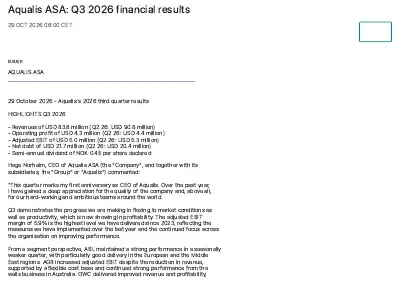
Despite our revenue being down this quarter compared to last quarter and also compared to this quarter a year ago, I am very proud to present a profitability of this quarter, which is the highest we've had since 2023. 5.9% EBIT margin, which is up about 30% from this quarter last year, quarter-on-quarter, no, year-on-year.
Up from 4.2% this quarter last year, and also up from Q2 this year. On top of that, within this profitability, we have found space to invest in group investment programs of $1.1 million, which will be important to drive our profitability further, as we expect and as we've said we are driving towards 20% ROCE next year.
We will come back to this program in a minute. Our net debt is also slightly up to $21.7 million this quarter, despite positive operating cash flow from increased profit.
We've also increased the capex by consolidating our acquisition this quarter, Synergen, which we will also come back to a little bit later. We declare the semiannual dividend of 0.45 NOK per share to be paid in November.
Let me just remind you that we are a truly global company: 2,000 employees nearly, including our freelancers, across the globe, 79 offices in 44 countries. We are a company that has grown tenfold over the last 10 years, that's mainly through acquisitions, and created four very good brands that I will also speak a bit more about in a second, which covers or which works in the energy and the maritime sector, of which oil and gas represents 75% of our revenue, maritime around 11, and renewable sector around 15%.
Of the four brands, particularly two of them constitute the main part of our revenues: ABL and AGR, although Longitude and OWC are also there producing their revenues, but on an EBIT basis, ABL is clearly the largest segment that we have or brand. Again, our brands: ABL, our leading marine consultancy in loss prevention and loss management globally; AGR, our experts in drilling and well and subsurface work; OWC is our, sorry, our renewable arm; and Longitude, our engineering arm.
We like to show you some typical projects that they have won or executed in the quarter. Let me draw some attention to these four projects.
In a year, we do deliver on 8,000 contracts, also in this quarter, there are a number of contracts that will not be mentioned. ABL did win this quarter a very exciting contract to do the marine warranty survey for the world's heaviest single-lift offshore operations on Statfjord A on the Norwegian shelf, which will be something we will be working on for several years going forward.
Very proud of that, very exciting. AGR won a contract to consult the Danish Ruby CO2 storage onshore, which is a CCS project basically, in Denmark, where we will be supporting them, advising on subsurface and geomechanics of that project.
OWC in this quarter executed a contract as technical and environmental due diligence of the Danish Cadeler's acquisition of the German company Mank. Longitude, as I mentioned, included Synergen this quarter, and they have already won a substantial contract that we will talk more about in separate press releases when it's ready, on process safety and risk engineering on an FPSO replacement in the Asia-Pac region.
Done for our teams here. Before I leave the floor to Stuart, let me just comment on our group investment program.
In this quarter, we've spent $1.1 million investing in projects or programs which are aimed at materially improving our productivity, developing new products and services, or expanding existing businesses to new sectors and geographies. This is aimed at improving our profitability next year to 20% ROCE.
The projects are managed at group level, that's very important to us, and they all have to pass a strong profitability hurdle in order to be invested in. This also allows us to keep a keen eye on underlying business performance in the segments while we are investing at the group level in these projects.
We do expect that these investments will be more or less at this level in the quarters going forward, and we will be showing those investments as we go. I think on that note, I will leave the table to Stuart.
There you go.
Stuart Jackson
Thank you, Hege. Good morning, everybody.
To go through some of the financials in a bit more detail. Firstly, the revenue and EBIT bridge that we provide, looking at Q2 compared to Q3.
As Hege has mentioned, there is a reduction in revenue during the quarter. As you can see from the bridge here, predominantly that is a softening of the market in Norway, where AGR has the largest part of its business.
I'll come back to that when I come onto the AGR slide. There's a slight reduction in terms of ABL, in terms of revenue level, but this is generally a seasonally weaker quarter, no surprise in that respect.
Turning then to the adjusted EBIT bridge, you see some positives and negatives across the four segments, but overall an improvement in results from the operations activity of the business. I guess I'll concentrate mainly on the corporate part on this slide, an increased cost of $0.8 million on the corporate side.
As Hege has mentioned, we've initiated the group investment programs, and that was a $1.1 million cost that we absorbed through Q3, and we'll have that cost going forward as we go into 2027. If you strip out the impact of the group investment programs, there's actually an improvement of $0.3 million in terms of the underlying corporate costs during the quarter.
Don't forget when we're comparing this $5 million of EBIT here to the $5.3 million back in the previous quarter, that we did have a $0.7 million one-off non-cash provision release in the second quarter as well. Turning then to segments, and firstly, ABL.
Another good quarter for ABL, which is always important for the group because this is the largest contributor in terms of EBIT. Our revenue slightly down at $39 million, no surprise because of the seasons, but, yeah, holding up quite well relative to the same period last year.
In terms of EBIT margin, we've maintained the margin that we had in Q2 of 2026, we're at 19.2% compared to 19% in the previous quarter. Similar to the previous quarter, the Middle East region, despite the conflicts that are going on there, is performing very well, as is actually our European region as well.
In relation to AGR, the downturn in revenue, which you see there's a bit of a trend in this respect, a couple of things behind that. Firstly, the softening of the Norwegian market, which is where AGR has a large part of its business activities, really coming off, I think, the incentives that were provided post-COVID.
There's a bow wave of projects that started after COVID, and we're starting to see that slow down. There's a lower activity level in the Norwegian market.
That flows through in terms of our AGR sector, in terms of revenue reductions. We've had less activity with the vessel revenues, down $3.5 million compared to the previous quarter, and similarly the resourcing activity of AGR has been lower because of lower activity.
Pleasingly, the EBIT is performing well, we're up in terms of overall EBIT at $1.7 million, and that's a 5.8% percentage EBIT margin for the quarter. Similar to the last couple of quarters in AGR, the wells business in Australia's been performing very well, and that's a driver of that improvement in EBIT margin.
We do, because we have a lot of pass-through revenue here, look at this on a net revenue basis, and you'll see in the middle here, yeah, net revenue for the quarter was at 22% compared to 17% on the same basis for Q2 of 2026. In relation to OWC, improving performance, as we've seen over the last couple of quarters.
Pleasingly, our revenue is up 15%, the first change in terms of revenue being positive for some time. You see quarter-on-quarter an improvement in terms of the EBIT level and the EBIT margin, now up at 10% EBIT margin for the quarter.
A couple of things driving that: obviously, during the quarter, better utilization of our own people, our technical staff utilization has gone up, but also some of the actions we took in 2025 and into early 2026 are coming through in terms of financial results, reduction of the head count we had within OWC and the closure of some of the offices which were in weaker markets. Lastly, in terms of the segments, the Longitude segment.
I'd say reasonable performance from Longitude. We did consolidate Synergen during the quarter, so that's helped in terms of the increase in revenue compared to the previous quarter.
In terms of our EBIT margin, we're flat in terms of overall EBIT, a reduction in EBIT margin as revenue is up, at 16.2%. That's really reflecting slightly lower utilization of the people within Longitude during that quarter.
Turning then to the abbreviated financials. Income statement, I don't think a lot to add to what you've seen from the results so far.
Revenue down, but operating cost down by the same level. We're sitting at an EBIT of $4.3 million, relatively flat compared to the previous quarter.
Down below, after the adjustments for our acquisition costs, our amortization impairment of intangibles, we end the quarter with $5 million in terms of overall adjusted EBIT, and EBIT margin of 5.9%. I think as Hege has mentioned before, with the group investment program, if we adjusted for that on a like-for-like basis, we'd be at $6.1 million in terms of EBIT, a 7.2% EBIT margin.
Strong in terms of, I think, the earnings level, slightly more disappointing in terms of the cash flow side. We did generate $2.1 million of operating cash flow during the period, but as we indicated in Q2, we did expect to see a larger unwind of the working capital position during this quarter.
I'll come to that on the balance sheet slides because we need to look at that over a period of time, we have the working capital ratio to help us in that respect. Other items on the cash flow: I think from investing activity, the $1.8 million outflow during the quarter, the largest element of that is the payment we made for the Synergen acquisition of $1.3 million.
Then on the financing side, we drew down $3 million under the RCF during the quarter, and that's offset by interest and lease payments, a net inflow from financing activities of $1.8 million. It gives us a cash flow $1.9 million and at the end of the period, cash of $10.8 million.
Then in relation to the balance sheet. You can see our $10.8 million of cash, our drawings under the short-term borrowings are at $32 million, we're at net debt of $21.7 million at the end of the period.
Turning then on to the working capital, there's a bit more color here. You see on the left-hand side, our working capital hasn't really moved that much during the quarter, which is a bit disappointing.
There are a number of, I guess, internal and external reasons to explain that. Firstly, the Norwegian market being softer, our revenue is coming down, when you measure this as a working capital ratio, the denominator is impacting that and puts the percentage up.
More generally in terms of driving the net working capital, from an AGR perspective, we run this business at a zero or a negative working capital. As the activity level in AGR starts to decline, we see the unwinding of the advance payments we have from customers not being replaced by so many new projects coming in at the other side of it, and also the payments on existing payables being paid out of the business without the same level coming back in in terms of new projects.
In terms of our own activities, I think on OWC and Longitude, we're disappointed with results there on both the collections and the billing activity within the quarter. That's where we expected to see an improvement and therefore an unwinding of the working capital.
A large element of that's within our own control, and you can be rest assured there's a lot of focus on that as we go through Q4 and Q1 to improve that position. Also over the period, we have one-off items that impact working capital.
In this quarter, obviously, we've consolidated Synergen, and therefore we've brought in the net working capital of Synergen on her own balance sheet during Q3. Turning then to the debt facilities, our committed facilities under the RCF with HSBC still remain at $40 million.
We do have two accordions for $20 million, documented extensions of that facility, but uncommitted. I expect as we go through Q4, we will maintain the headroom we require and probably bring in an extra $10 million of that from the accordion to increase the committed facilities from $40 to $50 million.
This has a maturity of early 2029. Then finally from me before I hand back to Hege, dividends.
Following the resolution at the AGM, the board has decided to declare a dividend of 0.45 NOK per share to be paid on or around the 30th of November. As you see from the chart on the right-hand side, it's a continuation of dividends at 0.45 NOK per share, as we've had for the last four quarters now.
That'll probably take about $6.4 million in terms of cash going out the business at the end of November, depending on where FX rates finish. Sorry, I missed a slide.
With that, I will hand back to Hege.
Hege Marie Norheim
Thank you, Stuart. Let me then round off with a few comments on our markets going forward and a brief summary of what we've just heard.
Let's start with the oil and gas market. 75% of our revenue comes from this market.
We have updated the graph this quarter, actually, without that really changing the perception that this is a rather flat expectation or slightly upwards for 2027 for oil and gas on a macro level. For us, I think it's fair to say that we are and we expect to continue to be busy in South America particularly, also in Europe, except from the North Sea and Norway, as Stuart already alluded to.
We do still expect a soft Norwegian shelf the rest of this year and into 2027. Then, the one big thing obviously that does impact us and will change our perspective would be the conflict in the Middle East, which is impacting our oil and gas activities in the Middle East as well as some impact in the Asia-Pac region.
Our rig-moving services, on the other hand, in the Middle East have been very busy, and we expect that to continue as well through the conflict and past the conflict going on. We also do see the Indian market now for rig activities season starting, and we expect higher activity there as well.
In the renewables sector, we have not updated the graph this time. We do see again a relatively flat development, although that does mean that we are active and involved in a number of work in bankable markets, as we call them.
UK, France, Poland, Denmark, Netherlands, Germany, Taiwan, Japan, Korea are preparing and giving us work in preparing for new licensing rounds and new investment decisions. This is also positively impacting the opportunities for Longitude's offshore wind business line as well as ABL being quite busy on servicing with MWS services the construction market within offshore wind.
Onshore renewables is a market that we are pivoting towards. A number of our capabilities and service lines are able to also do work in that market, and that is huge, and it's really up to us to grasp those opportunities, which we are working on across the globe.
Then finally, the maritime market. Again, the graph is here to show you that the underlying drivers for our business there is steady and robust.
We are busy, particularly, again, in the Middle East. Our casualty work has been very busy, and we expect that to continue both through and after the conflict, and we're seeing a busy market generally globally.
On that note, let me summarize that we've had a great quarter. I would like to congratulate again my colleagues across brands and across the globe for improving our profitability with the highest EBIT margin since 2023.
ABL is performing stellar, and we are very proud of the work that they're doing, particularly in the Middle East, but also across the globe. AGR EBIT up, particularly in Australia activities then, and despite a soft market on the NCS where they're also working very hard.
The improvements in OWC and Longitude are very welcome and also the result of hard work from my colleagues. Semiannual dividend, we've declared of 0.45 per share to be paid in November.
As I said, outlook, obviously fundamentally long term, we are in businesses where we believe the demand for energy is not going away. Energy security is a topic that pops up in all our conversations with clients all over the world.
The one thing that will change our outlook going forward will be the conflict in the Middle East, but for now, we are pretty busy globally. Then, the group investment program, we are very excited about that.
It is a fundamental part of our way forward to improving our profitability further, and makes us believe in that possibility, which we will be working hard to do. We remain active in the M&A market as well, looking at acquisition opportunities to consolidate our industry.
I think on that note, I will ask Stuart to come back up if there are any questions that we should entertain, and thank you for your attention so far.
Operator
We can start with some questions in the room.
Can you walk us a bit on the bridge to getting to 20% return on capital employed in 2027? How much will need to come from growth, better margins, or better capital efficiency?
Hege Marie Norheim
I think as we've alluded to before, this company has grown tenfold over 10 years. It was fast.
Companies were added on to the business. I think over the last year, we've really seen opportunities to take out more of the synergies and actually do a material turn on productivity in the business, both on the back-office side, if you like, on the staff side, on group cost, but also in the ways we are working that hits all our consultants.
Having said that, we are also investing in business opportunities that we see in our business that with a bit more seed money, if you'd like, and some governance from our side, following it up, can really be expanded. I don't want to give you a sort of share of what's going to contribute with what, but I do think productivity is going to be a big part of the lift.
Yes. On OWC, there was a big margin jump this quarter.
Was there any single projects that were particularly important to drive that improvement?
Hege Marie Norheim
I think it was generally the cost reductions coming through, because they did cut or take down a number of people in the business through two rounds in OWC, but they all stayed and worked their periods, it was really now that the cost reductions came through. I would also say that they've worked very specifically on fine-tuning their pricing of contracts, so that their average price has increased.
In that, some of the services that OWC offers, particularly within, yeah, specialist services with very high price margin, has been part of this quarter's contracts, so that will sort of probably be more adjusted out in the next quarter.
Thank you.
Thank you. When I look at your net debt, it's up $20 million year-on-year, roughly, and only $5 million of that is the increase in net working capital.
Do you have a debt target or a leverage target? Because, obviously, returning capital to shareholders is a high priority for you.
How should we think about that going forward?
Stuart Jackson
I guess when you look at some debt in terms of ratio, we talked before about 40% working capital ratio as being our target. Now we're at 54% because revenue's come down a bit, and some of the other items I mentioned which we need to manage on.
That'll come down over time and help in that respect. In terms of a debt target or net debt target, we don't have a specific target.
We're quite comfortable where we are at the moment because that's helping us in terms of growing the business, making the new investments into the group investment programs, making the acquisitions, in-ground acquisitions we're doing at present. That's a level that we're quite happy with, and we have additional facilities, as I said, available to us, already committed or uncommitted, which we can convert committed with HSBC to continue that program.
Okay. On that investment program, just to understand that correctly, that's then sort of an annual recurring program where you are investing a million a year, or what exactly are the numbers involved?
Stuart Jackson
I don't think we should specifically give guidance of a million a quarter, which is what we've had this quarter, but we are going to have a program which will create significant opportunities for us to invest in infrastructure as well as new opportunities to increase our productivity and get into new markets and new geographies. That's the thing we're trying to do through the group investment program, is commit group resources to assist the segments to grow organically as well as the inorganic activity we've had through the acquisition.
Okay. Then on the Middle East, you said that it's fairly busy, maybe even business as usual.
If you look going forward, a scenario where things go back to normal or where things remain where they are, how do you think that's going to affect your activity level down there?
Hege Marie Norheim
I think what we've said is that the oil and gas activities in the Middle East obviously is impacted by the conflict. There is no projects continuing on the energy side in the Middle East.
The rig activity has been very active, and the casualty work has been very active, obviously. This is also impacting on the oil and gas side, impacting our business in Asia-Pac.
When the conflict is resolved, we expect a tick-up in the oil and gas activities, projects within oil and gas, both in Asia-Pac and in the Middle East. Then we think the rig moving will continue, and I think the casualty work will also be continuing at a high level for quite some time.
All in all, it's been a busy time for us in the Middle East.
Thank you.
Operator
We have a few questions online. First, can you elaborate on how you today apply AI in your business, how AI use can be extended going forward, and whether you see AI more as a potential threat than an opportunity?
Hege Marie Norheim
Part of the investment programs is absolutely addressing how we use AI, both in the back office, supporting the staff and the services, but also in how we deliver to our clients, as well as developing new products based on AI. That's very much part of what we are addressing and will yield, we think, results quite quickly, but also in the longer term, obviously, and there's more to be done.
We are also, as most of companies, in the start of that. I think it is an obvious opportunity.
I think particularly for a company like Aqualis, we are engineering consultants, we deal with a lot of data, and we are quite large in some of the services globally that we offer. The insights that we gather through that activity, we will be considering quite carefully how we can monetize and develop new offerings and new insights for our clients and better insights for our clients and solutions.
We are quite positive to how we can use this for our business. We are also, obviously, watching our competitors and our clients using AI and how that will change the market.
Operator
Next question: what are you doing in AGR in order to mitigate the reduced activity in Norway?
Hege Marie Norheim
Good question. AGR has business in Australia as well as in Norway.
I think it's fair to say with the softening market in Norway that we are absolutely looking to expand the businesses in Norway to other areas as well. UK is a market very close by, which in the decommissioning phase offers some opportunities.
We are also looking across the offices and in Aqualis to see if AGR can pick up work, and they do, in other parts of the world. Internationalizing the business in AGR is definitely part of the work being done going forward.
Operator
Then, the question is: can you give a guidance on the targeted or run rate working capital ratio and when you expect to be there?
Stuart Jackson
As I mentioned earlier, we've talked about 40% being a working capital ratio that we're happy with. Sitting at 54%, we're not going to get there quickly, it's going to be a progression through Q4 and Q1.
The areas where we can have influence ourselves, as I mentioned, OWC, Longitude have been slower in terms of collections and slower in terms of billing, those are actions that are already being taken to improve that position. I don't think our position has really changed with the mix of businesses we have, that long term, 40% working capital ratio is where we should aim for, but obviously we have a bit of work to get there at present.
Operator
The final question online is: are you confident in maintaining the dividend level for the foreseeable future?
Stuart Jackson
I think you saw a change in terms of the dividend profile as we came into 2026. Having had progressive increases in dividend for some time, we've kept that at 0.45 NOK per share.
We're comfortable at that level that the business we have at present can generate sufficient cash to cover the $12 million or so dividend payment we want to pass back to shareholders over that time. Yes, confident we can pay it going forward, and then we'll see what we do with the dividend policy in future.
Operator
We have no further questions online. Any more questions in the room?
That concludes the Q&A.
Hege Marie Norheim
Thank you very much for your attention.
Stuart Jackson
Thank you.