Vodacom Group Limited
Q2 FY2027 · Earnings Call TranscriptNovember 10, 2026
Shameel Joosub
Welcome to the Vodacom results call for the six months ended 30th of September 2026. I am joined by our Group CFO, Raisibe Morathi, as well as our Head of Investor Relations, J.P.
Davids. I hope you found the video presentation ahead of the call useful.
It covers our performance for the period and the progress we continue to make against Vision 2030. For those not able to watch our presentation, I will take you through some brief highlights.
We will then move into a Q&A session. This was one of Vodacom's strongest first-half performances, with broad-based growth across the group and good progress against our strategic ambitions.
We delivered above-target growth in service revenue, EBITDA, and operating free cash flow, while our customer base reached 250 million. This is 1/4 of a billion customers across our Africa footprint and a significant milestone that speaks to the scale that Vodacom has built.
The Safaricom transaction was another defining element of the six-month period. It remains subject to legal processes in Kenya, and we are set to return to the appeals court on the 19th of November to set a hearing date.
As a reminder, we paid ZAR 35 billion to increase our shareholding in Safaricom from 35% to a controlling 55%, and consolidated Safaricom results from the second quarter. The ZAR 35 billion was comprised of ZAR 26 billion to the Government of Kenya for 15% stake in Safaricom and ZAR 9 billion to Vodafone for an additional 5% stake.
The Safaricom transaction had a material impact on our reported results and growth rates. As such, we also provide pro forma disclosure, which includes Safaricom in the comparative period and gives a better feel for the group going forward.
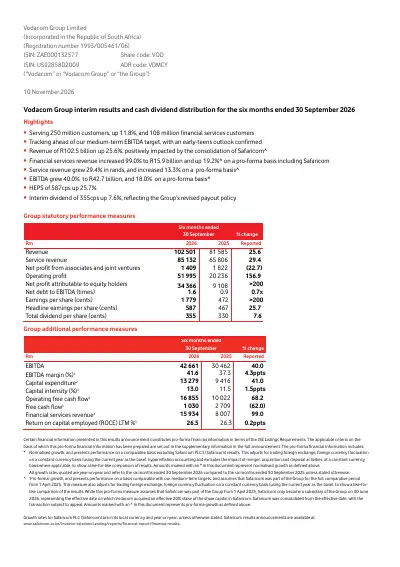
On this pro forma basis, service revenue grew 13.3%, EBITDA grew faster at 18%, and operating free cash flow increased 34.3%. These results reflect a larger, more diversified group with multiple engines of growth.
Including Safaricom, we are now annualizing ZAR 231 billion of revenue, with 61% of this revenue generated outside South Africa. Our eight markets, covering a population of over 600 million people, give us exposure to some of Africa's most attractive growth opportunities.
In addition to our geographical diversification, our Beyond Mobile products are scaling quickly and reached 27.4% of service revenue. Financial services is the largest of these products and a key growth engine for Vodacom.
We now serve 108 million financial service customers, up 15%. With Safaricom in the group, financial services contributes 22.2% of service revenue.
Over the last 12 months, we generated ZAR 43 billion, or $2.6 billion, of service revenue from fintech, while our platforms processed $575 billion of transaction value. Alongside this, our connectivity platform continues to scale, having invested CapEx of ZAR 13.3 billion in the period.
We now have more than 52,000 network sites and 4.1 million fiber homes passed, with Maziv in South Africa and Safaricom in Kenya. This gives us a powerful connectivity platform for which to continue growing.
Importantly, our commercial momentum and scale are translating into healthy earnings and returns. Headline earnings per share grew 25.7%, while return on capital employed was 26.5%.
That should give you some color on the group. Now let me briefly touch on the performance across our markets.
We manage our eight markets in four segments, starting in the north with Vodafone Egypt, which contributes 25.8% of group EBITDA. Vodafone Egypt delivered another excellent set of results, with local currency service revenue growth accelerating to 39.6% in the second quarter and 36.3% for the first half.
The growth was supported by investment into the network, spectrum, and new growth areas, including financial services. Despite this investment, EBITDA grew 31.3%.
We also announced that we will build Egypt's largest data center and first sovereign AI data center, adding to our long-term growth trajectory. This will be done in partnership with Cassava or Africa Data Centres and Elsewedy Cables.
Moving further south to Safaricom, which is expected to contribute 1/3 of group EBITDA once it is fully consolidated for a full period. Safaricom posted another set of outstanding results with double-digit growth in Kenya.
The result in Kenya was fueled by M-Pesa, which grew 13.6% off a large base. In Ethiopia, we are approaching EBITDA breakeven, which is an important inflection point for Safaricom.
For Safaricom overall, EBITDA grew 27.5% in shillings, supported by a significant improvement from Ethiopia and continuous growth in Kenya. Our four international markets contributed 14.8% of group EBITDA and delivered strong growth and operational leverage.
Service revenue was up 13.7%, while international EBITDA margins increased 1.7 percentage points to 35.6%. Even more impressive was the operating profit result, which was up 54.4% to ZAR 3.2 billion.
Finally, to South Africa, which contributed 40.1% to group EBITDA in the first half. We expect this contribution to reduce towards 34% as Safaricom is consolidated for a full period.
South Africa has delivered a resilient first half against a muted revenue environment. I am pleased with the performance in prepaid consumer contract and Beyond Mobile, which underpins service revenue growth of 1.9%.
In the second quarter, prepaid growth improved to 3.1%, bringing first half growth to 1.7%. Prepaid voice, which remains a drag, now contributes 27% of prepaid service revenue, down from 32% last year.
As our voice exposure reduces, our prepaid growth prospects continue to improve. We have remained disciplined on costs.
Our EBITDA margin of 37.4% is the highest since FY 2023, which demonstrates our ability to drive efficiencies against a more muted revenue backdrop. The commercial momentum across our segments means that we are well-positioned to deliver a strong FY 2027 and to reiterate our medium-term targets.
We target double-digit service revenue growth and early teens growth for EBITDA and operating cash flow. With that sentiment in mind, I will close my comments on our balance sheet and return prospects.
Reported net debt to EBITDA increased to 1.6x as a result of the Safaricom transactions. On a pro forma basis, the leverage is 1.3x, just below our internal threshold.
We believe that our revised dividend payout ratio of 65% and strong free cash flow generation position us well to pay down the debt responsibly and create equity value. Staying with dividends, our dividends per share increased by 7.6%, reflecting the revised payout policy.
While the foreign exchange environment remains volatile, we still see scope to grow our FY 2027 total dividend from FY 2026. That concludes my review.
Raisibe and I are now ready to take any questions you may have.
J.P. Davids
Thank you, Shameel, and good afternoon, everyone. This is J.P.
We will kick off the Q&A session in themes, starting with South Africa. We have got a number of questions on South African top line asked by Thando from UBS, Jono from Absa, amongst others.
Starting with Thando from UBS, he just asked around the prepaid voice growth in Q2, and can you provide a little bit of color on how that is exiting the quarter? Good to get an update on the competitive environment in prepaid.
Related to that, Jono is also asking a few questions on prepaid related to the competitive environment, and specifically, what are our expectations going into this summer promotional period in South Africa? Still on the theme of SA prepaid, seeing any impact from the low-cost prepaid fiber operators in some of the South Africa's townships?
Shameel Joosub
Okay, so maybe a couple of comments. I think the prepaid environment remains competitive, and I mean, that is including some competition from MVNOs, some from the fiber providers, and so on.
Is it dramatically impacting any of the numbers? No.
If I look at traffic growth in prepaid, traffic growth is up 41%, and we have seen a sequential growth in traffic over the last three quarters. Traffic growth is actually stepping up quite a bit.
The reason for that as well, I mean, just to take a step back, you remember last year this time, we repriced a lot of our prepaid offers to stay competitive. That has made us a lot more competitive in the market, but as we are seeing the elasticity coming through in terms of data growth.
What we have seen over the last two quarters is an acceleration of prepaid data growth, 9.4% in Q1, 9.9% in Q2. You will remember a year back or in the previous quarter, I think it was down to about 7%, so you are seeing the acceleration coming through quite nicely there.
The issue remains prepaid voice. To answer your question, prepaid voice in Q2 was down 13.3%.
In Q1, it was down 14.3%, so it has come off a little bit, now making up 27% of prepaid revenue. That is down from 32%, so we are seeing about a 5% decline from last year to this year in terms of the contribution from prepaid voice.
As that goes down, it will continue to expand. Data, which is the main growth driver in prepaid, is still very much there.
The prepaid revenue growth part is not the issue, or prepaid data revenue growth. The issue is voice, and effectively, that is in structural decline and will continue to be the case, but will become a smaller and smaller issue, now about 11% of overall SA service revenue.
It is becoming a smaller issue that we deal with, and as that comes down, you should see the growth in SA step up. That is the part there, and we are much more competitive now than we were previously across the board.
As we go into the summer promotion, we think we have created a very strong summer promotion, so we are hoping for a good quarter, boosted by some of the summer offers.
J.P. Davids
Finishing off the South African prepaid discussion for the moment, Rohit from Citi asked around the underlying prepaid performance in the period, noting that the reported trend was 3.1%. Do we have a sense of what the excluding the content adjustment was for the quarter?
I think you have already articulated the key drivers behind that, so perhaps just reflecting on that number, which is 1.7%. Just for completeness there, that is a zero-sum game with the contract segment.
The contract, that content revenue did positively impact prepaid, but it negatively impacted the contract segment at the same time by the equal and opposite number. Hopefully that addresses that question.
We want to move on now to some cost or margin discussion around the South African business. Starting with Jonathan from Prescient.
He is asking for some color around the cost optimization story in South Africa, and whether we could expect margins to exceed 38% in the second half of 2027 and be sustained into FY 2028. Raisibe, perhaps that one is for you.
Raisibe Morathi
The cost programs are fairly robust, and we are not starting from ground zero. We have had a number of programs, some of which are really coming from many years of really identifying opportunities where we can share, we can optimize, we can automate.
I mean, we are on a very strong trajectory in terms of AI, agentic AI being applied in different areas from the call centers to network management. For that, we are quite confident that we will continue to deliver on the savings that we have articulated.
For the year, we have a target of ZAR 1.9 billion of savings, and we are pretty much on track in terms of delivering on that. We see the margin being supported by the resilience of prepaid, as Shameel has articulated.
Obviously, contract is continue to also grow at roughly about 3.5%. Combined with the cost programs, we see the margin continue to be supported at levels of around 37%.
I think 38% will be a stretch, so we see 37% being the level that is well supported.
J.P. Davids
Raisibe, staying with you. Viwe just had a follow-up on that, and he is asking whether quantitatively or qualitatively, how much of these cost efficiencies are from AI?
I think you did allude to that in your answer. But just more broadly, our early teens EBITDA growth, for the group, are we factoring in AI-driven cost savings, cost-saving programs into that over the medium term?
Raisibe Morathi
Yes, we are factoring AI-driven savings. It is still early days, so we are both investing in learning, and obviously, licensing and so on.
But I think for the long term, we see the contribution from AI being quite material. But at this stage, it is a mix.
I mean, the savings that we have is between the network-related costs, renegotiating some of the leases, renegotiating a number of contracts with suppliers, being energy efficient. It is across the board, but definitely AI is something that we look out to.
We have a structured approach to make sure that we learn the use cases from different markets, from the industry, from everyone, and we are testing in a number of areas. So we see that as a material in the future, but not now.
J.P. Davids
Ganesh, hopefully that also answers your question from Barclays. Just staying with Viwe, from Morgan Stanley, he had a follow-up on prepaid, and the prepaid data trends more broadly.
He noted prepaid data revenue for the half is up 9.7% against traffic growth of around 40%. So what is happening to revenue per gigabyte, and how do you expect data monetization to evolve as this usage per customer keeps rising?
Shameel Joosub
Yeah. So effectively what is happening is that your effective rates have been coming down, some because of some of the products that you are selling, which is like fixed wireless products and so on, and others because effectively, we created much more competitive offers, and put that out now almost a year ago.
So, that, and we have continued to make sure that we are very competitive in the prepaid segment. So, as the voice part becomes smaller, just to be clear, the data revenue we see staying strong, and we see traffic growth remaining strong going forward.
We see some of the price elasticity starting to dissipate a bit, so we should see some positive jaws from that going forward. But voice remains the one element that we continuing to manage.
Now, in that context, what we're doing is we're giving customers bigger bundles, and so on the one side, but you are seeing customers also take up things like WhatsApp Voice. It is in structural decline, and on the one side, the faster it goes down to, let's say, below 20%, the more you'll see prepaid revenue accelerate.
It's a little bit of, how much can you manage it, and how much can you sustain it? On the one side, giving bundle accelerates it, but it also creates a bit more sustainability.
J.P. Davids
A final question for the moment on South Africa, which I will take. This was a question from Maddie at HSBC.
He's asking around the reason for the slower fixed line service revenue performance in South Africa quarter-on-quarter. Maddie, it's a tougher comp for that fixed line business in South Africa.
We had a big project win in 2Q of the previous year. We had expected to recover into the third quarter back to the more normalized trends we've seen in the past.
Shifting gear now to Egypt. We're going to start with a top line question or revenue question from Jonathan.
He wanted a bit more color on whether we expect the postpaid and prepaid customer service revenue to continue accelerating into the third quarter 2027, and under what conditions would there be a further price increase triggered? Perhaps related to the growth trajectory, he asks a follow-up question around Vodafone Cash and whether that can continue accelerating into the second half 2027, and whether the big investment push is behind us.
Both of those obviously related to Egypt and Vodafone Cash there.
Shameel Joosub
Yeah. From a revenue perspective, basically, remember the price increase came in May, so the step up from Q1 to Q2 did reflect a little bit of that as well, because you had one month less of price increase in Q2 versus, or one month more in Q2 versus Q1.
That's the one part. The strength of the growth in service revenue in Q2 should be more or less similar or slightly lower into Q3.
That's the one part. Are we expecting any other price increases?
No. I think it's very much also depending on any further price increases into next year at the earliest, will depend on the inflationary environment driven more by the oil price and electricity prices more than anything else.
Yeah.
Raisibe Morathi
Then in terms of the Vodafone Cash growth?
Shameel Joosub
Yeah. On Vodafone Cash, the 74% growth, the momentum continues, so you should see strong growth continuing into the second half.
The investment that we made into Vodafone Cash and the distribution should get better in the second half and step down slightly. We should start to see a bit of a margin improvement, or margin improvement in the second half of the year.
Raisibe Morathi
Particularly excited about the continued penetration of Vodafone Cash, where we have now reached 16 million customers.
J.P. Davids
Yeah. That is a nice segue into Egyptian margins.
Perhaps, Raisibe, a couple of questions for you on Egyptian margins. Firstly, whether there were any big one-offs or headwinds that we wanted to flag during this particular period, the first half.
That is a question from Maddie, and then Thando following up with the outlook for the remainder of the year with respect to the Egyptian margin or the Egypt margin. What should we expect there for the year to go?
Raisibe Morathi
The one-offs is actually investment for continued growth in Vodafone Cash, and I think it is the right thing to do. Continue with the, obviously, promotions and supporting that growth which we have seen coming through.
We spoke about the 74% growth in revenue there and growth of customers. Note that our business in Vodafone Egypt is still relatively young compared to some of the other markets, so investment is to be expected in that environment.
We are replatforming. We are really going to be adding additional products.
I think it is the right thing to have focused on continue to invest. We also called out FX.
With the geopolitical challenges, and particularly the Middle East war, we have seen the Egyptian pound weakening, and as a result, the FX on working capital is what would have affected our margin. We expect it to correct going forward, but we are still quite pleased that a margin of 45% is a credible margin in that business.
J.P. Davids
Raisibe, while you have the microphone, a follow-up question from Maddie more broadly on costs across the group, and he is just interested in if we are seeing or concerned about the margin impact from higher energy costs, and if so, are there any mitigations in place to address that?
Raisibe Morathi
The energy costs, we continue to leverage on the procurement relationships and our negotiating footprint, where we have been able to lock some wholesale pricing with the oil majors, and we manage the efficiency of use of diesel and related. The good thing is, from a contribution in terms of OpEx, it is quite small.
Actually, as a percentage of revenue, it is 4%, of which roughly 70% is based on grid, with the balance being based on diesel. We also took a further step of bulk buying.
Every time when the price was accommodative, we managed to bulk buy in the period of more volatility of the pricing. As a result, we have seen some moderate effect on our price increases despite what the pump prices were.
In some of the markets, we were also fortunate in Tanzania, where the lease arrangement with the tower company included a diesel price that was capped. So for that reason, it saved us a little bit.
It created a bit of a hedge against the volatile prices. So overall, very well managed, and we believe that it is something that we can continue to manage going forward.
J.P. Davids
Shameel, back to you. A follow-up question from Jono on the Vodafone Cash environment or fintech environment in Egypt.
Just asking what competitors are trying to do to win share from us, and what is Vodafone Egypt doing to defend? That is question one.
And then question two from Nadim. He wanted a little bit more color on the AI data center in Egypt, whether this could potentially be a template for other markets like South Africa or Kenya.
And beyond the equity stake, is that investment then going to be captured, the Egyptian investment going to be captured within that EGP 20 billion CapEx guidance? So it is the fintech competitive environment, AI data center as a template, and how are we going to fund that equity investment?
Shameel Joosub
Okay. Basically in Egypt, what is happening is that, from a competitive environment perspective, of course, when you have such good growth, you do have competitors who are trying to also gain momentum and so on.
So, there was promotions and these type of things that were in the market, and we made sure that we could secure our distribution, but also made sure that we had the right incentives for our customers and so on. And the result was that we still saw a 36% growth, 31% growth in customers to 16.7 million.
So we are kind of holding our own in that context, but also making sure that we are growing the use cases with customers. So competition is happening, is there, but I think we are outpacing competition, hence the 74% growth, and so on.
So yeah, very pleased with the result. Also, I think, now looking at what more can we take from the rest of the group learnings and so on, and at what juncture do we start to implement that into the Egyptian market, which will give us further differentiation as well.
In terms of the data center, basically it is a tripartite data center, basically Elsewedy Cables, which is a big entity in Egypt, and then of course Africa Data Centres and ourselves. The offtake from that will be hyperscalers on the one side, but us on the other side selling into the market.
So it is a very strategic move from us. We have 30% of the data center on the one side, but more importantly, the offtake or the on-selling into the market will be by and large done through us.
So, there is very healthy margins in that context. It will be built modular, so based on demand, and so on.
First, of course, making sure that we build it where there is enough power, and those are early days, but those are the discussions with the government, in terms of where to build it and where can we get the right power supply, incentives, and so on. So that is the one.
And then, basically, going from there. It will be funded in an off-balance sheet with debt and equity.
So, probably around 30% equity and 70% debt. It will not form part of the CapEx of Vodafone Egypt.
J.P. Davids
Great. Last question on Egypt, which I will try to take.
Thando is asking the underlying growth in Q2, excluding the price hikes. So Thando, I think the best we can do there is just remind you of what the price increases were.
They were between 10% and 15%. They will not apply to all of the business.
For example, they do not apply to Vodafone Cash. So you could, I think, back of the envelope, think to yourself, they support growth by high single digits as a starting point.
Okay, we are going to switch gear now to Safaricom, kicking off with a question from Maddie, who wanted an update on the deal, and what is the plan if the court case or court decision, next court decision does not go our way?
Shameel Joosub
Well, basically where we are is that it goes to the It is at the appeals court at the moment. Of course, we are doing all the submissions, so is government.
Both of us feel that we have a very strong case in that we did everything by the book, and so on. And I mean, one of the arguments is that they could have gotten more, but it is a listed stock.
And in fact, from the time we started the discussion to the time we ended the discussion, the price was 100% more. So I think, government did do a very good deal.
Another argument was that it was not- It was not socialized enough and so on, but it followed a very robust process where it was actually consulted on in every region of the country, including in parliament, and approved by all the regulatory authorities and so on. So, we are putting our best foot forward in that context, and hopefully we will prevail.
That said, if not, then we kind of gather around the table and look again. But, of course, we would still then own 40% of a fantastic asset.
J.P. Davids
Thando has a follow-up on that question. Perhaps this one's for you, Raisibe.
He's asking, in the case that the deal is not successful, is there any scenario where there are onerous debt obligations that Vodacom would face, i.e., we would be with debt we wouldn't be able to pay down, or there'd be penalties, et cetera, related to that debt?
Raisibe Morathi
In that event, which hopefully doesn't happen that way, is that the reverse of everything will happen. We paid to get the shares, which means that we'll give the shares, and then we'll have to get the money back, and then the debt that we raised for us to have paid for the shares, then the debt will be repaid.
All our debt stacks have an opportunity for unwind or early settlement in need, so that should be easy to do. Now, note that the 5% that we acquired from Vodafone, that should not be affected by all of this, so we would be remaining with the 40% shareholding.
J.P. Davids
Shameel, we're now going to shift gear to some questions on the dividend and then the strategy, starting first with a question from Alicea at Royal Bafokeng. She notes that the dividend payout policy was revised following the Egypt acquisition and then again following the Safaricom transaction.
How should investors assess the sustainability of the current policy and whether another major acquisition could trigger a further change or reduction in the payout ratio? Subsequently, what leverage or cash flow milestones could we reach that would perhaps support an increase in the payout ratio, and over what timeframe might that play out?
Shameel Joosub
Yeah, I think, a couple of things. I mean, we're not the type to chop and change dividend policies, so when we put one in, we kind of stick with it.
I think it was very important for us. We have taken on more debt in the Safaricom transaction, as I think you'll agree it's transformational for the group.
In that context, we want to bring down the debt again. We also have a lot of different opportunities to grow, and I think that the guidance that we're giving to the market in terms of teens growth in EBITDA, but also teens growth in cash, is a good reflection of what the expectations are and the growth that we are expecting in that context.
You will see strong cash flow generation into the LRP period, and yeah, so we're quite happy and pleased about that level of growth that will come. Yes, at some point in time, we could then look at the dividend policy depending on the returns that we're seeing.
We see, by all accounts, given the guidance that we're giving, you should see a very good growth in the dividend going forward, as borne out this year despite the change in dividend policy.
J.P. Davids
There are two follow-up questions on the dividend. First one from Rohit, who's asking, in a scenario where the transaction with Safaricom is ultimately reversed, would we consider changing the dividend policy back to 75%?
That's question one. Do we remain committed to the 65% going forward?
A question from Jono, who has picked up that we continue to see scope for our dividend to grow this year despite the payout change, and he wants to know whether the board would consider paying above the 65% payout if something went wrong with foreign exchange, for example, or there was a specific operational pressure point in the second half of the year which derailed our internal sort of estimates. Would we still pay out to grow?
Shameel Joosub
Yeah, I think firstly, we remain committed to the Safaricom transaction, so we're not going to start making assumptions about what we're going to do if that's not there. Of course, one of the reasons we changed the dividend policy is basically the acquisition.
I think that's parked that one. I think from a dividend growth perspective, we're very clear that we pay out on HEPS, and that we're expecting it to grow.
There has been occasions where we have paid higher, but I don't think you should pencil in anything in that respect.
J.P. Davids
Shifting now to some more strategic questions. Nadim from Standard Bank points out slide six and seven of our presentation, which show a very well-diversified portfolio by both product and geography now.
He's asking if there's one thing you could change about that mix, be it adding or reducing, what would that be? There's a follow-up question from Jonathan on Beyond Mobile, which I'll take after that.
It's a more quantitative number.
Shameel Joosub
Yeah. Look, I think the diversification is very good, and I think it gives us good representation now across the board.
The only thing we would change is Ethiopia growing faster. Really, that would be the one part that is growing 100%, which is very good.
We will break even in EBITDA this year. Of course, what we want to get to very quickly is how quickly can we get to net profit breakeven here.
J.P. Davids
Before I move on to Jonathan's question, just a thank you to Prashindran from 36ONE, who rather than send a question, just remarked, "Congratulations on the strong set of results." Jonathan wanted to know how much of the group's earnings growth is from the pillar Beyond Mobile versus the rest of the business.
I think I might take a slight shortcut here, Jonathan, if that is okay. If you look at that slide seven, we do provide the product diversification pie, and then give the different growth rates for the different business segments.
What you will see from that, it is Beyond Mobile and prepaid data that are growing the fastest. Beyond Mobile growing 21% on a pro forma basis, which would then tie back to that 13% service revenue growth that we reported.
Very broadly, you are getting to sort of a mid-single-digit contribution to the group's growth profile from Beyond Mobile. That we would see flowing down nicely through the P&L.
We have called out in the latest slide on financial services, that while it makes up 22% of service revenue, it is now making up around 1/3 of our profits. We do see Beyond Mobile growing faster than the rest of the old legacy telco business, both from a service revenue and from an earnings perspective.
Shameel, back to you. David from New Street Research had a question on the End-User and Subscriber Service Charter in South Africa, wanting to know if this will have any impact on the business or any update on it.
Thank you.
Shameel Joosub
Yeah. It is subject to a court challenge at the moment, but we are still hoping that we can find resolution with government.
Our issues are centered around basically making sure that the practicality of implementation is there. So example would be cutting off a call in the middle of a voice call does not make sense.
That is one of the implications. Asking that it applies to all players in the market.
You cannot exclude MVNOs because MVNOs operate off the telco licenses, so at the behest of the telco. The rules should equally apply to everyone in the market.
Then things like just on fixed wireless, that you cannot do transfer on fixed wireless into the normal base because it is a different product construct, and it is really trying to sell a fiber-like product on a mobile network. We've put these issues to the regulator, and we hope we'll find a solution.
If not, the court will decide.
J.P. Davids
On that note, we have come to the end of the Q&A. Shameel, I will hand back to you, just for some closing comments.
Shameel Joosub
Okay, so let me close with three takeaways. First, our portfolio is delivering.
We are larger and a more diversified group with multiple markets contributing to the growth. Second, we are converting that growth into earnings and cash, with EBITDA growing ahead of revenue.
Third, our growth opportunity is expanded. Safaricom materially strengthens our scale and long-term growth profile, while the opportunity in connectivity and financial services across Africa remains significant.
That gives us confidence to reaffirm our medium-term guidance of double-digit service revenue growth and early teens growth in EBITDA and operating free cash flow, while maintaining disciplined capital intensity. Vision 2030 remains our North Star.
Our focus is execution, maintaining the momentum across the group, capturing the benefits of Safaricom, increasing operating leverage, and ensuring that growth translates into attractive returns. We had a strong first half.
Our job now is to carry that momentum through to the second half and keep delivering against the opportunity ahead of us. Thank you for joining us today.
If you have any further questions, please reach out to the Vodacom investor relations team. Enjoy the rest of your day.
Thank you.