DexCom, Inc.
Q3 FY2026 · Earnings Call TranscriptOctober 29, 2026
Operator
Ladies and gentlemen, thank you for standing by. Welcome to the Dexcom third quarter 2026 earnings release conference call.
My name is Abby and I will be your operator for today's call. At this time, all participants are in a listen-only mode.
Later, we will conduct a question-and-answer session. During the question-and-answer session, if you have a question, please press star one on your touch-tone phone.
As a reminder, the conference is being recorded. I will now turn the call over to Sean Christensen, Senior Vice President of Finance and Investor Relations.
Sean, you may begin.
Sean Christensen
Thank you, operator, and welcome to Dexcom's third quarter 2026 earnings call. Our agenda begins with Jake Leach, Dexcom's President and CEO, who will summarize our recent highlights and ongoing strategic initiatives, followed by a financial review and outlook from Jereme Sylvain, our Chief Operating Officer and Chief Financial Officer.
Following our prepared remarks, we will open the call up for your questions. At that time, we ask analysts to limit themselves to one question each so we can provide an opportunity for everyone participating today.
Please note that there are also slides available related to our third quarter 2026 performance on the Dexcom Investor Relations website on the Events and Presentations page. With that, let's review our safe harbor statement.
Some statements on today's call may constitute forward-looking statements. These statements reflect management's intentions, beliefs, and expectations about future events, strategies, competition, products, operating plans, and performance.
These statements are made as of the date hereof, based on information currently available to Dexcom, are subject to various risks and uncertainties that could cause actual results to differ materially. For a discussion of these risks, please see Dexcom's annual report on Form 10-K, most recent quarterly report on Form 10-Q, and other filings with the Securities and Exchange Commission.
Except as required by law, we assume no obligation to update any forward-looking statement or to conform any forward-looking statement to actual results. Additionally, during the call, we will discuss certain non-GAAP financial measures.
Unless otherwise noted, all financial measures discussed on this call are presented on a non-GAAP basis. Non-GAAP measures should not be considered in isolation or as a substitute for or superior to GAAP results.
Please refer to the tables in our earnings release and the slides accompanying our third quarter 2026 earnings call for reconciliations to the most directly comparable GAAP measure. Now, I will turn it over to Jake.
Jake Leach
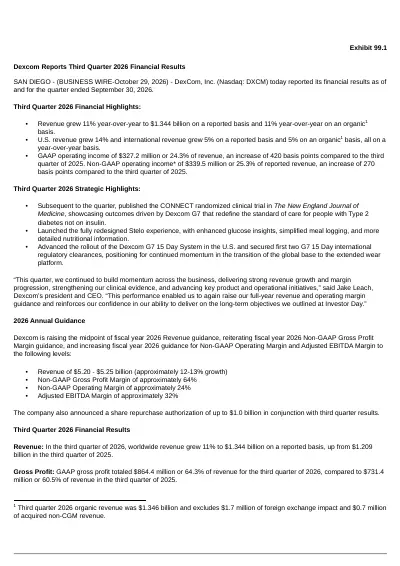
Thank you, Sean, and thank you, everyone, for joining us. Today, we reported third quarter revenue growth of 11% compared to the third quarter of 2025 on both a reported and organic basis.
Underlying our third quarter results are four key areas that advance our long-term vision we provided earlier this year. First, we continue to see strong momentum across the CGM category, driving our stable low-double-digit revenue growth with active base growth above those levels.
We once again gained share in the quarter, supported by prescriber and customer preference for Dexcom CGM, positioning us well as we prepare for significant access expansion. Second, our clinical evidence continues to strengthen the case for broader access to CGM.
Third, our product portfolio continues to advance, helping us deliver a more personalized and valuable experience for each customer. Fourth, our operational execution has given us upward momentum throughout the year, strengthening our scale and financial position, while also driving strong product performance in the field.
In the US, we again delivered strong revenue growth of 14% and captured share across the market. This extended a multi-quarter trend of share gains in the US, with our largest increase coming from customers with type 2 diabetes, including those not on insulin.
We continue to see greater physician awareness of the role Dexcom CGM can play across the spectrum of diabetes. This is contributing to growth today and preparing the market for a significantly broader coverage environment in the future.
Along those lines, we continue to expect CMS to announce a type 2 non-insulin coverage decision this year as the case for reimbursement is strengthening. Much of this confidence is driven by CONNECT, our type 2 randomized control trial, which is now widely recognized as the landmark CGM study for this population.
As a reminder, we announced the results of CONNECT this summer at the 2026 ADA Scientific Sessions and could not have been happier with the results. Over a 6-month study period, we saw a 1.6% A1C improvement for the Dexcom CGM group, which equated to a 0.9% difference in A1C between the CGM arm and the control group.
These are the strongest A1C results we have generated across our historic randomized control trials, which have helped shape standards of care and establish broad reimbursement. We now expect CONNECT to do the same thing for the type 2 non-insulin population.
Earlier this month, CONNECT was published in The New England Journal of Medicine. This provides an important level of independent validation and gives the study a prominent platform among clinicians, advocacy organizations, and reimbursement bodies around the world.
This marks the first time in nearly two decades that The New England Journal of Medicine published clinical data on the standalone use of CGM. While we believe our results speak for themselves, this publication reinforces both the quality of the data and its potential to reshape clinical practice.
As a next step towards broader coverage, we provided this publication update directly to the medical directors evaluating the submission for Medicare coverage expansion. We also look forward to seeing this evidence included in upcoming clinical standards, including the ADA Standards of Care, which is expected to be updated in the coming weeks.
CONNECT further strengthens the growing body of evidence supporting the broader benefits of CGM across metabolic health. This includes significant improvements across multiple studies in 10-year cardiovascular disease risk, blood pressure, cholesterol, triglycerides, and kidney disease progression.
Our expanding clinical evidence is supported by a product portfolio designed around the distinct needs of each customer. During the third quarter, we launched a fully redesigned Stelo app.
The new Stelo app experience is more intuitive and personalized, with enhanced glucose insights, simplified meal logging, and more detailed nutritional information. This is especially important because many Stelo customers are engaging with their glucose data for the first time.
Helping them understand how food and lifestyle choices affect their glucose can make the information more useful and actionable. Just as importantly, the redesigned app establishes a new software foundation for which our broader product experience can evolve.
Stelo gives us a platform to introduce new capabilities, learn from customer engagement, and ultimately bring the most valuable innovations across our broader product portfolio. This supports the goal we outlined at Investor Day to deliver greater personalization and engagement across every stage of the customer journey.
During the quarter, we also continued to advance the rollout of our G7 15-day system. With broad pump connectivity available as of this summer, customer adoption steadily built throughout the quarter.
This leaves us on track to convert nearly 50% of our US customer base to G7 15-day by year-end. Importantly, feedback from physicians and customers continues to be positive, particularly around the extended wear time, sensor performance, and updated patch design.
In fact, as the updated adhesive is rolling out into the field, we've already seen a 4 to 5 point improvement in 15-day survivability. We are now preparing to bring these benefits to customers outside the United States.
Earlier this year, Health Canada became the first international regulator to clear G7 15-day. Beginning in November, we will officially launch this product in Canada, marking the first of several planned international introductions in the coming quarters.
We also received clearance in the third quarter in Japan, positioning us for a launch in that market in early 2027. I'm encouraged by the level of execution we've delivered in 2026, including the third quarter.
During the quarter, we delivered further manufacturing efficiencies, improved freight costs, and saw strong product performance in the field. We also reached an important milestone at our Ireland facility, which recently initiated commercial production on schedule.
Ireland expands our manufacturing capacity and strengthens the resilience of our global supply network. With large-scale manufacturing plants now in the US, Europe, and Asia-Pacific, we have the capacity to support our ambitious growth plans ahead.
We are also expanding our digital customer support ecosystem into select international markets, including MyDexcom account. Building on the strong adoption we've seen in the US, these tools help simplify the support experience, improve efficiency, and save time for our customers.
This is another example of our commitment to setting the standard for customer experience. This continued progress reflects our team's focus and discipline throughout the year.
Across the business, we have advanced several important strategic initiatives, while continuing to deliver strong growth, margin expansion, and cash flow generation. As we look toward Dexcom's next chapter, it is critical that we have the right leadership and operating structure to scale with that same discipline.
In line with that goal, we recently promoted Jereme Sylvain to Chief Operating Officer, in addition to his responsibilities as Chief Financial Officer. Jereme is an exceptional leader and trusted partner with a deep understanding of every part of our business.
Expanding his role to include operations, quality, and customer success brings these functions even closer to our financial and strategic priorities as we work to reach millions more people around the world. With that, I will turn it over to Jereme.
Jereme Sylvain
Thank you, Jake. As a reminder, unless otherwise noted, the financial metrics presented today will be discussed on a non-GAAP basis.
Reconciliations to GAAP can be found in today's earnings release as well as the slide deck on our IR website. For the third quarter of 2026, we reported worldwide revenue of $1.34 billion compared to $1.21 billion for the third quarter of 2025, representing growth of 11% on both a reported basis and organic basis.
As a reminder, our definition of organic revenue excludes the impact of foreign exchange, in addition to non-CGM revenue acquired or divested in the trailing 12 months. US revenue totaled $970 million for the third quarter compared to $852 million in the third quarter of 2025, representing an increase of 14%.
As Jake mentioned, we again took share in the US market, with strong performance across all customer segments. This helped drive a nice acceleration in our US growth rate compared to the first half of the year.
Global new patient starts were near record levels in Q3, consistent with our expectation as seasonality continues to evolve in the business. Relative to the prior year, new customer starts were up in the third quarter, with these efforts amplified by our focused efforts on retention and utilization to maximize our growth algorithm.
International revenue grew 5% on both a reported and organic basis, totaling $375 million in the third quarter. As we've discussed in previous quarters, the second half of 2025 saw multiple reimbursement wins that we are lapping as we move through the third and fourth quarters of 2026.
We've seen a similar dynamic in prior years as the timing of these reimbursement decisions can create some quarterly variability in international growth rates. As usual, we expect this to be a short-term dynamic, with international revenue normalizing back to higher organic growth levels at the start of next year.
We are very excited about the business based on the number of drivers on the horizon, including new access wins, the rollout of G7 15-day, Dexcom ONE+ 15-day, Stelo, a full year of Dexcom Flex, and continued go-direct opportunities. We have not seen significant changes to our pricing environment, and we are executing the access expansion and go-to-market strategy that we discussed at Investor Day.
Our third quarter gross profit was $875.3 million or 65.1% of revenue compared to 61.3% of revenue in the third quarter of 2025. We delivered another quarter of strong gross margin performance, with margins up approximately 380 basis points compared to last year.
This reflected continued manufacturing efficiencies, further progress in freight and quality management, and a benefit from the continued ramp-up of G7 15-day in the US market. Operating expenses were $535.8 million for Q3 of 2026 compared to $468.4 million in Q3 of 2025.
Operating income was $339.5 million or 25.3% of revenue in the third quarter of 2026 compared to $272.9 million or 22.6% of revenue in the same quarter of 2025. We again delivered solid operating margin expansion during the quarter, despite increased investment in Ireland as we prepared that facility for commercial production.
Excluding the Ireland facility, we would have again delivered OpEx leverage in the quarter. Adjusted EBITDA was $435.2 million or 32.4% of revenue for the third quarter compared to $368.4 million or 30.5% of revenue for the third quarter of 2025.
Net income for the third quarter was $275 million or 73 cents per share. We remain in a great financial position, closing the quarter with approximately $1.8 billion of cash and cash equivalents.
Our cash flow generation continues to stand out, as we have now generated over $900 million of free cash flow through the first three quarters of the year. This enabled us to already execute our Investor Day goal of repurchasing $1 billion of stock in 2026.
Having completed that, we are announcing another $1 billion share repurchase authorization, in line with our commitment to deploy at least 50% of free cash flow generated over the course of 2027. During Investor Day, we also spoke to our broader framework for assessing tuck-in M&A.
Historically, acquiring international distributors has been one of our highest value uses of capital, and a key part of our strategy to transition to direct operations in select markets. Today, we are announcing another international distribution deal.
We recently signed a deal to acquire a business from a partner that allows us to go direct across high-potential markets in Europe. As we shared at Investor Day, these decisions to go direct help ensure that we have control and alignment as we significantly expand access to CGM in key markets.
Turning to guidance. We are updating our revenue guidance to be in the range of $5.20 to $5.25 billion, representing growth of 12% to 13% for the year.
At the midpoint, our updated outlook passes through the third quarter revenue outperformance, partially offset by approximately $5 million of incremental foreign exchange headwinds since last quarter. This also implies midpoint fourth quarter growth of 10%.
For margins, we are maintaining our full year non-GAAP gross profit margin guidance at approximately 64%. We are increasing our non-GAAP operating profit margin guidance to approximately 24% and adjusted EBITDA margin guidance to approximately 32%.
With that, we can open up the call for Q&A. Sean?
Sean Christensen
Thank you, Jereme. As a reminder, we ask our audience to limit themselves to only one question at this time and then re-enter the queue if necessary.
Operator, please provide the Q&A instructions.
Operator
Thank you. We will now begin the question-and-answer session.
If you have a question, please press star one on your touch-tone phone. If you wish to be removed from the queue, please press star one again.
If you're using a speakerphone, you may need to pick up the handset first before pressing the numbers. Once again, if you have a question, please press star one on your touch-tone phone.
Our first question comes from the line of Matt Taylor with Jefferies. Your line is open.
Matt Taylor
Hey, good afternoon, guys, and congrats on the nice results. Thanks for taking the question.
I thought maybe I'd start high level and wanted you to address the debate around category growth. We saw your competitor call out some pricing headwinds.
You just said in the prepared remarks you're not really seeing that. Maybe you could comment on that specifically, and what you think about overall category growth today before we're getting this CMS announcement.
Jake Leach
Thanks, Matt, for the question. I really appreciate the opportunity to be able to give you guys our perspective on this because there has been, as you mentioned, some recent noise out there about the category.
I think if you look at the way that this year's played out, from our perspective, nothing has changed in our view of the opportunity in front of us. We put out our LRP at our Investor Day this summer, and we're still extremely confident in that plan that we put forward.
As you look at the way we guided for this year, we looked at the current coverage environment, and we specifically mentioned that we didn't anticipate any expansions in coverage this year. At least that's how we based our plan.
We basically guided to a range of new customer starts with the bottom of our growth range strong customer starts, but not record. Then the top end of our guide would reflect a record year of new patient starts.
As you've seen, we've continually raised our guidance, and we're now guiding to the upper range of our original guidance we issued in January. That's because we're tracking to a record new patient year.
As you look at that against the backdrop of current coverage, we feel very confident in our ability to grow in this environment. Our active base growth is in the upper teens, and you can see the revenue growth.
We're confident in our ability to grow in this category.
Jereme Sylvain
To your question, Matt, on pricing. I think you asked the question on pricing, and can you talk to that?
I think it's pretty clear. We haven't seen degradation of pricing around the world.
Certainly, as we move outside the US into markets that are new for us, we have a product portfolio that we go in. I think we've matched the product portfolio to the reimbursement, and I think you've seen that be relatively stable.
I think we haven't seen some of the references that you've referenced with some pricing concerns, certainly not in the markets we've entered into and the markets we've been in. I think you'll see that ultimately reflected in our gross margins as our gross margins are the highest they've been since Q4 of 2022.
Operator
Our next question comes from the line of Robbie Marcus with J.P. Morgan.
Your line is open.
Robbie Marcus
Great. Good afternoon, and thank you for taking the questions or question.
One, I wanted to talk or ask about competition outside the US. Your competitor spoke to seeing pretty sharp pricing, mostly in cash pay.
I know you and them overlap, but not exactly. Some markets they're more exposed to than you.
What are you seeing outside the US? How do you feel about volume growth right now, and anything new on the competitive front?
Appreciate it.
Jereme Sylvain
Certainly I can take that. Certainly as we think about markets outside the US and monitoring pricing, it's been stable.
Certainly when it comes to reimbursement, and we'll start with reimbursement because typically that's how we've approached markets to begin with, we've seen that reimbursement is stable, and it's usually tiered based on the acuity of the condition. We've seen that play out.
It's why we have a product portfolio to match it, and to match what the need ultimately is. Again, it's been stable.
We don't exactly overlap. In all fairness to your point, there's a lot of markets I would say that maybe we don't overlap in where a competitor might be and we may not.
Ultimately, if there's a degradation in the existing business for that particular incumbent, there could be some impact there. For example, if you were the only CGM offering in a country and someone came in, there is a risk that the incumbent may have been overpriced into that window, and naturally with natural pressure, you come back to more market conditions.
What I would say is as we look at our portfolio and our offerings across the world and the market conditions that exist there from all competitors in that market, I think we're priced right. We haven't necessarily seen that degradation, at least in our book of business.
Competition, I think we compete well in those markets. Clearly the tiered portfolio is done to compete with the right patient with the right product.
When we get into these markets and we compete with that right product in that market, you can see we're taking share in those markets.
Operator
Our next question comes from the line of Travis Steed with Bank of America. Your line is open.
Travis, your line is live. Please check your mute button.
Travis Steed
Oh, hey, this is Travis, sorry. I guess I wanted to ask about there was a CVS contract loss recently.
I know you don't talk about payers too much, but maybe just talk about the potential when you do have contract losses that you're able to offset with revenue per patient, and how you think about your ability to still be confident in 10% plus revenue growth in '27.
Jake Leach
Hey, Travis. Thank you.
I think what I'll start is just talk a little bit about the landscape, particularly in the US, as you mentioned, payers and PBMs. Then I'll cover that.
I'll cover kind of how we view it, how we think things are moving forward, and then we'll also cover what we think the impact looks like for next year. If you look at the general access landscape in the United States, for CGM you've got formulary access through the pharmacy, and then you've also got medical benefit access.
Specifically on the formulary side, there's a lot of custom formularies. The specific contract you're talking about is a particular portion of a particular PBM access.
When we look at PBM formularies across the United States, we're generally in an equal access position, co-preferred with competitors. There are some where we're advantaged, and there are some where our competitors are advantaged.
One thing I want to be clear on is as we negotiate these contracts, we are always negotiating for equal access. We feel that that is the right thing for patients, it's the right thing for prescribers.
Ultimately, I think it's the right thing for employers and the plans that service them. We think we're very confident in our position to be able to compete in that type of a scenario, and so we're always pushing for equal access.
I think when these types of decisions are made, one of the things that I think is important to consider is sometimes it may be suggested that the products are comparable. I'll give you an example.
Imagine there's a child out there with type 1 diabetes been using Dexcom for 4, 5 years, powering an AID system, getting fantastic results, driven by the accuracy of our sensor, their ability to calibrate that sensor when they want to, and then the parents' ability to see their data through the Share Follow system anytime they want. Now if that individual tried to switch to a competitor, it is not compatible with their insulin pump.
There's multiple pumps out there that competitors are not compatible with here in the United States. They also lose the ability to use the Share Follow system in collaboration.
I think trying to consider that as a comparable product is not even in the realm of reality. The other example I'd give is if you have a prescriber who's prescribing Dexcom G7 to a basal insulin user because of the smart basal feature and the ability to hit those outcomes that both the patient and the prescriber want, that's not a feature that's offered by our competitor.
I think in the realm of maybe for certain patients the products are considered comparable, but for the vast majority, they are not. The good news, though, is that for patients who have potentially lost coverage through a formulary, through a pharmacy, most of them still have access through a medical benefit, and so they can still access the product through a DME.
Actually, one thing I wanted to mention is that we have a plan to launch a new system called Dexcom Direct. It is a service for patients that we've been building actually with the anticipation of the expansion into Medicare.
Our plan was as Medicare coverage expanded, we wanted to be able to help those folks navigate their coverage, whether it's through a Medicare Advantage plan or through a medical benefit fee-for-service, durable medical equipment benefit. That system was being developed very similar to some of the other direct services that you see out there in the marketplace, and it's all about helping our patients get access to our technology.
Again, we were originally planning to launch that in front of the Medicare expansion, but with that capability launching early next year, it is a perfect place where the patients, anyone, not just this example, but anyone who's having challenge getting access to our technology can go to Dexcom Direct, and we'll walk them through every step of the way to ensure that they get access to the technology they need. Jereme, you want to talk a little bit about how we see it move forward?
Jereme Sylvain
Yeah. Thanks for the question, Travis.
Maybe I'll give you guys some context to at least how we see it in the context of next year. I know we're not going to give guidance next year.
I do think it helps give you confidence around LRP starting point for next year. The PBM we're talking about represents less than 4% of our US revenue results.
Relatively small in the context of our overall company. Typically when you think about an arrangement where you have exclusivity or preferred one-of-one, even though it says one-of-one, you typically don't get all of it.
You might get two-thirds of customers and a third go through various pathways, whether it's off-formulary or other opportunities. Obviously, when you have that preferred status, there's differences in price tiers that you could probably imagine.
That's the way you typically negotiate these things. If you move off of preferred into the secondary, it typically comes with a pretty significant price increase.
The expectation is while we navigate through this from a financial perspective, and we'll talk about the patient perspective here in a second, the expectation is it doesn't necessarily have that much of an impact on our next year results from a financial perspective. Because we do expect to, even though there might be a flip in terms of patients, the reality is we expect obviously the remuneration to change as a result of that.
That's the financial piece of it. I think it's important to understand.
It's important context to size it. The underlying reality, though, and Jake alluded to it, is we don't like being in these situations for our patients.
That's one of the things, the reason why Jake alluded to Dexcom Direct, and working really hard to make sure there's limited patient disruption. Because at the end of the day, what we want to do is come back to our mission, which is empower people to take control of their health.
It means having access to product, making sure we don't disrupt their daily lives. We're going to work hard to make sure we keep every single patient undisrupted as much as possible through this process, against the backdrop of we don't expect to have much of a significant impact on our next year financial results.
Operator
Our next question comes from the line of Larry Biegelsen with Wells Fargo. Your line is open.
Leigh Huang
Hi, it's Leigh calling in for Larry. Thanks for taking the question.
You mentioned some impact from the PBM change being modest. Can you talk about any other top-line, bottom-line puts and takes for '27?
The consensus revenue number out there is roughly 11% growth, that's near the floor that you laid out. How should we think about US, OUS growth, just given kind of the coverage expectations?
Thank you.
Jereme Sylvain
We'll go back to kind of what we talked about at Investor Day in terms of how to think about it. We'll give guidance at the right time.
In terms of how we've talked about exiting 2026, obviously we've made some really nice progress over the course of the year on gross margin. We're going to turn on Ireland here in the fourth quarter.
I'd expect there to be a little bit of an impact of Ireland ramping up into the first part of next year. At the end of the day, underneath it all, you're still going to see more and more progression of a move to 15-day product.
Here, certainly in the US, talked about launching it in Canada, and we have a couple other markets that are going to be launching here 15-day relatively soon. You should start to see some of those tailwinds starting to play through next year, and then obviously we won't have the start-up costs associated with Ireland.
Those are some interesting puts and takes as we move into next year. We'll go ahead and give the guide for next year officially as we get to that point.
I think hopefully that gives you some puts and takes, at least to think about it, that we've historically talked about. Then, of course, we'll give you more as the right time comes.
Operator
Our next question comes from the line of Jeff Johnson with Baird. Your line is open.
Jeff Johnson
Thank you, guys. Good afternoon.
Maybe if I could just ask a follow-up question on the CVS question that was already asked. Jereme, as you explain some of those patients who might no longer have preferred access might be willing to pay the higher price to come off that preferred, typically what would that price increase look like?
If I'm a patient who no longer has preferred access, what would I be paying per month as an increase to stay on Dexcom number one? Number two, I know you're working with a group to try to move some of these patients, as you talked about, from pharmacy to medical.
Can you just help us understand the mechanics of that? If I'm a Dexcom G7 wearer, can I just call that group that you're working with and say, 'Hey, move me to my medical.'
Do I even know as a patient what that means? Typically what is my DME copay relative to my pharmacy copay?
Thanks, guys.
Jereme Sylvain
Sure, thanks, Jeff. While we won't get into specific pricing because there's obviously some competitive reasons behind that, it would typically be pretty sizeably higher.
The reason is obviously exclusive is very different than non-preferred. That's always embedded in contracts, and so it goes up by a pretty significant amount.
That at least gives you some context. It's not like a 5% increase.
It's much, much, much higher than that. In terms of then, well, what do I do?
How do I navigate through this? Typically what you would have to do is you'd have to have the script.
You'd write the script, and the script would go to either the DME or the pharmacy. In this case, you'd write the script to the DME provider, and the DME provider then go ahead and check against your medical benefit, do a prior authorization as needed.
And/or if you want to go through the prior authorization route with the actual PBM, which you also have that opportunity as well, that would go through it. This is where Jake's refer to Dexcom Direct comes directly into play there.
That's where you can send a script there, we'll do the work for you. It makes it much easier for folks to understand, okay, where do I have access?
What are my opportunities? Can you canvas the landscape for it?
Do I want to go cash pay? Do I want to go DME?
Do I want to try for a prior authorization? Again, we'll do that work for you.
Hopefully that makes it much, much easier for the patient. I think it's a good opportunity for us to make sure that we're doing that work for them.
The copay, it varies. It really depends on your individual insurance.
What's happened typically is a DME will have a contract with the payer, or with in this case, the medical benefit payer. Sometimes it's a percentage of the total list price.
Sometimes it's a flat rate. It really depends.
We typically see it in that 10% to 20% of total pay range per month. In high-deductible health plans, you have the upfront costs, but then you get to full coverage going forward.
We've kind of talked about this historically as we had a DME business. It depends on the individual payer contracts, but obviously we'll work best using that Dexcom Direct portal to try to maximize the opportunity for the individual.
Hope that helps, Jeff.
Operator
Our next question comes from the line of Matthew O'Brien with Piper Sandler. Your line is open.
Anna Runci
Hi, this is Anna on for Matt. Thanks for taking our question here.
Just wanted to ask on the CONNECT data, now that that's fully out, wondering how much of a contributor NIT type 2 patients were to the US new patient start number in the quarter. I know it's still pretty early days, but, just given that commercial coverage still exists for a pretty sizeable chunk of the market, are there any signs that CONNECT is starting to shift that mix?
To the extent possible, how much of the improvement in the quarter reflects the growth of the category versus share gains? Thanks.
Jake Leach
Thanks, Anna. When we think about CONNECT, we're very excited to see it published in such a prominent journal, which really changes the conversation out there and it makes the data very accessible to a large population of physicians and clinicians who read that journal.
What I'd say is it's additional evidence. We already had a pretty significant amount of evidence, but this now being kind of the landmark, irrefutable evidence of how Dexcom CGM can drive improvements in this population, it's really around helping our team that's out in the field raise awareness to the fact that we have these outcomes.
It's really changing the conversation out there more towards very broad coverage expansion as we prepare for that. When you think about new patients, to your question, we are seeing a good number of non-insulin users in our new patient numbers.
The insulin users are still the largest group, but the non-insulin users are not too far behind when you look at new patient numbers per quarter. As we continue to see awareness of the coverage, I think that's been what we've been working on, is making sure people are aware of that coverage.
Because it wasn't very long ago that we got that commercial coverage for non-insulin users, and we're basically priming the pump for when the Medicare expansion occurs. That way it'll be much easier for prescribers because you get to the point where when Medicare moves, then you'll see some more of the commercial plans move, and we get to the point where anybody who has diabetes should have access to a CGM because of the benefits that we can provide across that broad spectrum of patients.
The CONNECT data is extremely helpful in carrying that message to all those prescribers.
Jereme Sylvain
Then to your question on the overall market, you kind of look at the overall market. It remains stable.
I think you've got two of the three largest CGM players out there, and you combine the two and you're still in the low double digits, specifically in the US in terms of revenue growth.
Jake Leach
It's still a stable market. Obviously, if you look at the results, you can see it in various other forms, I think we're doing a nice job taking share.
A good chunk of that is us taking share there, but it is a stable market. I think we're excited to see it continue.
Operator
Our next question comes from the line of Joanne Wuensch with Citi. Your line is open.
Joanne Wuensch
Hi. Thank you so much for taking the question.
Did you update on the timing of expectations for non-intensive type 2, either the proposal and/or the implementation? Can you please update us on the timeline or expectations for G8?
Thank you.
Jake Leach
Hey, hi. Thanks, Joanne.
We haven't changed our perspective on the Medicare timing. We still anticipate hearing back from Medicare around a coverage decision this year, and then our current plan has that coverage taking effect middle of next year.
Nothing has changed there, very very consistent. It's consistent with the conversations we've been having.
I've been spending quite a bit of time in Washington talking to lots of different stakeholders. We've got our advocacy groups, lots of discussions going on around this coverage.
As mentioned in my prepared remarks, we made sure that the Medicare directors for making this decision had access to the CONNECT data. It was actually funny, they were very aware of the data even before it was published in the New England Journal, which I think is helpful, but we did make sure they had the official notice of that.
No nothing has changed on that front at all. Then on G8, the teams are continue to make fantastic progress on that technology.
We're seeing amazing results in the clinical studies that we're running around the accuracy and performance of that platform. It's a whole new platform for us with a new electronics, new sensor, everything kind of built into a 50% smaller volume with more capabilities than we have in the G7 platform.
Making fantastic progress on that, and so nothing has changed in that timing either. We're still targeting, depending on regulatory review timelines, either launching at the end of next year or early 2028, kind of depended on those timelines.
Everything's very much on track.
Operator
Our next question comes from the line of Jayson Bedford with Raymond James. Your line is open.
Jayson Bedford
Good afternoon, and congrats on the progress. I wanted to ask about the distributor deal that you announced, and see if we can get a bit more detail.
What percent of your international business is covered by this distributor, and was there any impact in 3Q or an anticipated impact in 4Q? Thanks.
Jake Leach
It's a good question. We'll have more specific details on it as we come up.
We've signed the deal, it has not closed yet. It's not going to impact this year, it's going to close next year, Jayson.
I think so in short, no impact in Q3, no impact in Q4. It certainly is a growth lever as we move into next year, as we lean into that market.
It is essentially our largest remaining distributor market in Europe. We'll be doing some work about taking that direct, very excited about that opportunity here soon.
We are in the kind of signed-to-close phase, and the close will take a little while just because there's a lot of conditions that we have to go ahead and address. Thanks for the question.
Probably have a little bit more about it as we get closer, and certainly as we close the deal, we'll kind of give you a feel for what that size looks like, what the impact looks like. Ultimately, we'd expect, as you might expect, as we take these distributors direct, as a growth lever, we are willing to invest in our business in a way that obviously others may not be.
Operator
Our next question comes from the line of Steve Lichtman with William Blair. Your line is open.
Steve Lichtman
Thank you. Hi, guys.
Jake, you mentioned the upcoming ADA Standards of Care update. Where do you hope that lands now with CONNECT in hand and published, and do the potential changes there give you more confidence in the ultimate coverage decision by CMS?
Jake Leach
Thanks, Steve. We anticipate that the CONNECT data is going to influence the standards of care.
What it really is, it's all about the level of evidence. The CONNECT study is level A evidence, and so when you have level A evidence, it is a strong recommendation for use of the technology in that population.
We very much believe that that will have a significant impact on the standards of care, basically making CGM the standard of care for anybody with diabetes now that we're rounding out the broad NIT group. Everything from type 1 through the different stages of type 2, CGM can has a significant benefit.
We do anticipate that. When it comes to confidence, yeah, as standards of care change around the world, coverage also changes.
As some payer systems recognize it sooner than others, but I think the important thing that we do is just keep the volume up on the noise around the benefits and make sure that everyone's aware of this new evidence that we've generated. We're going to continue to generate evidence.
We're not done here. This is NIT, but as we look to the future, there's still lots of opportunity.
You think about the prediabetes population, being able to screen that population and help them either prevent diabetes, reverse their prediabetes, or significantly slow that progression of diabetes and all of the complications, as I mentioned, that come along with that. We're very very excited about that publication and it being out, our ability to talk about it, and do feel like it's going to change standards of care around the world.
Operator
Our next question comes from the line of Bill Plovanic with Canaccord Genuity. Your line is open.
Bill Plovanic
Great, thanks. Good evening.
Thanks for taking my questions. Mine is around G7 15-day and the exit rate on 2026.
I think is your commentary changing? I think you said nearly 50%, you thought 50% in the past.
I know it's a nuance. Then just secondly, how much will Ireland impact this year?
Based on the guidance, it's 130 to 150 bps sequentially. Is that how we should be thinking it?
Then it gets better as you get into Q1 and Q2 of next year as you're absorbing that overhead? Thanks.
Jereme Sylvain
I think the 50% has always been nearly 50%. When we kind of gave a read coming into the year, I think the question was, are you going to get to half?
I think we said nearly 50%. By the way, it's tracking great towards that.
We're continuing to make good progress. Again, when we say nearly 50%, again, you're kind of making an estimation 12 months from now, and I've got to say, we're pretty darn close.
Certainly happy to see that, and that's been pretty consistent. That would be the thoughts there.
In terms of the jump-off point into next year, look, you can see some of the underlying improvements in 15-day, obviously, over the course of this year. A lot of that, ultimately, is also the work we've done around working on scrap and freight and some of the challenges that we had in the prior year.
You guys are paying close attention to it, you've seen our inventory levels stabilize on our books, and I think that's really important. That's allowed us to be more efficient as we've navigated through kind of how we're going to get product around the world.
All of that has contributed. What I think is great is you can see what happens in our gross margin with the existing facilities that we have.
That's great, it's a starting point. Now, obviously, we're guiding to a bit of a step back here in the fourth quarter.
That's just going to be some of the turn-on of Ireland. As we took a step back, it usually takes a few quarters for a facility to get up to kind of a normal volume ramp or you start to get back to normal.
We'll have some of those that drag into the first and to a lesser extent, the second and third quarters. Remember, these variances, they do amortize.
Even as you're getting more and more efficient, it does take time for when you make it to when you ultimately then distribute into the system. I would expect us to take a little step back from Ireland, obviously, in the fourth quarter as we move into next year.
Underneath it all, Bill, I think the most important part of this is you can see where our exit rate is prior to Ireland, and obviously as Ireland gets up to speed where our opportunity is. That's prior to having 15-day as a majority of our product.
Obviously, if we're getting to nearly 50% in the US exiting this year, next year we would expect a majority of our product, obviously, to be on G7 15-day. I think there's some real opportunities here.
We've laid out some of kind of the progression drivers at Investor Day, those are absolutely intact. I think it's that continued progression I'd expect to see into next year.
Give you a little bit more color when we give official guidance, but I'd expect us to continue to make progress into next year's gross margin.
Operator
Our next question comes from the line of Mike Kratky with Leerink Partners. Your line is open.
Mike Kratky
Hi, everyone. Thanks for taking our question.
You mentioned your focus on utilization and retention metrics. To what extent are you seeing those having a detectable impact in terms of your US growth in 3Q, and can you help frame that magnitude?
Jereme Sylvain
Thanks, Mike. One of the things we've been really, really focused on, and I encourage you to if you pay attention to all the work we're doing around customer success, and the work we're doing around, obviously, the product, and doing all we can around enhancing the product experience.
What we're seeing is a very stable retention and utilization. That's across a base that's growing more and more in the type 2 NIT space.
I think that's a positive thing. We are doing some of that work.
While we don't necessarily break out this is the bips from this and this is the bips from that, I think what's important is the question often comes up, well, do you expect your retention and utilization to wane over time, especially as more and more folks come into the category? I think the answer is it's holding steady based on all the work we're doing around it.
I think that's just an important thing to hold in the back of your mind. We're moving to more and more folks.
Those folks, I think, are seeing the value. Where there's an opportunity to improve the customer experience, we're absolutely taking advantage of it.
We're not done. There's a lot of things we're going to roll out here in the fourth quarter and into next year that we're really excited about.
Something that we launched in the third quarter, we talked about MyDexcom account and a new platform that we rolled out in the US in the past. That rolled out in Europe already at this point.
It's rolling out in APAC shortly after that. That really starts to enhance that customer experience so that someone once they get on the product, if they do have an issue, how do we help them?
How do we help them in an efficient manner? How do we make sure we meet their needs?
Then what we hope to do is how do we make it an excellent experience where they continue to come back and they see it as a differentiator? We're going to continue to work on that.
More to come on all the initiatives, and you'll start to see them coming out time after time. I think the most important part is those concerns that folks may have had around retention, utilization as we expand deeper into the population, I think the work we're doing is holding those steady, which is a great thing.
Operator
Our next question comes from the line of Daniel Markowitz with Evercore ISI. Your line is open.
Daniel Markowitz
Hey guys, thank you for taking the question. I wanted to talk a little bit about the basal opportunity.
Can you talk about where we are in terms of contribution from smart basal, and if we could really see that step up, and if so, when?
Jake Leach
Thanks, Daniel. The smart basal technology, we've been continuing to expand our pilot launch of that technology, and we're seeing really good results both when it comes to patient and prescriber satisfaction with the system, as well as the outcomes it's driving.
What we're seeing is most of these patients are getting to their optimum basal dose in about 3 weeks, and that's with no hypoglycemia, which is one of the things that folks could be challenged with if they don't have a system like this. It's rapidly getting folks to their optimum dose, driving the outcomes.
The thing that the prescribers love about it is the patients are actually taking their insulin and they're seeing the A1C levels come down. We continue to broaden the pilot there.
One of the things we've learned is, and we've made a bunch of adaptions to the system around the workflow. One of the things that we knew was that we designed the system for both patients and prescribers and the different user interfaces.
What we've learned over time is that based on some of the variability we see in the different setups at the clinics, we've needed to make changes the way we manage accounts, the way we make connections. The other thing, too, is many of these prescribers want to see this capability in the EHR, we've been using all this time to basically optimize the system to be able to roll it out even more broadly.
One of the things we're working on, too, is right now the system is compatible with the most popular basal insulin, insulin glargine, that's out there. We're also now working to expand the algorithm's capabilities to do degludec and some of the higher concentration insulins.
What we've learned is that to really make this an impactful feature, we want to have more compatibility with insulins. I feel that this is a very strong capability that's going to help drive our share in basal even higher because when a prescriber is thinking about basal insulin for a patient, this is the type of system you can put them on and ensure that they're going to get to that dose and ensure that they get the outcomes they're looking for in a easy and efficient way.
Because the patients love it so much, they're going to take their insulin, they're going to get that outcome. It has an opportunity to really expand the share that we are taking in that basal market.
More to come on exactly when we're going to roll it out more broadly, but we do ultimately intend to launch it across here in the US broadly, as well as internationally, because there are basal users all over the world that could benefit from this technology.
Operator
Our next question comes from the line of Kieran Ryan with Deutsche Bank. Your line is open.
Kieran Ryan
Hi there, thanks for taking the question. It kind of ties into the last question there, but I wanted to ask kind of about PCP prescriber growth and productivity.
Maybe you can talk a little bit about kind of how that's trending, where you're at on sales force coverage penetration of that broader type 2 PCP market. Then kind of within that, anything you're learning on the non-insulin side as far as turning that coverage into starts ahead of Medicare, which I know is what would really move the needle there.
Thanks.
Jereme Sylvain
Thanks for the question. This is Jereme.
What we've seen in that space, maybe I'll start with the sales force and then kind of the learnings that are coming out of it. In terms of the sales force, we made the decision to expand the sales force a few years ago.
It was with basal, but ultimately with NIT in mind. We did that work, and what we found over the years is there might be groups and areas that pop up and we might slightly modify sizes of territories because new prescribers are popping up.
I think we're doing a nice job tweaking without making massive changes to the sales force. That's the first start is I think we have a pretty stable sales force.
I would say a stable and efficient sales force, which is great. We're seeing great results from that team.
One of the things that we've learned is we've learned that one, it's important to find the right prescribers that have the right patient group. Obviously, if it's a NIT group with all Medicare patients ahead of Medicare expansion, it doesn't make sense to go and push non-insulin there.
It's one of those things where as we learn more and more about the prescribers and ultimately how they're prescribing, what they're prescribing, I think the team is getting ever more efficient about making sure they customize the approach as they get to the physician's office. Because you know this, I know this, we've all talked about this, you only get so much time with the physician in a primary care office.
They're very, very busy. They're seeing patients all day long.
It's making sure we're maximizing those touch points wherever we can, and we're using all sorts of tools to do it. I think that's the other piece as well we've learned, is making sure we're using tools internally that make us more efficient on those call points, but also using tools and creating tools that we bring into the physician's office like coverage calculators and ways they can understand who and who does not have coverage to make sure they're efficient and who they prescribe for and how often they prescribe.
The learnings continue. I think we're getting better and better at it, but of course there's always opportunities to continue to learn.
Operator
Our next question comes from the line of Richard Newitter with Truist. Your line is open.
Ravi Misra
Hi, it's actually Ravi here for Rich. Just I want to turn back to the payer comments with CVS.
Just trying to understand how you size the risk of potential other payers that you're with going to exclusive peer platforms. Then on Dexcom Direct, can you just walk through the impact that would have on maybe the backend and profitability per patient?
DME used to require a little bit more investment. How does that kind of compare to what this should offer today?
Jake Leach
Thanks for the question, Ravi. As we look at it, most of the formularies are, as I mentioned, co-preferred.
I think they're like that for a reason. It's about ensuring that their customers, ultimately they're in the business of serving beneficiaries, and at this point in time, their beneficiaries want the choice of the systems they use, as do the prescribers and as do the employers.
That's why when you look at these employer plans and the custom formularies that many folks operate off of, they have choice. I think that's because that's what the customers want.
Now the 2027 formularies are already kind of locked in, there's no near-term issue there. As we continue to have conversations throughout the market, we're going to make sure people understand the benefits of our technology as well as our push to ensure that there's equal access for patients so they can get the technology they need.
Jereme Sylvain
To your question on Dexcom Direct and how that works from an economics perspective. Certainly, we've talked about this other times in the past where there's certain channels that tend to be higher reimbursed, DME.
There's kind of the middle, which we'll call government. Then there's kind of pharmacy commercial.
All those incur whatever the underlying OpEx burden is associated with it. You're 100% right there.
As more folks move, for example, from one location to the other, certainly the costs associated with right-sizing, and we've kind of got a pretty good structure to navigate through those right now. I don't expect there to be a significant underlying cost structure for us because we've already kind of invested in high-volume capabilities across both.
There'll be a little bit of a cost of hand-holding that goes through it, you're absolutely right. There'll be a cost underneath it to support the benefits check, the white-glove service that we expect to provide for folks.
That would all be embedded in kind of sort of the run rates and investment areas that we make as an organization. In the context, you are right, there's a little bit of an incremental cost associated with it.
We'll ultimately be able to assume that into what I'd say is our growth algorithm because we do make investments. Every year we make investments in the business, and this is one we intended to make irrespective of this announcement.
We wanted folks, especially as you had CMS expansion, to know what their options were. Because you remember, CMS expansion is one side on the fee-for-service side, but then you've got to navigate to the Medicare Advantage side.
Making sure that we're helping the population navigate through what's a pretty complicated environment, that was always part of the plans. It'd be part of what our long-term plans were when we set our LRP out, quite frankly.
This is something we've been thinking about for a long, long time.
Operator
Our final question comes from the line of Marie Thibault with BTIG. Your line is open.
Marie Thibault
Hey, great. Thanks for squeezing me in.
I wanted to ask a little bit about operating expenses. You've been exceeding expectations on operating margin, and I know you raised the target here for the full year.
How should we be thinking about Q4 exiting 2026? I know obviously some dynamics with Ireland and shifting spend there, and you've answered the question on not needing to expand the sales force.
What else should we be looking for on OpEx and investments needed there, whether that's G8 or other priorities like that? Thanks for taking the question.
Jereme Sylvain
Sure, yeah. I think, at least as we think about OpEx for the remainder of this year into next year, you're 100% correct.
We are going to make sure we invest in G8. We've obviously got some clinical work to do for G8 as we get ready for submission to the FDA.
There'll be some investment there. I would expect to see us continue to invest in, obviously expansion, and we talked earlier about Dexcom Direct, and some investment there.
At the same time, remember, we are not investing in an Ireland expansion next year. There's an opportunity to gain leverage there.
We'll make the right investments in the business to drive growth. I think you've seen our LRP expectations, and you've seen us historically be able to do it.
We can invest in the organization, and we do invest in the organization. Every year, we add a couple hundred million dollars to OpEx.
We'll continue to do that, but we can do that while gaining leverage as we're going through the process. I'd expect us to make the investments we need to make, but also continue to be able to get the leverage we need to over time in 2027 and quite frankly, beyond.
We laid it out in the LRP. Nothing's changed from our thoughts on how we can track towards that.
Thank you for the question, and thank you for the acknowledgment over time. It's been a lot of work and great work by the organization in getting that leverage.
Operator
That concludes our question-and-answer session. I would now like to turn the call back over to Mr.
Jake Leach for closing remarks.
Jake Leach
Thank you, Abby. I just wanted to close the call by saying how proud I am of the execution we delivered this quarter and throughout the year.
The progress really reflects the commitment of our employees around the world, and I do want to thank them all for everything they do for Dexcom and for the people we serve. We're confident in our plan, we're energized by the opportunities we see ahead of us, and we're focused on execution.
As we head into November, which is National Diabetes Awareness Month, it's a meaningful reminder of why the work we do matters and the positive impact we can have on the lives of millions of people living with diabetes. Thank you all for joining us.
Operator
Ladies and gentlemen, this concludes today's call, and we thank you for your participation. You may now disconnect.