Dycom Industries, Inc.
Q3 FY2027 · Earnings Call TranscriptNovember 24, 2026
Operator
Good day, and welcome to the Dycom Industries, Inc. third quarter 2027 results conference call.
At this time, all participants are in a listen-only mode. After the speaker presentation, there will be a question-and-answer session.
To ask a question during the session, you will need to press *11 on your telephone. You will then hear an automated message advising your hand is raised.
To withdraw your question, please press *11 again. Please be advised that today's conference is being recorded.
I would now like to hand the conference over to Ms. Callie Tomasso, Dycom's Vice President of Investor Relations and Corporate Communications.
Please go ahead.
Callie Tomasso
Thank you, operator, and good morning, everyone. Welcome to Dycom's fiscal 2027 third quarter results conference call.
Joining me today are Dan Peyovich, our President and Chief Executive Officer, and Drew DeFerrari, our Chief Financial Officer. Earlier this morning, we released our fiscal 2027 third quarter results along with certain outlook information.
The press release and accompanying materials are available in the Investor Relations section of our website, including the Outlook Expectations Summary document, which provides additional outlook metrics beyond what will be discussed on today's call. These materials, which we will discuss during today's call, include forward-looking statements made pursuant to the safe harbor provisions of the Private Securities Litigation Reform Act of 1995.
Our discussion and these statements reflect our expectations, assumptions, and beliefs regarding future events and are subject to risks and uncertainties that could cause actual results to differ materially. A detailed discussion of these risks and uncertainties is included in our filings with the SEC.
Forward-looking statements are made as of today's date, and we undertake no obligation to update them. Additionally, we will reference certain non-GAAP financial measures during today's call.
Explanations of these measures and reconciliations to the most directly comparable GAAP measures can be found in our press release and accompanying materials. With that, I will turn the call over to Dan Peyovich.
Dan Peyovich
Thank you, Callie, and good morning, everyone. We appreciate you joining us today.
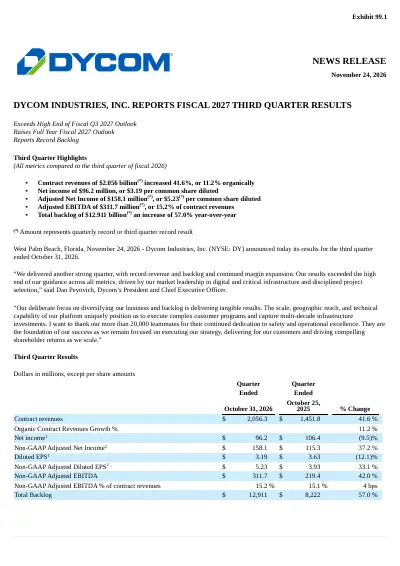
We delivered another strong quarter with record revenue of $2.06 billion, and adjusted EBITDA of $311.7 million, or 15.2% of revenue. Adjusted EPS was $5.23.
Every one of these results exceeded the high end of our guidance. Our performance this quarter is a direct result of our market leadership in digital and critical infrastructure, paired with strict discipline in project selection to maintain the quality of our revenue and backlog.
Quarterly revenue grew 41.6% year-over-year, including 11.2% organic growth in Telecommunications. Consolidated adjusted EBITDA grew 42%, and adjusted EPS grew 33% year-over-year, demonstrating our commitment and ability to deliver attractive returns for shareholders as our platform scales.
During the quarter, we significantly accelerated our share repurchases, taking advantage of the compelling value in Dycom shares to buy back $100 million of our common stock. As announced this morning, our board of directors has replaced the prior program with a new $200 million program for future share repurchases.
We finished the quarter with record total backlog of $12.9 billion, a book-to-bill of 1.3 times, and year-over-year backlog growth of 57%, including 36% growth in Telecommunications. This growth gives us visibility and confidence in our long-term growth prospects, and we continue to diversify our backlog across demand drivers, positioning ourselves for durable growth in the coming years.
Turning now to our segments, beginning with Telecommunications. We had a strong third quarter and expect a solid finish to the year.
Telecommunications revenue grew more than 11% in the quarter and is up 17% year-to-date. That performance is backed by robust underlying demand.
The country's ever-increasing data consumption requires significant, sustained investment in digital infrastructure, specifically in the outside plant and inside plant networks we build. Our foundational service and maintenance platform directly supports our high-growth program builds.
Maintaining and repairing our customers' networks day in and day out embeds us deeply into their operations, giving us unmatched visibility into their infrastructure, established local workforce capacity, and trusted relationships at the field level. That presence, combined with our national scale and deep technical expertise, gives us a decisive advantage in winning and mobilizing large-scale deployments across numerous types of build programs, including fiber-to-the-home, BEAD, long-haul and data center interconnect, copper reclamation, and wireless network modernization and densification.
We are pursuing large, long-term opportunities across these diverse programs that is driving durable growth in Telecommunications. Following this year of incredible growth, we expect next year to return to a more normalized growth cadence.
Based on our current visibility into customer build plans, we anticipate mid-single-digit revenue growth in the Telecommunications segment for fiscal 2028, accelerating to higher growth levels in fiscal 2029. We also expect adjusted EBITDA margins to expand year-over-year, and we will provide formal fiscal 2028 guidance on our fourth quarter call.
As we have continued to diversify our business, our fundamental growth drivers remain strong, with some near-term shifts in customer dynamics as pacing in some programs moderates and others accelerate. Let me walk through each of those drivers.
I'll start with fiber-to-the-home, which has been our largest demand driver this year, fueled by increased deployment across key customer programs and our strong competitive position, which has resulted in a significant increase in our leading share of the market. This has been a year of exceptionally strong growth in our fiber-to-the-home business, with revenue up 50% through Q3.
We continue to see many years of activity ahead as customers continue to reiterate their long-term build commitments. Having said that, the macro environment, combined with a higher cost of capital, is having an impact on regional fiber overbuilders, and some programs have slowed.
What's most relevant to Dycom is the effect this is having on several of our large customers who, as the market has seen, have in recent weeks indicated decisions to moderate the pace of their fiber-to-the-home builds next year. Given this near-term shift in dynamics, we expect fiber-to-the-home revenue to be down in fiscal 2028 when compared to fiscal 2027, though still performing at levels above fiscal 2026.
It's important to note that our customers remain committed to their buildout plans, we expect this to ultimately result in a higher pace in future periods or an extension of the fiber-to-the-home build cycle, which increases our confidence in the sustainability of that growth over the longer term. Next is BEAD.
Many of our customers are preparing for rural fiber passings through the program. We remain well positioned to capitalize on these opportunities and continue to expect construction to start in earnest next year.
Continued rapid growth in data consumption, cloud compute, and AI are driving the need to connect data centers across the country. We have spoken in the past about the multiple long-haul and data center interconnect opportunities we have been pursuing as customers broaden their fiber investments, and we continue to make strong progress on this front.
Long-haul and data center interconnect builds are tracking ahead of initial expectations and will be the leading growth driver for our Telecommunications segment next year. We got out in front of this demand early, performing several hundred millions of dollars of work-in-place over the past two years.
Our total contracted backlog to date, including contracts executed after the quarter end, has more than doubled from last quarter and now exceeds $2 billion, giving us a strong early position against the $20 billion opportunity set we identified two years ago. Copper reclamation is also expected to become a meaningful multiyear contributor as programs ramp in fiscal 2028, further diversifying the growth drivers supporting the Telecommunications business.
Customers are increasingly focused on retiring legacy copper networks as they migrate subscribers onto fiber. At current copper prices, salvage proceeds offset decommissioning costs, making these programs highly capital efficient for our customers.
Our wireless equipment replacement program has performed well and is on track to wrap up next year as expected. From there, we are well positioned for future network modernization and densification opportunities.
Lastly, customer consolidation is providing another meaningful tailwind. We continue to expect further consolidation across network operators in the coming years.
As our customers scale and integrate acquired footprints, they consolidate their vendor base around national partners with the balance sheet, safety record, and workforce capacity to execute across multiple states, a trend that favors Dycom. We have been deliberate in diversifying our backlog to balance the timing and velocity of each demand driver, and taken together, the program builds provide sustainable growth opportunities well into the next decade.
Our early identification and pursuit across a diverse set of programs is driving the continued growth of the segment, as these new programs more than offset the moderating pace of fiber-to-the-home work. Our record backlog, deep customer relationships, and position at the center of both converged broadband and AI infrastructure give us tremendous conviction in strong growth in the years ahead.
Shifting to Building Systems. Our strong execution continued this quarter, driven by robust demand for both electrical and structured cabling systems.
We delivered solid growth in the quarter while also securing new awards that extend our visibility beyond calendar 2028. In addition, the integration of National Technology Integrators is progressing well, and the business is performing in line with our expectations.
Our strategy is clear: differentiate through performance and pursue markets with resolute drivers for growth. Evidence of our success can be seen in our revenue growth and margin performance in the DMV region.
It's also visible in our growing structured cabling platform, which has expanded to 19 states as key customers bring us into new geographies to support their buildouts. As we engage with our customers to partner on their builds, we have not observed material changes in underlying customer behavior or planned scope as a result of recent policy and permitting uncertainty.
In fact, customer conversations continue to reinforce our confidence in the scale and duration of the data center build cycle. Looking ahead to fiscal 2028, we expect Building Systems to generate total revenue growth in the high teens or better, with adjusted EBITDA margins that range from the high teens to low 20s, building on a year of exceptionally strong performance in fiscal 2027.
Because this higher-margin segment is growing faster than Telecommunications, we expect this to drive continued consolidated margin expansion. Demand continues to grow, our focus remains steadfast, and we are well positioned to capitalize on the long runway ahead.
Reflecting our outperformance in Q3, we are raising our full-year revenue outlook to range from $7.66 billion to $7.73 billion. This represents an increase of approximately $125 million at the midpoint compared to our prior guidance range.
Moving to our strategic priorities, I'd like to highlight four updates. First, we are pleased with our ongoing progress in talent and workforce development.
Remaining an employer of choice and training a best-in-class field workforce is central to our ability to scale across complex programs. Second, expanding our Building Systems segment and further diversifying the enterprise remain key priorities.
The addition of our Building Systems segment has been accretive on every metric, increasing consolidated margins and improving cash flow. While we continue to grow our footprint organically, we are looking selectively at M&A in strong markets.
Third, margin performance remains solid, with consolidated adjusted EBITDA margin increasing to 15.2%, reinforcing the meaningful earnings uplift we're capturing as we extend our platform and demonstrating our ability to drive compelling shareholder returns as we scale. Fourth, we remain focused on operating cash flow discipline and expect seasonal benefits in Q4.
This quarter, operating cash flow was temporarily impacted as we work with customers who are consolidating businesses. Our DSOs were 112 days, and we expect this to normalize and revert to more recent levels in the coming months.
In closing, we are executing our strategy, and our results and record backlog demonstrate both our leadership in digital infrastructure and our ability to deliver certainty on complex, large-scale programs. Significant awards and further diversification in our Telecommunications program builds, combined with the success of our Building Systems segment, position us well for long-term, profitable growth.
Our people are the core of who we are, and our success is the direct result of their work every day across America. I want to thank our more than 20,000 teammates for delivering safely and at the highest level of quality.
With that, I'll turn the call over to Drew for further details on the quarter and our outlook.
Drew DeFerrari
Thanks, Dan, and good morning, everyone. We had a strong quarter driving double-digit growth in revenue, adjusted EBITDA, and adjusted EPS.
We also continued to invest in our future growth and repurchased $100 million of our shares during the quarter. Q3 total contract revenues of $2.06 billion grew 41.6% over Q3 of last year.
This reflects the strength of our relationships and continued diversification across our customer base. Consolidated adjusted EBITDA of $311.7 million, or 15.2% as a percentage of total revenue, increased 42% over Q3 '26.
Consolidated adjusted net income was $158.1 million, and adjusted diluted EPS of $5.23 per share increased 33% over Q3 '26. Telecommunications revenue of $1.615 billion grew 11.2%, driven by robust fiber-to-the-home programs, increased long-haul and data center interconnect builds, and continued maintenance and operations services.
Adjusted EBITDA for Telecommunications of $206.4 million was 12.8% of segment revenue, reflecting continued investments to scale our operations and approximately 50 basis points of cost pressure in the segment from higher fuel prices. During Q3, a rural customer filed for Chapter 11 bankruptcy protection and another smaller customer experienced significant financial difficulties.
As a result, the company reserved for uncollectible accounts receivable totaling $22.7 million, or $17.1 million net of taxes, or 57 cents per diluted share. The majority of the balances was for work performed last year.
There was no revenue from these customers in Q3, and we have no backlog of work for either of these customers. Moving on to Building Systems.
Revenue was $441.7 million as we continued to experience significant growth in this segment. Adjusted EBITDA was $105.2 million, or 23.8% of segment revenue, as the business performed exceptionally well.
Total backlog at the end of Q3 was $12.9 billion, including $11.2 billion of Telecommunications backlog and $1.7 billion of Building Systems backlog. Backlog expected to be completed in the next 12 months is $6.7 billion, including $5.4 billion from Telecommunications and $1.3 billion from Building Systems.
Strong cash flows remain a key focus area. The combined DSOs of accounts receivable and contract assets net were 112 days, reflecting the timing of work and collections during the quarter and the temporary effects from customer consolidation.
We expect DSOs to revert to normalized levels in the coming months. As we look ahead, we expect normal seasonal cash flow trends, and we expect to generate several hundred million dollars of operating cash flow during Q4.
During Q3, we prioritized share repurchases and bought back 345,000 shares of our common stock for $100.5 million. This week, our board of directors approved a new $200 million authorization for share repurchases through May 2028.
This authorization replaces the remaining amount of our prior authorization and further enables us to continue to opportunistically repurchase shares. We ended the quarter with cash and equivalents of $202.8 million, total liquidity of $949 million, and pro forma net leverage of approximately 2.3 times adjusted EBITDA, providing us with financial flexibility for continued strategic growth and investment.
Based on our outperformance in Q3, we have raised our full-year revenue outlook, and we now expect total contract revenues to range from $7.66 billion to $7.73 billion. This revised outlook is an increase of approximately $125 million at the midpoint compared to our prior range of expectations.
For the Telecommunications segment, we now expect full-year contract revenues ranging from $6 billion to $6.04 billion. For Building Systems, we now expect full-year contract revenues ranging from $1.66 billion to $1.69 billion.
We're maintaining our fiscal '27 outlook for consolidated adjusted EBITDA margin that is expected to increase compared to last year, comprised of strong margins in the Building Systems segment, partially offset by a decline in Telecommunications margins from cost pressures to scale the operations and for higher fuel costs. For the fourth quarter, we expect consolidated revenues of $1.63 billion to $1.70 billion, adjusted EBITDA of $204 million to $218 million, and adjusted diluted EPS of $2.48 to $2.78 per share, excluding the impact of intangible amortization.
Our outlook for Q4 reflects normal seasonal factors, such as fewer available work days due to the holidays, reduced daylight work hours, and winter weather conditions. As a reminder, Q4 of last year included 14 weeks of operations based on our fiscal calendar, compared to only 13 weeks in Q4 of this year.
Our performance this quarter highlights Dycom's position as a leader in digital infrastructure, and our backlog and line of sight to customer programs gives confidence in our continued growth in the years ahead. Operator, this concludes our prepared remarks.
You may now open the call for questions.
Operator
Thank you. As a reminder, to ask a question, please press *11 on your telephone and wait for your name to be announced.
To withdraw your question, please press *11 again. One moment while we compile our Q&A roster.
Our first question will come from Eric Luebchow from Wells Fargo. Your line is open.
Eric Luebchow
Hi, Dan. Thanks for the question.
Maybe you could dive a little bit more into what you're seeing in the fiber-to-the-home market, especially the outlook you gave for next year. Are you seeing more of a slowdown from some of the smaller customers?
You called out a couple that were having some financial difficulty, or is it some of the larger programs that are going through a little bit of moderation? Just a little bit additional color there would be really helpful.
Dan Peyovich
Good morning, Eric. This is happening earlier than we expected.
We thought it was going to be about another year out, but what I was trying to note on the call is the overbuilders have slowed down. In many cases, the overbuilders have stopped.
The pressure then that the bigger customers were feeling is just not the same as it was when they were accelerating their plans. That gave them an opportunity to just take another look at what their pacing is, take a look at their overall programs.
The highlight here is that they're maintaining their overall course and expectations. There's still 40, 50 million passings to do across the country.
Our customers have not come in on their total expectation, but what they are doing is looking at that year-over-year. Next year is going to come in from this year for some of our big customers, and overall we think across the fiber-to-the-home space.
I would just point to this is something we've been planning for for some time, why we've been diversifying the overall demand drivers. To see growth like we have year-over-year really just shows the positioning that we have in the space and the opportunity set in front of us.
Eric Luebchow
Great. Maybe you mentioned the copper reclamation efforts underway.
Maybe you could talk a little bit more about the pacing you're seeing there with your customers. You talked about that becoming a bigger growth driver into next year.
As we look at that segment, does that have any impact longer term on the service and maintenance business as more copper is decommissioned, or do you think it's just purely upside from the steady run rate you have today?
Dan Peyovich
I'll answer those in reverse order. On the service and maintenance, you have to think about that more as an installed base.
We have to have men and women around the country that, even this Thursday on Thanksgiving, can respond within one hour or two hours to an event. A lot of that includes driving time, right, to get out to some of these rural spots.
You have to have a certain amount of revenue, a certain amount of manpower, a certain amount of equipment and resources to do that. We don't think that we're going to see significant impact as we change from fiber to copper, and we haven't seen that to date.
On the first part, copper decommissioning is increasing very quickly. Multiple of our customers have talked about it.
They've had success in getting the ability now to start the decommissioning those, one, through regulatory approvals, but two, there's enough fiber in place that they can actually go start pulling out a lot of this copper. Where Dycom is, again this is something we've been training into.
This is a different skill set. This is a different type of equipment.
We have our own proprietary piece of equipment that we're using. We've had tremendous success, and really see that as a good growth driver in the coming years.
Eric Luebchow
Thanks, Dan.
Operator
Thank you. Our next question will come from Manish Somaiya from Cantor Fitzgerald.
Your line is open.
Manish Somaiya
Good morning, everybody. Just going back to fiber-to-the-home.
Dan, are you still assuming continued share gains?
Dan Peyovich
I think that's probably a big highlight for this year, Manish. I would tell you that we have done exceptionally well at expanding our market share this year.
These programs are highly complex, and where Dycom is differentiated in our ability to respond to our customers when they need expansion of those programs, when they need certainty of what kind of passings they're going to hit in a given quarter. That's gone tremendously well.
If you look at the beginning of the year, the overall outlook we gave for Telecommunications, we're up about $375 million in what we gave for the outlook now on the total year. A large part of that is from expanding into additional markets.
As we look towards next year, Manish, there's still opportunity, and I still think we're well positioned to do it. With the pace of these, it's prudent for us to really take that overall program in.
Again, just very pleased that we have the other demand drivers that are going to provide growth.
Manish Somaiya
Just turning to the long-haul conversion then. Obviously, the backlog went up pretty dramatically quarter-over-quarter.
How should we think about the conversion of that backlog in '28? Then just pertaining to margins, Dan, you said margins should be up year-over-year in fiscal '28.
What's contributing to that? Then just from an overall Telecommunications segment, you've talked about organic growth rate being 10% to 12% and margins sort of in that 13% plus/minus range.
How should we sort of frame that segment, I guess, going forward? Thank you.
Dan Peyovich
Sure. Starting with the long-haul, incredibly pleased.
More than doubled our backlog for the quarter-over-quarter compared to last quarter, and really at a great pace against that $20 billion that we talked about two years ago and that we highlighted. That's been a huge part of our strategy.
I talked about fiber-to-the-home being complex, and how we have really differentiated ourselves in the industry. The long-haul work, the data center interconnect, is multiple times more complex than fiber-to-the-home.
We think we're incredibly well positioned there. Manish, part of that backlog increase that we had this quarter is work that other folks were awarded sometime ago and were not able to really meet our customer satisfaction.
We're pleased with how we're performing in the space. We're very pleased with the overall outlook, and that backlog that we have has multiple years of builds in front of it.
Shifting overall to just the Telecommunications and margins, and I think again it's a really important point that this year we did a lot of building, right? We're training our talent for the future, we're getting ready for the growth and the expansion, we're training into these different demand drivers, but also we're responding to our customers' needs.
With all of that customer growth on fiber-to-the-home programs, what often happened, and you saw it this quarter, is a really good example. We had a customer within the quarter that wanted to highly accelerate their fiber-to-the-home passings and their fiber-to-the-home builds, in fact more than one customer.
When that happens, we're ready to answer the call, which means we're sending out hundreds of people, sometimes hundreds of crews, to go really try and get ahead of that. It's just not the most efficient.
That's the margin pressure that you saw this quarter, that's part of that, and that's part of the margin pressure you've seen this year. That's what gives us confidence as we look towards next year, Manish, with the mix of work and with where those programs are from maturity point, in continued margin expansion in the Telecommunications segment.
We'll give more on that as we get to next quarter. Then,
Manish Somaiya
Dan, just on a higher level, the organic growth rate in Telecommunications, how should we think about that beyond, I guess, '28? In the past, you've said 10% to 12% in a margin sort of in that 13% type range.
If you can just help us sort of understand how we should think about that segment going forward. Thank you.
Dan Peyovich
Think about it from a growth perspective. That we gave you an outlook to mid-single-digit growth for Telecommunications for next year.
Remember too, this year our Q1 was incredibly weather-favorable, where it acted more like a Q2 or a Q3. Obviously we're not going to bake that into our expectations in our outlook for next year.
Then the other part is there's other programs. Seeing how BEAD comes through provides upside to where that could be.
Then I also noted in my prepared remarks that we look at FY 2029 as additional growth on top of what we're going to expect next year. A lot of things moving in the right direction.
We do maintain overall that longer-term plus or minus 13%, but specific to next year, we'll give you more insight to that as we get to next quarter.
Manish Somaiya
Thank you.
Operator
Thank you. Our next question will come from Brent Thielman from Oppenheimer.
Your line is open.
Brent Thielman
Hey, thanks. Good morning.
Hey, Dan, just on the long-haul, middle-mile business, obviously kind of an important growth driver here for the segment into fiscal '28, especially kind of offsetting some of this fiber-to-the-home stuff you talked about. Are you actively ramping up on that today on some of these programs to levels that kind of give you comfort in those accelerating contributions, or just what else are you seeing and hearing from customers that kind of drives the confidence there?
Dan Peyovich
It's an important note, Brent, on the dynamics of a long-haul or DCI build compared to fiber-to-the-home. I was just explaining to Manish, the fiber-to-the-home, we can rapidly increase for customers as they need to go hit more homes or as they change how they're thinking about maybe the particular geographies that they want to be in.
That's very different in the long-haul work. That's linear route.
It's a much more structured, much more regular tempo. We can map those out, and there isn't really a way to go shotgun on those, because it's a direct route and a direct run.
That gives us a lot of confidence, again, in thinking about next year and how those programs are coming together. Yes, to answer your question, we're ramping across multiple customers, these awards are across multiple customers, these awards are across large swaths of the United States.
I really think that, again, where Dycom differentiates, I really believe we're one of the only companies out there that can compete across the entire country and have that intimate knowledge of not only the local geographies and geologies and working with the different municipalities, but also have a ton of experience of people that are already working there.
Brent Thielman
Appreciate that. Then just on Building Systems, maybe just the factors driving the outsized margin performance in the quarter.
A couple of really strong quarters here in a row. I guess, leading to, given this strong kind of demand backdrop, why something in excess of 20% EBITDA margins isn't kind of sustainable going forward?
Dan Peyovich
Sure. It could be sustainable, Brent.
We centered on this kind of high teens to low 20s to get people around that 20% plus or minus range overall, with showing these last couple quarters that we can obviously outperform that. Every quarter is not always going to be exactly the same depending on timing, even though we're working on more than a dozen data centers in the power space and even more than that in the structured cabling.
You still have to look at how they might come together in a given quarter. That's a little bit of a broader range.
We will certainly tighten that up as we get towards next year when we give you all an outlook. A ton of confidence.
These are fantastic teams. It really comes back to speaking to our strategy: buying strong companies in very robust markets that we really have a good idea of what the future is going to look like.
All signs point to really strong continued growth and continued profitability.
Brent Thielman
Great. Excellent.
Thank you.
Operator
Thank you. Our next question will come from Sangita Jain from KeyBanc Capital Markets.
Your line is open.
Sangita Jain
Good morning. Thank you for taking my questions.
Dan, I do really want to go back to the mid-single-digit coms growth comment for next year because your 12-month backlog in coms is up low double digits, and if we assume that the wireless work shifts to next year, O&M continues to grow low single digits, DCI bookings momentum is strong, I just want to understand why we should think of mid-single digits as a fair target, and if that assumes any BEAD revenue at all.
Dan Peyovich
It does include upside. There's no doubt about that, Sangita.
I think it depends, one, we are working with our customers right now to finalize exactly what their fiber-to-the-home build plans look like next year, we wanted to be prudent in how we projected that in what we gave you today. Then the second part, to your point, is exactly where BEAD's going to come in.
We continue to do well in opportunities there. We're looking forward to getting some of that in contracted backlog.
As everybody knows, that program's taken quite a while to come through. We do believe there's upside opportunity for next year, but we're not going to know that until we get a little bit closer and we really start to see exactly when these timelines are to play out.
Sangita Jain
Got it. Then on the operating cash flow in 3Q, I heard the comments that it's a timing issue, but do we expect it to reverse in 4Q, or is it a function of customers being in some type of financial stress and that you need to give them more time for you to recover your cash?
Drew DeFerrari
Good morning, Sangita. This is Drew.
I'll take that one. When I look at the operating cash flow for Q3, we outperformed significantly on the revenue side, and so that's going to have an impact.
We're going to consume working capital as we perform that work, so that used some working capital. We do expect normal seasonal benefits on the operating cash flow, and so you can see my prepared remarks, targeting several hundred million dollars in Q4.
Then we continue to work with our customers. As we talked about, several have been through mergers in the current year, and that just takes some time to transfer balances and integrate systems.
What I would point out, too, is even with the build and the share repurchases that we did this year, net leverage is still in that 2.3 range, and that's something that, generating significant cash flows going ahead, that number will continue to come down. Great.
Sangita Jain
Thanks for taking my questions.
Drew DeFerrari
Thank you.
Dan Peyovich
Thanks.
Operator
Thank you. Our next question comes from Frank Louthan from Raymond James and Associates.
Your line is open.
Frank Louthan
Great. Thank you.
Can you talk to us a little bit more about the fuel cost impact there? I think in prior calls you've indicated that would mitigate a bit, or you've mitigated some of that risk.
How did that impact the margins? Then you mentioned you're still looking at M&A.
I'm just curious how you think about that with where your stock's trading versus other uses of cash currently. Thanks.
Dan Peyovich
Good morning, Frank. On the margin one, we're pricing that into contracts as those contracts renew.
Right now as Drew mentioned, we don't see an end in sight to where the fuel prices are going to be, but we are pricing into contracts. Over time, that's going to iron out, and we are having conversations with customers as well.
On the M&A front, clearly you saw us prioritize share repurchases this quarter. You saw the increase in our authorization from our board as well.
With where the market is today, that's obviously been a good opportunity for us and something that we anticipate continuing to lean into. Then I would just speak to the discipline we've had around M&A.
Look at the acquisitions and the performance that we've had. Look at what the multiple has been on the forward and the growth that they've had.
We're going to continue to be highly disciplined, continue to be focused on strong geographies, strong markets with strong players.
Frank Louthan
All right. Just to follow up on the pricing for the contracts, are you moving diesel or other fuel pricing to more of a variable thing within the contract?
Are you passing on increases above a certain level? How are you pricing that in?
Or is it just more of a increasing that in as a baseline in the contracts going forward?
Dan Peyovich
Increasing the baseline typically, Frank.
Frank Louthan
Okay. Thank you.
Operator
Thank you. Our next question will come from Adam Thalhimer from Thompson Davis.
Your line is open.
Adam Thalhimer
Hey, good morning, guys. Can you quantify the long-haul fiber awards in November?
Then also, can you give us some color what you're seeing on the bidding side for those projects?
Dan Peyovich
Roughly, very roughly half and half. Half within the quarter and half in between from an award perspective.
From a competitive set, when you have $20 billion of opportunity out there, it continues to be a very active space, no different than the competition we've seen across the different demand drivers. As I said earlier, we really think this is where we're well positioned.
One, we were really first on the ground. We've been doing a ton of this work.
Two, we're getting ahead from a training perspective. We're getting ahead from an equipment perspective because of the breadth of opportunities that we're engaged in and what we see for that growth and what we see for that backlog.
We believe we're very well positioned, Adam, but it's going to continue to be a competitive space. Then,
Adam Thalhimer
Dan, how should we think about the margin profile for that work versus fiber-to-the-home?
Dan Peyovich
Overall, I would put them in a similar range. The difference that I mentioned earlier is on the fiber-to-the-home, if you're rapidly expanding or quite frankly if a particular market or particular geography is slowing down, you're going to have a different kind of margin pressure, where you're going to get a lot more consistency on the long-haul and data center interconnect work.
Then
Adam Thalhimer
on the power solutions side, have you looked at or are you looking at any opportunities outside of the DMV?
Dan Peyovich
You can see significant growth, they're tracking for something around 40% growth year-over-year. That's a lot when you're starting at over $1 billion of revenue, and I think they started with almost 3,000 electricians and growing.
Significant growth in their space today. That is something that we're always looking at, and I would point to our structured cabling, where we're now in 19 states.
A ton of growth there and ability to really flex and move to where our customers need us. We're looking at all of that collectively within the Building Systems, and think we're well positioned to continue.
Adam Thalhimer
Thanks, Dan.
Dan Peyovich
Thank you.
Operator
Thank you. Our next question will come from Richard Choe from J.P.
Morgan. Your line is open.
Richard Choe
Great. Thank you.
Just wanted to follow up a little bit on the long-haul and the copper reclamation. I think this gives you some better visibility longer term.
At least for the copper side, how long do you expect that work to last, and how should it ramp up over the next few quarters? Then same with long-haul, maybe just the pacing of how it should kind of contribute to revenue.
Then I have a follow-up.
Dan Peyovich
Yeah. Long-haul is a little earlier for us than we talked about going back two years, Richard, just because we've done really well on getting that work.
We're working on multiple projects across multiple customers. We really see next year as being the year where that starts to grow significantly, which is what we had anticipated overall, but obviously it's going to outpace even some of the fiber-to-the-home changing pace.
On the duration of that, when we're talking to those customers, when we're talking to the hyperscalers, we're talking about a decade-long-plus build to get everything that they need to get done. A ton of opportunity there.
Then on copper reclamation, that's going to go all the way as long as the fiber-to-the-home builds go, that's when you can start pulling out the copper. You've still got five or six years at least, and it's going to trail beyond that.
Lots of opportunity to continue to pull out copper. As everybody can imagine, with decades and decades and decades of putting copper in the ground, there's quite a bit to take out nationwide.
Richard Choe
With there being a little bit of a shift here with the, I guess, near-term fiber plans, maybe it seems like you're saying the long-term plans still seem to be in place for the fiber-to-the-home, does it make sense to adjust maybe your cost structure a little bit in terms of hiring plans and how we look at staffing levels given that there's going to be some kind of pull back here or some shifting, or do you think that's too kind of short-sighted?
Dan Peyovich
No. We don't look at it, our crews in the Telecommunications segment are highly fungible.
We've been training folks to move into the long-haul, into the data center interconnect work. We've been working on that for a while.
The investments that you saw this year were part of that. With growth, we're going to have headcount growth, that's part of where we're going next year.
We're really looking at just reallocating those resources.
Richard Choe
Great. Thank you.
Dan Peyovich
Thank you.
Operator
Thank you. Our next question will come from Steven Fisher from UBS.
Your line is open.
Steven Fisher
Thanks. Good morning.
Just wanted to follow up on the fiber-to-the-home, and really trying to understand what are the biggest factors that are causing this decline next year. Is it consumer health?
Is it cost of capital? Is it competitive dynamics, including things like Starlink?
Just in terms of the customer process, I'm curious when you get the visibility from your customers on what their plans are to spend. I know you told Sangita that there's still could be upside.
It's kind of early, but just curious for what the biggest drivers of that change are, and kind of how you see the dialogue and process playing out with your customers.
Dan Peyovich
Our customers are reaffirming their overall build programs, Steven, we really believe that the economics that they continue to see are strong. All the conversations that they're having both publicly and with us point to them continuing those programs.
What's really changed is just the competitive pressure. Before, what all of our customers learned is it really needed to be first with fiber.
That became a mantra across the industry. With overbuilding slowing down and with overbuilding in a much different place today than it was a few years ago, it just gives our customers an opportunity to take another look at it, balance out their CapEx.
Again, I think it's really important to note, this is very recent conversation, right? This is our customers talking about this in the last few weeks, not the last few months.
As they set their budgets and they set their plans for next year, we're spending time with them to really understand how that's going to play through overall. With some customers you're looking at an elongated cycle, and some you'll look at flattening, but all in all, there's still tons of opportunity in the fiber-to-the-home space.
Steven Fisher
That's very helpful. Then if you could maybe give a little bit more color on BEAD.
I think you've talked in the past about having perhaps $500 million of verbal awards. Is that still the case?
Has any of that become backlog? I think you've talked about it being in the Northeast.
Is all of that in the Northeast? Curious, I know that you're expecting it to go into construction next year, what still has to happen to get what you have most confident into moving forward?
Dan Peyovich
Very very very small amounts that would be in our backlog today, we're still looking to get that converted. That number has certainly grown over time, and it is highly diversified across the country across customers, it's not one play.
We've just started engineering in the Northeast was that comment a quarter, I think that was a quarter ago. It really just comes down to timing.
I think what the subgrantees, which are our customers, what they're working towards is before they kind of get up to the starting line, they want to get all of the ducks in a row, make sure that they understand exactly where they're headed and the pace of their builds, because there are constraints on the time. They want to make sure that they got the dollars figured out the right way.
Taking a little longer overall, but we think certainly next quarter or the quarter after, we'll have good updates around that.
Steven Fisher
Thank you very much.
Operator
Thank you. Our next question comes from Michael Funk from Bank of America.
Your line is open. Hey
Michael Funk
good morning, guys. Thank you for the question.
I want to go back to the fiber-to-the-home build comments, and maybe help me better understand some of the pressure points. I thought some of your previous commentary and discussions that we had was that aggregate demand for fiber builds far outstripped your capacity, that even if you saw one or more customer slow, that'd be made up for from others.
Want to make sure I understand that correctly. Then, second point there is what gives you confidence that this is a temporary slowdown beyond customers reaffirming long-term plans, and that it is not, in fact, maybe some pull back because of fear of competitive threat from Leo and/or reprioritization of FWA build and spending over fiber?
Then I'll have a follow-up, please.
Dan Peyovich
I think it's important to listen to what our customers have said publicly, Michael. As they've talked about the competitive pressures easing, that's why they're relooking.
They have not talked about overall changing what their build program or plan was, just purely the pacing. I think on the Leo comment, again I would listen to what our customers are saying, but also you just don't see consumers switching from fiber to satellite.
I think obviously that's a part that comfort our customers as well. From an overall pacing, I'm not sure exactly which comment you're referencing, but we have been able to continue to grow with our customers.
I think one of the things that's differentiated us is that when they have called and wanted to accelerate, and we saw a lot of that this year, that we were able to bring them the resources that they need to hit the numbers that they wanted to hit. That doesn't mean that there was a line waiting out the door.
We think we did a really good job of balancing that, making sure our customers were successful. As you see multiple of our customers now rethinking and relooking at their pacing, that's what we're reflecting in the outlook for next year.
Michael Funk
That was very helpful. Thank you.
Then given the backdrop entering fiscal '28 here, how are you thinking about capital allocation? Is an opportunity to do more acquisitions as maybe some of the multiples might be coming down?
Is it better opportunity return capital to shareholders? How should we think about capital allocation and priorities?
Dan Peyovich
Sure. Again this quarter you saw share repurchases, and you saw an increase in the authorization.
That obviously shows our appetite there, and that's a good return from where market dynamics are today. To be clear, Michael, our strategy around Building Systems has been playing out exceptionally well.
We do believe, and we have seen other businesses out there that are very strong, that could be a good complement. We're going to be very disciplined in how we think about it.
We've shown that in the past. We've shown our ability to integrate, operate, and grow those businesses well.
That's how our investors should think about how we're going to be looking at the future.
Michael Funk
Great. Thank you all for the time, and happy Thanksgiving.
Dan Peyovich
Likewise, Michael. Thank you.
Operator
Thank you. Our next question will come from Michael Dudas from Vertical Research Partners.
Your line is open. Hi,
Michael Dudas
yes, good morning, Callie, Drew, Dan.
Dan Peyovich
Good morning. Yeah.
Michael Dudas
Dan, you mentioned about vendor consolidation, and I'm looking at from a new business front, the strong book-to-bill. Are you seeing different customers coming into the fold, certainly you seem to be gaining share and mixing with some of your larger names.
On the Building Systems front, what is the limitations on the growth opportunities for that business as you're looking into '28 maybe and beyond? Certainly, I think you mentioned that you've got business into 2029.
Is that still the tightness in that market or generally is going to continue to lead to a more balanced or maybe a more accelerated growth into the future given the demand for compute?
Dan Peyovich
I'll I'll start with the second one, Mike. One, if you look at our Building Systems segment and look at the growth that they brought to Dycom this year, and I would point to our consolidated margins, last year last year our margins were up 100 basis points year-over-year.
If you look at the midpoint of our guide this year on consolidated, we're again guiding to be up around 100 basis points. If you look at the way that that business is operating and how it augments for our overall book of work, it's it's really been a great contributor.
We see that growth continuing and outpacing the overall growth in our Telecommunications next year. That gives us confidence in overall margin growth for that business.
The limitations there, growing as we've grown significantly, especially on the electrical side this year, that's a lot of headcount to add. That's got to come through the union hall there.
As you grow, you're starting with larger numbers to grow from. That's how we're thinking about the future.
We are partnered very closely with the union. We continue to look at potential market expansion organically as well.
A lot of confidence in continued growth, but it's again no surprise to anybody that electricians and the management teams to lead those groups are in short supply overall. On on vendor consolidation on the Telecommunications side, that's just a huge positive for Dycom.
These these are relationships that we've had for a long time. They're they're leaning into the scale that Dycom brings, they're leaning into the certainty that we bring, they're leaning into the local knowledge that Dycom brings.
We believe that that consolidation is going to continue, and that will continue to benefit benefit us overall.
Michael Dudas
Which should be helpful to your mid-single-digit growth opportunities next year, I'm assuming.
Dan Peyovich
Exactly right. As they consolidate, as Drew noted this quarter, there's things you have to work through, but overall it's a huge benefit for us, and we expect that to continue.
Michael Dudas
Thanks, Dan. Appreciate it.
Dan Peyovich
Thank you.
Operator
Thank you. Our next question will come from Michael Stratoti from Guggenheim Securities.
Your line is open.
Michael Stratoti
Hey, thanks for taking my question. Can you just give us a quick update on the wireless business?
I know it's not a huge driver, but can you share roughly what percentage of revenue came in this quarter with that pushout from last quarter, and maybe if we're still looking to see that pushout come back next year?
Dan Peyovich
I don't have in front of me what it contributed this quarter, and we haven't been publishing that of late. It's only a few percentage points of our overall revenue for the year, and then roughly flat year-over-year.
We do expect that program to continue as we originally predicted and finish up next year.
Michael Stratoti
Thank you.
Operator
Thank you. Our next question will come from Liam Burke from B.
Riley Securities. Your line is open.
Liam Burke
Thank you. Good morning, Dan.
Dan Peyovich
Good morning, Liam.
Liam Burke
Dan, there's a bill winding its way through Congress, specifically on permitting reform. If it does pass, how much does that help boost your long-haul business?
Dan Peyovich
The challenge with permitting is anything that's happening at a federal level, Liam, is only going to apply to federal properties. There are challenges there.
Every help certainly is wanted and will definitely help the build. As you get into local municipalities, you just have a numbers challenge, right?
They only have so many folks that are working, and there's only so much throughput. At the end of the day, they only want so many people in their towns working at a given point in time.
There is not just some kind of open up the throttle. We do believe permits are always going to be a big consideration in how you plan these out and the rate and the pace that they can go.
Liam Burke
Great. Thank you.
On the Building Systems and legacy Telecommunications business, are you seeing any cross-benefit on the craft side of the business?
Dan Peyovich
It's a great point. We are seeing fungibility between what we're doing structured cabling, inside the data centers, and then what we can do on our Telecommunications side of the business.
Folks that are trained to splice fiber, whether it's indoors or outdoors, we are seeing opportunities to flex across those groups, which is going to help with our future growth opportunity. Just goes to again the investments that we've made in training, the investments that we've made in our people to ensure that we continue to grow across the enterprise.
Liam Burke
Great. Thank you, Dan.
Operator
Thank you. I am showing no further questions from our phone lines.
I would now like to turn the conference back to Mr. Dan Peyovich for closing remarks.
Dan Peyovich
First, happy Thanksgiving to all, and I just want to pass along a huge thanks to the men and women of Dycom that are out there every day working to deliver for our customers. Thank you all, and we will see you next quarter.
Operator
Thank you for participating. This concludes today's program.
You may now disconnect. Everyone, have a wonderful day.