Dye & Durham Ltd.
Q1 FY2027 · Earnings Call TranscriptNovember 12, 2026
Operator
Good afternoon, and welcome to the Dye & Durham First Quarter Fiscal 2027 Results Conference Call. All lines have been placed on mute to prevent any background noise.
After the speakers' remarks, there will be a question-and-answer session. With me on the call today are Todd Schulte, Dye & Durham's Interim Chief Executive Officer and Chief Operating Officer, and Steve Waszak, Dye & Durham's Interim Chief Financial Officer.
Dye & Durham's Q1 Fiscal 2027 earnings press release, quarterly financial statements, and corresponding MD&A are available on SEDAR+. Please note that statements made during this call may include forward-looking statements and information and future-oriented financial information regarding Dye & Durham and its business.
Any disclosure regarding possible future events, conditions, or results are based on information currently available to management and indicate management's current expectation of future growth, results of operations, business performance, and business prospects and opportunities. Such statements are made as of the date hereof, and Dye & Durham assumes no obligation to update or revise them to reflect events, disclosures, or circumstances, except as required by applicable securities laws.
Such statements involve significant risks and uncertainties, and are not a guarantee of future performance or results. A number of these risks or uncertainties could cause results to differ materially from results discussed today.
Given these risks and uncertainties, one should not place undue reliance on these statements and information. Please refer to the forward-looking statements section of our public filings, including, without limitation, our recently filed MD&A and earnings press release, for additional information.
In addition, certain financial results discussed on this call are non-IFRS financial measures, namely adjusted EBITDA and segment adjusted EBITDA. These measures are not recognized measures under IFRS, do not have a standardized meaning prescribed by IFRS, and are therefore unlikely to be comparable to similar measures presented by other companies.
Please refer to the non-IFRS measures section of our public filings, including, without limitation, our recently filed MD&A and earnings press release, for additional information on the company's use of non-IFRS measures, including the company's definition of adjusted EBITDA and segment adjusted EBITDA, and applicable reconciliation of adjusted EBITDA and segment adjusted EBITDA to their most directly comparable IFRS measures. I'll now turn the call over to Steve Waszak.
Thank you. Please go ahead.
Steve Waszak
Good afternoon, everyone, and thank you for joining us today. As a reminder, all figures are in Canadian dollars, and comparisons are to the prior year and quarter, as applicable, unless noted.
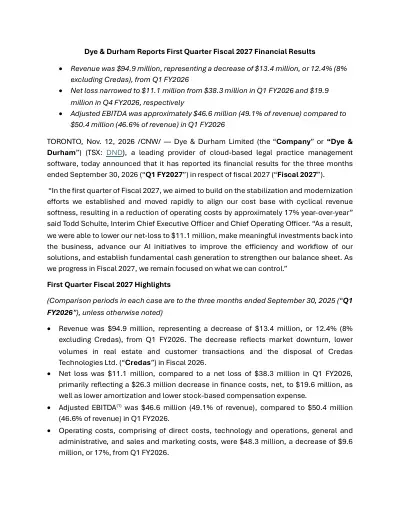
I'll start with a snapshot of the key details around our Q1 2027 financials. First-quarter revenue was $94.9 million, down approximately $13.4 million or 12%, 8% excluding Credas, from Q1 2026.
The decrease is driven primarily by market downturn, lower real estate volumes, a decrease in customer transactions, and pricing pressures across several different sections of our business, along with the disposal of Credas in fiscal year 2026. Adjusted EBITDA for the quarter was about $46.6 million, down $3.9 million or 8%, 5% excluding Credas, from Q1 2026.
While our adjusted EBITDA margins improved to approximately 49% from 46.6% in fiscal year '26 Q1. Our cost base is holding.
Combined technology and operations, general administrative, and sales and marketing costs were approximately $48 million this quarter, down approximately $10 million or 17% from Q1 2026. Now, let me dive into results from operations for the three months ended September 30th.
The $3.9 million or 8% decline in our adjusted EBITDA between Q1 '27 and Q1 fiscal year '26 was driven primarily by revenue pressures and lower capitalization rates, as we temporarily shifted certain activities and expenditures from a development to maintenance expenses, and then professional fees. These expenses were partially offset by planned cost reductions on marketing, entertainment, and IT services for the first quarter of 2027.
Our net loss narrowed to $11.1 million from $38.3 million in Q1 fiscal year 2026. The largest driver was lower finance costs, which decreased from approximately $45.9 million to $19.6 million, reflecting lower debt and non-cash foreign exchange and fair value items.
Lower amortization also added to this improvement. In addition, stock-based compensation fell by $2.7 million to basically $.01 million between Q1 fiscal year '27 and from Q1 fiscal year '26 after unvested awards were forfeited by employees who left the business.
Acquisition and restructuring costs were approximately $6.8 million in the quarter, essentially flat with the same period prior fiscal year. These included executive severance costs, which we expect to pay within the fiscal year, and costs related to board changes.
Finally, the company was compliant with its financial maintenance covenants under the senior debt agreements as of September 30th, 2026. Let me turn to segment reporting.
Canada remains the core of our business. Revenue for the first fiscal quarter was $56.3 million, down approximately 10% from Q1 fiscal year 2026 and 14% from Q4 fiscal year '26, actively reflecting the market downturn and volume and pricing pressures.
Our segment adjusted EBITDA is down 12% from last year to $31 million. Margin expanded to about 60% from approximately 49% a year ago, which is in line with the 61% margin we reported in the fourth quarter of 2026.
This shows the results from the efficiency initiatives we've described last quarter and following through on. UK and Ireland revenue was down 23% to approximately $21 million from Q1 fiscal year '26, which was driven primarily by the disposal of our UK subsidiary Credas in fiscal year '26, along with the market conditions.
Revenue was essentially flat with fourth quarter, and segment adjusted EBITDA of $8.5 million represented a 4% decline from Q1 fiscal year '26 and down by $8.2 million from the fourth quarter of fiscal year 2026. In Australia, revenue was $17.1 million, down only 3% from Q1 fiscal year '26, which reflects the softness in our data insight and mortgage service platforms.
Segment adjusted EBITDA was $8.8 million, up 17% from fiscal year 2026 Q1, and margin was approximately 43% of revenue versus approximately 54% in Q1 2026. With revenue only down 3%, the margin decline comes from the higher costs of about $1.7 million.
In South Africa, revenue was $.04 million, a decrease of 63%, mainly due to the timing of certain contract renewals. Segment adjusted EBITDA was a loss of $1.6 million, representing a 60% decline.
To summarize, our revenue for the quarter was $94.9 million, which represented a 12% decline, 8% excluding Credas, from what we reported in the first quarter of fiscal '26. While our net loss narrowed to $11.1 million from $38.3 million, driven primarily by lower finance costs.
The pressures on revenues, primarily due to market downturn and lower pricing models for our core product segments. Moving forward, our focus remains on cost discipline, establishing fundamental cash generation, and strengthening our balance sheet.
With that, allow me to turn the call over to Todd.
Todd Schulte
Thank you, Steve. Q1 was a difficult quarter in our markets, and our revenue reflects that.
We remain focused on stabilizing and optimizing the business. Our plan has three parts, and we are working in parallel.
First, stabilize. That goes for our customers, our product, and our company.
Second, centralize. Bringing our products, tools, and operating structure together so we serve customers consistently and run the company more efficiently.
Third, operationalize. Building AI and automation into our products and into how we work to take out costs and to speed up customer workflows.
We intend to keep reinvesting our savings into our people, process, and technology. We have valuable products, deep customer relationships, and critical market positions.
As these market conditions improve and transaction volumes recover, we expect a greater share of incremental revenue to translate into increased adjusted EBITDA and cash flow. Earlier this month, we announced support agreements with two of our largest shareholders, Plantro and EdgePoint.
Their backing will help us drive these goals forward, and we are aligned on building a stronger Dye & Durham for the future. There's more work ahead, and we expect this transition to continue through fiscal 2027.
I want to thank our employees around the world for their work this quarter, and our customers and shareholders for their continued support. With that, we'd be happy to take your questions.
Operator?
Operator
Thank you. Ladies and gentlemen, we will now begin the question-and-answer session.
Should you have a question, please press star followed by the one on your telephone keypad. You will hear a prompt that your hand has been raised.
Should you wish to cancel your request, please press star followed by the two. If you're using a speakerphone, please lift the handset before pressing any keys.
One moment, please, for your first question. Our first question comes from the line of Stephen Machielsen from BMO Capital Markets.
Please go ahead.
Stephen Machielsen
Hi, thanks for taking my question. I'm just on the line for Thanos.
With the recent change in the board, what do you think we can expect with respect to changes in strategy or approaches to the company's current leverage? With that, can we get an update on the status of the strategic review and the hunt for a permanent CEO?
Todd Schulte
I'll take the second part of that question first. This is Todd Schulte, by the way—the hunt for a permanent CEO is still ongoing.
That is still a process, and we do not have an ending date on that right now. It doesn't mean we're not kind of still progressing with what we're doing.
Your comments around the financial services, the strategic process is still ongoing, and that's about what we can say on that. We can't get into too much more detail in that particular area at this time.
The first part of your question, can you repeat the first part again? I'm sorry.
Stephen Machielsen
Yeah. Just with the two additional board members, including one who's, has a long history with the company, what can we expect in terms of changes to the strategy?
Will there be a review of the strategy in the near term, or is it just going to be kind of status quo for the next few quarters?
Todd Schulte
I think it's more along the lines of the status quo for the next few quarters. This is a situation where we've been working on strategy and are going to continue forward with this.
The new board members are behind it and going in the kind of the correct direction. I think one of the things we've maybe lacked at this company to some extent is some stability and consistency in what we're doing from a strategic perspective.
We're always looking at it and always refining how we're operating, where we're operating, what we're doing, what are our next directions to go. As far as an overall strategy change, no, I don't foresee anything like that.
Stephen Machielsen
We'll look forward to that. I guess if we dig into some of the segments, let's just start with banking software.
It's another quarter of year-over-year declines. Can you give us some context or insight into what's happening with that business?
Todd Schulte
Steve, do you want to take the specifics on that one? I'm sorry.
Steve Waszak
Guys, I think in terms of the banking software, it's really related to the market conditions, right? Where the market goes in terms of some of the real estate activities and volumes, is you're seeing a direct reflection of that.
We're still very bullish and feeling good about it relative to what we're doing internally and how we're supporting our customers in that regard, but the market's got to recover for us.
Stephen Machielsen
That's in the banking business. Some of the weakness in real estate is bleeding into that business.
Steve Waszak
No question. The company in total is dependent on it, certainly in the Canada space as well.
Todd Schulte
I would say that actually exists in all regions to some extent. There are things we can do as a company, and we're putting those things in place, but we are definitely seeing headwinds just with the macroeconomic environment.
Stephen Machielsen
Okay. Just in the Canadian real estate business, how much of the weakness there would you attribute to market softness versus working through some contract renegotiations that would have happened early last year versus working through additional churn?
Can you give us a breakdown on how those various factors impacted the year-over-year or even quarter-over-quarter comps?
Todd Schulte
We actually did some math around that. We think 70% to 75% of what we are seeing from a miss point of view is market-related and macro-related.
Stephen Machielsen
Okay. I'll pass the line.
Thanks.
Steve Waszak
Thanks, Stephen.
Operator
Thank you. Your next question comes from the line of Stephen Boland from Raymond James.
Please go ahead.
Stephen Boland
Just following up a little bit on contract renewals. Are you seeing a stabilization in customer base?
We certainly hear that there's competitors circling around your customer base, I'm just wondering if you can comment on if the stabilization is occurring.
Todd Schulte
I would say yes, stabilization is occurring. Are we to a point where we are totally stable yet?
No, but I would say the decline is slowing in what we've actually experienced in general. I think more of this is around a decrease in transactions, which is kind of what I referred to a little bit earlier, as opposed to true customer churn that you might experience.
Stephen Boland
Okay. Second question is, recently I think when we spoke, we were talking about the alignment between sales, technology, looking at the product lineup.
Is it early days there, or is that starting to occur and be passed on to the customer base?
Todd Schulte
It's ongoing, but as you might imagine, it's a pretty big lift to do a lot of that. I would say we're in two different workstreams at this point.
One really goes back to that stabilization: what are we doing to make sure what we have is operating and functional and working for our customers? The other is defining and delivering, I should say, what the future is going to be within our particular markets around the software and tech-enabled services that we provide.
Stephen Boland
Okay. Maybe just another thing on churn.
I can imagine it's been a difficult to be an employee there over the past several years with the management changes and vision changes. Is your employee base stable now?
I don't want to go too much detail there. I'm just curious, is there a positive outlook in terms of the employee base?
Todd Schulte
Not to, again, get into too much detail, we do have some attrition, but it was not attrition that really stood out one way or another from a positive or a negative perspective. It does not seem to be attrition in one particular region over another.
I would just call it normal. We haven't actually seen anything where we've had a mass exodus or a lot of disruption with our employees.
I would actually say our employees seem to be a little more stable in general because I think we're doing a better job in general of talking to them, including them, and having internal transparency, which I think is important in running a company.
Steve Waszak
Hey Stephen, this is Steve, the CFO. What I would say is by changing the company's operations to make it more globalized by function, John has global sales, Jason has global development, technology, and strategy.
By doing that, I think it's engaging people much deeper. These guys are making some real inroads by going and visiting these sites and soliciting employees' inputs.
We've got some really good engagement happening with the employee groups. I think that's really maturing and starting to show its value in terms of what we're doing to support customers, our customer assurance, things of that nature.
We're pretty excited about it, actually, in terms of how Todd has reorganized the company in this global sense so that it's one team as opposed to any silos at this point. I think we're seeing that it's more qualitative today, but I think the excitement and the energy is certainly picked up.
Todd Schulte
Steve brought up the topic of silos. One big push we have internally and we talk a lot about is tearing down silos in this organization, geographically, product-wise, practice-area-wise.
We are one unit, and we will operate in that manner.
Stephen Boland
That's helpful. Last one for me.
This is the winter season coming in. Housing volumes are pretty bad right now, but tends to be the lowest amount of volume over the winter months.
There's probably an expectation of even lower transactions, lower revenue. I just want to make sure that you think you're going to be comfortable with your covenants by the end of next quarter?
Steve Waszak
We don't really speak prospectively on that, but you can see by the past two quarters how we've managed our covenants, how we've managed our cash flows. As really transition to where we have good control, and part of this is by bringing the organization together globally, we have very good control, visibility on cash flows, both directions.
You can see part of it is we've reduced the expenses by $10 million year-over-year same quarter. It's a mix of things, but we feel we have good visibility, good control, and do some scenario planning to certainly be prepared should we have some surprises, as you comment on volumes and things of that nature around transactions.
In terms of how we run of the business, we're feeling very good about the model we have and the visibility we have.
Stephen Boland
Okay. That's it for me.
Thanks, guys.
Steve Waszak
Thank you, Stephen.
Operator
Thank you. Your next question comes from the line of Peter Youssef from Morgan Stanley.
Please go ahead.
Peter Youssef
Hey, thank you for taking the questions. Not to harp too much on the churn side of things, but I was curious if you guys quantify that in any way in terms of splitting out the actual churn number.
If not, do you have a sense for the split of your revenue that's coming from new contracts in terms of ones that weren't being renewed, in terms of completely new customers as opposed to the percent of your contracts that are being renewed?
Todd Schulte
I'll start with that, and Steve may be able to add some. I would say churn, the way I define churn and I've always defined churn, is losing a specific customer.
While some customers have gone away, it's not to the extent that you would think. This is more of a situation of dual sourcing or just a decrease in transaction, and that's what drives a decent amount of our revenue.
That is what we're seeing, as opposed to a total situation where we're losing a customer or anything like that. That kind of addresses the churn side of your question.
Peter Youssef
Okay. Then, in terms of your existing contracts, what's the average length for those?
Steve Waszak
It's probably a metric that we do not report on today, but I would say that the average length of those contracts is really around repetitive business with the customers as opposed to longer-term contracts in terms of what the market tells us today. We don't really run our business on long-term contracts per se.
It's more about the customers. What transactions are they driving with us?
What applications are they using, what platforms are they using, is really what drives the customer's business and the stickiness of that business, as opposed to long-term contracts, if that makes sense.
Todd Schulte
I would also say we have variability on a product-by-product basis. Some of our products are a bit more sticky, and that goes with more of a typical software lifecycle that you might see.
A lifecycle might be, and again, we don't have exact numbers on this, but might be in the 8 to 10-year range on a back-office piece of software that we run.
Peter Youssef
That's very helpful. Thank you.
Steve Waszak
Thank you very much.
Operator
Thank you. Our last question comes from the line of Sean Mulroy from Redburn.
Please go ahead.
Sean Mulroy
Hey, guys. Thanks for taking our questions.
I was just wondering if you can comment if there has been any churn within the financial services business?
Todd Schulte
Churn, are we talking specific customer churn or employee churn, or?
Sean Mulroy
Customer churn on the banking technology.
Todd Schulte
We've seen a decrease from a particular customer in that area for financial services in the Q1 time period.
Sean Mulroy
Is that customer in Canada, and was that a material reduction in revenue from them?
Steve Waszak
I think, Sean, you probably know our business as well as anybody from your closeness to us. All of our customers in that space, they're all material in terms of what they contribute to the business, and they all have material contributions.
I would say that it's no different than any other customer. We're just seeing, as Todd referenced to earlier, we're seeing some customers where they're doing some dual sourcing relative to actually moving away from the company or anything of that nature.
Todd Schulte
That's kind of where I was going to go, cuz you mentioned churn, and I don't know if I'd totally define it as a churn. It's more of a dual sourcing situation.
Sean Mulroy
That's helpful. Then my last one was, I was just wondering if you can help us quantify if the magnitude of the contracts on the legal side of the business that might still be priced too high or have minimums that are ambitious relative to the current market volumes.
Thank you.
Steve Waszak
Hey Sean, I think this is Steve again. We're really moving away from the minimums from that perspective.
As we renew new contracts and as you look out, the minimum is not as much there on a straight minimum. The way John is doing the contracting I think is part of it's just being, how do you capture the mind share of people?
It's really volume thresholds. As people achieve certain volumes, they're going to get different pricing as they get to those volume levels, as opposed to straight minimums.
Makes sense?
Sean Mulroy
Understood. I was just wondering if there's a lot of minimum revenue that's still flowing through the current numbers.
Steve Waszak
No, it's not a material amount anymore. It's not what it was, we'll say, a couple years ago.
Part of it is just pure accounting, how we recognize revenue, and what it takes to do that relative to these minimum contracts and things of that nature. There's some of it's commercial, some of it's just straight up accounting and how we do rev rec and all that.
There's a combination of those that moved us further away from straight minimum contracts and more into this perspective volume-based contracts.
Sean Mulroy
Understood. Thanks for taking the questions.
Steve Waszak
Thanks, Sean.
Operator
Thank you. That ends our question-and-answer session.
I will now hand the call back to Todd Schulte for any closing remarks.
Todd Schulte
Thank you very much. Appreciate that.
Wanted to take just a few minutes to say thank you to everybody who joined the call and your questions. Hopefully we were able to expand on some of the information that we've already put out, and happy to do so.
Thank you again very much, and we look forward to a good quarter coming up here. Have a good rest of your day.
Goodbye.
Operator
This concludes today's call. Thank you for participating.
You may all disconnect.