Erste Group Bank AG
Q3 FY2026 · Earnings Call TranscriptOctober 30, 2026
Operator
Ladies and gentlemen, welcome to the Erste Group third quarter 2026 results conference call. I am Sergen, the chorus call operator.
I would like to remind you that all participants will be in listen-only mode and the conference is being recorded. The presentation will be followed by a Q&A session.
You can register for questions at any time by pressing * and 1 on your telephone. For operator assistance, please press * and 0.
The conference must not be recorded for publication or broadcast. At this time, it's my pleasure to hand over to Thomas Sommerauer, Head of Group Investor Relations.
Please go ahead.
Thomas Sommerauer
Thank you, Sergen, for the kind introduction, and also welcome to everybody who is listening into this call on behalf of Erste Group. Today's call, as usual, will be hosted by Peter Bosek, our Chief Executive Officer; Stefan Dörfler, our Chief Financial Officer; and Alexandra Habeler-Drabek, our Chief Risk Officer.
They will lead you through a brief presentation highlighting the financial achievements of the third quarter, after which they are ready to take your questions. As usual, my recommendation to look at the disclaimer on page 2 on forward-looking statements because there will be one or the other in this call.
With this, I hand over to Peter.
Peter Bosek
Good morning, ladies and gentlemen. Welcome again to our third quarter conference call.
Even though everything around us seems to change ever faster, our message to Erste investors does not. I can again share with you quarterly financials that set records in many respects.
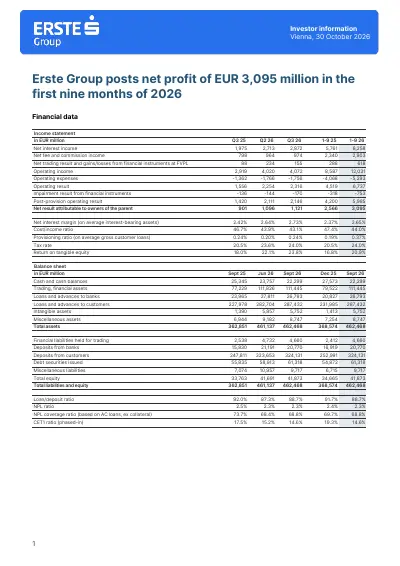
We posted record revenues complemented by a decline in costs quarter-on-quarter, which resulted in record operating profit. Risk costs remained moderate, and consequently, net profit also hit a new quarterly record.
Let's look a little deeper and start off with quarter-on-quarter operating performance highlights. Net interest income was clearly the star performer, up 5.9%.
This was mainly attributable to continued volume growth and rising rates. Fees also posted a new record as income from securities business as well as payment services continued to enjoy strong momentum.
Trading and fair value result came in somewhat lower, but this was mainly due to fair valuation volatility of customer loans. With this, quarterly revenues almost reached €4.1 billion.
At the same time, costs improved slightly, paving the way for a record quarterly operating result that topped €2.3 billion. If we look at a like-for-like year-to-date comparison, excluding the contribution from the Erste Bank Polska, the picture is equally positive.
Net interest income was up 7%, net fee income by almost 10%, net trading and fair value result north of 30%, while costs rose by about 3%. Risk costs were broadly in line what we saw in the first nine months of 2025.
If you add all this up, we also posted record operating profit and record net profit year-to-date excluding Erste Bank Polska. Based on these strong figures, we decided to upgrade our financial outlook for 2026.
We now believe that we can grow net interest income ex Erste Bank Polska by more than 6%, and with this, should beat the NII target for the enlarged group of €11 billion by a comfortable margin. This will be helped by better loan growth, which should propel our year-end loan stock to beyond, correct, €290 billion instead of previously about €290 figure.
Fee growth for Erste ex Polska should be around 10% compared to 7% to 9% before. Consequently, the cost-income ratio should also come in better for Erste ex Polska at below 46%.
In addition, risk costs are expected to stay at the lower end of our 25 to 30 basis points guidance for Erste including Polska. While all of this bodes well for 2027, I would kindly ask you for patience when it comes to official 2027 guidance.
For the simple reason that, as already communicated at the end of September, we will launch a tender offer for Erste Bank Polska shares next Monday, and prior to knowing the outcome of the offer, it makes little sense to issue concrete numbers. Having said this, despite all the noise that is currently out there, we see no reason why the favorable business momentum should not continue into 2027.
Let's now move to page 5 for some additional details on our financial performance. With net interest income climbing to a new high and interest-bearing assets growing broadly in line with loans, net interest margin increased to 273 basis points.
The cost-income ratio also continued to improve, supported by strong revenue momentum and muted cost growth. In fact, it reached an all-time low of 43.1% in the fourth in the third quarter.
The risk cost ratio, on the other hand, remained stable in the low 20s. This is also a reflection of the generally positive credit risk environment in our markets.
Banking taxes also remained stable at high levels, with the year-on-year increase explained by the inclusion of Erste Bank Polska. Finally, earnings per share and return on tangible equity also reached record levels in the third quarter.
A strong P&L performance is clearly linked to healthy balance sheet growth, and with this, I'm on page 6 of the presentation. In the year-to-date view presented on the slide, the major growth driver is the inclusion of Erste Bank Polska starting with the first quarter.
This, to a large degree, drove the material increase in intangibles and equity, but more importantly, also the significant increase in customer loan and deposit volumes. The good news is that hidden behind this inorganic growth, there is also substantial organic growth in the business, excluding Erste Bank Polska.
In this perimeter, customer loans grew by 5.8% year-to-date, putting us right on track to achieve our 6% to 8% growth target for 2026. Customer deposits rose 4.5% year-to-date.
On the asset side, we saw a good growth balance with both the retail and corporate segments making good contributions. On the liability side, slower retail deposit growth was offset by higher inflows in the corporate business.
While customer deposit growth was quite in line with loan growth year-to-date, quarter-on-quarter, it was only small, while loans continued to grow at a good pace. This explains the quarter-on-quarter rise in the loan-to-deposit ratio shown on the upper left-hand chart on page 7.
While it was down year-to-date as well as year-on-year on inclusion of deposit-heavy Erste Bank Polska. Talking about year-on-year customer loan growth, excluding Erste Bank Polska, it equaled 7.7%, while customer deposits advanced by 6.6%.
In line with moderate risk costs, asset quality also exhibited mild positive quarter-on-quarter trends. Both the NPL ratio and the NPL coverage ratio improved by a couple of basis points.
The decline in the reported CET1 ratio is attributable to not including third-quarter interim profit. Even on a pro forma basis, we saw some slippage to 15% flat, as method effects flagged for last quarter led to an outsized increase in risk-weighted assets.
Of course, pro forma, we continued to accrue the current dividend payments at the maximum of our target payout range of 40% to 50%. On target, in this respect, the magnitude of the final dividend for 2026 will be, of course, dependent on the outcome of the Erste Bank Polska tender offer.
When it comes to liquidity and leverage ratios, traditional strengths of ours, the third quarter, we registered a slight decline in liquidity coverage and net stable funding ratios, while the leverage ratio was stable. All these ratios remained at very satisfactory levels.
Let's now briefly examine the macroeconomic environment in our region on slide 9. A quarter ago, I told you that the geopolitical and with it the global economic situation was fluid.
Today, I cannot say anything different, maybe with one tangible difference that, in the meantime, we saw significant increases in interest rates across the yield curve and also across geographies. Not in all our geographies, but in most of them.
Of course, we also saw renewed upward pressure on energy prices. Despite all of this, the growth performance and outlook for our region remained broadly unchanged from a quarter ago.
As did other key macroeconomic indicators like inflation expectations, unemployment rates, as well as external and fiscal balances. Take all of this into account, we are therefore still operating in an environment that is favorable for us.
Solid economic growth combined with positive upward-sloping yield curves, that's at least for the time being a mix that supports sustainable volume growth at profitable margins. Talking about sustainable volume growth, let me share a couple of performance highlights on the retail business in the third quarter of 2026 with you.
I'm on slide 10 now. In our business excluding Erste Bank Polska, many of the positive trends that you are by now familiar with continued.
We saw continued good demand for housing loans evolved across all geographic segments, particularly in the Czech Republic, Hungary, Croatia, but interestingly also at the Austrian savings banks. Our success story of enabling customers to manage their own securities savings plans digitally also continued.
We now have a stock of 2.3 million plans where customers contribute anywhere between €50 and €200 monthly to invest in securities, thereby creating a steady stream of assets under management inflows for the bank. This may also be one explanation, in addition to rising interest rates, why we saw a consolidation of retail deposit volumes near record levels in the third quarter.
It may also help in understanding the minor mix shift we observed in the past quarter, namely a small increase in term deposit volumes, while current accounts and saving deposits decreased slightly. Far, this is just one data point after a couple of quarters of moving in the opposite direction, but we will certainly watch this space.
Finally, George continues to grow. We have now onboarded more than 12 million clients to the platform, but this is not the end of the story.
We are also doing a lot of business through our digital platform, thanks to which our overall digital sales share surpassed 80%. In the corporate segment, excluding Erste Bank Polska, and I'm on page 11 already, loans were up by 7.3% year-on-year and 1.6% quarter-on-quarter.
That's somewhat better than what we saw in the retail business. The quarterly growth drivers were similar as in the second quarter.
There was good loan demand from SMEs as well as from large corporate customers, with generally better demand for investment loans than for working capital or overdraft facilities. This is consistent with the constructive economic backdrop that I was mentioning before.
Czech Republic, Hungary, but also the three Austrian segments made good gross contributions. Corporate deposits, which are traditionally quite volatile, grew even faster than loans.
They were up by 15.5% and 3.1% year-on-year and quarter-on-quarter, respectively. Year-on-year, this was mainly due to inflows in all subsegments, while quarter-on-quarter, this was mostly driven by large corporate and public sector clients.
Similar growth rates were registered for current account and term deposits. Our market business, which has a great track record and consistency in delivering consistent results, did just that in the third quarter again.
Through treasury sales as well as selling capital markets products to our retail and institutional client base, it is one of the drivers of our fee gross story. In addition, the ECM and DCM teams, also contributing to this effort, year-to-date they successfully executed 256 transactions with a cumulative issuance volume of €189 billion.
In asset management year-to-date, net sales of €3.9 billion ex Polska contributed to assets under management volumes, which, including our Polish asset management operation, for the first time surpassed €120 billion. With this, I hand over to Stefan for the presentation of the quarterly operating trends in reporting segments.
Stefan Dörfler
Thank you very much, Peter, and also welcome to this call from my side. We are on page 13.
I won't repeat what Peter already told you about loan growth, but add one or the other interesting perspective. In absolute numbers, we added another €4.7 billion to our net loan stock during the quarter.
This translates into year-to-date organic loan growth of more than €15 billion. This is quite impressive, in my view, and shows well how we support the economic development of the region we operate in.
In terms of geographic highlights, a couple of countries were already mentioned. Hungary continued to do well, but to a lesser extent than in previous quarters.
This was due, on the one hand, to FX depreciation in the third quarter after the first half benefited from significant FX tailwinds, and on the other hand, to a slowdown in demand after three quarters of tremendous housing loan growth triggered by a subsidized mortgage scheme introduced a year ago. The rather small quarter-on-quarter increase in Polish loan stock is also explained by FX depreciation.
In constant currency terms, it was perfectly fine. The Czech Republic continued to deliver a consistent performance with unchanged growth drivers compared to a quarter ago.
Both retail and corporate business grew in a balanced manner. The other Austria segment, which essentially means large corporate lending across our footprint, also posted excellent growth in the third quarter.
Finally, a word on the Austrian savings banks. With annual growth of 5%, they also did really well, supported by better mortgage demand on the retail side and a good growth mix of investment loans and working capital facilities in the corporate business.
Due to the continued healthy growth momentum in the first nine months of 2026 on the back of a reasonably robust economic development, we confirm our 2026 organic loan growth target of 6% to 8%, but given all we know today, this probably means the upper half of this range. As a result, we again raise our year-end net loan stock guidance to higher than €290 billion from previously about €290 billion.
This, of course, includes Erste Bank Polska. Let's now move to the highlights of our deposit franchise on page 14.
Our deposit base was flat quarter-on-quarter, but grew by 6.6%, in real money, that is more than €16 billion year-on-year. The latter was driven by better growth in corporate business, while retail also contributed, but at a lower level.
In both client groups, inflows were well-balanced between current account and term deposits. As already mentioned, in the context of loans, quarter-on-quarter growth in Hungary and Poland was negatively affected by currency depreciation.
At the same time, growth in Slovakia is somewhat overstated by a large financial institution inflow. At Erste Bank Österreich and the savings banks, we saw some mainly retail-driven current account outflows over the past quarter, resulting in a slight decline of the deposit base.
As Peter already pointed out, we are watching this, but should not overinterpret this data point, as we have seen the opposite trend in previous quarters. In any case, the most important fact when talking about deposits is funding costs, and these have only itched up marginally in the third quarter, while, as we all know, interest rates have moved up noticeably.
This resulted in a more profitable deposit base. Talking about a more profitable deposit base transitions us nicely to net interest income, one of the real highlights of this quarter.
I'm on page 15 now. The main reason for the step change in net interest income growth quarter-on-quarter can be attributed to two factors.
Firstly, volume growth held up well, and secondly, short- and long-term interest rates went up. With roughly half of the loan book on variable rates, this obviously led to higher interest income on our loan portfolio.
At the same time, as just mentioned, funding costs for our vast retail deposit base only moved up marginally. Add to that incremental NII tailwinds from higher reinvestment yields and also volumes, for maturing government bonds, and there you have it, a massive 5.9% increase in net interest income quarter-on-quarter.
If you want to be fair and adjust the second and third quarters for the minor negative and positive one-offs, respectively, the clean increase would have been more around 4.5%. Even this is a very respectable number and bodes well for our future development.
The third quarter print is the best proof that the concept of NII sensitivity is rather theoretical. Assuming a 100 basis point instant parallel shift on a static balance sheet is simply not reflective of real life.
Loan and deposit mix, growth trends, and changes in the rate environment are much more relevant. For those who attach significance to this number, sensitivity has barely changed over the past quarter, standing at around €120 million for a 100 basis point parallel upward shift, while the same change to the downside would result in a minus of about €110 to €150 million.
In terms of segment highlights, our Austrian retail and SME businesses continue to perform very well for the reasons already mentioned, as did our Czech operation. Finally, Hungary extended its stretch of strong NII delivery supported by good volume trends.
While as Peter already mentioned, we don't provide a concrete detailed outlook for 2027 today due to the imminent tender offer for Erste Bank Polska, the print we produced this quarter really warrants an upgrade of the 2026 outlook with positive implications for 2027. We now believe that Erste ex Polska will grow NII in excess of 6% this year.
As I can imagine, before you ask why we guide for less than we have achieved in the third quarter year-on-year, in addition to the small positive one-offs we benefited from in this quarter, this is due to a technical effect I will explain shortly in the context of other operating result later. This effect will likely have a negative NII impact in the fourth quarter, please note, of about €30, 3-0, million.
Despite this, we should deliver our 2026 guidance for the enlarged group of higher than €11 billion by a comfortable margin. Now over to our fee performance on page 16.
The quarterly fee print also set a new record and could have been even better if Polish fees would not have been impacted by expenses related to a local micro campaign. These will still be significant in the fourth quarter, but fade out thereafter.
In all other segments, we posted good quarter-on-quarter growth in net fee income. If we exclude Erste Bank Polska and look at the year-on-year performance, growth was equally impressive.
Fees grew by 10.7%, and the reasons are the same as in previous quarters: strong growth in securities business fees on the back of continued demand for asset management products, and good traction in payment service fees. Consequently, we now project Erste ex Polska fees to grow by about 10% instead of 7% to 9% in 2026.
For Erste including Polska, we leave the guidance unchanged at about €4 billion despite allocating Polish FX fees to net trading and fair value result. Let's now check out operating expenses on page 17.
Managing expenses is all about maintaining discipline, even when revenues are growing much faster than costs. Cost discipline, we have successfully maintained.
Year-on-year cost inflation excluding Erste Bank Polska was only 2.4% and driven primarily by the usual suspects: staff and IT costs. Quarter-on-quarter costs were even down, but here we benefited from the non-recurrence of Polish brand amortization.
You remember, second quarter was the heavy brand introduction in Poland, that's about €15, 1-5, million, and lower personnel costs as a result of seasonally lower employee share incentive costs. When it comes to our cost guidance for 2026, we only do cosmetics tweaks.
The overall cost guidance for 2026 remains unchanged at about €7 billion, please be aware, on an FX-adjusted basis. We also confirm the guidance for Erste ex Polska, expecting roughly a 3% cost uplift.
When it comes to Polish integration costs, which we forecast is at up to €180 million, we are mindful of the fact that we have only utilized €100 million year-to-date, of which €27 million in the third quarter. From today's point of view, it is therefore unlikely that we will fully utilize the guided amount in 2026.
This simply means that any unutilized amount will shift into 2027. Any additional integration costs in 2027, however, will not be guided separately anymore, as we don't expect them to be material on the group level.
If we now add up everything you heard so far, and I'm on page 18, 1-8, already, namely that operating revenues hit a new record while cost inflation was well under control, there can only be one result, and that's record quarterly operating profit. This statement is in so far remarkable as in the third quarter net trading and fair value result normalized to the lower end of the €150 to €200 million quarterly run rate.
This was entirely due to fair valuation volatility of our Hungarian loan portfolio, where the volume of fair value loans doubled to more than €2 billion over the past year as a result of the introduction of a subsidized mortgage scheme. This had a negative effect of €68 quarter-on-quarter due to rates going up.
In a year-to-date comparison, the effect was insignificant, though. Returning to record operating profit, importantly, this statement is true in all relations, irrespective whether you include or exclude Erste Bank Polska or whether we look quarter-on-quarter or year-on-year or even a clean year-to-date comparison.
This also means that the cost-income ratio also reached its best ever quarterly level at 43.1%, as already mentioned by Peter before. In light of all this, we decided to upgrade our cost-income ratio guidance for the business excluding Erste Bank Polska to lower than 46%, underscoring strong positive operating leverage in 2026, while we confirm the full-year outlook of lower than 45% including our Polish operation.
With this, I hand over to Alexandra for more details on credit risk.
Alexandra Habeler-Drabek
Thanks, Stefan, and good morning. I'm now on page 19.
When talking about credit risk, no news is usually good news. The third quarter of 2026 is a perfect example of a, by and large, no-news quarter.
As Peter has already mentioned several times, the credit risk environment in our region remained good. We posted risk costs of 24 basis points, which is on a clean basis pretty much unchanged compared to the first two quarters of the year.
We released the last remaining industry overlays in the amount of €71 million, which mostly benefited the Austrian savings banks segment. We also topped up FLI provisions by €25 million, and this mainly impacted the other Austria segment and explains the quarterly jump in provisioning there.
In total, we now have about €350 million of primarily FLI provisions, which will move with the changing macro outlook. As a result, we do not expect and hence do not guide for material overlay releases going forward.
In terms of segment and country highlights, we mainly posted allocations in the corporate business in Austria, which includes also the FLI impact in other Austria, which I have mentioned before, while there were only minor net allocations in the retail business overall. Slovakia benefited from a significant provision release related to the corporate business on the back of rating upgrades, which explains the net release in the third quarter.
Everything else was unspectacular. We therefore confirm our full-year outlook, 25 to 30 basis points, including Erste Bank Polska, and I may add that, realistically, we are talking about the lower end of this range.
The rationale for doing so, despite being ahead of guidance in the first nine months of the year, is the same as one quarter ago: the ongoing volatility in geopolitics and its possible downstream effects. Let's now turn to asset quality on page 20.
In line with what I just told you about risk costs, stability is also the name of the game when it comes to asset quality. In actual fact, we saw minor quarter-on-quarter improvements in NPL ratio and the NPL coverage ratio.
The former now stands at 2.3%, while the latter, excluding collateral, sits at 68.8%. It's hard to highlight any specific developments in countries or segments, as we haven't seen any material shifts over the past quarter, certainly not to the negative.
This is also backed up by the fact the NPL inflows continue to be on a declining trend overall. Based on this, we see no reason to change our asset quality outlook for 2026.
We expect that the group NPL ratio will stay more or less at current levels, while NPL coverage is projected somewhere around 70%. With this, I already hand back to Stefan.
Stefan Dörfler
Thanks, Alexandra. We are on page 21 now.
The year-on-year decline in other result excluding Erste Bank Polska is fully explained by the third quarter 2025 benefiting from a significant one-off legal provision release in Romania in the amount of €77 million. Quarter-on-quarter, we also posted a small deterioration, which was driven by three partly offsetting factors.
Firstly, we posted some real estate selling gains in the amount of €48 million in the other Austria segment. Secondly, Erste Bank Polska continued to book FX legal provisions in the amount of €32 million.
Thirdly, since the new government in Hungary has yet to retract the mortgage interest rate cap, we booked a provision of €38 million to account for the possibility that this may not happen at all. In which case, and here I'm now circling back to my comment on the full-year NII outlook not being more aggressive, this provision would be released in the fourth quarter of 2026 and the impact booked in the appropriate lines.
About 80%, think of €30 million, would negatively impact net interest income, the remainder, risk costs. In P&L terms, the impact is fully digested in the current quarter, but it may still impact NII and risk costs in the fourth quarter versus the benefit in other operating result.
Hence, when it comes to the 2026 outlook, we would expect other results to, on the one hand, closely track banking levy charges, adjusted for any one-off bookings that happened or may still happen in 2026, including the effect I just explained. Let's now move to the bottom line and returns on page 22.
With operating profit hitting a new high, risk costs being moderate, and other results broadly in line with expectations, quarterly net profit for the first time surpassed €1.1 billion. As a result, earnings per share rose to €2.74 for the quarter, and return on tangible equity increased to 23.8%.
Ordinary return on equity also improved to 18.2%. Tangible equity climbed by another €2.1 per share in the quarter to almost €47, while book value per share improved to €61.
One small caveat in the context of returns: in the third quarter, they are always somewhat exaggerated, as there are no AT1 coupon deductions. All of this puts us in an excellent position to deliver on our recently upgraded bottom-line guidance, which we hereby fully confirm.
That's a return on tangible equity of higher than 20% and a higher than 20% earnings per share uplift based on a reported net profit of higher than €4 billion in 2026. With that, let's now move to wholesale funding and capital on page 24.
The main impact on our liability structure year-to-date was clearly coming from the consolidation of Erste Bank Polska. Quarter-on-quarter, there were no meaningful changes aside from a small increase in outstanding debt securities on the back of increased MREL-related senior unsecured issuances.
In addition, we were also more active in issuing certificates of deposits. Our core key funding source remains unchanged.
That's our strong customer deposit franchise across all markets, and in particular, the highly granular and well-diversified retail deposit base. When looking at our wholesale funding activities, the third quarter was another busy quarter that helped us to complete our 2026 funding plan early.
The key highlights, here on page 25, come from a group perspective from the first €1.5 billion dual-tranche issuance in senior preferred format. Our CEE subsidiaries were also very active during the quarter.
Česká spořitelna successfully executed a second €500 million covered bond benchmark transaction, while Erste Bank Hungary issued a senior preferred debt in the same amount, and very, very successfully when it comes to the spread levels, if I may add. Looking at regulatory capital and risk-weighted assets on page 26, let me remind you that in any third quarter, interim profit is not included in reported regulatory capital, as it's neither reviewed nor audited.
This, together with a minor negative impact from other comprehensive income, explains why CET1 capital slipped slightly quarter-on-quarter. At the same time, risk-weighted assets rose by 3.2% or about €6 billion quarter-on-quarter to €192.8 billion.
This development was driven by an increase in credit risk RWA by about €5 billion, primarily driven by the €3 billion one-off method effect we have already flagged last quarter, while the overall growth is also a reflection of a strong loan growth we have experienced during the third quarter. Market risk RWAs contributed about €1 billion to the quarterly RWA increase.
When looking towards year-end, regulatory capital should benefit from full profit inclusion, while risk-weighted asset growth should be more in line with asset growth, plus a markup in operational risk, which is mechanically tied to profitability. Consequently, I would expect our CET1 ratio to be somewhat higher at year-end compared to the third-quarter pro forma level of 15%.
Think of somewhere in the area where we were around half-year. You can see the waterfall for the third quarter on page 27.
That's purely the organic view and does not take into account the outcome of our tender offer for Erste Bank Polska shares. In reality, we will certainly end up somewhere else depending on shareholder take-up.
As far as the third-quarter pro forma print is concerned, we maintained the dividend accrual at the upper end of our target payout range of 40% to 50%. With this, we indicate our strong confidence in our distribution capacity.
Nonetheless, we retain full flexibility when it comes to deciding about the eventual 2026 payout in order to be able to internally fund an up to 46% additional stake in Erste Bank Polska. With this, Peter, I hand over to you for concluding remarks.
Peter Bosek
Thank you, Stefan. I'm on page 29 now.
As I already mentioned at the start of the presentation, the good business performance year-to-date allows us to upgrade our financial guidance for 2026 once again. In light of many uncertainties that are out there, this fact alone is remarkable.
Thanks to encouraging volume trends, a very constructive interest rate environment, healthy demand for asset management products, and smooth integration of Erste Bank Polska, we are in a position to do just that. We are now confident that we can grow our loan book, excluding Erste Bank Polska, towards the upper end of the 6% to 8% target range, which combined with our Polish business should result in a year-end net loan stock north of €290 billion.
We are also more positive on net interest income, expecting an increase above 6% excluding Erste Bank Polska and surpassing our €11 billion target including Polska by a comfortable margin. Fees ex Polska should grow by about 10% and help us to push the cost-income ratio excluding Erste Bank Polska to below 46%.
Finally, thanks to the generally good asset quality backdrop, we target risk costs including Erste Bank Polska at the lower end of our 25 to 30 basis points target range. Everything else remains unchanged, meaning that we should comfortably deliver return on tangible equity above 20% and reported net profit above €4 billion.
All of this puts us on a strong runway for 2027, for which we will provide detailed guidance with fourth-quarter results at the end of February. At that stage, we will know the outcome of the tender offer for Erste Bank Polska, which, having received all the required regulatory approvals, we will launch next Monday, as planned and communicated.
With this, ladies and gentlemen, we are concluding our presentation, and we are looking forward to your questions.
Operator
Ladies and gentlemen, we will now begin the question and answer session. Anyone who wishes to ask a question may press * and 1 on their telephone.
You will hear a tone to confirm that you have entered the queue. If you wish to remove yourself from the question queue, you may press * and 2.
Anyone who has a question may press * and 1 at this time. We have the first question coming from Gulnara Saitkulova from Morgan Stanley.
Please go ahead.
Gulnara Saitkulova
Hi, good morning, and thank you for taking my questions. First on Poland.
Santander commented on its result call earlier this week that they're comfortable with their remaining stake in Erste Bank Polska. Given that position, would Erste be prepared to revisit the pricing of its tender offer to increase the likelihood of acquiring additional shares?
How do you balance the strategic benefits of increasing ownership against maintaining attractive returns on your investment from potentially paying a higher price? Even
Peter Bosek
maybe if I may start, and of course Stefan and Alexandra just to jump in. The strategic rationale for us to increase our participation in Polska is very clear and obvious.
We are now owning this 49%. Good news since beginning of the year is that there are no surprises, everything is going as expected.
We see a strong profitability, we have a very positive outlook then on the economic growth in Poland over the upcoming years. We have a really good governance in place, although we just had closing beginning of this year, as you are aware.
We are right on track with our IT integration. We are very happy with our 49% investment, of course we would like to increase.
When it comes to Santander, it's of course up to Santander to decide, if they're happy to be in this situation from our perspective. It's very clear that related to the price of the shares, I think there are different interests, which is also very obvious, and this is not a point to speculate about the price now as we are starting our offer on Monday.
Stefan Dörfler
Nothing to add. We'll launch on Monday, having received all the approvals.
I think, Alexandra, it was
Alexandra Habeler-Drabek
Friday. Friday and last weekend, and then let's see what happens in the course of the tender offer.
That's it.
Gulnara Saitkulova
Thank you. Just linked to that, the question on capital.
Given the decline in capital this quarter, could you provide more color on this €3 billion one-off increase in credit risk-weighted assets? Specifically, what is it related to?
Previously you mentioned that an SRT transaction could potentially mostly offset the risk-weighted assets inflation from the LGD updates. Could you confirm whether you still expect to realize this SRT benefit this year and highlight any other key capital headwinds or tailwinds that investors should be mindful of going forward?
Stefan Dörfler
Thanks very much for this question. Important one these days, obviously.
I can start with a very clear and strong statement: absolutely no whatsoever headwinds expected. To the contrary, to be honest, rather tailwinds expected in the near future.
Namely, we will be very likely concluding a significant SRT in the fourth quarter. We have very good signs that in terms of regulatory requirements, it's going to be smoothly in the sense of, if anything, then even a small relief.
That regarding, to say, the environment we operate in. Concretely to the third quarter, please be reminded that we have been flagging already in the second quarter the impact, which Alexandra will explain in more detail, of €3 billion from an LGD model for corporates, which, of course, was exactly arriving then in July as expected.
If you adjust for that and the OCI, which comes from FX translation, then you are in a very normal development. When it comes to fourth-quarter outlook, my personal expectation, as I already shared with you in the presentation, is that we will trend higher, all of course subject then to the BTO and all of that.
In other words, we will have a lot of capacity for going either into a significant step-up in our holding in Erste Bank Polska or, if this does not materialize, in a significant distribution. That's my take, but Alexandra, more details maybe on this model.
Yeah.
Alexandra Habeler-Drabek
The €3 billion model effects that Stefan mentioned consists of 0.25 of something related to CCF and €2.6 billion to the retail LGD material model change. This is a very long-time planned and one-off effect.
We already applied in April 2024 for this model. Production go-live was then in July 2026, 26 months of regulatory approval.
The uplift is simply coming from the adoption of changes in IRB regulation in the meantime and the conservative addressing of historical data quality gaps. Overall a one-off effect, nothing unexpected, and yeah, that's so much to the model.
Stefan Dörfler
Just to complete the picture, since this has been in many calls of our colleagues also an interesting point of discussion, I think we informed you about our SRT impact on the CET1 ratio in the half-year, and give you an update on this. We back then said 72 basis points, barely changing in the third quarter, we're now at 73 basis points.
Why that? We had a very successful, and I'm very happy about that, for sort of development of this great market, implementation of a small SRT, small in the respect of the group level, in Croatia, which had an add-on effect, and then of course you have a runoff of the existing SRTs.
The effect that we are planning for the fourth quarter should lead us to something round about 80 basis points overall effect by the end of the year, a very important indicator also in our dialogues with the regulator. Thank you very much.
Gulnara Saitkulova
Thank you.
Operator
The next question comes from Gabor Kemeny from Autonomous Research. Please go ahead.
Good
Gabor Kemeny
morning. Firstly, on your NII, please.
You mentioned that the higher reinvestment yields benefited your NII and your margins in Q3. I see a 3.5% average yield on your financial assets portfolio.
Presumably you have some room left for upward repricing. Can you give us a sense how much is left and how this may impact your NII in 2027?
The small technicality you mentioned on the Hungarian interest rate caps, you booked the cost in other results, which you expect, if the rules remain unchanged, to rebook to NII with a neutral bottom line impact in Q4. Is this correct, or have I missed something?
Then back to the Polish tender and your comment on adjusting the dividend payouts, do you mean that you would cut the payout to ensure that your CET1 ratio stays above the 14.25% target? You would only cut it to protect the CET1 target?
Thank you.
Stefan Dörfler
All right, Gabor, thanks for these three very important points. First, replication book, I see it rather at 3.4% than 3.5%, everything else correct that you say.
We're still upward trending, and as you saw, and you remember we discussed this after Q1 and after Q2, the overall net interest margin now printing at 273 for the third quarter reflects all the points that we discussed during the call today already, and I think it's a very, very positive signal. This volume development combined with net interest margin, I think in my personal opinion, ticks all the boxes.
On the Hungarian, just to confirm, exactly it is like that. €38 million we booked now in the other operating result, simply reflecting the full impact of, to say, an eternal application of this interest rate cap that has been introduced already a while ago by the former government.
Should there be at any point in time a reduction, adjustment, shortage of this, then it will have a positive impact. When it comes to the allocation to the lines NII and risk, you are right, the 38 would translate to roughly 30 going into NII, and then the remainder into risk, and of course the positive effect would be in other operating results.
In other words, just to confirm as you phrased your question. Look, on the VTO take-up, now I could talk for the next 20 minutes about all the facts that are influencing, to say, a potential impact on CET1.
All of those: volume, prices, FX, blah blah blah blah. The message is, at the moment, we are accruing for the absolute maximum of our dividend policy, and as long as we do not have a final take-up that would reduce that significantly, that's the assumption.
Obviously, should there be a significant take-up by the minority shareholders at a certain level, that would, as we always said, also have an influence on the dividend 2026. It's simply much too early to say.
Gabor Kemeny
Got it. Thank you, Stefan.
To the replication portfolio, maybe I missed your comments, what is the NII benefit now, and how you expect it to evolve next year, please? Oh,
Stefan Dörfler
I think we have talked about that, that we are somewhere in the area of 2 3 4.4% yield. You are asking about the absolute number, right?
Or what's your question concretely?
Gabor Kemeny
Yes, exactly. The NII impact, yeah.
Stefan Dörfler
Yeah. The total volume is now just north of €80 billion with all the components included, including Erste Bank Polska and so on and so forth.
The impact on the NII is in the area of, let me just check the concrete number, €3 billion, €3.1 billion roughly for the business year 2026. If you ask me, which I will assume, what do I think about 2027, everything else equal, it should be still upward trending, however, at a slower pace.
Gabor Kemeny
Thank you.
Operator
The next question comes from Benoît Pétrarque from Kepler Cheuvreux. Please go ahead.
Benoît Pétrarque
Yes, good morning. The first one is on your NII guidance above the €11 billion number for the full year.
Obviously, you have a very strong print on Q3, even if I take this €30 million adjustment in the fourth quarter, I still get to at least exactly €11 billion. I get to a small decline quarter-on-quarter.
I was wondering why you've not maybe upgraded your NII guidance for the full year to maybe a slightly higher number, or do you expect operational trends to maybe be less favorable in the fourth quarter? The second question is actually again on NII, but this time on the trajectory in 2027.
Is your Q3 NII a good run rate to think about '27? Could you talk maybe about this trajectory in 2027, looking at the current forward curve, obviously the deposit pricing in your main markets, potential for mix shift, and obviously the volume growth, which remain strong?
Could you maybe help us to look at '27 a bit more in details? Thank you very much.
Stefan Dörfler
Look, let me start with '26. I share with you that in the Q1 roadshow, I had 20, if not 30, discussion rounds about what range our NII would be feasible.
The expectation of the investors was anywhere between just below 11 up to 11 and a quarter. Frankly speaking, if I reflect on those discussions back then, we are exactly in this range.
Now, 11 and a quarter will be too much, below 11 is of course too low. The range has been tightening a little bit.
I do not disagree with you that if you extrapolate the third quarter, even adjusting for the Hungarian story we discussed before, then you will rather not end up with 11 020. That's the story, but everything is still alive, we still have two two months to go.
North of 11, as I always strongly emphasize, doesn't exclude also a print of 11 1, 11 150. I cannot really go further than this because there are so many moving parts as we discussed them already in the call.
Into 2027, everyone would love to see a guidance into 2027, we don't give one today. However, if you look at the volumes, if you look at the margins, including certain pressures on the deposit side, as we heard, especially also from our competition, to be honest, we have had a very good quarter in that respect as well, then you can certainly expect a very, very solid NII guidance for us to be published end of February.
In my own belief, we will have a significant NII drive, assuming, let me say, a supportive interest rate environment during the year 2027. More color, I ask you for understanding then with the full-year numbers in the February.
Benoît Pétrarque
This is very clear. Just in the past, you've said that volume growth will be the main driver, and we could assume stable NIM.
Do you think it's going to be the same in '27? Basically main driver by far will be volume growth, and NIM could stay roughly stable?
Thank you.
Stefan Dörfler
Benoît, look, in principle, yes, but I just want to point to one thing that we all know as good as we do. There is a certain level of interest rates when the dynamics on term deposit repricing and deposit beta kicks in more aggressively.
Are we there today? Probably not.
Might we get there? Maybe.
Let's see. ECB in our expectation will do one more step, the Czech guys will do one more step.
Will this be enough to generate a certain deposit beta dynamics as we saw it in the last rate hike cycle? Let's see.
Those are moving parts. In principle, there is no change to that.
If I have a solid volume growth, if I do healthy business both from a risk perspective, but also from a margin perspective, that's the main driver, and that's exactly our growth story.
Benoît Pétrarque
Great, thank you very much.
Operator
The next question comes from Tarik El Mejjad from Bank of America. Please go ahead.
Tarik El Mejjad
Hi, good morning. Two questions, please.
Sorry to come back on the tender in Poland, and I think it's obvious that the take-up will be relatively small, and I'm not sure if you can give us a bit more guidance, especially in the light of what Santander said, plus the valuation, what's really the threat to the 50% already accrued payout? I would be even a bit more provocative in my question is if your take-up is small, and you still, as your CEO said in our recent conference, you want to balance between distribution and longer-term buildup of the stake in Poland, if you can be actually even more generous in terms of some special distribution on top of policy as you build up on the market stake?
Second question is on asset quality, and I heard your comments on the initial presentation, but we can see flare-ups here and there, especially in Central Europe. What's kind of comfort you can give that this is not something that would surprise the market and maybe yourself in terms of how things can get a bit sore in terms of deterioration?
Thank you.
Peter Bosek
Maybe let me start with the first part of your question when it comes to the voluntary tender offer in Poland. You said you have a provocative question, I have a provocative answer.
It would be for us great if we achieve something slightly above 50% because this would put us in a situation that we can then, after that, go on in increasing our participation without asking for additional approvals, no? Everything else is very much depending on market situation, and as you rightly mentioned in the second part of your question, we are trying to create shareholder value.
As it doesn't make sense to pay too high prices for the shares, probably because this is something we will closely monitor in a way that how to distribute our capital. This we have been proving in the past that we're doing well in that, and you can rely on us that we will do this again in the second in the quarter in the fourth quarter when it comes to this tender offer.
Alexandra Habeler-Drabek
Coming to your question on asset quality, if I understood correctly, it's about CEE in general and also going forward. If you just look at the Q3 formation of net impairments of 170, only 33 come out of CEE.
This is a very good picture, and it's not a one-off special quarter, which shows pretty well how extremely resilient and how good the risk profile in CEE has been developing for a very long time, and also going forward, we would not expect any bigger changes. Coming to Romania, Romania was, as you might recall, especially in Q1, was an outlier out of the CEE community, but also Romania, in the course of the year until now, recovered from the Q1 impacts on unsecured.
There have been sales of unsecured NPLs, which led to releases of provisions, and the remainder of the bigger impacts in Romania is due to FLI, and we all know how macroeconomic situation in Romania looks like. Poland, they also published or will publish today or published today the figures, roughly 30 bps as of Q3, a very, very good level.
Overall in CEE, nothing which is worrying me also going forward.
Tarik El Mejjad
Thank you.
Operator
The next question comes from Ben Maher from KBW. Please go ahead.
Ben Maher
Hi, thanks for taking my questions. I've got two, please.
Apologies if you already commented, as I had issues joining the call at the beginning. Some fees, looking at the €4 billion guidance, that implies quite a solid or strong 4Q is required to beat that guidance.
Just interested around the different moving parts behind that gives you that confidence. Also, I've seen some Czech pension reforms that are currently going through parliament, and that looks like it could be potentially quite impactful if those do come through.
Just interested in any thoughts, any color around the potential impacts to Czech fees from those changes. Then on loan growth in CEE, you touched on the de-acceleration during the quarter.
Obviously, rates appear to be going back up when you look at forward markets in Poland and Czechia, for example. Just interested in how you see the loan growth in some of these countries into next year.
Thank you.
Stefan Dörfler
Let me take, and thanks for the question, it's an important one. Let me take the fees.
Did I understood your question correctly? You had to join the call a little bit later, we were addressing that in our statements already.
Just as a explanation again, in all the countries, the developments have been at, or in I would say half of them, above our expectations so far, that's why we raised also the year-on-year guidance for the development of the fee line to 10% year-on-year, 10.7% so far the first nine months. Now, the fourth quarter is typically and traditionally a very strong quarter when it comes to fees.
You have all the premium bookings and all of that. If you look at the 2025 fourth quarter and adjust for sort of say the overall growth that we have already achieved, you're getting relatively close.
There is, for sure, and I have no problem to admit that, there is, for sure, the ongoing impact from the Polish campaign, which, by the way, runs super successful when it comes to client acquisition. This will have an impact since some effects of the investment into this client acquisition are still there in 2026 also in the fourth quarter.
Summing all up, your indication in the question that maybe getting to or even above €4 billion might be difficult, I can confirm. The guidance of around €4 billion still holds very nicely if you sort of say apply the typical rules of what round about €4 billion means.
That's my statement, and with that, Peter, to you.
Peter Bosek
To the part of the question you were mentioning the pension funds probably in Czech Republic, this is something which we will see not this year, this is something which will have an impact in the fee income next year. We are very much aware of this, of course it will be a heavy impact on our P&L in the Czech Republic.
Given the strength of our Czech bank, especially in the asset management area in a broader sense, we will be able to rebound from fee growth next year when it comes to the Czech Republic. When it comes to loan growth momentum and what we are expecting in the near future, we don't see too many changes.
Especially in Czech Republic, Hungary, Croatia, even Austria, business is going strong. To be very transparent, there is some kind of increase of competition in Austria, this is nothing new to our business, this happens from time to time in some countries.
We don't have any kind of reason to expect a decrease in this loan growth demand, especially in the mortgage lending area. What we have seen in corporate banking, there is a very strong demand for investment loans, which from our perspective is a very positive signal for the further development of our economies because our clients are trusted in investment loans when they have a positive outlook on the future.
We are optimistic when it comes to loan demand.
Ben Maher
Great, thank you.
Operator
The next question comes from Jovan Sikimic from ODDO BHF. Please go ahead.
Jovan Sikimić
Oh yeah, good morning. Thanks for the call.
I have a short question on Czech operations. I think you reported a bit of increasing margin in Q3.
Can you tell us a bit how do you see the current competition, especially actually on both sides, lending and funding, and how do you see it going forward? Maybe also strategic one for your existing operations in Hungary and Serbia, how do you assess your current positioning compared to peers, especially as those countries witnessed, I would say, kind of major political turnaround?
Would you consider eventually some inorganic growth opportunities in both of them in next future? Thank you.
Peter Bosek
Let me start with Hungary and Serbia. We are seeing the strong loan growth in Hungary already since 1.5 to 2 years, which was very much related to an additional subsidy scheme which was implemented before the change in the government.
In general, let me say, and this is also true for Serbia, we are not in politics, we are a bank trying to support the economic growth in the region, this is our major task, and not changing our view on the economy of the country when there's a change in the government. When it comes to strategic positioning, I think we are very well positioned in Hungary.
Our local team succeeded in the last years to onboard different kind of portfolios, when you think back about corporate portfolio of Commerzbank, retail portfolio of Citibank. We also were looking, and we also look on some kind of opportunities when it comes to in-country consolidation.
In Serbia, from a market perspective, we are number eight in the market, this is comparable to other parts of our group, not where we want to be. Will there be an impact of the change in the government and economy?
I think it's much too early to have an opinion on that, this is nothing we can come up with a judgment right now. The first part of your question, Stefan?
All right,
Stefan Dörfler
I take this, Peter. It was about general trends of competition, deposits, lending, and more specifically on Czech Republic.
Let me just start with a general remark. As you rightly observed, in the third quarter, we saw rather limited pressure on the aggregate pricing, both of core deposits, but also on the lending side, as the margins output shows you.
However, we had, of course, and we expect also going forward, as I explained before, a repricing of some term deposits, and here, Czech Republic, especially if the Czech National Bank decides to do, in fact, one or even two other moves, will not be an exception. What is specific to the Czech market, and that's of course due to the excellent profitability there, that there are different players of course not also coming in, not only the traditional competition, but also challengers.
This is fine, and honestly speaking, for us as the leading bank there, also appreciated because it pushes our efforts to get better, to be honest, even further. One specific thing that you might have observed in Czech Republic is the public sector initiative around the municipality financing.
This is something which has not yet been fully rolled out, but that's something to watch when it comes to liquidity, and that's probably also the reason for your question because there were some statements by other players, I think colleagues there made some statements in that direction. We have not seen any impact on that, but we know that this will have, in terms of volumes, some impact.
Just be clear, that's not, to say, super sticky deposits or something, that's influencing the liquidity ratios too much, but in terms of volumes, it can play a role. Last but not least, Peter explained it already earlier, we are also seeing a positive element of some deposit outflows, which are going into our own asset management activities.
You cannot, to say, ignore that part of the benefit, you love it, and the other part you hate it. All in all, Czech market will be a very strong also in 2027, but certainly it will be a tough market to manage given the competition, I agree.
Jovan Sikimić
Thanks, and if I may add a question on Czech fees, there were some potential changes, right, on pension fund schemes or fees, should we rather let's say a bit of tough for all the banks right there?
Stefan Dörfler
Peter explained that, yeah.
Peter Bosek
It will be an effect next year, you're right, there is a change in the pension scheme, and this will have a negative fee impact in Czech Republic. We will, given our strong performance in asset management overall, we will be able to also deliver strong results.
Stefan Dörfler
If I may, Peter, let me just add one thing because we discussed it in very much detail with our Czech colleagues. If you look at the details of this plan, in the mid-term, this is purely positive, especially for a strong player like Česká because the goal of the whole exercise is to significantly increase volumes in the pension fund area.
Yes, you are perfectly right, and that's so to say short-term fees, the fees will have to be significantly reduced in the whole system, but think of the volume trends that are currently expected in a 2 to 3 to 4 year horizon. We have to look at the complete picture, and Erste as we as Erste are definitely interested in a significant buildup of the second pillar, right, Peter?
That's how you always are also
Peter Bosek
To say what Stefan mentioned now is strategically very important, not maybe next year, but maybe in the upcoming years after that, because given the reduction in distribution fees for the pension fund products, the market will maybe partially reset, which could give us, given our franchise, a huge opportunity if a consolidation in pension funds will happen, yeah? Then we will definitely look at it because we see this as a kind of included part of our asset management business.
Jovan Sikimić
Great. Maybe if I may add just a short one on rate outlook, if you can share it just maybe for Czech Republic and Poland over the next 12 months.
Stefan Dörfler
My recommendation always is, and having been a trader for the first part of my life, I always say look back last 12 months, look at the analyst expectations in October 2025, and then give me a chance to also be very clear that I have no crystal ball in front of me. As I said, we expect the Czech National Bank to do one more move, 25 basis points, that's our expectation.
When it comes to the Polish National Bank, there are mixed views. Some think they will do one move, some think rather not.
Then if you look at the market forward, yeah, when you look at the forward rates, then, by the way, look, I never hesitate to say my own opinion. My own opinion is that the Polish National Bank ultimately will do one step, maybe not more, but one step, that's my personal opinion, not, to say, house opinion.
Then let's see where things go with regards to inflation, geopolitical environment, and so on. Frankly speaking, I don't know anyone who could give you a serious, let me say, outlook for where we stand on a Q3 2027 level.
Look at the market forward rates, that's a good indication, but everything beyond that would not be professional, at least from my side,
Jovan Sikimić
yeah? Perfect.
Thanks a lot, guys, for your answers. Thank you, appreciate it.
Operator
The next question comes from Mate Nemes from UBS. Please go ahead.
Mate Nemes
Yes, good morning, and thank you for taking my questions. I have a few of them.
Firstly, I wanted to follow up on deposit competition, both in Czech Republic and Austria. I hear you that certainly there's some trade-off around flows going to fee-generating products, asset management, and so on.
Just looking at outflows in Austria, broadly stable deposits in Czech Republic, and Stefan, you flagging mild pressure, upward pressure on funding costs, I was just wondering if you could talk broadly about how you're managing this upward pressure. Are you content perhaps seeing some continued outflows?
Are you actively trying to direct some of these flows into fee-generating products? What would you expect in the next one or two quarters on this front?
Second question is on corporate lending growth. Clearly, we're seeing corporate lending growth outstripping what you're seeing in retail, at least sequentially.
I was just wondering if you could talk a bit about what is driving that, where do you see the drivers, which sectors? Are we seeing any impact from defense spending or perhaps the stimulus program in Germany?
The last question is on digital sales. Peter, you mentioned overall digital sales reaching 80% for the first time in terms of straight-through processing.
I was wondering if you could talk a little bit about the evolution here, where is that coming from, and what exactly that 80% share means? Also related to that, what that implies in terms of the cost to serve going forward in the next couple of years?
Thank you.
Peter Bosek
Let me start with your question about rates and competition on deposits. For us, this is a holy triangle of how to run the bank between how do you take care about the happiness level of our clients, how do you take care about the happiness of our shareholders when it comes to our P&L, and how not to make our competitors too happy, right?
This is something where we have to steer through. There is no golden bullet, to be honest, and I'm in this business since 30 years, because you have to very much be in a situation that you're closely monitoring how competition is acting, and you also have to monitor your in- and outflows in a way that there could also be a change in consumer behavior.
This is something we are regularly discussing, even on holding board level, because this is quite important for us, because it's an important part of our business model, as you're very much aware. I know this is not a very satisfying answer because I can't tell you we take this action or this action, but I can tell you we're closely monitoring, and we are willing always to take action to be at market rate.
It's never our strategic goal to pay highest rates in the market because we are strongly convinced, and we have proven over the last 25, 30 years, that the quality of our service is on a level where clients are happy when we are, to say, in the market. We don't have to be above the market, we also can't afford to be below the market for too long, yeah?
You can be below the market for a period of time, but this is always a risk of a firing back. Then in terms of corporate business, we, as mentioned before in the presentation, I think it's healthy that we see this growth in investment loans, yeah, and not so much in the other product lines, because this is exactly something where we believe that this is a very positive signal of further development of economies, again, because it's a kind of emotionally mood topic how economies are doing and how entrepreneurs or companies are willing to invest.
Maybe when it comes to segments, Alexandra can jump in.
Alexandra Habeler-Drabek
Yes. Let me complement on this.
So 100% confirmed, it's investment loans, it's a very positive and healthy appetite, and we see, and you also have seen it in the Q3 figures, a large portion of the corporate growth is in other Austria, in holding, in our big company business. When it comes to various industries, the largest contributor to the current portfolio growth is machinery, which is also a part of result of big investments in the energy transition, but also non-cyclical consumer products, healthcare, and services has been growing, yeah?
On the other hand, automotive and transportation rather going down. Everything supporting what has been said on a healthy appetite for investments.
Peter Bosek
Coming to the last part of your question, the close to 80% digital sales ratio, to be very precise what it means, 80% digital sales means including digital assisted sales, yeah? This doesn't necessarily mean 80% of our clients are digitally end-to-end sold, yeah?
We are also including everything which is sold in a branch network with digital assistance, yeah? Why do we do this in this way?
Because we started relatively early after we implemented George in our countries, in some of the countries, to also use it as a kind of operating system in the branch network, yeah? One of the role models in our group is Romania, for example.
Clients are getting used to use George in the branch network guided by our advisors in the branch network. Therefore, we decided some years ago, I think three or four years ago, to take this kind of measurement also to give a target to ourselves, that it's not only about the front end to the client, which should be in great shape when it comes to convenience, it's also very much about end-to-end processes, including operations, yeah?
You are spot-on in terms of costs to serve, this is the major driver behind. It's on the one hand, of course, expectation of our clients to do a lot of stuff digital, that's very clear, but also in the branch network, it's very important that we have end-to-end processes in place, because in long run, this helps us to keep our operational costs, to say, on a certain level.
This is also, I think, very much important to mention, is also an important topic in terms of operational risks, yeah, because we are trying, of course, to scale our group, to put ourselves in a situation that we can scale business, and that additional business doesn't necessarily mean an increase in headcount, yeah? This is not what we try to achieve, we try to achieve to keep headcount as it is or even slightly decrease, depending on market situation, but be able to book more business on these platforms, and therefore you have to have end-to-end processes in place.
Mate Nemes
That's great. Thank you.
Operator
The next question comes from Riccardo Rovere from Mediobanca. Please go ahead.
Riccardo Rovere
Thanks. Thanks a lot for taking my question.
Two or three if I may. The first one is on Poland.
Let's assume that at the end of the offer, you land at 50% plus one share. At that point, could you buy eventually more share in the market and reach the level of ownership that you think could be the most appropriate for you?
If that is possible, could this be done at any price? Second question I have is on NII.
Given that 50% of your book roughly is variable rate, and considering the ECB hiked rates toward the end of September, is it fair to say that in Q3 we have not seen much of the very last rate hike by the ECB? Somehow related to that, given that Poland has cut rates quite a long time ago, last time they cut, is it fair to say that the NII we see in Poland today has already absorbed all the headwinds from the last rate cuts?
Third question I have is, a few weeks ago, Austria decided to cut the systemic risk buffer related to the CEE exposures, also to you, if I'm not mistaken, this should be kind of approved by the Austrian Financial Market Authority, correct me if I'm wrong. If they approve it, would it be reasonable to assume that more or less one year from now your capital requirements could be 50 basis points lower than it is today, the 14.3% getting back to let's say 13.8%, or would you be inclined to leave it at 14.3%?
Thank you.
Stefan Dörfler
One after the other, Riccardo, and please interrupt me if I didn't get all the questions precisely right. On the first one, part one, yes, full stop.
In other words, 50% plus one share, your theoretical scenario, would allow us to buy in the market as every other participant further on, right? Point one.
Point two, to what extent are the current central bank rates already in the run rate of the, let me say, directly affected entities? Mostly in Q3, yeah, to be honest, because the ECB move helped, if you look at the Austrian business, Erste Bank Österreich as well as savings banks, it already helped on the variable loan stock significantly, and that's also true for most of the other countries.
It's a big difference due to the, let me say, slow speed, I would call it, of this rate hike cycle, if you want to call it a rate hike cycle at all, compared to last time, that you have most of the effects already in. They might maintain, yeah, if we don't have, as we discussed with earlier questions in the Q&A part, if we don't have a big change in deposit betas and so on, you should maintain these run rates mostly at least for time being in 2026.
Now and then to the, yes, I agree, positive news that we saw from the September meeting of the Austrian FMSG committee. By the way, we worked a lot there with the professionals and authorities on the other side to explain them how we see the systemic risk buffer.
It will be decreased in two steps by 25 basis points in 2027 and another one in 2028. However, there are, due to our increasing size in terms of overall balance sheet and so on, there are other countervailing factors so that most likely the net positive effect going into 2028, now we are already quite significantly forward-looking, will be a relatively small.
Hence, to your point, of course, and we also told this to the authorities, that if you are doing everything by the book, then you have all the good reasons as Erste also to consider a reduction in a management target. However, since this seems to be only interim, please assume as a base case that our management target of 14.25% for the CET1 quota remains unchanged.
The good news in all of that is, you remember earlier question by a different colleague, there are absolutely no whatsoever headwinds that we are facing on capital requirements, to the contrary, due to the well-diversified business model and also explaining very well our overall MPE strategy, we could get this acceptance of the Austrian FMSG, which is very helpful. Thanks for flagging this, Riccardo.
Riccardo Rovere
Thanks, Stefan. Just a quick clarification on this.
You're basically saying that given that you're getting larger and larger, because the loan book is expanding, the benefit of this could be largely mitigated by other systemic risk buffer in other countries? I'm not sure I understand.
Stefan Dörfler
It's on the group level. We are not yet a globally significant bank, but we are getting into the absolute category one of the risk buffers, which is simply the other systemic risk buffer, which in two years would have an impact of, if I make correctly remember, 40 to 45 basis points, Thomas, right?
Riccardo Rovere
Exactly. 40 basis points,
Stefan Dörfler
yeah.
Riccardo Rovere
That's
Stefan Dörfler
standing against the 50 there. There is a sort of say shift in time.
Short-term, January 2027, as you rightly assumed in your question, we have a relief, but it's very temporary. It's a little bit ping-pong then going down and up again.
That's why please assume an unchanged management target because those two effects of systemic risk buffer and other systemic impact will more or less balance out.
Riccardo Rovere
Yeah. No, Stefan, that was very, very clear, the reasoning.
I understand, perfectly. Thanks.
Operator
The next question comes from Chris Hallam from Goldman Sachs. Please go ahead.
Chris Hallam
Morning. I just have two questions left, and sorry, they're both on capital.
At H1, you flagged a €2.7 billion RWA model effect for Q3, which we saw. At the same time, I think you flagged there would be a €2 billion SRT to partly offset that.
Is that €2 billion SRT still in the bridge, I guess, for Q4? I just ask because that's the right number, I think you said earlier on this call, it's a significant SRT.
Just wanted to check if it's bigger or smaller than or in line with the €2 billion number that you flagged at Q2 results. Second question, if you finish this year at 15.2% CET1, and there's no change in your Poland stake, either because there's no take-up on the tender or the free float condition is not satisfied, then what do you do with that excess capital?
What's the floor you'd distribute down to? Then is there a time limit on launching another tender offer?
Are you able to disclose how many shares you own in Erste Bank Poland today? Thank you.
Stefan Dörfler
What I said in the presentation already, the effect overall, all total SRTs, to give you the total picture, which is currently standing at 73 basis points by Q3, is expected by the year-end to be slightly above 80. How come?
We will have an impact of the expected Austrian transaction of round about 10 basis points in volume, this is €1.2, €1.3 billion, and that will be slightly counterbalanced by a runoff of the existing portfolio. How does this compare to the 2 billion that you rightly referred to?
We did the Croatian transaction already in the third quarter, that does not add up to the 2 billion, as you will easily conclude, but it adds up to something like 1.6-ish area simply because we had to redesign the portfolio a little bit since with last time talked. The overall effect to your very initial question will come with a very, very high likelihood in the fourth quarter, which means that in the fourth quarter we should see very satisfying capital trends.
The other point was something on VTO again, right? I didn't
Peter Bosek
VTO,
Thomas Sommerauer
CET1,
Stefan Dörfler
how much do we own in Polska? 49%.
Currently,
Peter Bosek
I think it was the question for number of shares.
Thomas Sommerauer
That's 49 of 102 million.
Stefan Dörfler
Exactly. It's slightly above 100 million share counts, i.e., we own just around 50 million shares as of today, and then you can do the numbers.
I didn't hear the question. If
Thomas Sommerauer
we don't buy more in Poland, what to do with the
Chris Hallam
The question was just if you finish this year at 15.2%
Stefan Dörfler
pro forma
Chris Hallam
CET1, and then there's no change on Poland, then where do you want to take CET1 down to, and how?
Stefan Dörfler
Look, you probably were in a different call or earlier before already. We are accruing 50% for now, and obviously, as we have then all the room to maneuver still on the dividend as well as on other distributions.
To be honest, it is really too early to say because we have just announced to go live with the VTO on Monday, and then we will see how this will go. Yes, it's very clear, if we have a significant take-up, this will eat some of our excess capital.
If we have no or a very small take-up, it will leave room to recommend or propose a very, very solid dividend or, yeah, whether then there is room to discuss, I'm looking at my CEO, even above the policy, this is really too early to say, I ask you for understanding.
Chris Hallam
Thank you.
Operator
We have a follow-up question coming from Riccardo Rovere from Mediobanca. Please go ahead.
Riccardo Rovere
Thanks. Somehow related to the previous question.
I always had the feeling that you are not big fans of buybacks. Whenever you will have to decide on what to do with your capital repatriation, would you say that cash dividend in whatever amount will be the main way of repatriating capital rather than a buyback at this levels?
Peter Bosek
Start, Riccardo, and I hand over to Stefan. I think you're slightly wrong if I may say so, in a way that we are ruling out or we are not big fans of share buybacks.
I think when you look back going back to middle of 2024, we were in a similar situation because we had two share buybacks before. Final point number two, yes, we had excess capital, and I was slightly pushing back on a share buyback at this point in time because we thought that there could be an opportunity to invest in something like Santander Polska, and that turned out to be right, and I think from a shareholder perspective and capital distribution, I think this was absolutely the right thing to do.
Having said that, we are completely neutral to different kind of ways how to distribute capital because at the end of the day, we look at it like a toolbox, and I think it's very important to find a mix between bank strategy and of course expectation of our shareholders in terms of getting their money back. I would not put it in a way, please take this into consideration, that we are in favor of this kind of tool or in this kind of tool.
We look at it as a kind of portfolio of tools.
Stefan Dörfler
I can share with you, Riccardo, we have not been discussing this in the preparation of this call this time, but I'm very happy that my CEO is using exactly the wording I would have been using. There's very little to add, just to reconfirm, look, all those tools, and I'm extremely happy and proud also that the whole team across all disciplines has managed that we are in a position to execute SRTs in almost all of our countries.
We have done this now, adding Croatia to the portfolio just last quarter, that we can at any point in time turn to an SBB if this is reasonable. Let's not forget, being a fan or not a fan depends also on what level of your, to say, price-to-book level you are considering a share buyback.
All of that you know. I completely confirm what Peter just said, it's really about optimizing with regards to our shareholder value and of course our capital position overall.
That's what is the guiding principle always, always, supporting healthy operating business. This I want to flag as our part number one priority at any point in time.
Riccardo Rovere
It's very clear answer, thank you.
Operator
There are no more questions at this time. I would now like to turn the conference back over to Peter Bosek for any closing remarks.
Peter Bosek
Thank you very much for your participating in our call, thank you very much for your questions. Let me just mention that our full-year results for 2026 will be communicated on the 25th of February 2027.
Thank you.
Operator
Ladies and gentlemen, the conference is now over, and you may now disconnect your lines. Goodbye.