EcoSynthetix Inc.
Q3 FY2026 · Earnings Call TranscriptNovember 5, 2026
Operator
Morning, ladies and gentlemen, thank you for standing by. Welcome to EcoSynthetix 2026 third quarter results conference call.
At this time, all participants are in a listen-only mode. Following the presentation, we will conduct a question-and-answer session.
Instructions will be provided for you at that time for questions. If anyone has any difficulty hearing the conference, you may press *0 for operator assistance at any time.
Listeners are reminded that portions of today's discussion may contain forward-looking statements that reflect current views with respect of future events. Any such statements are subject to risks and uncertainties that could cause actual results to differ materially from those projected in the forward-looking statements.
For more information on EcoSynthetix' risk and uncertainties related to these forward-looking statements, please refer to the company's annual information form dated February 17, 2026, which is posted on SEDAR. This morning's call is being recorded on Wednesday, November 4, 2026, at 8:30 a.m.
Eastern Time. I would now like to turn the call over to Mr.
Jeff MacDonald, Chief Executive Officer of EcoSynthetix. Please go ahead, sir.
Jeff MacDonald
Thank you. Good morning, and thank you all for joining us.
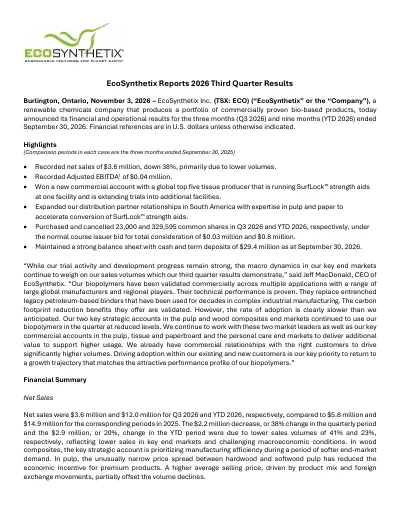
Yesterday afternoon, we reported our 2026 third quarter results. Sales were $3.6 million in the quarter, a decline of 38% compared to the same period last year.
Despite that top-line pressure, adjusted EBITDA was essentially break-even at $39,000. We're in the midst of a very challenging year, particularly compared with the progress and momentum we built through 2025.
We recognize that the current results are not acceptable to any of us. This morning, I'll discuss what's changed, and more importantly, I'll outline what we're doing to accelerate growth.
As we reported in the second half of 2025, we had built strong momentum with our two key strategic customers: a top global pulp producer and an international retailer that is backward integrated into wood panel production. Both organizations were actively and publicly promoting products enabled by our biopolymers as part of their growth and sustainability strategies.
They became our two largest customers, and the momentum was evident in our financial results. Just as important, these customers are the leaders in their respective markets.
Our progress with them provided strong proof to other producers that our products work and create value. In the case of the international retailer, the global affordability crisis led to leadership and strategic changes, including a stronger focus on reducing costs and simplifying operations.
As a retailer built around affordability and value, it is highly sensitive to its cost base. Running two glue systems adds operational complexity and costs.
As the newer, lower-volume supplier, our DuraBind products can be marginally higher in cost and carry the burden of changeover costs, and so we've been disproportionately affected as the newer, lower-volume supplier. The retailer remains committed to its 2030 sustainability goals of reducing fossil-based glue use by 40% and greenhouse gas emissions from glue by 30%.
The retailer continues to run DuraBind at regular intervals, but at lower volumes. The customer continues to invest alongside us.
A trial planned for later this year will evaluate an enhanced DuraBind formulation designed to reduce costs, addressing a key barrier to broader adoption. In 2025, one of the world's largest suppliers of hardwood pulp grew to become one of our top two customers through the use of our SurfZell strength aids to create an enhanced, stronger hardwood pulp.
The commercial opportunity they're targeting is growing sales of high-margin, enhanced-strength pulp made with our SurfZell biopolymers. These products enable customers to replace higher-cost softwood pulp, improve manufacturing line speeds, and reduce energy costs.
The producer aims to capture a substantial share of the value through premium pricing, while offering end customers significant savings to encourage adoption. Hardwood has significant production advantages: it grows faster and can be processed more efficiently by new, very large-scale pulp mills.
These advantages are evidenced by the huge investments being made in expanding hardwood capacity in places like Brazil and Indonesia, while softwood capacity continues to decline given its inherent inefficiency. Normally, because of its strength, softwood is priced at a premium to hardwood.
However, cyclical oversupply and weak global economic conditions have narrowed the premium to historically low levels in North America and only modestly better in Europe. Some industry estimates indicate that 40% of softwood pulp is being sold below cash cost today.
That is not sustainable. The narrower price spread reduces both the savings available to customers and the premium the producer can charge for its enhanced pulp, weakening the near-term commercial opportunity.
However, both our customer and industry experts expect more typical pricing dynamics to return. Industry pricing data cites a historical spread in excess of $200 per ton.
Our customer continues to manufacture and sell enhanced pulp using our biopolymers it purchased in late 2025, demonstrating continued commercial use despite the challenging pricing environment. Through the past 6 months, we have seen announcements of pulp mills curtailing softwood capacity and new hardwood capacity coming online.
These dynamics are expected to contribute to restoring a normal balance. The question is when.
These are the market forces we have faced in 2025, 2026. We do not expect them to change in the immediate term, and we're being affected by rapid shifts in two different markets.
We used these two global market leaders as proof points to generate broader commercial activity. At the same time, that progress increased our customer concentration.
Together, these two accounts represent more than 100% of the year-over-year decline in quarterly sales. The proof points we built with these accounts remain real and important.
We're using them to build our position proactively rather than simply waiting for market conditions to improve. What are we doing?
Our value creation strategy has two key pillars: innovation and commercialization. Based on my experience and given the disruptive positioning of our biopolymers, the surest path to a stronger business is innovation.
That is priority number one. Innovation is how we've gotten to where we are with a successful product line, and it's how we'll make our product offerings more successful going forward.
The second pillar is commercialization. We are continuing to invest in the internal resources and partnerships needed to take proven products to market and develop new ones.
We already have strong relationships across our end markets, some dating back to our legacy paper business. Given the complexity of these markets and their industrial processes, distribution will also remain an important part of our strategy.
Let me start further with innovation. Although development timelines can seem long, we've built and commercialized proven product lines in periods that are short by chemical industry standards.
Our unique chemistry, manufacturing process, and size allow us to move quickly. We're increasing our investment in innovation and broadening the reach of our product lines.
We're targeting value that can sustain success through industry cycles. We want our products to always lead in value, not simply provide an alternative.
In a very short period, we developed a next-generation DuraBind product. Lab trials have shown a significant improvement in both cost and sustainability.
The international retailer has been engaged and excited about these results and plans to begin its own trials in the coming quarter. This progress is proof that they remain committed to their strategy of sustainability, and we're supporting that strategy with a more cost-advantaged solution.
This is one of several development programs in which the retailer is investing alongside us. That investment demonstrates its commitment to better solutions for the future.
These investments include an upgrade at one of its large production lines to better support the use of our bio-based glue system going forward. We continue to view the elimination of formaldehyde from household products and a significant reduction in the carbon footprint of glue as necessities for this industry.
We have a substantial lead with a solution that achieves these goals at a competitive cost. As long as this market leader continues to invest, we will invest thoughtfully alongside it.
The opportunity represented by its change agenda alone is approximately $60 million. We're making similar investments to broaden the SurfZell product line for fiber strength in pulp, tissue, paper, and packaging.
Our commercial success at multiple mills, together with growing interest from chemical distributors, provides strong proof that SurfZell works and delivers distinctive value, even in challenging market conditions. This work has also deepened our understanding of the needs we can address through improved fiber bonding and strength.
Those needs vary by application, by geography, and by fiber furnish. Based on these learnings, we're developing several SurfZell variations for different applications.
The first of these are now entering commercial trials. In tissue, packaging, and pulp, a new tissue mill represents an opportunity of a few hundred thousand dollars, a packaging line a few million dollars, and a large pulp mill in the tens of millions of dollars of opportunity.
Our solutions address all three applications. We also continue to innovate with our personal care partner, Dow.
Based on the demand it sees for all-natural ingredients, Dow provides us with direction on new product needs and continues to invest significantly in bringing these applications to market. For example, we expect Dow to launch another MaizeCare product for all-new natural ingredient applications next spring during personal care show season.
Its pipeline and sales continue to show steady, modest growth as it positions MaizeCare as an important product line for current and future demand. We also continue to make disciplined development investments in new areas where our biopolymers can deliver distinctive value.
Innovation is our first priority, and in my experience, the surest path to greater success. Our second priority is to strengthen our commercialization efforts.
Earlier this year, we recruited an experienced leader to head our SurfZell business development efforts. In a short period, we've completed multiple successful mill trials at a North American tissue mill, giving us our first proof point in this geography.
We believe his leadership is already making an impact. Distribution partners are essential to maximizing SurfZell's commercial potential.
They bring established customer relationships, technical expertise in complex industrial and chemical environments, and they're in the mills every day. Our first two distribution partners have become important customers.
Distributors that joined us earlier this year continue to build their pipelines through trial programs. One has worked with us over the past few months to commercialize SurfZell with a top-five global tissue producer in Europe.
In North America, strong lab results have opened the door to mill trials in both pulp and packaging with industry leaders. We've also expanded our distribution network, with new partners signed in South America and potential relationships progressing in Asia, the U.S., and Canada.
We believe our partners' customer access and technical capabilities make distribution the right model for expanding SurfZell adoption globally. To support these efforts, we're further strengthening our internal team as well, adding an R&D leader with extensive development and hands-on application experience in our core markets.
In the near term, our commercialization efforts are focused on selling what we have already proven. SurfZell's value has been demonstrated repeatedly in tissue and hardwood pulp, and we're using those successful cases to amplify the efforts of our team and distribution partners across the broader tissue market.
In tissue, we've demonstrated value beyond the hardwood-softwood price spread. SurfZell can reduce energy consumption, improve runnability, and lower dust levels in tissue products and operations.
For these reasons, tissue represents a large part of our current prospect pipeline. Hardwood pulp is a larger and more complex opportunity, with longer adoption timelines.
Building on our success, we have advanced programs with three additional pulp producers. Two are progressing toward mill trials over the next few months.
The opportunity in our core markets has not changed. Our products have been proven to work and deliver value.
Market setbacks at our two largest customers have affected our results and timelines. We expect those conditions to shift over time, but we're not waiting.
We're accelerating our highest-priority development work and investing in the internal resources and external relationships needed to expand beyond our current base. Our objective is to make our products the solutions of choice regardless of cycles we cannot control.
With that, I'll turn it over to Rob to review the financials. Rob?
Rob Haire
Thanks, Jeff, and good morning. Net sales were $3.6 million in Q3 2026, down 38% or $2.2 million from the same period in 2025.
The decline was driven by lower sales volumes for our two key customers amid challenging macroeconomic conditions. As Jeff noted, our key strategic account in wood composites is prioritizing lower costs during a period of softer end-market demand.
In pulp, the unusually narrow price spread between hardwood and softwood pulp has temporarily reduced the economic incentive for enhanced pulp products. Excluding manufacturing depreciation, gross profit as a percentage of sales was 37.8% in the quarter, compared to 34.2% in the same period in 2025.
The improvement was primarily due to higher average selling price due to product mix. Gross profit was $1.1 million in the quarter, down 36% or $620,000 from the same period last year.
The change was primarily due to lower sales volumes, partially offset by a higher average selling price. SG&A expenses were $1.4 million in the quarter, compared with $1.8 million in the same period last year.
The $420,000 reduction was primarily due to lower salaries and benefits, reflecting reduced variable compensation as we have not achieved our performance objectives this year. R&D expenses were $270,000 in the quarter, compared with $390,000 in the same period last year.
The decline was primarily due to lower variable compensation and higher refundable government tax credits than in the prior year. R&D expense was 7% of sales in Q3 2026, unchanged from the same period last year.
As Jeff noted, our R&D efforts remain focused on increasing the value of our existing products and expanding our addressable opportunities. Adjusted EBITDA was essentially break-even at $39,000 in the quarter, compared with $200,000 in the same period last year.
The decline reflected lower gross profit from reduced volumes, partially offset by lower operating costs adjusted for non-cash items. As of September 30th, we had $29.4 million cash and term deposits, compared with $29.6 million as of December 31st, 2025.
During Q3, we invested $33,000 through the NCIB to purchase and retire 23,000 shares. Year to date, we've invested $766,000 to purchase and retire 329,000 shares.
Our strong cash position provides flexibility to invest in growth and return capital to shareholders. With sales below expectations and the timing of recovery uncertain, we believe measured share repurchases are appropriate to preserve capital for development, commercialization, and execution of our long-term growth strategy.
With this in mind, the board has committed up to $500,000 Canadian to share purchases through the NCIB in Q4 and will review that allocation quarterly. With that, I'll turn it back to Jeff for closing comments.
Jeff MacDonald
Thanks, Rob. In periods like this, we believe transparency and consistent communication are especially important.
There is still uncertainty ahead, and we have a significant sales volume gap to close following the challenging conditions facing our two strategic accounts. We do not expect an immediate change in market conditions.
Even so, we remain confident in the large opportunities we have described. We intend to pursue them through continued innovation and the commercialization of both our existing products and the new products we're bringing to market.
Market conditions are challenging, and industrial change takes time. Innovation and a strong commercialization strategy are two key pillars within our control, and they are how we will work to restore growth that reflects the attractive performance profile of our biopolymers.
The current results are not acceptable to us either. We're doing everything within our control to improve them under these market conditions.
With that, I'll ask the operator to open to the call to your questions.
Operator
Thank you. Ladies and gentlemen, we will now begin the question-and-answer session.
If you wish to ask a question, please press * and 1 on your touchtone phone and wait for your name to be announced. Once again, * and 1 if you wish to ask a question.
Please stand by while we compile the Q&A roster. Once again, as a reminder, if you wish to ask a question, please press * and 1 on your touchtone phone.
We now have our first question, and this comes from Jeff Schacter from TD. Your line is now open.
Please go ahead.
Jeff Schacter
Morning, guys.
Jeff MacDonald
Good morning, Jeff.
Rob Haire
Good morning.
Jeff Schacter
I heard on the call a lot about innovation and trials, which we've heard about for several years now, but we haven't heard a lot about, obviously, sales? I understand you have a bunch of these distribution partners.
You have the international player selling your product at a premium. Now, I understand the weakness from the core customers, but what would help me reconcile your product position, your success of the product, the integral innovation you've made with the product would be to see an undercurrent of success of direct sales by Eco with all these trials in place for multiple years, to their direct customers, which aren't, I'm assuming, being sold at the premium pricing that the international player is pricing it at.
My ask here is, how would you comment on more in-depth of your sales team, your distribution communication, even the success of how many lines they've added over the last number of quarters? How many of these trials are out there?
How many lines do they represent, and why aren't they converting?
Jeff MacDonald
Thanks, Jeff. I guess, to preface it, I would just say that the market conditions that are affecting our large pulp customer also affect the pulp and paper market more broadly.
There's a general condition that doesn't favor our value proposition as much as it did a year ago. That's a bit of the backdrop.
That said, our value proposition remains very strong in tissue in particular and goes beyond just the hardwood-softwood spread. The first two distributors that we established are on our books as significant customers to us today, and that kind of proves that that distribution model is working for them and for us.
Then we established several more relationships right at the beginning of this year. One of the wins—and we're not going to go into what everybody has in their individual distributor pipelines, but one of the significant wins we've achieved this year, although at first doesn't show up in big dollar terms because it's one line within tissue, but one of those recent distributors from early this year has secured a top-five tissue producer, with expansion plans to further lines, and the additional lines are already in play and under trial.
The plan there is for expansion, and I just use that really as a good example of progress. We've also used the progress we've had from our initial tissue wins now to expand into North America, which was a challenging market for us to enter at first.
With the help of one of our new team members, we've now developed a positive proof case at our first North American tissue mill. It takes those beachhead wins and demonstration cases in new geographies, because things are different by geography, to prove it out.
Then based on those successes, the number of distributors—and more so initially it was us going and knocking on doors, we have distributors coming and knocking on our door now based on what they've seen. We're seeing the number of distributors grow as they come online, the pipeline of trial activities grow, and we're starting to see the first wins from those we added in January come through already, albeit at low volumes, because it is the first tissue line in each case.
Product works and is expanding in its reach to the market through these distribution partners. That's the best way I can put it.
Jeff Schacter
Can I just ask as follow-up, are the mills that you're trialing at, because there's still this, I don't know if you consider it an issue, but, as you mentioned, different geographies require a whole sort of, not full redraw, but a whole sort of restart of trialing, are the mills you're trialing at have impactful number of lines so that you're at core plants that can go from 1 to 15 lines quickly, or are we in a situation where you get one line success and then you've got to start a year out for other geographies, and is there any innovation around or different strategies around speeding up or making it easier for adoption?
Jeff MacDonald
Got it. Good question.
The tissue market is characterized by having fairly distributed operations because you need tissue it doesn't ship really well, and so you need tissue operations close to where consumers are. It is fairly distributed.
A larger mill might have two or three lines within it, but they typically are relatively smaller operations compared to packaging or pulp for sure. There is more work on an individual basis relative to the revenue opportunity.
Once you get into a mill, and we're seeing this already with this new top-five tissue producer, they have people within the organization that can translate success with us into other operations and really take the lead in driving that across additional mills. They've already done that, and we're well into trial programs on the next set of mills with them.
The other thing that I would just add to that, though, is that part of the variation that we see by geography is how companies create packaging with different furnishes in different markets. Those furnishes can be very, very different in their inherent fiber characteristics and the chemicals that go along with that.
Especially in packaging, as we've learned more and we have to adjust to these geographical differences, we're making some progress there in different geographies, some with existing products just used in more optimized ways, and some with new products that, as we've learned, we've made some tweaks to our SurfZell products to address these different furnishes. Those are ones where you do have a very concentrated opportunity at one site, and they're very attractive to us, to the distributors, who are putting a lot of work into that right now.
Jeff Schacter
Okay. Just finally then, the development pipeline, can we say it's 50% higher, like trial activity has never been higher?
Is it flatlined? Is it the same players or are you actually seeing increased interest translating to increased trials, serious trials, amongst parties?
Then that's it for me.
Jeff MacDonald
Thanks, Jeff. My response to that is going to be balanced.
With adding new distributors, we definitely have more trial activity than we've had before. That said, the trial activity would and could be much higher if the dynamics in the pulp market were different.
That definitely has an overall damper on things, and it's a challenge that our distribution partners are facing generally as well, not just with our products. Market conditions, I guess, put a damper on it, but we're expanding the size of that pipe despite the pipe not moving as fast as it normally would if we had a $200 price gap between hardwood and softwood pulp and general market conditions were more favorable.
Operator
Thank you. The next question comes from Gerry Wimmer.
Your line is now open. Please go ahead and ask your question.
Gerry Wimmer
Hi, Jeff.
Jeff MacDonald
Hi, Gerry.
Gerry Wimmer
First question, you talk about the new tissue manufacturer you brought on board, top-five tissue manufacturer. You talk about that one line has gone commercial.
Two questions: from trialing to going commercial with this one line, what was the time period? Secondly, you mentioned that this tissue manufacturer has multiple lines.
Can you quantify how many lines, and can you quantify approximately what revenue per line for this manufacturer is?
Jeff MacDonald
Yep, good question. Thank you.
I'll just roll back to tissue lines generally first. We've said all along that a tissue mill represents an opportunity of about $200,000 to $300,000 to us for our SurfZell products.
This first line, I would say, is gone faster than things normally happen within the pulp and paper industry, and it's testament to the value we are offering this customer. We got started in trialing with a new distribution partner in January, and this customer was accepting commercial orders on a continuous basis starting in August.
That's a very short period of time to get to success within pulp and paper. It was enough, even before that, they saw enough that they began efforts at two other lines as well.
The mill that we're in itself has two lines. The customer on an overall basis, I don't want to give away exactly who the customer is, but as a top-five player, they would have more than 30 lines in their fold.
Gerry Wimmer
How many lines are you trialing right now amongst those 30, other than the ones that you've commercialized?
Jeff MacDonald
They're going step by step. They've added a few more that they can manage, it's a few.
I think it's probably the expectation from what we understand from them would be proof point on one, move to a few to replicate, and then go further across the rest of their network.
Gerry Wimmer
That $200,000 to $300,000 per 30 would be the standard amount that you could expect from each line, that $200,000 to $300,000 annually? Yep,
Jeff MacDonald
yeah, that's a tissue mill. There's some that are meaningfully larger than that.
There are a few that are smaller than that, but that's a good average: $200,000 to $300,000 worth of SurfZell per line.
Gerry Wimmer
Okay. Would there be reason to expect for the trialing to commercialization in these additional lines would be quicker or slower, or that's impossible to predict at this point?
Jeff MacDonald
I use history and what the customer is telling us as the best predictor. 8 months is a pretty good trialing program.
I'll say that our guy in North America is also achieved something in a similar timeframe with our first proof point here, although not quite commercial yet, through three trial programs to get to a level of technical success that everybody's happy with. So 8 months is fast, but it can go that fast.
Gerry Wimmer
Moving on to your major wood panel client. At one point, you used to quantify how many lines they had or how many lines they had and how many they outsourced, I believe, third party.
I think last year at this point, we were on one line, maybe converting to two lines. When you convert a line at this customer, does that line stay with your product?
It's just a matter of how much volume is driven on that line that changes?
Jeff MacDonald
Yes, that is what happened through last year and leading up to last year. We were on one line, and we started off with a low volume on that line and managed through the course of last year to get to a point where at least 50% of the products coming out of that factory had our bio-based glue in them.
Normally, that stays. It's the conditions that they've faced and the need to simplify their operations that have made that more challenging and reduced our volumes.
Normally, once in an operation like that, you stick. They have four mills that are captive to them that are backward in most cases, in three of the four cases, are backward into furniture production facilities.
Then they, including those mills as well as through their supply chain, they represent about 17 lines of production capacity to serve their needs. When we frame the opportunity for us relative to their 2030 goals, that's those 17 lines of demand that represent that $60 million opportunity.
That's how the math works.
Gerry Wimmer
Okay. From a cost standpoint, and you talked about that the value wasn't as great today on a cost basis, never mind the practical basis, but with oil prices hovering around $100 for the last year, now maybe corn prices are up too, what's the value proposition on the cost side of your product versus the incumbent products that are used by this customer, their own mills still and maybe third-party mills?
Jeff MacDonald
Specific to wood, I'll say we're in a slightly advantaged position today compared to normal times because we have more bio-based content, but our DuraBind solution also works together with an oil-based crosslinker. There is still an oil-based component that's also up significantly alongside methanol and formaldehyde.
It's not a full impact there. Where we actually see a bigger swing and a bigger economic gap that we can take advantage of is actually in our legacy products.
A lot of the components that go into styrene-based latexes, particularly those going over to Asia, have faced a huge price increase, and even a question of whether demand can be satisfied given the Gulf crisis. We're seeing opportunities open up in the Asia market as a result of that that otherwise customers would not have been willing to make an investment in a change agenda, but the gap is just big enough and security of supply has become important enough to them that our partners in Asia see some opportunities there that they haven't seen before.
We're hoping those translate into something early in the new year, but those are opportunities that are being worked on today.
Gerry Wimmer
Okay. Just two more questions.
On your customer in North America, is that in part tissue or paperboard?
Jeff MacDonald
We have activities on the go actually in all three segments for SurfZell. We have a really interesting trial program with a pulp producer in North America that all of the lab work has showed up very interestingly in the past few months, and they're moving to a mill trial here shortly.
We have our first proof case through three trials in the tissue market, which is now being translated and promoted across others in that space. We've got some really interesting work on the go in packaging with a major packaging producer pretty close to home here that is showing some very interesting results, too.
That's all on the go here in North America.
Gerry Wimmer
It's hard to predict, would you anticipate that that activity could turn commercial in 2027?
Jeff MacDonald
I would say especially on the tissue side, just given how fast the program has progressed and then the ability to translate that more quickly in tissue. Packaging takes longer, but we've been at this for a while now, and the results we're showing are quite interesting.
The pulp opportunity is, I think, a little bit more of a wild card. North American pulp is challenged today, but it seems like our product is helping with some of those challenges and may allow this customer to be more competitive.
A few of those, yes, I would expect to be real in 2027.
Gerry Wimmer
Okay. My last question, as it pertains to your major pulp customer and the cost differential between soft and hardwood lumber, and you produced the chart and obviously in 2026 there was a dramatic drop-off in the price differentiation between hardwood and softwood, and as a result, your revenues in that segment has dropped dramatically in a short period of time, how quickly, if the structural imbalance changes to our favor, does it turn right back on or how should we look at that?
Because it turned off very quickly. How would you look at that if the differential goes in our favor and changes, is it a 3-month effect where business could return or how would you see that?
Jeff MacDonald
I guess the one thing is that the underlying business that our customer had already converted continues, and they continue to produce product and support those customers. Once a customer's been converted, like we said with the other market earlier, it stays pretty sticky, and they continue to support it.
They also had a really exciting pipeline. I was with their people just a few months ago, and the head of the pulp business said, "I was on top of the world," before this change happened in January.
What he meant was that they were out with this product trialing at many customers. I think once softwood isn't as attractive as it is, they've already got the pump primed as well.
From our side, we're definitely in a position to be able to support them with product really quickly as things turn around. I guess the other thing I would add to that, too, Gerry, is that the pulp customer is also a significant player in the tissue space.
Both with their own existing operations and some recent acquisitions is maybe the best way I'll put it. That really should be the lowest-hanging fruit for them, given what we see ourselves in the tissue space, and we're pretty sure that they're working that opportunity as well.
A lot of tissue mills within their control today where our product can certainly make a difference.
Gerry Wimmer
Those are all my questions. Thank you.
Jeff MacDonald
Thanks very much for the questions, Gerry. Bye.
Operator
Thank you. Once again, for those who want to ask a question, please press * and 1 on your telephone keypad and wait for your name to be announced.
* and 1 for questions. No further questions have came through.
I will now turn the call over back to Jeff MacDonald. Please go ahead, sir.
Jeff MacDonald
Thanks again, everyone, for joining us today, and we look forward to updating you again soon.
Operator
Thank you. This concludes our conference call for today.
You may now disconnect.