Endeavour Mining PLC
Q3 FY2026 · Earnings Call TranscriptNovember 12, 2026
Operator
Good day and thank you for standing by. Welcome to Endeavour Mining's third quarter 2026 results webcast.
At this time, all participants are in listen-only mode. After management's presentation, there will be the question-and-answer session.
For those who wish to ask a question, please dial in to the phone line. Please note that due to time constraints, we'll be prioritizing questions from covering analysts, and we ask analysts to limit themselves to two questions before jumping back into the queue.
Today's conference call is being recorded, and transcript of the call will be available on Endeavour's website tomorrow. I would now like to hand the call over to Endeavour's Vice President of Investor Relations, Jack Garman.
Jack Garman
Hello everyone, and welcome to Endeavour's third quarter 2026 results webcast. Before we start, please note our usual disclaimer.
On the call today, I'm joined by Ian Cockerill, Chief Executive Officer; Guy Young, Chief Financial Officer; and Djaria Traore, Executive Vice President of Operations and ESG, who will talk you through the presentation. I'm also joined by Sonia Scarselli, Executive Vice President of Exploration and Growth; and Rousso Juste, Chief Technical Officer, who will be available as part of the Q&A.
Today's call will follow our usual format. Ian will first go through the highlights of the first three quarters of the year, Guy will present the financials, and Djaria will walk you through our operating results by mine before handing back to Ian for his closing remarks.
We'll then open up the line for questions. I'll now hand over to Ian.
Ian Cockerill
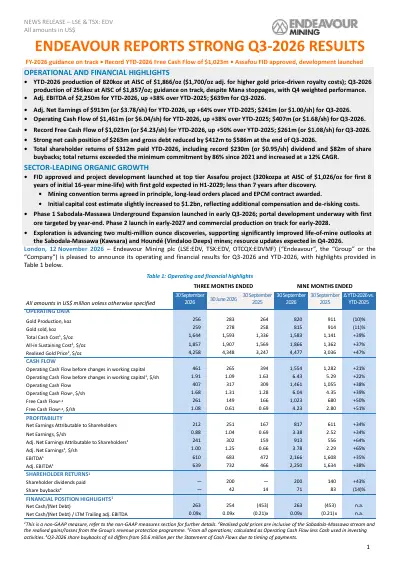
Thank you, Jack, and hello to everyone who's joining us on the call today. Our solid operational performance, coupled with higher realized gold prices, has underpinned record financial performance so far this year, which positions us really well to unlock the group's significant organic growth potential, increasing production by over 27% to 1.5 million ounces by the end of the decade, whilst delivering sector-leading shareholder returns.
Operationally, we remain on track to achieve the lower half of our production guidance for the year, with costs in line on a royalty-adjusted basis, as Lafigué's particularly strong performance has helped offset lower-than-expected production at Mana. We expect Q4 to be our strongest quarter, as Houndé, Ity, and Sabodala-Massawa move into higher grades.
That is despite the recent suspension of underground mining at Mana, which Djaria will talk through in more detail later. This performance has driven record free cash flow generation [unclear] of the same period last year.
Now that cash generation has allowed us to maintain a net cash balance sheet position of $263 million, while underpinning our key strategic priorities of delivering both sector-leading shareholder returns and sector-leading organic growth. On shareholder returns, we delivered a record return for H1, and we're on track to deliver another record for the full year.
On organic growth, we're very pleased to have approved the final investment decision at Assafou, and we have launched project development, targeting first gold in H1 2029. At Sabodala-Massawa, underground expansion phase one is progressing well, with phase two expected to start early next year, with commercial production on track for delivery in early 2028.
Finally, our exploration program continues to focus on unlocking our significant discoveries at Vindaloo Deeps at Houndé, and Koussara at Sabodala-Massawa. Updates on both of these multi-million ounce resources are expected later this year, offering significant life-of-mine upside at both of these mines.
To summarize, our operations remain highly cash-generative, we're returning a meaningful share of that cash to shareholders, while investing in the projects that are going to support our next stage of growth. Now, let me walk you through each of those areas in a little bit more detail.
On slide seven, starting with our outlook for the year. As mentioned, we are on track to deliver both group production and all-in sustaining cost guidance, with stronger production and costs expected in Q4.
We expect production in the lower half of the range due to the lower-than-expected production at Mana following underperformance this year that has been compounded by the suspension of underground mining activities following the ramp subsidence that we reported a few weeks back. On costs, we are firmly on track given year-to-date ASIC, that is $1,700 per ounce on a royalty-adjusted gold price basis, completely in line with the midpoint of our original guidance range.
This year's performance highlights the importance of our high-quality and [diverse?] portfolio, because when one asset underperforms, any one of the others can certainly help pick up the slack.
As we move into next year, we will leverage this portfolio, particularly Lafigué, driving higher throughput, and Sabodala-Massawa, optimizing throughput and grades, to try to offset as much of the shortfall from Mana as possible. On slide eight, you can see we've produced 820,000 ounces so far this year at a record margin of 40% higher than the same period last year.
Clearly, we are capturing higher margins at higher gold prices, but at the same time, our low cost base ensures we remain resilient even at lower gold prices. On slide nine, we've generated a record $2.25 billion of adjusted EBITDA so far this year.
That's up 38% on the same period last year, at a very healthy adjusted EBITDA margin of 61%. Despite slightly lower production, higher gold prices and the full realization of those gold prices following the end of our hedging program at the end of last year has certainly supported record earnings.
Now, our record earnings have translated into a record cash flow. On slide 10, you can see we've generated free cash flow of over a billion dollars, equivalent to $1,246 of free cash flow for every ounce of gold that we produce.
That's around 50% higher than the corresponding period last year. We expect to continue generating strong cash flow into Q4, given the stronger production profile and seasonally lower cash costs.
On slide 11, our strong free cash flow generation has continued to bolster our balance sheet, which remains in a healthy net cash position of $263 million, with leverage well below our long-term target. Our strong cash flow, coupled with our very healthy balance sheet, positions us well to prioritize our strategic objectives of delivering sector-leading returns whilst delivering sector-leading organic growth.
Looking at returns in more detail, we have a strong track record, and since 2021, we've returned over $1.9 billion to our shareholders. We've maintained annual double-digit growth [unclear], highlighting the importance we place on shareholder returns, and we expect to build on this track record moving forward.
We don't provide forward-looking guidance beyond our annual minimum commitment, but our track record supports returns of around 86% above that minimum return. This year, we've already returned a record $312 million in dividends and share buybacks, which is more than our minimum commitment for the whole year.
For 2026, we're on track to pay out record shareholder return. Looking forward, we don't expect Mana to have an impact on our shareholder return program either.
On slide 14, and looking at our sector-leading organic growth pipeline, we have a clear runway to achieve a 27% production growth by 2030 through our top-tier Assafou project and our Sabodala-Massawa underground expansion. Beyond these projects, exploration will support further growth, with major discoveries like Vindaloo Deeps and Koussara, both offering significant life-of-mine upside at our existing mines.
We've not stopped there. To ensure our pipeline is robust and that we can continue to deliver organic growth over the long term, our new ventures exploration program is focused on identifying a diverse suite of top-tier development projects to support continued organic growth even after Assafou.
Turning to Assafou on slide 15, where we've approved the final investment decision and launched project development. This is obviously an important milestone that significantly de-risks the next phase of the project and the timeline to first gold, which is expected in H1 2029, just seven years after discovery, and 24 to 30 months post-FID.
Since our last update, we have now finalized the in-principle terms of the mining convention with the Minister of Mines, based upon the 2014 code, and we expect to have this fully signed off by the rest of the government in the coming weeks. We've increased our capex envelope to $1.2 billion in order to further de-risk the project.
The majority of this increase, around 60%, is due to increased land and crop compensation rates that followed local government and community consultations, and we expect to finalize the resettlement plan by the end of this year. Around 25% of the increase is from additional contingencies, particularly around the highway diversion, the grid connection, and the moved transmission lines, as both are still under final negotiation with government.
Finally, around 15% of the increase is driven by a number of small de-risking changes, including additional advance grade control drilling, an extension of the EPCM and owner's team support, additional spares, and improving the site's network connectivity. We've now committed about 5% of the initial capital, and activities at Assafou will start to ramp up in Q4 as we finalize the mining tenders and start plant, dam, and relocation earthworks.
Moving to slide 16, which is a simple reminder that Assafou is a top-tier project and clearly one of the best approved gold projects globally. What I'm particularly excited about is that we're building a scalable processing plant, and a lot of exploration potential across our permits is in close proximity to the Assafou plant.
We see potential to expand throughput beyond the initial design over time, with significant exploration upside beyond the 5 million ounces of resource that's been defined to date for this project. At Sabodala-Massawa, we're also making progress on the underground expansion that will bring high-grade ore into the CIL plant and lift production towards our 350,000-ounce-a-year goal.
The initial phase of expansion is on track for first ore by year-end, and the second phase is now board approved. That's expected to launch in early '27, targeting commercial production by early 2028.
Early works for phase two are already underway, with key contracts, procurements, and underground drilling starting to accelerate. Beyond these two projects, exploration is advancing our two large discoveries: Vindaloo Deeps at Houndé, and Koussara at Sabodala-Massawa.
Both of these multi-million ounce discoveries are expected to drive significant life-of-mine extensions at both mines, and that's not factored into our 1.5 million ounce target. We will be announcing resources for both later this year, and moving into next year, we will prioritize reserves definition and mine plan updates, as well as further resource definition as our focus steps out beyond the initial resources.
Before handing over to Guy, I'd like to touch on our commitment to safety. Last month, we sadly lost a colleague at our Ity mine, and clearly our thoughts remain with his family and his colleagues.
The safety of all our employees and contractors is a number-one priority for us, and we've been implementing throughout the year a number of initiatives to reinforce safety practices that Djaria will take you through shortly. During the quarter, we also officially launched our phase-two ESG strategy, which we call ESG 2030.
Guided by our purpose, which is to produce gold that provides meaningful value to people and society, our ESG 2030 strategy is structured around five strategic pillars: championing our people, empowering host communities, boosting local economies, protecting the environment, and last but by no means least, upholding ethics and compliance. Co-designed with our stakeholders, our strategy supports delivery of the UN Sustainable Development Goals and the national development plans of Senegal, Côte d'Ivoire, and Burkina Faso.
To bring our ESG 2030 strategy to life, we organized a dedicated ESG caravan across our sites and host communities. Through toolbox meetings, presentations, cultural events, and social media, we've reached over 4,500 employees and contractors and connected with more than 8,500 members of our host communities.
With that introduction, let me hand you over to Guy, who will take you through the financials. Guy, over to you.
Guy Young
Thank you, Ian, and hi to everyone. I'll walk you through our financial results for the third quarter now.
On slide 21, our Q3 production and sales were in line with our expectations, albeit slightly lower than Q2, due to the usual wet season impact and mine sequence. All-in sustaining costs were $50 per ounce lower quarter-on-quarter, driven predominantly by lower sustaining capital expenditure across the portfolio, as well as lower-than-anticipated input cost increases.
EBITDA and adjusted EBITDA were lower, due to the lower sales and realized gold prices. However, cash flow was significantly stronger quarter-on-quarter, with free cash flow up 76%, driven by lower quarterly cash taxes, in line with our guidance.
As Ian mentioned earlier, we expect to achieve the lower half of our full-year production guidance range, despite the operational challenges at Mana, and with costs within the range. We produced 256,000 ounces of gold in Q3, down from Q2 as I said, and driven by lower grades processed at Ity, Houndé, and Lafigué, due to their mine sequence; lower tonnes milled at Houndé, due to the wet season; and the pause in mining activities at the Wona portal at Mana.
Our ASIC improved quarter-on-quarter, largely due to lower sustaining capital. Despite the lower ASIC, our all-in sustaining margin per ounce was slightly lower quarter-on-quarter, because of the lower realized gold price.
Most of these factors, though, are expected to reverse in Q4, with higher grades at Houndé, Ity, and Sabodala-Massawa expected to make Q4 the strongest production quarter of the year, despite the suspension of underground mining activities at Mana since late October. Q4 costs are also expected to improve, due to the higher production, as well as the reduced contribution from the higher-cost Mana mine.
On slide 23, our adjusted EBITDA decreased slightly to $639 million for the quarter, due to lower gold sales and gold prices, with EBITDA margin also declining slightly, reflecting the lower gold prices. On slide 24, our operating cash flow increased by 28% to $407 million for the quarter.
The bridge shows the negative impact of $110 million from lower gold sales and prices, partially offset by a small decrease in operating expenses, including lower royalty payments related to the lower gold price. Cash taxes decreased by $291 million quarter-on-quarter, in line with the usual payment seasonality.
Finally, net working capital reversed from a $52 million inflow last quarter to a $54 million outflow in Q3, driven by a normalization of payables from the prior quarter, an increase in VAT receivables, as well as a build-up in spares and consumable inventories. As a result of this stronger operating cash flow, you can see on slide 25 that free cash flow increased by 76% to $261 million for the quarter, bringing year-to-date free cash flow to a record $1.02 billion.
Similar to previous years, we expect our strongest operating quarter in Q4, and as guided, we've now paid around 95% of our full-year cash taxes. As such, we expect to generate strong free cash flow again in Q4, building on our record year-to-date performance.
If we can move on to our balance sheet now, where we maintained a very healthy net cash position and a stable leverage ratio quarter-on-quarter. During Q3, we generated $407 million of operating cash flow and spent $146 million in investing activities, including mine and project capital.
On financing, we paid $227 million in minority dividends, in line with the timing of minority dividend declarations and cash upstreaming, as well as $16 million in financing fees and lease liabilities. In terms of gross debt, we also repaid $410 million on our revolving credit facility and $10 million on our Lafigué term loan during the quarter, bringing our gross debt down to $586 million.
Overall, liquidity is very healthy, with around $850 million of cash and $700 million available through our undrawn RCF. Our healthy leverage position gives us the required flexibility to fulfill our shareholder commitments of both investing in growth whilst maintaining our strong shareholder returns program.
Finally for me, on slide 27, earnings from mine operations were $514 million for the quarter. I won't go through every line on the slide, but just highlight a couple of the standout items, including our current income tax expense, which fell by $180 million, reflecting lower taxable profits and the timing of approvals for cash upstreaming.
Deferred tax was a $37 million expense, as compared with a recovery in Q2, largely reflecting the local board approval and payment of withholding tax in the prior period. Finally, add-back adjustments of $35 million included other expenses, a non-cash tax adjustment related to foreign exchange on deferred taxes, and losses on financial instruments relating to foreign exchange movements between the euro and dollar, partially offset by fair value gains on our marketable securities.
That brings us to the adjusted net earnings attributable to shareholders of $241 million, or $1 per share. Thank you for your attention.
I'll now hand over to Djaria to walk you through our operating performance. Djaria?
Djaria Traoré
Thank you, Guy, and hello everyone. I will begin with safety.
As Ian mentioned earlier, we sadly lost our colleague, Mr. Biéman Léon Bado, who had been with our Ity mine for over 30 years.
He passed away on the 7th of October after being found unresponsive in the processing plant. Our thoughts and prayers remain with his family, his friends, and his colleagues.
Following a comprehensive investigation, we are implementing several recommendations, including an expansion of camera coverage in the process plant, as well as testing currently some wearable technology to support earlier incident detection and prevention for employees who are working alone or in distress. In addition, we have commissioned an independent third-party review of our operational risk and safety culture.
This month, Ian and I will be hosting a contractor CEO safety workshop in Abidjan. That is really to ensure that all our business partners are fully aligned with our health and safety requirements and reaffirm their own commitment to zero harm.
While our trailing 12-month total recordable injury frequency rate of 0.67 remains below industry average, the commitment that we have to zero harm for everyone at our operations, and [unclear] is achieved. If we turn to slide [unclear], our performance over the first [unclear] month of the year positions us to achieve our full-year [unclear] a high [unclear] portfolio.
The strength of our portfolio helps mitigate variability, allowing high-performing assets to offset [unclear] is expected to be in the lower half of the guidance range, as [unclear] performance at Lafigué partially [unclear] underperformance [unclear]. We expect quarter four to be our strongest [unclear] grades [unclear] Sabodala-Massawa in line with our mine sequence.
Then [unclear] costs, [unclear] and remains on track on a royalty-adjusted basis. We expect [unclear] costs to improve compared to quarter three.
That is [unclear] higher [unclear] and lower contribution from the high-[unclear]. On slide 31, I will start the mine-by-mine overview with Houndé.
As we flagged last quarter, quarter three was the peak of waste stripping activity at Houndé, which, coupled with the impact of the wet season, has led to a decrease in production during the quarter. All-in sustaining cost has also decreased due to lower sustaining capital spent, with a portion of waste stripping at the Vindaloo Main pit reclassified from sustaining to non-sustaining capital.
This reclassification was related to the prioritisation of ore mining and the slight delay in starting the waste stripping activities. Can you hear me?
Hello? Djaria, please go ahead.
Hello? We can hear her.
We can hear you, Djaria. Very good.
I do apologize, I'm not sure where the line was lost, but I'll go back to the beginning of Houndé. On slide 31, I will start with a mine-by-mine overview with Houndé.
As we flagged last quarter, quarter three was the peak of waste stripping activity at Houndé, which, coupled with the impact of the wet season, has led to a decrease in production during the quarter. All-in sustaining cost has also decreased due to lower sustaining capital spent, with a portion of waste stripping at the Vindaloo Main pit reclassified from sustaining to non-sustaining capital.
This reclassifications was related to the prioritisations of ore mining and the slight delay in starting the waste stripping activity. Looking forward, we expect a stronger quarter four at Houndé, mainly driven by higher-grade ore, following the completion of waste stripping at the Vindaloo Main phase three pit.
As a result, productions and all-in sustaining costs are both on track at Houndé for full-year guidance. Turning now to Ity, where production decreased in the quarter, as we processed lower grades from the Le Plaque as well as the Yapi pit, as expected.
Despite this, all-in sustaining cost improved due to lower sustaining capital, following the completion of the waste stripping at the Le Plaque, and a build-up of stockpile inventory. In quarter four, we expect grades to increase, as we mine more higher-grade ore, mainly from the Bakatouo, Walter, and the Le Plaque pits.
As a result, Ity remains on track to achieve its full-year productions and cost guidance. While costs are currently tracking below the lower end of the range, the higher sustaining capital related to stripping activities and plant upgrade in quarter four is expected to bring all-in sustaining cost within the guidance range by year-end.
We have also reduced non-sustaining capital spend for the full year by $20 million, down to $25 million, as we focus on advancing the detailed engineering around the recyanidation plant upgrade before we implement it fully into next year. On slide 33, at Mana, production and cost for the quarter were consistent with the prior quarter, as higher grades offset the impact of the pause in mining activities at the Wona portal.
After the end of the quarter, on October 28th, we paused all underground mining activities due to access ramp subsidence on the ramp leading to the Wona open pit. As a result, we expect production to be significantly below the lower end of the production guidance, with costs above the top end.
Capital expenditure guidance is on target for this year. On slide 34 and 35, I want to highlight what has happened and also provide you with an update on our geotechnical findings so far, as well as the outlook.
The access ramp leading into the Wona pit, and eventually providing the access to both the Dingouna and Aviera portals, partially subsided, which meant the ramp was no longer usable, and the surface access to the Dingouna and Aviera portals was also restricted. Access to the third portal of Wona is via a different ramp, and that access is not impacted.
However, following the ramp subsidence, we paused all underground mining activities as a precaution, and we launched a comprehensive geotechnical review. In the first two weeks since the incident, the geotechnical review focused on visual inspections, as well as drone-assisted scans across the upper levels of the Wona underground workings, where so far no anomalies or evidence of ground failures were found.
While the review is still underway, it has identified a significant north-south trending graphitic shear zone, which runs through the affected area. This geological structure, coupled with the historic use of the sublevel open stoping mining method, especially in the shallower portion of the underground workings, may have contributed to the subsidence event.
Now if you go on to slide 35, in terms of next steps, we continue the geotechnical review, while we also increase our routine geotech monitoring program, using various method: radars, lidar, as well as InSAR data, to ensure safe operations and also advancing into the Wona portal. In terms of the underground activities, we expect to re-enter Wona in quarter four.
Initially, we would like to focus on stabilizing the shallow area of the deposit as a precaution before we restart any ore mining, which is expected in quarter two 2027, and that is subject to all the relevant regulatory approvals. At the same time, the geotech review will continue to advance through Wona, with the objective of a sign-off to re-enter.
Once re-entry is authorized, we expect to start remediation works that are currently planned to extend through to quarter two next year, and that is to provide access and avoid the area in close proximity to the subside section of the ramp. In terms of open pit activities, we are working on accelerating the Bana Camp open pit, and we have now received the mining permit.
At the same time, we'll start grade control at the Maoula open pit ahead of ore mining, which is expected in quarter two 2027, subject of course to positive drilling results. We expect processing to remain paused until quarter two 2027 to allow for stockpiles build-up therefore support a stable operation.
It's a little premature to discuss guidance for 2027, as we are still in our budgeting process at the moment, but a detailed guidance will be provided with our usual update at the end of January. In short, we will expect full-year 2027 production to be impacted by the lack of processing, especially in quarter one, and the ramp-up of underground mining activities from quarter two onward.
However, at the group level, we are focused on opportunities across the group to boost production, and particularly from Lafigué and Sabodala-Massawa, where we do see some scope through an increase in throughput, as well as higher grades ore. Now moving into slide 36 with Sabodala-Massawa.
Production increased slightly, due to improved mill availability, following a maintenance program from quarter three, and the addition of higher grades from Massawa North Zone stockpile, which were treated through the BIOX plant, as part of the test work program. The test work program results in lower recovery, as previously communicated, albeit better than expectations, as we blended the ore from Massawa North Zone with our main feed from the Massawa Central Zone, focused on optimizing the recovery rate.
Based on this test work, we expect to start processing the Massawa North Zone fresh ore late in 2027. During the quarter three, all-in sustaining cost decreased, which is driven by lower sustaining capital and higher gold sales.
Now looking ahead at Sabodala, we expect a stronger quarter four at both process plant. Higher-grade ore from the Niakafiri West, Goumbati, and Samina pit is expected to support an increased production through the CIL plant, while at the same time, we continue optimizations in the BIOX plant to deliver higher throughput and even better recovery.
At Sabodala-Massawa, we're well on track to achieve both production and all-in sustaining cost full guidance for the year. Now Lafigué, on slide 37.
We've had a very strong nine months at Lafigué, mainly driven by the outperformance of processing throughput, which has achieved an 11.5% above design nameplate for the year to date 2026. In quarter three, production decreased slightly, due to increased drawdown of lower-grade stockpile during the wet season, while the all-in sustaining cost increased slightly, due to higher mining cost through the wet season.
We expect slightly lower production at Lafigué in quarter four, as we begin the pre-stripping for the next pushback at the Main and West pits, which will result in lower grade and lower throughput. Given the strong performance so far at Lafigué, the mine is on track to deliver near the top end of its production guidance, with cost near the lower end of the range.
Now if we move into slide 38. At Lafigué, we've launched a 16-megawatt solar power plant project to help lower cost, reduce our CO2 emissions by nearly 27%, and also diversify our power sources.
The deferred purchase sales agreement with TotalEnergies ensures we incur limited upfront capital and lock in a low unit rate for solar power for the reserve life of mine. We are launching construction in early 2027, and we expect to complete construction in early 2028, supporting again our target to reduce our CO2 emissions intensity by 30% by 2030.
Thank you, everyone. I will now hand back over to Ian for his conclusion remarks.
Ian Cockerill
Thanks very much, Djaria. Before we open up for Q&A, I think let me just take a few minutes to walk you through why we believe Endeavour is still a very compelling investment.
We have a strong track record of delivery in exploration, project development, and operations, which has helped build a high-quality and resilient business that we have today. We've not stopped there.
We're future-proofing through our organic growth projects, including Assafou and the Sabodala-Massawa underground expansion, driving sector-leading organic growth to the end of this decade. In addition, our new ventures exploration strategy provides a solid foundation for new projects into the 2030s.
Thanks to our high-margin production, strong free cash flow generation, and healthy balance sheet strength, we can pay a sector-leading shareholder return whilst we continue to grow. In short, Endeavour offers a rare combination: strong cash flow, an unrivaled organic growth pipeline, sector-leading shareholder returns, and very few companies in our sector can deliver all three of those at the same time, at such an attractive valuation.
With that, let me hand you back to the operator, and let's open the line for any questions you may have. Thank you.
Operator
Thank you. Dear participants, as a reminder, if you wish to ask a question, please press star one one on your telephone keypad and wait for your name to be announced.
To withdraw a question, please press star one and one again. Please stand by while we compile the Q&A roster.
This will take a few moments. Now we're going to take our first question.
The question comes from the line of Daniel Major from UBS. Your line is open, please ask your question.
Daniel Major
Hi there, can you hear me okay?
Ian Cockerill
Yes, Daniel. Good afternoon.
Daniel Major
Great. Thanks very much for the questions.
The first one, you've provided the capex update for Assafou. I guess you'll provide more details with the full-year results, but can you give us a kind of broad steer on the distribution of the $1.2 billion of spending between now and commissioning in '29?
Ian Cockerill
Look, we said previously that for this year, the likelihood is that we would spend around about up to $100 million. That $100 million was really sort of focused on long-lead items.
Obviously now, as we've started with the crop compensation scheme, and we've already started paying out to people, that's where the $100 million will go there. Then in 2027 and 2028, I would say, reasonable sort of balance, maybe slightly biased towards 2028 for the extra sort of $1.1 billion.
Let's assume up to 500 in 2028 -- sorry, in 2027, and say about 600-odd in 2028. Then preparing us for production coming in in the beginning of 2029.
Daniel Major
That's good. Thanks.
Just to clarify, you would still spend, the group, to spend somewhere near $100 million this year on growth capex, implying you'll have a pretty significant acceleration in Q4 from Assafou, just to clarify on that?
Ian Cockerill
You're going to see a big increase principally, as I said, because we've started paying out the crop compensation and obviously certain invoices coming through now for the long-lead items. We're well underway, but the $100 million obviously forms part of the 1.2.
It's certainly not in addition to the 1.2, just for clarity's sake.
Daniel Major
Got it. Thank you.
Then, yeah, my second question, yeah, on Mana, we've obviously had an incident, an issue that happens in this industry. I guess for some time, the discussion has been whether this asset is of a comparable quality to the rest of the portfolio.
I guess it's been another source of downside to guidance offset by other assets. When you look at Mana, is it still core in the portfolio in the potential you see in the asset?
Look,
Ian Cockerill
I've said before, Daniel, up until this particular incident, it has been strongly cash-generative. It's made a very healthy contribution to the group.
This is an unfortunate hiccup. As Djaria said, we're grateful that there was absolutely zero injuries as a result of this incident.
I've been on site with Djaria and the team, the on-site investigations lead us to believe that there is a workaround to get back in underground on the operation. It's not going to be an overnight sort of turnaround story.
It will take some time. Based upon the information that we now have, certainly with understanding the importance of this sympathetically aligned graphitic shear zone in the shallow areas, that certainly I think for the abundance of caution says to us, we should be extremely cautious about going back in again.
We're going to do it in a way that is responsible, that is properly thought through, we'll make sure that we will not have this problem again. Certainly the deeper operations, everything that we have seen, we're not seeing any further deterioration.
I think the important point to make here is it's not like say, for instance, in South Africa where you have significant ground movement due to seismicity. There was no associated seismic activity with this.
It is just simply an unraveling of material that peeled away from this graphitic shear into the open voids. That is what's happened.
Certainly the access through Wona, the investigation that we've seen of the shallower areas that have been mined there show no meaningful deterioration of those voids over and above that of the original excavation. That provides us with, I think, a sensible way back in, and then opening up slowly, surely, but in a professional way, getting back into the rest of the mine.
Now, there may well be some additional access ways that we would require. That will form part of the overall remediation plan that is currently being looked at.
Unfortunately, we're not in a position at this stage to give final details because obviously there's lots of what-ifs. Once we have got that sorted, I believe that we should be in a very sound position to give some fuller descriptions and answers at the end of January next year when we do the year-end results.
Daniel Major
Thank you. Then just one more if I could.
Very much sort of, I think the market appreciates the increase in capital returns. When we look at what you said earlier in the year, you said $600 million of capital returns if the gold price was 4,500.
I guess it's probably going to be slightly below that, but would it be fair to say that, yeah, somewhere between 5 and $600 million of capital returns for the full year would remain the target on the basis of the 600 at 4.5 thousand you previously gave?
Ian Cockerill
Look, we never give forward guidance on something like that. Your calculator works as good as ours does.
I think as we've said in the narrative, and Guy mentioned it, we're still in a sound position to be able to give very, very good returns. I would not want to give an exact number, but we're still in a strong position to continue being a sector leader when it comes to shareholder returns.
Daniel Major
All right, I'll leave it at that. Thanks very much for the questions.
Operator
Thank you. Just give us a moment, and now we're going to take our next question.
The question comes from the line of Kristian Koschany from National Bank of Canada. Your line is open, please ask your question.
Kristian Koschany
Hi there, everyone. Congratulations on the strong quarter.
Thanks for taking my call. Could you just walk us through what's required on the regulatory front to get the open pit mining started at Bana Camp and Maoula, if anything, especially now that you've received that permit for Bana Camp?
Similarly for the restart of underground mining at Wona, Dingouna, and Aviera, have those conversations with the authorities already started?
Ian Cockerill
Kristian, thanks. Two great questions.
As after some delay, we have now received the official permit to go into Bana Camp. We had already done some preparation work so that once we got that approval, we could sort of start getting stuck into it very quickly.
There'll be some limited sort of ground movement in terms of a little bit of stripping, leveling off of areas, creation of drill pads. We'll be doing some advanced grade control drilling just to firm up ore body models, and on the basis of that, it would be our intention to start doing some stripping, hopefully early next year.
We will be looking to be in a position where we could start stockpiling ore from Bana Camp and from the other permit, by certainly moving into Q2 of next year, once all the stripping is done. These are not areas of fairly extensive cover, stripping ratios are quite modest, we should be able to get into ore reasonably quickly.
We'll stockpile that, and it will be used as supplemental feed coming in from the underground ore that we would start getting, also probably starting sometime in the first half of 2027. With regard to approvals for restarting underground, we've already had conversations with the Minister of Mines, who's following the whole process very carefully, and has certainly insisted that his team and his advisors should be strongly associated, firstly, with the program; secondly, with the approval of that plan; and then finally giving the overall approval to commence operations.
Bluntly, as you would expect any responsible regulatory authority in any country to do. There's good, open, transparent conversations taking place with the authorities, and we're making good progress in that regard.
Kristian Koschany
Thanks for that. For my second question, I just wanted to get some color on the grade profiles for Houndé and Lafigué.
At Houndé with Vindaloo Main phase three done, is the big four -- grade of the Q4 step-up a peak or should we expect it to be the new baseline for 2027? At Lafigué with the next Main and West pit pushbacks starting in Q4, how long and how deep is the grade and recovery dip as stockpile feed rises?
Thank you.
Ian Cockerill
I'll let Djaria give you the detailed response on that.
Djaria Traoré
Thank you, Ian. Kristian, again, sorry, because I'm in Abidjan, the line is a bit unstable.
You were talking about the Vindaloo Main three at Houndé in terms of stripping, isn't it?
Kristian Koschany
I just wanted to know whether the grade step-up in Q4 is going to be a peak, it's going to move back down again in 2027, or should we consider the grade step-up to be the new baseline moving forward at Houndé?
Djaria Traoré
Thank you. No, I think as we've communicated earlier, Vindaloo Main three was the main source of the productions in 2026.
Now that we've done the peak of the stripping, we're seeing the higher grade that we're expecting. We do not believe that it will go back down, obviously, at each, because it's all based on the mine sequencing.
We will make sure that throughout 2027 and onward, we always do our stripping, and then we're seeing the higher grade. What we're seeing today, I think it was expected, hence we've already communicated way before that we'll be doing a higher stripping.
What you're seeing today, again, is all part of the mine sequencing, whether or not it will be the baseline. I think it all depend on, again, what we're trying to achieve, and I think we always said, let's try and maximize our production in quarter one, quarter two.
Always quarter three, you will see a dip, and then it will come back again into quarter four. We also make sure that we always try to sequencing as such.
Kristian Koschany
Great, thank you.
Operator
Thank you. Dear participants, as a reminder, if you wish to ask a question, please press star one one on your telephone keypad and wait for your name to be announced.
Dear speakers, there are no further questions. I would now like to hand the conference over to the management team for any closing remarks.
Ian Cockerill
Operator, thank you very much indeed, and thank you, everyone, for your participation today. As usual, if any of you have any thoughts or ideas or questions that you want to raise, having digested the results, please feel free to reach out to Jack and his team, and we will respond as quickly as we can.
Thank you all, and we look forward to seeing you all again when we do our full-year results at the end of January. Thanks very much, everyone, and good afternoon.
Operator
This concludes today's conference call. Thank you for participating.
You may now all disconnect. Have a nice day.