Nexus Industrial REIT
Q3 FY2026 · Earnings Call TranscriptNovember 6, 2026
Operator
Thank you for standing by. This is the conference operator.
Welcome to the Nexus Industrial REIT third quarter 2026 results conference call. As a reminder, all participants are in listen-only mode and the conference is being recorded.
After the presentation, there will be an opportunity to ask questions. To join the question queue, you may press star then one on your telephone keypad.
Should you need assistance during the conference call, you may signal an operator by pressing star then zero. I would now like to turn the conference over to Kelly Hanczyk, Chief Executive Officer.
Please go ahead.
Kelly Hanczyk
Thank you. I'd like to welcome everyone to the 2026 third quarter results conference call for Nexus Industrial REIT.
Joining me today is Mike Rawle, Chief Financial Officer of the REIT. Before we begin, I'd like to caution with regard to forward-looking statements and non-GAAP measures.
Certain statements made during this conference call may constitute forward-looking statements, which reflect the REIT's current expectations and projections about future results. Also, during this call, we'll be discussing non-GAAP measures.
Please refer to our MD&A and the REIT's other securities filings, which can be found on our website and at sedar.com for cautions regarding forward-looking information and for information about non-GAAP measures. The third quarter was an excellent quarter for Nexus.
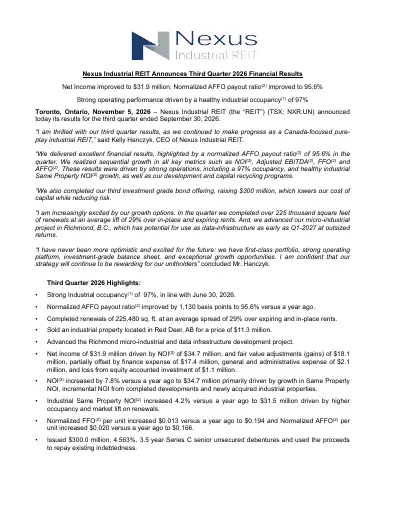
We delivered sequential and year-over-year growth in net operating income, normalized FFO, normalized AFFO, and last 12 months adjusted EBITDA. These improvements reflect strong operating results, while we also advanced three strategic initiatives.
First, in September, we completed our third investment grade bond offering of the year, which has transformed our capital structure. Second, we advanced our capital recycling and focused our portfolio further by closing on property sales at 40th Avenue in Red Deer, Alberta, and surplus land in Blackfalds, Alberta in October after quarter end.
Third, we advanced our sub-strategy in-fill development projects in British Columbia, which have the potential to be significant growth opportunities for Nexus. I will first review our operating performance, then provide an update on financing, capital recycling, and development before closing with our outlook for the balance of 2026.
In the third quarter, we delivered another quarter of excellent operating performance. We renewed 225,000 square feet at an average rent lift over in-place and expiring rents of 29%.
Of this, 150,000 square feet is at the building in London, Ontario, where we were able to negotiate rents from $7.50 per square foot to $9.75 per square foot net, with healthy 2.75% escalators in a seven-year lease term. In Quebec, we renewed three smaller units for a total of 37,000 square feet for an average lift of 34%.
These renewals resulted in industrial same-property NOI growth of 4.2% and demonstrate our continued ability to capture the market lift on renewals. At September 30th, we had an attractive average spread between market and in-place rents of 14.6%.
We also leased an additional 36,000 square feet of vacant space in the quarter, resulting in a strong 97% occupancy at September 30th. This healthy occupancy, combined with our recent completed developments, expansions, and acquisitions, grew net operating income by 7.8% from a year ago to $34.7 million.
Normalized FFO increased to $18.8 million, and on a last 12 months basis, adjusted EBITDA grew to $123.8 million. For the quarter, we posted normalized AFFO per unit of 16.6 cents, resulting in a payout ratio of 95.6%, as we remain on track to deliver a full year 2026 payout ratio below 100%.
Looking at our fourth quarter renewals, we have approximately 270,000 square feet remaining for renewal. Of this amount, we have already renewed or expect to renew over 75,000 square feet.
The remaining space includes a 90,000 square foot strategic vacancy in Montreal, where the tenant was paying $9 per square foot, which is well below market rent. This lease comes due at the end of November.
The remaining space also includes 80,000 square feet in London, where the tenant is paying $8 per square foot rent, also well below market rent, and the lease comes due at the end of December. I'd also like to highlight some leasing activity that will drive additional NOI in the new year.
In Hamilton, I'm pleased to share that we have executed an offer to lease for our 115,000 square foot new build on Glover Road. We own 80% of the property and it has been a challenging market in Hamilton.
We expect to finalize a 10-year lease with the tenant for the entire building commencing in Q2 2027. This will resolve a long-standing vacancy, and I expect it to contribute significantly to our NOI.
The tenant will be granted an incentive rate in the first year, quickly ramping up to market rent in the third year. Also, at our newly built small bay 115,000 square foot building at 102 Avenue Calgary, we have signed two additional five-year leases starting in February and April.
We have now leased eight of the nine units of the 115,000 square foot building, and we anticipate having the final unit leased very soon. Turning to our strategic initiatives, during the quarter, we built on our momentum from April by completing our third investment grade bond issuance of the year.
I will let Mike speak more about it in a minute, but suffice to say that the outcome was very positive for Nexus. We have also continued to make good headway on our capital recycling program.
At the beginning of the quarter, we closed on the $11.25 million sale of our 190,000 square foot building in Red Deer, Alberta, marking the end of a challenging situation that our team managed extraordinarily well, demonstrating resourcefulness and ingenuity to continually add unit holder value. You may recall that 18 months ago, in March 2025, our tenant, Peavey Mart, surprised us by filing for CCAA protection.
They were a tenant in two of our buildings: a Western distribution warehouse at 40th Avenue in Red Deer, and an Ontario distribution warehouse in London. We quickly filled the London property in August 2025 with a top-tier tenant who has invested over $22 million to update and fully modernize the building, and leased it for a 15-year term at rates over double Peavey's rate, with strong escalators.
In contrast, we knew that it would take time to address the Red Deer property, which was large for the area. However, our team steadily pursued options and found an owner-user to buy the building.
It took the buyer time to achieve a development permit to close their financing, we arranged for them to lease it from us for a few months before they closed on the purchase in August. All told, I am very pleased with the outcome, and Nexus is left in a better position than where we started.
During the quarter, we also contracted for two opportunistic sales. We contracted for the sale of our 105,000 square foot building at 149 Street Northwest Edmonton for approximately $12 million.
This represents a cap rate of approximately 6.5% on in-place rents, and is scheduled to close at the end of November. At our 29,000 square foot empty cross-dock facility at 4700 102nd Avenue in Calgary, we received a purchase offer well above our carrying value from the City of Calgary, and accordingly, we have decided to sell the building to them for $12.5 million, equivalent to a cap rate of 5.2%.
The transaction has gone firm, and is scheduled to close in December. After quarter's end, we closed on an opportunistic sale at our property in Blackfalds, Alberta.
Previously, the land had been leased with a building on an adjoining property. In April, upon renewing the tenant, we severed off the unused land, and in October, sold the land for proceeds of $2.5 million.
Turning to development, we have launched a sub-strategy with our portfolio to consider development of data infrastructure projects where such investments meet our investment objectives and our disciplined approach to capital allocation. In addition to other properties, as a start, we believe that 1751 Savage Road Richmond and 555 Adams Road Kelowna have the existing electrical infrastructure, power capacity, and strategic locations that may provide a competitive advantage in pursuing possible digital infrastructure opportunities.
During the quarter, we entered into a development profit-sharing agreement with a tenant that enables Nexus to earn income from the tenant's data operations. The agreement creates a conditional exclusive platform for the tenant to construct and develop data infrastructure projects across our portfolio.
Data revenues generated from the portfolio will be first used to fund the operating costs, after which Nexus will earn a prescribed return, and then the residual net operating profits are shared equally between Nexus and the tenant after we sign the end users. At our Savage Road property in Richmond, BC, we are developing an additional 10-unit micro-industrial units that may be used individually or combined as data infrastructure, referred to as micro-vaults.
These vaults are designed to accommodate data operations, micro-industrial activities, or storage. Vaults fitted for data operations are designed with dedicated power, backup power, cooling systems, providing customers with separately secured space for their equipment.
Customers may occupy one or more vaults to meet their required power needs. We anticipate development costs of $41.3 million, and additional data infrastructure and fixturing costs of $19 million, for a combined investment of $60.3 million.
The planned data operations are for an aggregate gross electric capacity of 9.9 megawatts across the site. The property currently has 2.1 megawatts of electrical capacity available for use right now, with conditional approval to increase capacity to 6.6 megawatts and then to a further 9.9 megawatts.
The REIT expects the project to generate significant returns and meaningful value creation for unit holders. If market conditions or other circumstances prevent operation of a data business at the property, the completed units will be instead used for micro-industrial or storage purposes, with an expected stabilized blended return comparable to the property's current return.
During the quarter, foundations were poured, and framing was initiated. Framing should be completed in a few weeks, and we incurred development expenditures of $9.2 million on the project.
At our Adams Road property in Kelowna, BC, we are developing micro-industrial units, which may also be used individually or combined as data infrastructure. We do not anticipate any change in the development cost of $47.3 million, and we expect the project to generate a minimum unlevered return on investment of 6%.
Again, the project has potential for much greater returns if the micro-industrial units are used as data infrastructure. The planning phase has been completed, and the construction permit application has been submitted for review.
During the quarter, we incurred development expenditures of $4.3 million on the project. Turning to our outlook, I continue to expect Nexus to deliver a strong 2026, driven by our completed development projects, embedded rent steps, the lease-up of vacant space, and the releasing of space at market rents above expiring rents.
Due to the opportunistic sale of 4700 102nd Avenue Calgary, as well as slower lease-up of 4750 102nd Avenue in Calgary and 1020 Adelaide London, I now anticipate industrial same-property NOI growth to be between 3% to 4% for the full year. I continue to expect our normalized AFFO payout ratio to average well below 100% for the full year.
With that overview, I'll now turn the call over to Mike for some more color on our financial results.
Mike Rawle
Thank you, Kelly, and good morning, everyone. As Kelly mentioned, during the quarter, we raised $300 million of 3.5-year bonds at a coupon of 4.563%, and used the proceeds to repay existing drawings on our credit facility.
This issuance resulted in several positive outcomes for Nexus. We are now left with our $585 million credit facility virtually undrawn, which gives us plenty of rainy day liquidity, and an ability to continue to absorb mortgage expiries on our credit facility, increasing our unencumbered asset pool.
We now have well-laddered, termed-out debt maturities, with expiries evenly spaced in 2029, 2030, and 2031. This also will reduce our cost of debt, while adding flexibility.
Our latest debenture issuance priced at GoCs plus 105 basis points, which is significantly tighter than the CORRA plus 170 basis points that we pay on our unsecured credit facility. I anticipate we will begin to realize these interest savings going forward.
Finally, having now established a robust investment grade debenture program, we have both lightened our covenant package as compared to the credit facility and increased our flexibility by diversifying our lender base and adding the ability for fast debt financing if needed. Turning to our financial results, starting with headline earnings in the quarter, net income was $31.9 million, a $28.4 million increase compared to a net income of $3.4 million last year.
The increase is due to higher fair value adjustments on Class B LP units and on derivative financial instruments by $23.4 million and $7.2 million, respectively, and a higher net operating income of $2.5 million. These increases were partially offset by a higher fair value adjustment loss on investment property by $2.8 million and a higher loss on equity-accounted investments by $1.3 million.
As Kelly mentioned, our Q3 net operating income increased 7.8%, or $2.5 million, year-over-year to $34.7 million. This was primarily due to a $1.2 million increase in same-property NOI, $1 million from the completion of our St.
Thomas and Calgary developments, and the acquisition of the two Montreal buildings in November 2025, which added $700,000. This was partially offset by $600,000 of straight-line rent adjustments and $200,000 relating to dispositions completed since Q2 2025.
Normalized AFFO for the period was 16.6 cents per unit, compared to 14.6 cents from a year ago, primarily due to the higher net operating income that I just mentioned. Total general and administrative expenses for the quarter were $2.1 million, slightly lower than a year ago due to lower professional service fees.
Net interest expense in the quarter was $13.9 million, which was $800,000 higher than a year ago, primarily due to lower capitalized interest in the quarter by $500,000, as well as a higher average debt balance. The carrying value of our investment properties decreased by $800,000 in the quarter, primarily due to the $12.5 million transfer of our building at 4700 102nd Avenue Calgary into assets held for sale, and fair value adjustments of $7.1 million, partially offset by $13.5 million of development expenditures and $3.6 million of additional capital expenditures, tenant improvements, and leasing costs.
At September 30th, our NAV per unit was $13.24, a 1 cent per unit increase from last quarter, and our weighted average cap rate was 5.95%, which is consistent with last quarter. I will now turn the call back to Kelly.
Kelly Hanczyk
Thanks, Mike. In summary, as you can see, we are delivering on our strategy as Canada's industrial building partner by continuing to realize organic growth through embedded rent steps and positive mark-to-market on renewal.
We have an A-class portfolio that is beginning to reap rewards, a sub-strategy that we expect to provide significant growth, and we will continue our track record of accretive capital recycling through opportunistic acquisition, dispositions, and development. With that, operator, please open up the line to any questions.
Operator
Thank you. To join the question queue, you may press star then one on your telephone keypad.
You will hear a tone acknowledging your request. If you are using a speakerphone, please pick up your handset before pressing any keys.
To withdraw your question, please press star then two. The first question comes from Kyle Stanley with Desjardins.
Please go ahead.
Kyle Stanley
Thanks. Morning, guys.
Kelly Hanczyk
Good morning.
Kyle Stanley
Got a few here, I'll probably ask a couple and jump back in the queue and see if they're asked later on. Just first, on the data center opportunity, can you walk through what your current leasing prospects might look like and if you can provide maybe an expected timeline to a result?
Kelly Hanczyk
Okay. I would like to underpromise and overdeliver on this one, I don't know what that says, but I want to start by saying it's a very well-advanced sub-strategy, as we began this whole process over 22 months ago.
We're well on our way. As I mentioned, we'll have completed framing within about a week, a week and a half, we're moving pretty quickly.
We do have 2 megawatts available right now. We're in, like I said, for 6.6.
I'm anticipating that to be able to be tapped in by, let's call it second quarter, and then up to 9.9, which will take a little bit longer. I don't know, it'll depend on Hydro.
We have paid deposits, and are in the planning stage for that upgrade. For us, it's been, I would say, robust activity, with activity even picking up after the midterms in the States.
With the change in the House and Senate, things have kind of come to a stop, and projects, I think, that were earmarked have been halted, and so there's a mad flurry because a substantial need for data with not much available. Anything that's being built is either taken or it is well out, three, four, or five years out.
What we're doing is, if you take an existing warehouse, it's all about entitlements. Entitlements is, you may have the power, but do you have the entitlements to use it as data?
That's a whole other question. If you take an existing warehouse, you become a Tier 2 facility, which is not as good.
Ours is, purpose-built micro-industrial units, call micro data vaults, that is going to be a Tier 3 facility, which is much preferred by the AI under lock and key, which is good for sovereignty. On the leasing side, I'd say it's not a matter of if anymore, it's a matter of when.
We are doing everything, I guess, to maximize our value in certain negotiations. The more demand, the better it gets.
It's still a little bit early, but when I do have something, we will release it, because it'll be extremely positive to our results.
Kyle Stanley
Great. Good progress, just not there quite yet.
That checks out. Just switching over to kind of the disclosure around the profit share, can you walk through some of the nuances of that?
Is there a predetermined hurdle rate before the profit share is enacted? Then, I guess, just as we think about the incremental projects to the two that are currently underway, can you talk about how the agreement looks, specifically regarding the profit share there and how the development partner Studio would participate in the development cost?
Kelly Hanczyk
We're the developers, we build, we will finance. We're focused on Richmond right now.
Richmond is well underway. It is the one to focus on.
If we're successful in our lease negotiations, which I believe we will be, it's material to our NOI. Our focus is pretty much there for right now.
That has a specific hurdle that would be, I guess, what you would call a good hurdle from a development project, in general terms. We'd get that return, and then, on top of that, the profit after expenses come out, is split 50-50, which is pretty substantial if we get the terms that we're looking at.
Richmond is our full focus. We have other ones earmarked.
It's also a very volatile market, right? I have them earmarked, but who knows what's going to happen with different governments and the way it works.
Canada looks like it's in good shape right now in this side of things. I'm focused on Richmond because if we execute on that properly, it is meaningful to our numbers.
If at the end of the day, that's all we get out of it, it's still substantial to us. I'm hoping it is a sub-strategy right across our portfolio.
The hurdle on future ones on other locations of our first return on our construction is higher. It's substantially higher, and it becomes even more lucrative.
Like I said, we are focused on Richmond, we're going to execute on Richmond, and I'm extremely positive on it.
Kyle Stanley
Sounds good. A last one, just trying to understand, again, I guess, how the development could unfold.
In the event you were unable to secure a data center lease, obviously, with your commentary, it doesn't seem like that's the case, but just in that event, is there part of the total project budget that relates more to the data infrastructure that you would not incur? Meaning, if there's roughly 19 or 20 million of data infrastructure cost here, you wouldn't spend that if you didn't get a data center lease?
Kelly Hanczyk
Correct.
Kyle Stanley
Thank you. Correct.
Kelly Hanczyk
This is, call it micro data vaults that would be Tier 3. We are delivering something really that is plug-and-play for them, a little different strategy.
Kyle Stanley
Okay. Understood.
I will turn it back. Thank you.
Kelly Hanczyk
Yep.
Operator
The next question comes from Sam Damiani with TD Cowen. Please go ahead.
Sam Damiani
Thanks, and good morning. I'm just going to continue on the same theme.
I guess the focus is Richmond. I'm just wondering how long will it take or could it take for that project to reach completion, reach some sort of stabilization to a point that you're ready to, I guess with confidence and visibility, commit capital to the second project?
Kelly Hanczyk
I'm pretty optimistic that we'll have something to release in the upcoming weeks, hopefully. We are trying to maximize our value here when we're looking at rates.
We aim to do deals at wholesale rates for co-location facilities, which are very attractive. I think we'll have something within a month.
At the end of the day, we have two, we can deliver two right now, that's the first hurdle, and then, depending on Hydro, we're at the whim of Hydro as well, to be able to move to the 6.6 and then again to the 9.9. Like I said, I think 6.6, I'm hopeful for second quarter of next year, we'll probably be done with construction as a whole and just need to power up.
Then the 9.9 could take a little longer. We've also applied for more than that as well.
Whether we get it or not, I don't know, but this is what we've got conditional approval on.
Sam Damiani
Okay. That's helpful.
It's pretty capital-intensive, Richmond, and I guess subsequent projects might have some similar capital intensity. What's the sort of funding strategy for the strategy to fully realize the potential?
Mike Rawle
Hi Sam, it's Mike here. First off, funding strategy for us, we have plenty of headroom on our revolver, as we've mentioned, we have tons of liquidity, but ultimately, at this point, with the way we expect the business to unfold, we'll be able to fund most of this out of operating cash flow.
Sam Damiani
Okay. Maybe last one for me.
I guess the relationship with Studio Events seems pretty integral to at least the Richmond and maybe other projects, too. I've never heard of them.
Is there something you can say to just help us understand who they are, what their background is?
Kelly Hanczyk
No, it was our development partner on the site. When we were looking at the infill of building the micro-industrial units, it started off as just we were going to build micro-industrial.
Then as we realized we have additional power, and started looking at it about 22 months ago, we had, before, I guess, all the rage, applied for additional power across a number of sites and began to get conditional approval. They've been integral with working with the brokers, we have two major data provider brokers that are working on the file.
For us, it's just the build. Over these last 22 months, we've had a number of engineers that have come in and tweaked the design over and over until now that design is finalized.
It's a project that we're entering into together. We have significant interest in the project from a number of different groups, and so that's kind of where we are in the lifeline right now.
Sam Damiani
Before I wrap up here, the relationship with your partner on Richmond before this strategy was limited to just two assets in the portfolio, or were there other assets? Are there other assets in the portfolio today?
Kelly Hanczyk
It was those two. Those two, yep.
Sam Damiani
Thank you. I'll turn it back.
Kelly Hanczyk
Thanks
Sam Damiani
very much.
Kelly Hanczyk
No problem.
Operator
The next question comes from Jimmy Shan with RBC. Please go ahead.
Jimmy Shan
Thanks. Just to follow up on the same theme, this may be a bit of a silly question, but so is your lease contract that you have at Richmond, would that be with Studio Events, or and then they, in turn, sublease out to these micro data vaults?
Is that how it works? Exactly.
Kelly Hanczyk
That's how it works. The reason for that, it takes Nexus one step out of the process, we have a head lease with them, and then they would take on the risk with the subtenant, who we would have on covenant.
It just removes us one step in case there are power outages, there are issues, whether it's penalties or whatever. That removes that liability from Nexus and moves it downstream.
Jimmy Shan
Is that why you felt the need to sort of give them exclusivity for the entire portfolio?
Kelly Hanczyk
It's a strategy we developed together, and the design is patent pending. It's their design.
It's been tweaked over a number of months to where it's actually, I personally think, with what's going on with data, it's a perfect infill strategy, and I think it's going to be very fruitful. The design is patent pending, and so overall, they've been the lead on with the tenants and moving things along, and with the engineers and everything.
For us, it's optionality, across the portfolio, it's us who approves them as we go along. It's not, yeah, we're doing this, we're doing this, it's, yeah, here's our site, we have power approved, and then it's possible to do another site.
Right now, we're really focused just on Richmond and executing on that one.
Jimmy Shan
Okay. Is it possible for you to give us sort of maybe bracket the upside and downside?
It sounds like the upside is quite quite material. Can you give us a a range in terms of what the yield could look like?
Kelly Hanczyk
It's too early. I'm not willing to do it yet, but when we do have paper, we will release and explain in greater detail what it could mean to us.
If we aim to do deals at wholesale rates for co-location facilities in a Tier 3 facility, it's pretty good.
Jimmy Shan
Then last, if I look at the 2027 lease maturities, you do have about 336,000 square feet expiring in Ontario. Any progress in renewing that, and what's your expectation in terms of rent that you'll get there?
Mike Rawle
A little early for us, as we're going through our budgeting process now, for us to give direct guidance for 2027, Jimmy, but we are very optimistic on the year, we love the momentum we have right now, and expect it'll continue through 2027. We'll give you a more wholesome update with guidance as we complete our budgets and are able to do so.
Jimmy Shan
Thank you.
Operator
Once again, if you have a question, please press star then one. The next question comes from Saloni Seth with Raymond James.
Please go ahead.
Saloni Seth
Good morning. For the Glover Road property in Hamilton, could you throw some light on the tenant incentives being offered, including the magnitude and duration?
Kelly Hanczyk
Give me just two seconds, I'm just trying to look it up.
Mike Rawle
Glover Road. Just at the beginning at 10 bucks, then stepping up to market in three years.
Kelly Hanczyk
I believe it's not incentive, it was part of the build cost of the facility, which we just have to finish off the offices portion that we held back, because as an empty building, brand new build, each tenant requirements different from offices, we have to build that. Then I believe we've done a pretty significant deal for us, where first-year incentive rate is something like $10 a foot, but ramps up to market in year three, and then I believe it has 3% annual growth.
For us, it's a pretty good transaction, takes the operating cost burn away from us, and starts to provide income, I believe, in around second quarter next year. That's a pretty big swing on our FFO.
Saloni Seth
Okay. Thank you.
I'll turn it back.
Kelly Hanczyk
No problem.
Operator
The next question comes from Matt Kornack with National Bank Financial. Please go ahead.
Matt Kornack
Hi guys. Actually, going back to Glover, I apologize, I missed the opening comments, but can you give a sense as to how the discussions ultimately ended up getting to where they got to and what other alternatives you would have thought about for the property?
Kelly Hanczyk
Funny enough, Glover was very interesting, because we had very little activity, we had it under contract once and then the guy just walked away, then very little leasing activity. Then we went and we made a decision to drop the rate and offer a year-one incentive.
In a matter of a week, we had three offers to purchase and two two lease deals. We looked at on the offers to purchase, the ability of the purchaser to close, and we looked at our tenant here versus the other tenant, and this one, we were, I guess, 98% certain that we would end up in a long-term lease deal that was good for the property.
Great covenant tenant, 10-year term, and once it ramps up to market, tuck it away and take our 3% increases with a brand new Class A property in the portfolio. We looked kind of long and hard at who's the covenant, their ability to close, and who did we want, had the least conditions and the least risk to starting to generate income for us.
Matt Kornack
That makes sense. Now that you have a tenant, is the idea to keep the property, or does it also make it more attractive on a sale basis?
Just interested.
Kelly Hanczyk
I think we'll end up purchasing the other 20% from our partner at some point. I just don't know when that is, but it would be probably some point next year.
Matt Kornack
Makes sense. Fair enough.
Maybe just a quick lay of the land in terms of geographic tenant demand and who's taking space and what you're seeing. I know the macro has been volatile, to say the least, on a number of different fronts, but maybe it's getting a little bit better going forward.
We saw a good leasing uptake from CBRE, but I think, ultimately, things got a little dicey after that. Interested in a lay of the land on industrial at this point.
Kelly Hanczyk
For for us, obviously, Glover was a good sign. Two larger tenants looking for space in in a market that has been pretty slow, very positive.
London London to us London to us has been pretty good. We've seen some activity there.
Our partner down there had at one point a 500,000 square foot manufacturing facility come back to them that they had to come in and, I call it, make it bright light and watertight, do all the things that you need to do, and they've been successful in pretty much filling up that 500,000 square feet. From an overall demand, I'm seeing things pick up, especially Southwestern Ontario, even where nothing was going on, and now there's two to three kind of larger mandates out there in the 200,000 to 300,000 square feet of people looking for space.
Overall, it it bodes well, where we weren't seeing that before. We take Hamilton, and we've got that, we've got London where we're I'm seeing that demand, Montreal still quieter.
Out west, Edmonton, Calgary is still pretty solid overall. For us, I I'm feeling pretty positive for for the first time in a while on the leasing front.
I I think things are starting to turn a corner. I think we're getting guys are getting more comfortable that there is going to be a trade agreement relatively soon, and that I think that just bodes well even more well for the industrial market as a whole.
We've had a couple deals, I had a deal the other day where we did we haven't announced it, but it's not announceable, but our second largest tenant, we just extended for another 10 years, we have them till 2040, and that's a pretty big cash cow for us, 2.5% increases a year on a higher cap rate portfolio. Overall, I'm feeling more positive on the general business than in past quarters, because I feel it's getting there.
If I think if you look at our results, we're all focused on the data, which is a sub-strategy that's really really moves the needle and be a game changer for us overall. Our overall our overall portfolio is kind of doing exactly what we said, and that that payout ratio is starting to drive down, and as the new deals kick in.
From overall performance, we're feeling pretty good, and then when we throw in the sub-strategy, like we're feeling really good. We're so pretty positive on the future.
Matt Kornack
Awesome. That's great.
Glad to hear. Take care.
Operator
This concludes the question and answer session. I would like to turn the conference back over to Kelly Hanczyk for closing remarks.
Please go ahead.
Kelly Hanczyk
Okay. Thanks, everybody.
Thanks for attending, and we'll see you next quarter.
Operator
This brings to a close today's conference call. You may disconnect your lines.
Thank you for participating, and have a pleasant day.