Everest Group, Ltd.
Q3 FY2026 · Earnings Call TranscriptOctober 29, 2026
Operator
Welcome to the Everest Group Limited third quarter 2026 earnings conference call. All participants will be in listen-only mode.
Should you need assistance, please signal a conference specialist by pressing the star key followed by 0. After today's presentation, there will be an opportunity to ask questions.
To ask a question, you may press star then 1 on a touch-tone phone. To withdraw your question, please press star then 2.
Please note this event is being recorded. I would now like to turn the conference over to Matthew Rohrmann, Senior Vice President, Head of Investor Relations.
Please go ahead.
Matthew Rohrmann
Thank you, Drew. Good morning, everyone, and welcome to the Everest Group Limited third quarter of 2026 earnings conference call.
The Everest executives leading today's call are Jim Williamson, President and CEO; and Elias Habayeb, Executive Vice President and CFO. We're also joined by other members of the Everest management team.
Before we begin, I'll preface the comments by noting that today's call will include forward-looking statements. Actual results may differ materially, and we undertake no obligation to publicly update forward-looking statements.
Please note that forward-looking statements, including estimates, projections, and forecasts of future results, are subject to the risks, uncertainties, and assumptions noted in Everest's SEC filings. Management will also be referring to certain non-GAAP financial measures.
Available explanations and reconciliations to GAAP can be found in the earnings release, investor presentation, and financial supplement on our Investor Relations website. With that, I'll turn the call over to Jim.
Jim Williamson
Thanks, Matt. Good morning, everyone.
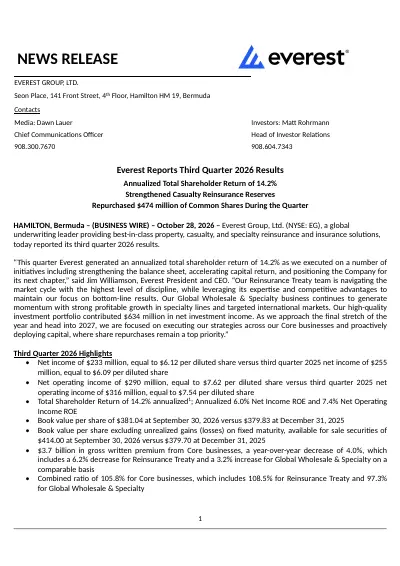
Everest has generated a year-to-date annualized total shareholder return of 14.2%, while executing on several initiatives focused on generating shareholder value and positioning the company for its next chapter. I've said that Everest would do whatever was necessary to ensure the strength and sustainability of our balance sheet.
This quarter, we prudently strengthened our casualty reserves in reinsurance, while not taking full credit for favorable development in short-tail lines. As a result, our reserve position is now over $850 million above our more conservative actuarial central estimates, further demonstrating this commitment.
Our annual long-tail reserve studies were more robust than ever. Both Elias and Katie Bradica, our new Group Chief Actuary, materially enhanced our reserving process, applying more conservative assumptions while giving little to no credit for the significant underwriting actions we've taken, unless clearly evident in our data.
Elias will provide more details. Moving on to third quarter results.
Our strategy is centered around strengthening our core underwriting businesses while managing the cycle with relentless discipline. Operating earnings per share of $7.62 were driven by disciplined attritional underwriting across our core businesses, record net investment income, and accelerated capital return.
Our core businesses delivered $3.7 billion in gross written premium, a modest year-over-year decrease reflecting our disciplined approach. As I've said, prioritizing bottom-line results over top-line production is imperative, especially when we're seeing more signs of irresponsible behavior in the market.
Over the past several years, we have significantly repositioned the casualty portfolios across both core businesses, balanced our mix, and improved risk quality. We prudently raised our casualty loss picks at the beginning of this year.
Coupled with the significant underwriting actions we've implemented, our current accident year loss picks remain conservative. Now turning to the segments.
Our reinsurance treaty team continues to do an excellent job managing the cycle across all markets. We continued to decrease our exposure to US casualty lines and selectively reduced business where rates were not adequate.
This resulted in about a 6% decrease in gross written premium year-over-year on a constant dollar basis and excluding reinstatement premiums. Casualty lines were down by 18%, while property premiums decreased slightly as growth in property pro rata was offset by decreases in our cat and non-cat XOL portfolios.
We continue to see growth opportunities in our global specialty and financial risk portfolios, where risk-adjusted returns remain attractive. Growth in the quarter was led by a variety of specialty lines.
The increase in the combined ratio in the quarter largely reflects the casualty reserve strengthening I mentioned, as well as pretax catastrophe losses of $277 million, net of estimated recoveries and reinstatement premiums, primarily associated with the Colombia earthquake, events in the Middle East, and a number of smaller European and Canadian losses. At the same time, the underlying portfolio's performance remained solid, as evidenced by the attritional loss ratio improving to 56.3% in the quarter.
Looking ahead to the 1/1 '27 renewals, we expect market conditions to remain competitive. Everest is well known in the industry as a top-tier lead market, sought after by high-quality cedants looking for longstanding partnerships.
Despite expected competition, we continue to see opportunities for attractive capital deployment. That said, we remain disciplined.
Where deals don't meet our return thresholds, we'll adjust our participation accordingly. Turning to the Global Wholesale and Specialty segment, which delivered another solid performance.
Despite rate headwinds in short-tail lines, our strategy to expand the portfolio in specialty lines and targeted international markets remains consistent, while continuing to deliver margin expansion. Gross written premium increased over 3% year-over-year.
We grew double digits internationally, with broad-based growth across financial lines, marine, and a number of specialty classes, partially offset by aviation. While rate across our portfolio increased modestly, it continues to vary by line.
More importantly, the areas of our business we are expanding are rate adequate. The attritional loss ratio improved 90 basis points year-over-year to 60%.
This is a result of the team's disciplined risk selection and portfolio management, driving improved loss experience. The combined ratio was 97.3%, prudently positioned at the high end of our expected range in the mid to high 90s for the full year.
This included pretax catastrophe losses of $25 million, net of estimated recoveries, primarily resulting from the Colombia earthquake and mid-sized losses in the Middle East. Now a word on capital management.
We accelerated capital return to shareholders to approximately $550 million in the quarter, inclusive of dividends, bringing the year-to-date total to over $1.4 billion. Share repurchases continue to be a top priority for capital deployment as we approach year-end and head into 2027.
Over the last two years, we have transformed Everest. As we move forward, I couldn't be more optimistic in the strategy we're executing across our core businesses as Everest embarks on its next chapter, one that I believe will consistently generate value for shareholders, led by proactive capital management, and balance sheet strength.
With that, I'll turn the call over to Elias.
Elias Habayeb
Thank you, Jim, and good morning, everyone. The third quarter financial results reflects our continued focused execution on our strategic priorities.
We grew book value per share, excluding unrealized gains and losses on the available-for-sale fixed maturity portfolio, to $414, which grew both on a year-over-year basis as well as sequentially. This is despite higher cat losses and reserve strengthening in our reinsurance business.
Before unpacking this quarter's results, let me first touch on reserves. First, as Jim said, Katie and I performed in-depth reviews of all material reserve studies for the quarter, which included all material long-tail lines.
Second, we followed a very robust process. We thoroughly vetted and refreshed all material actuarial assumptions and methodologies with added conservatism.
This included expected loss ratios and loss development factors across all years, and we responded more promptly to credible emerging trends. We improved line of business segmentation within our reserve studies to better reflect performance and mix.
While we've taken meaningful underwriting actions in recent years, we did not make any adjustments for these actions unless definitively evident in the data. While there's evidence of accelerated case reserving in casualty based on our enhanced claims analytics, we did not make any adjustments for this deliberate action in our core businesses.
As I stated last quarter, our philosophy is to book our reserves at management's best estimates, which we expect to be above the actuarial central estimates. The actions we've taken this quarter have moved our reserves to a more conservative position and have meaningfully increased the differential between management's best estimates over the actuarial central estimates.
This differential increased to over $850 million as of September 30. This further strengthens our balance sheet as well as reduces the potential for future reserve volatility.
Now turning to the reserve movements in the quarter. We reported overall net unfavorable development of $268 million, driven largely by casualty reinsurance reserve strengthening.
While loss emergence in short-tail lines continues to be favorable, we held back the majority of the favorable development as we look to enhance our conservative position. In reinsurance treaty, we strengthened gross casualty reserves in the quarter by approximately $600 million, which is on top of the $200 million of strengthening in the second quarter in US casualty.
The vast majority of the development was in underwriting years 2022 and prior, where we added conservatism to each underwriting year. In addition, we also rolled that experience forward into the more recent underwriting years.
Turning to our insurance businesses. The bifurcation of our reserve studies into separate studies for each of Global Wholesale and Specialty and Legacy resulted in de minimis net overall reserve movement with no meaningful change to reserves subject to the ADC.
As a result, we continue to have approximately $1 billion of net limit remaining under the ADC. More importantly, the reserve study confirmed our view that the underwriting actions we took over the past few years have been beneficial, and the Global Wholesale and Specialty business is performing as expected.
Finally, the reserve studies resulted in no change to our 2026 loss picks, as they were previously set more conservatively. Now turning to the third quarter group results.
Everest generated after-tax net operating earnings per share of $7.62. This was largely driven by attritional underwriting income, record net investment income, and strong share repurchases.
Moving to our core businesses. Gross written premiums were $3.7 billion, down approximately 4% on a comparable basis year-over-year, largely driven by our underwriting discipline in casualty lines.
The attritional loss ratio was 57.2%, a decrease versus the prior year reflecting improved loss experience and mix. Pretax cat losses were $302 million net of estimated recoveries and reinstatement premiums in the quarter, largely driven by the events Jim mentioned.
The expense ratio increased to 5.2%, largely reflecting the impact of lower net earned premium. Now moving on to our reinsurance treaty business.
Gross written premiums were $2.7 billion, down approximately 6% on a comparable basis year-over-year, largely driven by our underwriting discipline in casualty lines, to a lesser extent rate softening in property. The combined ratio included 11.3 points of net adverse prior year development and 12.8 points of cat losses.
The attritional loss ratio improved to 56.3%, reflecting improved loss experience. Now moving to our Global Wholesale and Specialty business, where we're focused on improving underwriting margins as we pursue profitable growth in targeted lines and geographies.
While the combined ratio increased to 97.3% due to cat losses, the attritional loss ratio improved by 90 basis points to 60% as a result of the underwriting actions we've been taking and an improving mix of business. Pretax cat losses net of estimated recoveries and reinstatement premiums contributed 3.5 points to the combined ratio versus 80 basis points in the prior year quarter.
The underwriting-related expense ratio increased to 12.6%, largely driven by lower earned premium volume. We continue to expect this business to deliver combined ratios in the mid to high 90s in the near term.
Now moving to our Legacy segment. We continue to manage the transition of our commercial retail insurance business to AIG, which remains on track.
As expected, the segment generated a modest earnings drag on the group underwriting results in the third quarter. At the same time, we continue to proactively manage claims down as efficiently as possible.
Moving on to investments. Net investment income set a new quarterly record of $634 million.
This was largely driven by strong performance from the private equity portfolio, which generated $144 million of income in the quarter. Overall, our book yield increased to 4.6% in the quarter, which is below our current new money yield of approximately 5.1%.
The portfolio's average credit quality remains at AA-. Turning to capital management.
In the third quarter, we repurchased approximately 1.3 million shares, amounting to $474 million, at an average share price of $374 per share. Since the beginning of 2025, our share count has been reduced by approximately 13%, and when including our quarterly dividend, we returned approximately $550 million to shareholders this quarter.
Over the last four quarters, our payout ratio has been approximately 92%. Looking ahead, while we continue to view share repurchases of $300 million as our quarterly floor, we expect to exceed that amount when appropriate, given the strength of our balance sheet and earnings generation.
In summary, Everest continues to create momentum through the execution of our strategic objectives of disciplined underwriting and proactive capital management, while taking the necessary steps to maintain a strong balance sheet. With that, I'll turn the call back over to Matt for Q&A.
Matthew Rohrmann
Thanks, Elias. Drew, we're now ready to open the lines for questions.
We do ask you please limit your questions to one question plus one follow-up and rejoin the queue for additional questions. Drew, over to you.
Thanks.
Operator
Thank you. We will now begin the question-and-answer session.
To ask a question, you may press star then 1 on your touch-tone phone. If you are using a speakerphone, please pick up your handset before pressing the keys.
If at any time your question has been addressed and you would like to withdraw your question, please press star then 2. At this time, we will pause momentarily to assemble our roster.
The first question comes from Alex Scott with Barclays. Please go ahead.
Alex Scott
Hey, good morning. First what I have for you is just for Elias, and I'd be interested in if you could provide some additional commentary on your confidence in the process and really your confidence that you've got it to a place that would be more typical for this point in the cycle, kind of coming out of a hard market and maybe relative to industry peers, and if you think this can be a clearing event.
Elias Habayeb
Hey, thanks, Alex. Listen, I'm going to answer it in three parts, your question.
Part one is what did we try to accomplish with this reserve review? Our motivation was to increase the conservatism on the balance sheet, and to position us to be able to bring more stability to our reserves going forward, and reduce risk of further what's called reserve volatility.
I think we've accomplished that with the exercise we just went in. Second, I'll talk about the process we did.
This was Katie and my first go-around since we've joined the company to go through it, and I think we went through a pretty robust and thorough process around it. We reviewed all the lines that were scheduled for the quarter, which includes all the major long-tail lines.
We went through all the key assumptions, and we thoroughly vetted them, challenged them, and refreshed them. That includes things like loss trends, loss development factors, tail factors, expected loss ratios, as well as expanding the actuarial methodologies that are considered.
We did increase the segmentation to get a more accurate view on performance and mix in the business, and we enhanced the claims analytics and the feedback loop relative to it. With that, I think from a process perspective, we went through a pretty robust process this quarter.
The third element on conservatism, and this also links to some of the things I said in the second quarter earnings call things we're considering. One is where we saw loss emergence in the older accident years, we didn't just react to it then, we kind of rolled it forward into the more recent accident years.
Second, there's been a lot of underwriting actions in the last few years. We do see it kind of emerging, if you look at '26, but we decided unless it's in the data, we didn't make any adjustments.
There was no explicit adjustments made for any of the underwriting actions. We'll wait till it emerges in the data before reflecting it.
Second, I would say we've done work from a claims analytics perspective that shows evidence in the insurance side of the house about case reserve strengthening in casualty. We see indications of it in the data from a number of our cedants.
That being said, we did not make any adjustment for it in the reserving for our core businesses. The other thing I would say is when you look at the short-tail lines, there's been a significant amount of favorable loss emergence on the short-tail lines.
We released a smaller portion of it this quarter. The majority of the favorable emergence we're seeing on short-tail lines, we held back.
As a result of this work, I believe we've moved our actuarial central estimate up to a more conservative position from where it was before. At the same time, the differential between where we're booking our reserves and the actuarial central estimate, we also increased that differential and it's over $850 million as of the end of September.
I think this is one of the highest it's been, as far as I could tell, at the company. With respect to '26, that we applied the same approach and judgments.
We had the higher loss picks entering into this year, and we didn't see, given the emergence we're seeing and the results of the actuarial work, any need to make any changes to '26, that '26 continues to be prudent.
Alex Scott
That's all really helpful. Second question I had is as you're looking at 1/1 renewals, any commentary you can provide there?
Is there any need for additional underwriting actions just coming away from all the work you've done?
Jim Williamson
Alex, look, obviously a topic that's been widely discussed over the last few weeks. Our expectation on 1/1, and particularly as it relates to cat renewals in peak zones, is it'll be another competitive renewal.
You're looking at some additional rate decreases. Obviously, our view, as I've stated in prior calls, is that current rate levels continue to deliver a very strong expected return, and which is why we continue to deploy capital.
As rates compress, more and more of the programs we look at will look a little less favorable, and we respond very quickly to that. You saw that certainly in this quarter's results where our cat XOL written premium decreased in a reasonable way, and I wouldn't be surprised if we continue to get more selective as we go into 2027.
Where we're really focused from an underwriting perspective is a few things. Number one, best-in-class cedants, and we've been very consistent on putting our capital to work with people that we think have a sort of differentiated expertise in what they're writing.
The second would be terms and conditions. I know we like to talk about rate because it's easy to measure, but the most recent hard market delivered substantial improvements in terms and conditions.
In many cases, for Everest, those happened in a non-concurrent fashion, and we've been able to sustain those despite recent rate decreases, and our outlook is that we'll sustain the vast majority of that as we head into 2027. Then obviously, the work that we do around portfolio optimization and shifting capital from lower-return to higher-return opportunities.
You're going to see all that play out. I'm really confident that our reinsurance team, notwithstanding some of the competitiveness we've seen, will deliver an excellent portfolio for us to enjoy in 2027.
Alex Scott
Thank you.
Operator
Thank you. The next question comes from Andrew Andersen with Jefferies.
Please go ahead.
Andrew Andersen
Hey, good morning. You had described some short-term emergence as significant, but you only released a small portion there.
What prevents you from recognizing more of that favorability today?
Elias Habayeb
Hey, Andrew, it's Elias. We had the ability to release more of it.
We chose not to, and that's kind of ties to our objective of this reserve study is kind of increasing the conservative position on the balance sheet and to kind of position us to reduce future reserve volatility risk. It was a management decision not to release more.
Okay.
Andrew Andersen
Maybe bigger picture, with the book shrinking in several areas and market conditions becoming more competitive, how do you ensure the underwriting discipline today doesn't come at the expense of market relevance or your ability to reaccelerate growth over time?
Jim Williamson
Sure. Look, we've proven over multiple cycles that we can effectively prune exposures when we think the economic terms available are below our standards, and then reaccelerate into the hard market.
In fact, I would take you back to the 2023 hardening. In the year prior to that, we substantially cut our cat book.
What allowed us to reaccelerate is core to Everest's value proposition, which is we are an incredibly nimble organization. We're very lean.
We have empowered leaders in each of the regions who have deep customer relationships. We tend to participate, given our depth and breadth of expertise across many lines of business.
We're a top-tier market, and we're welcomed on the reinsurance panels of all the lead market underwriters. I think that they will be more than willing to find more room for Everest when the time comes.
That's frankly when they'll need our capacity most. We deliver a real service to our clients in that fashion.
There's nothing about what we're doing now that even gets close to the idea of changing our relevance or the quality of our value proposition.
Andrew Andersen
Thank you.
Jim Williamson
Got it.
Operator
Thank you. The next question comes from Meyer Shields with KBW.
Please go ahead.
Meyer Shields
Great. Thanks.
One, I guess, process question. Elias or Jim, are you open to maybe updating the year-end global loss triangles for the strengthening that you've done so far this year so we can take a look at that, maybe substantiate your confidence in the reserves?
Elias Habayeb
Hey, Meyer, it's Elias. We'll take it under consideration.
Our process was to release it after we're done with all the reserves for the year. There's still some more studies in the fourth quarter, even though we covered all the material ones from a long-tail line perspective this quarter.
We'll take it under consideration.
Meyer Shields
Okay. Then, Jim, just going back to 1/1, I was hoping you could talk about how the casualty reinsurance environment is looking from your perspective.
Jim Williamson
Meyer. Look, I think this is a frustratingly consistent message to what I've said over the last many number of calls.
The fact is our view of casualty reinsurance is a fairly bearish one. I would attribute to a number of things.
One, the underlying environment remains very challenging, and that's driven by social inflation and legal system abuse in the US. The plaintiffs' bar has not let up on their aggression in that space.
While there is some, I think, very encouraging signs that states are beginning to wake up to how destructive this process has been to the US economy, it's still pretty limited. The underlying environment isn't great.
Rate, while I think in a number of areas continues to stay abreast of loss trend, I am starting to see more competition, which I think is problematic. I think for a lot of new entrants in particular into the primary liability space, I think they're kidding themselves a little bit around the idea that the industry has somehow achieved excellent rate adequacy in that space and that it's a place to make a lot of money.
We just don't see it that way. Then lastly, ceding commissions are stubbornly high, and I think are not justified by the underlying performance, which is why you certainly saw in this quarter's results, our written premium for casualty pro rata was down by 18%.
We will continue to critically evaluate that portfolio. Now the good news, I would say, is, given all the work we've done in casualty, we're down to a core portfolio of really exceptional underwriters where we have a lot of confidence in what they're doing.
We can be I think selective and have a lot of confidence in the performance of the existing portfolio. I certainly don't see us going out from here and trying to regrow that portfolio until conditions improve materially.
Meyer Shields
That's very helpful. Thank
Jim Williamson
you. Got it.
Operator
Thank you. The next question comes from C.
Gregory Peters with Raymond James. Please go ahead.
C. Gregory Peters
Hey, good morning. I guess, when I laser focusing on the reinsurance piece, you've spent a lot of time talking about the casualty side, but we also know that the property side is under intense competitive pressures.
Can you talk about when you think about next year, how you think the portfolio within reinsurance might change or what the headwinds might be to growth, and then sort of map that in with how your views on PMLs look?
Jim Williamson
Sure. Yeah.
Look, I think if you piece together the last few questions, right, property on the cat side is going to be challenging. We are fortunate in that we write the majority of our cat XOL business on a non-concurrent basis, and I think we're shielded from some of the competitive pressures, but it's certainly a reality.
Casualty, we just talked about, and I think on a broad basis, it's sort of a status quo situation. What I will say, though, is, and I made this comment in my prepared remarks, we're still seeing a lot of really interesting places to deploy capital, and it's occurring more in international markets and more in our specialty business.
Those tend to be higher-margin, very high-quality portfolios. We've delivered a lot of expertise into the market.
We are a lead, if not the lead, global engineering market. We have a renewable energy vertical that we've stood up that's performing exceptionally well, that offers differentiated value to clients.
We have a high-performing parametric business, and you can kind of go down the line. Now from a pure volume perspective, Greg, those subsegments are not going to overtake property pro rata or casualty pro rata premiums, but I'm not worried about that.
We don't really get focused on the top line. It's how are we delivering margin.
I do see some sustained margin development in those parts of the business. As respects PMLs, and we've certainly seen it in our net PMLs over the last few quarters, those will more likely than not continue to retract slightly as this market cycle plays itself out.
Again, I don't get too worried about that either. It frees up capital, and we have options for deploying that capital.
As we said in the last few calls, that priority for that capital redeployment will be to return it to our shareholders. It's not necessarily a bad thing that we're being a little more selective and taking some chips off the table from a PML perspective.
C. Gregory Peters
Great. That makes sense.
You sort of teased this and you've spoke about it in your comments, but pivoting to the Wholesale and Specialty business, if we just look at some of the increases in growth that you're seeing in casualty, financial lines, and specialty, maybe you could just spend a second and just tell us what you're seeing in the opportunities there, because those growth rates are pretty impressive.
Jim Williamson
Sure. No, it's a great question.
I think we are in a really good spot with Global Wholesale and Specialty. While we've spent a lot of time talking about reinsurance reserves on this call, we're in an equally conservative position on how we're thinking about our loss picks in that business, and all of the indicators are showing that we're developing incremental reserve strength and margin in that business.
Those are very good signs. As respects growth, look, we came out of last year, after we divested retail, we doubled down on our Global Wholesale and Specialty strategy.
That business has really come together under Jason Keen's leadership in a great way in terms of its operation, its cohesion across geographies and across lines of business, and we're now starting to see the benefits of that. Where you're seeing growth, though, you really need to look under the covers to see where it's coming from.
For example, in casualty, this is not open market excess casualty for any and every class of business in the US. This is targeted growth, mainly internationally, and in particular in lines of business or areas of the market where we have distinct product, expertise, and capabilities.
For example, in the area of construction, where you're seeing a global boom in data centers, in manufacturing, we have specific products, underwriting expertise, we're delivering that to the market, and you're seeing growth. The other piece of the casualty story is rate, and we are continuing to drive rate into the market.
Even with stable exposures, you would expect to see growth. I think that same story plays out in financial lines.
Then in the specialty markets, which has been the really core area of our focus, very much driving growth in our London market business and increasingly in the US in those specialties. Those, again, are areas where rates are adequate, we have a differentiated position in the market, we're highly valued as a trading partner, which is why we could see growth.
For GWS overall, very modest growth in the quarter. As you unpack it, what you're seeing is a lot of very strong portfolio management.
In areas where we see more competition like facultative casualty, we're decreasing meaningfully. In areas like specialty, in particular in London where still lots of great opportunity, we're growing even faster.
We'll continue to manage that dynamic through the coming quarters without a whole lot of concern about what it means for the top line. This is all about driving the right margin outcome, and I think you'll continue to see that.
C. Gregory Peters
Appreciate the detail.
Jim Williamson
You got it, Greg.
Operator
Thank you. The next question comes from Josh Shanker with Bank of America.
Please go ahead.
Josh Shanker
Thank you very much for taking my question. I guess this is for Elias, and it's about process on the reserves.
If over the last two quarters you had not made any changes into your casualty reserves, but you had released $550 million of short-tailed lines, would that be a process that people should say we've gotten more accurate in our short-tail reserving, or that there was a cushion in the reserves that we had at the beginning of the year that we don't have anymore? I'm trying to weigh, yes, certainly the casualty reserves have gotten more conservative, but how should we feel about the reserving on the short-tail side where you've released a lot of reserves to offset that?
Elias Habayeb
Hey, Josh, it's Elias. Good question.
What I would tell you is what it tells you there's prudence on the property and the short-tail lines from the beginning, and with the favorable loss emergence, it demonstrates the prudence and the strong underwriting in that. That being said, when I said we have a margin over our actuarial central estimate of $850 million, that's coming from both long-tail and short-tail lines, but a bigger proportion is coming from the short-tail lines.
While we may have released $500 million year-to-date on short-tail lines, we still have a hefty redundancy within our short-tail line reserves, and I feel comfortable with that.
Josh Shanker
One of the things that manufactures short-tail reserve releases is short-tail losses. Since 2Q '25 to present, we really haven't had much cat activity.
At what point in the way that you're doing the reserves can enough quarters pass without any major property losses to say, 'Look, we're still conservative, we just don't have the loss reserves up because we haven't had the losses'?
Jim Williamson
Josh, it's Jim. Let me add a little bit of flavor on this because I think when you unpack the details, particularly within reinsurance and in our property pro rata book, a lot has happened over the last few years to reduce the amount of volatility that book contains.
This is very much an attritional loss ratio story when it comes to a lot of the short-tail property reserves. Now that's not to say that it's not influenced by cat activity.
It certainly is, but not nearly to the degree I think you're implying. Then lastly, I would say, and I would ask Elias to weigh in here as well, having said all that, we're also seeing that same strength in our cat book.
When cat events occur, as you saw in this quarter, we're booking those very, very prudently. We don't need an event-free quarter to have strong performance in our cat reserves.
That's just not the linkage you should be drawing. I don't know, Elias, anything you'd add to that?
Elias Habayeb
I think you covered it. The one thing I would say is, in terms of cat, we did have some movement on cat reserves, some net releases.
It's more from the attritional side this quarter. When we look at individual cats, you got to look at the facts and circumstances of each cat to evaluate if it's matured or not.
Some events, you may have to wait a couple years, some events less. It depends on the facts and circumstances of those individual events.
Josh Shanker
Thank you for all the answers. Appreciate it.
Jim Williamson
You got it.
Operator
Thank you. The next question comes from Rowland Mayor with RBC Capital Markets.
Please go ahead.
Rowland Mayor
Hi, thank you for taking my questions. As you went through the review process, did you identify any incremental portfolios of business that no longer meet your return thresholds and need to either be non-renewed or divested?
Jim Williamson
Sure. No, good question.
No, not really. We've had a firm bead on the performance of a number of these portfolios, and I would say in reinsurance, you've certainly seen that play out over the last several quarters.
Casualty, which again is the subject of a lot of the conversation today, we've been reducing consistently over the last couple years on the order of magnitude of billions of dollars of reduction in written premium. We clearly were ahead of that, we saw it in the underwriting, and so feel good about where that portfolio is and reduced it further obviously as you saw in the third quarter.
In GWS, in a similar way, Jason and his team I think took a very critical eye of all those portfolios, and overall feel excellent about where we're positioned. There have been spots, a recent one that I would cite is transactional liability.
We didn't need a reserve study to tell us that that market was in a bad spot, and we moved away from it. I think our portfolio management in some ways has been well ahead of these reserve outputs.
That means that we're now in a position where, as far as the in-force book is concerned, we feel great. I would sort of as a last comment, as a proof point of that, you reference back to Elias's comments on the current accident year loss picks, we didn't feel a need to move them.
If we were discovering new things about our in-force portfolio, we certainly would be moving those picks, and that's just not the case.
Elias Habayeb
I agree with what Jim said. I don't know if there were any surprises coming out of those reserve studies.
I kind of, Rowland, refer to my comments earlier responding to Alex. What drove a big part of the $600 million in strengthening on casualty is increasing prudence because we want to position ourselves to reduce risk of future reserve volatility.
That drove kind of a lot of our decision-making and how we position the balance sheet to contribute to more stable reserves going forward, recognizing, listen, there's still some uncertainty with social inflation, but we feel much more comfortable with where we are today as a result of the actions we took.
Rowland Mayor
Thank you. That's super helpful.
Then for my follow-up, on the AIG renewal portfolio, can you maybe walk through any capital that's locked up as those liabilities run off? How long is the tail, and is it incremental to the current buyback pace?
Elias Habayeb
On the non-renewal part, on the new business, there's not capital that's being consumed. There's capital on the portfolio that we have on our balance sheet.
The average duration is maybe 3 to 4 years on that for it to release itself. It's going to depend on the speed and if there's opportunities to accelerate it.
The other thing, I just since we're talking about the AIG renewal rights deal, just want to remind people is we were getting a TSA payment from AIG about $30 million a month to cover expenses. That one expired at the end of the third quarter.
We won't be having that credit in the fourth quarter.
Rowland Mayor
Helpful. Thank you so much.
Operator
Thank you. The next question comes from Chris Hartwell with Autonomous.
Please go ahead.
Chris Hartwell
Good morning. Apologies to come back again to the reserve question, but wondering if you could maybe talk to I guess the split between IBNR and case reserves in terms of what's really driven the action there.
I guess there's a part B to that. Where do you think you are in sort of the broader range of sort of best estimate now?
I don't know whether you think about that in terms of confidence intervals, but it'd be interesting to know where you sort of if you think you really are at the maximum you can be there.
Elias Habayeb
Hi, Chris. Thank you.
In terms of the IBNR versus case reserves, we've definitely increased the proportion of reserves that are IBNR. With respect to the range, what I could tell you right now is we definitely moved up within the range.
We're above our central estimate on that. We have a margin of over $850 million.
Most of that margin sits within our reinsurance business, and that's what gives us confidence with what we did about contributing to more stable reserves and reducing future reserve volatility.
Chris Hartwell
Thank you. Just to sort of come back, and I think it really sort of touches on one of the earlier questions, but if we're thinking about I guess management confidence and conservatism within reserving, obviously the timing of releases to some extent is within your gift.
How should we think about, particularly on this sort of short-tail question, how should we think about the future emergence? If we look at what's effectively been held back on the shorter-tail lines, could we expect, I don't know, $100 million a quarter of reserve release in an ordinary period?
I don't know. Wondering if you could just sort of help me think about future reserve releases.
Elias Habayeb
No, happy. Our philosophy is, we want to book our loss picks conservatively and allow the lines to mature and position us in a position where we're more likely to be releasing reserves than needing to strengthen it.
In the short term, we are going to continue to be prudent and maintain conservatism on our balance sheet. Not sure if there'll be net favorable reserve releases in the immediate future, but our philosophy is to maintain a strong balance sheet, conservative loss picks, and as they mature, will release reserves.
Chris Hartwell
Thanks, Elias.
Operator
Thank you. The next question comes from Michael Zaremski with BMO Capital Markets.
Please go ahead.
Michael Zaremski
Hey, thanks. Good morning.
Maybe you can shed light on kind of the rating agencies. I know you've talked in the past about the importance of the rating agencies, and I know there's, I believe, a negative outlook.
Just does today's actions have any influence on the thought process there or the rating over time? Thanks.
Elias Habayeb
Happy to, Michael. What I would say is, if you look at the three rating agencies and why they have us on negative outlook, it has nothing to do with the strength of the balance sheet or the solvency of the company.
We have a very strong balance sheet from there. They see the franchise value in the company.
Historically, what put us on negative outlook, it has been the volatility around reserves. As I said, we think the actions we've done this quarter contributes to more stable reserves and lower reserve volatility going forward.
That should be a positive. As normal operating procedures, we briefed the rating agencies in advance of this earnings call and our earnings results, excluding the reserves.
I'm not going to speak for them, but we think the actions we've done has positioned us in a position to address some of the concerns they've had.
Michael Zaremski
Got it. That's helpful, Elias.
I guess just switching gears to the cat load, loud and clear about what you said about PMLs going forward, but just kind of want to make sure, looking at the cat load this quarter versus consensus, a good bit higher. Should we be penciling in a bit more cats in 3Q on a go-forward basis, just maybe you've shifted appetite to kind of less non-hurricane areas, geographies?
Thanks.
Jim Williamson
Michael, as I've said on maybe some past calls, you got to be careful about any one quarter's cat activity, because it's obviously purely driven by events. It's been interesting to hear people describe 3Q as a light cat quarter.
There was a lot of stuff happening in the world, and it's tagging a lot of global insurance and reinsurance companies. I wouldn't draw any conclusions from this quarter in terms of the future load.
What I would say is, given my earlier comments, I would expect PMLs, all things equal, to decrease marginally as we get into next year. That tends to reduce your cat load.
Having said that, remember, the cat load is the expected cat loss, but you got to divide by total earned premium, and that's all earned premium, including casualty. The denominator could get smaller as we manage the cycle, and so we'll see where the actual percentage load comes out.
I don't expect any material shifts. We manage within a pretty reasonable range around the total amount of volatility we want in the group.
I would also take you back to a slide we put in our investor presentation every quarter on our earnings and capital at risk. You see we've managed that within a pretty confined box and have been able to take advantage of the market within that box.
I don't see us doing anything dramatically different next year.
Michael Zaremski
Thank you.
Operator
Thank you. The next question comes from Yaron Kinar with Mizuho.
Please go ahead.
Yaron Kinar
Thank you. Good morning.
Just going back to the commentary that the accident year '26 loss picks are showing to be prudent and don't need additional strengthening, even as prior years, including the more recent years, did. Would you say that the prior-year reserves have now reset at the prudence level and margins that you built into 2026?
Elias Habayeb
What I would say, Yaron, is across all years, right now we have our loss picks in a prudent position. We did strengthen all the prior years within casualty.
For '26, it was already set at a more conservative level where we started the year. Part of our redundancy of the over $850 million, small piece is coming from underwriting year '26.
We didn't feel there's a need to do more on '26.
Yaron Kinar
Okay. Then I think you'd said that there's some additional reserve review to come in the fourth quarter.
Would that include the financial lines reserves?
Elias Habayeb
No, the financial lines was largely done this quarter. Fourth quarter would be parts of the international insurance business as well as cyber and a couple smaller lines.
Yaron Kinar
Okay. The reserve strengthening in casualty, was there anything also in financial lines?
Elias Habayeb
There was in total on casualty, that lumps professional lines, that's how we report it externally. There were some elements of professional lines that we did strengthen in the $577 million.
If you unpack the $577 million, Yaron, about two-thirds of it is coming from North America casualty, and it's heavy to your kind of traditional casualty pro rata, some elements in casualty XL, and the rest was kind of more mixed globally.
Yaron Kinar
Thank you very much.
Operator
Thank you. The next question comes from Brian Meredith with UBS.
Please go ahead.
Brian Meredith
Thanks. Jim and Elias, I'm just curious, during the whole reserving process, was there any consideration of an ADC cover on the casualty book?
Is that something you may consider in the future just to give maybe the investors a little more confidence?
Jim Williamson
Sure. Look, Brian, and I think I've made this comment in the past, we look at all options for managing both capital and our reserves.
We certainly feel that the ADC we put in place for our insurance business was prudent and gives us a lot of flexibility, freedom, obviously is going to free up capital. Would we consider it, would we look at it?
We could, I think, if conditions were right. What I would reiterate, though, is, given everything Elias has described about what he and Katie and their teams did with our reinsurance reserves, I feel exceptionally confident in where we've landed.
If I were to think about my decision tree on any potential transactions, it would have to deliver meaningful capital relief benefits for us to be, I think, really interested. We do from time to time evaluate these things.
Brian Meredith
Great. That's really helpful.
Then second question. I'm just curious, we're hearing more and more about business moving from the wholesale E&S markets to the retail markets.
I'm wondering if you're observing that in your Global Wholesale business, and what impact that potentially has on your business.
Jim Williamson
Sure. Look, I think the industry data would suggest there's a little bit of movement.
One of the things that I think it's important to understand is there's been a structural shift of business from admitted markets to E&S. While there may be some oscillation around that new, much higher level, no part of me expects there to be the traditional 15, 20 years ago where that would wash from one bucket to the next based on the market cycle.
That is just not happening. There is no way the admitted market could re-consume the risk that's been relocated into E&S.
I would say for our own business, for Evolution in the US, where we write our US E&S book, we have relatively tiny market share. We've got great products.
We've got fantastic leadership. For us, it's about getting our fair share.
Even if the overall pie shrinks marginally, it's not going to change our opportunity one iota. There's plenty of good business for us to be writing in that space.
Brian Meredith
Thank you.
Elias Habayeb
I'm going to jump in, guys, one minute to clarify something on the TSA payment with AIG. I may have said $30 million a month.
It's really $30 million a quarter.
Operator
Thank you. The next question comes from David Motemaden with Evercore.
Please go ahead.
David Motemaden
Hey, thanks. Good morning.
Just had another question for Elias on the casualty reserves. Could you just unpack how much of that $850 million risk margin is on the casualty reinsurance business, and how we should think about that going forward?
Is that a buffer that we should think about that can absorb additional adverse development or increases above the central estimate?
Elias Habayeb
Hey, David, it's Elias. If I unpack the $850 million, the majority of it sits on the reinsurance balance sheet, and smaller piece of it sits within our GW&S business.
The vast majority of it ties to reinsurance. Within reinsurance, that covers both the long-tail lines as well as the short-tail lines.
The short-tail lines are a bigger proportion. On the casualty side itself, we are booked above the central estimate.
That's part of the conservatism we brought to our decision-making this quarter.
David Motemaden
Got it. Okay.
I guess I'm just sort of thinking in the past, I think at the end of 2024, you guys had talked about $180 million, I think it was $180 million of a risk margin that was embedded in the casualty re reserves. I guess this number is all in.
You had said some of the short tail. I guess could you just clarify maybe just more specifically with casualty re how much of a margin is there as a percentage of the reserve base?
Elias Habayeb
Let me take a step back. First, our actuarial central estimate has moved up, and it's more conservative than where we were before.
Within that actuarial central estimate, there's more conservatism. We didn't give credit to underwriting action we didn't see in the data.
We didn't give credit to the potential for case reserve strengthening. We know it's happening in our book.
We've made investments on claims handling, and as a result, that's accelerated setting up case reserves and improved the adequacy of case reserves. We see some of that data also coming through from some of our cedants, but we did not make any adjustments for that, as well as we built conservatism by building conservatism in the older accident years and rolling it forward.
You got to start, David, with thinking the actuarial central estimate is more conservative than where we've been. To me, there's some margin inherent as a result within our actuarial central estimate.
Then on top of that, we booked in excess of that. You've got implicit margins in the central estimate, as well as on top of it.
That's what gets us to be more comfortable with where we are and comfortable that we've reduced the potential for future reserve volatility.
David Motemaden
Okay. Maybe just quickly on that, the actuarial central estimate, I guess how much has that moved up now versus the end of 2025 and the end of 2024?
Elias Habayeb
I can't speak to the end of '24, but the central estimate moved up in the few hundred millions this quarter. Top of it, if you look since I've been here, the margin on top of the central estimate also moved up by a few hundred million.
David Motemaden
Thank you.
Operator
Thank you. The next question comes from Matthew Heimermann with Citi.
Please go ahead. Oh,
Matthew Heimermann
thanks for taking me in. I guess just one quick one.
All followed by others. Just on the Legacy segment, if my math is right, looks like that's paying down like $500 million per quarter.
I just was curious whether or not that was representative of the numbers you have internally, and just kind of tie that back to capital freeing up on that book of business.
Elias Habayeb
What you're seeing is it is coming down, and what's paying down is the short-tail lines within that book, more than the long-tail lines, which is what you would expect. It's paying down in line with our expectations within that book.
We haven't seen anything different than what our expectations is.
Matthew Heimermann
Okay. Should we expect that if that's mostly short tail, that long tail will pick up and kind of keep that level of paid losses similar, or will that degrade over time as the short tail pays out?
Elias Habayeb
We expect both to pay down over time. You're just seeing it's faster on the short-tail lines than the long-tail lines.
The duration on the overall book today is about 3 to 4 years. Got it.
Matthew Heimermann
Thank you.
Operator
Thank you. The next question comes from Elyse Greenspan with Wells Fargo.
Please go ahead.
Elyse Greenspan
Hi, thanks. My first question is on the reinsurance segment.
You guys have been trending from an underlying combined ratio basis, right, just around 85% so far this year, right? It sounds like your commentary on the reinsurance market is right, both property and casualty will be more competitive next year.
Would you expect that underlying combined ratio, right, that's kind of been within range of 85%, would you expect that to trend up in '27 based on how you guys see the market today?
Jim Williamson
Sure, Elyse. I would think about it in terms of a couple countervailing trends.
One, yeah, as you point out, things are getting a little more competitive. All things equal, that tends to put upward pressure on your underlying combined.
As you've heard, I think abundantly today, we're not playing any games with the loss picks. We intend to keep them in a conservative spot, and so that would certainly support that trend.
The countervailing pieces, though, that we'll have to keep an eye on is, as I said earlier, a lot of really interesting places to deploy capacity, particularly in our specialty businesses. Those tend to be very high-performing businesses.
I think that will be quite favorable. Then there's just an earned premium mix reality with the ramp-up of the Annapurna vehicle that will reduce the amount of casualty earned premium, which obviously sits at a higher attritional combined.
Those things will mix together and come up with results. I'm not going to predict what that will be, but just give you some sense of how to think about it.
Elyse Greenspan
Thanks. Then my second question going back to the actuarial estimate, right, versus the risk margin, right?
You said you're $850 million above, right, that actuarial estimate, and I think you said the actuarial estimate went up by like a few hundred million. What was the $850 million, the management best estimate?
What was that before this reserve charge?
Elias Habayeb
If I look at it where we were at the end of June, we've moved in probably like $300 million up since June.
Elyse Greenspan
Both moved up about $300 million?
Elias Habayeb
No, the margin over the ACE moved up $300 million, and we moved the ACE up by a few hundred million.
Elyse Greenspan
Got it. Thank you.
Elias Habayeb
Elyse, if I could just come over the top on that, I think what's important to understand is, notwithstanding what we've observed in the back book, we are building reserve strength continuously. That's been a reality now for a number of quarters.
I think that's a very favorable trend line, given where we're at.
Elyse Greenspan
Thank you.
Operator
Thank you. The next question comes from Tracy Benguigui with Wolfe Research.
Please go ahead.
Tracy Benguigui
Thank you. Just going back to the recent discussion, Elias, you said that you took the ACE baseline up and then added a risk margin on top.
I always assumed that the MBE was where you had subjectivity and ACE was from an external actuarial perspective. To be sure, who's moving up the ACE?
Is that Everest or a third-party actuary?
Elias Habayeb
The actuarial central estimate is the indications we get from our reserving actuaries. That's based on their judgment from that.
It was the work that Katie and I with our reserving actuarial team and kind of getting feedback from underwriting and claims that kind of went into our judgments. What moved up our ACE is the stuff I referenced before about refreshing tail factors, development patterns, expected loss ratio selections.
All that increased it. Then over and above that, we made the judgment from a management perspective where we want to be booked.
Part of it is we decided not to release the short-tail development that we could have released, as well as booking our casualty over and above our actuarial central estimate.
Tracy Benguigui
It sounds like your ACE was internal. Would that risk margin been different compared to a third-party actuarial ACE?
Elias Habayeb
Listen, you bring three actuaries in a room, you'll get three very different opinions. I think the work our internal reserving actuaries did this quarter was pretty robust.
We have our auditors, they do their own work independently, and from what I understand is they found our work to be reasonable.
Tracy Benguigui
Okay. Heads up, my next question is pretty technical, please bear with me.
You have $2.4 billion of debt that's about to lose its BMA and S&P capital treatment. I recognize that you sound optimistic on exceeding your $300 million buyback floor, and it's also quite remarkable that S&P at least still thinks you have substantial AA capital despite losing this credit.
My question is, given how low the coupons are on that legacy debt, is it fair to assume that you wouldn't refinance it? Is it also practical to just amend the indenture language to make them explicitly contractually subordinate to operating companies, you could keep the capital credit without having to recap at higher rates?
Do you think the BMA would be on board with that?
Elias Habayeb
Let me address that. One, from an S&P perspective, as they said in their notice, even by not giving us capital credit for the debt, we had this excess over what their threshold is, and that speaks to the strength of our balance sheet.
The second, we are having constructive discussions with our regulators. There's multiple options around how we get that debt to be compliant, and most of these options don't involve us having to reset the coupons, and we could protect where we are pretty much.
I'm not worried about it. We'll get this sorted out, and I don't think there's going to be a punitive outcome coming out of it.
The thing I'll take you back to, Tracy, is we have a strong balance sheet, and where we land on the debt does not change that.
Tracy Benguigui
Thank you.
Operator
Thank you. The last question today will come from Ryan Tunis with Cantor.
Please go ahead.
Ryan Tunis
Thanks. I guess first question, ignoring the $850 million margin, how much movement was there from these actions on the actuarial central estimate?
Elias Habayeb
Hey, Ryan, as I mentioned earlier, our actuarial central estimate moved by a few hundred million dollars. That's reflecting the extra prudence we baked into it.
If I go back to my commentary on the approximately $600 million in reserve strengthening on casualty, the biggest driver behind it is we wanted to be in a more conservative position to reduce reserve risk volatility going forward and provide more stability around our reserves. We were more conservative with how we set our actuarial assumptions around casualty, and we went through a pretty robust process.
At the same time, we decided and we had the ability to offset it, we decided not to fully offset it, and we held back most of the favorable loss emergence on short-tail lines.
Ryan Tunis
Just thinking about when I look at the premium reduction in casualty that's still happening on the reinsurance side, I guess what I'm struggling with is presumably that's premium that you could have gotten rid of a year ago, and you're just choosing to get rid of it now. It feels like you might be seeing something.
I'm just curious, how do you square that with the comments about the prudence in the 2026 loss picks?
Jim Williamson
Yeah. Sure.
Ryan, look, I think one thing to keep in mind is when you see, written even written premium flowing through our financials in the third quarter, that that is premium we got rid of in the past. Last year and and certainly at 1/1.
What I would really indicate is this is an evolving environment. If anybody's sitting out there thinking that social inflation was a thing that happened and stopped happening, that you're thinking about it the wrong way.
We reevaluate, ground up, every quota share, every casualty quota share transaction that we do every year. It's an actuarial and an underwriting exercise, a lot of analytics.
Our perspective on any given deal could change. It could change because we see some movement in the underlying results from the cedant.
It could change because they've changed their mix in a way that we don't like. We have extremely robust analytics around the underlying portfolio composition and how it reflects in our results.
The team responds to those factors. The ceding commission could be going up, and we respond to that.
It's really a combination of things that result in our underwriting decisions. I think all of those things are inuring to the benefit of the loss pick, not putting pressure on a loss pick.
I think those are underwriting actions that, as as Elias has indicated a few times, we're not taking credit for, but I do think those will prove to be good guys for us over time.
Ryan Tunis
Thanks.
Operator
Thank you. This concludes our question-and-answer session and the Everest Group Limited third quarter 2026 earnings conference call.
Thank you for attending today's presentation. You may now disconnect.