Element Fleet Management Corporation
Q3 FY2026 · Earnings Call TranscriptNovember 4, 2026
Sumit Malhotra
Good morning, and welcome to the Element Fleet Management Q3 2026 financial results conference call. My name is Sumit Malhotra, Senior Vice President and Head of Financial Performance here at Element.
Presenting to you on our call this morning are Laura Dottori-Attanasio, President and Chief Executive Officer of Element, and Heath Valkenburg, Executive Vice President and Chief Financial Officer. Following our remarks, we will be pleased to take your questions.
Before we start, and on behalf of the executives speaking today, Element wishes to caution listeners that today's information contains forward-looking statements. The assumptions on which they are based and the material risks and uncertainties that could cause them to differ are outlined in the company's most recent MD&A and annual information form.
Although management believes that the expectations expressed in the statements are reasonable, actual results could differ materially. Element also reminds listeners that today's call references certain non-GAAP and supplemental financial measures.
Management measures performance on a reported and adjusted basis and considers both to be useful in providing readers with a better understanding of how it assesses results. A reconciliation of these non-GAAP financial measures to IFRS measures can be found in the company's most recent MD&A.
With that, I would like to now turn the call over to Laura.
Laura Dottori-Attanasio
Thank you, Sumit. Good morning, everyone, and thank you for joining us.
In the third quarter, Element continued to deliver strong profitability, attractive returns on equity, and robust cash generation. At the same time, our revenue growth has moderated.
We recognize that our commercial performance, particularly in the US and Canada, has not met our expectations. We have taken decisive steps to address this.
Today, I want to focus on our underlying business strengths, the actions underway to improve execution, and how we are positioning Element for sustainable, profitable growth. Now let me start with the strength of our franchise.
Element is a global leader in commercial fleet management, with deeply embedded client relationships, highly recurring revenue, and significant competitive advantages in scale, purchasing power, supplier relationships, data, technology, and funding. Our services are mission critical to clients, helping them operate their fleets more efficiently, safely, and cost-effectively.
In the third quarter alone, our strategic advisory team identified approximately $430 million in client savings opportunities, with 44% actioned. We also have a substantial organic growth opportunity.
Approximately half of the addressable market remains self-managed, and we have considerable scope to expand the services we provide to existing clients. During the quarter, we added 49 new clients compared with 38 a year ago, with more than half coming from self-managed fleets.
At the same time, we continue to invest in capabilities that expand our addressable market and strengthen our value proposition. Our strategic partnership with Waymo is a good example.
We are preparing to operate Waymo's San Diego depot in 2027, providing charging, cleaning, maintenance, and vehicle readiness services for its autonomous fleet. We recently announced an expansion of our partnership into Toronto, initially supporting mapping and validation activities, with first riders targeted for 2028.
This partnership demonstrates how Element's existing fleet management capabilities can extend into emerging mobility markets and create new sources of services revenue over time. We're also progressing with Element Pay, our vehicle-based payment solution.
For example, our client Crown Capital has achieved approximately 15% overall savings alongside improved fraud detection and reduced administrative effort. These are practical examples of how we're applying technology and our operating expertise to deliver additional value for clients.
Now turning to commercial execution, this is where we recognize we need to do better. While macroeconomic conditions have affected fleet investment decisions, we also have opportunities to improve our own performance, particularly in the US and Canada.
During the third quarter, we made changes to our commercial leadership, organization, and operating processes to address these issues. Our commercial efforts became too concentrated on what we refer to as mega opportunities, rather than maintaining a balanced pipeline across the mid-market that supports consistent growth.
We know we can and will do both. The fact is, our win rates have not been where they should be.
We've refocused our US and Canadian teams, with strengthened pipeline management and clearer accountability for performance. Now given typical fleet sales cycles of 130 to 250 days, we expect the contribution to revenue from the changes we've made to build progressively through 2027, with a more meaningful impact thereafter.
We're realistic about the near-term trajectory, but confident that these actions address the commercial execution issues that are within our control. In parallel, we are maintaining strong cost discipline and accelerating productivity improvements.
As previously announced, we identified additional operational efficiencies, including opportunities enabled by automation and AI. These actions progressed as planned during the third quarter, and we remain on track to deliver approximately $20 million in annualized run-rate savings beginning in 2027.
Importantly, we see opportunities to go further. We've already made significant investments in our technology capabilities, and we intend to leverage those investments to simplify our operations, enhance client service, and generate further productivity improvements.
For example, DigiAdvisor, our AI-powered maintenance decisioning platform, illustrates what is possible. In its initial deployment, average repair order handling time declined from 4.8 minutes to 2.3 minutes, while supporting more consistent decisions for our clients.
Together, these initiatives are intended to support operating margin expansion, while preserving our ability to invest in growth. Now finally, our approach to capital allocation remains disciplined and focused on shareholder returns.
Our highly recurring revenue, our strong free cash flow generation, and investment-grade balance sheet provide considerable financial flexibility. We will continue to prioritize organic investment, maintain our dividend, and allocate capital to opportunities offering the most attractive risk-adjusted returns.
At current valuation levels, we believe share repurchases represent an attractive use of capital, and we intend to remain active under our normal course issuer bid. Bringing it all together, we expect growth to moderate in Q4 and in 2027.
Against this backdrop, we are intensifying our focus on productivity, operational efficiencies, and disciplined cost management, while continuing to deploy capital through share repurchases. This should support adjusted earnings per share and free cash flow per share growth.
I'll conclude by saying that Element remains a high-quality, profitable, and cash-generating business, with significant competitive advantages and a substantial organic growth opportunity. We recognize where execution needs to improve, and we have taken concrete action.
Our focus is on converting those actions into stronger organic growth, continued margin improvement, and attractive earnings and free cash flow per share growth. Heath will now take you through our third quarter financial performance and our outlook in greater detail.
Heath, over to you.
Heath Valkenburg
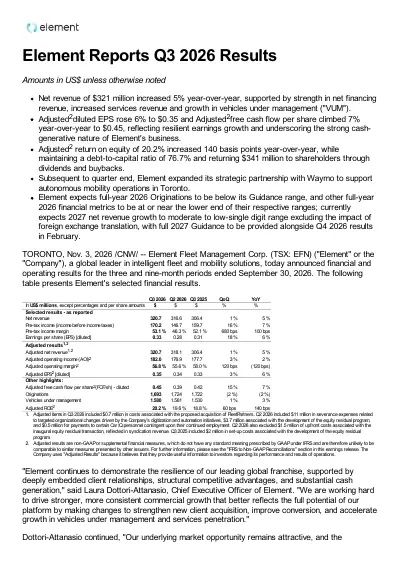
Thank you, Laura, and good morning, everyone. Element delivered solid results, with net revenue of $321 million in the third quarter, up 5% year-over-year, driven by growth in both net financing and services revenue.
On an adjusted basis, EPS increased 6% to 35 cents, free cash flow per share grew 7% to 45 cents, and return on equity expanded to 20.2%. These results demonstrate the resilience and cash-generating strength of our business, notwithstanding a moderation in top-line growth.
I'll now highlight the key drivers of our third quarter performance. Starting with services, revenue increased by 5% to $164 million versus last year, supported by 3% growth in the total vehicles under management and higher services revenue per VUM.
While services revenue growth remains solid, it is below the trajectory we expect from the business. Our opportunity remains to grow VUM and increase the value of services delivered per vehicle.
Turning to net financing revenue, we generated $138 million, up 6% year-over-year. Core NFR yield increased to 5.76%, supported by the continued strength of our leasing economics, lower funding costs, and a benefit from foreign exchange.
The total NFR was partly offset by lower gains on sale, particularly in Australia and New Zealand, where used vehicle pricing continues to normalize. There are also some quarter-specific factors that contributed to the higher reported yield.
As a result, we expect yield to normalize over the coming quarters. Our funding efficiencies are an important competitive advantage for Element, where our scale, investment-grade credit profile, and access to multiple funding channels allows us to manage costs effectively and support attractive returns across our leasing portfolio.
Syndication revenue was $19 million, down 6% year-over-year, reflecting a lower syndication yield of 2.4% compared to 3.2% a year ago, primarily driven by a shift in the mix of syndicated assets. Origination volumes were $1.7 billion, down 2% year-over-year.
From a year-to-date perspective, originations decreased 5% year-over-year, but increased 2% excluding the originate-to-syndicate client discussed in the first half of the year. Orders reached $1.4 billion, increasing both sequentially and from a year ago, including activity from clients that had deferred orders earlier in the year.
I would just say here that we remain focused on consistently increasing our vehicles under management, which is an important indicator of growth of the overall franchise. As Laura highlighted, the broader environment remains mixed, with some existing clients taking a measured approach to fleet investment amid economic and trade uncertainty.
Turning to costs, adjusted operating expenses were $139 million, up 8% year-over-year, and underpinning an operating margin of 56.8%. Expenses grew faster than revenue year-over-year, reflecting our investments to support longer-term growth, but declined sequentially for the second consecutive quarter.
As Laura stated, the investments we have made and the actions we have taken on costs are designed to drive consistent, positive operating leverage over time. We will invest in the business where we see attractive returns, while continuing to manage our cost base with discipline.
During the third quarter, we remained active on share repurchases, bringing the year-to-date total to nearly 11 million shares. We also intend to renew our normal course issuer bid following its expiry in November 2026, subject to TSX approval.
In terms of our balance sheet, we ended the quarter with a debt-to-capital ratio of 76.7%, within our targeted range of 73% to 77%. Maintaining a strong investment-grade profile remains a priority, supporting our access to funding and financial flexibility across different market conditions.
As we look at 2026, through the first nine months, net revenue increased 10%, adjusted EPS grew 14%, and adjusted free cash flow per share increased 9%. These results demonstrate the resilience of Element's business model.
Given what we see in the fourth quarter, we now expect 2026 full-year originations to be below the company's previously published guidance range, and other 2026 full-year financial metrics to be at or near the lower end of the guidance ranges. Looking ahead to 2027, we expect net revenue growth to moderate to low single-digit range, excluding the impact of foreign exchange translation, as slower commercial growth continues to impact our near-term outlook.
We expect the translation impact of the Mexican peso relative to the US dollar will create an additional headwind to reported revenue growth. In keeping with our usual practice, we will provide formal 2027 financial guidance with our fourth quarter results in February, but wanted to give you a view of how we see the year developing.
Thank you. Operator, we are now ready to take your questions.
Operator
Thank you. We will now begin the question-and-answer session.
If you would like to ask a question, please press star, then the number one on your telephone keypad to raise your hand and join the queue. We do request a limit of two questions per analyst to give everyone a chance to participate.
If you would like to withdraw your question, simply press star one again. Your first question is from Jaeme Gloyn with National Bank Capital Markets.
Your line is open.
Jaeme Gloyn
Thanks. I think, probably first of all, want to dig into how you arrived at the low single-digit growth rate for 2027, if you could provide maybe a little bit of detailed color, breaking that down perhaps by the three key revenue segments would be helpful.
Heath Valkenburg
Good morning, Jaeme. We'll provide our full annual guidance in February as what is our normal sort of course of operations.
What we're providing today is really just an indicative outlook based on the trends we're seeing as we exit 2026. We really expect the moderation in revenue growth we've experienced in the second half of 2026 will continue into 2027.
The changes we're making to improve commercial execution will take some time, as Laura discussed, to translate into revenue growth with sales implementation cycles, but also as VUM and services utilization build from new client wins. For us, we'll come back with the detail in February.
I'd finish off by saying, against that backdrop, we're placing emphasis on productivity, operating efficiency, capital deployment to support both EPS and free cash flow per share.
Jaeme Gloyn
Okay. Then on the margin itself, as we look at the negative operating leverage this quarter, some of the expense savings starting to come through, as you kind of noted quarter-over-quarter decline in adjusted OpEx.
Last quarter it was maybe too early to kind of think about that. In terms of that OpEx savings, how much would you sort of think to drop to the bottom line?
There's good 100-plus basis points of operating margin there. What's your updated view on utilizing those cost savings to reinvest or to just take those savings and drive margin expansion?
Heath Valkenburg
From an expense perspective, we're very focused on our expense base and certainly recognize that the current level of growth relative to revenue is not where it needs to be. We're making progress, operating expenses have declined sequentially now for two quarters, reaching $139 million in Q3.
We remain focused on cost discipline. I'd say we're on track to deliver the $20 million of annual productivity savings for 2027.
Importantly, the investments that we've made in the past in terms of technology, digitization, automation, they are creating opportunities to structurally improve efficiency and support future growth without a corresponding increase in costs. Certainly on track to deliver that $20 million number for next year.
We expect the expense growth will moderate in 2027 with a clear focus on restoring positive operating leverage throughout the year.
Operator
Your next question comes from Graham Ryding with TD Securities. Your line is open.
Graham Ryding
Hi, good morning. Just wanted to touch on Car IQ, or I think you rebranded Element Pay.
Is there any evidence yet of services revenue coming through from that acquisition, or you're still trying to figure out how to take it to market properly?
Laura Dottori-Attanasio
Hey, Graham, it's Laura. I'm happy to take that one.
We just launched that, under Element Pay, we did our rebrand. We've incorporated the technology into our systems.
We're seeing, I'd say, some pretty encouraging client interest. To date, 100% of the proof of concepts that we've done with our clients have resulted in them asking to use Element Pay.
That's promising. Again, I'd say it's still early in commercialization, as you saw.
I think we just press released not that long ago. That work begins, and we think it's going to help strengthen our value proposition, and it should open up more opportunities.
I just say, from a financial contribution, which is your question, that's really going to build over time, I wouldn't expect it to materially change our near-term growth trajectory.
Graham Ryding
That's fair. Then on the changes that you're targeting on the commercial front, beyond the management changes, which I think you announced a few months ago, can you talk about some of the changes you are focused on sort of making at the operating level, with your sales team and what not, to drive what you said, better win rates and better services penetration?
How are you actually going about doing that? Then what's a realistic timeline for you to sort of measure whether those changes are actually translating into better VUM growth, services penetration, originations?
Laura Dottori-Attanasio
Without, I'd say, going into too much detail and share commercially sensitive things, just from a change perspective, look, I believe they're going to be impactful in terms of allowing us to get back onto a path of better growth than what we're showing. I think the leadership that we put in place will make a big difference.
They're going to bring a much more disciplined operating approach. We're going to have greater emphasis on things like pipeline quality, core and mid-market opportunities, more focus on self-managed conversions, and then focusing on moving those opportunities from our first engagement to turning that into implemented business.
I guess I'd share we also strengthen the sales effectiveness function. We're relooking at incentives as well, so that's going to create some clear priorities, and it'll create better measurement.
Really what we're looking at is stronger accountability across the entire commercial process. I'm confident with the people and the leadership team that we have and the changes that they've already implemented since they've been in role, I think just in September, that we are going to be back on the path to success.
To your other question, just given the length of the sales and implementation cycles, which as you know they can be long, Well, I guess I'd see early evidence in our pipeline quality and activity before we start to see those changes fully reflected in, be it our VUM or our revenue, and so that should build through 2027, would be the expectation.
Graham Ryding
Great. That's it for me.
Thank you.
Operator
Your next question is from John Aiken with Jefferies. Your line is open.
Mr. Aiken, your line is open.
John Aiken
My apologies about that. Laura, in your prepared commentary on Waymo, you talked about the services that were being provided in San Diego versus Toronto, and I believe that they're actually a little bit different.
Can you explain the rationale behind that, and then more importantly, I guess moving forward, how do you see this relationship evolving?
Laura Dottori-Attanasio
Sure, John. I guess as you can imagine, the deals that we have are definitely going to vary, I'd say, city to city.
Maybe from a San Diego perspective, so that's on track with the plan that we've outlined. We expect our operations to begin in 2027, likely end of Q1, beginning of Q2, but again those dates can move.
San Diego, what we're doing really it's right now it's establishing the operating infrastructure, whether that's the facilities, the charging, the maintenance partnerships, the staffing, etc. We've hired our key leaders, we're preparing the sites and all the operating capabilities that are going to be required.
That's actually going well. I'd say once we have that, in 2027, again let's say mid-2027, what we'd expect to see is that the volumes are going to start to ramp up from there.
Again, I just say it's going to take years, that revenue contribution's going to build progressively. It's not just going to appear all at once.
For Toronto, we see that as a really positive development. I think it just reinforces the strategic value of the partnership that we have with them, and I think it highlights the potential for us to scale beyond just one single market.
That's a positive. Then for Toronto, the activity in 2027, and you might have seen some of the vehicles, they're already on the streets, it's all about validation testing, and we're there helping support the regulatory process.
That too, we're going to see a multi-year ramp, no different than you see in some of the other major market launches. For Toronto, that'll start in 2028.
John Aiken
Thanks for that, Laura. On capital, good to see the ROE back above 20%, but can you talk about the thinking behind the bid on FleetPartners and then rescinding the bid?
Is there interest moving forward in terms of M&A if it's not in a hyper-competitive bid environment?
Laura Dottori-Attanasio
Sure. Look, our Australian operation that we have, I guess I'd start by saying we've got a solid business.
We've got a solid team there. As when we looked at FleetPartners, we saw it as a specific opportunity really to add scale and get synergies in a market that we know really well.
It did have to meet our risk-adjusted return thresholds. I'd say we're very disciplined when we look at things.
When we did preliminary due diligence, it didn't hit our thresholds. Again, we stayed disciplined, and we walked away from it.
Our main focus now is all about commercial execution. It's all about converting the capabilities that we've built over the last, let's say, two to three years into better financial outcomes.
As Heath pointed out, and it's going to be all about delivering positive operating leverage for our shareholders.
John Aiken
Thanks, Laura. I'll re-queue.
Operator
Our next question comes from Paul Holden with CIBC. Your line is open.
Paul Holden
Thank you. Good morning.
Want to be clear on terms of the way you talk about improving the commercial performance here. I think an important question for people is the slowdown in revenue, the slowdown in originations, is this really an issue with the win rates, which seems to be what you're suggesting?
I guess my question is, are there any issues with client retention? Basically, client retention is good, and we can grow revenues sort of low single digits with existing clients, and then revenue growth can accelerate as we start to have better win rates with new clients?
Is that the right way to think about it?
Laura Dottori-Attanasio
Look, honestly, and if so where your question is going, we've still got solid client revenue retention rates that continue to be in that 97%, 98% range. I guess what I'd say, the change, and this is important to say from our perspective, we don't see anything, I'm going to say, structural in our growth opportunity, and I think that's important to raise.
We continue to have, and I might sound like a broken record, and I've talked about this, but some great competitive advantages, whether that's scale that we bring, our people, our tech, our operations. The market opportunity remains intact.
You saw in the past, we did have the ability to deliver growth at or above that 6% to 8% medium-term range or opportunity that we've always talked about. It's really our commercial execution, I'd say, that's fallen short.
We've made the changes, and a lot of this, honestly, is around just operating discipline. I said it earlier, it's greater emphasis on pipeline quality and on the opportunities.
We had over-indexed in some of the mega opportunities, and we weren't as disciplined as we should have been. Those changes, I believe, are going to address our growth challenge.
Again, it's going to take some time to translate into revenue. For myself and the team, I'd just tell you, we're confident that we continue to have that mid-term potential.
What we got to do, and that's what the entire focus now is just, we got to deliver stronger commercial execution so that we can translate all of that potential into results. That's our focus.
Paul Holden
Okay. Second sort of related question is with respect to service income growth and the penetration rates.
You've been very clear on the strategy in terms of increasing those penetration rates. How are we thinking about that in terms of, I guess, growth really next year?
Is that still something that should be able to grow service income higher than low single digits, and is there anything that needs to improve in the commercial execution to re-accelerate service income growth?
Heath Valkenburg
Good morning, mate. Maybe I'll take that one.
From a service revenue perspective, we grew 5% in the quarter, which was supported by VUM growth of 3%. We did have a headwind in Q3 from utilization, and utilization can move around from quarter to quarter based on client uptake, and we did see lower in Q3.
As you said, we're certainly focused on driving commercial execution, and onboarding new vehicles under management, that is a key component of it, but additionally, is also driving the product penetration. We still have a lot of white space in terms of driving penetration, not only on our mature products of as maintenance and those sorts of ones, but also our newer technology-enabled products.
Certainly to get the service revenue to where we want it to be, we want to drive both VUM growth and product penetration.
Paul Holden
Let me reframe the question. Are you falling short of your own expectations in terms of service penetration, or are you meeting your expectation and the intended improvements are really designed to improve originations?
Heath Valkenburg
I would say we're falling short on the product penetration. We've been flat in terms of services per unit in our USA and Canada business.
Paul Holden
Okay. Thank you.
I'll re-queue.
Operator
Your next question comes from Stephen Boland with Raymond James. Your line is open.
Stephen Boland
Morning. [cough] I don't want to beat this to death, but I guess when you provide that guidance for 2027 and you're talking about execution.
[cough] Excuse me, fighting something here. Is there further possible downside like economic uncertainty, tariffs, elevated fuel prices?
Have you already baked in changes in your customer behavior into that guidance? I guess the point being if fuel prices, we've seen this in the past, remain elevated that purchase decisions start to get changed at the corporate level.
I'm just wondering where that is outside of the execution problems that you've had.
Laura Dottori-Attanasio
Hi, Steve. Look, we're not like anyone, I'd say, immune to what's happening in the economy, and I think we've shared that.
We're seeing some of our clients taking longer around whether that's replacement or extension decisions given what we're seeing in the macro and trade environment. That does have an impact.
I'd tell you, we have taken that into account. As we've said, the biggest thing that we need to do, and look, I take full accountability for that, is we've got to be better from a commercial execution perspective.
We've got to get better pipeline quality. We've got to improve our win rates, and we've just got to deliver on a more consistent basis.
Stephen Boland
Okay. When you say win rates, [cough] so you're basically going into an RFP situation and you're not winning that RFP for a new client, or the service penetration isn't winning?
Is it origination or is it service?
Laura Dottori-Attanasio
We actually do well when we end up in RFPs. It goes back to again, we ended up, honestly, relying too heavily on really mega opportunities.
I'd just say really it was not being sufficiently disciplined to convert the broader pipeline into implemented business. It's really about having a much more disciplined operating approach, having better pipeline quality.
All of those things would improve our win rates. It's not RFP per se related.
It's ensuring that we've got a much better pipeline quality, and that when we get to, I'm going to say, first engagement to implemented business, that there's more rigor in the system.
Stephen Boland
Great. Thanks.
Thanks so much.
Operator
Your next question is from Tom MacKinnon with BMO Capital. Your line is open.
Tom MacKinnon
Thanks very much. Good morning.
Just a question with respect to FX on the headwinds you point out with the Mexican peso when you gave this low single-digit net revenue outlook growth. How are you thinking about the peso versus the US dollar where it is right now or where it was several months ago?
Heath Valkenburg
Clearly there's always an impact on our reported results based on FX. It was a headwind in '25.
It's been a tailwind for the first three quarters of '26, likely become a headwind again as soon as Q4 and into '27. Importantly, this doesn't change the underlying performance of our Mexican business, which continues to deliver strong growth.
It really is just a translational impact of the FX of the reported results. In terms of impact for 2027, based on sort of the current exchange rates and our planning assumptions, we do expect it will have a meaningful headwind, of approximately 2% to 3% headwind to our reported results.
Ultimately, that outcome will depend on exchange rates throughout the 2027 year, and we'll provide an update in February.
Tom MacKinnon
That's 2% to 3% versus 2026? Is that what you mean, then, in terms of growth?
Heath Valkenburg
Correct.
Tom MacKinnon
Thanks. Then, with respect to net finance revenue yields, it was elevated in the quarter.
I think there were a couple one-timers in here. How do you see this trending going forward, and probably more importantly, what are you hearing from clients in terms of demand, just given the fact that rates are significantly higher?
Heath Valkenburg
I'd start off by saying we take a really strategic approach to pricing our leasing product, and we focus on driving profitability across our entire business. Our objective is to really balance competitive pricing from a growth perspective and overall returns, rather than just maximizing yield.
In relation to the yield, I'd probably separate the strength in NFR into two components. The first is structural, our leasing business initiative, the lower funding costs we've been able to deliver as we've matured our funding program, and these types of improvements we expect the benefits to be largely sustainable.
The second would be some more specific items to the quarter in terms of normalization of credit provisioning, FX, timing-related interest benefit, which did give us a higher yield in Q3. From a normalization in the coming quarters, I'd point you to sort of the first half of the year average, which was just north of 5% as a data point.
In terms of competitiveness and all of those sorts of things, what we have seen is that these assets are mission critical for our clients. The ultimate cost of a fleet is more the cost of the vehicle and maintenance and those sorts of things, and while interest rates may play some impact on client decisioning, ultimately it gets to a period where you need to replace the vehicle.
Then finally, I'd just say that in terms of all of the work we've done from a funding perspective to lower our funding costs, that really gives us flexibility to compete for new business, and we'll be focused on balancing both yield, but also growth and volume into the future.
Tom MacKinnon
Thanks.
Operator
Your next question comes from Bart Dziarski with RBC Capital Markets. Your line is open.
Bart Dziarski
Great. Thanks.
Good morning, everyone. Wanted to ask around the growth moderation for 2027.
Could you help us understand how much of that is driven by macro impacts, which are sort of out of your control, and then how much of that is driven by more idiosyncratic or just the team not capturing the growth opportunities in front of you? Thanks.
Heath Valkenburg
Good morning, Bart. No doubt the macro environment is causing delays in client ordering and expansion of fleets, and that is impacting results for the back end of '26, but also we expect that to continue into 2027.
Having said that, I do think the biggest opportunity for us is what's in our control, which is all of the items that Laura spoken about in terms of commercial execution. While we do have strong client retention, we can always improve that.
We want to get the win rates up and the new business wins up to drive VUM growth, and then we also want to deliver on increased product penetration and getting more products into our vehicles.
Bart Dziarski
Thanks, Heath. Then on capital allocation, I think in the prepared remarks you talked about current valuation being attractive.
Could you walk us through how you're thinking about buybacks from here, and why not give investors a SIB, or how are you thinking about that? Thanks.
Laura Dottori-Attanasio
Not sure what you mean by a SIB, but maybe you can clarify?
Bart Dziarski
A significant buyback, more like a one-time
Laura Dottori-Attanasio
SIB. Fine.
Got it. Look, Bart, what I'd say is we clearly see attractive value in our shares, and you saw that we already increased, I'd say, the repurchase activity that we've had pretty materially.
From our perspective, look, we've made the investments in all the capabilities that we need to strengthen the platform and to support our long-term growth. As Heath pointed out, we've got a strong investment-grade balance sheet that we remain very committed to maintaining.
Those two items I'd say are important, and then look, what we've said and what we always do is then we just return excess capital to shareholders. For sure, our shares represent an active use of our capital, you can expect to see us, I'd say, more active under our NCIB.
Again, and I'll repeat it, but right now our main focus is all about commercial execution. It's converting those capabilities into better financial outcomes, and as Heath pointed out, delivering positive operating leverage for our shareholders.
You will see us more active.
Bart Dziarski
Got it. Thanks, Laura.
Operator
Your next question comes from Vasu Govil with KBW. Your line is open.
Nick Brady
Good morning. This is Nick Brady on for Vasu.
Just to clarify your comments on utilization impacting servicing fees this quarter, I know last quarter you guys mentioned a new client could create a drag on fees per VUM. Are those the same driver there, and how long will that drag continue?
Thank you.
Heath Valkenburg
Good morning. I think the comments around new clients, that's more often will bring in new clients and they may have a lower service uptake relative to the rest of the portfolio, and then you try and build the relationship and the product uptake over time.
That has no impact on utilization per se. That's more products per vehicle.
In terms of utilization, it does bounce around from quarter to quarter. We did see some lower utilization in Q3 in particular parts of our North American portfolio, but really focused on driving commercial execution and bringing in more vehicles and driving product upsell across the portfolio.
Nick Brady
Got it. I know we've covered execution on the commercial front, but I guess on the market dynamics for next year, how is that playing out?
Is it still just softness in order conversion and general demand, or are there other dynamics we should consider? Maybe help us understand why the solid order trends you've mentioned recently aren't really expected to drive upside in the near to mid-term?
Thank you.
Heath Valkenburg
Maybe I'll talk about the orders side of that question first and then we can talk about market dynamics. What we saw in the first half of the year is some delayed orderings in our existing clients.
Pleasingly, in Q3, our orders are up 31%, but a much of that was orders that we actually expected in the first half of the year coming through in Q3. Then just with the cycle time between orders and originations, a portion of that activity will convert into originations into 2027 as opposed to 2026.
That's what we're seeing there from an orders to origination perspective. From a broader market perspective, we operate in a competitive market.
I wouldn't say that anything has materially changed outside of what we've already called out in terms of there are some broader macro themes in terms of higher fuel prices, trade uncertainty, and that always makes people a bit more cautious in terms of replacement activity and expansion activity. From a broader market perspective, I'd say we're in a consistent perspective of where we're at over the last couple of years.
Nick Brady
Thank you.
Operator
Your next question is a follow-up from Jaeme Gloyn with National Bank Capital Markets. Your line is open.
Jaeme Gloyn
A couple of follow-ups, if I may. First, last quarter you talked about Waymo contributing a few points to service revenue's growth in 2027.
Do you still stand by that comment, or has that been pushed out for any reason?
Heath Valkenburg
From a Waymo perspective, we still stand behind that sort of growth rate. What I would say is that one, we need to kick the program off.
Number two, as Laura said before, we need to expand the relationship. It's not like we'll start with all of the vehicles on day one, and the revenue will build throughout the year.
The key items for us is launching the program, and then the second is expanding the number of vehicles in the city of San Diego before we move on to other spots, such as Toronto.
Jaeme Gloyn
Understood. Then you mentioned and Laura mentioned pipeline quality as being an issue, and something that we'll probably want to continue to follow up on over the next couple of quarters to determine if these commercial changes are having an effect.
Can you maybe dig into pipeline quality a little bit to help us understand, where did it weaken? Is it the size of the clients coming in?
Is it their interest in the types of services or higher-value services? Where has this pipeline quality deteriorated, or is it simply just the number of customers that are potentially coming through the door?
Laura Dottori-Attanasio
Jaeme, it's more the latter. As I said, I'd say previously our team was just too concentrated on a very small number of really large opportunities, and so when you do that, that makes, I'm going to say, your conversion rates sort of less predictable.
The focus really is on pipeline quality. It's not just size, but it's having the right quality of pipeline.
The changes are really around, I'm going to say, around discipline, it's around opportunity qualification, and then just having everything balanced across all of the segments that we cover, like core, mid-market, self-managed. I know it sounds simple, but it's just strengthen accountability and ensuring that we convert these into implemented revenue, and it's having more rigor in the system.
Jaeme Gloyn
We'll
Laura Dottori-Attanasio
look, we'll come back, if I may, we'll come back at some point when we come back in February, and we'll talk about what we can share so that you can get a feeling that we are moving in the right direction, as opposed to just waiting to see if we deliver the results. We recognize that that's important that we can show you that given we haven't grown at our own expectation nor at yours.
When we come back in February, we'll talk about what we can share so that you feel that we are in fact headed in the right direction.
Jaeme Gloyn
That'd be great. Then last one, you've talked about the market mostly from a macro standpoint.
How has it shifted from a competitive standpoint? How are your competitors operating?
Is it becoming far more competitive from a pricing standpoint today, just given that everyone is facing some macro headwinds? What can you share on that front that could be impairing your win rates and your growth rates overall?
Laura Dottori-Attanasio
I guess let me start by saying directly, are we losing market share? The answer to that is no, we don't see, I'm going to say, any evidence of that whatsoever.
In fact, when we look across all of the, I'm going to say, the available indicators, I think we've still got a great underlying competitive position. I talked about it a bit earlier, but we continue to have strong client revenue retention and all of the different capabilities set that strengthen our competitive position.
The issue for us, again, it's getting out there and taking those advantages and doing more to drive growth. No fundamental, I'd say, real change in the market.
It's a competitive market. We compete very well.
We just need to have a much better and larger pipeline, and we need to focus on more of the, I'm going to say, the core accounts and not overfocus on some of the larger ones as we've done in the past.
Jaeme Gloyn
Great. Thank you.
Operator
Your next question is a follow-up from Paul Holden with CIBC. Your line is open.
Paul Holden
Great. Thanks for taking my follow-up call.
First one, it kind of just goes back a little bit to what Laura was just talking about, but Heath, you made an interesting comment in one of the answers regarding sort of a better balance between growth and the NFR yield. Maybe either you or Laura can expand on that.
Does that suggest, with all the margin expansion you've seen over the last five years or so, and it's a lot of margin expansion with lower funding costs, you're at a point where maybe you'll share a little bit more of that benefit of the lower funding costs with your clients in order to gain market share? Is that how I should be reading into your comment?
Heath Valkenburg
I'd say my comment is, number one, the growth in the NFR yield that we've been able to deliver for a number of years now, I wouldn't just simply extrapolate that indefinitely into the future. All of the work we've done to make ourselves more efficient on the funding side of things does give us flexibility from a pricing perspective.
We can balance, and ultimately we will balance, strategically, price versus volume to optimize overall profitability.
Paul Holden
Okay. Last one for me, maybe we can dive into the objective of delivering, I think you said positive operating leverage next year, Heath, and that obviously comes despite low revenue growth.
Maybe we can get more specific in terms of potential future cost actions. Not sure the $20 million you've already actioned is enough.
Is this mostly head count reductions? That's what I'd anticipate.
Maybe you can give some color of kind of what functions or roles those relate to.
Heath Valkenburg
What I'd say is, we'll come back in February and provide our 2027 guidance and some further detail there in terms of our cost base. What I would say is that the investments that we've made in technology, and Laura touched on items like DigiAdvisor and those sorts of things, automating the operational components of our business has enabled us to achieve some of the cost reductions that we've already spoken about, and we see that continued investment in technology will continue to drive results, not only from a cost perspective, but more importantly, a client experience perspective as well.
I think we'll come back in February and provide more detail on 2027 then.
Paul Holden
I will leave it there. Thanks for your time.
Operator
Your next question is a follow-up from Graham Ryding with TD Securities. Your line is open.
Graham Ryding
I just wanted to quickly touch on the FX impact next year. You said potentially a 2% to 3% headwind.
That just seems like a lot to me when you consider only, I think, roughly 20% of your revenue mix comes from Mexico. Can you sort of just explain to me that the math there a little bit, and why that impact is so expected to be so material?
Heath Valkenburg
We call out in our disclosure a 1% impact on FX is approximately $3.6 million of AOI, and the bulk of that is Mexico. Ultimately we've seen a sharp devaluation of the peso in the last 45 to 60 days, and we expect that will continue into 2027.
Graham Ryding
Now does that relate to the fact that you've got financing revenue coming from Mexico, but your debt cost, your interest expense, is largely US
Heath Valkenburg
based? We do have local funding in Mexico that we utilize, which is in peso, and there is some US dollar funding as well.
Really it's ultimately just the translation of our Mexico P&L, which as I said before, does move around. It was a headwind for us in '25, it's been a tailwind for the first three quarters, and we expect it to be a headwind just because of the devaluation in the peso over the last couple of months.
Will also obviously help us from an expense side of things in terms of reduced expenses as well.
Graham Ryding
That's it for me. Thank you.
Operator
That concludes our question-and-answer session. I will now turn the conference back over to Laura Dottori-Attanasio for any closing remarks.
Laura Dottori-Attanasio
Thank you, Operator. Thanks, everyone, for joining us today, and thanks for your continued interest in Element.
While we recognize there's work to do to strengthen our commercial performance, we do remain very confident in our business, in our competitive advantages, and the significant opportunities ahead of us. Our priorities are clear, and we're focused on delivering results.
Before closing, I'd like to take a moment to thank our team members across Element for their dedication, their hard work, and their unwavering commitment to our clients. Our team members' efforts are what make this company successful, and I'm incredibly grateful for everything they do.
Thank you again for joining us, and we look forward to updating you on our progress for next quarter.
Operator
This concludes today's call. Thank you for attending.
You may now disconnect, and have a wonderful rest of your day.