Eltek Ltd.
NNASDAQ:ELTKQ1 FY2026 · Earnings Call TranscriptMay 19, 2026
Operator
Ladies and gentlemen, thank you for standing by. Welcome to the Eltek Ltd.
2026 first quarter financial results conference call. All participants are at present in a listen-only mode.
Following management's formal presentation, instructions will be given for the question-and-answer session. For operator assistance during the conference, please press star zero.
As a reminder, this conference is being recorded. Before I turn the call over to Mr.
Eli Yaffe, Chief Executive Officer, and Ron Freund, Chief Financial Officer, I'd like to remind you that they will be referring to forward-looking information in today's presentation and in the Q&A. By its nature, this information contains forecasts, assumptions, and expectations about future outcomes, which are subject to the risk and uncertainties outlined here and discussed more fully in Eltek's public disclosure filing.
These forward-looking statements are projections and reflect the current beliefs and expectations of the company. Actual events or results may differ materially.
We'll also be referring to non-GAAP measures. Eltek undertakes no obligation to publicly release revisions to such forward-looking statements to reflect events or circumstances occurring subsequent to this date.
I will now turn the call over to Mr. Eli Yaffe.
Mr. Yaffe, please go ahead.
Eli Yaffe
Thank you. Good morning.
Thank you for joining us for our 2026 first quarter earning call. With me is Ron Freund, our Chief Financial Officer.
We will begin by providing you with an overview of our business and the summary of the principal factors that affected our results during Q1 2026. After our prepared remarks, we will be happy to answer any of your questions.
By now, everyone should have access to our press release, which was released earlier today. The release will be also available on our website.
As we previously indicated, revenue in the quarter were below our expectations. This was primarily driven by the mix of timing of backlog conversion, ongoing logistic constraints, and foreign exchange impacts, rather than any change in the underlying demand.
The product mix in the quarter was primarily a function of a backlog release timing, rather than any change in a price discipline, customers quality, or market positioning. During the quarter, a larger portion of our shipments originated from the orders received in a prior period at lower average pricing levels, while significant portion of the higher-value programs and advanced products added more recently to the backlog are scheduled for the delivery later in the year and into the year 2027.
In addition, due to the supply chain and material allocation constraints, we prioritize certain deliveries in order to maintain customers commitments and production continuity, which also impacted our quarterly mix. As a result, the average selling price of products delivered during the quarter declined, negatively impact profitability.
We believe that the current quarter does not reflect the normalized margin profile of the business going forward. Importantly, underlying demand remains strong.
During the quarter, our backlog more than doubled compared to the beginning of the year. This increase includes the two orders we publicly announced, with deliveries expected across 2026 and the year 2027.
We believe this substantial backlog growth enhance our revenue visibility and provides a strong foundation for future growth, even so the timing of revenue recognition may continue to vary between quarters. On the operational side, we continue to operate in a challenging supply chain and logistic environment.
Due to the ongoing regional complexities and global logistics disruption, we experienced constraint in sourcing, transportation, material flow that affected our ability to manufacture at sufficient volumes to efficiently absorb fixed operation cost. Air freight capacity from the Far East, Europe, and United States remained constrained, and certain chemicals that were previously eligible for air transportation can no longer be shipped by air, reduced logistical flexibility.
In addition, extended sea freight transit time and ongoing global shortage of prepreg material are contributed to the longer supply cycle. The prepreg shortage is being driven in part by strong demand for the fiberglass materials from the rapidly expanding AI hardware infrastructure market.
These operational and logistical challenges further impact production efficiency during the quarter and limited our ability to increase output level. In addition, the continued weakness of the US dollar against the Israeli shekel had a significant negative impact on our operational results and increased the operational loss by approximately $1.3 million compared to the corresponding quarter last year.
We are actively managing this dynamics through close coordination with suppliers and customers. In response to the increased raw material constraint and cost, we have updated our pricing structure and are currently selling relevant fiberglass products at adjusting price level and under allocation quotas designed to secure supply continuity and protect operational efficiency.
Turning to our investment plan, we continued to make progress. The first new production line was delivered and partially installed.
As previously noted, due to the current situation in Israel and the war with Iran, the installation team from the supplier had temporarily left the country, which created delay in the installation processes. We are pleased to report that the supplier installation team returned to Israel yesterday and the installation work has now resumed.
We expect the installation process to be completed over the coming weeks, after which we plan to begin the qualification process for commercial production. While recent events have created some delays in the installation timeline, they do not change our strategic direction.
As we have noted in the past, the qualification process is inherently lengthy and expected to take several months. Following successful qualification, we will be gradually ramp up the line into commercial production.
Overall, while the near-term results are affected by timing and external constraints, we are encouraged by the strength of the demand and the significant growth in backlog and the progress we are making to expanding our production capacity. In parallel, the process of bringing foreign workers to work in our operation continues to advance.
We believe that upon their arrival, we will be stronger position to address the ongoing challenges in the local labor market and better support our planned production growth and operational efficiency. Looking ahead, our focus remains on gradually returning business to normalized profitability levels.
A key element in achieving this objective is our continuous effort to secure new orders at pricing level that apparently reflect the increase of raw material, the impact of the weaker US dollar environment, and the value of the company execution capability, technological expertise, and on-time delivery performance. At the same time, we continue to invest operational improvement, production capacity expansion, and supply chain stability in order to better support long-term profitable growth and strengthening our competitive position into the market.
I will now turn the call over to Ron Freund, our CFO, to discuss our financial results.
Ron Freund
Thank you, Eli. I would like to draw your attention to the financial statements for the first quarter of 2026.
During this call, I will also discuss certain non-GAAP financial measures. Eltek uses EBITDA as a non-GAAP financial performance measurement.
Please see our earnings release for its definition and the reasons for its use. I will now go over the highlights of the first quarter of 2026.
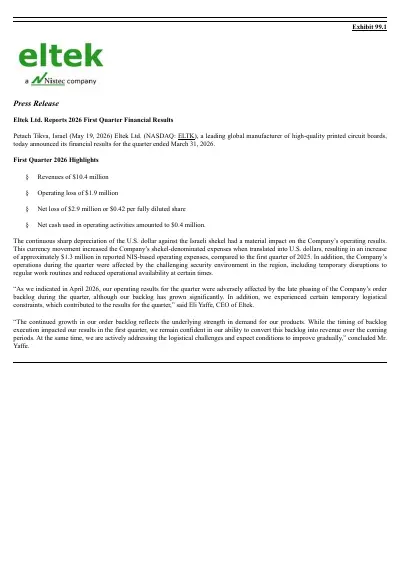
All numbers mentioned are in US dollars. Revenues for the first quarter of 2026 totaled $10.4 million compared to $12.8 million in the first quarter of 2025.
Gross loss was $1.9 million down from $2.2 million gross profit in the first quarter of 2025. The decline was driven by the mix and timing of backlog conversion, ongoing logistic constraints, and foreign exchange impact.
Operating loss for the quarter was $3.3 million compared to operating profit of $0.7 million in the same period last year. We recorded financial expenses of $0.1 million in the first quarter of 2026 compared to financial income of $0.5 million in the first quarter of 2025.
The expenses recorded in the current quarter are primarily due to the devaluation of the US dollar against the Israeli shekel, net of interest earned on our interest-bearing accounts. Net loss for the quarter was $2.9 million or 42 cents per share compared to net income of $1 million or 15 cents per share in the first quarter of 2025.
EBITDA loss for the quarter was $2.7 million compared to EBITDA of $1.2 million in the prior year period. Cash flows used in operating activities totaled $0.4 million during the first quarter of 2026.
As of March 31st, 2026, we had $11.1 million in cash and cash equivalents with no outstanding debt. We are now ready to answer your questions.
Operator
Thank you. Ladies and gentlemen, at this time, we will begin the question-and-answer session.
If you have a question, please press star one. If you wish to cancel your request, please press star two.
If you are using speaker equipment, kindly lift the handset before pressing the numbers. Your questions will be answered in the order they are received.
Please stand by. The first question is from Mark Sharogradsky from Kepler Capital.
Go ahead, please.
Mark Sharogradsky
Hi, Eli. Hi, Ron.
Really disaster quarter, but I want to understand when we can expect margins normalization, because as we see, there are huge demand to the PCB now in Israel and also in USA for AI hyperscalers. I'm trying to understand why it's so difficult to raise prices in this environment.
Eli Yaffe
Hi, Mark. It's really not a good results.
As we don't give forecast of looking forward statements, but as I discussed in my long conversation, I gave all the background for you to decide when we'll come to normal operation. It depends upon the length of the conflict with Iran, it depends upon the labor market, it depends upon the shekel against the Israeli, and a lot of factors that is unknown to us.
We do everything to adjust, to accommodate this risk and mitigate against it. For example, we adjusted all our prices to the devaluation of the shekel against the dollar, but if there will be more devaluation, we cannot expect it and we cannot and we cannot forecast it.
I never forecasted that we'll be at 2.9 shekel per dollar. I didn't forecast the shutdown and the hours that we lost during the first quarter because of the siren in Israel.
We cannot do it. What we do is we can promise that for long term, as I mentioned before, we continue with our strategic plan to continue to have the two lines operating by the end of this year and start to fly from this point to a more good future.
Mark Sharogradsky
Okay. I want to understand.
Let's say the dollar will stop to devaluate and everything will stabilize and you will finish your construction lines, you still project that you will be able to achieve 27%, 28% gross margin, if there are no other devaluation in the US dollar and you stop production of the old backlog?
Ron Freund
Yes, as we said—hi, Mark, this is Ron—as we said in the past, okay, when we'll finish our investment plan, and taking into account that the current circumstances stay the same, okay, no devaluation, no new bad news, we expect that our revenues will increase up to what we told before, up to the around $60 to $65 million, and at that volume, we estimate that the gross profit will be 26% to 28%, as we previously said.
Mark Sharogradsky
Nice. I see if I read recently the earnings call of TTM, I see huge demand in USA, and they even need to cancel or to delay some projects.
Do you think you will be able to secure some additional orders from USA due to at current environment?
Eli Yaffe
As we announced in the beginning of the year, we took a nice chunk in a competition with TTM of a work, a defense contractor of the United States that we compete head-to-head with TTM.
Mark Sharogradsky
That's
Eli Yaffe
a good signal, yeah.
Mark Sharogradsky
Yeah. Now also very big orders for hyperscalers.
Do you think you will maybe be able to also secure some orders from those clients, because they also need some specialized PCB to be manufactured?
Eli Yaffe
Mark, we don't know exactly which segment will in the future ask for bids from us, but what we can say is that our high technology and the products can serve many high-end segments. We hopefully wish that we will be manage to compete TTM in that market also.
Currently, we are investing energies trying to get more orders from customers abroad. The US is a very important market.
We're also trying in Europe. We hope to increase our backlog.
As we said before, we more than doubled our backlog from the beginning of the year.
Mark Sharogradsky
Okay. It's also very important the mix of the backlog.
Do you see enough products in the not only on the rigid PCB, but also on the same flex PCB?
Eli Yaffe
Yeah. The basket of the future I don't have it in front of me in parallel, but the basket is well organized, but some portion of the basket is based on dollar to shekel 3.3, and actually right now we are at 2.9.
Mark Sharogradsky
It
Eli Yaffe
will be there's going to be weakness in this period that we have to honor anyway.
Mark Sharogradsky
Okay. If you will be and if the USD dollar against shekel will rise in the near future, you will benefit from the current orders that you received, if I understand?
Of course.
Eli Yaffe
Yes. Of course, all exporters.
Yeah.
Mark Sharogradsky
Okay. Guys.
Thank you. I don't have other questions at this stage.
Eli Yaffe
Thank you, Mark.
Ron Freund
Thank you, Mark.
Mark Sharogradsky
Thank you.
Operator
The next question is from Ran Tzur from Private Investor. Please go ahead.
Ran Tzur
Hi, Eli and Ron. First question is regarding the sourcing problem.
Can you elaborate more on that, until when you're going to face this problem? Second question is now I hear for the first time that the integration of the new equipment and facility is going to happen until the end of this year.
Last time you mentioned it will it will due by the end of the first half of 2026.
Eli Yaffe
Can you repeat the first question? I didn't hear your first question.
Ran Tzur
You mentioned that you in the first quarter, you had a problem with sourcing?
Eli Yaffe
Yes.
Ran Tzur
Can you elaborate more on that?
Eli Yaffe
Because it's an
Ran Tzur
important issue. Until when
Eli Yaffe
will
Ran Tzur
it be done? Is it over?
Do you still face it in this quarter? When do you think it will be over?
Eli Yaffe
The sourcing problem and logistic problem in the first quarter is divided to two. Is international problem that there is a shortness of fiberglass all over the world because of the AI demand, as I mentioned before.
The suppliers allocate quotas. If we are ready to pay the AI prices, quote-unquote, we'll be out of the quota, and we agreed to pay the AI prices because we didn't want to stay in shortage.
This was problem number one. Problem number two is how to bring this and this is only related to Israel is how to bring this raw material, which is as a limited life shelf, to Israel under a cooling condition during the conflict time.
As I mentioned before, there was a short of supply short of flights between the Far East, United States, or Europe. This is the main three hubs that we bring fiberglass to Israel, and we suffer from short of raw material, which is not the situation today because we agree to pay the high prices and the bottleneck is open.
If the conflict will return, the problem will return again. This is regarding your first question.
Regarding the second question that you asked—
Ran Tzur
Just a second. For the first question, the AI problem, the AI constraint is going to continue.
It's not done. We are just in the beginning.
Eli Yaffe
It's only impacting the If we'll pay the AI prices for fiberglass, we'll be out of the quotas. If we want to stay in the old prices of the PCB only and not pay the premium that AI is willing to pay, we'll be under quotas.
Ran Tzur
The question is, does your business model, your pricing model take into consideration you want to arrive a specific gross margin. Does the pricing model take into consideration the getting out of this quota and paying a premium?
Eli Yaffe
I don't have a choice, because
Ran Tzur
I have to load it
Eli Yaffe
on the prices to our customers.
Ran Tzur
You can increase the prices to the customers?
Eli Yaffe
It's very tough here. It's very tough.
We start to do it, and we got objection from our customers, it's a lot of explanation work, showing articles. There is a very famous Morgan Stanley article that helped us.
We explain, we're going from customer to customer and explain him that it's beyond our control. It's impacted, and I think that this is a common problem to all the PCB suppliers all over the world.
It's not related only to Israel.
Ran Tzur
It's something that going to accompany, to be with the company in the coming future also.
Eli Yaffe
Yes. Yeah.
Ran Tzur
Okay. Regarding the second question?
Eli Yaffe
Regarding the second question, as I mentioned, the plan was originally and the installation started, and during the first two days of the conflict with Iran, the team, which was eight labor people and two engineers, left Israel immediately. They returned only yesterday.
It was almost six weeks or seven weeks that they were not here. Now so we suffer another delay now.
Once they will finish it, we have to qualify the line. The update that I had before that by July 1 we'll have line standing and running has to be updated right now.
Operator
I repeat, if you have a question, please press star one. There are no further questions at this time.
Before I ask Mr. Yaffe to go ahead with his closing statement, I would like to remind the participants that a replay of this call will be available tomorrow on our website.
Eli Yaffe
In summary, while we are negatively navigating near-term challenges related to the timing, logistic, and foreign exchange, we remain very confident in the foundation of the business. Demand continues to strong, as I reflected in the significant growth in our backlog, and the long-term visibility is provided.
At the same time, we continue to make strategic investment to expand our capacity and support future growth. As these initiatives progress and external constraints begin to ease, we believe we are well positioned to translate our strong demand environment into improved financial performance in the period ahead.
I would like to take the opportunity to thank the employees of for their decision and reliance, particularly in the current environment, as well as our investors for their continued supports and confidence in our strategy. Thank you all for joining us on today call.
Have a good day.
Operator
This concludes the Eltek Ltd. 2026 first quarter financial results conference call.
Thank you for your participation. You may go ahead and disconnect.