ENGIE S.A.
Q3 FY2026 · Earnings Call TranscriptNovember 5, 2026
Operator
Welcome to the ENGIE's 9 months conference call. For your information, this call is being recorded.
It will take place in a listen-only mode, and you'll have the opportunity to ask questions after the presentation. Anyone who wishes to ask a question may press star and one on their touchtone telephone at any time.
To remove your question, please press star and two. I will now hand you over to Ms.
Delphine Deshayes, Head of Investor Relations. Please go ahead, madam.
Delphine Deshayes
Thank you, and good morning, everyone. It's my pleasure to welcome you to ENGIE's 9 months conference call.
Shortly, Catherine and Pierre-François will present our 9 months performance, following which we will open the lines to Q&A, with my polite request of limiting your questions to one or two only, please. With that, over to Catherine.
Catherine MacGregor
All right. Thank you, Delphine, and good morning, everyone.
Welcome to our 9 months 2026 results call. I am very happy, very pleased to report that ENGIE has maintained its dynamic performance in Q3, and we now expect us to achieve the upper end of our full-year guidance.
All of the regular hallmarks that you've come to expect were on display in Q3: strong focus on execution of our growth strategy with expansion on a global basis in renewables, in batteries, in networks, plus significant progress on performance, notably through operational excellence and initiatives that are focused on culture and competitiveness, efficiency. The key takeaway for me is that we have built a fantastic engine that is thriving in what is a new paradigm: a world with constant political, geopolitical, macro changes.
We have optionality, both in the technologies that we deploy and in the geographies where we invest, in the business models, and, importantly, we have the agility to allocate capital where we see the most value. A few words on Belgian nuclear.
Given the current circumstances, the complexity of the negotiations, and the determination to leave no stone unturned in our efforts, we and the Belgian government have agreed to a further extension of negotiations up until the 12th of December. While we have made progress on some aspects of the negotiations, there are significant divergencies related to the valuation of the transaction, notably of the liabilities, that we want to try to resolve.
Before I move on to my review of Q3, a few words on why macro risks, including the French ones, should not be confused with ENGIE risk. First, our financial structure: 78% of our net debt is at fixed rates, 79% of our euro debt, and 90% of our sterling debt.
That gives us strong protection against rising rates on our existing debt, and the markets recognizes it. Our spread over the Bund has stayed contained and in line with the sector, as you can see against the iBoxx Euro Electricity index.
Second, our earnings. Remember that our asset base provides a substantial natural hedge against the effects of inflation and higher rates.
With UK Power Networks now on board, we are well on track for our 2028 guidance of two-thirds of EBIT from regulated or contracted activity, with almost €50 billion of RAB or RAB-equivalent, with indexed and/or inflation-protected revenues. When I look at France on its own, the majority of our EBIT comes from gas networks and pass-through contracted local infrastructure.
One message as a summary: remember, we are long inflation at ENGIE. Third, our growth story, because if you look at our growth markets, the overwhelming majority are outside France, and they are underpinned by strong fundamentals, whether you look at actual power demand, with year-on-year rises of 2% in Europe after years of decline of stagnation, 3% in the US in the first 9 months of this year, whether you look at supportive policies, with the EU, for example, targeting a doubling in electricity share in energy consumption to 46% by 2040.
These translate into growth, with clear evidence: network investment is accelerating, renewable generation is growing, and the need for flexibility is increasing, and we see these trends holding across all of our key markets. Of course, when it comes to new investment decisions, for example, in renewables and in batteries, we do take into account the new interest rates and inflation environment, but we are in a very good position to navigate this backdrop thanks to our supply chain and our execution capabilities, thanks to the size of our portfolio, that geographical optionality that we have built, as well as our energy management and commercial franchise.
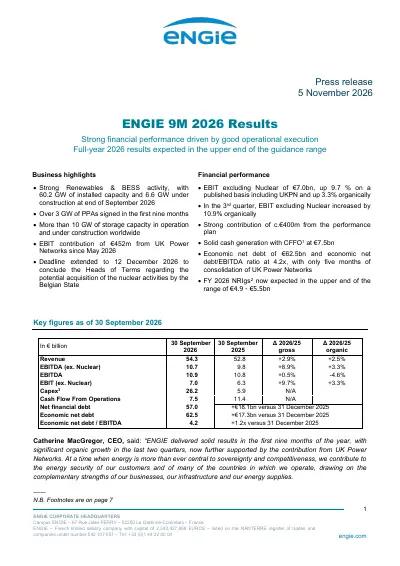
Turning to the next slide, some headline numbers at the 9 months stage. EBIT, excluding nuclear, reached €7 billion, up 9.7% year-on-year, underpinned, of course, by the inclusion from May of UK Power Networks, and growing by 3.3% organically.
In fact, when you just zoom on the third quarter, EBIT, excluding nuke, increased by 10.9% organically. Economic net debt amounted to €62.5 billion, and we achieved another substantial contribution from performance improvements at €406 million at 9 months, over €100 million in the third quarter alone.
This was half from operational excellence with initiatives such as asset efficiency, contract portfolio cleaning, cost optimization; quarter from culture and competitiveness actions such as improving span and layers of control; and the remaining quarter from loss-making entities with disposals and turnaround measures. Let's now turn to our first growth pillar, Renewables and Flex Power, where we achieved a significant milestone in this quarter as we passed 60—6-0—gigawatt of operating capacity in BESS, solar, and wind.
We commissioned 3 gigawatt of new capacity over the first 9 months, with 6.6 gigawatt under construction at the end of September. As usual, we have been active worldwide on markets that we know well, and in the second half of 2026 so far, we have announced our largest BESS at 500 megawatt in Saudi, and we've brought on stream 450 megawatt of solar in India and 250 megawatt in Australia.
Commercially, we maintain a high level of PPA signings, with 3.2 gigawatt at the 9 months stage of 2026, similar level to 2025. Most recently, we signed a renewable energy supply agreement to provide up to 568 megawatt of wind power for Oracle's expanding AI and cloud data centers in Texas, and there is plenty more in the pipeline for further substantial data center expansion.
Our B2B supply business is building up strong momentum in bespoke 24/7 supply contracts to customers such as Legrand in France and Aquabir Marinas in the US, and we are far ahead of schedule to meet our 2030 objectives on volume supply to the tech and data center sector. In the third quarter, we achieved a milestone in storage capacity, reaching more than 10 gigawatt in operation or under construction.
Out of this, 7 gigawatt is in BESS, an activity that didn't even exist at ENGIE 5 years ago, quite an achievement, and demonstrating, indeed, the urgent need for flexibility in power production. We made big strides in Europe over the third quarter, entering the Polish market through the acquisition of a 758 megawatt portfolio, acquiring projects in Romania and Spain, starting constructions of facilities in Belgium and Portugal, and commencing operations at Maxima in the Netherlands, and our first two batteries in the UK.
On our second growth pillar, Networks, where the acquisition of UKPN has added a major new dimension, we are delighted at the smooth and rapid process of integration. We have been particularly impressed by UK Power Networks' strong, data-driven culture, its operational focus, and the close connection between management and field operations.
Over the first 3 years of the ED2 price control period, in other words, between April '23 and March '26, UK Power Networks achieved a return on regulatory equity of 11.2%, maintaining its outstanding operational track record. UK Power Networks is now finalizing its ED3 business plan for Ofgem, and while the political and regulatory debate has become more focused on affordability, we do not see any credible pathway to deliver the UK electrification, economic growth, and security of supply objectives without materially higher distribution network investment.
We are confident that a significant step-up in ED3 investments will be needed. Very relevant for our gas network is the development of biomethane in Europe, and particularly in France.
In October, we signed a framework agreement with CMA CGM to develop a biomethane production unit in the industrial port area of Le Havre that will supply 100 gigawatt hours of biomethane annually for their fleet from 2029 onwards, subject to FID. With that, I will pass over to Pierre-François.
Pierre-François Riolacci
Thank you very much, Catherine. Good morning, everyone, and thank you for joining us in a busy day with another two releases.
EBIT, excluding nuke, reached €7 billion, up 10%, including 5 months of contribution from UK Power Networks. We are delivering a second quarter in a row with double-digit organic growth, despite absorbing €54 million of support to vulnerable households in France in Q3.
Our 2026 earnings offer a very solid base from which we are growing as promised. Cash generation remained robust, with CFFO at €7.5 billion, despite the material, but temporary, working cap headwind from higher energy prices and margin calls.
That our working cap tend to increase when energy prices go up; I will come back to it. CapEx reached €26 billion, including the acquisition of UK Power Networks.
This transaction, together with the working cap variation, explains the increase in net debt and leverage. Based on year-to-date delivery and current visibility, we now expect '26 to land at the upper end of our guidance range.
Let's turn now to the evolution of EBIT excluding nuke. Forex was broadly neutral, and scope, excluding UK Power Networks, had a limited negative impact.
UK Power Networks contributed €452 million over 5 months. On an organic basis, EBIT, excluding nuke, increased by €205 million.
Price and volatility effects were negative overall, mainly due to the roll-off of high-price hedges put in place after the Ukraine crisis in European gas generation. We also saw continued price normalization in B2B.
Supportive prices on unhedged generation volumes partly offset these headwinds. Volumes were down due to warmer weather, lower hydro generation in France, and lower gas consumption in regulated networks.
Against this, commissioning and investment contributed strongly through new renewables and battery capacity, and the continued expansion of power networks and regulated assets. Performance added €406 million, confirming that operational excellence translates into earnings.
Modest negative others reflect variation of one-offs from one period to the other. Nuclear EBIT declined to €113 million, reflecting the Belgian nuclear phase-out that is now completed.
Looking now at the three reporting segments. Renewable and Flex Power EBIT reached €2.6 billion.
Renewable and BESS grew organically by 5.5%, supported by new capacity and operational performance, and partly offset by lower hydro volumes and lower capture prices in Europe. Gas generation normalized, as expected, reflecting lower capture spreads in Europe, partly offset by good prices in Latin America and commissioning of Flémalle in Belgium.
The conjunction of geopolitics-driven volatility and record extreme weather require constant adaptation of the optimization of the assets to mitigate risk and extract value from the fleet. Infrastructures delivered strong growth, with EBIT reaching €3 billion, including €452 million from UK Power Networks.
Gas networks benefited from performance and tariff increase, despite warmer weather and lower volumes in France. Power networks grew organically in Latin America, while LEI, Local Energy Infrastructures, delivered close to 20% organic growth, driven by performance and development in district networks and EV charging.
Supply and Energy Management EBIT reached €1.8 billion. B2C increased strongly, supported by active portfolio management and the non-repeat of negative timing effects, partly offset by milder weather and €54 million of support to vulnerable households in France.
B2B declined, as expected, with high-margin legacy contracts phased out, compounded by positive one-offs in 2025. Commercial performance is on track.
Energy Management performed strongly in gas, supported by market conditions and contracts renegotiation, closing H1, while power remained more challenging. Turning now to cash generation.
CFFO amounted to €7.5 billion in the first 9 months, compared with €11.4 billion last year. The year-on-year decrease is explained by a €3.6 billion adverse movement in working cap requirement.
Three items matter. Gas inventories had a €1.1 billion negative impact from higher prices and injections.
Operational working cap reduced CFFO by another €1.1 billion year-on-year due to higher customer receivables. Finally, margin calls had a €1.5 billion adverse effect, reflecting reduced use of letters of credit and higher collateral requirements in volatile energy markets.
These are temporary working cap effect, not a deterioration in underlying performance. The group continued to generate solid operating cash flow.
Maybe, by the way, you have noticed that the operating cash flow is stable despite the phase-out of nuclear. It is a fact that more cash has been tied up in the energy cycle.
This is something we have seen, you remember, in '22 and '23, with a reversal in '24 and '25. We hence expect at year-end, subject to market condition, of course, some moderate increase in the working cap requirement.
Let us now move to net debt and credit metrics. Economic net debt rose from €45 billion to €62 billion, mainly reflecting the €13 billion net impact of the UK Power Networks acquisition, net of capital increase and hybrids, and the €3.6 billion working cap increase I just mentioned.
Adjusting for the temporary working cap headwind, it's good to note that CFFO covered both the dividend paid to shareholders and CapEx, excluding, of course, the strategic acquisition of UK Power Networks. Economic net debt to EBITDA stood at 4.2 times, including the full UK Power Networks debt impact, but with only 5 months of EBITDA.
We expect the ratio to improve at year-end, despite increased pressure on working cap due to high energy prices, targeting around 4. Now, a word on Belgian nuclear provisions.
Catherine walked you through where we stand with the Belgian government and mentioned a significant gap in respective views on valuation, particularly regarding nuclear obligations. Before I wrap up with the guidance, we thought it could be useful to share with you what we plan to do at year-end with regard to nuclear provisions, notwithstanding any transaction.
Until the end of '25, the views of the CPN and ENGIE were compatible, and our provisions were therefore based on the CPN estimate. As these views have since diverged, group provisions will be based on our own best estimate in full compliance with IFRS.
The chart on the right shows what this would mean for the provision. Starting from €8.6 billion at the end of 2025, we currently expect it to remain broadly stable by year-end 2026.
There are three main effects at play. One, we are taking a conservative view on cost, using the ONDRAF assumptions for overnight cost.
Two, we adjust 22 contingencies given changes in scope and factoring the impact of higher cost, which, mechanically, increase the contingencies. Three, we are increasing the discount rate to reflect, partly, the rise in long-term interest rates observed in all capital markets over the last 4 years.
The discount rates used in '22, respectively 2.5% for back-end spent fuel and 3% for dismantling, are clearly out of market range. Overall, while the underlying assumptions are moving, we currently expect the provision to remain broadly stable, with no significant impact on economic net debt.
Of course, Synatom, our wholly owned subsidiary managing provisions and related financial investments, will keep using CPN assumptions, and funding in the years to come will be fully compliant with Belgian law. Let me conclude now with our outlook for 2026.
Based on the performance achieved at the end of September and our current visibility, we now expect to land in the upper end of the guidance range. This confidence reflects investment contributions, continued performance plan delivery, and Q3 momentum.
We remain focused on delivering in a fast-changing environment, monitoring FX, financing cost, weather events, commodity prices, and, of course, the broader economy. In summary, ENGIE is delivering on its strategic priorities, investing in attractive regulated and contracted assets, executing operationally, generating solid cash, and maintaining financial discipline.
I now hand over to Catherine for the final words.
Catherine MacGregor
Yes, indeed. Thank you.
Very strong 9 months for ENGIE. The second point is about the strength and the breadth of our industrial model that is showing its relevance in this world of constant geopolitical, market, and weather uncertainty.
Third, we continue to have a strong focus on execution, continued effort on performance, commitment to maximizing the value from our existing asset base, and, of course, strict financial discipline in our new investment, all of this aimed at supporting our customers by supplying the affordable and reliable, sustainable energy whenever they need it. This is why I am very confident about what lies ahead.
Our strong performance over the first 9 months shows that we have all the building blocks in place to perform, to capture the [wave?] ahead and to deliver on our ambition to become the best energy transition utility.
Thank you very much. Delphine.
Delphine Deshayes
Thank you, Catherine. Operator, can you please open the lines to Q&A?
To all, please make sure to limit your question to no more than two. Thank you.
Operator
Thank you, madam. This is the conference operator.
We will now begin the question and answer session. Anyone who wishes to ask a question may press star and one on their touchtone telephone.
To remove your question, please press star two. The first question comes from Harry Wyburd of BNP Paribas.
Harry Wyburd
Hi, good morning, everyone. Hi Catherine, hi Pierre-François.
Two for me, please. Firstly, inevitably, on the Belgian deal, can you give us any kind of flavor on the range of negotiation on the liability?
Or you guided us on where your assumptions going to land by the end of the year. Where is the Belgian or Synatom assumption going to land by the end of the year?
Have you got any color on that, which can just give us an idea of the range of negotiation that we're thinking of? Then just a sub-point on that, you've given us kindly the liability guidance end of the year.
There's an associated sort of dedicated asset fund, as I understand it. Would that also be broadly flat, or would you expect the value of that to have gone up or moved a little bit?
That's question one. Second one, totally different, on the thematic of rates in France.
As I understand it, when your networks review for gas comes around in a year or two, you should be getting an increase in allowed returns because the returns are partly iBoxx-driven, partly OAT-yield-driven. Are you able to give us any kind of flavor as to what kind of movement you'd expect?
There's also a consultation suggesting they might move to full nominal, which presumably would also give you a revenue uplift. Would you expect any delta on volumes as well?
I know there's a lot in that, but basically as a whole, trying to understand whether we should be upgrading our French gas networks estimates a couple of years out because of what's going on in France. Thank you.
Catherine MacGregor
All right. Maybe, Harry, I'll start with the nuke story because I think it's important to comment a little bit.
As we had said, at the end of July, we have entered into these discussions that are dense, they are rich, they cover all of the aspects of the transaction. As it's really a complex transaction, especially when it comes to valuation: valuation of the liabilities, but also, of course, the asset side.
Indeed, we have progressed through the discussions, very constructive engagement. We have also uncovered significant divergencies of positions related to the valuations.
I would comment specifically, when it comes to the liabilities, a divergence about estimating the whole risk profile of dismantling activities. These activities of dismantling, and we had many opportunities to discuss that, as an industrial player, we have experience in.
This has a industrial nature. It's very different, obviously, from the long-term waste management.
It's really an industrial project. By the way, we conduct dismantling activities in many parts of the world.
We are doing that when we dismantle coal. We even have, as you guys know, a mining dismantling, decommissioning project in Australia.
We know how to do dismantling. It's manageable in time.
While I think it's fair to say that a government that would take on these activities might not be looking at this risk the same way as us. That's, I think, fair to say.
Given the current circumstances in Belgium, as well, of course, as the strategic nature of the deal for the government, this is why we have decided to give it a bit more time to see whether these divergence can be reconciled with the principles, of course, of financial neutrality, which remains core to the whole transaction. Let's see how that goes and what we'll see on the December the 12th.
Maybe you want to say a few comments on the provision. Maybe, sorry, before passing on to Pierre-François, of course, the situation is that if we are able to land a deal, eventually there will be no more provisions.
I think it's also important to give you clarity, and this was the purpose of the slide that we put there and the comments on the provisions. We also want to give and share with you the view of what it would look like for us should a deal not be reached.
Pierre-François Riolacci
I'm not going to dwell too much more on the provision. I think that since in our own books, we use the ONDRAF assumptions for overnight cost, that's the plan.
I think the key criteria will be around the contingencies that you put on top of the estimate of cost, and that the second point is about the discount rate. I make a link with your second question, which I think is somewhat linked to it, which is the performance of the dedicated assets in Synatom.
I'm not going to give you any number for year-end, but what I can tell you is that at the end of September, the performance was 5.4%, which reflects, of course, the trend in the market. I think it's a very good point.
Then maybe on the gas revision, well, we don't like to comment too early on this kind of things, which are super sensitive. That we will file our first tariff proposal, I think at the end of Q1 next year, still a bit of time.
Yes, the interest rates have gone up, and you could expect that there would be an impact that would come, everything being equal. Of course, in the revision, there will be many things that we need to discuss, including, potentially, some significant decrease of risks.
We need to take in account volume trends. We need to think the risk of stranded assets.
This could trigger a broader discussion with the regulator, and of course, we get the benefit of the increase in rates. Now, you also refer to volumes.
Historically, what we have seen is that the volumes which are used for the assumption on tariffs are usually rather ambitious. That's something we discuss, sometimes we don't use the same assumption for our own forecast, to be discussed.
I guess that behind this question of volumes, you had also the question about the CRCP, which is the volumes which are actually recovered from the previous period. I'm sure everybody remember that in the current revision, we are recovering volumes which were short in the previous period.
It's likely that in the next period, given what we see today, we will have also to recover on various operators some of the volumes. That should not expect a big cliff effect on that one.
We discussed that a year ago and 18 months ago, and this is more or less confirmed. Of course, depending on winter volumes, which are the main driver of this potential clawback.
Harry Wyburd
Super clear. Thank you.
Just one rapid clarification on going back to the provisions. If the liability leg of €8.6 billion is roughly flat and you're saying you've had good progress on the dedicated assets, presumably the net liability, which I think was around €3 billion, is on track to shrink a little bit, if I got that right?
Pierre-François Riolacci
Yes, but the vision of the liability may differ from one party to the other. I think we feel very strong about the value of the liability as an industrial operator for plants that we've been managing for tens of years and with dismantling that we are familiar with.
We dismantle in many places in the world: in Australia, in the US, and in Chile. We are used to it.
Now, of course, for a government that would take over, they may come with a different opinion. You can imagine the nice discussions that we can have around that.
Harry Wyburd
Understood. Thank you very much.
Operator
The next question is from Ajay Patel of Goldman Sachs.
Ajay Patel
Good morning, and thank you for the presentation. A couple of questions, please.
Firstly, I think previously, at the last set of results, you indicated a guide of €1.7 billion on B2B and EM. I just wondered if you could give us an update on what that looks like at the 9-month?
Then I was wondering, just on the nuclear provisions again, what would be the difference if you had just continued with the existing practices of what you were doing in '25 into 2026, relative to what you're pointing to now? Just wanted to understand what a change it would have made.
Pierre-François Riolacci
Maybe to start with the provisions. We are compliant with IAS 37.
It means that we need to use our best estimate when we close the books. We did in '22, we did in '25, and what we did in '22 when we booked the provision, we used the same set of assumption that CPN.
We have kept that assumption, and that was the practice as a good proxy of our best estimate. What happened today is that we have different views.
When we have different views, of course, it means that we have to use our own best estimate, and that's the number that we are reflecting here. The other route was to take the CPN valuation, and probably at some point, CPN will issue its own notification, and that's what they have to do, but of course, it's suspended due to the transaction discussions, but that should come.
Then there will be a number pushed by CPN, and that number, we expect to see a different number based, again, mainly on the contingencies and the discount rate. I cannot talk on behalf of CPN.
What I can tell you is that we have to use our best estimate, and this is what it is. Sorry, the other question was about B2B EM, and we are, indeed, on track, and we keep to the target.
Ajay Patel
Thank you very much.
Operator
The next question is from Arthur Sitbon of Morgan Stanley.
Arthur Sitbon
Hello, thanks for taking my questions. The first one is on your 2026 recurring net income guidance.
I think the midpoint of the new indications is roughly €450 million above the midpoint of your initial guidance at the start of the year. I was wondering if you could help us understand, out of these incremental profits of €450 million, what is the share of that that you would consider as recurring, sustainable, and what is more one-off in essence?
That's the first question. The second one is I noticed that the TTF Henry Hub spread is up very significantly compared to earlier in the year, even for the medium term, even when you look at forward prices for 2028, 2029.
I was wondering if that makes a difference to your kind of normalized former GEMS EBIT guidance of €1.5 billion if we think medium term. In the current conditions, does that make it more of a ceiling than the actual level we should expect towards the end of the guidance time horizon?
Thank you very much.
Pierre-François Riolacci
Sorry. On the first one, I think the upgrade of the guidance, we commented that in H1, and now being at the upper part, it's always a bit the same story.
Of course, when we upgraded in H1, you remember that there was also taking in account the early close of UK Power Networks, but this is not, of course, not going to go away, it's the base of it. It's clearly we have good level of performance, which is another point that we mentioned, which is there.
At the end of the day, the growth of the net income is driven by good level of performance, good contribution of our CODs. In one word, it means that it is recurring.
You should not see that as one-off or especially boosted. I think that we are pleased with the quality of earnings that we will deliver in 2026.
Now you are mentioning, yeah, but we have also, of course, some spread in TTF, Henry Hub. That we are very careful, and we don't speculate on Henry Hub.
When we are sourcing in the US, we have hedging policy to make sure that we protect ourselves of that kind of spread in quite a few years, not for the full duration of the contract, but for quite a few years. We are, of course, not sensitive to that in the target years to come.
We are not directional. We never do that.
We are not going to play games whereby we would be buying Henry Hub and selling TTF, that kind of thing. We don't do that.
We are always hedging at inception, so that's super important. You should not see a drive in there and us locking that kind of profit, which would be super volatile and, of course, super risky.
Arthur Sitbon
Okay. Thank you.
Operator
The next question comes from James Brand of Deutsche Bank.
James Brand
Hi, thank you for taking my questions. The first is a little bit political, obviously, and a sensitive topic.
Just there has been press reports related to the Belgian discussions that the Belgian government might be threatening to nationalize the assets. I was just wondering whether you had any comment on that.
It seems like that may be inconsistent with EU energy rules and therefore might not be able to be achieved. It was interesting any comments on that.
Then secondly, just a follow-up on the earlier comment around the French regulatory review. I appreciate you said that that is also sensitive and obviously very early stages.
I think the approach that was used last regulatory review was a mix of weighting on kind of current forward-looking bond yield expectations and trailing expectations, and with quite a high weight on the trailing that might not fully take into account quite how much the cost of capital has gone up in recent years. I was just wondering whether you thought there might be an opportunity to kind of revise the framework and maybe get a fuller reflection of the rise that we've seen in rates.
Thank you very much.
Catherine MacGregor
On the methodology, to be honest, it's really too early to comment. There is, as a lot of things that come in play on this whole regulatory parameters.
It's too early to comment on exactly how we will engage on calculating the WACC and the formula. I think we will for sure take into account what's happening in the rate environment today, but to get into the formula details, a bit too early, James.
On the noise, remember, we always said, and we told you, please, be careful about the media noise because there is always media and press noise to very nicely accompany some of the discussions that can happen. On the nationalization noise that you are referring to, it's really press rumors.
We are very confident that the Belgian government is very seriously negotiating with us in good faith. Nationalization is definitely not on the agenda.
By the way, nationalization of nuclear operations would be really something, but that's a side comment. No, just noise, rumors, and not on the agenda.
Operator
The next question is from Bartek Kubicki of Bernstein.
Bartek Kubicki
Thank you very much. Good morning.
Two things from me as well, please. Firstly, I would like to ask you about the US and the latest political change and how do you see this, whether there will be more opportunities to grow or less opportunities to grow for the time being.
Second of all, if we look at your growing batteries exposure, you are also expanding the coverage in terms of the markets. You are moving into different markets.
If you can just maybe give us a little bit of color how the attractiveness of particular markets you are exposed to look like in comparison to other. What are the most attractive countries?
What are the least attractive countries you are exposed to? I'm hearing from some of the industrial players you can even get 20, 30% IRRs in some countries.
Whether you think this is the actual number? Then, lastly, of course, how long do you think this El Dorado in terms of batteries will last, because I suspect there's a lot of batteries coming on the market, so, consequently, the potential arbitrage opportunities you may be utilizing right now will be shrinking in the future.
Thank you very much.
Catherine MacGregor
Okay. Maybe on the US, it's obviously a bit early, but what I think is fair to say is that there was quite a lot of pausing in momentum pre-elections.
I can think of, in certain states, there were pauses made on, for example, permitting data centers. There was a little bit of a slow down in momentum pre-election.
Elections are always a bit of a catalyst where things can resume. I think what's happening on the data center side, and potentially push back and slow down, we'll have to see what the newly elected want to do about that.
I would think, hopefully, we will see eventually in the US a more all-of-the-above energy policy. In other words, some technologies not being isolated or, as we have seen in some circumstances.
Hopefully, we can see permitting resuming, but again, we'll have to see. It's a bit early to say.
That's what I would say on the US. On the batteries, we see batteries, frankly, thriving in many markets where renewables are being developed, which is many markets, actually.
India, for example, doesn't do solar anymore; they do solar and batteries. Obviously, anytime you have only renewables gigawatt as an objective, you will fall into trouble at some point because you're going to have too many negative hours.
We see many markets now catching on flexibility, and within that flexibility realm, you see batteries. We're going to see that even in Brazil, which was not so much a battery market before.
We starting to see that. We've seen that in Chile.
Anywhere you have also obviously grid congestion, a lot of renewables penetration, you see batteries thriving. That's some of the commentary I can say about batteries.
20, 30 20, 30% return, we see double-digit return for sure. I'm not sure that we can say 20, 30, but we see, indeed, because part of the BESS are exposed to merchant exposure, obviously you will expect to have double-digit returns.
Again, as long as renewable penetration continues, in Europe, we still have a long way to go, we expect batteries to be able to capture value. Remember, the payback of batteries is typically quite short.
While in some cases when batteries get developed very quickly, you can see a little bit of a collapse of the intraday spreads, but because you add more renewables, then batteries become important again. Speed to market is really important, by the way, which is why we like our positioning.
We have been quite fast in moving in batteries, and that's important because cannibalization can happen, but only if you come a bit too late. Maybe the last point I'd say on batteries is what we have seen in the United States is that battery costs have increased quite a bit, and that will probably put pressure on battery development.
If battery development gets a bit slow down in the US, you'll see it again in the spread, and that should be actually positive for existing asset, for sure, and potentially help and facilitate new developments.
Bartek Kubicki
Thank you very much. Very clear.
Thank you.
Operator
The next question is from Juan Rodriguez of Kepler Cheuvreux.
Juan Rodriguez
Thank you for taking questions. I have two on my side, if I may.
The first one is again on Belgium discussions and provisions. First is, okay, what is the red light for you?
You signaled that you expect a neutrality on the deal, but what could be the level that you can stay into this, like a very low single-digit billion level for additional provisions? What will be your plan B on your side if a no deal is reached by the 12th?
Why the 12th? Can we expect a further update if no deal is reached on that date or there's a specific timeline that needs to be reached by that date?
That's the first one. The second one is on the asset management and the expectations of power improving.
We see that power has been relatively calm until Q3, and then we see that future prices has started to tick up. Can we expect a positive gas success as well to be extended until 2027, '28 on new contracts, or this is mainly going to be a 2026 effect on the gas side?
Thank you.
Catherine MacGregor
Look, on nuclear, again, what we've said is that, indeed, we want to do a deal that allows us or gives us financial neutrality. That needs to be looked at as a package: asset and liability.
Of course, given the sensitivity of the discussion, I'm not going to go into more details. What's, I think, is important, what we try to do today is to give you the realm of possibility.
Either we have a deal, and it will be a good deal for ENGIE in the sense that it will, one, allow us to meet the strategic goal for the government; two, have a financially neutral deal; and third, it will, in a way, deal with kind of from future nuclear exposure. By exposure, I mean some of these discussions that we're having, are we prolonging or not, etc.
That's what is today at the table. If we don't have a deal, it's okay as well.
We had, as a framework which is called FéNIX, very famous, FéNIX deal. We will go back to some sort of FéNIX deal with the two.
By the way, we didn't comment, but our plants have restarted after the LTO on time, one mid-October, one November the 1st. The FéNIX deal is working.
Very importantly, the purpose of that slide was to say we also have a view, very clear view, of the provisions that we will have on the balance sheet of the group. That's the two, if you like, possible situations that we will land in, and when you look at them, both, actually, are really, really good for ENGIE.
Now it's how do we give more clarity on whether we'll be on the left or on the right. Indeed, let's see on 12th of December.
That's the date that we have given ourselves with the government to get to that clarity, because we have indeed this divergence in valuation that we need to bridge, and if not, we will fall into the other side. Let's see on 12th of December.
Pierre-François Riolacci
On prices, maybe yes, on power, of course, there will be an impact because even if we have decreased our merchant exposure in power, we still have some. We have some residual merchant position in wind and solar.
We have, more importantly, some hydro, as and we have the French drawing rights in nuke. These are our dry power position, and we have a rolling 3 years hedging policy, so that means that, indeed, some of the benefit of the higher prices, to the extent that they are reflected into the forward curves, would reflect in '27 and to a lesser extent in '28 based on the curve.
That should come through. When it comes to gas, it's a bit of a different story because we, as we are not a gas producer.
We are hedging at inception, there is not such an exposure. However, when gas prices are higher, indeed, there are deals that you can enter into.
Some of these deals can go a bit further indeed than the quarter, and that could bring a bit of value, but that's not to the same extent. What we could expect if gas prices start to decrease is that we would have a better environment for clean spark spreads, which today are a bit squeezed, as of course the power prices are going up, but they're pushed by the gas prices.
We can expect that if gas prices come down, there might be a bit more room for locking in better spreads for our CCGTs. That's what I can say when I look forward.
Juan Rodriguez
Quite useful. Thank you.
Operator
The next question is from Piotr Dzięciołowski of Citi.
Piotr Dzięciołowski
Hi. Good morning, everybody.
I have two questions, please. I think we understand the liabilities part of Belgium discussions, but can you tell us what is your view on the asset value there and a meaningful value remaining in the connection points of the five reactors that were closed and how you think about it?
Is there a divergent view on this side as well, or how should we think about this as I understand both sides are discussed. The second question, I wanted to ask you about the impact of the increase in rates on your future projected financial results.
How does this impact '28 guidance or by the end of a decade how much of the extra financing costs you will have? Thank you very much.
Pierre-François Riolacci
Thank you. I'm not going to comment on the details of the transaction again, but you're right, there is a liability side and there is an asset side.
Of course, it's, here, in that case, a kind of an M&A transaction, you need to agree on both. As you can imagine, we don't necessarily agree at the first discussions.
Yes, there is also a topics that we need to dig in in valuation of assets. When it come to the long-term rates, I think Catherine shared a few elements about the structure of our debt, and you can see that we are fixed to a large extent.
We do have also a cash position, which is offering a natural hedge on the short-term part of the curve, and that we have seen at work, you remember, when the long-term rates started to go up a couple of years ago, and you've seen that we have been pretty resilient. Now, that's being said, we do have bonds which are maturing every year, ballpark, it's €3 billion, €4 billion of bonds which are maturing every year, and these bonds are carrying a historical rate which is lower because they were secured, for many of them, they were secured at a time rates were more lenient to borrowers.
You should see, on this €3 billion, €4 billion a year which are lapsing, you should see a gradual increase in the rates based on the market expectations that you can build by yourself. That's, I think, a good way to look at the potential exposure going forward.
The key point here is that it will take time, because we are fixed, because we have long-term maturity, and the average maturity of the debt is north of 9 years, of course, we have a lot of inertia in the way the rates will be reflected in our books.
Piotr Dzięciołowski
Thank you very much.
Operator
The next question is from Louis Boujard of ODDO BHF.
Louis Boujard
Yes. Hi, good morning, and thank you for the presentation.
I appreciate that most likely there is not much to add on the nuclear deal, I will go to other topics at this point in time. Maybe the first one would be regarding the net debt level, of course, with the rising power market price environment and the volatility into the system.
Could you, in the end, maybe provide us with some visibility regarding how you see the economic net debt landing by the end of the year, considering also the uncertainties that we should still take into consideration on the working cap level that might be partly, at least, reversed in 2027 and maybe 2028 as well? The second question, maybe a bit more onto the business line and a specific aspect on the B2B, I think that we've seen that the EBIT declined 30% organically at the 9 months, but the third quarter is a kind of improvement.
I would like to know if when you sign your 24/7 renewable supply contract into this division with large customers, is it only to retain these customers, or is it also something that could potentially enable you to improve the margins going forward into this B2B division? Thank you very much.
Catherine MacGregor
No, think of the 24/7 contract as a quite differentiated product that we provide for customers. Behind the 24/7 concept, there is different flavor.
You have the ones that are super demanding, that are 90%-plus hourly matching, and you have the ones that are a bit more let's say democratic, more affordable, more reachable, which can be at 60, 70% hourly matching. Those ones obviously the big ones, the 90%-plus, are premium, but the 24/7 now is becoming a bit of a medium-tier product.
We are able to do more of those. It's less selective.
It's for more medium-sized customers, or customers that want to greenify, want to decarbonize, want to have better predictability on their power price, but can't afford the 90%-plus hourly matching. The beauty of this product is that it is both higher margin, and we can do much more of that, because the customer base is larger.
That's really what we like. It's a bit of a sweet spot between customer base and as well as, indeed, better margins that your normal supply contract, and it really meets a customer's demand.
We see good traction this year for the first time, actually, with this product.
Pierre-François Riolacci
Thank you. Good question.
Thank you for the working cap. All right, there are three components you've seen on the variation.
Gas storage, well, you should expect this actually to slow down in Q4, because at the end of September, we had the peak period in terms of gas storage, where at the end of December, we have been starting to use it, you should see less of an impact at year-end. When it comes to receivables net of payables, that depends, of course, on the level of prices that we have at the very end, but of course, a lot of this is already hedged, we know that is a real trend in the business, and clearly that's where we expect to see a bit more of working cap in the business.
Margin calls, we have tools. We have the toolbox, and of course, at year-end, we'll use the toolbox to minimize the impact of margin calls.
This is something that we have been developing in '22, '23, pretty used to that. We can do that.
You should expect a lower impact on that side. Then, indeed, the reversal will come when prices stabilize or even start to decrease.
That could mean that if the prices were to stay high, clearly that would mean locking in this money for longer. If the prices are high, it's not necessarily bad for the operating cash flow.
You remember, there is a direct link, and again, we would, of course, cover that in '27 with a strong operating cash flow. All in all, we, again, based on the experience of '22, '23, we are pretty relaxed that there might be a bit more working cap due to high prices.
For the rest, we are in control of the mechanics.
Delphine Deshayes
This is the end of the Q&A session. Thank you for joining the call today, and of course, if you have any follow-up questions, do not hesitate to call the IR team.
Thank you.
Operator
Ladies and gentlemen, this concludes today's conference call. ENGIE thanks you for your participation.
You may now disconnect your devices.