Enovis Corporation
Q3 FY2026 · Earnings Call TranscriptNovember 5, 2026
Operator
Good morning, and welcome to the Enovis third-quarter 2026 earnings conference call. All participants will be in listen-only mode.
Should you need assistance, please signal a conference specialist by pressing the star key followed by zero. After today's presentation, there will be an opportunity to ask questions.
To ask a question, you may press star then one on your telephone keypad. To withdraw your question, please press star then two.
Please note this event is being recorded. I would now like to turn the conference over to Kyle Rose, VP of Investor Relations.
Please go ahead.
Kyle Rose
Good morning, everyone, and thank you for joining us today for our third-quarter 2026 earnings conference call. I'm Kyle Rose, Vice President of Investor Relations.
Joining me on the call this morning are Damien McDonald, Chief Executive Officer, and Ben Berry, our Chief Financial Officer. Our earnings release was issued earlier this morning and is available in the Investor section of our website, enovis.com.
We also posted a slide presentation to accompany today's call on our website. Both the audio and the slide presentation of this call will be archived on our website later today.
During this call, we'll be making some forward-looking statements about our beliefs and estimates regarding future events and results, including statements related to our pending acquisition of e-Centric Robotics. These forward-looking statements are subject to risks and uncertainties, including those set forth in the Safe Harbor language in today's earnings release and in our filings with the SEC.
Actual results might differ materially from any forward-looking statements that we make today. The forward-looking statements speak only as of today, and we do not assume any obligation or intend to update them except as required by law.
For further details regarding any non-GAAP financial measures referenced during this call, the accompanying reconciliation information can be found in our earnings press release and in the appendix of today's slide presentation. With that, let me turn it over to Damien.
Damien McDonald
Thanks, Kyle. Good morning, everyone, and thank you for joining us today.
I'll start with an overview of our third-quarter results across Recon and P&R and give a short update on e-Centric Robotics. Ben will then walk through the financials and our outlook for the fourth quarter and the full year before we open the call for questions.
In the third quarter, we delivered organic growth of 5% with 6% organic growth in Recon and 3% in P&R. In US Recon, we grew 5% organically, with extremities up 5% and hips and knees up 3%.
In extremities, we're now past the anniversary of the AR-G launch, and AR-G continues to be a strong growth opportunity for the future. As planned, ARVIS is expanding in shoulder, and we build upon the launch that began in Q2.
Shoulder remains a healthy market, and it's where we have one of our leading share positions globally. In hips and knees, Nebula continues to drive growth, with over 80% of new instrumentation sets going to competitive users in the quarter.
While we've now annualized the launch of the Nebula in the US, we remain in the early stages of a multi-year product cycle. I'm proud to note that it is now our top-selling stem, and we've got a long runway ahead of us.
We're competing and winning in both hospital and ASC settings, and the ASC continues to be a good fit for our portfolio. Internationally, Recon grew 8% organically.
As we've noted the past several quarters, market dynamics in Western Europe remain challenging, and the conflict in the Middle East continues to weigh on growth. Despite these challenges, shoulder grew double digits and led the international business.
We continue to win competitive accounts outside the US, and I'm excited to announce we completed the first ARVIS shoulder cases in Europe last month. On e-Centric Robotics, we announced our binding offer to acquire the company on September 1st.
Since then, we have completed the works council consultation, and we expect the deal to close by the end of the year. Integration planning is well underway.
Our Recon team is working with the e-Centric team in Grenoble on the knee and shoulder programs, and the timelines we laid out are unchanged. In fact, through our integration planning, we are making investments to secure the talent and technology required to accelerate our development upon deal close.
We expect to bring the knee robot to market within two years and shoulder to follow soon thereafter. Since the announcement, I've spent a lot of time discussing robots with surgeons.
What I hear most is how much opportunity there is to develop innovative enabling technology and implant systems which solve known problems and anticipate the evolution of surgical workflows and patient outcomes. This is an exciting inflection point for our Recon business, and we believe it will be a meaningful contributor to our sustained above-market growth.
Now moving to P&R, which grew 3% organically, including 5% organic growth in the US. Global bracing grew 3%, driven by business mix and new products in spine, corn knees, and lower extremity bracing segments.
Recovery Sciences was driven by double-digit growth in regen as we accelerate the launch of ManuFuse and capitalize on key competitive conversions. Now I'll turn it over to Ben, who will walk through the financial details.
Ben Berry
Thanks, Damien. Hello, everyone.
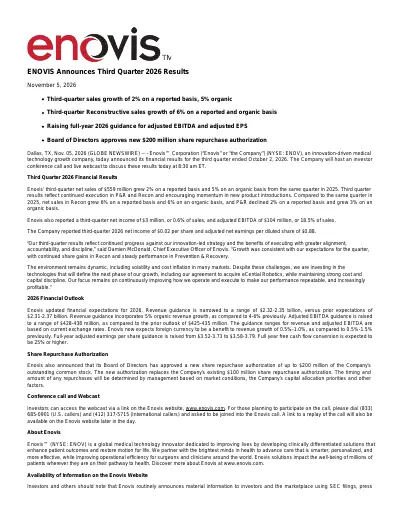
We reported third-quarter sales of $559 million, up 2% versus prior year on a reported basis and up 5% on an organic basis. Reported growth included a 30 basis point headwind from foreign currency and a 250 basis point headwind related to the divestiture of Dr.
Comfort. As a reminder, Q3 is the last quarter in which the Dr.
Comfort divestiture affects our year-over-year comparison. Recon grew 6% organically, with extremities up 8% and up 5% in hip and knee.
P&R grew 3% organically. Ongoing conflict in the Middle East was a 100 basis point headwind to international growth, which represents about 40 basis points to total Enovis growth in the quarter.
We delivered adjusted gross margins of 60.9%, up 60 basis points, driven by mix and operational productivity. This includes $8 million of tariff refunds offset by roughly $3 million of inflationary pressure from higher raw material and freight and distribution costs tied to the Middle East conflict.
Our teams continue to work on mitigation actions to soften the overall impact of inflation in this dynamic market. Adjusted EBITDA margin was 18.5%, up 120 basis points year-over-year.
Our third-quarter effective tax rate was 23%. Interest expense was $8 million for the quarter versus $9 million in the prior year.
Overall, we posted adjusted earnings per share of 88 cents, up 17% versus prior year. Free cash flow in the quarter was $35 million, bringing year-to-date free cash flow to $37 million, up $50 million versus the prior year.
We remain confident in our 2026 target of greater than 25% free cash flow conversion. I'm encouraged by the strong demonstrated progress we have made on cash generation, which now gives us more flexibility as we think about capital allocation in the future.
We exited the quarter with net leverage of 2.9 times, which is below the goal we set for the year. When the e-Centric transaction closes, leverage will step up about a half turn.
While we remain committed to improving our balance sheet and paying down debt, we're also focused on continuing to make capital allocation decisions that we believe will drive long-term growth and shareholder value. To this end, today we announced that our board has authorized a new 200 million share [repurchase?]
program. We do not plan to materially waver from our leverage commitments.
However, we plan to use this opportunistically and stay within a range of 2.5 to 3.5 times leverage. We see real value in our long-term growth strategy, and share repurchases are another tool we can utilize to create shareholder value.
Turning to full-year guidance, we are narrowing our revenue range to $2.32 to $2.35 billion. We expect organic growth to be approximately 5%, and we are increasing our adjusted EBITDA range to $428 to $438 million.
We are also raising our adjusted earnings per share range to $3.58 to $3.79. As we outlined last quarter, in Q4 we expect modest acceleration in both segments driven by ARVIS in shoulder, continued Nebula conversions, and new products in P&R.
Our outlook assumes the procedural environment we saw in the third quarter holds through year-end with typical Q4 seasonality. On the profit side, our updated guidance assumes an incremental $4 million investment in enabling technology R&D talent and a $1 million negative impact from currency.
We continue to expect free cash flow conversion of greater than 25% in 2026. To summarize, the third quarter was in line with expectations we set in August in a market that remains dynamic.
Cash generation continues to improve, and we are carrying new product momentum in both segments into the fourth quarter. Now I'd like to turn it over to Kyle to start the Q&A.
Kyle?
Kyle Rose
Thanks, Ben. In an effort to accommodate everyone in the Q&A session and keep things to a reasonable time, we ask that analysts limit questions to one question and one follow-up.
You are welcome to rejoin the queue, and we will fit you in if we still have time. With that, we would now like to open up the call to take your questions.
Operator?
Operator
We will now begin the question and answer session. To ask a question, you may press star then one on your telephone keypad.
If you are using a speakerphone, please pick up your handset before pressing the keys. To withdraw your question, please press star then two.
At this time, we will pause momentarily to assemble our roster. Our first question comes from Ryan Zimmerman of US Bancorp, BTIG.
Go ahead, please.
Izzy McMahon
Hey, good morning, everyone. This is Izzy on for Ryan.
Thanks for taking our questions. I just wanted to start on the US Recon business, specifically with knees and hips.
It was a little bit softer than what we saw your growth for both extremities and the international business be, and we've heard some comments from your peers about softness in the large joints market. I was curious what your take is on the outlook of the market and what will help get your knee and hip growth back in line or better through that.
Damien McDonald
Yes, good morning, Izzy. Thanks for the question.
Look, we've been saying since Q1 that the market is more volatile than we'd normally seen, both in the US and internationally. I know there's a lot of swirl about markets, even from those who have much larger perspectives than we do.
Look, we're focused on controlling the controllables. It's a dynamic market environment.
We think we're building a strong, resilient customer organization, our focus is really on gaining market share and candidly not being a victim to the market.
Izzy McMahon
Understood, that's helpful. Thank you.
I understand that it's still a little bit on the early side, but I was hoping you could maybe provide some color on your thoughts around 2027. Thanks for taking the questions.
Damien McDonald
With 2027, we're going to point everyone back to what we outlined in September when we did the e-Centric announcement. Our view hasn't changed since then, and we're going to comment fully in February when we do the Q4 full-year results.
Kyle Rose
Operator, next question, please.
Operator
Thank you. Our next question comes from Vijay Kumar of Evercore ISI.
Go ahead, please.
Vijay Kumar
Hi, guys. Thank you for taking my question.
I guess my first one, when you look at this Recon assumptions getting back to high singles in Q4, is the bridge between 3Q to Q4 just a comp from days headwinds? Could you also comment on what's happening in ASCs, what percentage of Recon procedures are being done in ASCs and what's the growth rate in the ASCs has been?
Ben Berry
Hey, Vijay. Thanks for the question.
I think as you recall, we get an extra selling day in Q4, so that's going to contribute about 150 basis points, a little bit more than that, to top-line growth. That, plus some of the dynamics that we talked about with just normal Q4 seasonality, will drive some of the acceleration there.
In terms of ASCs, we continue to see movement there in terms of our knee business. I think what we're seeing is a little over 25% of primary knees going through the ASC.
It's about 20% or a little bit more than that in hips, and we're climbing closer to that hip number in shoulder, still in the, I'd say, high teens in terms of percentage of our procedures going through the ASC. We see the ASC as a continued strategic channel for us and one that we will continue to be focused on in terms of setting our business up for success.
Vijay Kumar
That's helpful. Then maybe one on free cash.
Third quarter is pretty impressive, 68% free cash conversion. Is this a sustainable number for you guys, when you think about fiscal '27?
I know with the deal coming on, does it impact free cash conversion or is this a sustainable number?
Ben Berry
Thanks, Vijay. Again, we'll point you back to what we talked about in September where we see a step-up to at least 50% free cash flow conversion next year and $100 million of cash generation.
We still see line of sight to that. We'll try to do better than that, but overall, I'll point you back to that in terms of thinking about next year.
Vijay Kumar
Thanks, guys.
Operator
The next question comes from Jeff Johnson of Baird. Go ahead, please.
Jeff Johnson
Thanks. Good morning, guys.
Damien, maybe a follow-up on your comment about controlling the controllable. US hip and knee growth was 3% this quarter.
It does seem, as others have said, that the US market, especially for US hips and knees, may have slowed a bit this quarter. Just are you seeing anything, even if you can or can't control, I guess, surgical schedules, higher cancellation rates, extended willingness to pay copays, deductibles, things like that, patients slowing down, anything at all there?
Ben, I guess the corollary or follow-up on that is just that you talked about Nebula being one of the drivers of acceleration in 4Q. If US hip and knee was 3 this quarter, you pick up the extra day, that's 4.5, and then Nebula on top of that, should we see US hip and knee growth above the mid-single digits next quarter?
Thank you.
Damien McDonald
Hey, good morning, Jeff. Was there an option D there that was like all of the above?
I'd point you to that. I think all of the things you mentioned, we're seeing all of that.
It's pretty choppy, and we're, as I said, very focused on market share gain and using EGX to get after the targeting and segmenting, account acquisition, account penetration, being very disciplined on price, and again, making sure we have the best sales force, doing a lot on sales force training. The way we're countering all of those things that you mentioned is by focusing on our performance.
Ben Berry
In terms of hip and knee growth in the US, Jeff, we don't guide particularly on anatomy-level growth given some of the dynamics in the market that Damien talked about, but we see momentum building there. We still see a large opportunity in US hips and knees in terms of ability to take market share as we continue to reinforce the portfolio and build more strength there with enabling tech.
Overall, I think the way you're thinking about it makes sense, but, like I said, we don't guide for anatomy level.
Jeff Johnson
Fair enough. Then just one follow-up.
I think last quarter that low-single-digit US shoulder numbers, what caught a lot of us off guard. I think you explained it well with some of your ARVIS shoulder training during the period last quarter, so that all made sense.
Encouraging to see that shoulder number get back to high single digits in the US this quarter. Just what can you talk about the competitive environment?
You do have a couple of your competitors out there with new shoulder systems, maybe even some robotic applications in shoulders, even though early stage there. Just how to think about the shoulder competitive environment until you get the robotic option out in a couple years on shoulder?
Can you sustain above-market growth? How are you thinking about that in the US?
Thank you.
Ben Berry
I think it's definitely a competitive environment. We're pleased with our position in the market.
We believe we're continuing to take share. We're the global number three player in shoulder, number two internationally, knocking on the door of being number two globally.
We really are encouraged by the portfolio that we built in the shoulder in terms of the dynamics that we have in terms of products that can be used for different philosophies. That continues to build with new product innovations, things like AR-G that are complementing that overall portfolio, putting the Lima and legacy Enovis portfolios together just add strength, adds compatibility, gives more options.
What we're really seeing right now is really strong uptake and interest in the ARVIS platform. Given where shoulders are in terms of the enabling tech curve, which still needs a lot of development in terms of use cases there, we feel like ARVIS will continue to be a player here in terms of giving the surgeons enabling tech tools that really help aid them in a way that makes surgery more efficient in the shoulder.
We're encouraged by the portfolio, the momentum, ARVIS's contribution to that, and we would expect that to continue into the future.
Operator
Thank you. Our next question comes from Robbie Marcus of JPMorgan.
Go ahead, please.
Lily Lozada
Hi, everyone. Thanks for taking the question.
This is Lily on for Robbie. One on guidance, you beat EPS by about 11 cents, but guidance, by my math, is moving up by 5 at the midpoint.
Hoping you can unpack that a bit more. Why not flow through the full upside, and are there any incremental headwinds or expenses down the P&L we should be baking into the fourth quarter?
Ben Berry
Hi, Lily. Thanks for the question.
As I mentioned in our prepared remarks, we're investing in enabling tech resources, particularly in R&D, to really get ahead of bringing e-Centric into the family. We see lots of opportunities to really de-risk that program and to add some strength with regards to talent within the organization.
That's about $4 million that we're going to make investments in Q4 to support that acquisition. On top of that, currency's moved in a negative way since last quarter, so that's going to hit us for about a million in Q4.
Contemplating those two things is really the reason why we didn't flow everything through.
Lily Lozada
Great. Then just to follow up to that, you delivered pretty significant SG&A leverage this quarter, with expense actually down a bit year-over-year.
What drove that, and was there anything one-time or timing that drove the greater than expected leverage in the third quarter? Thanks.
Ben Berry
Nothing I would point to as one-time. Overall, I think it's just phasing of expenses through the year.
We generally invest a little bit heavier in the first part of the year. You have the softer Q3 with regards to international markets, and that generally reduces expenses in the quarter.
Overall, nothing unexpected there, and it's just really phasing.
Lily Lozada
Perfect. Thanks very much.
Operator
Our next question comes from Lawrence Biegelsen of Wells Fargo. Go ahead, please.
Ross Osborn
Hi. Good morning.
This is Ross Osborn for Larry. Thanks for taking our questions.
Starting off, we'd be curious to hear where Lima stands, how much integration spending carries into '27, and how much of this 50 bps underlying EBITDA margin expansion comes from Lima synergies versus improvement elsewhere in the business? Any integration expense in the quarter?
Ben Berry
Lima integration expense, oh. I think, like we've laid out, this is the third year of integration on the Lima where we're continuing to finish a lot of that journey with regards to the investments we needed to make to integrate that into the organization.
We're continuing to track to our stated plans there. This will be the last big, meaningful year of investments in integration on Lima, and it's going very well in terms of the way that we laid out the plan, in terms of executing against that plan.
A lot of what we're doing this year is cleaning up some things, moving some things from manufacturing to other locations. That's all continuing to track.
In terms of the synergy value, yes, it continues to contribute to our mix and gross margins. We see that as an opportunity to continue to drive improvement there, and that is one of the key drivers as we lay out how do we drive our 50 basis points of improvement every year.
It's a contributor, it's not the contributor, but overall, I'd say it's tracking to what our expectations were.
Damien McDonald
I think the other one that's stepping down a lot, too, is the EUMDR, right? Year-over-year, that's the other step-down.
Ross Osborn
Great. Then on capital deployment and with your leverage within your comfort range and a new $200 million authorization program, is repurchasing shares now a near-term priority or more so optionality?
What capacity remains after e-Centric, and how do you rank buyback against debt reduction and M&A?
Ben Berry
Thanks, Ross. We believe that the company's valuation is significantly below where our value lies.
You look at where the stock is traded off quite considerably over the last 12 months, and it's dislocated given our performance and our outlook for the future. What we wanted was flexibility to take advantage of this dislocation.
As we think about share buybacks, we're going to be very much opportunistic, disciplined, and focused on how we do that. It's really going to depend on if we feel like the shares are really dislocated from where they should be.
Right now, the value that we're trading, we would say that we do see that. We will use this as a capital allocation tool, but, like I said, we'll be disciplined about how we deploy it.
Ross Osborn
Thank you.
Operator
Our next question comes from Young Li of Jefferies. Go ahead, please.
Young Li
All right, great. Thanks for taking the question.
I guess to start just on e-Centric, the deal hasn't closed yet, but what has been the early feedback on that from your customer base as well as from your reps? Are there any features that e-Centric offers that the customers or reps are more excited about?
Damien McDonald
Good morning, Young. I have to say, we've had a great response from our customers, both on the knee side and the shoulder side.
In fact, Ben and I just last night were with a group of physicians that were very close to, and we had a long conversation about this. In both therapeutic areas, both anatomies, there's a lot of excitement about what we can bring to the table.
It's not just about the robot. We've always talked about enabling tech: planning, navigation, assistance.
We think the whole ability to bring an ecosystem to an offering for physicians is really key here and meeting the physician where they are. A lot of people work in large hospitals, and then they also work in small ASC clinics, and being able to give them an ecosystem that seamlessly moves between those venues we view as exciting, and so do they.
The reps are just excited to be able to compete. In terms of a contractual basis, a lot of accounts require the assistance part of the equation.
We've got that now coming into the bag, and I think they view that as a really great opportunity to compete. Candidly, a lot of shareholders also viewed it as that, just being able to compete head-to-head.
Also shape the direction of where we're going in shoulder with a new form factor is exciting.
Ben Berry
I'll pile in there, Young. I think that we continue to be very impressed with the e-Centric team, their talent, their ability to collaborate, the speed in which they operate.
Overall, we're really excited about this acquisition and what it's going to bring to Enovis in the future. All right,
Young Li
okay, great. Really, really helpful.
Then just one more, just on the US extremities side. Shoulders leading the growth there.
Can you talk a little bit more about what's going on in the US foot and ankle side? That market is typically viewed as a little bit more deferrable, kind of like knees.
How's that business doing, any changes in the macro or competitive dynamics you'd call out?
Ben Berry
Thanks, Young. I think foot and ankle market continues to be a little bit volatile quarter-over-quarter.
I think underlying performance through the first nine months, we were very pleased with the foot and ankle business. Portfolio continues to get stronger with some of the new innovations that we're launching.
We've got some other things coming here later this year and into next year that we're really excited about. We still see this as a market that over time is going to grow into the high-single-digit range, and we're really excited about the portfolio that we're putting together to continue to capitalize on that growth and take share.
Overall, I'd say in the quarter itself, it was a little bit softer than what we would have anticipated. Could that have been some deferrals?
Maybe. If we look at where it was coming from certain product lines, it's nothing that we're concerned about, and we saw a nice rebound as we stepped into the first month in the fourth quarter there.
Overall, I think foot and ankle continues to be a growth driver for us, and we're excited about the portfolio we're building. Quarter-over-quarter, there could be things that pop up, but overall, if you look at it over the course of time, we expect this business to continue to grow high single digit plus.
Young Li
All right, thank you.
Operator
The next question comes from Caitlin Roberts of Canaccord. Go ahead, please.
Michaela Smith
Hey guys, it's Michaela on for Caitlin. Thanks for taking the questions.
Just one for us today. We were just wondering if are you seeing any impacts from recent competitive dynamics, including the new knee launch from one competitor and then the weakness another has called out in hips related to the lack of an impactor?
Damien McDonald
Again, I think we've got a great knee portfolio, and we're continuing to take share with that, which is exciting. On the impactor side, we could definitely tell you that having an impactor and, by the way, a triple-tapered collared stem with Nebula has really made a tremendous impact on our ability to take share and partner with new clinics.
Definitively, an impactor is a key part of that equation.
Michaela Smith
Awesome, thank you.
Kyle Rose
Next question, operator?
Operator
Yes. Our next question comes from Vik Chopra of BMO.
Go ahead, please.
Vik Chopra
Hey, good morning, and thanks for taking the questions. I had two, and apologies if these have been asked; I've been bouncing around.
You said that US hips and knees grew 3% in the quarter. By our math, that's still ahead of the market.
I'm just curious what you're seeing in underlying procedural volumes exiting the third quarter, and how much of that growth represents share gain versus the market? I had a quick follow-up.
Ben Berry
I think, Vik, the way that we see it is, yes, we continue to feel positive with regards to our US hip and knee performance as you stack it up versus the overall market. We have seen some nice start to Q4 here.
Again, it's still early in the quarter, we'll have to see how that plays out. Overall, as Damien mentioned, we're excited about the portfolio we're building there, still see a large opportunity for us in growth in terms of our hips and knees, particularly in the US market.
Vik Chopra
Great. Thanks, Ben.
You delivered about 5% organic growth in the third quarter. As we look into 2027, maybe just talk at a high level about the biggest drivers and potential offsets to sustaining that 5% or better organic growth.
Thank you.
Damien McDonald
Again, without commenting on '27, I think what gives us confidence about going into the new year, in a choppy market, and there's been a lot of talk about that in various forums, we've continued to take share in global hip and knee, global shoulder, P&R is growing above the market. I think our underlying performance and commercial execution is what gives us confidence about how we not only finish off the year, but where we're heading into next year.
Kyle Rose
Operator, next question, please.
Operator
Yes. Our next question comes from Steve Lichtman of William Blair.
Go ahead, please.
Steve Lichtman
Hey, good morning, guys. Wanted to ask on the P&R business.
It's delivered pretty steady 3% underlying growth here the last few quarters. Can you give us your latest outlook on the market there and the state of your business overall, just so how are you feeling overall about where your P&R business sits today?
Damien McDonald
We're really proud of how that business has shaped. We've talked about the portfolio now that more than 50% of it is growing mid-single digit or greater.
I think the team is really executing. In the US, really as in the prepared remarks, regen with ManuFuse has done a great job of doing competitive conversions, and that's really leading the way.
Broadly, we've got some great things going on and some tailwinds like the NOPAIN Act driving cold therapy, and where we're going with the OA portfolio. I think in the US, we're seeing really solid above-market performance there.
Internationally has been challenged. We have a big presence in international, and we've talked about markets like France and Germany where, by the way, we skew towards France and Germany for that portfolio, being under pressure.
Again, I think those teams are working hard to counter all of those changes in the dynamics in those markets. Overall, we're really really pleased with how that group's going.
Steve Lichtman
Great. Then just follow up, Ben, you highlighted some of the drivers of free cash flow improvement.
Sorry if I missed it, but one thing I'm not sure you mentioned was leverage on the CapEx side. Looks like that was down.
Is that more of a timing thing, or do you see that continuing to run lower year-over-year, and what might be driving that? Thanks.
Ben Berry
Thanks, Steve. I think if you look at how we deploy instruments and CapEx, it's generally first-half weighted so we can capitalize on those placements throughout the course of the year and as we build into next year.
I'd point it more towards the phasing of spend versus anything at this point. Overall, I'd say we see CapEx as a percentage of sales to tick down over the next couple years, but it will continue to grow because of the investments that we're making on the Recon side of the business.
Steve Lichtman
Got it. Thanks, Ben.
Operator
The next question comes from Mike Matson of Needham. Go ahead, please.
Joseph Conway
Hi, guys. This is Joseph on for Mike.
Maybe just a couple product ones on P&R. It looks like maybe in the quarter there was some SKU rationalization or discontinuing a product maybe in US other P&R.
Just wondering what that was and maybe the reasons for that is a margin problem that was being addressed. Then maybe just MotionMD, you guys called out penetration there in the slide deck.
I saw on the website that you guys list some metrics there, including maybe 75 integration partners. I'm just wondering in terms of penetration, what's the ceiling there, if you can quantify it at all, and how's growth looks like in that product?
Ben Berry
Thanks, Joseph. I think what you're referencing is the divestment of Dr.
Comfort that we did last year, this is the last quarter that's in the comparable. That is what's driving that down in terms of the rationalization, I believe.
Damien McDonald
On MotionMD, we don't declare the metrics broadly, but I will say there's a number of things that are really important for us. We have a 99% customer satisfaction rating with the software and the service that's attached to that, and that provides enormous stickiness.
Again, without declaring the number of accounts that we service, it's a significant number and growing year-on-year. We've got demonstrable ability to show how we can reduce inventory at the clinic level, how we increase the speed of processing of claims, and the return of claims.
We're very very proud of how that team works, and it's a real core competency and I think a differentiator in the P&R space.
Joseph Conway
Great. Then maybe just on the robotics launch.
I guess my assumption for the launch in 2028 would be to target current customers that are already using Astra, ARVIS, and Portal. Maybe you can touch on that strategy, whether it's more broad-based or targeted.
Then just based on your initial conversations, if you guys have a good idea, what's maybe your expectation of how many of those Astra customers would be interested in integrating robotics or maybe feel comfortable with just the navigation and planning of ARVIS and Portal?
Damien McDonald
That's a whole bunch of questions there, and we don't even own the company yet. First, we're interested in getting to the close, which we think is on track to be done before year-end.
Once we do that, we'll start talking about how we are going to frame this up. I'm definitely not in a position to talk about strategy yet, but we certainly have some great ideas.
Again, as I said earlier, the reaction to this from our key customers has been really very positive.
Ben Berry
I'll just weigh in there, too. I think we see an ability here to create a seamless ecosystem between ARVIS and the robot, and as we do that, we don't believe there's a one-size-fits-all.
We'll continue to try to leverage this to take as much market share as we can and to really drive penetration into the market as best we can. I think it's still a little bit early in terms of our go-to-market approach, but overall, I think we're going to have some flexibility for customers and some really good products for them to leverage.
Joseph Conway
Fair enough. Thanks very much.
Damien McDonald
Thanks, Joseph. Cheers.
Operator
The next question comes from Nakul Desai of Freedom Capital Markets. Go ahead, please.
Nakul Desai
Hey, guys. Good morning.
This is Nakul on for Keith. Thanks for taking the question.
We have just one quick one. If we exclude the tariff refund, gross margin was down approximately 80 basis points year-over-year.
Can you give any color on what the drivers were there and how we should think about gross margin in 4Q and heading into 2027?
Ben Berry
I think the way to really think about it, it's the mix of the business in the third quarter that was really driving that and some of the pressure points that we saw there. Overall, that's the key contributor.
Not commenting on guidance in terms of that line for the fourth quarter, but overall, I think we still see gross margin as the company grows and as Recon becomes a bigger part of the portfolio, we see opportunities to expand gross margins year-over-year.
Nakul Desai
Got it. Thanks so much.
Operator
Again, if you have a question, please press star then one. This concludes our question and answer session.
I would like to turn the conference back over to Damien McDonald, CEO, for any closing remarks.
Damien McDonald
Thanks, Cindy. Thanks, everyone, for joining us today.
The third quarter played out largely as we expected, and I want to thank our teams for delivering on our commitments and to take share regardless of the challenges posed by the dynamic and volatile markets we face. We appreciate all of you for your continued interest.
Thanks for your support, and we look forward to updating you in the fourth quarter and our full-year results in February. Thanks, everyone.