Enphase Energy, Inc.
Q3 FY2026 · Earnings Call TranscriptOctober 27, 2026
Operator
Good afternoon, and welcome to the Enphase Energy's third quarter 2026 financial results conference call. All participants will be in a listen-only mode.
Should you need assistance, please signal a conference specialist by pressing the star key followed by zero. After today's presentation, there will be an opportunity to ask questions.
To ask a question, you may press star then one on a touchtone phone. To withdraw your question, please press star then two.
Please note this event is being recorded. I would now like to turn the conference over to Zach Freedman.
Please go ahead.
Zach Freedman
Good afternoon, and thank you for joining us on today's conference call to discuss Enphase Energy's third quarter 2026 results. On today's call are Badri Kothandaraman, our President and Chief Executive Officer, Mandy Yang, our Chief Financial Officer, and Raghu Belur, our Chief Products Officer.
After the market closed today, Enphase issued a press release announcing the results for its third quarter ended September 30, 2026. During this conference call, Enphase management will make forward-looking statements, including, but not limited to, statements related to our expected future financial performance, market trends, the capabilities of our technology and products, and the benefits to homeowners and installers, our operations, including manufacturing, customer service, and supply demand, anticipated growth in existing and new markets, including the TPO market, the timing of new product introductions and enhancements to existing products, and regulatory, tax, tariff, and supply chain matters.
These forward-looking statements involve significant risks and uncertainties, and our actual results and the timing of events could differ materially from these expectations. For a more complete discussion of the risks and uncertainties, please see our most recent Form 10-K and 10-Qs filed with the SEC.
We caution you not to place any undue reliance on forward-looking statements and undertake no duty or obligation to update any forward-looking statements as a result of new information, future events, or changes in expectations. Also, please note that financial measures used on this call are expressed on a non-GAAP basis unless otherwise noted, and have been adjusted to exclude certain charges.
We have provided a reconciliation of these non-GAAP financial measures to GAAP financial measures in our earnings release furnished with the SEC on Form 8-K, which can also be found in the Investor Relations section of our website. Now, I'd like to introduce Badri Kothandaraman, our President and Chief Executive Officer.
Badri?
Badri Kothandaraman
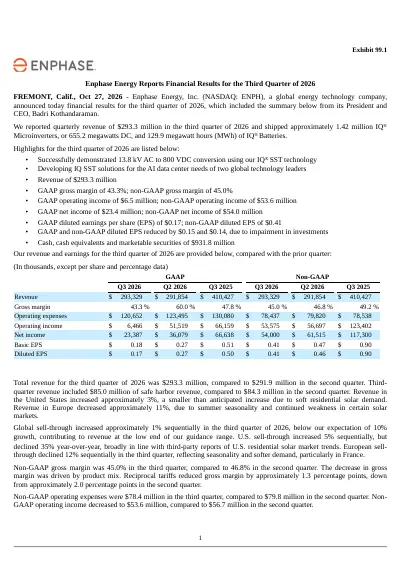
Good afternoon, and thank you for joining us today to discuss our third quarter 2026 financial results. We reported quarterly revenue of $293.3 million and shipped 1.42 million microinverters and 129.9 megawatt hours of batteries.
Our Q3 revenue included $85 million of safe harbor revenue. We exited the quarter with channel inventory a little above normal for batteries and microinverters.
On a GAAP basis, we delivered gross margin of 43.3%, operating expenses of 41.1%, and operating income of 2.2%, all as a percentage of revenue. On a non-GAAP basis, we delivered gross margin of 45%, operating expenses of 26.7%, and operating income of 18.3%, all as a percentage of revenue.
Mandy will cover the financials later in the call. Our customer service NPS was 79% in the third quarter, compared to 80% in the second quarter, while the average call wait time was approximately 1.9 minutes.
Our AI assistant has been rolled out to all our homeowners worldwide, and we are now rolling it to Enphase installers in this quarter to help them manage their fleets. Let's cover operations.
In the third quarter, we shipped approximately 1.4 million US-made microinverters and battery inverters from our US manufacturing facilities and booked the associated 45X production tax credits. We also shipped 63.8 megawatt hours of IQ Batteries from our Texas manufacturing facility in the third quarter.
We offer IQ Batteries that meet domestic content and FEOC regulations, helping lease and PPA customers qualify for ITC bonuses. Let's now cover revenue and regional performance.
Our global Q3 revenue increased approximately 1% compared to Q2. Our global sell-through also increased by 1% compared to Q2.
This fell short of our original expectation for sell-through growth of approximately 10%, which contributed to us delivering revenue towards the lower end of our guidance. Our revenue mix was 80% from the US and 20% from international markets.
In the US, revenue increased approximately 3% sequentially. Safe harbor revenue was $85 million in Q3, compared to $84.3 million in Q2.
Our US sell-through in Q3 increased by 5% compared to Q2, a more modest increase than expected, primarily due to the impact of interest rates on the residential solar market. On a year-over-year basis, our Q3 '26 sell-through declined 35% compared to Q3 '25, reflecting pressure from higher interest rates and the transition following the expiry of the 25D tax credit.
Third-party market reports suggest overall US residential solar permits were also down approximately 35% year-on-year for Q3 '26. With our results in line with these reports, we believe we continue to hold our market share, reflecting balanced exposure across channels, including TPOs.
Our US commercial sell-through grew approximately 50% in Q3 compared to Q2, as sales of IQ9 commercial microinverters ramped. Our current commercial volumes are mostly channel-based, with larger direct opportunities emerging for 2027.
In Europe, revenue decreased approximately 11% sequentially in the third quarter, while sell-through also declined approximately 12%, in part due to summer seasonality and a modestly weaker demand environment, particularly in France. Europe is evolving into a battery-led market, with approximately 50% of our revenue in the region coming from storage systems in Q3.
In Netherlands, our battery activations increased 23% in Q3 compared to Q2, a counter-seasonal increase building on the 102% growth in Q2 versus Q1. Homeowner events have become a successful selling tool for us.
In France, however, battery activations were down by 12% compared to Q2, while microinverter activations fell 24%, reflecting summer seasonality and macroeconomic uncertainty that may continue in the short term. In Germany, overall activations were down 5% as compared to Q2.
Let's now cover the outlook for the fourth quarter. We expect revenue for the fourth quarter between $225 million and $255 million, including approximately $51.2 million of safe harbor revenue.
For batteries, we expect shipments of 100 to 120 megawatt hours. We are currently about 70% booked to the midpoint of our revenue guidance.
Our global sell-through has remained relatively flat over the first three quarters of 2026. We're not seeing any meaningful recovery in the US demand.
We do expect global sell-through to decline approximately 10% sequentially in Q4, which is approximately $20 million. With Q1 '27 expected to be seasonally slow, we anticipate distributors will remain cautious about building inventory heading into the new year.
Accordingly, we plan to ship approximately $20 million below sell-through in Q4 to further reduce channel inventory. While the near-term market environment remains challenging, I'm very excited about the growth drivers we have established and would like to spend the rest of my remarks on how we see Enphase growing in 2027 and beyond.
I will walk through five growth drivers. First, residential batteries.
Second, recovering our US residential solar business driven by Propel. Third, our commercial solar and battery business.
Fourth, bidirectional EV charging. Fifth, AI data centers with our IQ solid-state transformer.
Let me start first with where we are today. In 2026, we expect that approximately 72% of our revenue would have come from residential solar, 21% from residential batteries, and 7% from commercial solar, EV charging, and other.
Now, let me walk through each of our growth drivers. Our first growth driver is residential batteries.
Global adoption continues to accelerate, driven by demand for energy resilience, self-consumption, and VPPs. In the US, third-party reports estimate Enphase's residential battery market share at approximately 15% to 20%.
With approximately 50% share of the US solar inverter market, we see a significant opportunity to achieve a similar market share in residential batteries over time. A key catalyst will be our next-generation IQ Battery G5, our fifth-generation product.
This is because the installers have been asking us for a compact, stackable, AC-coupled battery that scales up to 30 kilowatt hours in a single stack, with higher energy density, faster installation, and an improved cost structure. Beyond new solar installations, we also have a substantial retrofit opportunity across approximately 3 million Enphase solar households in the US, many of whom could benefit from backup power, energy independence, and VPP income.
We expect the IQ Battery G5 pilots in the fourth quarter and volume shipments next quarter, Q1 '27. We're also seeing VPPs move from small pilots towards large-scale commercial opportunities.
Major utilities and hyperscalers are engaging with us on programs that compensate homeowners for making their batteries available to support the grid. This is particularly compelling in communities near data centers, where distributed batteries can help manage growing electricity demand, while providing financial benefits to homeowners.
We expect utility programs to contribute to growth in 2027, with larger utility and data center-driven VPP opportunities developing in 2028 and beyond. In Europe, our largest near-term opportunity is the Netherlands, where approximately half a million existing Enphase solar-only customers represent nearly a $2 billion battery retrofit opportunity.
With net metering ending at the end of this year, 2026, the economics of adding storage have become increasingly attractive. We are reaching these customers directly through homeowner events, emails, and webinars.
Beyond our install base, approximately 2.5 million Dutch homes with non-Enphase solar systems also represent another substantial opportunity. Our universal AC-coupled battery architecture allows us to serve this huge market, which we are targeting through social media campaigns.
We expect a strong growth in battery activations which was seen throughout 2026 to accelerate further in 2027. We're also excited about Australia, where the median residential battery installation is about 30 to 40 kilowatt-hour.
Until now, we have not been well-positioned to compete in this high-capacity market with our third-generation battery. Our Gen 5 or the fifth-generation battery, G5, changes that.
With up to 30 kilowatt-hour per stack combined with improved cost structure, G5 gives a tremendous opportunity to penetrate Australia's 12 gigawatt-hour-per-year market. Putting it all together, we expect residential battery shipments of approximately 450 megawatt hours in 2026, and we believe we can grow this business approximately by 50% in 2027.
With a highly competitive product, millions of existing solar customers, expanding VPP opportunities, and access to new international markets, we see a substantial multiyear growth opportunity ahead on residential batteries. Our second growth driver is the recovery of the US residential solar market.
Propel is central to how we see that happening for Enphase. The expiry of the 25D tax credit removed a meaningful portion of the cash and loan market, which has historically been the core of our long-tail installer business.
In today's high-interest rate environment, a third-party ownership offering with 48E tax credit is a practical path for many of these homeowners. Propel, a prepaid lease offering from SolSource Solutions that combines Enphase equipment, loan financing by TriBeam Financial, and national distribution through Greentech Renewables, is purpose-built for long-tail installers.
Propel is now available in 13 states, and installer participation has grown to approximately 350 as compared to 290 in Q2. Weekly originations of Propel have increased to over 300, compared to approximately 200 in Q2, with a battery attachment at roughly 71%.
SolSource recently announced $300 million in capital raised to support its growth, an important milestone in today's environment. SolSource is actively working to secure additional capital to support the next phase of expansion into new markets.
We expect the growth in Propel originations to translate into higher Enphase equipment sales as these systems get installed in the first half of '27. With growing installer participation, strong battery attach, and opportunities to expand into additional states, Propel can become a meaningful driver of our US residential solar and battery business in 2027.
Our third growth driver is our commercial business. US commercial solar has been one of the most resilient segments of the market in 2026, with permit activity up approximately 13% year-to-date.
We expect strong fundamentals to continue into 2027, supported by rising electricity rates and investment tax credits. The recently announced FCC restrictions on new foreign-produced inverters create a significant competitive advantage for Enphase as a US-based manufacturer with domestic manufacturing capabilities.
Our three-phase microinverter portfolio spans 208-volt to 480-volt applications, including the IQ9S-3P, our highest power, 548-watt GaN-based microinverter. Beyond expanding our distribution channel business, we are pursuing several large national accounts that could meaningfully accelerate growth in 2027.
We are also excited about our entry into the US small commercial storage market with the IQ Battery C80, a fully integrated 480-volt AC-coupled system delivering 80 kilowatt-hours of energy and 40 kilowatts of continuous power. A key application here is demand charge reduction, where the battery discharges during peak demand periods to lower electricity bills.
It also supports time of use, solar self-consumption, and grid services. Customers can scale up to 2 megawatt hours of capacity by combining 25 battery units, each with 80 kilowatt hours of storage.
The battery will be manufactured in the US and designed to meet FEOC regulations and qualify for domestic content incentives. We opened pre-orders in August and have seen encouraging initial demand.
We expect to sell approximately 100 megawatt hours of commercial batteries in 2027. We expect it to do pilots in Q1 '27 and volume shipments in Q2 '27.
Putting it all together, we anticipate our commercial revenue in 2026 will be approximately $30 million. We believe it could grow to over $100 million in 2027.
Over time, we expect to target 40% market share of the US small commercial market, which across solar and batteries, could represent approximately $250 million annual revenue business for Enphase. Our fourth growth driver is bidirectional EV charging, which brings Enphase directly into the automotive market.
EVs carry batteries 5 to 10 times the size of a typical home battery. With bidirectional charging, the vehicle becomes part of the home energy system, providing backup power, time of use optimization, and VPP participation.
Our IQ bidirectional EV charging solution is built on our GaN power platform, and will support both AC and DC bidirectional charging architectures. Our DC solution integrates the bidirectional inverter directly into the charger, while our AC solution combines our standard unidirectional AC charger with an additional V2X kit to enable bidirectional functionality.
The DC solution will support both 400 volts, as well as 800 volts vehicle architectures with up to 11.5 kilowatts of bidirectional power. We expect pilots in this quarter, and volume shipments in Q1 '27.
We are collaborating with three top global auto OEMs in the US to bring these solutions directly to their battery EV and plug-in hybrid EV customers. We believe our bidirectional charging solutions offer some of the simplest, lowest-cost installations in the market, backed by our best-in-class quality and customer service.
We believe this expansion into the automotive market also creates a compelling cross-selling opportunity, as every EV customer could also become potential customer for Enphase solar and battery systems. For bidirectional EV charging, we anticipate a $15 million to $20 million revenue opportunity in 2027.
We have a substantially larger growth opportunity in 2028 and beyond, with the potential to generate over $100 million in annual revenue as they ramp. Combined with our cross-selling opportunities, we see multiple avenues for additional growth from this business.
Our fifth and final growth driver is IQ SST, which brings Enphase's power conversion expertise into the rapidly expanding AI data center market. IQ SST is designed to convert 13.8 kV or 34.5 kV medium-voltage AC directly into regulated 800 VDC through our modular single-stage architecture.
We are targeting approximately 98.5% efficiency, five nines reliability, and sub-millisecond response times. By eliminating multiple power conversion stages, we believe IQ SST can fundamentally improve the efficiency, reliability, cost, and simplicity of AI data center power infrastructure.
We recently achieved a major technical milestone, successfully demonstrating 13.8 kV AC to 800 VDC conversion in our Austin laboratory. We expect to demonstrate 34.5 kV capability very soon in the fourth quarter.
We are also preparing megawatt-scale full system demonstrations this quarter, both at our Austin facility, as well as at a national lab with customer participation at both locations. These are important steps towards validating our technology at scale and operating conditions required by AI data centers.
Our customer engagement is accelerating. Since our last update in July, our pipeline has expanded significantly to more than 50 potential customers.
Of note, we are developing specific IQ SST solutions for the AI data center needs of two global technology leaders: a hyperscaler and a global AI computing leader. These collaborations are helping shape our product roadmap and system architecture.
We remain on track for customer pilots in 2027, followed by initial commercial shipments in 2028. By 2030, we believe IQ SST has the potential to become a $1 billion annual revenue business for Enphase in the data center market alone.
Three things stand out from our customer discussions. First, reliability is paramount.
Our distributed architecture, built on more than two decades of microinverter experience, offers inherent redundancy and fault isolation, providing a powerful foundation for the reliability requirements of AI data centers. Second, our successful 13.8 kV demonstration and upcoming 34.5 kV validation gives us increasing confidence in our ability to meet customer development timelines.
Third, our US manufacturing capabilities and supply chain readiness are important competitive advantages as customers prepare for large-scale deployments. We recognize the substantial engineering, qualification, and execution work ahead.
We also recognize the magnitude of this opportunity, and we are executing with urgency to make this vision a reality. Let me conclude.
We do not believe today's financial results reflect the full potential of where Enphase is headed in 2027 and beyond. We are working with determination to build a stronger, more diversified company with five powerful growth drivers: residential batteries, driving residential solar with prepaid leases, commercial solar and batteries, bidirectional EV charging, and solid-state transformers for AI data centers.
What makes these opportunities especially compelling is that they are all built on the same foundation: our world-class power electronics technology, our unique single-stage power conversion architecture, our custom-designed ASICs, state-of-the-art magnetics, proprietary predictive control software, and industry-leading GaN technology. All of these give us the ability to deliver smaller, more efficient, more reliable, and lower-cost power conversion solutions across multiple markets.
We remain confident in the long-term recovery of residential solar, while prepaid leases can help drive adoption in the near term via Propel, and rising utility rates will help, will expanding virtual power plants, and finally, the homeowner's growing desire for energy independence will support the market over time. We are not waiting for that recovery.
We are building new businesses, entering new markets, and positioning Enphase for a much larger future. We believe these opportunities have the potential to more than double the size of our company over time.
With that, I will turn the call over to Mandy for her review of our financial results. Mandy?
Mandy Yang
Thanks, Badri, and good afternoon, everyone. I will provide more details related to our third quarter of 2026 financial results, as well as our business outlook for the fourth quarter of 2026.
We have provided reconciliations of these non-GAAP to GAAP financial measures in our earnings release posted today, which can also be found in the IR section of our website. Total revenue for Q3 was $293.3 million.
We shipped approximately 655.2 megawatts DC of microinverters and 129.9 megawatt hours of IQ Batteries. Q3 revenue included $85 million of safe harbor revenue.
As a reminder, we define safe harbor revenue as any sales made to customers who plan to install their inventory over more than a year. Non-GAAP gross margin was 45% in Q3, compared to 46.8% in Q2.
The decrease was primarily due to product mix. GAAP gross margin was 43.3% in Q3, compared to 60% in Q2.
Q2's GAAP gross margin was positively impacted by 15.6 percentage points for the IEEPA tariff refunds received. Reciprocal tariffs negatively impact our gross margin by 1.3 percentage points in Q3.
Non-GAAP operating expenses were $78.4 million for Q3, compared to $79.8 million for Q2. GAAP operating expenses were $120.7 million for Q3, compared to $123.5 million for Q2.
GAAP operating expenses for Q3 included $39.4 million of stock-based compensation expenses and $2.9 million of acquisition-related expenses and amortization. On a non-GAAP basis, income from operations for Q3 was $53.6 million, compared to $56.7 million for Q2.
On a GAAP basis, income from operations was $6.5 million for Q3, compared to $51.5 million for Q2. On a non-GAAP basis, net income for Q3 was $54 million, compared to $61.5 million for Q2.
This resulted in non-GAAP diluted earnings per share of $0.41 for Q3, compared to $0.46 for Q2. GAAP net income for Q3 was $23.4 million, compared to $36.1 million for Q2.
This resulted in GAAP diluted earnings per share of $0.17 for Q3, compared to $0.27 for Q2. We incurred $26.5 million of impairment in investments, which reduced third quarter non-GAAP and GAAP diluted earnings per share by $0.14 and $0.15, respectively, net of tax.
We exited Q3 with a total cash, cash equivalents, and marketable securities balance of $931.8 million, compared to $937.7 million at the end of Q2. In Q3, cash provided by operations was approximately $90,000, while capital expenditures were $11.5 million, resulting in negative free cash flow of $11.4 million.
The negative free cash flow primarily reflected negative working capital changes, including the timing of safe harbor revenue prepayments and PTC monetization. As of September 30, 2026, we had approximately $228.5 million of PTCs on our balance sheet.
This consisted of $108.3 million related to US-made microinverters shipped in 2024, and $120.2 million related to shipments during the first nine months of 2026. We expect to receive the refund from the IRS for the $108.3 million of 2024 PTCs by the end of the year.
As a reminder, in April, we announced a tax credit transfer agreement to sell $150 million of 2026 PTCs to a leading financial institution, with four quarterly payments from April 2026 through January 2027. As of September 30th, we had monetized $75 million under the agreement.
Subsequent to the quarter end, we monetized an additional $37.5 million, bringing year-to-date 2026 PTC monetization to $112.5 million. Now, let's discuss our outlook for the fourth quarter of 2026.
We expect Q4 revenue to be in the range of $225 to $255 million, including shipments of 100 to 120 megawatt hours of IQ Batteries. We anticipate recognizing approximately $51.2 million of safe harbor revenue in Q4.
We expect GAAP gross margin to be within a range of 38% to 41%, and non-GAAP gross margin to be within a range of 40% to 43%. Both ranges include approximately two percentage points of reciprocal tariff impact.
The lower sequential margin outlook is primarily due to product mix, battery price adjustments, and increased freight costs associated with our new product production. Non-GAAP gross margin excludes stock-based compensation expenses and acquisition-related amortization.
We expect our GAAP operating expenses to be within a range of $119 to $123 million, including approximately $43 million estimated for stock-based compensation expenses and acquisition-related amortization. We expect our non-GAAP operating expenses to be within a range of $76 to $80 million.
We remain focused on cost discipline, aligning our spending with the revenue environment, and prioritizing resources toward our highest-impact opportunities. Throughout this process, we will protect the customer experience and continue investing in innovation, including IQ SST and other strategic growth priorities.
With that, I will open the line for questions.
Operator
Thank you. We will now begin the question-and-answer session.
To ask a question, you may press star then one on your touchtone phone. If you are using a speakerphone, please pick up your handset before pressing the keys.
If at any time your question has been addressed and you would like to withdraw your question, please press star then two. In the interest of time, please limit yourself to one question and one follow-up.
The first question will come from Brian Lee with Goldman Sachs. Please go ahead.
Brian Lee
Hey, everyone. Good afternoon.
Thanks for taking the questions. Badri, I know there's some moving pieces here, but could you clarify?
I think you said 4Q guidance includes a $20 million undershipment. Without that, I guess the math implies revenue would be flat at the midpoint ex-safe harbor from 3Q to 4Q.
I guess is that right? Then with the $20 million undershipment, how does that impact kind of the Q1 opportunity, if $210 million is sort of the normalized midpoint for 4Q, is that down another 10% to 20% on normal seasonality into 1Q, or just how should we think about the revenue range of outcomes for 1Q, given the undershipment and also the interplay with some of the new product and new end-market opportunities you have heading into '27?
Right. Yep.
Badri Kothandaraman
Brian, thank you. Let me just give you the full color.
Basically, what we said is that our global sell-through in the first three quarters of this year has been kind of flat at roughly $230 million a quarter. That's the global sell-through.
What we are seeing right now for Q4, and what we said is we anticipate a 10% reduction in that sell-through. You can do the math, that's about $210 million of sell-through, global sell-through, expected in Q4.
Now, we all know that in Q1, there is seasonality. Therefore, distributors are going to not stock a lot of inventory in Q1 because of seasonality, and we want to get ahead of that by basically undershipping $20 million from that 210 number, basically 190 million into the channel.
That's what we are talking about. Big picture for 2027, the way you should think about it is, excluding safe harbor, our core revenue has been approximately $200 million per quarter in the last two to three quarters, approximately 200 million.
You take 200 multiplied by 4 for 2027. Then, you add the $200 million of growth drivers that we gave you, which comprises of we said that the battery number goes from 450 megawatt hours to 675 megawatt hours.
We talked about commercial going from $30 million to $100 million. We did not quantify Propel, but that could be some upside.
We then talked about bidirectional EV charger adding a modest $15 million to $20 million because we have the top three OEM partnerships. While we are not guiding for 2027, that's a framework that we are thinking about, $200 million core plus these growth opportunities.
Now, with regarding your specific question coming into Q1, Q1 is, of course, going to be seasonally down. We have all seen that.
However, what is good in the growth vectors that I outlined, we have five growth vectors. Many of them are actually going to start in late Q4, early Q1.
Like for example, our fifth-generation battery is going to do pilots in Q4 and introduce very early Q1. Our commercial battery is going to do significant number of pilots in Q1.
Our bidirectional charger is going to do pilots in Q4 and volume production in Q1. Propel is an ongoing business.
We have some growth drivers there for Q1. While I'm not going to give you guidance, that's the way you can think about Q1 is there is some seasonal offset in the core business plus Enphase-specific growth vectors where we are not depending on the market to come back, but these are additional revenue drivers.
Brian Lee
Super helpful, thank you. Maybe just focusing on one aspect of the growth, if we kind of look at the different drivers you mentioned, the 50% growth in battery storage megawatt hours in 2027, that seems to be probably the single biggest year-on-year delta for potential revenue growth.
I guess, what's the cadence of that? How much visibility do you have?
It's pretty heady growth. Is a lot of that in the second half of '27?
Then any pipeline leads kind of you can speak to for visibility into that level of growth into next year? Thank you.
Badri Kothandaraman
We expect this to be a transformational product. Just so you have the background, Europe, Australia, international regions will be going from the third-generation battery to the fifth-generation battery, while the US will be going from the fourth-generation battery to the fifth-generation battery.
The single biggest driver for our fifth-generation battery is one box on the wall. One box on the wall.
For example, with a third-generation battery, if you need three boxes on the wall for a 15 kilowatt-hour, it'll be one here. The other big thing is, because the energy density is so much better, we are able to reduce the cost structure.
If we are able to reduce the cost structure, we can compete at a good price, maintaining gross margin. Therefore, we are extremely excited about Australia.
Australia, for example, the median kilowatt-hours is approximately 30, 30 to 40 kilowatt-hours, and we can address it with one or two stacks. Therefore, the form factor becomes amazing, and similarly, we can address Germany, for example, with just one stack.
In places like Netherlands, we are going to go into turbo charge, which is, come 2027, batteries are going to become the norm because the Dutch are going to see their bills start to increase. There, we have half a million homes where we can really drive adoption of the battery, and we are driving the adoption of the third-generation battery today, and that will become even better with the fifth-generation battery.
Similarly, in France, we have half a million or 400,000 homes in France where we apply the same concept. While for us, we're going to start ramping in Q1, meaning pilots in Q4, volume shipments in Q1.
As there will obviously be a transition there, it'll take usually a couple of quarters for the batteries to transition from the old generation to the new generation, may even take three. Therefore, you would expect naturally in the back half to be a nice growth compared to the first half.
Brian Lee
All right. Thank you.
I'll pass it on.
Badri Kothandaraman
Thank you.
Operator
Again, if you'd like to ask a question, please press star then one. If you have additional questions, you may rejoin the queue.
The next question will come from Philip Shen with ROTH Capital Partners. Please go ahead.
Philip Shen
Hey, guys, thanks for taking my questions. We published yesterday that the '27 outlook for resi solar could actually be down year-over-year.
Wanted to see if you could kind of comment on the overall market sentiment as well. Seems like first half next year, with seasonality, Q1's going to be lower certainly versus Q4.
I wonder if it could even be weaker. Then, Q2 could be weak as well given the delay on the Treasury Department issuing FEOC guidance, and so, can you comment on what you see for the market overall and if you see potentially even some downside risk to your 200 million per quarter baseline?
Thanks.
Badri Kothandaraman
In general, I am commenting on today's today's market. You're correct.
Today's market is is weak due to the higher interest rates and due to, FEOC FEOC compliance, issue or FEOC guidance not not being very clear, and so there is reduced visibility, you're correct about that. It's difficult for us to difficult for us to see how 2027 is, which is why I focused on our growth drivers, which are independent independent of the market.
For us, I will go back to the to the same growth drivers. Those growth drivers, for example, the battery, will help us get additional market share in all regions, starting with the US, Europe, new market share, for example, in Australia, as well as Europe, increasing market share in the US.
That's what we are we are targeting. The next one is Propel.
Propel is going from strength to strength. Last time, we talked about 200 originations.
Now Propel is in 13 states, 300 originations, over 300 originations a week. Of course, Propel has raised its first round of funding, and every time they go to additional states, they will need new rounds of funding.
That's that's that's always, that's that's something they have to execute on. If they execute on that, Propel is clearly demonstrating growth, and the from originations to it showing up in PTO usually takes 3 to 4 months for us.
All of those, we expect to start seeing the results of all of those in 2027. The next one is commercial.
Commercial, again, is independent of what we are talking about, the residential weakness. In commercial, we have this year we have introduced two good products.
They are the 3-phase 480 volts and 3-phase 208 volts IQ9, 427 watts and 548 watts, all gallium nitride. Why are we going to do well in commercial?
Same principles. We are FEOC, we do US manufacturing.
We comply to FEOC regulations. We have domestic content.
Per panel monitoring is a very big deal for the commercial asset owners most of the time. That's the differentiator, and, of course, our high quality.
Now, what we are doing there is to have a full-fledged commercial energy management system, which means what? Commercial solar and commercial storage.
Commercial storage is, I would I would almost say it's a niche market in the US. There aren't clear enough clear players like residential solar or utility-scale solar.
It's a good opportunity for us. There, once again, an 80 kilowatt-hour battery extendable to 2 megawatt hours, solving real problems of demand charge.
Demand charge is the single biggest application there in addition to the usual VPP, self-consumption, time of use. For example, one of our opportunities is a utility company in Texas who wants to put these commercial batteries in a distributed way front of the meter.
We are entering, of course, the business here will be the growth here will be measured. Commercial takes is a design-in product, it will take time, but that's a completely different vector we're talking about, commercial solar plus commercial batteries.
The fourth one is bidirectional EV charging. Bidirectional EV charger, again, I'm very excited to highlight that we have three big automotive OEMs who have recognized that our product, the Enphase product, both AC by-di product as well as DC by-di product, is one of the easiest easiest to use, easiest to install, easy in terms of, installation cost, etc., and just works.
We have been, in the last year, we have been doing a lot of pilots with those EV OEMs. We are very excited about that, and that product is coming imminently with pilots in the current quarter, then going on.
Then, the last last one I talked about at length is SST. SST for us is we've got to do a few things in SST.
In SST, we showed the 13.8 kV demonstration, although it is not full megawatt-scale, but that was a proof-of-concept. Very soon, we are going to show proof-of-concept of 34.5.
Then, towards the end of the year, we are going to show megawatt-scale megawatt-scale demonstration of the SST. The moment we do that, we are then going to go into compliance.
Once we go into compliance and finish compliance successfully, we will do DVTs or pilots with end customers. That's that's the path there.
I know it's a long answer I gave you, but many of our vectors are about diversification and reducing the reliance on the residential market.
Philip Shen
Got it. Thank you, Badri.
Next one here is related more to pricing and margins. We recently published also that you may have lowered some pricing on batteries, ADLP, the authorized distributor list price.
I think in Mandy's comments, she talked about battery price adjustments contributing to the lower sequential margin outlook. Was wondering if you can talk about how much did you lower that battery price by, and then going forward, is that a lever that you might pull again maybe through '27?
What's really the right margin we should be thinking for a normalized level as we get through '27? Thanks.
Badri Kothandaraman
Right. This change was done a couple of months ago, where we basically reduced the list price of our batteries in the US, I would say by approximately 8% to 9% to distributors.
That's what we did. To answer your question on do we see more price reductions, the whole point why we have been working on our fifth generation is we understand the battery business is a tough business.
We understand that consumers expect better pricing over time. Hence, we embarked on the fifth-generation product.
The fifth-generation product uses 100-amp-hour cells, uses an energy density that is I won't say exactly double, but almost double of what we have with respect to the fourth-generation product. You should look at the form factor of our fifth generation.
It is very very compact, enabling one box on the wall, which means most installations can fit into one stack. The whole point is to make our cost a lot more competitive so that we can participate in segments where we couldn't participate before.
For example, in Australia, for example, in certain parts of Europe. We are looking forward to do that.
You asked, what does that mean for gross margin? The way I always think about there may be hiccups in the short term on gross margin, but the company's target is always 40%.
That's the way I think about it. Any business that we get into, we make sure we have a clear line of sight to achieving 40%.
It might take one to two quarters sometimes, or a little more, but our target is 40%.
Operator
The next question will come from Eric Stine with Craig-Hallum. Please go ahead.
Eric Stine
Hey, Badri. Just wanted to confirm.
Obviously, you are talking about pretty significant storage growth, but I just thinking about last quarter, seems to me that you were maybe more optimistic about storage in the outlook going forward. First, I guess maybe confirm that.
If that is the case, is France the main culprit there, because the other end markets you're talking about, I don't think your optimism is changed at all versus last quarter.
Badri Kothandaraman
I think I think in in general in the short term, we are seeing weakness, weaknesses in the US primarily due to interest rates in the short term. That's that's my comment on the US weakness, and hence, our guidance guidance is appropriately, this time between 100 and 120.
Like but like what I said, our what what we are looking at is to introduce our fifth-generation product, which will make us which will make us competitive everywhere. We are looking to take market share in the US.
Right now in the US, we have 15% to 20%, depending on on the third-party reports. If you look at them, we have 15% to 20% market share.
It's a It's a two-horse race in the US, and we would we would like to basically increase market share there like how we have on the solar inverter side in the US. We do see tremendous opportunity in Netherlands come 2027.
Our optimism there has not changed. In terms of France, we do see, again, a huge opportunity for us to to, market to our own homeowner base of 400,000, and I already talked about Australia.
There is some short-term hiccups here in the US, but with our fifth-generation battery, we should start to grow again.
Eric Stine
Yep. Okay.
Thanks for that. Then just to clarify on EV charging the collaboration with OEMs.
I think you said three, and I'm just curious, were those three in the US? I believe in the past, you've also talked about one in Europe.
Badri Kothandaraman
All three are in the US right now, and there is one in Europe, which is ongoing, too.
Operator
The next question will come from Colin Rusch with Oppenheimer. Please go ahead.
Colin Rusch
Thanks so much. I just want to follow up on the pricing question on batteries.
Can you talk about how much elasticity you've seen with those price declines in terms of being able to move product to your distributors and then through the channel?
Badri Kothandaraman
Yeah. Since we did the action only a couple of months ago, it is too soon for us to comment on the elasticity.
Let me leave it at that, Colin.
Colin Rusch
Okay. Then in Europe, in the Netherlands, there has been this big opportunity to sell into that market, and it seems to not be materializing in the way that everyone had hoped it might.
Can you just talk about where the friction is? Is it a price issue?
Is it a customer education issue? Is it a financing issue?
Just want to get a sense of where the real friction point is.
Badri Kothandaraman
Yeah. Customers aren't going to react until they see their electricity bill, and they're going to start seeing their electricity bill go up quite a bit in 2027.
Just a note for you is our activations for batteries have grown about 102% from Q1 to Q2, and grown by 23% from Q2 to Q3. We just held a round table last week with a lot of Netherlands installers, and everyone is extremely excited, and going into 2027, all of them expect the volumes to go up.
What are we doing about it? The multiple angles.
We are conducting six homeowner events a week. Six homeowner events a week, which means we invite homeowners, about 150 come.
We give them a presentation for an hour. We talk about the value of a battery in 2027 post-NEM, and then we see a nice conversion there.
We also have our inside sales people in the room, they're taking the orders. Sometimes, we do these events with installers.
Sometimes, we just do it. Six homeowner events a week * 13, 78 homeowner events.
Each homeowner event is about 100 150 people. Obviously, there's some yield there.
That's one vector, one avenue of growth. Then, we take the leads from that and we essentially funnel it to our installers, and that increases the loyalty a lot because they not only get free leads from us, they also are running a business, and therefore, they tend to use Enphase for their business as well as for the leads that we give them.
Then, the second one is actually webinars. Webinars have been again a huge source of leads for us.
That again, we are doing a live webinar that's also done frequently every week. The other opportunity which we plan to take advantage of going into 2027 is, because our battery is an AC-coupled battery, we have a huge opportunity to take the 2.5 million non-Enphase solar homes.
There is 8 million homes in Holland or in Netherlands, 8 million homes. Of that, there is 3 million homes with solar.
Of that, there is half a million Enphase homes with solar. You have a balance of 2.5 million homes with non-Enphase solar, and we are basically actively targeting that, and we expect the demand from that also to add up soon.
The vectors for us in Netherlands are continue the homeowner events, establish direct relationship because they all know Enphase well, and therefore, if they know that a huge company is behind it, and they understand Enphase is a premium player, they do want that premium support experience there. We plan to do that.
We plan to do webinars. We plan to go after the non-Enphase homes because our technology is AC-coupled, and then Gen 5 is now coming.
Gen 5 will take the number of boxes on the wall to one. That will make the cost structure better, will be easier to install.
Installer doesn't need to have multiple points on the wall, it'll be stackable, easy to install. Yeah.
We're incredibly excited about Netherlands.
Operator
The next question will come from Mark Strouse with JPMorgan. Please go ahead.
Mark Strouse
Great. Good afternoon.
Thank you very much for taking our questions. Badri, the last few years, you've been very disciplined with your focus on operating margins.
Not looking for 20- 2027 guidance, but just kind of targets over the near term. To the extent that the residential business weakens further, how we should think about pro forma OpEx as a percentage of sales in the context of all of these growth initiatives that you're trying to ramp at the same time?
Badri Kothandaraman
Right. Enphase has always been disciplined.
When it comes to gross margin, the same thing. When it comes to OpEx, the same thing.
We are going to be looking at our annual operating plan as we go into 2027, and we are not going to be afraid to make all of the necessary changes in order to be profitable. No matter what, you can count on Enphase to innovate, spend the correct dollars on innovation, like SST, like commercial battery, like fifth-generation battery going to a sixth-generation battery, and so on.
We are all seeing AI help us in productivity as well. The answer is we will continue to be disciplined, and we will continue to be profitable.
Mark Strouse
Understood. Thank you.
Then just a follow-up on the I believe you mentioned a possibility for about a $1 billion in revenue from SST by 2030. Can you just give a bit more color on how you're coming up with that metric?
Is that a top-down view with an assumed market share, or is it some kind of risk-adjusted bottom-up view? Anything there would be helpful.
Thank you.
Badri Kothandaraman
I'll have Raghu elaborate on how SST is going, the conversation with customers, and then answer your question as well.
Raghu Belur
Yeah. We are making a lot of progress on SSTs.
You saw the announcement that we made this morning about 13.8 kV product working and generating 800 volts DC. The core of our SST, just to remind everybody, is that power module.
It's basically a large microinverter that uses the technology that we have worked on for the last 20 years and nine generations of products, five generations of ASIC. It's basically a large microinverter, that's what we do and it's our core competency and core expertise.
We are actually on our third revision of that product. We already have three cycles of learning underneath our belt, and what we have done, kind of just to the technology itself, it's a very high frequency, single-stage power conversion, custom ASIC, predictive control, and GaN, including BDS GaN or bidirectional GaN.
We've shown it working at 13.8. For us to go to 13.4 from 13.8 to 34.5, we just stack additional number of power modules or microinverters.
One other key element of the device that's really interesting in there that we have spent a lot of time on and we have a lot of IP, is that high-frequency transformer, because our high-frequency transformer needs to be what's called partial discharge, PD-free or partial discharge-free, to operate at 34.5 kV. A lot of work has gone on there.
We have demonstrated 13.8, we will show 34.5 shortly, as well as demonstrate 34.5 at megawatt-scale. Then we'll do that both at our Austin lab as well as at another national lab.
All of this is in discussions with hyperscalers and other big players in the ecosystem. They're very familiar with what we are doing.
They like our approach. They see the benefits of the modularity in terms of the reliability that we do.
We have undersubscribed all our power modules by almost by 60%. We have a very fast response time, which means we could potentially eliminate that low-voltage battery that's in the system.
85% of the supply chain for a power module is the same as our microinverters that we have today. From a FEOC-compliant standpoint, which is a huge deal because SST will get classified as it's an inverter-based resource and it'll get classified as critical infrastructure.
We have a FEOC-compliant or meet FEOC regulations and US manufacturing, it leverages the same manufacturing line that we have for our microinverters today. We already have an established manufacturing line to build these power modules, which go into our IQ SST.
We are having very good conversations, 50-plus engagements with customers including hyperscalers and large ecosystem players there, and they are, in fact, guiding us towards what exactly they would like to see in the product. Of course, OCP is coming out with their specifications as well in terms of the SST requirements.
As far as the total addressable market is concerned, you do see a lot of variability there in terms of the size of the market. We had said 11 gigawatts by 2030, obviously we think that's a very conservative number.
When we talk to some of our hyperscaler customers, one hyperscaler, as an example, itself is talking about in the tens of gigawatts. It can vary anywhere between 11 to 30 gigawatts or even higher than 30 gigawatts.
We looked at those numbers, we took what we assumed would be a reasonable market share, and at a price that we think is the right price, and came up with that $1 billion number by 2030.
Operator
The next question will come from Dylan Nassano with Wolfe Research. Please go ahead.
Dylan Nassano
Hey. Good afternoon.
Thanks for taking my question. Just want to dial in a little more on Europe, to better understand kind of what's happening on the ground there.
I know you specifically called out France, I think, as is being a little bit softer, but just trying to understand why core resi solar in Europe isn't kind of acting stronger here given we're tracking energy prices are still relatively elevated. Just any thoughts there would be helpful.
Thank you.
Raghu Belur
The Europe usually in Europe, summer seasonality is quite high. That's what we saw.
That's what we're reporting. We saw our sell-through basically was approximately, little over 10%, I think, 12% down.
I think that was in line with the past seasonality. Europe, there was a small time during Q1 and Q2 where the war basically accelerated energy the need for energy independence.
We saw a spike, and that acceleration seems to have worn off. Now, it's back to regular demand.
For us for us, the big opportunities in Europe are with batteries and are with our, what we sell today is our third-generation battery. We sell today our focus countries are Netherlands, France, Germany, and UK.
The These are our focus countries. We believe all of them can be changed dramatically with our fifth-generation battery.
Our opinion is that once we get the battery, then solar will automatically come attached. We also have a beautiful home energy management system in Europe, which is, ability to work with third-party EV chargers, including ours, as well as third-party heat pumps.
Really for us, is with IQ9 microinverters, with the fifth-generation battery, with a full-fledged home energy management system, and now soon to be added bidirectional charging, we have a complete, best-in-class ecosystem to go forward.
Dylan Nassano
Got it. Thank you.
Then just quick follow-up on the bidirectional EV charger. We noticed that there were some announcements recently with automotive companies kind of coming out with the next generation of more affordable bidirectional EVs.
Just any thoughts there on how your product kind of compares or is positioned relative to a bidirectional EV?
Raghu Belur
That's that's that's what we're talking about. There is two types of bidirectional EV chargers, DC-based bidirectional EV charger and an AC-based bidirectional EV charger.
We will have solutions for both, and they will be shipping in volume in Q1 '27. Our engagements with the top three OEMs in the US are basically for both, some engagement, meaning, one engagement is on DC and the other two engagements are on both AC and DC.
For us, for us, it is it is a huge opportunity there. Our product works very well already with most EVs.
Even, un- unofficially, it works, but we will not we will not claim any compatibility unless that EV OEM agrees and certifies the same.
Badri Kothandaraman
What we do in America is that's why it may be a little slow. The top three OEMs, for example, OEM 1, is introducing a car with bidirectional capability, we start testing that like 9 months ago.
In that way, we we can certify that our bidirectional chargers are compatible, and they will have to certify that, not us. We are well underway with these three OEMs.
The installation is going to be very simple and sleek. We have the meter collar, which we have now we have over if I remember right, over Over?
over 65 utilities?
Raghu Belur
100. I
Badri Kothandaraman
yeah, I may be getting that wrong. We have the meter collar qualified by these utilities.
All we need is a meter collar and the DC bidirectional charger, two components. In fact, you won't even see the meter collar because it is hidden behind the meter.
You have our inverter, and it can do V2H, which means it can function like a generator, which is, in the case of a blackout, the relay in the meter collar opens and the car is powering the home. You can also, obviously, make it do vehicle-to-grid, subject to the to the utility approval, where the car can feed the grid in times of need.
That DC bidirectional charger in the US has got 11.5 kilowatts of power, plenty, plenty enough. We anticipate interesting combinations.
We anticipate people to buy this DC bidirectional charger and then add solar, for example. It it there is, like what I stated in my prepared remarks, we see very good cross-sell opportunity.
First things first, is essentially release, work with the OEM, with the approval of the OEM, launch the bidirectional chargers one by one of each of their models, and you will see press releases that will come.
Operator
The next question will come from Corinne Blanchard with Deutsche Bank. Please go ahead.
Corinne Blanchard
Hey. Good afternoon.
Thank you for taking my question. Maybe shifting gears a little bit here.
Can you talk about your view about the midterms election, since maybe some investors have become a little bit more optimistic on some of the conversation going on to maybe see potential tax credit extension? Just wondering what you guys think, and how that could maybe be a positive as well going into 2027.
Raghu Belur
This is Raghu. Without commenting on getting into the details of the politics of it, but, yes, there is discussion.
Actually, some of this discussion is bipartisan in terms of extension of some of the investment tax credits for sure, as well as some of the production tax credits, as well. I think there is a broad view that that the election results may help renewables in general.
To be specific, these particularly these two tax credits, it seems like has bipartisan support. I think we'll wait to see what the outcomes are, but seems like we are going to see good support for extensions, and because it makes sense.
Corinne Blanchard
Thank you. Maybe just to continue on that one, would that change anything in term of your strategy for maybe bringing more manufacturing footprint in the US, or would you rather stay put given the current demand context in the US market, and just wait maybe a few more quarters to see how that evolves?
Badri Kothandaraman
Yeah. We have all of the capacity we need, and when, for example, the SST starts ramping, we can easily scale that.
Our capacity here is quite good. We won't hesitate to scale US manufacturing, and there's no obstacles to that right now.
Operator
The next question will come from Julian Dumoulin-Smith with Jefferies. Please go ahead.
Hey, guys. This is Carter on for Julian.
Thanks for taking our questions. Just a follow-up on SST.
You called out a leading hyperscaler as well as a global AI computing leader specifically in the release. Just curious if there's any color on those relationships specifically, feedback you've gotten so far.
Are they working with you exclusively on SST? Really just any color on those ones you called out in the release.
Raghu Belur
We won't go into any details there, that's the extent of what we are saying. In general, they're working closely with us.
We have we have shown them the power modules, they've seen they've even visited our Austin lab and seeing how we are progressing, and we're keeping obviously everybody up to date on how the development is progressing. The 13.8 kV announcement this morning was a pretty exciting announcement.
For us, when we think about going from 13.8 to 34.5, we use the same power module, it's not like we are changing our power module. Of course, the fact that we are using GaN is very interesting to them because of the reliability of of particularly because of the reliability of GaN.
More importantly, it's also about the reliability of the entire system. It's the reliability at the component level within the power module.
The way our SST is constructed itself gives us some intrinsic the modularity of the power module gives us some big advantages as well. When you think about we hear this discussion a lot around, GaN versus silicon carbide.
For us, GaN was a natural, organic fit for us. We are fans of wide-bandgap technologies in general.
For us, because of the reliability that GaN has, particularly in terms of AC surge robustness, the withstand capability, the BDS support that GaN has, which also gives us additional withstand. GaN is commodity product, very large very high volume, very it's very from manufacturing point of view, GaN is very easy to manufacture because it is GaN on top of silicon, it's a small epi layer on top of mostly silicon.
What GaN also allows us to do is to run the controller at higher and higher frequency. Because we run it at higher frequency, we get the response time that we need, we get benefit in terms of the magnetics being much much much smaller.
It is a a a really good choice for us to go to to with GaN in particular. In in to summarize, really working closely with the hyperscalers has been really informative for us because we're working very closely, and they, in fact, inform us a lot on our product development and exactly how they would like to see the pro- the evolution of the product in terms of both the technology, the performance, etc.
The nice thing about the power module that we have, the GaN-based power module, is it gives us a lot of flexibility in terms of meeting their specific requirements, whether that is in size or dimensions, or support for a low-voltage battery, the C-rate of the battery, to match the C-rate of the battery, etc. It's been it was a it was it's been very, very good for us to be working with, demanding customers like these because they just make you better.
Great. Thank you for all the color there.
Just from a timing standpoint, if you guys are doing megawatt-scale demos by the end of this year, then you go into a compliance period, when could we start to see pilot announcements into '27? I guess I'm thinking how long that compliance period would last.
Raghu Belur
I think the compliance period will start with the demonstrations this year, exactly like you said. We expect that in the second half, we should be through our compliance by the first half of year, and then head into pilots in the second half.
We should be realistic about that because some of the UL standards are still an outline of investigation, we need to work closely with UL, get through that, if you look at something like UL 2877 or UL 34 347 A. We got some work to do there.
Again, we expect that the first half of the year will be focused around getting through compliance, and then depending on how that goes, depending on how some of the early testing with the hyperscaler goes, we will enter the pilots in the second half of the year, and then close to the end of the year and early 2028, we go into commercial production. I think it'll all be gated by those two elements.
From a manufacturing point of view, I expect that we'll be ready to meet that timeline. In fact, in discussing with some of these larger customers, it seems like it aligns well with their timeline.
I think we are in a good place from that point of view.
Operator
The next question will come from Sunaina Ocalan with Bernstein. Please go ahead.
Sunaina Ocalan
Hey, guys. Thank you for taking my question.
Really appreciate the color on the previous answer. Maybe if I can just follow up to that, can you comment on what the commitments are from the hyperscaler and the other company?
Are they essentially technical evaluations, or are they some form of risk-sharing funded development with you? Maybe if I can follow up, are they the same architecture on both sides, or do they require different designs from your part?
Raghu Belur
No, this is our own development. We do talk to them about testing, test plans, etc., talk to them about what their specific requirements are, but all of the development is ours, the IP is ours, everything is Enphase-driven.
While yes, there are discussions on the business aspects of it, of course, given where we are with the 13. 8 announcement this morning and 34.5 shortly, we are actually keeping it a little bit more technology-focused, but there is definitely discussions on the business aspect of things, as well.
Sunaina Ocalan
Thanks, guys.
Operator
The next question will come from Jonathan Kees with Daiwa Capital Markets. Please go ahead.
Jonathan Kees
Great. Thanks for taking my questions.
I wanted to I guess ask a couple here. One on the financials.
Q4 was a negative free cash flow, cash burned, with Q3 that is. With Q4, you've got lower revenues.
Can you kind of indicate what are the puts and takes there in terms of working capital for Q4? I guess that impacted the Q3 numbers in terms of the cash burn there.
Then, I also want to ask about France. You talked about some weakness there, but also the potential.
The strong possibility there, including with your embedded base of 4