Euronext NV
Q3 FY2026 · Earnings Call TranscriptNovember 6, 2026
Operator
Hello, and welcome to the Euronext third quarter 2026 results conference call. On today's call, we have Stéphane Boujnah, CEO and Chairman of the Managing Board, and Giorgio Modica, CFO.
Please note this conference is being recorded, and for the duration of the call, your lines will be on listen-only. However, you will have the opportunity to ask questions at the end of the call.
This can be done by pressing pound key 5 on your telephone keypad to enter the queue. I will now hand you over to your host, Stéphane Boujnah, to begin today's conference.
Please go ahead, sir.
Stéphane Boujnah
Good morning, everybody, and thank you for joining us for the Euronext third quarter 2026 results call. I'm Stéphane Boujnah, CEO and Chairman of the Managing Board of Euronext, and I will start with the highlights of this outstanding quarter.
Giorgio Modica, Euronext CFO, will then cover the main business and financial highlights before I conclude and open the floor for your questions with the representatives of our management team. I'm now on slide 4.
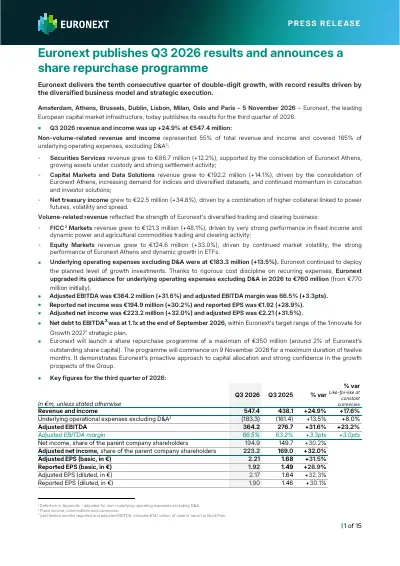
This quarter, we delivered the strongest quarterly performance since our IPO, with record revenue and income of €547.4 million, up 24.9% compared to last year, almost 25% growth in revenues and income. We have delivered the 10th consecutive quarter of double-digit revenue growth.
Such sustained performance over 2.5 years is clear evidence that the diversification of Euronext has transformed the group into a stronger and more resilient business, capable of generating solid growth across different market environments. 10 consecutive quarters of double-digit growth is not luck.
This is performance. Adjusted EBITDA increased by 31.6%.
As a result, the EBITDA margin reached 66.5%. This represents a +3.3 percentage point improvement compared to Q3 2025, despite continued investment in growth.
Adjusted net income increased by 32% to €223.2 million. Adjusted earnings per share rose by 31.5% to €2.21 per share, highlighting our consistent value creation for shareholders.
Non-volume-related revenue accounted for 55% of total revenue and income, and increased by 14.8%, almost 15% increase of non-volume-related revenue year-on-year. This robust performance was driven by the contributions of Euronext Athens, alongside commercial expansion and sustainable growth in custody and settlement.
The strong results were also supported by renewed momentum in primary markets, especially in listing, and advanced data solutions. Volume-related revenue increased by +40.1%, driven by record volumes across asset classes, resilient revenue capture, and the contribution of our strategic initiatives in power futures.
We consistently diversify our volume-related revenue by adding new products and expanding into new geographies. Our underlying expenses, excluding D&A, amounted to €183.3 million, representing an increase of +13.5% compared to last year.
This reflects our investments in innovation and talent to support long-term growth, as well as the impact of the acquisition of Euronext Athens. On a comparable basis, excluding the impact from acquisitions, our underlying costs grew by +8%, while our revenue grew on a like-for-like basis by 18%.
Net debt to EBITDA stood at 1.1 times at the end of September 2026. Normalized for cash in transit at Nord Pool, our leverage was 1.2 times, in the lower end of our target range of 1 to 2.
Supported by our strong position, we are pleased to announce a new €350 million share repurchase program. Our financial strength enables us to deliver attractive shareholder returns today and to invest in building the capital markets infrastructure for tomorrow.
This ensures Euronext remains at the forefront of rapidly evolving industry. At the time where we return €350 million to shareholders, we are also paying €3,000 of a special bonus to all Euronext employees across the globe who make a fixed salary below €120,000.
Euronext continued to deploy the planned level of growth investments. Thanks to our rigorous cost discipline, and beyond that, a fundamental, rigorous cost culture across the organization on recurring expenses, we are able to upgrade our guidance for underlying operating expenses, excluding D&A, in 2026 to €760 million.
This is €10 million less than the €770 million initially announced in February 2026. Turning to slide 5, I would like to take a few minutes to illustrate the successful delivery of the strategic projects announced in November '24.
Just 2 years later, thanks to consistent execution, to disciplined operating performance, we are now well positioned to capture the future trends on a wide range of diversified asset classes. We are building scalable businesses.
Let me focus on four critical projects. First, we have consolidated our leading positions on ETFs after the launch of ETF Europe in September 2025, the first fully integrated European marketplace for ETFs.
Retail participation in ETF almost doubled in Q3 2026 compared with last year. That demonstrates the attractiveness of this asset class for individual investors.
With the growing number of initiatives announced and implemented across Europe to mobilize household savings and to encourage retail participation, Euronext is very well positioned to capture this long-term growth opportunity. Second, in November 2024, we shared our ambition to expand our fixed income, commodities, and currency trading and clearing franchise.
Since then, we have further integrated the European energy market with new products, new geographies, and new services. Fast-growing physical power activity and the successful launch of our power futures business in the Nordics in March '26 paved the way for further geographical expansion to our power franchise across Europe in order to penetrate larger energy markets.
Third, we have transformed our fixed income trading and clearing franchise into a pan-European offering. Today, we clear all major European government bond markets and supranationals.
We accept collaterals in euro, dollar, sterling, and Norwegian kroner, and we are the only continental European CCP connected to all three leading tri-party agents. Combined with the efficiencies brought by our risk framework, this provides a highly competitive clearing proposition for market participants.
In October, we successfully completed the third and final migration wave of our repo expansion program. Most of the building of this critical initiative is behind us.
Now, the focus is commercial development. More than 20 existing members have already extended their activity to European debt markets through Euronext Clearing.
Several major international banks are onboarding, and finally, our sponsored access model opens the door to the buy side. Fourth, the successful launch of Euronext Securities' new European CSD model on September 21st is a game changer for European capital markets.
By connecting trading, clearing, and post-trade activities through a common infrastructure, Euronext does reduce fragmentation and does improve the competitiveness of European capital markets. What began as a strong conviction in November 2024 is now reality in November 2026.
The first clients are actively using our innovative model, benefiting, first, from greater efficiency, second, from increased choices, and third, a single European framework within an enhanced commercial value proposition. The remarkable performance over the last quarter demonstrates the resilience of our diversified business and the growing revenue contribution of our strategic initiatives.
As you can easily understand, after 10 consecutive quarters of double-digit revenue growth, our results are tracking well ahead the Innovate for Growth 2027 financial targets that we shared with you 2 years ago in November 2024. Our scalable business model, integrated value chain, and our disciplined execution position us ideally to deliver the next level of growth for European capital markets.
I will now hand over to Giorgio Modica for the business and financial review of Q3 2026.
Giorgio Modica
Thank you, Stéphane, and good morning, everyone. Let's now focus on the drivers of the performance for this 10th consecutive quarter of double-digit growth.
I'm now on slide 7. This quarter, we delivered record results with double-digit growth across all business lines.
This performance reflects the strength and diversified business model, disciplined execution, and contribution from Euronext Athens. Total revenue and income in the third quarter 2026 reached €547.4 million, up 24.9% compared to the last year.
55% of revenues and income was non-volume-related. This represents a decrease compared to the 60% in the third quarter 2025, driven by the dynamic trading environment.
This part of our revenues, the non-volume-related one, covered 165% of underlying operating expenses, excluding D&A. Let's take a closer look now at the key drivers behind this exceptional growth, beginning with non-volume-related revenue and income on slide 8.
Non-volume-related business grew 14.8% compared to last year. Security services revenue reached €86.7 million this quarter, a solid 12.2% increase compared to last year.
Custody and settlement revenue grew by 11.8% compared to the third quarter of 2025 to €78.9 million. This strong performance was driven by growing assets under custody, reaching €8.1 trillion in September 2026, up 5.6% year-on-year.
This increase was also supported by strong settlement activity and growing demand for issuer services. Other post-trade revenues increased by 17.1% compared to the same quarter last year to €7.8 million, explained by higher guarantee deposit and the contribution from power futures.
Net treasury income was up 34.8% compared to the third quarter 2025 at €22.5 million. The increase is driven by a combination of higher cash deposit linked to the power future clearing, volatility, and higher average spread.
Turning to capital markets and data solution on slide 9. Revenue reached €192.2 million, marking a 14.1% increase compared to the third quarter 2025.
Primary markets generated €53.3 million of revenue, up 15.6% compared to the third quarter 2025. This was driven by continued strong admission activity and follow-on transactions, despite a volatile market environment.
The performance was also supported by contribution of Euronext Athens. Advanced data solution revenue grew to €73.8 million, up 11.5% compared to the third quarter of 2025.
This performance reflects increasing demand for indices and diversified datasets. Corporate and investor solution and technology services reported €65 million revenue in the third quarter 2026, up 16%.
This performance is driven by the growth in investor solution, governance solution, and a steady upward trend in colocation and logical access. Moving to slide 10.
Our volume-related revenue saw an increase of 40.1% compared to last year. Revenue for FICC markets reached €121.3 million, delivering a 48.1% increase compared to the third quarter 2025.
Fixed income trading and clearing revenue grew by 56.2% to €73.1 million. This reflects record performance of MTS Cash, reaching €88.1 billion average daily value traded.
The activity was supported by favorable market condition, greater use of cash bond alongside derivatives for hedging, and a robust debt issuance across Europe. The activity was also supported by growing of non-Italian volumes and the expansion in the dealer-to-client space.
Commodities trading and clearing revenue increased by 42.1% to €39.3 million in the third quarter 2026. The strong growth was driven by the addition of power futures and record intraday power trading, printing an impressive 40% volume growth year-on-year.
The result reflects strong customer engagement and confidence in Nord Pool's market as Euronext continued to expand the power offering across Europe. The good performance of commodity trading and clearing was also supported by strong activity in agriculture commodities, powered by volatility and a supportive market environment, as well as the expansion in trading options and the extended trading hours.
FX trading revenue reached €8.9 million, up 19.6% compared to the third quarter of 2025. This reflects high volatility at the end of the quarter.
Continuing with our review of volume-related revenue, I'm now on slide 11. Equity market revenue increased by 33% compared to the same quarter last year, reaching €124.6 million.
Cash equity trading and clearing revenue grew by 34.3% compared to the third quarter of 2025, reaching €110.8 million. Average daily volume traded on Euronext cash market reached €13.7 billion, reflecting a 24.4% year-on-year increase on a pro forma basis including ATHEX.
This quarter, Euronext reached an average revenue capture on cash trading of 0.52 basis points. Euronext market share on cash equity averaged 66.8%.
The performance this quarter was also supported by the dynamic growth in ETFs and the strong contribution from Euronext Athens. Lastly, financial derivatives trading and clearing revenue was at €13.3 million, a 23.6% increase compared to the third quarter of 2025.
This reflects higher volume, resilient revenue capture, and the contribution from Euronext Athens. Moving on with the EBITDA bridge on slide 13.
Euronext reported EBITDA for the quarter grew by 29.3% to €355.8 million. This was mostly driven by €77.8 million of organic revenue growth at constant currencies and €28.2 million of additional revenue from Euronext Athens.
When we look at cost, Euronext reported €14.4 million of additional cost at constant perimeter and €7.4 million of cost from change of scope. The increase in cost mainly reflects investment in growth and the impact of the strong share price performance on long-term incentives for Euronext employees.
In the third quarter 2026, non-underlying expenses increased by €6.8 million, mostly related to the integration of Euronext Athens and costs linked to the acquisition of the remaining 25% of GRSS in August 2026. As a reminder, Euronext acquired 75% of GRSS, the leading provider of services to benchmark administrators, in June 2024.
Total non-underlying items, excluding D&A, accounted for €8.4 million this quarter. To conclude with this slide, Euronext adjusted EBITDA for the quarter grew by 31.6% to €364.2 million, with an adjusted EBITDA margin of 66.5%, up 3.3 points compared to the third quarter 2025.
Moving to net income on slide 14, adjusted net income this quarter reached €223.2 million. Depreciation and amortization increased by €5 million, +10.1% with respect to the third quarter 2025.
This increase is mostly explained by the inclusion of the PPA related to Euronext Athens and AcceleFin Control. Net financing expenses increased by €1.6 million.
The increase is mainly explained by higher interest expenses linked to the new bonds issued in November 2025 and FX impacts. Income tax increased by €19 million as a result of the higher profit before tax this quarter.
The effective tax rate amounted to 26.4% for the quarter. Share of non-controlling interest increased by €10.1 million, mostly due to the very strong performance of MTS and Nord Pool, as well as the consolidation of Euronext Athens.
As a result, the reported net income, share of parent company shareholders, reached €194.9 million in the third quarter of 2026, up 30.2% compared to the third quarter 2025. Reported EPS basic was at €1.92 per share, up 28.9% compared to the same quarter last year.
Adjusted net income, share of parent company shareholders, was up 32% to €223.2 million. Adjusted EPS basic was at €2.21 per share this quarter, up 31.5% compared to the same quarter last year.
I'm now on slide 15 for cash flow generation and leverage. In the third quarter 2026, Euronext reported a net cash flow from operating activities of €208.2 million, compared to €401 million in the third quarter 2025.
The difference reflects higher profit before tax, negative changes in working capital from CCP activities, and higher income tax. Excluding the impact of working capital, net cash flow from operating activities accounted for 88.5% of EBITDA in the third quarter 2026, versus 99.9% in the same quarter last year.
Net debt to EBITDA ratio was at 1.1 times at the end of the quarter, at the low end of our target leverage. It includes €141 million of cash in transit at Nord Pool at quarter end.
Excluding this element, leverage at the end of the quarter was 1.2 times. I will conclude now on slide 16.
At our Investor Day 2 years ago, we have announced that we would have proactively assessed special shareholder returns according to our capital allocation principle. In line with those principles, Euronext has decided to launch a share repurchase program of maximum of €350 million, which represents around 2% of Euronext outstanding share capital.
The share repurchase will start off on 9 November for a maximum duration of 12 months. This program underlines our strong confidence in the growth prospects of the group, and will not impact the flexibility from a strategic standpoint, nor the capability to invest and capture market opportunities.
With this, now I would like to give the floor back to Stéphane.
Stéphane Boujnah
Thank you, Giorgio. Before we conclude, I would like to insist on the outstanding performance of several businesses and the growth opportunities ahead.
Let me focus on four critical developments that pave the way for future growth. First, the integration of Euronext Athens continues to deliver very tangible results.
In October, we welcomed the third shipping company to list on Euronext Athens, reinforcing the group's position as a global hub for the maritime sector. This is a very fundamental new development of the Athens Stock Exchange.
The momentum on the Greek market is further strengthened by the reclassification of Greece to developed market status that led to exceptionally high trading volumes this quarter, and this is to continue. In October, we also saw a strong pickup in follow-on transactions, with the completion of multiple large capital increases, including some multibillion-euro transactions.
Third, the FICC markets revenue grew by +48.1% compared to last year, as underlined by Giorgio. Although growth was supported by the favorable market environment, our continuous innovation and geographical expansion made the difference and is going to continue making the difference.
First, we continue to extend the MTS model internationally, and we innovate in the dealer-to-client space with new product launches. Second, the energy transition and electrifications are reshaping the European power market.
Building on the successful launch of power futures in the Nordics and the Baltics, and the structural growth of intraday tradings, we are now expanding our physical and financial power offering across Europe, in particular in the most promising large electricity markets in the rest of Europe. Third, the dynamic growth in agricultural commodities was strengthened by the expansion in trading options and the extended trading hours that made the difference over the past few months.
Fourth, the Savings and Investments Union has the potential to become a major catalyst for European capital markets. By encouraging households to invest a greater share of their savings in capital markets, Europe can unlock a significant source of long-term funding for businesses, innovation, and infrastructure.
As retail participation increases and defined contribution pension systems develop, capital markets become deeper, more liquid, and more attractive to issuers and investors. This policy shift has started in most countries where Euronext operates an exchange.
Governments are building the bridges between savers and markets. A growing number of EU countries are implementing initiatives to increase retail participation to lit market.
With increased amount of savings moving to pension funds, hence to long-term investments, hence to deeper liquidity, this is going to translate into significantly higher volumes of equities trading in the next years. These developments are encouraging and closely aligned with Euronext's long-standing vision.
For Euronext, this supports structural growth opportunities across trading, clearing, settlement, custody, indices, and market data, while strengthening the competitiveness of European capital markets as a whole. Finally, earlier this week, we have announced that the Supervisory Board of Euronext intends to nominate David Knibbe as Chief Executive Officer and Chairman of the Managing Board at the Annual General Meeting on May the 25th, 2027.
The appointment of David Knibbe follows a rigorous succession process conducted by the Supervisory Board, which considered several candidates and profiles. The Supervisory Board concluded that Mr.
David Knibbe's leadership experience and track record make him well placed to lead Euronext into its next phase of growth. Given that David Knibbe is expected to join Euronext in May '27, there is little more to add at this stage beyond what has already been communicated.
For today's call, I suggest that we focus on Euronext's excellent business performance and the continued execution for our strategic objectives because 2027 will not be a transition year for Euronext, it will be another year of success and continued growth. Thank you for your attention.
We are now ready to take your questions.
Operator
If you wish to ask a question, please dial pound key 5 on your telephone keypad to enter the queue. If you wish to withdraw your question, please dial pound key 6 on your telephone keypad.
We kindly ask you to limit the number of questions to two per analyst. The first question comes from Andrew Lowe of Citi.
Please unmute your mic and go ahead.
Andrew Lowe
Hi, thanks for the presentation. I had questions in two areas.
The first is in your new markets for CSD. In your opening remarks, you referenced client wins, clients that have already started using your offering.
Could you give us an idea of the quantum here? There was an issuer switch announced last week, if you could give maybe some color about the pipeline for Q4 and 2027, that would be very, very helpful.
The second question is just on your commodity business. You've had another really strong quarter for Nord Pool and the rest of the commodities business.
Could you just outline the drivers of Nord Pool's growth, specifically in the intraday spot market? Looks like you've been taking a lot of market share from your competitors in Central Europe.
What's driving this, and how does your offering compare to the competition? What benefits have you seen so far from running the power futures franchise along that spot franchise?
That would be really helpful.
Stéphane Boujnah
Thank you very much for your questions. For the sake of completeness, I'll give the floor to Pierre Davoust, who is in charge of our CSD expansion project, and we answer your first question.
Then, Camille Beudin, Chief Diversification Officer, who is responsible, among other things, for our commodities business and our power business, is going to answer your second question.
Pierre Davoust
Thank you for the question. As this project is not a migration, it's a project where we offer new choice to clients that has started on the 21st of September.
As a result, what clients look at is early adopters that are willing to be the first ones to test an unprecedented route. The first adopters are there, as mentioned by Stéphane, on the two sides of the market.
First, on the side of the issuers, we already have around 16 issuers listed in Paris, Brussels, and Amsterdam who use the Euronext Securities model, including four of them who joined recently the model in the context of our project. This is the beginning.
As you rightly noticed, there are further issuers who are willing now to follow suit and join Euronext Securities' value proposition. Very concretely, one of them, Eurocommercial Properties, announced last week publicly their decision to migrate to Euronext Securities, and others are following.
We see on the issuer side, first adopters having already moved to Euronext Securities and a healthy pipeline of issuers who are willing to follow and are taking steps to move to Euronext Securities. On the other side of the market, we have the first trading members who are live on the model.
It's a couple of them. In addition to this first adopters who are already using the model and demonstrating the relevance of the new offering, we have a pipeline of clients who are actively onboarding into the new Euronext Securities settlement model.
On both sides, we have the first adopters who are live on the model, we have a healthy pipeline of clients who are taking steps to move to Euronext Securities. It takes time.
It takes time because it's unprecedented for clients to change the CSD post-trade structure, but we see a healthy pipeline of clients gradually moving from the incumbent settlement model to the new European settlement model delivered by Euronext.
Camille Beudin
Then to your question on our energy offerings, let me start by your question related to the intraday offering. There are two underlying drivers behind the growth.
The first one is the market. The market for intraday is growing, fueled by the growth of renewable into the grid.
The second driver is basically the growth of our market share due to the quality of our platform and the superior customer experience we offer to our clients. When we acquired Nord Pool back in 2020, it was primarily a Nordic business, but we have significantly expanded the offering across Europe, and we now generate more revenues from our intraday offering outside the Nordics than within the Nordics.
Indeed, the market share has grown significantly across Europe, especially in Germany, in France, in the Netherlands, and in Belgium. Now when it comes to the power derivatives offering, it was also an important driver of growth during the quarter.
Actually, the month of September was the highest month in the power derivatives market for the last 5 years, it demonstrates the confidence of the customers in the offers that Euronext has been rolling out in March last year. The market share in the power derivatives market in the Nordics for Euronext Nord Pool has been, during the third quarter, above 95%, 95%, and the open interest recorded on our platform reached a new record at 1.70 1.97 terawatt-hour, growing 14% since the migration.
As Stéphane and Giorgio alluded to during the introductory remarks, it is an important source of growth for us going forward, and we are going to expand this power derivatives offering in Q2 next year, starting with Germany, and then progressively rolling out this offering to the rest of the European continent.
Operator
The next question comes from Julian Dobrovolschi of ABN AMRO ODDO BHF. Please unmute your mic and go ahead.
Julian Dobrovolschi
Good morning, gentlemen, and thanks for taking my questions. Two as well.
Maybe to begin with the fixed income business. Again, another outstanding quarter.
If you look at it for the fixed income trading and clearing, up 56% year-over-year and 30% quarter-over-quarter, clearly very strong comps. I'm just wondering if you could split and kind of talk about what's coming from the structural expansion, i.e., let's say international expansion in the business, what's driving the part of the growth from that, and how much is then coming from the volatility side?
Also in light of your international expansion agenda, which I think is going really well, just wondering how should we think about the new run-rate growth in the fixed income business? Then the second part on the minorities, the non-controlling interest now pretty much doubled if you compare it to Q3 '25.
Just wondering what's your appetite to buy out the minority stakes that you currently have in MTS, Nord Pool, or the Euronext?
Stéphane Boujnah
Thank you for your question. I'll let Giorgio answer both questions, the one on the fixed income dynamic and the minority interest where we have a clear view, which is that we manage businesses that are jointly owned by some of the users in a very effective manner, and our intention is that as long as they want to stay with us as partners for these ventures, we are going to continue developing this business with them.
Over to you to answer specifically the situation of MTS.
Giorgio Modica
Absolutely. When it comes to MTS, I believe that it does make sense to look at the evolution of volumes throughout the year to give a sense of what is seasonal, what is recurring.
What we have seen is at the beginning of the year, we have started seeing a good growth of MTS, running double-digit growth, and then that growth has keep increasing until the volatility of the market has spiked. What we have seen is that when the volatility has spiked, the volume of the platform have temporarily reduced for some weeks, and then the growth has restarted even stronger than what it was at the beginning of the year.
The reason why I'm mentioning that is that what we are currently seeing in the market is something which is similar to what has happened at the beginning of the year. We have recorded in the third quarter exceptional volumes that were mainly triggered by a prolonged period of stability that helped market participant to build large fixed income portfolios.
With the increased volatilities of the last 3 weeks, we have seen a reduction of volumes, which with the gradual normalization of market condition, has partially recovered. To make long story short, what I would say is that we are still looking at very sustained growth across the cycle, which from time to time is altered by spikes of volatility to return then back to the previous level when market condition normalized.
In this respect, the exceptional quality, which is widely recognized, of MTS is a source of confidence for future growth.
Operator
The next question comes from Grace Dargan of Barclays. Please unmute your mic and go ahead.
Grace Dargan
Hi, good morning, thank you for taking my questions. Maybe I could just come back on the fixed income, because it's been a great performance.
I guess I just wanted to come on the revenue margin piece, just the volumes within fixed income. Obviously, there'll be a mix effect in there, but by product, should we be thinking about broad stability within the revenue margins?
Then secondly, on Athens, that continues to surprise to the upside. How are you thinking about Athens's growth into next year across all the business lines?
Where do you think there is the greatest upside now? Thank you.
Stéphane Boujnah
I'll take the question on Athens and then Giorgio will answer the question on fixed income. The acquisition of the Athens Hellenic Exchange that became Euronext Athens is an absolute success for several reasons.
Number one, and you need to look at what we are doing in Greece in an holistic manner, number one, we believe that the equity market in Greece is going to continue growing because what we have made is to connect the Greek market that were relatively insulated to global markets. There is a defining event that's going to happen in June '27, which will be the connection of the Greek equity market to the single liquidity pool, the single book, and the single technology platform of Euronext that will be a significant accelerator of volumes in Greek markets.
Second, we are actively working on primary markets development in Greece. There is a significant number of Greek shipping companies that up until now were listed everywhere in the planet except in Greece.
We have created a momentum for those large Greek shipping companies to be listed back at home, and this is possible because they see the prospects of enhanced liquidity on the Greek markets and enhanced visibility to global investors. This is going to continue beyond shipping, which is already a significant sector in Europe, and in particular for Greek technology and services companies, and we are confident that it's going to play a significant role.
Third, Greece has been redefined by various index players like MSCI, FTSE, etc., as a developed market, and this is changing completely the perception by various asset managers in the planet vis-à-vis Greece. This is also a significant source of tailwind.
In addition to that, we are growing our business in fixed income with the Debt Management Office of Greece. We are growing and expanding into various projects with EnEx, which is the Greek energy market, which is owned 40% by Euronext Athens.
Beyond that, across all the value chain, we are working on various synergies that to be extracted from the business. We are already very advanced, actually well more advanced than we thought at this stage, on extracting synergies.
We announced to the market that we would be extracting €12 million of synergies, and we are going to probably beat that guidance because we are making huge progress. Never forget that there is something more or not which is as important as what we do in Greece for the Greek markets, which is that we have decided to create in Athens a technology and support center that is going to operate for the benefit of the rest of the group, taking benefits of the top quality of Greek talents, which have a cost which is lower than the one in other geographies.
Just as we have now 500 people doing IT in Porto, Portugal, for the rest of the group, we are building a team that is going to increase significantly in Athens to serve the rest of the group. That will have, over time, a significant impact on the cost base of the group.
That's for Athens. On fixed income, Giorgio.
Giorgio Modica
When it comes to fixed income, the pricing of fixed income is relatively stable with respect to changes in volumes. When it comes to the profitability, what you should look at is two things: increase of volumes generally trigger a very similar change in revenues, and as is the same for other platform business, the cost base is largely fixed.
That's very helpful, thank you.
Operator
The next question comes from Michael Werner of UBS. Please unmute your mic and go ahead.
Michael Werner
Thank you, guys, for the presentation. Two questions from me, please.
I guess, first, I think in the past couple of years, you've alluded to some AI-driven cost savings. I was just wondering if you can update us on your views there, and any quantification would be great.
Then, second, on MTS, just going back to kind of the fixed income volumes, and again going back to Giorgio's comments about the decline in volumes more recently of the volatility. The declines were quite substantial, let's call it 50%, 60%, and essentially almost overnight.
I was just wondering if you could give us a little bit more color as to kind of what drives that change in the client behavior in terms of activity, and why ultimately it seems to happen, or at least did in October, suddenly? Thank you.
Stéphane Boujnah
Thank you. Giorgio is going to answer your question on MTS.
I'll take your question on the cost base to the extent it's related to AI deployment. AI is being deployed across the organization in a very systematic way.
As I said on a few occasions, that creates some debates about the total cost of operating and deploying AI. Second, it creates all sorts of strategic issues about what are the risks associated to outsourcing to AI agents some significant parts of our business.
Third, it creates a question about the sustainability of this deployment and the way we manage our talent pool in the new context. Within that framework, which is much broader than just cost and just face value of AI deployment, we are definitely observing stronger than expected cost reduction related to AI.
We do not communicate any specific number in this respect because the fundamental decision from our side of the call is how much of this productivity gains we capture and return to shareholders, and how much we reinvest in terms of spare capacity into new projects. When you are facing a company that does 66.5% EBITDA margin and a share buyback of €350 million and a revised cost guidance, you have to assume that AI is contributing to that strong performance in terms of cost, is contributing to the capability for us to invest in new projects by releasing spare capacity.
The permanent decision we have to take is to do it in a sustainable manner, addressing all the three constraints I mentioned earlier: risk profile of outsourcing decisions, the management of the talent pool, and total cost of operating those agents, because this is not free like internet, it's expensive. Then precisely decide where we allocate productivity gains, and that's the way we address the things.
There are more productivity gains than what you see, and a part of them are reinvested in the business.
Giorgio Modica
Then when it comes to MTS, one way to look at it is the following: you should look at two parameters. The parameter number one is the absolute level of volatility in the market, and the parameter number two is what is the level of expected volatility for the next months.
These two drivers, I believe, explain what has happened to the volumes. Let me try to clarify each one of the two.
First one, level of volatility. When if you are a fixed income trader, if the volatility is extremely low and you're making money pretty much with changes in the yield curve, especially on the short end, you need to build huge portfolios to gain something.
Because as the market is stable, if you want to make a lot of money, you need to deploy a lot of money. This is variable number one.
Variable number two is when there is a significant expected change in volatility, you need to adjust before it happens. If we apply these two drivers to what has happened in the last 12 months, I believe that it gives a fairly good view of what has happened.
At the beginning of the year, we have witnessed a very similar sharp decrease in volume exactly in the moment when the expected volatility for the following months has increased quite rapidly. The same thing has happened at the beginning of this quarter when we have seen the drop in value that we have registered.
Now, where are we in this moment? We are in a moment of sustained high level of volatility.
Now, what is reasonably to expect is that once this level of volatility is going to go back to more normal level, we will see the reverse of what has happened, which means traders building back up more significant portfolios and driving more trading activity that will drive tighter spread and with all the positive cycle. Now, if we look at the trend in the last 4 weeks, what we have seen is something which is positive, which is, despite the fact that the market volatility has remained unusually elevated, we are starting seeing some recoveries that are driven by the fact that these high level are stable.
What we have seen is volumes that have dropped to around €40 billion per day. Now, if I look at the volume of yesterday, they were closer to €60 billion, which is still a reduction with respect to the record quarter that we have just reported, and a more sustained level of activity.
Going forward, what do we expect is again that when market condition will have stabilized, we will keep seeing the trend of growth that has characterized MTS in the last 5 years.
Operator
The next question comes from Benjamin Goy of Deutsche Bank. Please unmute your mic and go ahead.
Benjamin Goy
Yes, hi, good morning. Two questions, please.
Sorry, one more on MTS, maybe similar to the commodities business. Can you talk a bit about the non-Italian volumes you're seeing in terms of their volumes and maybe even at some point revenues, what developments you're expecting?
Then secondly, on the leadership transition, I know you want to stick it to operating momentum, but clearly you have an outsider coming in, and there might have been internal candidates. Just wondering how the board and the group thinks about talent retention to ensure this operating momentum?
Thank you very much.
Stéphane Boujnah
No, I'll take the transition question, and Giorgio will take your first question on MTS. The board has decided, after a long process, to appoint the current CEO of NN in the Netherlands as the next CEO of Euronext.
He will take office after the next general meeting in May '27. The board is taking steps to organize proper retention, and I can assure you that everything is being done to maintain the continuity of operations and strategy for sure to deliver a strong 2027 year, and to create the platform for a new period, a new development under the leadership of Mr.
Knibbe when he comes. I would not be concerned about any retention issue.
Giorgio?
Giorgio Modica
Yes, when it comes to non-Italian revenues of MTS, a few elements on my side. The growth of the non-Italian business is as strong as the one of the Italian business, potentially at times even stronger.
However, given the fact that the two go at the same trajectory, still the bulk of the business in MTS is linked to the trading of Italian government bonds. Same is true for the growth of the dealer-to-client business that keeps recording double-digit growth, but remains a minority share of the MTS revenue.
To make long story short, unfortunately, the exceptional success that we are encountering in Europe is a bit diluted by the intrinsic strength of the Italian business.
Operator
The next question comes from Russell Quelch of Morgan Stanley. Please unmute your mic and go ahead.
Russell Quelch
Good morning, thanks for taking my questions. I have three.
Firstly, around the MTS expansion outside of Italy. France is perhaps the biggest opportunity here.
Any progress there in your conversations with the DMO around primary issuance? I'm just wondering, is this a matter of time given you've shown the benefits of MTS within Italy, and then what that can bring to the French market?
Do you think that recent volatility in French sovereign spreads highlights the need for innovation there in France? Secondly, on costs, given the updated cost guidance, I wonder what the exit cost base should be for next year?
Can you maybe give a bit more color on where you're looking to accelerate investments, you said that earlier, based on the better cost performance? Specifically on digital assets, wondering what your strategy is there.
It would be great to hear if there's anything going on when you think about your strategy around that. Then thirdly, just on the European CSD expansion, just to come back to that.
It seems like there's an upgrade to your language given you describe this as a game changer in the press release. I'm wondering how quickly you expect volumes to ramp there, and what conversion metrics or milestones that we should be tracking through 2027?
Stéphane Boujnah
I'll take your question on MTS France. Giorgio will take your question on the cost dynamic.
I will then give the floor to Nicolas on the digital asset project because he is in charge of this project and he will tell you broadly where we are, because we don't want to create specific and numerical expectations until the project is fully live. Then I'll give the floor to Pierre Davoust to answer your question about the definition of success in '27 for the CSD expansion.
On MTS France, we have, as I told you, a very intimate dialogue with the Debt Management Office, the office of the minister in charge of budget, public accounts, and the office of the minister, and the minister himself, in charge of economy and finance. The situation on the French debt is under control, and the Debt Management Office is successfully doing all the auctions they have to do in '27.
They have a close and intimate relationship with primary dealer system. They are using more MTS France that already exist than they do in the past.
We have a continuous dialogue about at what time it would make sense for them to move more significantly to a different incentive-type of program. At the moment, they have not yet made the relevant steps for all sorts of reasons I don't want to comment here, which is a combination of interest for liquidity management versus the signaling of what it would mean in the current environment.
As I told you, it's not yet there. I believe that one day it will happen.
When it will be the case, I don't know. It's the definition of a moonshot.
It would be a game changer for MTS. It will happen, but I don't want to create specific expectations on timing because that will have significant implications for the primary dealers who are very close to the Debt Management Office of France for the moment.
I can't be more specific, except that it's work in progress, and we are not yet where we want to be, but we are making slow progress. Giorgio on costs, Nicolas Rivard on the digital assets ambitions, and Pierre Davoust on the CSD expansion's definition of success for '27.
Giorgio Modica
The best answer I can give to you is the following: that there are different elements that are present at the same time. Number one is that we are starting to see positive impact coming from the implementation of AI.
This is already happening, and we will see that as well in the next years. The second element is we're seeing as well a strong demand to develop new solutions as a way to improve the service we provide and generate other opportunity going forward.
We need to put all these into something that makes sense for the budget of next year. We are right in the middle of the budget process, which is going to be the mean to make a synthesis in between the different pushes on the one side.
Everyone has a very exciting opportunities. On the other side, we need to prioritize and allocate capital in the most efficient fashion.
Unfortunately, it's a little bit early to tell you exactly what is going to be the net effect of all the elements I've just described. This is going to happen, as every year, in February next year where we will announce the cost target for the following year.
What I can tell you is that these two elements are equally relevant and equally true. On one side, we are still benefit from increased efficiency.
On the other side, we see a lot of opportunities that would justify for us keep investing in new solution in '27 and '28.
Nicolas Rivard
On the digital asset, I want to share with you three three points. The first one is indeed, as this domain remains highly exploratory, there is increasing interest in this space with an increasing investment we see across various stakeholders.
Security tokenization could be an enabler to reach new client and expand the usability of existing assets. The second point is that Euronext has already allocated resources, in line with the cost guidance, with a dedicated digital asset team.
The team is currently working on the most promising products and services with the objective to identify the most relevant one before scaling our offering. As mentioned by Stéphane, it is too early to create specific expectation or guidance about this initiative.
The third point is Euronext is very well positioned as a Europe-leading financial market infrastructure, and is very well positioned to bridge the gap between traditional finance and digital finance. We have a pan-European footprint, strong commercial relationship with largest global investor, asset holders, intermediaries, etc., and we have a full functional coverage of the transaction chain and asset life cycle.
There is a strong interest from market participant to co-develop solution with us in this distributed digital asset space.
Pierre Davoust
I will now answer the question on the language on the CSD and the definition of success in 2027. I think first point is that the reason why we say it's a game changer is that for decades, European equity markets have been stuck with fragmented domestic post-trade infrastructures.
This is the first time in decades that clients now have access to a European infrastructure. To take the words of the head of custody at a tier-1 bank, the standstill has lasted for far too long, and we are putting an end to this standstill, and that's why we say it's a game changer.
Second point, I think it's important to stress that this is not a winner-takes-it-all type of competitive dynamic. In some other parts of the capital markets, either you win the liquidity or you don't win anything.
In this particular case, because there is an interoperability between Euronext Securities and incumbent CSDs, we can gradually build market share, and this is demonstrated by the fact that we have first clients that have joined already the platform. Now, last point, what does it mean for '27, and what's the vision of success we have for 2027?
For me, really, the vision of success is to have a regular flow of new clients leaving the incumbent infrastructure and joining our European value proposition, both on the issuer side and on the market participant side, and to see that regular flow of clients onboarding into our platform translate gradually into visible revenue, top-line impact throughout 2027.
Stéphane Boujnah
Just if I may complement to give a sort of a broader perspective. It's absolutely normal and legitimate for you, or from your side, to try and translate into numerical output everything that the company does, but from our point of view, you have to realize that this project is successful because we had to transform a PowerPoint ambition in November '24 into a live platform in November '26.
Actually, it went live in September. The journey to transform what was a vision and an ambition in November '24 into a live platform with clients moving and migrating in September '26 is a lot of technology development to build a state-of-the-art, brand-new technology platform, to build an integrated model, to build a commercial value proposition which is very competitive, to have it blessed and endorsed by supervisors, to build what I call a roaming agreement with the incumbents to make sure that the transition or the migration is seamless for clients from their existing provider to Euronext Securities.
This was a very heavy-lifting project that we deployed on time, on budget, over the past 2 years. Now, it's true that in order to monetize that platform completely, we need to accelerate the commercial development.
It was always meant to be a progressive process, and this process has started with the first clients, and the focus of our organization is going to be for the next few months on commercial deployment. I want to insist, from this side of the call, the difficulty of intensifying commercial development is far less complicated than architecturing, designing, and executing a heavy-lifting technology project, supervisory project, operational project, commercial positioning project, competition management project, and interoperability project.
I want to insist on that. I fully accept, recognize, and acknowledge the need for you to have numbers for your model, but I think we are building something which is scalable, which is new, which is changing, and has changed already, the landscape because prices have reduced significantly because of us joining the market and creating competition.
In this respect, it's a game changer. To your question, which is basically, show me the money, you will show you the money when the money is there, and the money is starting to be there, but not in a material level for the moment, but the money machine is built, which is very different from where we were 2 years ago.
Operator
The next question comes from Hubert Lam of Bank of America. Please unmute your mic and go ahead.
Hubert Lam
Hi, good morning, I've got a couple of questions. Firstly, on cash equity markets.
The market share was quite high at 66.8%. Could you talk about what's driving this, and if this can be sustained?
The other question is also on cash markets. The revenue capture was also increased quarter-on-quarter, 0.52 basis points, despite the higher volumes as well as the higher order size.
Could you also explain what's going on behind this and if this is also sustainable? Thank you.
Stéphane Boujnah
I'll let Nicolas Rivard reply to your question because he is in charge of our cash equity market and he will reply to both your questions on market share and on yield.
Nicolas Rivard
Thank you for your question. On the market share, indeed you noticed the strong performance on the quarter, which is also in line with the previous quarter in terms of performance.
There are two drivers in this performance. The first one is linked to the very strong performance of the market share on lit continuous market.
Euronext has successfully recapture lit continuous market share thanks to a successful liquidity management program and better performance compared to other competitors. With regard to the sustainability, you know very well that it is a very competitive market, and that it's a constant battle, but the battle for now is in a very good shape.
The second one is linked to the market structure with a decrease of relative weight of dark and periodic auction compared to previous quarters, and therefore an increase of auction weight in the mix, which explain also the strong performance of the market share. With regard to your second question on the yield, the yield year-on-year is slightly down, quarter-on-quarter is up.
There are three effects to this performance. The first one is, however, a decrease of volume compared to the previous quarter, which explain a significant portion of the increase of the yield because, as our fee grid is based on tiering and volumes.
The second driver is the relative weight of the Euronext Athens with regard to the overall mix of volumes. You have noticed that the overall volume on Euronext has decreased quarter-on-quarter compared to Q2, whereas the volume of Euronext Athens has increased, notably as mentioned by Stéphane and Giorgio, linked to the very strong volume on the day of the rebalancing linked to the change of status of Greek capital market.
The third element, which is of lesser importance, is as you noticed, the slightly up order size compared to previous quarter, with a record 21k of order size, but it is of lesser importance, and it's a negative one. Those are the three elements that you should have in mind.
Operator
The next question comes from Enrico Bolzoni of JP Morgan. Please unmute your mic and go ahead.
Enrico Bolzoni
Hi, good morning, thank you for taking my questions and for the presentation. I have two questions, one on the CSD and one on AI, please.
Starting from the CSD, I know you answered already a number of questions on this topic, can you perhaps just give us some color in terms of what competitors, or the incumbents if we want to call them, are trying to do to protect their market share considering your offering, which clearly it's very interesting? That's my first question.
My second question is a bit of a general question on AI, but I wanted to hear from you. We often hear arguments about how AI can lower costs, but specific to cash equity markets, I was just curious to hear from you on whether you think that AI can perhaps increase competition between the various venues, lit, dark pool, systematic internalizers, because I suspect that it will make everybody better, everybody will be more efficient, and I was wondering whether this will have repercussions in terms of pricing, and how do you expect this will move flows and market share over the medium term?
Thank you.
Stéphane Boujnah
On the second question, Nicolas Rivard will share with you intuitions, because I don't think we have definitive views. I would advise everyone to be cautious about the concept of AI being a one-size-fits-all development.
It has plenty of implications, in particular for trading strategies, for enhancing what used to be called back in the days algorithmic trading. Clearly that will change the behavior of all sorts of asset managers.
To what extent it's going to fragment liquidity is a question that is not as obvious in my view. Nicolas Rivard will share with you his intuitions.
For the moment, we don't see benefit in fragmented liquidity and large spreads that could be compensated by AI development. Anyway, we are in the space of intuitions.
Nicolas will share his views. On your CSD question and how the incumbents are reacting, Pierre Davoust is going to give you facts.
Nicolas, you want to take the open-ended intuition question?
Nicolas Rivard
I can try, and thank you for your stimulating question on this Friday morning. Two two intuitions I want to share with you.
The first one is, and you have not mentioned, but it's something which is getting traction, is agentic trading, where more and more brokers are proposing LLMs integration to build portfolio, to consume real-time market data, even to execute automatically trades. While it's very early and it's, again, an intuition, it's difficult to put number on it at the moment, we see it as a positive trend.
Everything that can empower retail investor to invest smartly and to become more sophisticated with regard to their investment, we believe is a good solution and it's a good outcome. We believe that it should increase the demand for real-time market data, and the demand for an increased trading volume overall in the market.
The second intuition is with regard to your comment on the market structure, which underline a number of assumptions which I don't have the answer to. The first one is that the market today is not totally efficient, which means that you alluded to the fact that with AI, some market participants could find different ways of trading and leveraging different platforms, which is an hypothesis and I'm not sure this will be confirmed.
The second one is that Euronext in this overall space is going to lose to other platform, which, as I mentioned in my previous answer, is not proven by data at the moment, as we are performing very well on the cash equity market share, on the lit continuous market share, on the auction, etc. My intuition at the moment, on the first one is stronger, which is a positive, and on the second element is I don't have a view on the fact that it's going to be a negative trend, to be honest.
Pierre Davoust
I will now answer the question on what is the competition doing, and maybe highlight also what we do in turn to fight against this. I think our competitors are mainly doing three things.
One, they have intensified their commercial engagement with clients to the point that some clients told us, thank you because thanks to your project, I now know that I have an account manager at one of your incumbent competitor. Secondly, they reduce the fees to diminish the incentive for clients to move to us.
Thirdly, they highlight, especially to issuers, the risk of moving to this new European infrastructure that we build out of Euronext Securities. What do we do to counter that?
On the client side, beyond being extremely customer-focused, we leverage one key asset of Euronext, which is our integrated value chain. With Mathieu Caron, who is on the call, with Nicolas Rivard, who is on the call, we are joining forces to engage with clients in holistic way to sell Euronext Securities, but beyond selling Euronext Securities, to be there to support clients front-to-back in their capital markets activity, and this proves to be a powerful means to achieve client wins.
On the fees, yes, our competitors reduce their fees. We are still competitive and more competitive in many cases.
Now, value proposition is not just about fees, it's also about the services and the value added that we create. We've invested a lot into new services that not only help clients cut their costs, but help clients doing business in a better way, especially around tax services, for instance, or around the way clients manage registered shares, investors.
Thirdly, on the risks, we spend a lot of time demonstrating to clients, especially to issuers, that there is no risk in moving shares from where they are today to Euronext Securities. We have been successful so far because the first adopters who looked especially at this risk aspect concluded that it was okay to have their shares issued outside of their home country in a European infrastructure.
Operator
The next question comes from Oliver Carruthers of Goldman Sachs. Please unmute your mic and go ahead.
Oliver Carruthers
Hi there, morning, team, and thanks for taking my questions. One question on advanced data solutions and then one follow-up on MTS.
On advanced data solutions, just as we think about the growth rate in ADS ex-Athens in 2026, which is already kind of very strong in 3Q, just how much benefit are you going to get from the October reasonable commercial basis related changes to market data pricing? Should we view this as a discrete pricing benefit that lifts Q4 and that kind of base for 2027, or does this new framework create an opportunity just for structurally higher pricing and monetization going forward?
Then, if you can, what would the growth rate look like without this benefit? Then the second question, really just a follow-up on MTS.
I think Giorgio, you comped the kind of post-September volume backdrop to kind of what we had earlier in the year. Interested if you can give any kind of specifics and numbers on MTS Cash, which is I guess the biggest revenue driver for you.
Are we going back to levels of the €50 billion ADV that we saw in March, April this year? Thank you.
Stéphane Boujnah
Thank you for your question. Nicolas Rivard, who is also in charge of our advanced data business, is going to answer your first question, and Giorgio Modica to follow on the MTS developments.
Nicolas Rivard
Thank you for your question. Two two points.
First, in terms of revenue drivers, I think before answering your question, it's important that you understand the revenue drivers. The strong performance of advanced data services is driven by a strong performance of our index business, also by the strong monetization of data across the group in non-real-time data and quant product, and the performance of data from asset classes beyond equity and ETF.
Now, I believe it gives some light to your question regarding RCB. RCB is, as you all know, is a regulation which requires Euronext to move to a cost-plus model based on a limited number of client categories.
We have changed our fee model to become compliant with RCB on October the 1st, but under this framework, we don't expect this framework to be revenue-neutral for Euronext as a whole. Answer number one is the revenue driver you understood, which are beyond RCB, and the second one, RCB is not a driver of growth in ADS.
Giorgio Modica
When it comes to the volume, I've tried to propose a kind of a simplified model with two variables. It's one, the volatility in the market as a level, and the second one, the change in volatility in the market.
To be even more explicit, the more benign market condition for us is when the two are low, which means low volatility in the market and no change expected going forward, because this triggers the two behaviors: building up of more substantial fixed income portfolios and increase trading activity on the platform. Where are we now?
We are in a situation where the volatility is high, which is a negative parameter if you want, however is stable, which is a good parameter, and what we're seeing is that thanks to the stability, we are seeing volume recovering. As I said, we have seen from €40 billion to €60 billion per day.
The condition is not yet perfect, because it's going to be perfect when the market volatility will go back to what it was during the period of sustained growth, which is difficult for us to predict. Honestly, I don't have any crystal ball, but what I can say is that when, and we believe that there is going to be a moment where situation will revert back to where they were, when we will have the combined effect of stability and lower level of volatility, we see no reason why the volume should revert back to what we've seen in the previous months.
Operator
The next question comes from Arnaud Giblat of BNP Paribas. Please unmute your mic and go ahead.
Arnaud Giblat
Good morning. I've got two two quick follow-ups.
First on Euronext Securities. Could you comment about the market share that you have so far in French and Dutch settlement?
Also, I'm curious, is there a pricing differential for issues of moving, whether they're small cap or large cap? Do they pay the same, or is it a wide difference?
My second question is on MTS. I just wanted to come back on pricing yield.
Your cash trading volumes have grown at a much higher rate than the actual revenue, I'm just wondering how to think about revenue capture there, whether there's a sliding scale or something to think about. Thank you.
Stéphane Boujnah
Pierre Davoust is going to answer your question on Euronext Securities, and then Giorgio is going to answer your question on MTS. Maybe we need also to clarify your perception of the cash market, and Nicolas can contribute precisely on this
Nicolas Rivard
point. It
Stéphane Boujnah
was on the cash market? It was only on cash, probably MTS, okay, then just Giorgio.
Pierre Davoust
On on the CSD question, actually, you had two points, one on the market share and the other one on on the issuers. Market share, we don't we don't give a market share a number.
We highlighted earlier in the call the the dynamic, which is that following the go-live of the model, we have a number of first movers on the issuer side, on the market participant side, and that we expect to build a market share gradually as clients join Euronext Securities. On the pricing, well, I think the pricing is not a very material element in the conversations with issuers.
What they are looking for is an infrastructure that can support them front-to-back in their access to capital markets, hence the important commercial synergy with our primary markets division. Secondly, they're looking at ways to support, grow, sustain the liquidity of their shares, and the fact that we build a European infrastructure to which we connect participants from all over Europe is a good news for for for issuers who are looking at at at at supporting the liquidity of their shares.
Thirdly, they're looking at value-added services, and here again, we've developed new features that allow clients, for instance, to manage a painful and boring withholding tax processes in a much more efficient manner. These are the things that are central in the conversation with issuers.
Pricing is is is not so much an issue because, as you as you may know, in the CSD business, it's a two-sided market: issuers in one hand and market participants on the other side, and the bulk of the of the fee pool is supported by market participants, not by issuers.
Giorgio Modica
When it comes to the pricing of MTS, on the cash market, you have two, if you want, two legs. One leg is the D2D leg, and the second leg is the D2C leg, or BondVision.
Now, for what it concerns the pure MTS Cash, then the revenue capture is extremely stable and not impacted by volume, which means just to be clear that changes in volume reflect a one-to-one changes in revenues on the upside and on downside. BondVision is slightly different because the pricing is slightly more sophisticated.
It depends on client behavior. If I look at the price of BondVision in the last quarter, the price per value traded has gone up.
This is what you might see in your assessment. The bulk of the business, MTS Cash, is very linear.
BondVision, it depends more on client behavior and could give a kind of the wrong reading around the overall pricing of MTS.
Operator
The next question comes from Tobias Lukesch of Kepler Cheuvreux. Please unmute your mic and go ahead.
Tobias Lukesch
Yes, good morning, thanks for taking my questions. Very quickly on the rock-solid balance sheet that you have, with the adjusted net debt-to-EBITDA ratio of 1.2 times, you're approaching one time basically by the year end, yes.
You have now established the up to €350 million buyback. Just wondering, there would have clearly been a bit more capacity also maybe to go towards midpoint.
What are you doing with the dry powder? Should we think about CEO succession and leaving a bit for the new CEO, potentially also for a new mid-term update, or is that rather something you might redo with the year-end results basically, maybe adding another 2% to 3% buyback yield then?
Thank you.
Stéphane Boujnah
Thank you for your question, and let me be crystal clear. We run Euronext as a going concern.
Next year is a transition year, but it's not a transition year, it's a success year and a continuous year of growth and performance for the company. We do not manage the cash we generate in accordance with any succession plan in any way whatsoever.
What we are doing is the same for the past 11 years since this team is in charge. We try to maximize revenue, and therefore to grow revenues in a diversified manner.
We try to minimize the cost structure. We try to invest a lot of the margin we create to innovate and be relevant and to disrupt existing incumbent market positions, and we allocate the free cash flows we generate to a disciplined M&A, or to return to shareholders if we don't find opportunities to deploy capital in a disciplined manner.
That's exactly what we have been doing for the past few years. When we can do acquisitions without burning cash, as we have done in '25 with the acquisition of ATHEX, where that we paid in shares, we do it.
When we have to pay in cash because we believe that this is an important asset for diversification purpose, like AcceleFin Control last year, we do it in cash. When we find opportunities to deploy cash, but when we find assets that are far too expensive, then we don't bid, or we are being kindly told by the sellers, you are too cheap and too greedy because you don't want to pay the full value, and then we tell them, guess what, we don't pay the full value because we don't get the return on capital employed over the WACC of the company between year 3 and 5 post synergies.
You have to look at the performance of the company as of Euronext as being extremely disciplined on revenue generation, cost minimization, and therefore operating performance and profitability, but being also very disciplined on capital allocation. To answer your question in very concrete terms, we do have investment committees every 4 weeks for 4 hours to review all sorts of opportunities, and we do miss a lot of opportunities, but we make much fewer mistakes than the others.
One of the things we are very proud of, and that we are going to continue, is that over the past 11 years, not only we have multiplied the market cap of the company from €1.4 billion at the IPO to €18 billion as we speak, not only we have returned to shareholders about €3 billion of dividend and share buybacks, but we have also not posted one single impairment. We are not going to start posting impairments, but we are not going either to stop investing if we find right things to invest.
We continue to manage the company as a going concern, and the new CEO, when he takes over, will continue to run the company to deliver growth and performance, and I'm absolutely confident that he's going to do it in a strong way. For the time being, we are not going to inject in capital allocation ambitions any timetable related to what is the normal, ordinary course of action, which is after three three terms at the helm of the company, I'm leaving and there will be a new CEO, but the company will continue to grow in '27 and to perform extremely well.
Operator
There are no more questions at this time. I will now hand back to our speakers for their closing remarks.
Stéphane Boujnah
I thank you very much for your time, and as always, our CFO, Giorgio Modica, and our exceptional investor relation team, which is the best in the Northern Hemisphere, Judith and Margo and all the others, are available to take your questions and to help you better understanding all numbers. Have a good day.