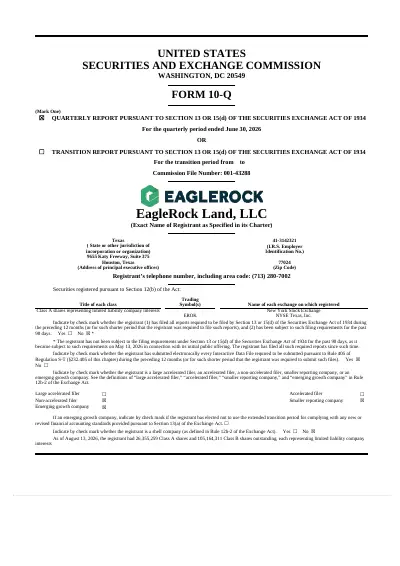
EagleRock Land, LLC
NNYSE:EROKQ2 FY2026 · Earnings Call TranscriptAugust 11, 2026
Operator
Hello everyone. Thank you for joining us, and welcome to the Eagle Rock Q2 2026 earnings call.
After today's prepared remarks, we will host a question-and-answer session. If you would like to ask a question, please press star one to raise your hand.
To withdraw your question, press star one again. I will now hand the conference over to Chris Cossey, Vice President of Finance.
Chris, please go ahead.
Chris Cossey
Thank you, operator. Good morning, and thank you for joining Eagle Rock's second-quarter 2026 earnings conference call.
With me today are Greg Pipkin, Chief Executive Officer, and Neal Shah, President and Chief Financial Officer of Eagle Rock. Shortly, Greg and Neal will deliver their prepared comments before going into a question-and-answer session.
Yesterday, we posted an updated investor presentation on our investor relations website, and we may reference certain slides during today's discussion. A replay of today's call will be available on our website after the call.
Before we begin, I'd like to remind you that in this call and the related presentation, we will make forward-looking statements, current beliefs, plans, and expectations, which are not guarantees of future performance and are subject to a number of known and unknown risks and uncertainties that could cause actual results to differ materially from results and events contemplated by such forward-looking statements. You're cautioned not to place undue reliance on forward-looking statements.
Please refer to the risk factors and other cautionary statements included in our filings with the SEC. I would also like to point out that our investor presentation and today's conference call will contain discussions of non-GAAP financial measures, which we believe are useful in evaluating our performance.
These supplemental measures should not be considered in isolation or as a substitute for financial measures prepared in accordance with GAAP. Reconciliations to the most directly comparable GAAP measures are included in our earnings release and the appendix of today's accompanying presentation.
Now, I am pleased to turn the call over to Greg.
Greg Pipkin
Thank you, Chris, and good morning, everyone. We appreciate you joining us for Eagle Rock's second-quarter 2026 earnings call.
After our successful IPO in May, we've moved quickly to build on that momentum. In what amounts to less than a full quarter as a public company, we are already beginning to demonstrate the potential that is inherent to Eagle Rock's unique platform.
Through the execution of our densification strategy, we delivered strong results for the quarter, with revenue growth of 32.3% and EBITDA growth of 31.7% versus Q1. We also took further steps this quarter to deepen our relationship with Double Eagle, which I'll expand on shortly.
Subsequent to quarter end, we announced the acquisition of Intrepid Ranch, which is comprised of surface acreage that is directly contiguous to our existing footprint in New Mexico, sharpening an already strategic position in the region. Before we dive deeper into Q2, I would like to take a moment to explain Eagle Rock's differentiated surface utilization strategy and go-forward value proposition.
Eagle Rock owns or controls approximately 286,000 surface acres in both the Delaware sub-basin in New Mexico and the Midland sub-basin in Texas within the heart of the Permian Basin. We maintain a stronghold position in both major sub-basins with our acreage co-located or adjacent to deep, economic drilling inventory within one of the premier regions for oil and natural gas development in the world.
Importantly, the activity on our land which directly drives revenue requires little to no capital or operating expenses on our part. By spanning the basin, we benefit from the complementary nature of our position, and at the same time have a broader base from which to grow, both organically and through acquisition.
Double Eagle is one of our key strategic relationships and a meaningful component of our growth story. They are our largest shareholder and continue to be one of the most active private operators in the Midland Basin.
This quarter, we took several steps to further expand our Double Eagle relationship. Our DE Flow water infrastructure system has begun to sell water into Double Eagle's acreage ahead of schedule.
This relationship is backed by a long-term agreement with minimum annual royalty commitments that provide predictable, largely commodity price-insulated cash flow. Beyond the water business, we see real synergies across the asset Double Eagle contributed to us, and we continue to see a pipeline of additional drop-down opportunities over time.
DE Flow isn't just an infrastructure asset; it's a strategic advantage that strengthens our position in the Midland Basin. While the Permian is a prolific oil and gas play, it is evolving and diversifying into a full-scale energy ecosystem.
Commercial development, power generation and transmission, renewables, and data centers are broadening the potential uses for our land and resources beyond traditional E&P activity. We're continually evaluating a number of ways to participate in that broader value chain directly, including power and data center development and wind.
We think about these opportunities as potential upside to the plan we've laid out as we came to market, and not as something we're depending on. Our business model is also unique because of the quality and durability of the revenue it generates.
Our royalty revenue and fee streams are separate from any operating business, and Eagle Rock carries little to no operating or capital expenditures. Additionally, we hold no oil and gas minerals.
Instead, our revenue comes 100% from land-related streams that give us significant size and scale without being directly impacted by the volatility of global commodity markets. Our land position is differentiated because of the quality and depth of the subsurface drilling inventory which has attracted the premier North American upstream operators who are well-capitalized and focused on financial discipline.
This directly contributes to the durability of our revenue stream. In just the past few months, oil has traded from around $60 a barrel, where it sat when we launched our IPO process, up towards $120, and back closer to $60.
Through that swing, activity on our acreage has stayed remarkably consistent, and the capital discipline across the E&P sector means our royalty and fee streams move largely independent of near-term oil price swings. Surface use agreements spell out exactly what we're paid for, which is essentially every activity that touches our land.
When a developer wishes to pursue a commercial opportunity outside of an existing agreement, they have to come back to the negotiating table, which often gives us the chance to revisit other terms as well. That structural leverage, together with the minimum royalty commitments from our operating partners, is a key reason we're confident in the durability of this cash flow.
Turning to growth. Organic commercialization and acquisitive growth work hand-in-hand on this platform, and the same discipline guides both.
We look for assets that are worth more inside Eagle Rock than stand-alone, with accretion to shareholders as the standard for every deal. The clearest example in motion is Intrepid Ranch.
As announced after market close yesterday, we've acquired this approximately 50,000-acre asset in Lea County, New Mexico. The acreage is directly adjacent to our existing New Mexico footprint and includes approximately 22,000 fee acres, an increase of roughly 60% to our fee acreage in the state.
It sits in a corridor developed by several of the industry's most active blue-chip operators and is proximity to growing urban development in the region, and opens the door to non-oil and gas commercial opportunities over time. As with the rest of our portfolio, we intend to bring an active management approach to Intrepid, renegotiating and modernizing surface use agreements, optimizing and expanding our water infrastructure and water rights, and unlocking additional royalty opportunities, including from sand development, all of which we expect to meaningfully improve the acquisition's economics over time.
That's exactly the kind of accretive adjacent acquisition we described during our IPO process, and we will walk through the financial details of that deal in a moment. Every deal we do follows that same discipline: assets that make this platform stronger and are more valuable within the Eagle Rock portfolio than they would be individually.
Now our focus turns to integrating Intrepid and executing on that same strategy across that position. With that, I'll turn it over to Neal.
Neal Shah
Thank you, Greg, and good morning to all. Before turning to our second-quarter results, I'd like to briefly reflect on an important milestone for Eagle Rock.
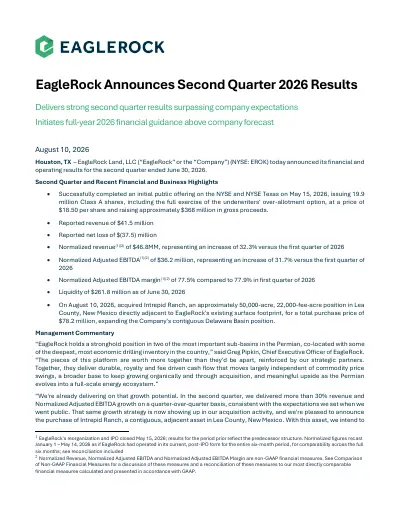
In May, we successfully completed our initial public offering on the NYSE and NYSE Texas, issuing approximately 19.9 million Class A shares, including the full exercise of the underwriters' overallotment option at $18.50 per share, and raising approximately $368 million in gross proceeds. Through the IPO, we combined three complementary businesses into a single, publicly traded platform, establishing Eagle Rock as a differentiated land and resource management company focused on creating long-term value across the Permian Basin for our shareholders.
This milestone is truly reflective of our employees and their dedication. Turning to our second-quarter financials.
For context, I'll be discussing our results on a normalized basis, treating the contributions of the Double Eagle and Shallow Valley assets as if they had occurred on January 1st, 2026, so that you have an apples-to-apples comparison between our second-quarter and first-quarter results. Our normalized numbers also include additional cost assumptions related to operating as a public company.
The second quarter was an especially strong period. The team worked hard to deliver results that were above our internal forecast across all metrics.
We generated strong normalized revenue of $46.8 million, an increase of approximately 32% when compared to the first quarter of 2026, reflecting continued growth across our diversified portfolio of land management and royalty assets. Looking at the composition of normalized revenue, surface use revenues represented $7.1 million or 15% of the total, surface use royalties represented $15.5 million or 33% of the total, and resource sales represented $24.2 million or 52% of the total.
On the operating side, water sales volumes increased by 9% quarter-over-quarter, driven by strong brackish water volumes. Produced water takeaway volumes continue to increase into the second half of the year, benefiting high-margin surface use royalty revenue.
Normalized adjusted EBITDA was $36.2 million, up approximately 32% from the first quarter of 2026, with normalized adjusted EBITDA margins of 77.5%, demonstrating both the benefit of our high-margin revenue with low operating costs, as well as the advantage of Eagle Rock's scale encompassing both New Mexico and Texas. Also, we continue to expect increased revenues from our high-margin surface use royalties, which carry no associated cost of sales, to become a larger share of our revenue mix during the second half of 2026.
Turning to the cash flow statement and balance sheet. The company generated free cash flow of $22.2 million for the quarter.
Capital expenditures were $1.2 million, resulting in free cash flow conversion of 75%. Importantly, adjusting for the cash interest expense associated with carrying the predecessor company's credit facility would have increased free cash flow by $6.4 million, resulting in free cash flow conversion of approximately 96%, demonstrating the immense potential of our capital-light business model.
On June 30th, 2026, we had $61.8 million of cash and cash equivalents and $261.8 million of available liquidity. Our balance sheet remains strong and provides ample financial flexibility to support both our organic growth initiatives and disciplined evaluation of strategic opportunities.
Turning to our outlook, we're initiating full-year 2026 guidance. While August is an unusual time to initiate full-year guidance, as a newly public company, we are pleased to report that our initial outlook is now above our original expectations, driven by the strong momentum in our business and the outstanding execution and hard work of the entire Eagle Rock team.
For the full year 2026, normalized adjusted EBITDA is now expected to range between $129 million and $133 million, reflecting the continued strong commercial activity across our diversified platform and the acceleration of realized synergies between the Shallow Valley and DE Flow systems. Important to note, this guidance does not include incremental EBITDA from the Intrepid acquisition.
Now let me elaborate on the specifics around the Intrepid acquisition we announced yesterday. The $78.2 million headline purchase price net of the $1.1 million deferred surface revenue results in a net purchase price of $77.1 million, implying an attractive acquisition multiple of less than nine times EBITDA.
As Greg noted, we expect to meaningfully compress that multiple through our active land management strategy and commercialization efforts. Given the highly contiguous nature of the acquired acreage with our existing land position, as one would expect, we have intimate knowledge of the land, strong relationships with the operators active across the footprint, deep understanding of the applicable surface use agreements, and importantly, a clear line of sight to additional revenue opportunities.
The Intrepid acquisition is expected to be accretive and further benefit our already strong EBITDA margins and enhance free cash flow conversion. We funded the acquisition through a combination of cash on hand and the company's existing $200 million revolving credit facility, reflecting Eagle Rock's strong liquidity position and balance sheet capacity.
Notably, we continue to view cash and debt as our preferred sources of M&A financing, avoiding dilution to existing shareholders. Thank you for your time and attention.
Operator, now over to you to begin the Q&A session.
Operator
We will now begin the question-and-answer session. Please limit yourself to one question.
If you would like to ask a question, please press star one to raise your hand. To withdraw your question, press star one again.
We ask that you pick up your handset when asking a question to allow for optimum sound quality. If you are muted locally, please remember to unmute your device.
Please stand by while we compile the Q&A roster. Your first question comes from the line of Theresa Chen with Barclays.
Theresa, your line is now open.
Theresa Chen
Good morning, and thank you for taking my questions. Appreciate all the color and context related to what you've seen across your footprint in the few months following IPO.
I am curious as far as the integration of the assets, the volumetric outlook, it sounds like certain things are running ahead of schedule, translating to an improved EBITDA outlook. What has surprised you along the way, and how does this translate to your outlook beyond 2026?
Neal Shah
Hi, Theresa. Thank you for the question.
I wouldn't say that anything has necessarily surprised us. I think from a high level, we knew going into this that combining assets in New Mexico and in Texas together that there would be synergy capture related to putting a surface position that was largely passively managed with an active water midstream asset.
When you think about our ability to utilize the full benefit of what we have on Shallow Valley from a surface infrastructure perspective, near term when you think about refresh rates from water wells and the ability, combined with above-ground storage, to be able to move a large amount of water to Double Eagle, that alone provided a lot of upside to us, and being able to realize that ahead of schedule provides meaningful upside to our shareholders.
Theresa Chen
Understood. On the in-
Operator
Your next question comes from the line of Alexander Goldfarb with Piper Sandler. Alexander, your- Apologies, folks.
Your next question comes from Eli Jawson from JPMorgan. Eli, your line is now open.
Eli Jawson
Hey, good morning everyone. I guess maybe just to continue on the kind of M&A landscape.
Obviously, generating a ton of free cash across the business, and it seems like it's a really accretive way for you guys to continue to grow. Can you just describe what you see out there, what kind of opportunities exist for the business, and realistically what we might see in terms of future bolt-ons?
Greg Pipkin
Thanks, Eli. M&A was one of the main drivers in why we went public, and having a public currency gives us a lot of flexibility and creativity around acquiring assets.
I would say that as we sit here today, we have a handful of deals at various stages of negotiation. Those opportunities range in size with varying levels of commercial activity on those specific deals.
I think our ability to transact on M&A really comes down to our relationships, our infrastructure, and our contiguous footprint. When you think about our strategic relationship with specifically Double Eagle in the Midland Basin, that's a differentiator, and gives us a unique ability to source and execute deals relative to other public and private buyers in the space.
Neal Shah
Eli, hey, good morning. It's Neal.
I'm going to add a little add-on to Greg and some of that color there, which I think is extremely important in terms of what he articulated. Suffice it to say, look, M&A, as we've discussed, really remains an important part of our growth strategy.
We're going to be thoughtful in how we approach it. If you think about the Intrepid Ranch, really focused on those assets that fit our proven template where we really understand the land, see clear opportunities to grow revenue, and believe we can actually create additional value through commercialization and proactive land management, and really from the financial perspective, one that specifically drives incremental EBITDA and is accretive to the EBITDA margins and free cash flow yield.
When you think about from the funding perspective, if you assess our capital-light model, and you really saw that the benefit of that this quarter is once you net out the interest expense, as I noted in my earlier commentary, and our low operating costs, we generate a tremendous amount of free cash flow, really which provides us a significant amount of flexibility. We expect cash and debt really to remain those preferred sources for M&A financing.
Look, if you think about it, we can prudently add leverage for the right acquisition and then really use our strong free cash flow to quickly delever, rebuilding the capacity for the next opportunity, right? Because that is an avenue of material growth that really benefits our investors on the long-term basis.
We'll just continue to be thoughtful in assessing those opportunities that drive financial performance for our investors.
Eli Jawson
Awesome. I guess maybe further on the kind of organic and Double Eagle side, you alluded to in your opening remarks just kind of consistent performance despite a volatile macro backdrop.
As you look towards '27, I know it's probably early to give guidance, but as we think about the outlook across the business and the visibility that your relationship with Double Eagle provides, what are you kind of seeing and hearing from your customers and producers that shapes confidence going into next year, particularly relative to the type of visibility you had when you launched the IPO? Thanks.
Greg Pipkin
I'll hit on the Double Eagle piece, and kick it over to Neal kind of about the 2027 outlook. Our relationship with Double Eagle, as we mentioned, is backed by a long-term agreement with minimum annual royalty commitments, which really sets a tremendous floor and gives us predictable free cash flow that's largely insulated from commodity prices.
Outside of that commitment, we're seeing tangible synergies across our assets, as I've mentioned. Continuing in on the M&A front and the Double Eagle relationship, we expect to see a continued pipeline of drop-down opportunities over time.
When you think about that relationship, it's multifaceted, and we'll continue to lean on it moving forward.
Neal Shah
Then, as you said, it's early for 2027, but in terms of the context of how we view 2027, as we discussed in the past, it's really an increase of margins as we see margin expansion as a larger part of our revenue is derived from surface use royalties, and a part of that is produced water takeaway that will increase, more connectivity into the DE Flow and Shallow Valley connector and the benefits that we saw there, and then the benefits that come through DE Flow as it pertains to their business specifically. Look, we still have that tremendous amount of confidence in 2027.
I give a tremendous amount of credit to the team. We talk about commercialization and proactive land management.
I can tell you it's very easy for us to say those words, and it's another thing for the team that's out there day-to-day executing at a very high level. Really we saw the benefits of that here in the first half.
We're going to continue to see the benefits of that in the second half, and I would expect us to see the benefits of their labor and the commercialization of our land here in 2027 as well.
Eli Jawson
Awesome. Really appreciate the color today, guys.
Operator
Your next question comes from the line of John Mackay with Goldman Sachs. John, your line is now open.
John Mackay
Hey, team. Thank you for the time.
Appreciate all the color so far. I was just wondering to pick up on the M&A.
Greg, you mentioned a couple deals you guys are considering. Maybe if you could just walk us through a little bit more of how you're thinking about Midland versus Delaware, fee versus adding state or BLM land.
Just kind of walk through that matrix for us.
Greg Pipkin
Thanks for the question, John. I would say that we are largely basin-agnostic when deciding on acreage to pursue, either in New Mexico or Texas.
It really all comes down to being able to evaluate a deal and our ability to buy at an accretive multiple with an opportunity to compress that multiple via our active land management strategy. That combined with integrating an asset into our existing footprint are several ways that we can really drive that multiple down and create value.
We're less concentrated on one region or one basin, and more focused on asset quality and the overall commercial dynamic as a whole. When you think about kind of the M&A landscape between the two states, I would say that New Mexico has several large, contiguous acreage positions, where the Midland Basin is a little bit more fragmented, with anything from a half-section all the way up to 50,000-acre surface positions that are super commercial.
When we evaluate a position, whether it has fee or leased land, and our position is that all acreage is important. When evaluate an asset, in most cases, SUAs govern both leased and fee land.
As it pertains to New Mexico acreage, the leased lands there hold significant value, especially when you are the owner of a grazing lease, and that has some significant advantages as it relates to market intel, conversations with operators, and being able to drive activity towards your acreage position.
John Mackay
Appreciate all that color. Kind of follow-up is, you guys included some of the recent comps on a dollar-per-acre basis in terms of acreage deals you've seen.
It's a kind of trend we've been watching as well. I'd just be curious your thoughts on, your chart makes the point that we actually haven't seen acreage prices on these public comps basis go up that much over the last couple years.
Just wondering if you kind of have a view on where that could go from here, should it stay steady cuz there aren't that many buyers yet, or there are only that many buyers that can kind of transact? Just walk us through what you think that trajectory could look like.
Neal Shah
Hey, John, it's Neal. I'll I'll I'll take that.
Look, if you think about trajectory, it's exactly what we're trying to demonstrate through those graphs. Right, there's a there's two ways to look at acreage.
There's those acreage positions that may be somewhat more commercialized, that will have a higher EBITDA. With that, there might be some impact to multiple, but you have to look at it as you said, as it pertains also to a dollar-per-acre.
From our perspective, right, if you're able to pick up acreage that has true intrinsic value, in which you can really feel you can incorporate it into the business, commercialize it, and proactively manage that acreage, when you're purchasing at a at a low level on the dollar-per-acre basis, although it may seem potentially high on a EBITDA multiple, you can see how from an intrinsic level you're buying it really relatively inexpensively with the ability to really drive EBITDA higher and compress the EV- EBITDA multiple, or the EBITDA multiple in this case. We're really looking at it two from two perspectives.
You want You want to really triangulate what you believe is the right value of the acreage, and it's a function of both, right? The dollar-per-acre, which is I'd say more of the intrinsic value, kind of giving you a level set baseline assessment vis-a-vis the other acreage transactions in the area, and then it's the assessment that we utilize with the teams of, okay, what is the what is the land?
What is the water resource? What is the ability to drive commercialization of that land?
Where do we believe we can take EBITDA, and then what does that EBITDA multiple compress to over time? That's really how we would say we can drive incremental, additional long-term share- shareholder value is by really taking those positions that are passively managed, putting them in our hands in the Eagle Rock machine, and proactively managing the acreage position and commercializing the extra position.
Now, in reference to your other question about where do we see values moving, I think I I think your assessment is pretty accurate. Although you we do see some others in there from time to time, I I don't foresee a tremendous amount of buyers really right now out there.
I think it is a a smaller subset. A few of us tend to play in our sandbox, to speak.
The competitive landscape, as you can see on a dollar-per-acre basis, and even on the EV- EBITDA EV-to-EBITDA multiple or EBITDA multiple that we transacted at as being very very attractive, I don't see it as being overly competitive in which I would see any of or either of those two metrics deviate materially over time.
John Mackay
Neal, that was great. Appreciate the time, guys.
Thank you.
Neal Shah
Thank you.
Operator
Your next question comes from the line of Alexander Goldfarb with Piper Sandler. Alexander, your line is now open.
Alexander Goldfarb
Oh, hey. Good morning, and thank you.
Two questions. First, can you just go over the economics of leased land?
Obviously, fee you can do whatever you want, but when you acquire leased land and then you want to do different uses on that, can you just walk us through what you have to do in terms of whether it's BLM or state of New Mexico versus the user who wants to use the land?
Greg Pipkin
Thanks, Alex. Like I mentioned earlier, in most cases, SUAs govern both leased and fee land.
From an SUA perspective, that agreement will dictate what an operator or commercial activity can be done as it relates to that acreage. Like I said, we continue to believe and feel that all acreage is important.
From a business operations perspective, operators tend to want to do business with people on fee land as it relates to a landowner like us versus the state land office or the BLM. In terms of keeping relationships intact, it's important that our grazing lease is maintained properly and that they communicate any activity to us.
That dialogue gives us kind of an open playbook and open conversation with any commercial activity on the fee or on the leased or BLM land. Then from an economics perspective, the grazing leaseholder still receives disruption payments, and we still have the ability to sell resource into any commercial activity or operators on the leased land.
Alexander Goldfarb
Okay. Then the second question is on the brackish water.
Just given the increased focus that potentially recycling, how have the economics been in terms of end users? Are more people willing to pay the premium to recycle brackish into something that's usable for industrial and similar uses, or is that spread so wide that it's still only a few users who are willing to pay for that?
Greg Pipkin
I think the pricing for brackish water depends on location, and it depends on the quantity of volume that is needed for a specific project. We are still seeing a continuous amount of demand as it relates to brackish water, and the economics are very appealing to us.
Neal mentioned in his commentary the margins on sales of brackish water are super high. Then when you switch to the conversation around recycling, we have the ability in Texas to dispose of water via SWDs on our land, but as of right now, it's an economics decision where we would like to get paid a royalty twice, rather than disposing of water downhole.
When you think about recycling, specifically on the Texas side, receiving that royalty twice, and also kind of putting the beneficial reuse muscle in motion, that is the flavor of the day for us.
Alexander Goldfarb
Thank you.
Operator
Your next question comes from the line of Derrick Whitfield with Texas Capital. Derrick, your line is now open.
Derrick Whitfield
Good morning, guys, and thanks for your time. For my first question, I wanted to lean in on Midland surface M&A specifically.
With the time you've spent with the W guys over the last 6 months, how do you view the competitive landscape and opportunity set for Midland surface acquisitions specifically now versus 6 months ago? As we think about the opportunity, the fragmented nature of Midland should be to the advantage of Double Eagle if the bid-ask spread remains reasonable.
Is that a fair statement?
Greg Pipkin
I would say that the dynamic 6 months ago is very similar to today. The one difference is that we are able to get more creative considering we have a public currency.
We've seen a handful of deals, like I mentioned, come across our desk. We are in various stages of negotiation on a lot of different packages, spanning the gamut as it relates to size and commercial ability.
One thing I've liked to say about surface acreage is that it is sticky. You can see it.
Unlike royalties or leasehold, when you buy surface acreage, it's final. Those relationships, especially the ones that Double Eagle, our other partners, and our management team have are super important when stewarding and purchasing an asset, especially a surface position, moving forward.
Neal Shah
Derrick, and I'd add just a little bit to that. I think Greg hit all the salient points.
The connectivity to Double Eagle has been a big benefit, and we've only seen that accelerate, I believe, and that also extends to our other equity partners as well. I would actually provide everyone credit, and it's amazing in terms of the connectivity across the basin.
We talk a lot about the Permian being very unique, and it really is a very relationship business. These folks have been here for decades and decades in terms of our equity partners, and these ranches have been owned, in many cases, for hundreds of years.
Who you know and the relationship is extremely, extremely important. I can also say since going public, we've received a number of inbounds now as well.
To Greg's point, even the internal relationships that he and I both have and the Eagle Rock brand and since the IPO is only really increased the flow so to speak as it relates to inbounds. Across the board, connectivity, relationships, Eagle Rock brand, going IPO, all of it's really been to our advantage.
Derrick Whitfield
Great to hear. Then as my follow-up, I wanted to circle back to some of Greg's opening commentary on the energy ecosystem.
Several of your peers have offered data center-related updates this quarter. While I understand the upside's not included in your projections, how would you characterize the opportunity set that you see today across your surface position?
Greg Pipkin
Yeah. I would say at a high level, we are differentiated in how we think about data center development.
I would say that we are patiently evaluating data center opportunities. Those opportunities represent a meaningful piece of optionality for us across our footprint, and it's an area where we're actively spending time alongside managing our core surface royalty business.
While we've had a ton of active dialogue with a range of counterparties with a varying level of engagement which we've been encouraged by, I would say that the success of our business does not depend on immediate data center deal announcement or execution. We kind of harken back to the fact that our business generates substantial free cash flow on its own today.
You layer in the M&A that we've talked about, and a successful data center agreement would only compound the revenue quality we have across the portfolio today. We are continuing to scope and high-grade potential sites across our position, focusing on various tracts across our acreage that offer proximity to fiber optic lines, power generation solutions, and water supply and infrastructure.
We're going to continue to march down that path. Like I said, we maintain a bottoms-up approach, and that's a great call option on the Eagle Rock brand and business.
Derrick Whitfield
Thanks, guys. Thanks for your time.
Operator
Our next question comes from the line of Jarrod Giroue with Stephens. Jarrod, your line is now open.
Jarrod Giroue
Hey, good morning, guys. Congrats on the strong quarter and on the acquisition.
On slide 14, you break down the near-term drivers and incremental growth opportunities to enhance the value of the Eagle Rock platform. Of the incremental growth opportunities, which, if any, do you see as a near-term catalyst that could provide the most growth to Eagle
Greg Pipkin
Rock? Thanks for the question.
I think I personally have been surprised by the amount of commercial activity that we have seen before and post going public. I would say that we have several conversations that are in varying levels of process that could be incremental upside to the base business.
I'll list off a few that are tangible at this point. We have a solid waste facility percolating in New Mexico.
We've been talking to some international parties on evaporative disposal and desalinization. We have a brine water development project also in New Mexico.
What I think is unique, when you think about our acreage position and its proximity to urban areas, we have several commercial real estate developments both in New Mexico and Texas that are on the table. Then finally, we've been talking to folks as it relates to kind of hydrogen fuel cells and what we could do there from a power perspective.
Just wanted to give you a flavor for what we've seen that is by no means all-encompassing, and there continues to be a snowball effect of having large acreage positions that have abundant resource with a willing party in a benign regulatory environment.
Jarrod Giroue
Thanks for that color. That's really interesting to hear.
Then my second question's just on capital allocation. You just reported your first public quarter, but I was hoping you could break down your capital allocation priorities between balance sheet, reinvestments into the business, and eventually shareholder returns.
Thanks.
Neal Shah
I'll take that. Hey, it's Neal.
That's a great question, and we think about that. We're entrusted with our shareholders' equity, and that is paramount to the process of the decisions that we make.
Because I'll start with the dividend, and that kind of a little dovetail in terms of M&A as well. We believe there's value in initiating a dividend, returning capital to shareholders, and we will continue to engage with our board on the appropriate timing and the merits of establishing a modest yield.
We believe having a dividend would really broaden Eagle Rock's investable universe, providing access to dividend and other income-oriented funds that have minimum yield requirements, but are also known for longer holding periods. Now that being said, we continue to believe the most compelling way to create long-term shareholder value is by taking that capital and reinvesting it back into the business through accretive M&A at attractive acquisition multiples.
I say that's key because as we talk about our proactive land management business, we talk about commercializing the acreage, the footprint, as well as acquisitions that we bring in, that multiple that we acquire at is something that we believe can be driven even lower over time through our commercialization efforts and the strong efforts of the team, proactive land management strategy. It's exactly like the Intrepid acquisition we announced today.
It's that template that we're searching for, being thoughtful in terms of how we approach M&A, and then really driving EBITDA higher over time, and really moving that multiple lower. I think the benefit of size and scale across both the New Mexico and Texas footprint, we saw that benefit us even just now in this quarter, and we'll continue to see internal dividends and benefits of that as we move forward, as we continue to build out in M&A and are able to purchase at attractive multiples, grow EBITDA, and drive that asset-level multiple lower.
Now importantly, I would say we don't think we view the two as mutually exclusive, meaning a modest dividend with the ability to reinvest back in the business. The strength of our free cash flow generation, as Greg pointed out earlier in our capital-light model, we can support a modest dividend while continuing to execute thoughtfully on accretive M&A opportunities that really drive long-term shareholder value.
You lever up, you take on the debt to make an acquisition that's highly accretive. With the free cash flow generation, our ability to pay down that debt very quickly is really important and paramount to the strategy.
Provides us a wealth of opportunities that we feel and levers that we feel really drive long-term shareholder value.
Jarrod Giroue
Awesome. Thank you.
Thanks for taking my questions.
Neal Shah
Absolutely.
Operator
Your next question comes from the line of Kevin McCurdy with Pickering Energy Partners. Kevin, your line is now open.
Kevin McCurdy
Hey, good morning. Great execution out of the gate with the $36 million of EBITDA in 2Q.
I wanted to ask about the moving pieces for the guidance in the second half of the year. Maybe some thoughts on the different pieces of revenue and cost as we move through 3Q and 4Q.
Just to confirm, the Intrepid acquisition is excluded, right?
Neal Shah
Correct. From EBITDA, that's right, from our guidance.
I'll start maybe from the top then is, you talk about the midpoint of guidance around $131 million of EBITDA. To your point exactly, Intrepid, let's just say on a quarterly run rate probably adds an additional $2 million of EBITDA to that, on a quarterly basis.
The teams just did a really excellent job, I think, on this past quarter, really the whole first half. We saw benefits coming across the board really from high resource sales, as we spoke earlier.
We had strong brackish water sales, and we saw greater surface use revenues as well, that's extremely high-margin. As we move forward in the back half of the year, it recalls we talked about earlier, the benefit of the Double Eagle and DE Flow system, that is higher-margin revenue.
It's royalty revenue, there's no associated cost there. That increases in the back half of the year similar to our plan, and now you compound that with the strong commercialization efforts that we had in 1H, and those trends we believe continue into the second half as well.
I think you see a lot of benefits in terms of the business and the underlying drivers of the business. When you look at the spend side, I'll say on the G&A side, we were modeling $26 million per year.
The first half, I think was a little bit light maybe relative to what we might have been discussing, and I'd say that really is a function of our public company costs. If you think of the IPO really occurring in May, that is midway through the quarter.
I'd really look at the end of the quarter as that G&A run rate, and that really gets us back to what we'd say is more normalized of roughly $6 million G&A per year. CapEx was light as well, and very modest in the second quarter at roughly $1.2 million.
We're modeling somewhere between two and three, but I think what's it really important is the EBITDA margins relative to our expectations to where they are this past first half, what we believe they will be in the second half continues to be quite strong and higher than what we expected initially. If you even look at the free cash flow conversion rate at 96%, let's say adjusted for the interest payment as it relates to the predecessor company's credit facility, extremely high free cash flow conversion, and we expect that to stay above 90% as well.
I think across the board, if you look at the sales component, extremely strong, cost controls very strong, and our ability to drive high EBITDA margins and then strong free cash flow conversion on those EBITDA margins and on the EBITDA remains consistent into the second half of the year.
Kevin McCurdy
Great. I really appreciate those details, Neal.
Maybe as a follow-up, appreciate your perspective you can provide on what you're seeing in terms of go-forward operator activity changes in both the Midland and the Delaware compared to maybe your expectation a few months ago for the higher brackish water sales activity driven in 2Q. Is that operator activity kind of part of the strong guidance, too?
Neal Shah
It's interesting when you look at the rig count in the Permian more broadly, and we really spoke to this on the road, you see oil prices can be about $20, down $30, down $20, but you actually see on an average basis quite a amount of stability on the rig count. As many on this call know, my background is from Pioneer on the E&P space, and I can tell you as how we viewed it, and I think how many operators view it now is they're spending a much smaller part of their operational cash flow, you don't see the vacillation in the rig count, be it up or down.
Right, they're driving operational efficiencies that drive a steady state of rig count, a steady activity. That's what we've been seeing for the most part as well.
As we think about our future guidance, it really isn't predicated on activity, right? Even as we spoke about it when we were on the road during the IPO process, the activity component is something that we kind of normalized, and we say, what is it that we can do?
How is it that we can grow EBITDA? How can we utilize the benefits, the strength, the contacts, and the focus of the team and the Eagle Rock team in commercializing the land and being proactive as it pertains to land management?
That is really the larger component of what you see even in the first half, even as we move forward into the second half. Look, any increase or material increase in activity would be a tailwind, but I can tell you in terms of what we've delivered, what we see going forward is really a function of the great work by the Eagle Rock teams and commercializing the land and driving incremental revenue in EBITDA.
Greg Pipkin
To dovetail on that, having the contiguous footprint and large foothold in each basin, coupled with infrastructure and in this case, a lot of above-ground storage, gives our asset and our team more reach when you think about the amount of water that we're able to deliver to operators. When you think about continuing to expand that footprint, expand the infrastructure, the activity remains consistent.
As Neal kind of hit on it, and I'm saying in a different way, our reach and ability to deliver large portions of water and volumes quickly and efficiently gives us the ability to derive more volumes our way.
Kevin McCurdy
Thanks, Neal and Greg, and congratulations on the IPO.
Greg Pipkin
Thank you.
Operator
There are no further questions at this time. I will now turn the call back to Greg Pipkin, Chief Executive Officer, for closing remarks.
Greg Pipkin
Thank you, everyone, for your time today. Really enjoyed speaking to all of you about our success, through our IPO, and as we march into the public domain.
Looking forward to catching up with all of you very soon, and we'll talk to you on our third-quarter call. Thank you very much.
Operator
This concludes today's call. Thank you for attending.
You may now disconnect.