Societe Generale SA Class A
Q3 FY2026 · Earnings Call TranscriptOctober 29, 2026
Operator
Ladies and gentlemen, welcome to the Société Générale third quarter 2026 results conference call. I will now hand over to Mr.
Slawomir Krupa, Chief Executive Officer. Sir, please go ahead.
Slawomir Krupa
Thank you. Good morning, everyone, and thank you for joining us today.
Léo and I are very happy to present our results for the third quarter and the first nine months of the year. All organizations today operate in a complex and highly uncertain environment, but despite that, our strong momentum continues to accelerate.
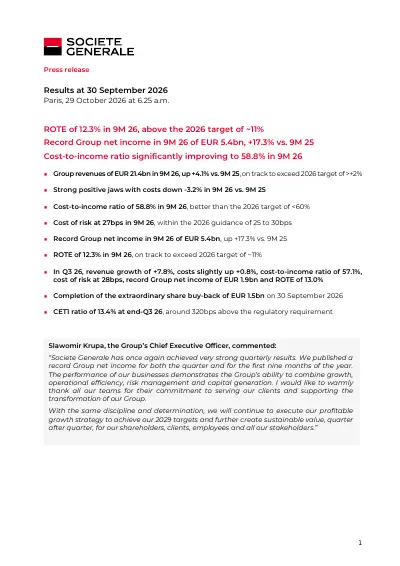
Today, we are announcing a record group net income for both the quarter and the first nine months of the year. Our accretive growth translates into strong profitability, with a ROTE of 12.3% over the first nine months of the year, compared to 10.5% last year.
It is also significantly above our end-of-year target of around 11%. Specifically, our revenues are up by 4.1% versus 9M-25 on a reported basis.
This is more than twice our 2026 guidance. We remain disciplined on costs, with operating expenses down 3.2% versus 9M-25, despite the much higher pace of revenue growth.
This translates into a cost-to-income ratio of 58.8%, which is much better than our year-end target of a cost-to-income ratio below 60%. With a cost of risk of 27 basis points, we remain in the middle of our guidance range, indicating both our prudent risk management and the strong quality of our credit portfolio.
Again, all of this has substantially improved profitability, with a ROTE of 12.3% in the first nine months of 2026. Ultimately, our capital position remains high, with a CET1 ratio standing at 13.4% after taking into account the completed extraordinary share buyback of €1.4, €1.5 billion.
Now, let me hand over to Léo, who will take you through our Q3 '26 financial performance. Léo?
Leo Alvear
Thank you, Slawomir, and good morning, everyone. Moving on now to our financial performance for the quarter.
Overall, Q3 '26 is another strong set of results. Our revenues are strongly increasing by 7.8% versus Q3 '25, notably on the back of a continued solid momentum in French Retail Banking, as well as in Global Banking and Investor Solutions, as we will see later.
At constant perimeter and exchange rates, the revenue growth stands at 8.4% versus Q3 '25. Thanks to our continued cost discipline, which increased by only 0.8% this quarter, despite provisioning for the increase in variable compensation linked to the strong evolution of revenues, we deliver a significant positive jaws expansion of 7 percentage points.
This results in further strengthening our operational leverage, with a cost-to-income ratio of 57.1% in Q3, down by around 4 percentage points versus Q3 '25. From an asset quality perspective, the cost of risk remains well-contained at 28 basis points, which is within the 25 to 30 basis points guidance range.
The quarterly net income reaches a record high €1.9 billion, and our ROTE stands at 13%, a strong improvement versus Q3 '25 level of 10.7%. The next slide highlights the key drivers behind our revenue growth in Q3.
As previously stated, the group recorded a strong increase in reported revenues by 7.8%. The first item of the bridge reflects the impact of disposals, with an overall effect of -€48 million, lower than previous quarters, as anticipated.
The impact is mainly related to the disposals of the activities in Cameroon and Equatorial Guinea. At constant perimeter and exchange rates, the increase is even higher, reaching 8.4% versus Q3 '25.
Business-wise, revenues in French Retail, Private Banking and Insurance showed a strong momentum, with a growth of 10.9% on a reported basis, mainly supported by a high NII, which grew 12.7%. Revenues at Global Banking and Investor Solutions increased by 12.5% versus Q3 '25, or 11.8% at constant perimeter and exchange rates, supported by a record performance in Equities.
On the other hand, revenues in Mobility, International Retail Banking and Financial Services decreased by 4.3% this quarter at constant perimeter and exchange rates, as revenues at Ayvens declined, driven by lower used car sales results, which continue to normalize as guided. To conclude with Corporate Centre, revenues improved by €94 million, driven by revaluation effects.
On the following slide, we can see the main drivers of cost development in Q3. In detail, our costs are moderately up by 0.8% versus Q3 '25 on a reported basis, and by 1.1% at constant perimeter and exchange rates.
The slight increase is primarily driven by higher costs on GBIS level, driven, of course, by the growing variable compensation, which reflect a stronger-than-expected financial performance. The remaining downward drivers are the disposals, which explain a variation of -€20 million, lower transformation charges as guided, which explain -€39 million, and a net core cost decrease of €31 million, confirming our continued focus on cost discipline quarter after quarter.
Restated for the disposals' impact and GBIS cost increase, total costs are down 1.7% versus Q3 '25. As you can see on the right-hand side of the slide, the cost-to-income ratio is falling by around 4 percentage points, from 61% in Q3 '25 to the current 57.1% in Q3 '26, which is better than our below 60% 2026 target.
Finally, one important point in this slide is that all pillars are below their end-of-the-year cost-to-income targets. Moving on to cost of risk on the next slide, we can see that the cost of risk for the quarter stands at 28 basis points and is fully in line with our target range between 25 and 30 basis points for the year.
At business level, cost of risk stands at 33 basis points for FBPI, 11 for GBIS, and 47 for MIBS. The cost of risk this quarter mainly comprises a Stage 3 provisions, which account for €488 million and are slightly up versus Q3 '25, driven by the normalization of defaults in MIBS from low levels observed in past quarters.
In Stage 1 and Stage 2 provisions, we had a net reversal of €80 million, mainly related to some transfers to Stage 3 provisions. As a result, total outstanding Stage 1 and 2 provisions decreased by 2.6%, while remaining at a high level of €2.9 billion, or 2 times the two years of cost of risk.
NPL ratio stands at 2.75% in Q3, down versus last year. Finally, the net coverage ratio remains strong at 81%.
Let's now turn to slide 9, where we can see the evolution of our strong capital position. The group's CET1 ratio stands at 13.4% at the end of the quarter, representing a strong buffer over MDA of around 320 basis points.
Now going through the bridge in this slide from left to right, we see that retained earnings contributed to an increase of 21 basis points, even after accruing for a 50% distribution payout. The group employee share ownership program has a positive contribution of 9 basis points, and all in all, other optics impacts contribute to a net decrease of 3 basis points.
Additionally, as you can see on the bottom right-hand side of the slide, all other capital ratios are comfortably above the regulatory requirements. On slide 10, we can see that liquidity reserves remain very high at €358 billion in Q3, with a balanced mix between cash and securities.
The liquidity profile of the group remains strong, with sound liquidity ratios. The LCR stands at 145%, while the NSFR is 118%, both well above regulatory requirements and in line with our steering targets.
The 2026 long-term funding program is fully completed, with €16 billion issued, driven by our good access to liquidity in all currencies. Finally, deposit base remains strong, granular, and highly diversified.
Overall, the loan-to-depo stands at 74% at group level. In slide 11, we show a summary of the P&L for the group for Q3, which we will cover in more details in the following slides.
Let's now move to the individual businesses, starting with SG Network, Private Banking and Insurance on slide 13. At SG Network, Q3 '26 loans outstanding are stable compared to Q2 '26 and fell by 2% versus Q3 '25.
Outstanding deposits are also stable compared to the previous quarter and fell 1% versus Q3 '25. This took place within a context of growth of retail savings and investment products, which contributed to the continued robust momentum in overall asset gathering.
On one hand, AUMs in Private Banking reached a record high of €150 billion at the end of September, up 10% versus Q3 '25, while on the other hand, life insurance outstandings stabilized at a record level of €167 billion, increasing by 9% versus Q3 '25. Moving on to BoursoBank on slide 14, we can see that commercial performance remains strong within the asset under administration gathering, which continued to grow, reaching €86 billion at the end of September.
This represents a 13% increase versus Q3 '25, including the continued increase in deposits of 7% versus Q3 '25. Equally, life insurance outstandings increased by 17% versus Q3 '25, with a high 51% proportion of unit-linked products.
The number of market orders increased substantially by 20% versus Q3 last year, up to 3.4 million. On the lending side, total loans outstanding are up 7% versus Q3 '25.
The number of customers reached 9.4 million, after onboarding 446,000 new clients in Q3, with a churn rate which still remains at a very low level, below 4%. In Q3, BoursoBank's net income stands at €101 million, representing a total of 277 for the first nine months of the year.
This is well on track to exceed its '26 target of more than €300 million. Finally, the RONE for BoursoBank stood at 74%, illustrating the strong profitability of this model.
Looking now at the whole pillar on slide 15, revenues for French Retail, Private Banking and Insurance increased sharply by 10.9% versus Q3 '25, driven by a 12.7% growth in NII and an 8.3% growth in fees. At the same time, operating expenses fell by 5.1% versus the same period last year.
As a result, the gross operating income, GOI, increased by 41.7% versus Q3 '25, and the cost-to-income ratio stood at 56.1%, representing a substantial improvement of 9.6 percentage points since Q3 '25. Overall, the net income lands at €682 million for the quarter, which is up 55% versus Q3 '25, with a high RONE at 14.6% versus 9.9% last year.
Moving now to Global Markets and Investor Services. Global Market revenues are significantly up by 18% versus Q3 '25, supported by the outstanding performance of our Equities franchise.
We reported a record quarter in Equities with €1.2 billion in Q3 '26, growing by 45.9% versus Q3 '25, driven by very strong business momentum in all key businesses and geographies. Revenues in Fixed Income and Currencies declined by 20.6% versus Q3 '25, and in line with previous quarters, performance continues to be influenced by low activity in rates.
Finally, revenues from Security Services grew firmly by 9.1% versus Q3 '25, thanks to strong commercial momentum and deposit growth in key markets. Now turning to the evolution of Financing and Advisory.
Revenues increased by 4.2% versus Q3 '25, on the back of strong business dynamics. Global Banking and Advisory revenues grew by 2.5%, driven by core franchises.
Structured Finance kept growing thanks to strong origination momentum and robust client activity across key sectors. We also had a strong quarter in Transaction Banking and Payment Services, where revenues increased by 8.8% versus Q3 '25.
The strong commercial activity continued to drive growth in fee income and client deposits in most of our key markets. Now moving to the overall view on GBIS.
At pillar level, revenues are up by 12.5% versus Q3 '25. In line with our disciplined track record, efficiency is a key priority for the group and therefore also for the pillar.
We generated 4.9 percentage points of positive jaws in the quarter, driving our gross operating income up by 19.8% versus Q3 '25. This translates into a cost-to-income ratio of 57.4% in the quarter, or 2.6 percentage points better than Q3 '25.
The cost of risk remains low at 11 basis points, below the 13 basis points of Q3 '25 or 18 basis points average for the whole 2025. All in all, GBIS posted a net income of €899 million, up by 22.4% versus Q3 '25.
As a result, GBIS reported another quarter with high RONE, which stands at 19.8%. This is 2.4 percentage points higher than in Q3 '25.
Turning to International Retail Banking on slide 19, we see that in Czech Republic, KB continues to perform well, with revenues up by 4% versus Q3 '25 at constant perimeter and FX, underpinned by strong loans and deposit dynamics, which grew by 9% and 7% versus Q3 '25, respectively. BRD in Romania shows a strong increase in loans of 11%, while deposits are up by 2%.
This translates in NII up by 6%, offsetting lower fees. Revenues are overall up by 2% versus Q3 '25.
Lastly, revenues in Africa and others were stable versus Q3 '25, driven by growth in core franchises. Loans and deposits are up by, respectively, 1% and 3% versus Q3 '25.
Turning now to Mobility and Financial Services in slide 20, this quarter, the businesses printed lower revenues of -7.8% versus Q3 '25, driven by Ayvens' used car sales normalization. At Ayvens, the level of margins is high once again at 620 basis points, 30 basis points above Q3 '25 numbers.
On the used car sales front, results continued to decrease over Q3, landing at around €310 for the first nine months of '26, within the targeted range between €200 and €600 for the full year '26. All in all, the cost-to-income ratio improved to 49.2%, notably thanks to synergies, and this implies a ROTE of 13.2% for the quarter.
Both cost-to-income and ROTE are fully in line with the target set for 2026. With regards to Consumer Finance, revenues increased by 7% versus Q3 '25, supported by high NII, which benefits from continued proactive repricing policy.
Overall, in slide 21, the pillar recorded lower revenues by 4.3% versus Q3 '25 at constant perimeter and FX. At the same time, MIBS continued to monitor strictly its costs, leading to a 2.6% decrease versus Q3 '25 at constant perimeter and FX.
All of this translates into a cost-to-income ratio of around 52%, which is below the 55% target set for '26. Cost of risk this quarter stood at 47 basis points, slightly up versus 43 basis points in Q2 '26, and roughly consistent with the 40 to 45 basis points through-the-cycle cost of risk estimated for the pillar.
All in all, MIBS printed a net income of €349 million, down by 8.6% versus Q3 '25 at constant perimeter and exchange rates, equivalent to a RONE of 12.9%. To conclude with the quarterly results, let's move quickly to slide 22 with the Corporate Centre.
Similar to previous quarters, revenues improved versus Q3 '25, driven this time by positive revaluations of liabilities accounted at fair value through P&L. Overall, group net income is almost stable versus Q3 '25.
Let me now give back the floor to Slawomir.
Slawomir Krupa
Thank you, Léo, and turning now to sustainable development. This quarter once again demonstrates the strength of Société Générale's position as a trusted partner for our clients as they navigate the energy transition.
Recent transactions demonstrate the breadth of our capabilities, from battery storage in Australia to grid infrastructure in the UK. We also supported an innovative project in Italy that combined solar energy generation with biodiversity considerations in agriculture.
Partnerships remain a key enabler of our strategy and an important way to increase our impact. We continue to work with multilateral institutions to develop blended finance solutions, and continued, for instance, to partner with the EIB in supporting the growth of European clean tech.
Taken together, these achievements reflect the consistency of our approach. Combining sector expertise, financing capabilities, and strong partnerships, we continue to support our clients' transition strategies.
In conclusion, we keep building momentum, and we keep improving our performance quarter after quarter. We will exceed our 2026 targets, and with the same discipline and determination, we will reach our 2029 goals.
Thank you very much, and we will now open the Q&A session and kindly ask everyone to keep to two questions per person, as usual. The floor is yours.
Operator
Thank you, sir. Ladies and gentlemen, if you wish to ask a question, please press * and 1 on your telephone keypad.
The first question comes from Tarik El Mejjad of Bank of America.
Tarik El Mejjad
Hi, good morning. Thanks for taking my questions.
Two, please. First on the Equities business.
This quarter, you've actually delivered a very strong performance in line with the big equity houses, I guess, in Europe. In your slides, it was very short explanation saying what it did well across regions and products, but can you maybe go more in detail on what has worked well this quarter?
Also when you look at actually the balance sheet with that work to deliver this, RWA went up quite a lot. In the Financing activities and Advisory, that went down a lot.
Are you thinking of RWA within GBIS, or is it completely independent where to manage the balance sheet, and if to expect some reversals on some of the RWA used for the Global Market part? That's the first one.
Second one on capital. You've been very clear in your recent CMD about the cadence on distribution with full year and then with Q2 results, some excess capital above 13%.
Things have changed a lot since your CMD with the noise around France and your shares have derated materially. Would you consider being more agile around excess capital return and leverage on your actually distressed multiples and use the accretive aspects of the buyback we've been looking for?
Thank you very much.
Slawomir Krupa
Thank you, Tarik. On the Equities, the comment is very short because it just simply states the reality, which is it's across the entire scope of the businesses.
Literally, every unit performed well. If you want to get some more color, I can point to better financing rates for us, which helped with the financing side of business, strong volatility, and commodities clearing on the futures side was supportive, investment solutions, and the linear business benefited from actually stronger equity markets and a lot of commercial appetite.
It was really across the board, and this is why we're very happy. We're also benefiting from the Bernstein consolidation.
It's really across the board. No specific, again, one-off or specific outperformance of one particular business.
This is why we're very happy about this. In terms of the RWA, listen, if you look at what happened in terms of the RWA within the market, it's actually a very small increase in terms of overall RWA, market risk stable.
By the way, I should have mentioned that this performance of Equities was also reached with no change in broad balance sheet usage or, more importantly, stress test usage, right? Completely in line with our risk profile and risk approach.
Coming back to the RWA, market risk stable, and credit risk RWA slightly up single digit. That's that.
In terms of the capital, listen, let me put it this way, right? You expect us, our clients expect us, investors expect us to be nimble in markets that change very often in terms of, especially these years, in terms of outlooks, prospects, trends, news flow, and so on and so forth.
If that makes sense to you, you should expect us to be nimble when considering the execution piece of our capital management policy.
Tarik El Mejjad
Thank you.
Operator
The next question, sir, is from Giulia Aurora Miotto of Morgan Stanley.
Giulia Aurora Miotto
Hi, good morning. Thank you for taking my questions.
I have two. The first one, I wanted to follow up on nimble.
Can we expect then a buyback in Q4 given how attractive the share price level is? Then my second question is more numbers driven on French Retail, fee growth of 8%.
How much of that was driven by the change in accounting on the way you booked the customer acquisition costs in BoursoBank, please? Thank you.
Slawomir Krupa
All right. On the first question on being nimble, it's very simple in the end, right?
We have a very strong statement that we've been consistent with, which is that we intend to operate the business at slightly above practically 13%, but with a strategic objective to be at 13%. We have a component which is the regular, ordinary distribution, which you know well, with some flexibility there in terms of what's the portion for the dividend and what's the portion for the buybacks balance.
Like we said in the past and actually acted upon this, something between, let's say, 40% and 60% in terms of respective shares, depending on market conditions and other considerations that ultimately the board may have when it makes the decision in February. Then there's an exceptional distribution potential, right, depending on, again, our little framework in terms of what goes into organic growth, what goes potentially into inorganic moves, and what can be used for exceptional distribution.
Within that framework, right, we have to take into account both the performance of the group, both the absolute level of the ratios, and, of course, market conditions. Like we do this for a living for everybody, it would be weird for us not to do it for ourselves.
You're talking about the increase in fees for the second part of your question?
Giulia Aurora Miotto
Yes, yes, the fees in French Retail. I guess part of it comes from a change in accounting.
Slawomir Krupa
It comes from a very good performance, as you may have seen, of basically our asset gathering business within the French Retail and across all of the components, if you will, because as much as the deposits are basically flattish, we have actually, as you've seen, strong increases in terms of asset gathering, and actually strong increase in that side of the business, financial fees, and so on and so forth. That's the main driver, and in particular, at BoursoBank and private banking, actually.
Then, in terms of the overall performance, indeed, of course, the new accounting rules for capitalization of acquisition costs allow us to do, as you've seen, both a very strong acquisition, which is close to 500,000 new clients this quarter, which is close to the maximum pace that we expect to have, while generating substantial bottom line because of the benefit. Actually, the substantial bottom line is somewhat higher this quarter because we just started to do this, right?
Obviously, as we layer new capitalizations quarter after quarter for the acquisition costs, that upside, if you will, will tend to converge to the long-term guidance that we gave of above 45%
Giulia Aurora Miotto
RONE
Slawomir Krupa
for BoursoBank.
Giulia Aurora Miotto
Thanks.
Slawomir Krupa
Thank you.
Operator
The next question is from Delphine Lee of J.P. Morgan.
Delphine Lee
Yes, good morning. Thank you for taking my questions.
My first one is just on French Retail. Just trying to understand a little bit, because the volumes on the lending side and on deposits have been a little bit muted, slightly down.
Are you starting to see a little bit of that impact from the sort of political and social environment, or is that rates going up, any color here? Also on deposit mix with sight deposits, the mix has marginally changed, but any expectations here that with higher rates and higher Livret A, you might start to see something, or you're quite confident about your assumptions so far?
Then my second question is on the cost side of it. You clearly tracking very well versus this year's target.
I know it's a bit early, but any indications of sort of how much we should expect maybe for next year? You have already said at the CMD that a lot of it would be front-loaded, just trying to understand a little bit the pace here.
Thank you very much.
Slawomir Krupa
Thank you. On the first question, listen, there's nothing at this point that I would characterize as structural in what you see.
The activity is not booming in France. That's not a news, obviously, to anyone.
It is in that fairly stable, let's say, zip code, to speak. Now, remember, one of the drivers of the volumes on loans are the mortgages, and the mortgages, as you know in France, is a topic which is both absolutely critical in terms of commercial momentum and commercial performance, because it is an anchor product for the relationships with retail clients.
On the other hand, it has a challenging pricing, let's put it this way. What we tend to do is we tend to be strategic in terms of how we market this product throughout the year, and typically we have been more on the slow end of the dynamic at the beginning of the year.
We have accelerated then in Q2, and you will see that marketing acceleration move through the volumes later during the year. That's on the margin what you could see.
Now on the deposit, remember, same thing in France, you have this coexistence of the life insurance wrapper and other ways of investing your excess liquidity, if you will, for the client, and you see the very strong momentum that we have on that end of the spectrum. That's mostly how you explain a subdued dynamic on the deposits.
In terms of the forward-looking portion of your question, at this point, we definitely expect a cost of funding to increase a little bit with the Livret A expected increase in 2027. That's for sure.
That obviously was already in our planning and in our scenarios at the CMD and earlier, we don't expect changes at this point to our outlook there. In terms of the behavioral component linked to a higher interest rate environment, we believe, but with a lot of humility, right, when it comes to behavioral changes on deposits in France.
We learned the lesson of three, four years ago, and so with a lot of humility. We believe that a lot of the behavioral component has already happened and is kind of part of the new behavior.
At this point, we do not expect significant swings in that behavioral characteristics of the market, and therefore do not expect a major shifts in our outlook for this business. In terms of the costs overall, well, as discussed indeed during the CMD, we have a trajectory which was rather front-loading the cost benefits, and we don't expect this to change at all, actually, right?
If anything, we're constantly, constantly focused on cost discipline. The only variable, and you've seen this perfectly this quarter, is if we have a strong outperformance in a particular business, you will see a cost impact.
As perfectly evidenced this quarter, which will be more than accretive in terms of its impact on both cost-to-income and positive jaws. That's that.
Thank you.
Operator
The next question is from Chris Hallam of Goldman Sachs.
Chris Hallam
I have two questions, both on Global Markets. I just want to come back actually to the first question on Equities, because in Q2, you said you were making a sort of a conscious decision not to fully participate in the very vibrant markets that we saw, and now this quarter clearly is a big contrast.
It looks like you really did fully participate. I just wanted to understand sort of what changed, either in terms of market conditions or in terms of your own risk appetite, Q3 versus Q2?
Then second, and again a little bit of a follow-up to the comments you just made, Slawomir, there was 11% opex growth, I think, in Global Markets this quarter. Is it possible to split out how much of that was sort of directly related to higher revenues, how much of that was related to the build-out you've talked about across new products in new markets, and then how much is the sort of underlying opex gross run rate if revenues were flattish?
Thank you.
Slawomir Krupa
All right. In terms of the Equities, again, as evidenced by both the market risk RWA and my statement earlier about balance sheet usage being broadly in line with our appetite and market stress test, most importantly, kept at the similar level as these past quarters and years, it was not a shift in risk appetite.
It's really driven by the fact that our businesses benefited from higher, high-quality commercial flows, and this is why we have this, let's say, consistent participation with the market, right? Last quarter, what happened was different, right, and was driven by different positioning and something which we were feeling was more risk-intensive.
This quarter, the commercial activity, which is the core focus of what we're trying to achieve in this business and in the other markets business, was very strong across the board, as I said, including in futures clearing and so on and so forth. Again, as evidenced by the data on market risk RWA, and what I'm saying about the stress test, it's no adjustment to risk appetite.
In terms of the costs, mostly it's linked to the variable compensation, right? Even sheer market execution fees can go up here and there, but these are marginal lines.
The overwhelming impact that you see is linked to variable compensation. The build-out in some of the businesses, and namely Prime, is really within the trajectory.
It's not like some new spend that we would have started in Q3. Again, the IT platform, which is the last piece that we're investing on the Prime side, is something that we've been doing, right, at our own pace, with our own, let's say, investment policy in terms of costs for now a few years, and we're continuing to do this the same way.
No expectation for the structural costs to really go much higher than what you see in the trends in the last few years.
Chris Hallam
Thanks. That's really helpful.
Slawomir Krupa
Thank you.
Operator
The next question is from Jacques-Henri Gaulard of Kepler Cheuvreux.
Jacques-Henri Gaulard
Yes, good morning. We're going to talk again about Equities, right, because it's been really good and it's really pleasant.
I was wondering the portion of Bernstein, or more generally, if you're not comfortable isolating, how much the ROI now of that acquisition has been? In light of, I guess, how successful it has been to you delivering that, what about trying to actually get to this type of niche acquisition in that business in particular?
I was thinking about Prime. The second question, I guess, linked to that is, are you happy about the organic development in Prime, or comes the moment where, okay, you need to really buy a book or get to a niche player there and try to change the scale?
Thank you.
Slawomir Krupa
Thank you. Thank you very much.
Listen, on Bernstein, it has been a successful story, right, for one, the contribution that they bring to the flows, to a high-quality client business, that's one. In an area that I know that you know that very well, we were lagging.
It was a hole in our product offer, right? Again, both the quality, the capacity to grab some of the market dynamic there, in particular in the US, because it's a firm which is heavily present in the US, both with the research, but also with the cash business.
We're very happy, and it's true that we have executed in ways that make it a profitable investment for us. We're not disclosing the ROI per se, but it has been a profitable investment, all the more, and these are not huge numbers yet, but all the more since it helps us have a relevant ECM business in the US exactly as we had intended it to be, in particular in the US where we do have a large client base, where we can now compete for this primary business.
It's now already quite a few tens of millions of NBI from zero 18 months ago, right? That's the other piece that's important.
In terms of the organic, inorganic developments, I think in Prime in particular, I think nothing's off the table, right, because nothing should be off the table. Equally, in this business, I think, well, let me spit it out, right?
I think we do have a preference for organic growth because it's a business where the capabilities are essential, right? You have to have the research piece, you have to have the execution piece on the cash side, on the clearing side, and so on.
You have to have the whole IT platform for all the cross-margining and all the reporting and so on and so forth. You need to have that with people that you understand, with whom you've done business throughout the years or decades, more accurately.
Our play here, like I explained at the CMD, is really to bridge that product gap that's in front of our large existing hedge fund client base, right, and asset manager client base. That's more of the approach that we have here because if you acquire a book that is different from what you are used to do with clients that you're used to service, to bank, and to be a counterpart for, well, you're importing risks that are of different nature.
I'm not saying no, right, because again, back to being nimble, we have to consider all the opportunities, but we do have a strategic preference here for organic growth.
Jacques-Henri Gaulard
Thanks a lot.
Slawomir Krupa
Thank you.
Operator
The next question, gentlemen, is from Andrew Coombs of Citi.
Andrew Coombs
Hi there. Sorry, two questions.
Just one on Ayvens. Obviously, your peer yesterday for their Mobility division talked about gross operating income being flat in 2027 versus 2026.
I assume you're somewhat more constructive than that given the normalization in UCS and the higher service margin this quarter. Perhaps you could just give us your thoughts on the trajectory into 2027 for Ayvens.
Then second question just on BoursoBank. I guess the interesting thing this quarter is you've added 500,000 clients, as you said, that's at the top end of your quarterly run rate, but also the profitability is at the top end of your quarterly run rate.
When you're thinking about that, and I appreciate that has been the accounting change, how are you thinking about growth versus monetization going forward for BoursoBank? Thank you.
Slawomir Krupa
Thank you. In terms of the Ayvens outlook, we give the yearly targets at Q4, right, this is when you will get more color from both Ayvens and us on these topics.
What we see right now is very consistent with the story we've been telling you and the way we've been managing this business, which is very early on, right, just to give you a reference point, we stopped positive prospective depreciations two years ago, basically. This was reflective of our view back then already that things are going to be changing a lot in that market, right, because of all the EV dynamics, both regulatory-driven, behavior-driven, and so on and so forth.
Our stance for now multiple years has been we are focusing on high-quality business, while making sure that our overall size basically remains stable, right? You could say it differently, maybe in even simpler terms, we have focused on profitability and risk management at the expense of spot growth.
Right, this has been a major strategic decision made by Ayvens, its governance obviously, and us as a major shareholder there. What you see happening today is clearly linked, right, to our analysis of what was going to happen, and gives a different color to what we have been doing versus some of the other market participants.
This is why both our vision for the UCS remains consistent. What we have said so far, and in terms of our 2027 targets or 2029 targets, more importantly, there are no specific changes because this market reality was entirely embedded in our thinking for years now, right?
That's what I can tell you. In terms of the second question, the line wasn't so great, but and please, follow up if I'm not answering your question completely.
If your question was monetization versus growth as a matter of strategic direction, it's very clear that because of the ultimate objective of being a key player, if not the leading player, in retail banking in France in terms of number of clients, and so on and so forth, we do very clearly focus on growth today beyond monetization. Conversely, though, we do build this business as a banking business, right?
In a banking business, you need to have relationships, you need to have flows, you need to have deposits, you need to have people and clients engage with you through the products and services that we offer them, right? The idea that we need to continue to, first of all, maintain our leadership in client satisfaction, which is absolutely key, maintain our leadership in pricing, which is absolutely key, and continue to deepen the engagement, not necessarily the product offer, which is already very large, and you can do anything at BoursoBank, even very sophisticated investment products are available there, we will be continuing to increase the quality and the depth of the relationship with the clients, leading ultimately, obviously, to higher NBI per client.
At the strategic level, the priority is growth. Thank you.
Operator
The next question, sir, is from Joseph Dickerson of Jefferies.
Joseph Dickerson
Hi, thanks for taking my question. I just had a question on the Czech and Romanian businesses.
You've had 9% loan growth in the Czech business, 11% loan growth in Romania, and the revenue in both is lagging the loan growth. It looks like there's slightly different dynamics in Romania versus Czech.
I suppose when would you expect the revenue growth to start to match the balance sheet growth in those markets, because it seems kind of like a decent coiled spring impact potentially for revenue in those markets? Thank you.
Slawomir Krupa
As you certainly know, these are two markets which clearly are highly competitive and marked by substantial growth still, and in particular in Romania. Let me put it this way, from strategic standpoint, as a key market participant in both markets, we do engage in this competition and we do follow the market trends, but with a certain slight marginal degree of caution.
That's one thing, because you do have substantial margin pressures in these markets, actually, on both sides of the balance sheet. Also, this particular quarter, it's not a major number at the scale of these assets, but also the trading income in both areas was slightly lower than in the past.
This is why you see these trends. Again, highly competitive growing markets with margin pressure.
Like in every other business of ours, we're trying to navigate, of course, participating in the trends, we're not retrenching whatsoever, but with a slight degree of caution in terms of both quality, from margin perspective, and, of course, risk management.
Joseph Dickerson
Thank you.
Operator
The next question is from Anke Reingen of RBC.
Anke Reingen
Thank you very much for taking my question. I just had one on the cost of risk.
Know that Q3 trend benefited from the €80 million positive Stage 1 and Stage 2, and I just wondered which division that would have been accounted for? I guess if we sort of take that into account, some of the divisions might have had quite higher loan losses.
Is that due to any one-offs? Thank you very much.
Slawomir Krupa
Thank you. The moves that you see between S1, S2, and S3 is actually mostly reclassification.
Things that moved from from S2 to mostly from S2 to S3, that therefore generated more S3 and and and therefore, a lower S2. It's more mostly reclassification.
It's not like a deliberate decision to to manage, obviously, our our S1, S2 buffer. That's that's that.
In terms of the one-offs, no, there are no specific one-offs in the in the in this in this quarter, and it's a it's a broadly, very decent performance in the current market environment across the across the board, and most of the divisions being well within their historical averages.
Anke Reingen
Thank you for the clarification. Thank you.
Slawomir Krupa
Thank you.
Operator
The next question is from Pierre Chédeville of CIC.
Pierre Chédeville
Yes, good morning. One question regarding liquidity.
We can see that you have increased your liquid asset buffer by nearly €20 billion and your LCR by 4 points, and I wanted to know if it was I would say something normal, or if it is due to the situation, the environment, and you're a little bit more cautious on this side? My second question relates to the number of shares, because every year you buy a significant amount of share in terms of number.
I was wondering if at some point you wouldn't like to have a number of share inferior, let's say, 700 million, I don't know, in terms of liquidity on this share, or if you don't care about that? If you care, can we imagine that at a certain point of time you would prefer dividend than share buyback?
Thank you.
Slawomir Krupa
Thank you. Thank you, Pierre.
On liquidity, these kind of moves are absolutely stochastic, if you will. It's well within our targets and steering levels, and we have been posting these kind of levels very consistently in the last few years.
It reflects indeed an overall prudent strategy, but that dates back basically to when I took over, where we pushed up the targets across the liquidity metrics as a general rule in terms of how we saw the risk management of that side of the equation. Nothing recently.
It's really consistent. If you look at the history, it's really consistent.
It fluctuates, but it's really consistent with let's say our behavior from this perspective. In terms of the number of shares, the way I understand your question, I would say the following things.
One, in itself, I don't think, right, I'm going to, of course, spend some time thinking about your question afterwards, but the quick answer is, I don't think that we care, other than the buybacks, the whole logic of the buybacks is obviously in the end to reduce the number of shares, increase EPS, and therefore the unit valuation, everything else being equal, right? As long as share buybacks make sense in terms of capital management for shareholders, and at valuations that we see right now, and valuations for sure around one time book, they do represent a very meaningful opportunity for capital management purposes of shareholder equity.
You should expect us to be consistent with what we've done so far in terms of both the proportion of buybacks within the ordinary distribution, and if there is and when there is exceptional distributions, that the route for this would be more the buyback. Finishing up with the dividend component of your question, therefore, at this point, there's no reason to expect us to change anything to our approach in this space.
Thank you.
Pierre Chédeville
Thank you.
Operator
The final question, sir, is from Sharath Kumar of Deutsche Bank.
Sharath Kumar
Good morning. Thank you for taking my questions.
I have two. First on Ayvens.
Arval, one of your main competitors, yesterday highlighted a possible slowdown to their fleet growth aspirations. Do you see this as an opportunity to slightly pick up fleet growth again?
I know Ayvens' fleet growth expectation is back-end loaded, but just wanted to have your thoughts, as well as the competitive landscape. Second on French Retail.
One of the positive side effects, at least from your point of view, of the ongoing French macro concerns could be higher household savings. In this light, do you think that the current fee growth dynamic is hence sustainable?
Can you also give the breakup of the fee elements within French Retail, like financial savings, banking transactions, et cetera? Thank you.
Slawomir Krupa
Thank you. On the second question, I'll start with the second question.
If I'm not answering, because, again, the line wasn't perfect, and so if that's not what you really wanted me to answer, please follow up. If your question was, as I think it was, about the saving rates dynamic in the French market, and whether the current macro would push that saving rate higher, and therefore represent an opportunity from the savings market, savings products, savings services perspective for us, the answer is marginally yes.
Then how high a savings rate can go in a given country, right? We're already at 18% plus.
I don't expect this to kind of change the nature of the market. It is a market where there's a lot of actually accumulated wealth.
It's one of the strengths, actually, of the French economy and of France. We expect this to continue to be a substantial driver of the opportunity for us.
This is no accident that at the heart of our vision for the future of this business lies the opportunity with the mass affluent, affluent segments. We do believe that, already from a position of strength, as we have twice the penetration rate in these segments versus the average penetration rate.
From this perspective, it is definitely a strategic opportunity of the market that we do intend to focus on as part of our strategy for this business. Now, again, is there an incremental uptick recently?
I think at this point, it's marginal, and I don't expect this to be an overwhelming trend at this point. In terms of the fleet growth, well, my answer is going to be reasonably simple, which is, again, our strategic choice was let's make sure we focus on high-quality business, on relationship management, on margins, and that whenever the market hits a certain level of stabilization, and in terms of the behaviors and the components in terms of the fleets, et cetera, et cetera, the various vehicles categories, that we will be able to very easily, right, reaccelerate growth from a very healthy base, if you will, situation, both in terms of margins, quality of the business, but also, of course, in terms of costs, and in terms of risk management, right?
We have that, and we stand ready to take advantage of the opportunities that will arise. Now, I think that our vision, right, and I think this was very clearly explained at the CMD of Ayvens, and regularly by Ayvens, and it is obviously our stance, that we're still waiting for this market to truly stabilize.
The fact that a competitor allegedly would twist their commercial policy to something more conservative will not drive us to change our strategy, right? What it will do, most likely, like anytime somebody adjusts its commercial policy, it's going to most likely improve the quality of the market, right?
That we can only be happy about. It's not going to drive us to change our strategy, because our strategy is also based, and we've shown this quite clearly, not so much by the behavior of others, but most importantly, by our own vision of the opportunities and risks that one particular market represents.
Strategy will remain consistent, but listen, if the market behaves in ways which are conducive to better margins and better quality business, we can only be happy.
Sharath Kumar
Thank you.
Slawomir Krupa
Thank you. All right.
Thank you very much. Sorry, please.
Operator
No, I was just turning it over to you, sir, excuse me.
Slawomir Krupa
Thank you. No, sorry.
I was just going to thank you for your time, thank you for joining us today. I know you have very busy days, good luck with that, and we'll talk to you for our Q4.
Thank you very much. Take care.
Leo Alvear
Thank you very much.
Operator
Ladies and gentlemen, this concludes today's Société Générale conference call. Thank you for your participation.
You may now disconnect.