Evonik Industries AG
Q3 FY2026 · Earnings Call TranscriptNovember 3, 2026
Operator
Ladies and gentlemen, welcome to the Q3 2026 earnings conference call. I am Sharon, the Chorus Call operator.
I would like to remind you that all participants will be in listen-only mode, and the conference is being recorded. The presentation will be followed by a Q&A session.
You can register for questions at any time by pressing * and 1 on your telephone. For operator assistance, please press * and 0.
The conference must not be recorded for publication or broadcast. At this time, it's my pleasure to hand over to Dr.
Claus Rettig, Interim CEO. Please go ahead.
Claus Rettig
Yes, good morning, and welcome to our quarter three earnings conference call for the first time from our new head office here in Essen. Thank you, everybody, for joining today.
Given we are in a new executive board set-up since, yeah, end of August, let me start with a few words about myself. For many of you, I hope I am a familiar face by now, but let me give you a little bit of background.
I am a chemist by education and joined Evonik more than 35 years ago. I worked in several leadership positions in Germany, South Africa, Japan, and Singapore over the time.
For the last 4 years, I am heading the Asia region and have been an associated member of the Evonik executive board. I also served as an interim CFO from September 2025 until beginning of May 26.
My start as an interim CEO was therefore, let's call it, very smooth from my point of view. We have a very competent and well-working management team.
While Christian Kullmann is recovering from his surgery, there's absolutely no standstill here at Evonik. We continue to execute our strategy with full speed.
Before we come to the strategy execution and our excellent financial performance in the quarter three, a few words on the BASF takeover situation. As we have decided not to enter into negotiations with BASF on the basis on the information we have received so far.
That said, we will engage in a purely informational and confidential exchange with BASF in order to explain our position and to give them the opportunity to outline their rationale and the key consideration underlying their interest. Please understand that we will not comment any further, also not during today's Q&A session.
We remain fully focused on our strategic direction and our development as an independent company. This I will demonstrate now by laying out our roadmap to our most important mid-term goal of achieving return on capital employed of around 11% by 2029.
Michael will then comment on our continued strong operating performance in quarter three, and then we'll end the presentation with the outlook for this year. In the next 3 years, we will shape Evonik into a different company: a company that is much more focused on its core, that is much more agile, and that in the end, latest by 2029, will earn more than its cost of capital.
That is something that not many companies in our sectors will achieve. I can only refer you to a survey that's done recently showing that only 1 in 5 companies in the chemical industry is earning cost of capital today.
We are highly confident that we will get there. This confidence is backed by tangible measures, a lot of them.
We are looking at return on capital more holistically now. On top of the equation stands the increase in earnings in form of adjusted EBIT.
That is not new. The existing strong emphasis on growth and efficiency will continue.
The same strict focus is now on the denominator, aiming at the reduction of capital employed. We will show you the enhanced focus on capex and net working capital for the coming years in a minute.
Almost as important, the whole management team is what we call laser-focused this time on execution. By launching portfolio change, by driving Evonik Tailor Made, and by investing into new solutions and sites, we have in the last years laid the foundation for strong financial success.
Now is the time to take final execution steps and to harvest the results. Our strong performance in 2026, with ROCE gaining more than 2 percentage points, shows us that we are moving into the right direction.
I will not go through all the slides that we have prepared for you today, but will only highlight 1 example for each of the 5 return on capital employed levers. The most important lever is growth.
A company has to grow to be successful in the long run. This is currently not easy in chemicals, as but it can be done, and we see it.
Growth for Evonik will not come from 1 single new product or plant. It will come from a combination of factors: launching entire new products and solutions, bringing existing products into new markets, enhancing our plant utilization, and increasing product contribution margins, and therefore have an EBITDA margin expansion.
At the forefront of future sales growth are products developed in our 3 innovation growth areas. These products are targeting markets which by far outgrow GDP.
For example, our biotech platform already posts a few hundred million euros of sales. This is an incredible strong basis we have to drive further growth where customers shift to bio-based products in cosmetics, pharma, but also in some industrial applications, such as coatings.
The second big pillar is about efficiency. Since the end of 2023, we are tailoring our organization to better suit our business needs and to become more agile, while at the same time keeping our cost base under control.
Balancing inflation is the minimum target, and any additional savings are contributions to our targeted earnings increase. The first phase of Evonik Tailor Made is almost concluded, and we kicked off the second phase of the program mid of this year.
It now takes a more holistic approach by integrating all business optimization and administrative programs under 1 roof. We have strong proof points of our progress.
Employee numbers are falling fast, by more than 700 already this year alone. We announced 3 site shutdowns this year.
This is a decisiveness not seen before from us. On top, we are getting divestments done.
The sale of Oxeno will be signed in the coming months. Thereafter, Evonik will account for only 1/3 of the chemical activities at the chemical park in Marl.
For our infrastructure business called Synect, which is serving Marl, we will find a new best owner shortly after. Of course, we will go through these processes with all our stakeholders in mind, but especially our employees, and find the best future for these 2 assets.
We will be focusing on what a specialty chemical company like us should be focusing on, namely on our business, on custom solutions, and advanced technology segments, to deliver benefits to our customers and to our end users. Infrastructure services should be better owned by infrastructure specialists or large-scale integrated chemical park owners.
We will deploy the divestment proceeds to invest where we see our future: in additives, in biotech, for growth markets. Now, Michael will take over as we move from increasing earnings to reducing capital employed.
Michael, floor is yours.
Michael Rauch
Thank you, Claus. Welcome to all of you also from my side.
As Claus said in the beginning, capital employed is now a bigger focus than before. Starting with capex, you can observe a steady decrease already over the last years.
This trend will continue. We see our run rate for capex even lower than today at around €700 million for the coming years.
This is a reflection of the reshaping of our portfolio: less capital-intensive businesses with higher returns, like additives or biotech solutions. Capex level below our historic depreciation and amortization is a sound testimonial of our strategy execution.
It is clearly not a sign of us underinvesting. After exiting Oxeno and Synect, the capex needs will even fall further.
To bring capital employed down further in the coming years, we will also reduce our net working capital needs. In the last years, we had to take heavy year-end net working capital optimization measures to then end with around 18% of net working capital to sales ratio.
Our target is to reach a net working capital to sales ratio of 17%, and this is much more balanced throughout the year. To this end, we will, among other measures, also leverage the power of artificial intelligence to further optimize inventory management and improve administrative processes for our payment collection and execution.
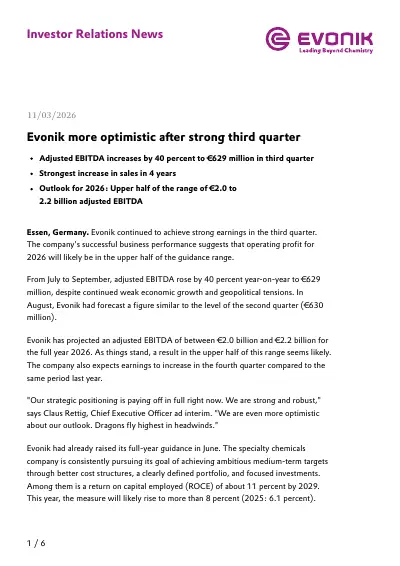
Moving on to current performance in the third quarter of this year. Our adjusted EBITDA rose by 40% to €629 million in the third quarter.
This is exactly in line with Q2 and our expectations set at the time for Q3. The increase was driven by mainly higher prices in Advanced Technologies and in our C4 business.
Volumes were also up in Advanced Technologies as well. As anticipated, methionine delivered a strong third quarter with price increases now fully coming through.
Also other businesses performed well, despite some Asian competition slowly coming back. For example, we recorded strong volumes for polymers and solid pricing for crosslinkers again.
This shows that the strong performance is not just due to slowly vanishing supply chain disruptions. Our results are a clear sign that our customers value our solutions and services, as well as our supply reliability.
This will not go away again. Cost savings made a good contribution, while higher bonus provisions had an adverse effect.
This is, as usual, mostly visible in the others line, which is more negative than last year. One remark on adjustments.
As projected during our Q2 results call, we now did a provision for the second phase of Evonik Tailor Made program in Q3. It is a bit over €300 million, and we expect another high double-digit million euro amount to follow in Q4 when all negotiations are finalized.
As already demonstrated in Q2, we once again were able to convert the strong operating performance into cash. For Q3, we improved our free cash flow significantly year-over-year by more than 20%.
Operator
Ladies and gentlemen, please hold the line. The connection with the speakers has been lost.
The conference will continue shortly. Thank you.
You are back on the line. Please go ahead.
Ladies and gentlemen, please hold the line. The conference will continue shortly.
You are back on the line. Please go ahead.
Claus Rettig
Where did it stop?
Restart here.
Michael Rauch
I just learned that unfortunately the line broke down. Let us please resume, and I was commenting on the more than €1.7 billion adjusted EBITDA in the books after the first nine months.
You'll be likely not surprised about our confidence to deliver earnings in the upper half of our guidance range. This implies also earnings growth in Q4.
On return on capital employed, we revised our guidance upwards, now expecting more than 8%, and with that, making good progress on our way to earn more than our cost of capital. Looking into Q4, we still have to work hard for a solid finish to 2026, as Q4 is typically a lower-volume quarter due to seasonality of our businesses.
Raw material and energy costs are increasing, while methionine prices are normalizing from the elevated Q3 levels. That said, this is a specific Q4 situation, which does not tell much about next year.
Order books are looking good going into 2027. We're seeing continued, healthy demand.
Our good business performance continues for longer. We can say already today that we expect a good start into 2027.
Now coming back to 2026, we reiterate our cash flow guidance for 40% cash conversion. This should bring us to a strong cash generation of around €850 million.
The strong free cash flow is leading to a significant deleveraging. At the end of September, our net financial debt declined by almost €400 million compared to 1 year ago.
Our leverage is now down to 2.1 times and trending down further. Our strong financial position has also been reflected by the Moody's upgrade to Baa1 end of August.
We will continue to improve our financial strength further. With that, back to Claus for some final words.
Claus Rettig
Thank you, Michael. I hope we can still be heard well because technical problems here on the phone line.
Let me sum up what we just discussed. As you can see, we are executing on our strategy with full speed and direction.
We drive earnings growth through growth investments and efficiency gains, and at the same time, we reduce our capital base. The exits from Oxeno and Synect are underway.
This will make Evonik a much more focused and agile company, more competitive, and more profitable. We will post a ROCE of around 11% latest by 2029, with a continuously high cash generation.
With that, we can come to your questions. The floor is yours.
Thank you.
Just a quick one from my side, we will dial in the main line again before we start the Q&A, Cedric, please. We take a quick break unfortunately as Claus has said we have some technical difficulties at the new headquarter.
First time in a new room, just bear with us 1 second. Thank you.
Operator
We will now begin the question and answer session. Anyone who wishes to ask a question may press * and 1 on their touchtone telephone.
You will hear a tone to confirm that you have entered the queue. If you wish to remove yourself from the question queue, you may press * and 2.
Participants are requested to use only handsets while asking a question. Anyone who has a question may press * and 1 at this time.
The first question is from Chetan Udeshi, JP Morgan. Please go ahead.
Chetan Udeshi
Hi, can you hear me?
Yes, Chetan, we can.
Chetan Udeshi
Hi. Morning.
I had a couple of questions. First, I was just hearing your comments on Q4 where you said what you see in Q4 is specific to Q4 and you expect a good start in 2027.
I'm a bit confused why is it different for Q4 and why is it better in H1 2027? I don't understand if methionine prices are normalizing, why would it be any better in 2027?
Can you maybe explain that? The second question I was going to ask you is, and I tried to ask this last time, and it seems it's also a bit visible in Q3, at least optically, which is your Advanced Technologies, you beaten there, but then the Custom Solutions is weak.
I guess it's not hard to see this again, a quarter driven almost entirely by strong methionine prices. I know you referenced polymers being strong.
Maybe you can sort of help us understand what is going on in Advanced Technologies outside of just methionine strength, just for us to get confidence that this is not a one-off that doesn't continue into 2027. Thank you.
Hi, Chetan. Thanks for your two questions.
Michael will start with the first one, and then Claus continues on the Advanced Technologies versus Custom Solutions question.
Michael Rauch
Yes, Chetan. Good morning.
Let me be clear on what I said. Typically, we have the seasonality that in the fourth quarter, we have weaker quarter, which you've also seen in prior years.
That was my remark with regard to volume in general. The second remark was with regard to the methionine prices.
There, we see the price levels, which were elevated in Q3, coming down a bit. The third remark was regarding Q4 in relation to the start into 2027.
We do expect for the year 2027 a good start. Even though methionine prices come down a bit, they don't come down so much.
We're not falling off a cliff. We see the good business performance continuing longer.
You also mentioned yourself the polymers and also the crosslinkers. We see that effect continuing.
Typically, what you do have in the fourth quarter is also inventory revaluation and other year-end effects. That's why we see basically weaker fourth quarter, then the good start into 2027.
For the second question, I would hand over to Claus.
Claus Rettig
Yes, question was about comparing CU performance and Advanced Technology. Chetan, it's just to make clear, it's not just methionine.
Let's stay with Advanced Technologies for the moment. Methionine is, of course, strong.
We see already a normalization happening as we speak, yeah. From that point of view, peak prices were in June, July, but we are already this year on a normalization pathway.
We are pretty confident that we will have also a good business going forward. We can see it already, I think Michael mentioned it, order books Q1, that's why we say good start into Q1.
It's not only methionine. We pointed it out, I think, also in the papers we distributed.
High-performance polymers, namely our polyamide 12 business, super strong this year, regaining shares which we have lost before. We are way above market growth in polyamide 12 globally contributing to this.
The crosslinker business is better than the year before. These are three elements on the Advanced Technology side.
Custom Solution, you could say only a sales growth of 7% or EBITDA growth of 7% is of course, much less than the other one, true. Here, we have a lot of effects which we addressing with our portfolio changes.
We have here clearly growing areas, and we have one that are shrinking. Also on the cosmetic side, we have the base ingredient business is really shrinking, then and of course, overlying the growth in other areas.
That's contributing a lot to you see in the sum a lower one. Of course, this is also much less affected by any kind of this supply chain problems, the business.
This you can say it's almost not touched at all by this, you see pure business development. With the portfolio measures and the investments, you have seen what we are doing also on the side of our healthcare business, super strong focus on delivery systems where we're super strong, refocusing our energy on a cosmetic solutions side, on a specialty part of the business.
Of course, also I think making portfolio clean-up of the non-performing part or not as we want them to perform part. This is also moving forward.
You will see Custom Solutions taking more and more the role which we see in Custom Solutions being the growth engine across the portfolio.
Chetan Udeshi
Got it. Thank you.
Claus Rettig
I hope that answers.
Operator
The next question is from Roediger Martin, Kepler Cheuvreux. Please go ahead.
Martin Roediger
Yes, thanks for taking my three questions, actually. What is the real reason why you do not want to speak about the BASF bid, although it is a very important topic for investors?
Secondly, unrelated to this BASF bid, we know the chemical industry, especially in Europe, is not really in a great shape, with low growth, high costs, high bureaucracy, plus some geopolitical tensions, and you say you want to stay independent. Is there any circumstance when you change your mind and say, "Okay, now we need to team up with a larger player"?
The third question, Evonik wants to play an active role in the consolidation process of the chemical industry. Can you define your M&A criteria and your financial discipline?
Thank you, Martin. As you can imagine, we are not commenting on BASF, right, so that doesn't really make much sense, but Claus will for sure comment on our own view on the portfolio and how we see potential M&A and the consolidation in the sector.
Claus Rettig
Yes, like you said. I think we made it pretty clear.
We have a very good view on what we can do ourselves in the future. I think we also said always, yeah, consolidation is a part we want to play in as an active player, yeah.
From that point of view, I think this is the clear path of ourselves. I can only repeat what I said.
While we have a clear capital allocation priorities for us. We are independent, we have good performance, we are in very good market in our businesses.
Not everywhere, that's where we are cleaning up the portfolio, but that's where the future focus is on, more than in the past, and therefore, also we will use these strengths to foster our growth. The capital allocation priorities for us are also very clear, have not changed: disciplined investment into our own growth.
I think you heard also Michael, when you look to the portfolio of the future, it's much less capital-demanding. It's also important element.
Then second priority is and will be attractive shareholder returns through dividend, no doubt, that has not changed. Then we strengthen the balance sheet, deleveraging, in order to be ready if something that fits comes along.
The chemical industry is very diverse, yeah, and so there's a lot of topics that could make sense for us if they would become available. We are executing our strategy, I think we said it, with full speed.
That we have the divestments already, the big ones are all already announced, yeah. Optimization program is announced, progressing well.
Deleveraging also going on, progressing well. Once again, if the right target comes along, and can tell you we have with a very good view what are targets that are interesting for us.
When it comes to consolidation, it has to make sense. We would also add on only stuff which is adding to our portfolio in growth fields where we can achieve extraordinary growth.
I just repeat it again, growth is so important for our industry, and that's why the combination has to be focused on growth. Complementary portfolio mainly for Custom Solutions.
I think this is all what we have said. It's not changing at all, and this is the basis for our view of the future.
Let's call it like this.
Martin Roediger
Thank you.
Operator
The next question is from Sebastian Bray, Berenberg. Please go ahead.
Sebastian Bray
Hello, hello. Good morning, and thank you for taking my questions.
I have two, please. The first is on the interest costs that can be expected over the next 2 or 3 years.
The adjusted net financing costs at Evonik has crept up over the last few years. I think around the time of the pandemic, it was about €100 million.
It could be a bit more than that actually, it could be as high as €160, €165 this year. Are there any debt refinancing or short-term rate sensitivity that means this number could go higher in '27 and '28, net of deleveraging effects?
Any comments on the tax rate to be expected for that year? My second question is on your unfortunately unwell CEO, or at least on a interim on a full-time basis, but I appreciate I'm asking something that bridges the gap between private and public life, and if Evonik can't comment, that's fine.
Do you have any indications on when Christian Kullmann may be well enough to return to work? Thank you.
Thank you, Sebastian. Michael will start with interest costs and tax rate, and then Claus can take over on Christian.
Michael Rauch
Yes, thank you, Sebastian, for asking those questions. As you all know, the interest rates unfortunately in the markets are still high, so that also has an impact on us, and that's why we pay higher interest costs than in previous years.
The debt instruments that we have out there in the market. You also heard Claus, and I can only reiterate what he said earlier, we are on a good path to further deleveraging.
We have our Oxeno divestiture, and the next one up is our Synect divestiture, and we will use those proceeds also to pay back debt. Then, all else being equal, our interest costs will also go down.
Your question was also on the tax rate. I can be very precise here.
We have for 2027 tax rate implied for about 25% here. We will go back to the usual level of tax rate, which we have as a run rate, also originally projected for 2027, sorry, for 2026 before we went into some special effects.
With that, I hand over to Claus for the second question.
Claus Rettig
Thank you, Sebastian. Thank you for asking the question about our CEO.
I find that really nice. Can tell you, not too much really.
I have once in a while exchange with him on WhatsApp. He is in a rehabilitation clinic where they pay a lot of attention that the patients are focusing on rehabilitation.
From that point of view, we also are asked not to do too much of exchange. We have no clear picture when he is coming back.
We still believe this will be beginning of 2027. Nothing has changed with that kind.
Sebastian Bray
That's helpful. All the best to Christian and yourself, and thanks for taking my questions.
Operator
Please hold the line. The conference will continue shortly.
We lost the connection with the speakers.
Claus Rettig
Kann ich so gut muten, ne?
Operator
The next question is from David Symonds, BNP Paribas. Please go ahead.
David Symonds
Thank you. Good morning.
Thanks for taking my questions. The first one is another bridging one into 2027.
Could you talk about your energy costs expected into next year and hedging position? Secondly, could I ask about the EU Critical Chemicals Act, your latest thoughts on that, the next steps, and then which products you're hoping will be included on that?
Then finally, another question on 2027. It's interesting to hear you taking confidence on the 2027 outlook from the current order book because I remember earlier this year, you and peers were struggling to extrapolate anything from the order book because it was so patchy.
Could you talk about what's changed, which end markets have started to become more reliable for you to be able to sort of extrapolate that confidence into next year, and the general behavior of customers as you see it today? Thank you.
Hi, David. First one, energy costs, Michael will answer.
The second one, critical chemical lines goes to Claus. Also the last one on the end markets then back to Michael.
Michael Rauch
Thank you. I'll start with the first one.
As there is still a level of uncertainty regarding the duration of the conflict and the conflicts I should actually speak about here in the world, and that does have an impact on energy costs. With that caveat set, we are expecting energy costs around a similar level.
There could be a little bit of a spike in prices. However, our exposure in energy is also well hedged.
We have a hedge quota going into next year for more than 50% of energy that is being hedged here on our end. We do expect a similar level like 2026 with a slight spike up here, which we are prepared to take.
With that, I would hand over to Claus for second question.
Claus Rettig
Thank you, Michael. I hope you can hear me now because we have to use our mobile phone, which is not usually the case.
Critical Chemical Alliance, let me give you a little bit of background in here. The outcomes of this Critical Chemical Alliance have been presented to the General Assembly of the EU in October.
The chemical sector has been reaffirmed as a strategic industry for Europe, with a focus on safeguarding existing production while accelerating the transition to sustainable technologies. A preliminary list of critical molecules has been presented as the basis for this future industrial trade and funding measures.
The list is expected to be narrowed down significantly by the end of this year to accelerate implementation. In total, 49 products have been on the list, yeah.
Eight of them are from us, yeah. I think these are, yeah, it's, for example, I can tell you methionine is one of them, yeah, and also isophorone diamine is also one of them, being really critical for the value chain within Europe and also for food safety, as you know.
There are some others on it as well, but these maybe for us the most important one, and we're pretty confident that they will stay in there. Another was question on the...
I think end markets view.
Claus Rettig
End markets, yeah.
Go back to Michael.
Michael Rauch
Thank you. I'll take that.
You were asking regarding the order books for 2027, what do we see as development here going into 2027? Of course, let's be clear here, this is not the guidance call for 2027.
Let's make a couple of remarks. First, we are not resting on this year's success, right?
We're doing what's in our hands to be better placed in any environment. We have growth investments, cost savings, and portfolio optimization to come.
Evonik will be definitely a much better company in 2027, though we do not know what the environment will really be like. What we have seen is that actually our order books are picking up, and we have more visibility than we had basically during the difficult periods coming into the year 2026 and then moving into Q2.
The strong business performance that we currently see is continuing for longer. Therefore, we expect a good start into 2027, comfortably above the level of this year's Q1.
To give you also some tangible examples from our businesses. You notice yourself the earnings base for Custom Solutions as a whole is not particularly high.
We are seeing in Animal Nutrition a stronger entry position than a year ago. The starting point for the expected price normalization is higher than it was at the end of the last year.
Our backward integration should deliver mid double-digit million euro cost savings over the year. In hydrogen peroxide, we are well positioned to benefit from the growing semiconductor demand.
In addition, our innovative nanobubble technologies gaining traction in meat disinfection applications, particularly in the U.S., and thus opening attractive new growth opportunities. Last one here in silica, just to mention, we're benefiting also from the capacity expansion in Charleston and expect further growth from customer-specific projects, as well as new specialty applications.
All in all, we are more confident moving into 2027.
David Symonds
That's very clear. Thank you very much.
Operator
The next question is from Pandya Jaideep, Onfield Research. Please go ahead.
Jaideep Pandya
Thank you. First question is around, apologies for this, but around methionine.
Could we discuss some of the puts and takes that you see in the market for the next four quarters in terms of the capacity additions compared to the demand, especially I'm very curious about the powder versus liquid dynamic here as well. The second question is really around your portfolio outside of methionine really.
When you look at the core Evonik portfolio outside methionine, what is the competitive landscape today, referencing something like crosslinkers where you used to have very strong market share and then you had increased competition? When you analyze your portfolio, are you confident that it is not going to have the same level of competition out from China which is going to put pressure on your returns?
The last question really is obviously there are rumors around what you're looking for in terms of M&A. Should we think that cosmetic ingredients, healthcare are the main areas where you're looking for bolstering your strength?
Thanks a lot.
Hi, Jaideep. Thank you very much for the questions.
Claus will start with methionine, then we go to Michael for the competitive dynamics for the two segments, and then back to Claus for the M&A focus areas. Thank you.
Claus Rettig
Yes. With the phone, so that you can hear me, sorry, yeah.
Methionine, yes, that's of course always a big debate. We have very operational strength currently.
It will continue into Q4. I said it already.
We had a peak prices in June, July. Since then, we see normalization trend and strong volumes still have.
We also have the fact that our customers have seen in the earlier days of this year that we were able to deliver, that we are very reliable supplier, and reliability of supply becomes a new factor in competitiveness, that's for sure. Having said this, it is currently the case that we have strong demand, yeah.
We have quite a bit booked already for Q4, we have a very good view in Q4, and we also have very good view into Q1. This is, of course, with a normalization of price, but a very strong volume trend over and above.
This year, we are going to grow slightly above market, and the market is still very solidly growing market. When it comes to you're asking about what's happening on the capacity side.
I think you know that CJ announced to permanently close down its Malaysia plant, and this started mid of October. They sold remaining stock this year.
We believe so the capacity the announced capacity of this plant is I think it's round about 170 kt, 180 kt even, and but we believe they only have produced 100 kt. So 100 kt is going out of the market.
We have Sumitomo currently down, yeah, and they announced to stay down until end of the year, they have some problems. We have, over and above, the new plant, new Ningbo Cropscience coming in, the only new competitor in this field in Inner Mongolia adding they will add another 100 kt of DL-methionine.
Currently, we don't see anything happening there. It's already pretty cold in Inner Mongolia, there's not much you can do until the winter is gone.
We believe they will come on-stream maybe in Q2 next year with a new technology, we have to see how that works. Nevertheless, logistically, they are in a totally different territory, yeah.
Then we have the extension of the other extensions that are in announced, especially Adisseo end of this year with 140 kt, it's all known, and this is an existing player with DL-methionine. Existing players usually behave different than new players.
I think we are pretty well in assuming how the market develops, and from that point, this all this is part of our statement that we see a very solid start into 2027. Maybe I leave it here on the methionine comments.
Michael Rauch
I'll take over on the internal competition comments which you asked. Of course, we do take competition always very serious.
We've also been proving throughout the year 2026, as Claus has mentioned, that we were very reliable. We were serving in the region for the regions all of our customers, and that reliability has actually led to market share gains which we will also continue to have going into 2027.
We improved our competitive position here. Now you also mentioned the increased competition from China.
Just to remind you, on the Custom Solutions side, we are not so much exposed to that competitive angle. On the Advanced Technology side, we've actually done significant measures, as we also mentioned earlier in the call and have said also during the last couple of conference calls, significantly improved our cost position here in Advanced Technology, and that's why we are not afraid of the competitive landscape and are looking very much forward to serving our customers with reliable service and best solutions as we've done in the past.
With regard to your last comment on M&A, of course, we don't comment on rumors, but for the general search fields, you heard Claus before. I hand over to Claus.
Claus Rettig
Thanks, Michael, again. M&A, like I said, matter of principle, on rumors, we don't comment at all.
When you look to us, I think that's also not new, first of all, let me say, M&A is one element, of course, but we also said, I think earlier, organic growth is number 1 on our list to do. We can tell you we are looking into quite a few the organic growth options which we are exploring right now in different degrees of let's say stage.
I can tell you we are looking into quite four projects in Asia. We'll open a new plant here in Essen next week, yeah.
This is not to be forgotten. This is something we are focusing on is number 1.
When it comes to M&A, like I said before, it has to fit, and it has to fit on a portfolio level. Where does it make sense?
No, I think no surprise, we said Custom Solutions is the area we are focusing on, there's no doubt. Custom Solutions also different areas.
We have a new business line in play that we are looking into in looking into where are add-ons. Generally speaking, additives, you know we are strong in additives, additives for growth fields.
It's an important area for us, we're looking into cosmetics ingredients, specialty ingredients, growth field, no doubt, and biotech. These are the three areas where you will see us focusing on when it comes to M&A, where it makes sense.
If it gives you a little bit more taste on when we are looking for something, what can it be, can only say we have a good list of interesting targets, but they have to also become available. Right now, we are focusing on our own growth.
Again, if something comes along that fits very well along these lines, then, of course, we look into it.
Jaideep Pandya
Just one follow-up if I may on methionine. What sort of capacity utilization are you at as of this year?
In the sense just want to understand because you haven't invested in this business in terms of extra capacity the last couple of years, a few years rather, just wondering when would there be a need given the dynamic has changed a lot, and as you've rightly pointed out, there are few competitors that have left the market now. What sort of capacity utilization are you at as of 2026?
We're not commenting on the exact utilization, obviously. The market is growing 3% to 4%, as so we need new capacity.
Claus mentioned some capacities also stepping out. Overall, I think we're okay with where the situation is in the market.
With that, I think we end the Q&A and go back for closing remarks from Claus.
Claus Rettig
Yeah. Good.
Thanks very much, all of you, for the questions, and sorry for this technical problems, yeah, from our new landlines here in the head office. We will fix this for the next call, that's for sure.
Thanks to all of you. This concludes our call for today.
We are looking forward to our discussions on the roads in the next days and weeks to come where we have much more time, and we make a special effort to see many players in the market one-on-one, and there we have much more time to discuss than we have now. Thank you for now, and goodbye.