Endeavour Silver Corp.
Q3 FY2026 · Earnings Call TranscriptNovember 10, 2026
Operator
Thank you for standing by. This is the conference operator.
Welcome to the Endeavour Silver third quarter 2026 financial results conference call. As a reminder, all participants are in listen-only mode, and the conference is being recorded.
After the presentation, there will be an opportunity to ask questions. To join the question queue, you may press star, then one on your telephone keypad.
Should you need assistance during the conference call, you may reach an operator by pressing star, then zero. I would now like to turn the conference over to Allison Pettit, Vice President, Investor Relations.
Please go ahead.
Allison Pettit
Thank you, operator, and good morning, everyone. Before we get started, I ask that you view our MD&A for cautionary language regarding forward-looking statements and the risk factors pertaining to these statements.
Our MD&A and financial statements are available on our website at edrsilver.com. On today's call, we have Dan Dickson, Endeavour Silver's CEO, and Elizabeth Senez, Endeavour Silver's CFO.
Following Dan's formal remarks, we will open the call for questions. Now, over to Dan.
Dan Dickson
Thank you, Allison, and good morning, everyone. Our third quarter delivered higher metal production, and with stronger metal prices, delivered substantial growth in mine operating cash flow.
Quarterly cash costs and all-in sustaining costs per silver ounce improved compared to Q3 2025 and our previous 2026 quarters. Most importantly, these metrics reflect the steady operational improvements we anticipated at Terronera throughout 2026.
At Terronera, grades have progressively increased over the course of the year, recoveries are now achieving feasibility study targets, and our cost profile has continued to improve quarter-over-quarter. While we see further opportunities to optimize the operation and expect incremental improvements over the next several quarters, Terronera is increasingly demonstrating the consistency and predictability we expect from a steady-state operation.
This is an important milestone as the mine continues to perform in line with our expectations. Our quarterly production results were achieved despite two operational disruptions during the third quarter.
At Terronera, operations were temporarily suspended for 12 days in August while we worked with the local community to address their concerns. We believe our relationship with the community remains positive, and it was important to us that all concerns were heard, understood, and appropriately addressed.
We believe these discussions have strengthened our mutual understanding and established a solid foundation to avoid similar disruptions in the future. I want to take this opportunity to recognize and thank our leadership team in Mexico for the professionalism and commitment they demonstrated throughout these discussions and the way they represented our company.
At Guanaceví, a crack identified in the trunnion reduced our capacity for the final nine days of the quarter. Of course, this is not ideal.
However, we met our planned timeline for replacement and hope to partially recover this production in the fourth quarter. On a consolidated basis, we now expect annual production to be between 7.8 and 8.1 million silver ounces and 42,000 to 43,500 ounces of gold, representing silver equivalent production of 13.7 to 14.3 million ounces in 2026.
This revised outlook reflects our results to date and the expectations for the fourth quarter. The temporary operational disruptions combined to the revised guidance, they're only part of the story.
At Guanaceví, silver grades have been below plan throughout the year. This is partly due to the natural variability in the ore body, but also reflects the opportunities presented by the higher metal price environment that we've experienced in 2026.
With the stronger metal prices, we've been able to economically mine lower-grade material that may not have been attractive in the lower-price environment. We've taken a similar approach across our operations where it makes operational and economic sense.
While these decisions can impact near-term production grades, the longer-term benefit is the opportunity to recover more ounces from our existing mineral resources and potentially extending mine lives. We have also revised direct operating cost guidance at Terronera to a range of $170 to $180 per tonne, and on a consolidated basis, direct operating cost guidance is now $155 to $165 per tonne.
Again, we expect the trend to continue downwards. However, the higher costs per tonne in the first six months of the year was just too much to overcome.
Grades, recoveries, and operating efficiencies have been improving at Terronera while costs per tonne continue to come down. Our focus remains on carrying that progress into the coming quarters, and with further opportunities to improve operating performance and strengthen cash flow.
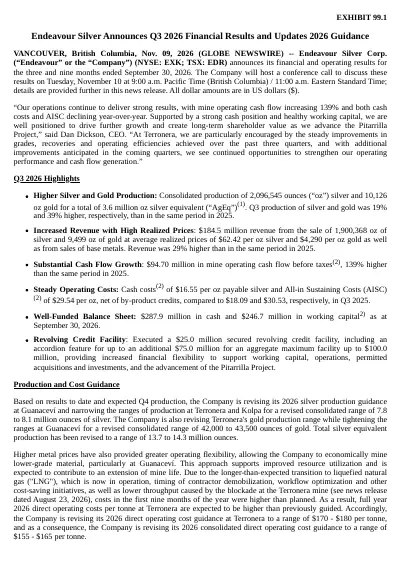
With that updated outlook in mind, let's take a closer look at our third quarter production and financial results. The company produced 2 million ounces of silver and 10,000 ounces of gold in Q3, bringing total production, including base metals, to nearly 4 million ounces of silver equivalent.
Silver production was up 19% from a year ago, and gold production is up 39%. Total revenue was $185 million, up 29% from Q3 last year, with realized average prices of $62 per ounce of silver and $4,290 per ounce of gold.
Mine operating earnings reached $69 million compared with the $16 million a year ago, and mine operating cash flow before taxes was $95 million, an increase of 139%. Cash costs were $16.50 per payable ounce of silver net of by-products, a decrease of 9% compared to Q3 last year.
All-in sustaining costs were $29.54, down 3% from a year ago as well. The company reported $54 million of operating earnings compared to $2 million a year ago, and earnings before taxes were $40 million compared with a loss of $38 million in Q3 of last year.
Looking at direct operating costs per tonne, we've made progress throughout the year. Consolidated costs declined from $187 in Q1 to $162 in Q2, and now sit at $152 in Q3.
That was still 5% above Q3 last year, reflecting the different operating mix, with Terronera now included and Bolañitos no longer part of our operations. At Kolpa, grades and recoveries remain consistent, while higher throughput helped bring direct operating costs down from 138 to $138 in Q3, compared to $153 in the first half of 2026.
The economies of scale are offsetting any pressures we have from a labor standpoint. At Terronera, as I mentioned earlier, direct operating costs continued to decline, reaching $156 here in Q3, down from $169 in Q2 and $195 in Q1.
Contractor demobilization and workflow improvements helped bring costs down earlier in the year, and in Q3, we completed the LNG plant, allowing us to switch our power generation from diesel to LNG. Beyond costs, we've encouraged by the steady improvements in Terronera's grades, recoveries, and operating efficiencies over the past three quarters.
We expect further improvements in the coming quarters with the opportunities to strengthen both operating performance and, obviously, cash flow. With the higher metal prices, we are mining material at Terronera that's not included in our resources with the aim extending mine life.
Further drill results are expected in the fourth quarter, and we look forward to sharing those in the coming weeks. At Guanaceví, direct operating costs were $188 per tonne, reflecting lower throughput and the appreciation of the Mexican peso.
Similarly, we continue to drill at Guanaceví, and will be sharing those results in the coming weeks. Moving over to our balance sheet, we ended September with $288 million in cash and $247 million in working capital, giving us a strong foundation to support our operations and advance our growth initiatives.
We also converted our project loan into a $25 million secured revolving credit facility. It includes an accordion feature for up to an additional $75 million, bringing a maximum potential facility to $100 million.
This adds flexibility to fund working capital, operations, permitted acquisitions and investments, and the advancement of Pitarrilla. Pitarrilla is a major growth story for Endeavour Silver.
Our management team visited the project last week, and the feasibility study is nearing completion. We expect to issue a news release imminently.
Together with the financial flexibility I just outlined, Pitarrilla is central to our long-term growth. We look forward to sharing that next update.
To close, I think the third quarter really demonstrated the progress we've made as a company throughout 2026. While we certainly had some challenges along the way, we're seeing the benefits of the work we put into our operations.
Terronera continues to improve, our cost profile is moving in the right direction, and we're generating significantly stronger cash flow. With Pitarrilla's feasibility study nearing completion, we're approaching another milestone for Endeavour.
We believe Pitarrilla has the potential to be a transformational asset for the company, and we're excited about what lies ahead. I want to thank our employees and operating teams for their continued hard work and commitment, and our shareholders for their ongoing support.
We'll now open up for questions. Operator, please open up the Q&A session.
Operator
Certainly. We will now begin the question-and-answer session.
To join the question queue, you may press star, then one on your telephone keypad. You'll hear a tone acknowledging your request.
If you're using a speakerphone, please pick up your handset before pressing any keys. To withdraw your question, please press star, then two.
The first question is from Heiko Ihle with H.C. Wainwright.
Please go ahead.
Heiko Ihle
Hi there. Thank you guys for taking my questions.
Appreciate it. Greetings from Zurich.
You talked in the release and also earlier on this call about the cost per tonne at Terronera. Obviously, we went from close to 200 to effectively just over 150 in Q3.
You raised the direct operating cost guidance at site to 170 to 180. Just looking in the longer term a little bit, how much more cost savings can we see at site?
What's the next steps and what is those cost savings, what are they based on? I guess we can sort of peg the results for Q4 by just backing out Q1 through 3 and then taking the direct operating cost guidance for 2026 as a whole.
Aiming a bit higher, you want to maybe just give a bit of color on what you think we might see next year and what factors might swing pricing into one direction or the other, please? I know that's a lot.
Dan Dickson
Yeah. No, for sure.
Thanks for the questions, Heiko. I hope you enjoy Zurich.
We have some of our team there right now. For us at Terronera, obviously, the revised guidance is more a reflection of what happened in the first six months and just an elongated time period where we thought we could be on the LNG power generation a little bit sooner, and that pushed up our costs on an annualized basis.
Obviously, as I say you saw $153 operating costs for Q3. The expectation is it to continue to come down.
Now, we're not going to see the same step-downs that we saw from Q1 to Q2, then from Q2 to Q3, but there's still opportunity there. One of the things that mainly comes to mind is the LNG plant came on in July for the lower and upper platforms, and then ultimately for the mine late in the quarter.
We'll have in Q4 for the entire 91 days, ultimately, be on the LNG diesel plant. We're also developing our waste development, we call it waste dump 2, which is just outside portal 4.
Currently, and throughout all of Q3, we trucked it to the other side of the plant, which is ultimately near our tailings facility. We'll be able to cut that 2 kilometers off here in Q4, hopefully sooner rather than later, and start dumping waste here in Q4.
That should save us some operating costs. Obviously, what's most important going forward will also be where the peso sits.
We've seen a recent depreciation of the peso. Hopefully that continues, or at least settles here in the mid-18s.
Ultimately, our full guidance for 2027 will come out in January of next year, and I don't want to get too ahead of that because we are going through management's review of 2027 plans and costs. There still remains opportunity to reduce costs at Terronera, which is great.
Heiko Ihle
You sort of preempted my follow-up. We're at 18.6, 18.7 right now.
I was actually going to ask what exchange rate you guys are using for your Q4 numbers.
Dan Dickson
We haven't changed any of our assumptions that we use at the beginning of the year when we came out with it, and I want to believe -- I believe it's at 17 that we use in our estimates.
Heiko Ihle
Cool. Yeah.
Although that was a lot of words, I'm going to get back in queue. Thank you guys very much.
Dan Dickson
Thanks for the questions, Heiko.
Operator
The next question is from Wayne Lam with TD Securities. Please go ahead.
Wayne Lam
Thanks. Morning, guys.
Maybe just on the updated production guidance, it kind of looks like the implication at the midpoint is a slight decline in Q4, and I would assume it implies flat production quarter-over-quarter at Terronera and Kolpa, along with the lower output at Guanaceví just given the downtime. I was just wondering, is that conservative since I would have assumed a bigger step change at Terronera as you enter into the higher grades?
Or should we be expecting the grades to hold relatively flat around the 150-ish level, and more of a step change in '27 when you get into the La Luz vein?
Dan Dickson
That's a very fair question. Obviously, we put out what our range is.
We feel like with any range, you always want to end up coming at the top end of that range and beat effectively what people are expecting. Terronera, though, it is fair to think of grades being relatively flat to Q3.
We hope that they come up a little bit when that comes through. Ultimately, there's two things that will happen in 2027: we'll be more into the high-grade shoot and get more tonnes out of that high-grade shoot, and then ultimately bringing in La Luz probably mid-year to the end of the year, still trying to determine when that will come in because we're drilling in La Luz and trying to figure out what that depth that we want to develop to.
Ultimately expect 2027 to be still higher grades from where we are at Q3.
Wayne Lam
Great. Thanks.
Then maybe just on the costs, not sure if I missed it, but what was the updated cash cost and AISC guidance on a consolidated basis, and then specifically at Terronera? I wasn't sure if that was excluded purposely.
Dan Dickson
We excluded that purposely, just with the number of where we're sitting and where we put our original assumptions in January. We haven't gone out and re-changed and updated all the assumptions from January, just the production expectations for the year.
Wayne Lam
Because looking at the operating cost per tonne, the main driver is a 30% increase at Terronera. I guess if you could just help us understand maybe how much of that is attributed to the LNG plant versus other factors, and then how much should we add to the costs just based on the $36 silver price used in the guidance versus spot price?
Dan Dickson
Sorry, Wayne, I just kind of misunderstood. Are you asking for the consolidated cost per tonne and trying to understand the changes there?
Wayne Lam
No, specifically at Terronera, if you look at the increase in the operating cost per tonne, how much of that is attributed to the LNG plant and that we can kind of expect to take out of our costs now that that's in place?
Dan Dickson
Really the decrease, how much the LNG and going from diesel gensets to LNG, how much of the portion of the drop from the $165 to $153 is part of attributed to the LNG plant? It's anywhere between $8 to $10, depending on how much LNG and how much diesel we're using per tonne.
Wayne Lam
So $8 to $10 on the LNG plant. Then what would be the offset on your labor and consumables pressures that you're seeing?
Dan Dickson
There's a small portion. At Terronera, we haven't seen as much labor pressure on our costs, we lock in our union rates in January, January/February, and we do that on an annualized basis.
This year was an increase of 5%, 6% that was included in it. Where we've seen impacts potentially is we've actually had reduced staff at Terronera, our labor costs at Terronera have actually come down.
Where we are getting pressure in reagents or steel costs, it's been minimal at Terronera. It's significantly been offset by our efficiencies and our using less steel per meter, to speak, in our development.
Wayne Lam
Great. Thanks.
Maybe just last one, I guess what's the updated timing on the Pitarrilla study, and do you anticipate a construction decision shortly after? I know we've kind of walked through the math before, and the balance sheet looks solid with nearly $400 million in liquidity, but just given the CapEx inflation encountered with the Terronera build, is there any appetite to kind of de-risk the balance sheet a bit further and build up a bit more flexibility before you dive headfirst into the next project?
Dan Dickson
Oh, we like to dive headfirst. No, a lot's there with Pitarrilla.
We're very close to completing the feasibility study and getting all the necessary sign-offs, and ultimately putting out a news release, and then hopefully filing that feasibility study shortly thereafter, and not having the full 45 days where it's sitting there. Really just going through final reviews and then getting QP sign-offs, we should have a news release out hopefully in the next 10 days, if not at less.
As far as our balance sheet's concerned with regards Pitarrilla, correct, we, like I say, we have close to $300 million of cash. We have the ability with that revolver credit facility to what we feel fund Pitarrilla.
The main construction decision point isn't going to be the feasibility study, Wayne, it's ultimately the tailings dam permit. As you're probably aware, the underground mine's permitted, the plant site's permitted.
What we need permitted is the tailings dam permit, and we've submitted it. We expect permits, which is going through the state of Durango.
It's a dry stack facility, not a lot of environmental concerns compared to conventional tailings. If we can have that for Q1/Q2 of 2027, that's the gating item to a construction decision.
At that point, we'll be able to determine where we sit from a cash flow. Really, from the cash flow that we generate, we should be able to fund Pitarrilla, again, and that's dependent on the price environment we're in.
If we're sitting at $50 silver, we should be pretty strong. We'd always look at other mechanisms to ensure that we can fund Pitarrilla all the way through to operations, of course, and make that assessment.
Again, we feel like we're in very strong shape from a balance sheet standpoint and the cash flow that we generate. We expect that Pitarrilla news release to be out within 10 days, and then the construction decision sometime mid-year next year.
Wayne Lam
All right, great. Looking forward to the update, and thanks for taking my questions.
Dan Dickson
No problem. Thanks for the questions, Wayne.
Operator
Once again, if you have a question, please press star, then one. The next question is from Alex Terentiew with National Bank.
Please go ahead.
Alex Terentiew
Hey, guys. Good to see costs coming down.
Much of my questions have already been asked here, let me just kind of look through my last remaining ones. One question is on Terronera.
There's been a lot of changes here, some exploration, you've got the LNG plant, you talked about changing gold metal prices and cut-off grades, and some drilling is happening. Is there going to be, or do you have planned for a new resource update and mine plan to kind of help us get a sense of what we should expect not just really in 2027, but over the next few years?
Because, yeah, I understand, the old study is probably, I don't know, whatever it is, 4, 5 years old now, and a lot's changed. Any clarity there?
Dan Dickson
Yeah. No, that's a very good question.
We actually have new resource estimates that will come out. We've locked those down.
They'll come out early in the new year for Terronera, Guanaceví, and Kolpa, actually.
Alex Terentiew
This would be for Kolpa, this would be the official inaugural Endeavour-stamped 43-101 resource, correct?
Dan Dickson
Correct.
Alex Terentiew
Okay. Okay.
Then on the costs, like I said, great to see Terronera's costs coming down. I think that's something we've all been kind of waiting for.
On Guanaceví, I think costs came down there as well, but I'm just curious, is that a function of how much ore is being purchased versus your own ore being milled this quarter, just kind of trying to gauge what the outlook could be for the rest of this year and into next on costs?
Dan Dickson
You'll see in the MD&A and our reconciliation, and we always want to make very clear about this, that we always talk to direct operating costs, and then we also have direct costs. Direct operating costs per tonne includes mining, processing, and indirects, or G&A.
Our direct costs include the royalties, which is royalties we pay to Frisco, 16%, special mining duty that we pay to the government's included in that, and then purchased ore is also included in that direct costs per tonne. We do a good job separating that in the direct operating costs that we always speak to.
We did see a decrease in direct operating costs at Guanaceví this quarter. Can we sustain that?
I hope so. We're working towards that.
Because ultimately, we start talking about purchased ore, royalties, special mining duty, the price is what really drives that. The silver price and gold price is what really drives that, and that's kind of out of our control.
Again, if we can keep our costs here lower at Guanaceví, that would be beneficial. We feel like we've got good control of the water, we've got great ventilation.
We are very deep in Guanaceví, it's always going to be a high-cost operation kind of going forward. Again, we have drill results coming out in the coming weeks.
Those drill results will be included in our resource. It's a mine that's never had more than a two-year reserve life, and we've been there for 20 years, and we hopefully continue to have a two-year reserve life when those resources come out.
Alex Terentiew
Great. Thank you.
Just one more question then on Pitarrilla, just kind of following up on Wayne's questions there. This year, and you guys noted that spending has been well below what you originally targeted.
I know you're going to have a feasibility study out, like you said, within the next 10 days, hopefully. I'm sure there'll be more details there.
How are you kind of positioning your planning here? Has the delay's kind of impacted your plans for 2027?
I'm just trying to gauge kind of the schedule here and ramp-up, and you guys putting orders in to kind of get a project into construction-ready or moving into construction mid-2027. Just trying to gauge your confidence of that that can kind of happen, or are there other things other than the tailings permit that we need to see?
Dan Dickson
Yeah. No, as you know us, Alex, we're probably a little bit more aggressive on it.
Now, we're in complete different position as a company compared to when we built Terronera, and ultimately, from our feasibility study, which is a 43-101 feasibility study, not probably what historically 10, 15, 20 years ago would people talk about bankable feasibility study. From this feasibility study, we've already engaged a firm to push forward with finalizing basic engineering, then going into detailed engineering.
There's other aspects of the project that we deem to be early works, road improvements, power lines, work that we've started this year that's gone slower than maybe expected, partially because we're waiting for some of the design criteria to be completed that was in the feasibility study. We need to continue to push on that to make a timeline of, say, production by 2030, Q1 2030.
We have a really good feel of what our spend will be in 2027. I don't want to get ahead of ourselves on that.
All that's predicated on if we can get to a construction decision by mid-year 2027. We have a very good feel of the first six months and doing some of that early works stuff.
I think about wells and water, making sure we can get water to site from wells. Again, road improvements, and continue to push with power lines with CFE.
It's very clear what we need to do. We'll have a pretty definitive budget for 2027 when that comes out in January.
Alex Terentiew
Good to hear.
Dan Dickson
I would also add, you see a lot of the engineering firms, because of the price environment we're in, are being pulled in every direction, and whether they have a sufficient staff. Things have just taken a little bit longer, more from an engineering standpoint than anything else.
Alex Terentiew
Great. That's it for me.
Thank you.
Dan Dickson
Thanks for the questions, Alex.
Operator
This concludes the question-and-answer session. I'd like to turn the conference back over to Dan Dickson for any closing remarks.
Dan Dickson
Thank you, operator, and thanks for everyone for joining our Q3 financial earnings call. Again, we're very excited about how Terronera has been shaping up this year.
I think it's very important that we've seen recoveries improve and lined up with feasibility study targets. We've seen grades continue to improve as management's expectation, and we hope to see a little bit more improvement going forward.
Ultimately, we've seen our costs come down quarter-over-quarter over quarter. Thank you for everybody attending, and hopefully hear for you in January.
Bye.
Operator
This brings to an end today's conference call. You may disconnect your lines.
Thank you for participating, and have a pleasant day.