Factorial Energy Inc.
NNASDAQ:FACQ3 FY2026 · Earnings Call TranscriptNovember 10, 2026
Operator
Greetings, and welcome to Factorial's Third Quarter 2026 Results Conference Call. At this time, all participants are in a listen-only mode.
A question-and-answer session will follow the formal presentation. As a reminder, this conference is being recorded.
It is now my pleasure to introduce Brad Cray, Investor Relations. Thank you, you may begin.
Brad Cray
Thank you, and good afternoon. With me today are Dr.
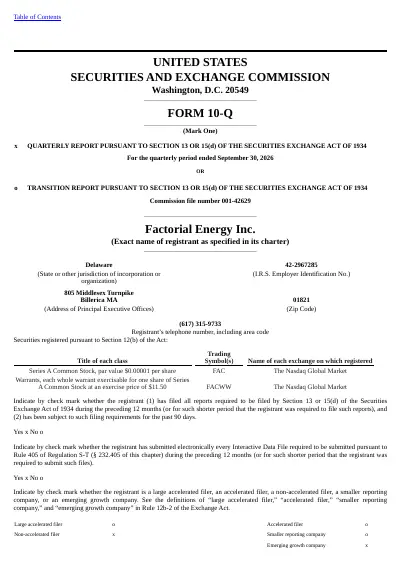
Siyu Huang, Co-Founder and Chief Executive Officer, and Richard Wei, Chief Financial Officer. Earlier today, we published our third quarter shareholder letter on the investor section of our website at ir.factorialenergy.com.
The company uses its website to disclose material non-public information and to comply with its disclosure obligations under SEC Regulation FD. We encourage investors to monitor the site and sign up for email alerts.
Today's discussion contains forward-looking statements within the meaning of applicable securities laws, including statements regarding industry trends, our 2026 outlook, the timing and amount of commercial revenue, manufacturing plans, partnerships, technology development, business plans, and milestones. Actual results may differ materially.
Please review the risk factors described in our quarterly report on Form 10-Q for the quarter ended September 30th, 2026 filed today and in our other filings with the SEC. Factorial disclaims any obligation to update forward-looking statements except as required by law.
During this call, we will refer to non-GAAP operating expenses, a financial measure that is not prepared in accordance with generally accepted accounting principles. We define non-GAAP operating expenses as total operating expenses excluding depreciation and amortization, stock-based compensation, the previously disclosed legal judgment, and for 2025, the loss and impairment on lease termination, all of which are reconciled in our shareholder letter.
Beginning this quarter, non-GAAP operating expenses no longer exclude non-cash lease expense. Management uses this measure to plan and evaluate the ongoing cost of operating the business.
It has limitations, should not be considered in isolation, may not be comparable to similarly titled measures used by other companies, and is not a substitute for the most directly comparable GAAP measure. A reconciliation to GAAP operating expenses is included in our shareholder letter.
With that, I'll now turn the call over to Siyu.
Siyu Huang
Thank you, and good afternoon, everyone. Factorial's first full quarter as a public company delivered a moment years in the making.
We recorded our first drone customer revenue well ahead of the 2027 timeline we set. We're now supplying cells that power real products for paying customers.
In just a few months, aerospace took us from sampling to system integration, to a world record, to commercial order and recognized revenue. That speed was built on years of development work with our automotive partners.
We have proven our path: partnership, system-level validation, then order. Aerospace is the first proof point, and automotive is next, with a longer runway and a far greater opportunity.
We have always planned to go market by market, starting where customers pay for performance and make decisions quickly. Right now, that is drones and aerospace.
We also see few large battery makers competing for drone batteries today, as suppliers from FEOC, which is foreign entities of concern, face growing restrictions in the US. That leaves room for a new supplier.
Our first revenue came from aerospace order we announced in July from a leading US drone maker. We began delivering cells under that order this quarter.
A test flight shows what a cell can do; a purchase order shows what it's worth to a customer. In July, we formed a strategic partnership with Tulip Tech, following customer tests that showed more than 30% longer range with our solid-state and lithium-metal batteries, in part due to a 20% reduction in battery weight before any engineering optimization.
Also in July, a drone built by Titan Dynamics and powered by our lithium-metal FEST cells set a world record for flight duration in Group 1 drones, the lightest drone group, up to 20 pounds, at the Game of Drones testing event at Edwards Air Force Base in California, with 521 minutes in the air, covering roughly 300 miles. In August, our solid-state and lithium-metal cells powered the winning aircraft in the DARPA LIFT Challenge, which carried a payload of nearly four times its own weight.
For drone makers, battery performance is one of the fastest levers to better mission capability. These results give customers independent, real-world proof that our cells deliver as they move from testing towards production.
From here, we expect revenue to grow in three ways. The first is more customers.
We're working to qualify our aerospace products with additional customers. Starting in October 2027, the Department of Defense will restrict batteries from named FEOC, or foreign entities of concern manufacturers.
Qualifying new cell makers takes months, drone makers are picking their suppliers now. Our US headquarters and our fabrication in the United States and South Korea align with that shift.
The second is better cells. In a drone, energy density decides how far it flies and how much it carries.
Last quarter, we said we expected our drone program cells to move towards approximately 450 watt-hours per kilogram by year-end. We have achieved 450 watt-hours per kilogram as of today, about 15% higher energy density than the cells that powered our world-record flight this year, and we continue to target further improvement next year.
That work builds on the FEST B-samples we delivered to Mercedes-Benz, which came in about 390 watt-hours per kilogram. It shows how much synergy that our automotive program is to our high-spec applications.
The next job is to carry those gains from development cells into production cells at consistent quality, because that is what turns the performance lead into orders. Independent testing, including nail penetration, crush, and thermal tests, has confirmed the safety of the FEST cells we have delivered.
Solstice is our all-solid-state battery platform with no liquid inside. We have built Solstice cells as large as 40 amp-hours and delivered them to partners for validation.
Separate from the drone program target, it is designed for up to 450 watt-hours per kilogram, and its enhanced thermal stability when compared to conventional lithium-ion battery cells. That makes it a fit for robotics, space systems, and other uses that need longer cycle life and high thermal stability.
The third is automotive, a much bigger market that moves on a longer timeline. It follows the same path as aerospace: partnership, system-level integration, and commercial order.
Over the years, our work there has grown from one vehicle to several across brands and regions. Mercedes-Benz put our cells on public roads in 2025.
Stellantis built them into a Dodge Charger Daytona development vehicle this year. Right after quarter-end, Stellantis showed the Peugeot Inception concept car with a solid-state battery developed together with Factorial.
Our next major milestone in automotive is a production offtake agreement with a mainstream automaker, building on the supercar order we received in January. An agreement would set us up to ramp towards volume production by the end of the decade.
This is how we're different: partnership, system-level integration, to commercial order. Each step takes years of effort.
Many companies have technologies on the paper, in the lab, but having a claim on the performance is different from having announcement of partnerships with leading customers with substantial investment and support over the years. Having just partnership is different from having those partners building the vehicles on the ground and in the air, not only just functioning, but set the world record.
Having the system integration for an innovative product is different from having a commercial order. We're not just living on the promise, but the track record.
We shared that we will have the first revenue by 2027, and we delivered in Q3 2026. Today, we build cells on our pilot line in South Korea and at our headquarters near Boston.
Those lines have shipped thousands of large-format cells to automakers for testing, and our line in South Korea can switch between the lithium-metal and silicon version of FEST. Next, we're expanding our own lines with FEST by end of 2027 and Solstice by end of 2028.
The new FEST line is being designed to make commercial cells built to the performance requirements of aerospace and physical AI applications. Then, we plan to scale through partners.
We design FEST so that a line can reuse up to 80% of the equipment in conventional lithium-ion line. That lets us grow through our partners' existing factories rather than new ones.
It also avoids much of the cost and environmental impact of new construction. In July, SK On, one of Korea's leading global battery manufacturers, signed a memorandum of understanding with us to jointly evaluate producing our battery technologies across its global manufacturing network.
SK On is our second significant industrialization partner this year, which is major progress towards our fabless business model. It has more than 200 gigawatt-hours of annual production capacity worldwide, including about 100 gigawatt-hours in the United States.
On the supply chain side, in September, we signed a joint development agreement with Mitsui Kinzoku, a leading manufacturer of sulfide solid electrolyte, to help industrialize Solstice. Its A-Solide electrolyte is advancing towards mass production at a dedicated plant in Saitama, Japan.
This builds on our partnership with POSCO Future M, a leading cathode and anode materials provider in Korea. With Mitsui Kinzoku joining POSCO Future M, we now have partners for all three key active materials of Solstice, which positions us to move Solstice to scale.
We're also working with Philenergy, a leading Korean maker of battery stacking and assembly equipment, and one of our investors, to build out the manufacturing infrastructure for Solstice. Our partnership coalition, led by Factorial, is designed to match the scale of today's largest cell makers through a fabless model.
We believe the market will divide into designers and contract manufacturers. Our innovation extends beyond materials and cell technology to manufacturing engineering, and we bring that expertise to our partners' line to raise yield and quality.
Partners can supply manufacturing capacity; the know-how to make solid-state battery work reliably at scale is hard to come by, and that is what we bring, backed by more than 150 patents and patent applications. On cost, our work covers manufacturing, materials, and the supply chain.
In manufacturing, yield has a large effect, because every scrapped cell adds to the cost of the good ones. When we began production of our first technology, yield was low.
Our pilot line has since demonstrated yield about 85%, compared with the 70% to 80% a state-of-the-art lithium-ion battery pilot line typically targets. With everything else held equal, that improvement has cut the cost of every battery cell by more than 80%.
Solstice's dry cathode process also uses less energy and avoids the volatile organic compounds that come with solvent-based processing. In materials, our lithium-metal cells follow a different cost curve from silicon anode cells.
With silicon anodes, more energy density takes more silicon, and the cell gets more expensive. With lithium metal, more energy density comes from a thinner anode, which means less material.
Over time, we believe that can make our lithium-metal cells less expensive than silicon anode cells. Because neither platform needs rare earth metals, we believe our cell costs can approach that of lithium-ion and become competitive as volume and our supply chain grow.
In the near term, we're focused on holding yield as volume rise, qualifying our drone products with more customers, and moving Solstice towards industrialization with POSCO Future M, Mitsui Kinzoku, Philenergy, and our manufacturing partners. Further out, we see significant opportunities in physical AI, automotive, and energy storage.
With that, Richard will take you through the numbers and our outlook.
Richard Wei
Thank you, Siyu, and good afternoon, everyone. Our revenue milestone in the quarter represents an early step toward a much larger opportunity.
The full detail is in the letter, I will focus on how this business is built to grow and how we plan to generate attractive returns from that growth. The opportunity ahead of us is enormous.
The IEA and McKinsey project that global battery demand will grow significantly by 2030 to several terawatt-hours. At gigafactory scale, we're built to grow with that demand through our industrialization partners' capacity.
In the high-specification market, we're expanding with a mix of our own capacity and our partners'. To serve our first customers, we're expanding FEST by the end of 2027 and Solstice by the end of 2028.
Both are on track. Revenue follows the same logic.
In high-spec markets such as aerospace, robotics, and supercars, we sell finished cells supplied from our own lines within our current capital plan, and supplemented by contract manufacture cells where appropriate. In automotive, the much larger market, we expect our industrialization partners to contribute installed manufacturing capacity, and we see two ways to earn revenue from it: contract manufacturing and joint manufacturing.
In contract manufacturing, partners manufacture cells to our design under contract, and we earn revenue on those cells. In joint manufacturing, partners license our technology and make cells themselves.
Licensing generates less revenue per cell than contract manufacture cells, but we expect it to carry higher margins and require little of our own capital. Separately, we expect to earn revenue from supplying key materials and from engineering services.
The third quarter is a starting point. Revenue was approximately $26,000 from our first cell shipments under the aerospace order we announced in July.
Gross loss was $1.8 million. Nearly all of it came from a write-down of inventory.
During the quarter, we built up inventory ahead of orders to support near-term demand. Those cells are on hand and available to sell.
At these early volumes, our fixed costs are spread over relatively few cells, and material prices are higher, each cell costs more than we expect to sell for. We carry the cells at what we expect to receive when we sell them and record the difference as a cost.
The size of the write-down largely reflects how much inventory we built up. As production scales, we expect higher labor productivity, overhead spread across more units, and lower material prices to bring unit costs down, providing a highly compelling value proposition when compared to lithium-ion batteries.
Non-GAAP operating expenses were $9 million for the quarter and $24 million year-to-date, mostly for research and development, sales and marketing, and the operating infrastructure behind the milestones Siyu described. Non-GAAP operating expenses also exclude $4.1 million related to the legal judgments we previously disclosed.
GAAP net income was $8.8 million this quarter that came primarily from a change in fair value of warrant liability of $24.0 million, a non-cash gain which moves with our share price. Our nine-month GAAP net loss was $11.1 million.
We now expect full-year 2026 non-GAAP operating expenses of $36 million to $38 million, below our prior outlook of approximately $40 million. The lower range reflects continued spending discipline and, in part, production costs that are now recorded in inventory and cost of revenues instead of operating expenses.
The range implies higher spending in the fourth quarter as the timing of some costs shifted into that period. We expect full-year capital expenditures of $10 million to $12 million, compared with our prior outlook of approximately $13 million, mainly reflecting the anticipated timing of milestone-based equipment payments, some of which may move into early 2027.
We expect more meaningful commercial revenue in 2027 as production programs begin. Until those programs ramp, revenue is expected to remain modest and to vary from quarter to quarter.
We have reached our energy density target of approximately 450 watt-hours per kilogram in our aerospace program cells, and we expect to keep spending within our outlook and complete both line expansions on schedule. We believe our balance sheet, disciplined operating model, and capital-light manufacturing approach give us the runway to carry out our value-creation plan.
With that, back to you, Siyu.
Siyu Huang
Thank you, Richard. When we founded Factorial, we believed that the world would need fundamentally better batteries.
This quarter, a customer paid us for cells for the first time, and we moved forward on each of the four priorities we set out in June. These are early steps in building the energy layer, the battery infrastructure we believe will underpin the next era of aerospace, mobility, and physical intelligence.
Our strategy has not changed. We prove our technology first in high-spec markets such as aerospace, where performance matters and customers adopt quickly, then carry that proof into mainstream vehicles and a wider mobility market towards the end of the decade.
There's a lot left to do, and this team is ready for it. Operator, we're ready for questions.
Operator
Thank you. We will now be conducting a question-and-answer session.
If you would like to ask a question, please press star, one on your telephone keypad. A confirmation tone will indicate your line is in the question queue.
You may press star, two if you would like to remove your question from the queue. For participants using speaker equipment, it may be necessary to pick up your handset before pressing the star keys.
One moment, please, while we poll for questions. Our first question is from Derek Soderberg with Cantor Fitzgerald.
Please proceed with your question.
Derek Soderberg
Hey, everyone. Congrats on the technical achievements as well as the commercial revenue.
I'm curious if you can quantify the level of firm orders and repeat demand you guys see for 2027. Similarly, can you talk about maybe which qualification milestones in the near term might accelerate that demand in '27?
Then I've got a couple of follow-ups.
Siyu Huang
Thank you so much, Derek. Again, thank you so much for being here today.
In terms of the revenue, we haven't disclosed the 2027 guidance yet, but we do see that as we ramp and after we get this initial order, we're expecting to receive more meaningful revenue as we scale. I think we're in our first customer and first few customer qualification process right now.
We're potentially expanding to the next 10 customer qualification process. We're under active testing with multiple of them as well.
I think we're anticipating that the customers will be moving faster and faster, and this is actually also surprising to us. Actually this customer moved faster than what we expected, and that's why we were able to bring our first revenue ahead of our 2027 timeline.
To your second question about the qualification, I would say aerospace is our first one here, and we have just been in this market over the last few months, since our acute investment, that we also had our first partnership announcement to the first demonstration with system integration and validation to our commercial order. We see that now we have to replicate the same process with other customers, even with bigger customers in aerospace market.
On top of that, I would say the holy grail is really in the automotive space, and that's what we see actually will likely follow the similar pattern. As we had our first partnership announcement back in '21 with Hyundai Kia, followed by investment with Mercedes, Stellantis, also the initial formation of the partnership coalition.
Recently, we also had additional OEM release with the partnerships as well. I think what was most exciting in that journey is that we also built one of the world's first solid-state battery vehicle with Mercedes last year, and it took on this record drive with 1,205-kilometer with a single charge.
This really speaks to the value as we come to the system-level validation, and we see that's going to be the next step to really focus on, to bring this to the commercial order in near future with automotive partners.
Derek Soderberg
Got it, super helpful. I also wanted to touch on manufacturing yield.
Your pilot line is at 85% or above. I was wondering if you could maybe talk about the pace of improvement there that you've experienced and when we might be able to get to kind of that 95%-plus that the industry targets.
Just on that, was wondering if you could touch on that. Then was curious if that 85% yield number, is that end-to-end yield for cells produced?
Siyu Huang
Our line in Korea right now, with the capability of doing FEST, is roughly about 85% yield over the course of the last few years as we ramped up. Initially, the yield was really low.
It's way below that. As you may know, this industry very well, yield is really important for the cost.
As a line with 20% yield is roughly about four times of the cost of the yield of 80% system. The typical lithium-ion battery pilot line will run about 70% to 80% yield, and for our system, that we already get to 85% yield, which is state of art.
Here we're talking actually about assembly and formation only and doesn't include the coating process, but includes the IQC, the incoming qualification process for coating already. I think for the gigafactory, you will typically expect to be at least 95% or above, but with a pilot line of 80%-plus yield, you're on a good path to get to the system like the gigafactory-level efficiency.
Derek Soderberg
Got it, super helpful. Appreciate the detail.
Then finally, just on the 450 watt-hour per kilogram achievement, can you talk about some of the other, I guess, I call them trade-offs, just on cycle life, discharge power? You'd mentioned some testing in various temperatures and things like that.
What sort of cycle life, discharge power do you get with this level of density, and maybe talk about some of the applications that you guys are uniquely suited to go after? There's really not other technology like this, just wanted to hear your thoughts on that.
Thanks.
Siyu Huang
That's definitely a very discerning question. Apparently, for battery industry, it's all about a balancing act.
It's all about the trade-offs. For this specific product that recently set the world record, we focused the development from that cell into an even higher energy and higher power cell.
Initial cell we literally brought it from automotive world. After 10 years of developments, we just had a smaller format from the Mercedes vehicle cell, but with a similar chemistry, and put it on the drone, and it flew and got a world record.
However, for this new system, we're targeting to really focus on range and power, because that what really matters for the drone industry and for the aerospace that we're targeting in near term. A lot of them, they don't really require many cycle lives, and it's not really long cycles that you're looking for for those specific applications.
That's why we have deemphasized the cycle life requirements, which is apparently much smaller than automotive environments. The discharging capabilities or the power capabilities could be 5 to 10 times as high as what is required for the automotive industry.
This is what we've never seen before. Lithium-metal cell has actually a very unique advantage on that, because for lithium-ion, especially like silicon, graphite lithium-ion batteries, you will have a natural compromise between energy and power.
Usually, energy cell cannot deliver a high power, and a high-power cell will have very limited energy. When you try to push both, the cost can become a big issue, even you're getting close.
That's why we think that for this technology, you will be able to get to the energy density much quickly, because lithium metal is literally the lightest metal on Earth right now. The same time, you can push for high power without the traditional physical limits that the lithium-ion battery are having.
Derek Soderberg
Super helpful, really appreciate it.
Siyu Huang
Thank you, Derek.
Operator
Our next question is from Colin Rusch with Oppenheimer. Please proceed with your question.
Colin Rusch
Thanks so much, guys, and congratulations on hitting the first revenue. Appreciate the detail on getting to the 450 watt-hours per kilo, but I want to get a better sense of how much, or what other advantages you might have at the pack level given the chemistry and some of the performance metrics that you guys are able to deliver.
Just want to get a sense of that relative to some of the other chemistries out there.
Siyu Huang
That's a great follow-up question to Derek's earlier question. Actually, there was one thing I forgot to mention is about the temperature, and this is very relevant to your question, Colin, on the pack level.
I think pack-level lithium metal, we also see a great thermal stability and also conductivity compared with silicon. We're happy to share with you more details in a more deep-dive technical discussion.
In high-content silicon pack, usually you will see a lot of heat generation at high power level, and for lithium metal, you don't see that, because lithium is, in general, a much better heat transistor compared with silicon. That's why we think that, I would say, having high energy, high power without generating too much heat is definitely one advantage you can see at the pack level.
On top of that, there's very similar integration effort needed for lithium metal compared with silicon. I would say there is a potential cost reduction that's required for the system.
This is not only just for aerospace, but also for automotive as well. If we have a lighter cell, and you need very much similar to in terms of integration for the drones, for example, and it can reduce the weight of the drone, and it can reduce the overall cost for the system.
For automotive, it's another different story. No matter if it's for lithium metal or for silicon, if you can reduce the total weight of the vehicle, for every pound you're saving is roughly about $5 of saving according to our customers' feedback.
This matters a lot when you are not only just reduce the weight of the battery itself, but also the supporting structure, like the steel and aluminum. Another important findings that we had recently is even about the power capability, because the lighter system, you might be able to have even better power.
For example, we had some recent discussion with motorcycle companies, and they even shared that typically they will require very high power discharge. When you have a lighter system, you don't even have to have extraordinary high power compared with traditional vehicles.
I think lighter vehicles can also lead up to a much higher power and longer distance performance.
Colin Rusch
Excellent, that's super helpful. Then, as you get into proper commercialization here with customers, can you talk about the customer strategy and the sequencing here?
Obviously, you're targeting a handful of different applications in different size orders. Certainly, the commentary around the automotive sales cycle and design cycle is, I think, well understood.
I want to think about how many customers you're working with, order of magnitude on that, and how those folks move through the sales pipeline into the production ramp as you get into this in a little bit more robust way next year.
Siyu Huang
We have been, in a long term, a true believer of starting with small and small market, but with nimble and faster adoption of new technologies. That's why we defined this aerospace and physical AI and all this high-performance market as high-spec market even back in 2020 at early stage of the company during COVID time.
That was a name that we initially defined ourselves as high-spec market. As part of this ramp-up, we believe that in near term, even intermediate term, automotive will be a real market for us tapping to.
It does have a commercial demand, and automakers are willing to spend a lot of capital, especially in early days, to support all of these developments. Also, surprisingly, they were very supportive for us to get into the high-spec market to begin with.
They say this is a strong validation in what they are trying to do, and especially with a cell chemistry that's almost the same as what they are developing as of today. In terms of pipeline, in our drone and aerospace market, we see that this is much more fragmented market, not like automotive, right?
If you grab the top five automakers, they're probably 50% of the market already. For drone, it's much more fragmented.
I think we're going to first of all find a few key customers, or the key opinion leaders in the market, and crack the code, right? That's what we're starting to build first.
That's why we're working with this US leading drone maker to build that initial success. Then we'll launch with volume, because this cell is commercial-ready, and we're scaling with volume.
I think this process, we see typically takes anywhere between 9 months to a year to get to fruition, but I think it's going to be much faster than automotive. When it comes to automotive qualifications, it's also going to be experienced the same process, where it's three-step process: number one, partnership formation; number two is system integration; and then the number three is commercial order.
It is a much longer journey, but has much bigger potential in that market. I think we have been enjoying one of the best advantage among auto solid-state players in the US that with Mercedes, Stellantis, Hyundai Kia, they are already more than 25% of the global market outside of China, and we just also onboarded a new JDA partner, and that is from Europe as well.
I think we're looking at a very significant part of the automotive market, even up to 30%, 40%. This is something we think we have a great pipeline today, and we also have done vehicles across two continents, in the US and in Europe.
We launched the first European solid-state battery vehicle last year with the record drive, and also we launched the first vehicle in American soil with Stellantis this year. We had another recent announcement with Stellantis about Peugeot.
I think all three vehicles are really good starting point about the validation, which is second stage we see is very important for them to have a tangible aha moments to say, "Oh, it actually works." Then, I think, we have to move towards the final stage of offtake, and that's where the fun things will start with all the manufacturing and partnership.
I think the recent announcements with SK On in this quarter is also very important. This is the second joint manufacturing partner we have announced this year, and this definitely paved the way for the manufacturing capabilities with more than 200 gigawatt-hour globally, in both US and Europe.
I think the next stage is really to focus on the manufacturing and reduce the cost for manufacturing. That's where the supply chain partnership matters a lot.
That's why we had Mitsui Kinzoku, that's one of the most reputable solid-state electrolyte suppliers in the world, join the partnership with POSCO Future M and Philenergy earlier this year to help scale the all-solid-state battery manufacturing. I think it's a really strong pipeline for us on both aerospace and automotive market, and we're one of the very few companies actually have strong partnership in both markets in the US.
Colin Rusch
Great, thanks so much, you guys.
Siyu Huang
Thank you, Colin.
Operator
Once again, if you would like to ask a question, please press star, one on your telephone keypad. Our next question is from Mark Shooter with William Blair.
Please proceed with your question.
Mark Shooter
Hi, Siyu and Richard, and congrats on the quarter. We appreciate that fabless business model that you talked about in the shareholder letter.
Regarding your relationship with SK On, can you give us a little color on what shape do you expect this to take? Is this a licensing deal, or a joint venture, or maybe just straight contract manufacturing?
Is this more focused on drones or EVs?
Siyu Huang
Oh, that's a brilliant question. Definitely, we're a big fan of the fabless business model, because we know this industry is bifurcating into the two segments: one is more on a designer, and the other one is on a contract manufacturer.
We know that it's going to be very important to focus on the design, especially the competition of the battery industry is so fierce at this moment. We see that for our automotive market, there are two main ways of doing this manufacturing with partners.
One is called contract manufacturing, which we recognize all the revenue, and we work with our contract manufacturer to produce the cells, which is something very similar to some of the semiconductor business. The other way, we call it joint manufacturing.
It's a combination of licensing on top of the material supply and manufacturing engineering services. This is really tailored for a certain manufacturing partners have strong relationships with OEMs.
Sometimes they are the daughter company, the wholly owned subsidiaries. I guess you can guess who they are out there.
Those are really the ones that were basically joint manufacturing with OEMs, right? That's where we think there's a fairly strong case that we can build a licensing model.
When it comes to the high-spec market, such as for aerospace, we see that it's a combination of our own manufacturing and contract manufacturing. Because, first of all, the speed for this market is much faster.
They don't have much patience to wait for three, four years to build a line, but would rather just to pick up the cell, put in the pack in a week and go. That's the speed of this market.
I think with our own capabilities in Korea and in the US, we do have some volume already. We're expanding those capabilities as Richard shared earlier, in '27 for the FEST product and '28 for Solstice.
I think for that market, we'll start with our own manufacturing, because also the cost, the capital to put into those build-out is relatively small, too. We could relatively turn around a manufacturing production line much faster with relatively small capital, and be able to ramp up in commercial order very quickly.
Then the question is, do we have to do this forever? My answer is apparently no.
If there's opportunity to leverage partners to build contract manufacturing capabilities, that will be definitely preferred. If we can use other people's money, why not?
This is also a win-win for our contract manufacturers, because a lot of them, they don't want it to be a cell maker, or they don't really have the technology to be a cell maker. I think being able to leverage this and give them significant revenue, at the same time for us to be able to ramp up our revenue without putting substantial capital would definitely be a preferred way in the long term.
Mark Shooter
Thanks, Siyu, that's really helpful. To dig in a little bit more on that fabless business model, being able to easily convert lines for contract manufacturing or the joint manufacturing, that would be key.
That's why we've seen such strong success with silicon anodes, because there's that drop-in replacement for graphite. The FEST system is flexible, where you can either use silicon, or it can be tailored for lithium metal.
With lithium metal requiring a bit more development in that commercial-scale equipment, can you give us some color on the differences between scaling those two, really if you're looking at a silicon anode versus lithium metal, either anodeless or not? Does that impact what chemistry you'll commercialize first?
Are the partners skewing one way or the other?
Siyu Huang
Absolutely, you are definitely the chemist in the room. Very much appreciate this question, Mark.
I think, yes, there is difference for the silicon versus lithium metal, and even in our system, our existing FEST system, with a lithium metal, we have up to 80% compatibility with traditional lithium-ion battery line, and silicon potentially can have even more compatibility, which I think is even better when it comes to contract manufacturing. We have not yet disclosed about our line expansion plan in detail.
I would say, for these two systems, to some extent, I think as long as we manage the raw material to be compatible, there is a potential to have still 80% compatibility. One thing I do also want to mention is that, I think was Derek asked the question earlier, from the cell manufacturing, there are three steps, right: coating, assembly, formation.
Yes, lithium does have a little bit difference in the assembly, but the coating and formation are pretty much the same. You can use the same equipment.
I think that's something where, and I will say there are also, of course, as there are different types of lithium-metal technology, too. In the end of the day, I think first of all, the coating, which is one of the most expensive part of the manufacturing, should be quite commoditized, and we could leverage it for our existing manufacturing capabilities.
I'm sure we'll release more details as we're moving along the next few weeks and to the next quarter. I think there is a even higher capability for the silicon ramp-up.
I think for our aerospace market, we're likely going to be focused more on the lithium-metal technology to begin with, because that's really the holy grail. In the automotive market, I think we see a combination of interest of both.
I would say even between FEST and Solstice, there is interest for both silicon and lithium-metal chemistry. Since we haven't shared in more details, and I would say it's roughly about half and half in terms of our customer interest at this moment.
Mark Shooter
That's very helpful. Thanks, Siyu.
Just one more if I can fit it in. To touch on that last point, the demand for FEOC-compliant cells, especially in the drone market, is high, and there's a timing component where a cell today is very important, and the performance of that cell may not even need to be top-benchmark.
It's just because the availability of supply is so low. I'm wondering if there's a trade-off or optimization of, okay, I can make silicon cells faster and easier today, but they're not as good as the performance of a lithium metal or anodeless or solid-state, but customers prefer cells today versus waiting two years.
Have you seen anything like that in your engagement with customers?
Siyu Huang
That's a great question. I think I don't see much difference between the time to market for the non-FEOC supply chain for either silicon or lithium metal.
For us, specifically, because we have this one of the strongest partnership coalition with POSCO Future M, which is one of the largest material maker in Korea, and they are also the only one produced both cathode and anode materials, and also a few other partners such as LG Chem over the years, and even SungEel HiTech on the recycling side. I think we have a really strong position in having access to one of the most advantageous, most advanced material supply chain globally.
We also have been focused on innovating products ourselves internally. This gave us almost the same time in developing NDA-compliant cell for silicon versus for lithium metal.
I think I know what you are asking here is more for a lithium-metal supply chain, and we do have a solution for that, and we'll be able to share with you, hopefully, by the end of next quarter.
Mark Shooter
Great, thank you very much.
Siyu Huang
Thank you.
Operator
Our next question is from Eric Stine with Craig-Hallum Capital Group. Please proceed with your question.
Eric Goldstein
Hey, good afternoon, guys, and congrats on all the accomplishments this quarter. I just had a couple of other questions.
You've put together pretty impressive list of partners. I was just wondering, how do you manage all the partners?
Do you have employees that are co-located at their facilities? Are they co-located in your facilities?
Where it makes sense, are you able to share advancements that are made with your partners across your entire ecosystem?
Siyu Huang
That's a great question, Eric. Thanks for dialing in today.
Our partnerships, especially with our customers and suppliers, have been growing constantly over the course of last few years with Mercedes, Stellantis in early days, and Hyundai Kia, and even with VW's recent onboarding, is definitely really strong coalition together. I think we have had a very clear firewall on the technology and our trade secrets internally with our partners.
I think I would say all of our partners have been very respectful for our technology, too. We haven't really have to have the partner to come in.
Of course, when it comes to say automotive offtake, you'll be a different story. You have quality people getting to your room.
That would be a different story. I think at this stage, and also with our drone customers, they're pretty hands-off at this moment.
What we also realized that usually when you have big OEMs or drone customers sitting in your room before you receive offtake, that means something's going wrong. I think fortunately, we don't have to have that issue.
I think we do have very close collaborations with our automotive partners. We actually had multiple interviews and even co-presentations in conferences, in press releases together.
I think a lot of people didn't realize how closely the relationship held with each other. From the earlier this year, we announced that the three partners across three continents with Coulr in the US, that's a NYSE publicly listed company for drone and aerospace integration; and with Tulip, as you know from the name, is from Netherlands; and JR from Korea.
Those three companies across three continents. Just over the course of last few months with the world record that we set with the Game of Drones event, and even with the partners with the DARPA LIFT Challenge and all these different competitions, and those partners have helped a lot in this process.
Sometimes we do visit their facility, and they also visit us. I think it's very friendly conversation, and we also keep a little bit healthy distance with each other.
Eric Goldstein
Great. Just a couple others.
The SK On MOU, are there any milestones that would turn that into a definitive agreement?
Siyu Huang
We actually have a lot of milestones within the MOU. Apparently, I don't have authority to disclose it as of today.
I would say, from the company's perspective, our next big milestone is really the offtake from OEM. I think that's really the one that we're looking in to, to build beyond those nitty-gritty, small, detailed milestones like we signed in MOU.
I think that's going to be a big driver to bring everything together.
Eric Goldstein
Okay. Then just one for Richard.
It looks like the cash burn in the third quarter was a little higher than what it had been in the first half of the year. I'm just wondering how you're thinking about the fourth quarter.
Do you expect cash usage in the fourth quarter to be similar to the third quarter?
Richard Wei
We provide guidance for the full year, about 36 to 38 range. That's on a non-GAAP basis.
I think you could deduce what the Q4 numbers should be based on that. We will continue to build inventory.
Eric Goldstein
Okay. Then just the last one, the $4 million legal judgment, was that paid out in the third quarter?
Richard Wei
That was paid out in the fourth quarter.
Eric Goldstein
In fourth quarter? Okay.
Thank you.
Operator
We have reached the end of the question-and-answer session. I would like to turn the floor back over to Siyu Huang for closing comments.
Siyu Huang
Thank you all for joining us today and for your thoughtful questions. It means a great deal to me and to our team to share this journey with you.
We look forward to updating you next quarter in the new year. If I don't see you before the new year, happy holidays, and we're grateful for your continued support of Factorial.
Operator
Thank you. This concludes today's teleconference.
You may disconnect your lines at this time. Thanks for your participation.