Franklin Covey Company
NNYSE:FCQ4 FY2026 · Earnings Call TranscriptNovember 4, 2026
Operator
Please be advised that today's conference is being recorded. I would now like to hand the conference over to your first speaker today, Boyd Roberts, head of Investor Relations.
Please go ahead.
Boyd Roberts
Thank you. Good afternoon, everyone, and thank you for joining us today on FranklinCovey's fourth quarter and fiscal year 2026 earnings call.
We appreciate having the opportunity to connect with you. Before we begin, please remember that today's remarks contain forward-looking statements as defined by the Private Securities Litigation Reform Act of 1995, including, without limitation, statements regarding our fiscal 2027 guidance and other statements that may predict, forecast, indicate, or imply future results, performance, or achievements, and may contain words such as "believe," "anticipate," "expect," "estimate," "project," or words or phrases of similar meaning.
These statements reflect management's current judgment and analysis and are subject to a variety of risks and uncertainties that could cause actual results to differ materially from current expectations, including, but not limited to, risks related to macroeconomic and geopolitical conditions, the timing of client and government funding decisions, the transition of our China operations, the success of our go-to-market and product investments, and other risk factors described in our most recent Form 10-K and other filings made with the SEC. We undertake no obligation to update or revise any forward-looking statements, except as required by law.
With that, I'd like to turn it over to Mr. Paul Walker, our chief executive officer.
Paul Walker
Thank you, Boyd. Good afternoon, everyone, and thank you for joining us today.
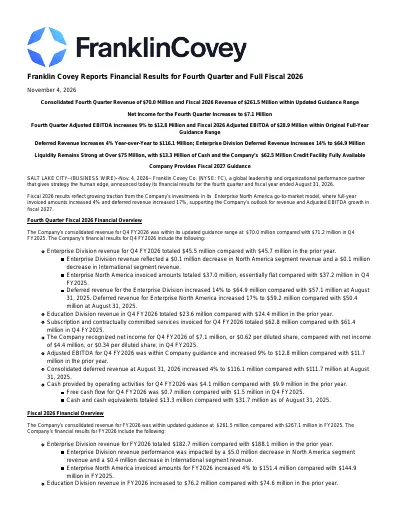
If I were to summarize fiscal '26 in one sentence, it would be this: the transformation investments we made have gained traction and are producing results, positioning us for growth in fiscal '27. For the full year fiscal '26, revenue was $261.5 million, within the guidance we revised on our third quarter call, and adjusted EBITDA was $28.9 million, within our original guidance range.
In the fourth quarter, adjusted EBITDA grew 9% to $12.8 million. Those results matter.
The more important story for fiscal '27 is what's happening beneath them. In Enterprise North America, our largest business and the main focus of our investment, fiscal '26 invoiced amounts grew 4% to $151.4 million, and deferred revenue grew 17% to $59.2 million.
That growth is already on our books, establishing a strong foundation for the revenue and adjusted EBITDA growth we expect in fiscal '27. I'd like to focus on three themes today, which you can see reflected on slide 3.
The first theme is related to our business in Enterprise North America. Enterprise North America has a resilient core, our go-to-market transformation there is working, and we're accelerating our investment to further build on the invoice growth we achieved last year.
The second theme I'll focus on is that our Education business is a proven platform, which has achieved significant growth over time, and we expect it to return to meaningful growth. Third, in the age of AI, the human edge matters more than ever, and that makes our business even more durable.
Diving into these themes, first, the first theme, Enterprise North America and its resilient core and the success of our go-to-market transformation. Enterprise North America accounts for approximately 80% of our Enterprise division revenue and more than half of the total company revenue.
It's the engine we reorganized and invested in to accelerate growth, and we expect it to drive the majority of our revenue growth in fiscal '27. As shown on slide 4, the core of this business has been resilient, growing 30% since fiscal '21, or 5% compounded.
Over the last few years, it's absorbed a pullback in federal government spending, the impact of our own go-to-market transformation, and a cooling in demand for unconscious bias training after the surge that followed 2020. Excluding our federal government and unconscious bias business, our core Enterprise North America business grew approximately 8% in fiscal '26.
In addition, clients are committing for longer: 60% of our contracted amounts in North America are now under multiyear agreements. As we've discussed throughout the year, much of our invoiced growth is recognized over time.
We collect the cash as we invoice, but the full benefit shows up in reported revenue over the following quarters. That's why the 4% invoice growth and 17% growth in deferred revenue in Enterprise North America that we built in fiscal '26 sets a strong foundation for fiscal '27.
We expect growth in both revenue and adjusted EBITDA this year, with adjusted EBITDA growing faster than revenue as we benefit from the operating leverage in our model. To build on that resilient core and accelerate growth in Enterprise North America, we invested in transforming our go-to-market model.
Today, we have dedicated hunters focused on winning new clients, and a dedicated farming team focused on retaining and expanding existing relationships, supported by a central sales hub. These bets are working, which you can see reflected on slide 5.
First, on the hunting side, compared with fiscal '24, the year before we launched the new model, invoiced amounts per hunter have more than doubled. Each hunter is winning more than 30% new clients, and invoiced amounts per new client are more than 50% higher than they were in the old model.
This is driving our growth in invoiced amounts that will flow through to reported revenue growth. Second, on the farming side, the invoiced amounts per farmer are also increasing.
This has driven a significant increase in our invoiced amounts per retained client, which grew in the high single digits this last year, as existing clients expanded their work with us. This was partially offset by our client logo retention rate being a couple of points lower than we like.
This is something that we're putting extra focus on this year. These larger new client deals and growing client relationships reflect the strategic importance clients are placing on the outcomes we're helping them achieve.
Clients are bringing us in to help them with bigger challenges and engaging both our experts and our solutions and content. I'll share just two brief stories from the fourth quarter that show what's behind these numbers: one from our hunters and another from our farmers.
First, on the hunting side, this is a story that's exactly the kind of win our dedicated hunting team was built to deliver: a new client engaged at a strategic level, starting with a larger initial commitment. This is a story of a global consumer packaged goods company who partnered with us to accelerate the adoption and execution of its strategy across its commercial operation as it expands its retail footprint.
What began as a conversation about aligning field execution with growth objectives quickly became a multi-solution, multiyear enterprise partnership totaling $300,000, well above the size of a typical first engagement for us. The relationship is already growing.
Following early momentum and rapid adoption, the client expanded the engagement within weeks of launch, adding a new phase focused on developing senior and mid-level leaders through our leadership solutions and executive coaching services. That positions their leaders to execute against aggressive expansion targets, and it shows how the relationship our hunters win today becomes the expansion opportunities our farmers grow tomorrow.
The second example is on the farming side. As a reminder, our farmers' job is to retain clients and expand our impact within them.
This story is a great example of that. One of the world's largest energy companies has grown an original engagement with us into a global execution partnership that now spans 10 countries.
The work began with operating teams in the Americas, where FranklinCovey helped leaders deliver against aggressive cost and growth targets. When the executive who sponsored that work was promoted into a global leadership role, he brought FranklinCovey with him, recommending our 4 Disciplines of Execution consulting and coaching to the company's senior leadership as a system for delivering on a major company priority.
The client's success across that initial deployment is now leading to additional work: pilots across nine business units with the potential to reach tens of thousands of people at more than 200 sites worldwide. This is what drives the high-single-digit growth in invoiced amounts per retained client that I mentioned.
Clients who see results with our content, our experts, and our technology bring us into more of their organization. Our key bets are working, and in fiscal '27, we'll enter phase two of our transformation to build upon the traction we've gained.
As we continue to invest in these areas, we're also restructuring other areas of the company to ensure that every dollar we spend is focused on the most important growth areas. In fiscal '27, we're focused in the following areas as we build on the traction we've gained.
First, hunters: we're growing our hunting team by more than 20% this year and plan to keep adding each year. We're backing them with roughly 30% more sales development representatives and a 25% increase in marketing to scale the lead generation that worked in fiscal '26.
Relative to our farmers, our farming team is already sized to support the growth our hunters are delivering, we don't need to add investments here. Instead, our farmers will be squarely focused on what they do best: retaining and expanding our client relationships.
Building on the meaningful improvement in revenue retention we achieved in fiscal '26, we expect our existing clients to become an even stronger engine of growth at very attractive incremental margins. The third area is our central sales hub.
The hub we built as part of this transformation is operating as designed and requires almost no incremental investment. It will support both teams as they scale.
The fourth area is our solutions. We've meaningfully increased our investment in solution development over the past few years, and we plan to increase it again in fiscal '27, funded within our operating budget.
Now, being led by our company-wide chief product officer, Sean Covey. Prior to successfully building and running our Education business, Sean led all of product development for the company.
We believe this transition will enable us to further bring clients the best content, technology, and AI services to address their mission-critical needs. Because the central hub is already in place and little incremental investment is needed on the farming side, more of each new dollar of revenue in fiscal '27 and beyond will flow through to profit.
That's a key reason that we expect adjusted EBITDA to grow faster than revenue in fiscal '27. We're also extending these same go-to-market disciplines to our business in the Enterprise division in Europe, Japan, and Australia, where we see a similar opportunity to accelerate growth.
The second theme I'd like to talk about briefly is related to our Education business. Education is a proven platform, which has achieved significant growth over time, and we expect it to return to meaningful invoice growth.
Our Education division grew reported revenue 2% in fiscal '26 to $76.2 million, driven by subscription growth and more coaching and consulting days delivered. School retention improved to its highest level since 2022, and Leader in Me now serves more than 8,000 schools worldwide.
Over the last several years, we've won a number of larger district and statewide commitments in addition to individual schools. That's been very good for the business overall; however, it can shift timing from one year to the next because district and state funding decisions don't follow our fiscal calendar.
Slide 6 shows how the division has grown over time and separates the core individual school and district sales from very large district and state contracts. This year, a few of those large deals, including the statewide commitment I mentioned on our third quarter call, did not land in fiscal '26.
That's the primary reason Education invoiced amounts declined. However, these opportunities remain in our pipeline, and we expect them to contribute in fiscal '27.
We see no change in underlying demand or in the results schools achieve with Leader in Me. Our focus here is on sharpening sales execution, reaching new schools and districts, increasing renewals, and adapting the disciplines working in Enterprise North America to educators' buying cycles.
To lead this work and build on the tremendous Education division foundation Sean Covey built, we welcome John Buchanan as executive vice president of Education. John joins us from GoGuardian, a leading education technology company, where he led sales and marketing teams that reached more than 50% of US K-12 schools.
I'm really pleased with John's early progress. With John's leadership and the market demand for outcomes Leader in Me produces, a strong subscription base, and a solid pipeline of opportunities, we expect Education to return to invoice growth in fiscal '27.
The third thing: in the age of AI, the human edge matters more than ever. That makes our business even more durable.
You can see this reflected on slide 7. We believe the opportunity ahead of us is both large and very durable.
AI is making information, analysis, and tools more accessible than ever. It doesn't solve one of the hardest problems in business: turning strategy into collective action across an organization.
Every organization has pockets of great performance and significant variability everywhere else. One of the biggest opportunities for breakthrough performance for an organization lies in moving the entire performance distribution curve righter and tighter toward the results that the best teams are already achieving.
Technology can help identify those pockets of great performance and help to analyze what makes them work. However, it still requires people throughout an organization to change their collective behavior to turn that answer into a result.
An organization can have the right strategy, the right technology, and even the right answer, and still fall short if its leaders can't align people, build trust, change habits, and execute consistently. As technology becomes more widely available, that ability becomes an even greater differentiator.
That's what we mean by the human edge. Our entire focus is on helping organizations build it.
We see the value clients place in our solutions in how they work with us. A majority are committing for multiple years.
In Enterprise North America, 59% of contracts, representing 60% of contract value, are now for multiyear periods. These clients are not only entering into licenses to use our tools, assessments, and content, but a majority are also engaging our experts to help them ensure their objectives are met.
Our value is in the combination of proven frameworks, trusted content, experienced consultants and coaches, and technology. Clients don't make those kind of multiyear commitments for something peripheral; they make them when the outcome really does matter.
We're also building AI into our own solutions, and it will be a powerful part of how we help clients achieve their outcomes. We have substantial room to grow by extending our work within the many clients we serve today and by capturing new clients within the large markets in which we're focused.
I'll close by returning to the central point: fiscal '26 was a year in which we continued to build a stronger company, and in which we saw clear evidence that our investments are producing the results we intended. We have a resilient core, a more productive growth engine, an Education business positioned to grow, and rising demand for the human edge we help clients build.
We're entering fiscal '27 building on the measurable progress we achieved on our key investment initiatives. The size, duration, and importance of client relationships are expanding.
Our business model is strong, and we expect to see our progress translate into growth in reported revenue, adjusted EBITDA, and cash flow. I'm deeply grateful to our clients for their trust and to our associates around the world for their brilliance, hard work, and commitment.
With that, I'd like to turn over to Jesse to walk through our fourth quarter full year results and share our outlook for fiscal '27. Jesse, over to you.
Jesse
Great. Thanks, Paul, and good afternoon, everyone.
Fiscal 2026 was a year in which the investments we made in our people, solutions, and go-to-market model gained traction and produced measurable, commercial progress that will shape our fiscal 2027 outlook. As shown on slide 8, revenue for the year finished within the revised guidance range we provided last quarter, and adjusted EBITDA was within both our original and narrowed guidance ranges.
I would like to highlight three points at the outset. First, our key leading indicators strengthened.
For the full year, consolidated subscription and contractually committed services invoiced amounts grew 9%, and consolidated deferred revenue increased 4%. Importantly, within Enterprise, those subscription and committed services invoiced amounts grew 18%, and deferred revenue in North America grew 17%.
Second, we improved our cost structure while continuing to invest in growth. Operating SG&A declined $7.7 million, helping us achieve a slight increase in full-year adjusted EBITDA even though reported revenue declined 2%.
Third, this progress, coupled with improving revenue retention in both Enterprise and Education divisions, will provide the bridge to revenue, adjusted EBITDA, and cash flow improvement we expect in fiscal 2027. In my remarks today, I'll walk through our fiscal year and fourth quarter consolidated and division results, capital allocation priorities, and finish with our fiscal '27 outlook.
Slide 9 summarizes our consolidated results for the year. Fiscal '26 reported revenue was $261.5 million, or $260.4 million in constant currency, within the revised guidance range we provided on our third quarter earnings call.
Reported revenue declined 2% year-over-year. Enterprise division revenue decreased 3%, partially offset by 2% growth in Education.
Corporate revenue declined $1.8 million following the loss of sublease income from other tenants when we exited our former headquarters campus in June 2025. For the fourth quarter, reported revenue was $70 million, compared with $71.2 million a year ago, representing a decline of 2% and within our guidance.
Foreign exchange effects on fourth quarter revenue were immaterial. Now let me separate the reported revenue picture from the commercial activity feeding future periods.
Importantly, consolidated subscription and contractually committed services invoiced amounts increased 9% to $155.1 million, led by an 18% increase in the Enterprise division to $117.7 million. Our consolidated deferred revenue balance increased 4% to $116.1 million, with a 17% increase in Enterprise North America.
These are important measures because, under our subscription and services model, some revenue recognized in fiscal '26 arose from invoicing in prior periods, while a significant part of what we invoiced this year will become reported revenue in fiscal '27 as the applicable performance obligations are satisfied. Gross margin was 75% for fiscal '26, compared with 76.2% last year, and 74.7% in the fourth quarter, compared with 75.5% a year ago.
These changes primarily reflect a change in the mix of products sold, increased training and coaching delivery costs, and increased amortization of capitalized curriculum costs. We are pleased that our cost discipline resulted in a 4%, or $7.7 million, full-year decline in operating SG&A to $167.1 million, reflecting efficiency and restructuring actions taken throughout the year.
Fourth quarter operating SG&A decreased 6% to $39.5 million. Those savings more than offset the decline in gross profit, allowing us to increase adjusted EBITDA modestly despite lower revenue.
That cost discipline positions us to deliver operating leverage as revenue returns to growth. Full-year adjusted EBITDA was $28.9 million, or $28.6 million in constant currency, compared with $28.8 million last year.
That result was within both our original and narrowed guidance ranges. Adjusted EBITDA margin increased to 11% from 10.8% in fiscal 2025.
In the fourth quarter, adjusted EBITDA grew 9%, or $1.1 million, to $12.8 million, and margin expanded to 18.3% from 16.4%. Foreign exchange effects on fourth quarter adjusted EBITDA were immaterial.
During the fourth quarter, we incurred $1.1 million of restructuring expense, principally severance and related costs under the long-term restructuring plan initiated in our second quarter, bringing full-year restructuring expense to $6.7 million. Fiscal '26 net income was $4.9 million, or 42 cents per diluted share, compared with $3.1 million, or 24 cents per diluted share, in fiscal '25.
Fourth quarter net income was $7.1 million, or 62 cents per diluted share, compared with $4.4 million, or 34 cents per diluted share, a year ago. Turning now to cash generation, cash flow from operating activities was $21.6 million in fiscal '26, compared with $29 million last year.
The decline reflected an approximately $8 million swing in working capital as accounts receivable were essentially unchanged this year against a large receivables decrease in fiscal '25 as we collected prior-year balances. Free cash flow was $9.2 million versus $12.1 million in fiscal '25.
Reduced capital spending on our new headquarters partly offset the working capital impact. We expect increased free cash flow conversion in fiscal '27 as operating performance continues to improve.
Turning now to the divisions, Enterprise generated approximately 70% of fiscal '26 revenue, while Education contributed approximately 29%. Enterprise division reported revenue was $182.7 million for fiscal '26, compared with $188.1 million a year ago.
At the same time, total Enterprise invoiced amounts grew 3% to $190.6 million, and subscription and contractually committed services invoiced amounts grew 18% to $117.7 million. The Enterprise division's overall deferred revenue balance increased 14% to $64.9 million.
Fourth quarter Enterprise revenue was $45.5 million, essentially unchanged year-over-year. Full-year Enterprise adjusted EBITDA rose 2% to $33.4 million, and margin improved 100 basis points to 18.3%, supported by lower SG&A.
Fourth quarter Enterprise adjusted EBITDA was $8.9 million, compared with $9.1 million a year ago. As shown on slide 10, in North America, the contrast between this year's reported revenue and this year's commercial activity is most pronounced.
Fiscal '26 invoiced amounts increased 4% to $151.4 million, driven primarily by growth in contractually committed services as more clients committed upfront to the solutions that will help them achieve their important outcomes. In the fourth quarter, approximately $6.4 million in invoiced amounts was for contractually committed, predefined services, bringing the full-year total to approximately $22.1 million.
While we continue to recognize the revenue upon delivery, because these services have been contractually committed upfront, any unused days are guaranteed and will be recognized at the end of the contract term if not delivered during the term. Excluding federal government business, which was affected by budget-related actions in fiscal '25, North America invoiced amounts grew approximately 6%.
North America reported revenue was $142.6 million, or 78% of Enterprise division revenue, 3% lower year-over-year. Fourth quarter revenue was $35.8 million, essentially flat with the prior year.
The full-year decline primarily reflects lower subscription invoicing in fiscal '25 that flowed through to this year's revenue, as well as services contracted and invoiced in fiscal '26 that will not be delivered until fiscal '27. That timing also explains why the growth in deferred revenue was so meaningful.
North America's deferred revenue balance rose 17% to $59.2 million at year-end, adding to our visibility as we enter fiscal '27. The underlying client metrics are encouraging as well.
Revenue retention increased, and the average size of retained All Access Pass client relationships increased meaningfully. Multiyear agreements continue to represent 60% of contracted amounts, and clients are expanding both the scope and the duration of their relationships with us.
Behind those leading indicators and metrics is a more productive sales force. We are winning new client relationships at a higher average initial commitment than we were two years ago, and we are expanding the relationships we retain.
That is the operating reason why we expect this year's invoiced and deferred revenue growth to convert into reported revenue and operating leverage in fiscal '27. North America adjusted EBITDA was $25.5 million for fiscal '26, compared with $27.4 million last year, and $6.6 million in the fourth quarter, compared with $7.6 million a year earlier.
The decrease reflected lower reported revenue, partially offset by approximately $5 million in lower SG&A. As shown on slide 11, Enterprise international revenue, including both international licensees and direct offices, was $40.1 million for fiscal '26, compared with $40.5 million last year.
Fourth quarter revenue was $9.7 million versus $9.8 million a year ago. China's operations continue to be adversely impacted by trade tensions and macroeconomic conditions.
Excluding China, international segment revenue grew approximately 2% for the year, supported by strong growth in Europe and Australia. International adjusted EBITDA for fiscal '26 increased to $7.9 million from $5.1 million in fiscal '25, aided by approximately $3.3 million in SG&A savings.
Fourth quarter adjusted EBITDA increased to $2.3 million from $1.5 million. That improvement reflects the expense discipline being applied across the business.
On Monday, we issued a press release announcing that we have signed an agreement to transition our China business operations from a direct office to a locally owned licensee arrangement. Currently, we expect to close that transaction by the end of the second quarter of fiscal '27.
We believe local ownership will provide greater flexibility to serve the Chinese market and allow us to direct more of our own investments toward markets with stronger growth prospects. Following the transition, our China revenue will be recognized as licensee royalties rather than as direct office revenue.
We therefore expect reported fiscal '27 revenue to be approximately $2 million lower than it otherwise would have been, without a material effect on adjusted EBITDA. We expect the transition to improve the growth profile of our international segment.
Turning to the Education division now, as shown in slide 12, fiscal '26 Education revenue increased 2% to $76.2 million, supported by 10% growth in subscription revenue to $50.6 million and the delivery of approximately 900 more coaching and consulting days than in the prior year. Those gains were partially offset by lower material sales, primarily tied to reductions in budgets for the statewide initiative Paul had mentioned.
Fourth quarter revenue was $23.6 million versus $24.4 million last year, primarily reflecting those lower material sales. Education invoiced amounts declined 10% to $72.8 million for the year, and 5% to $42.6 million in the fourth quarter.
Three factors contributed to this decline: the statewide budget delays that impacted the timing of our contracting, large multiyear prepayments last year that did not recur at the same level, and an approximately $3 million district renewal that shifted from our fourth quarter into fiscal '27. Education's deferred revenue balance was $51.2 million at year-end, 6% lower than last year, reflecting both the lower invoicing and the delivery of coaching days during the year, which drew down deferred balances.
Full-year Education adjusted EBITDA was $8 million, compared with $8.2 million last year. In the fourth quarter, its adjusted EBITDA grew 11% to $6.9 million from $6.2 million, with margin expanding to 29.1% from 25.3%, reflecting stronger membership gross margins and lower SG&A.
Our installed base of schools remains an important strategic asset. School retention improved to its highest level since 2022, and Leader in Me now serves more than 4,500 schools in North America and 8,000 schools worldwide.
We believe stronger execution on school retention and on new school and district relationships will reignite more consistent growth. Let me now move to our balance sheet and capital allocation.
Our approach remains balanced across three priorities: first, preserving financial flexibility; second, investing for growth; and third, returning capital to shareholders where appropriate. On the second, we will continue to invest in product innovation, including AI-enabled solutions, in our business transformation initiatives, and in opportunistic acquisitions when they become available.
We ended fiscal '26 with more than $75 million of total liquidity, comprising $13.3 million of cash and a fully available $62.5 million credit facility. That liquidity provides flexibility to continue executing our plan.
At the same time, capital discipline remains important. We returned $28.1 million to shareholders through the repurchase of approximately 1.6 million shares in fiscal '26, ending the year with approximately 11.3 million shares outstanding.
We had approximately $20 million remaining under our repurchase authorization at fiscal year-end. Our near-term priority is to rebuild cash through internal generation, while continuing to evaluate opportunistic repurchases as conditions warrant.
Slide 13 summarizes our fiscal 2027 guidance. The outlook reflects the impact of stronger invoiced amounts and deferred revenue, the cost actions we have taken, and a disciplined assessment of execution and external risks that influence the low end of the guidance range.
We expect fiscal '27 revenue in the range of $253 to $273 million in constant currency, after including the approximately $2 million reduction in revenue from converting China to a licensee model, which is currently expected to close by the end of the second quarter. Normalizing for the China transition in our revenue presentation, the range implies approximately 1.5% to 5% growth over fiscal '26, or about 3% at the midpoint.
We expect growth across all of our segments on a comparable basis. We expect fiscal '27 adjusted EBITDA in the range of $29 to $34 million in constant currency.
At the midpoint, that implies approximately 9% growth and about 80 basis points of margin expansion, reflecting our expectations that adjusted EBITDA will grow faster than revenue as sales force productivity and cost discipline translate into operating leverage. As in prior years, results should be weighted towards the second half of the fiscal year.
We expect 45% to 50% of annual revenue in the first half, roughly evenly split between the first two quarters, and 30% to 35% of annual adjusted EBITDA in the first half of fiscal '27. Margin should benefit as client delivery, savings, and operating leverage build later in the year.
As we think about the cadence for fiscal '27, I'd like to note that we expect first quarter North America invoiced amounts to be lower than the prior year. As we discussed on our first quarter call, Q1 of fiscal '26 included $5.6 million of contractually committed services invoiced upfront, primarily tied to a three-year contract with a leading global agricultural company.
Our partnership with that client continues, with those services being delivered over the contract term, but the upfront invoicing creates a difficult first quarter comparison. This is reflected in our outlook, and we expect North America invoiced amounts to grow for the full year.
With our initial transformation investments behind us, and our phase two growth investments funded within our operating budget, we expect adjusted EBITDA growth with improved margin and improved free cash flow conversion in fiscal '27 and beyond. While we are not providing specific multiyear guidance at this time, we view fiscal '27 as a year of growth as the momentum built in fiscal '26 converts, and fiscal '28 as a year of continued growth and increasing operating leverage.
I want to thank the FranklinCovey team for the outstanding results they help our clients achieve every day. Paul, I'll now turn it back to you.
Paul Walker
Thanks, Jesse. Great job taking us through all that.
With that, we'll now ask the operator to open the line for questions.
Operator
Thank you. At this time, we will conduct the question-and-answer session.
As a reminder, to ask a question, you will need to press *11 on your telephone and wait for your name to be announced. To withdraw your question, please press *11 again.
Please stand by while we compile the Q&A roster. Our first question comes from the line of Alex Paris of Barrington Research.
Your line is now open.
Paul Walker
Hi, Alex.
Alex Paris
Hey, guys. Hey, how you doing?
Thanks for taking my question tonight. A couple of cats and dogs to start with.
China, number one, what was revenue and adjusted EBITDA for the full year in fiscal 2026?
Jesse
In fiscal '26, it was about 2% of our revenue, total revenue. Because of, the transition that we're doing, we're expecting that by the end of Q year, by the end of Q2.
We are That's why we were adjusting about half a year, we adjusted the second half of the year of fiscal year '26, in the guidance that we provided. It was about a $2 million adjustment to the revenue, and neutral on EBITDA.
Then Because Because the thing to keep in mind, Alex, is not just the China revenue that comes out, but there's also like the impact with regards to the licensee royalties, too.
Alex Paris
In 2026, did China produce positive adjusted EBITDA, or was it a adjusted EBITDA loss in 2026?
Jesse
It was positive adjusted EBITDA. That's why the $2 million takes into So normally, what we were neutralizing was the revenue impact, as well as the EBITDA that's coming from that, too, because when we convert it to a license, you would receive that EBITDA as a royalty, 15 15% of that would come back as a royalty.
That's why we're saying it's EBITDA neutral.
Alex Paris
Gotcha. That was my next question: royalty is 15%.
That's what I thought. Then just remind me, where do royalties come into the P&L, at revenue?
At the revenue line?
Jesse
It comes in at revenue, and then flows through to adjusted EBITDA.
Alex Paris
Thank you. Then regarding the full-year guidance, and just to make sure I got the sequence or the cadence of it, you said 45% to 50% of the full-year revenue will be in the first half, 30% to 35% of EBITDA will be in the first half, correct?
Jesse
That's right.
Alex Paris
Okay. Then revenue in Q1—
Jesse
Sorry. Similar to historical, that was similar guidance that we provided this year, and that we had this year in actuals.
Then relative to the first half, we said expect the revenue to be roughly split equally between the two quarters. Then the adjusted EBITDA will start to slightly increase.
Second quarter will be a little bit higher. It'll increase throughout the year because of the impact of some of the restructuring that's happened, and as it compounds as you go through the year.
Alex Paris
That's great. Then I think you touched on this really quickly, but that's a big difference in full-year revenue guidance.
It could be up 1% in constant currency, it could be up 5%. You mentioned something about risks on the low end.
What would get you to the high end? What would put you at the low end of that guidance in terms of underlying assumptions?
Jesse
In the low end, when we looked at what happened this year, for example, there were a couple of timing things that happened. The timing of delivery and scheduled days, especially with regards to Q4 and what happens in Q4 with Education.
That's one. We are assuming some of the things that happened this year are pushed to this year.
In the event some of those large state deals, for example, if something were to happen, we're trying to be able to understand what happened to us this year, right? We don't want to be in a situation that happened to us this year.
We want to be able to think about what those risks can be on the low end. On the high end, it's continuing the progression that we're seeing, right?
Especially in North America, the invoiced amounts that continues to grow at the levels that we're expecting all through the year, and especially if things happen maybe a little bit earlier in the year, first half, that can translate then into net revenue because you get a higher amount of that conversion in year. That can lead towards a higher amount on the high end.
Alex Paris
Great, that's helpful. I appreciate that color.
Then one more cat and dog. You're going to add to the hunting team by about 20% this year.
On what base is that? I think the last time I asked the question, you had somewhere in the neighborhood of 44 hunters.
Paul Walker
That's right. That number fluctuates a little bit.
It came down just slightly in the year, just as you recall. The base is close to that, Alex, and we'll add about 20% on to that number this year is the short answer there.
You'll recall that was a new team we started up as part of our transition, and we hired most of those people from the outside and we've been really pleased with the way that they've ramped. You can see that in some of the percentage increases we shared on the call.
We'll grow 20% this year on roughly the same size base.
Alex Paris
Gotcha. Then no planned addition to the farming group, which is around 65 persons?
Paul Walker
That's right. We don't need to on that side.
You may recall in a previous call, we talked about when we went through the transition, farming is where we had some of our best instincts and some really good talent there, and we intentionally didn't cut as deep there in some of the transitions so that we could prepare for the new logos that would come over, and so we built ahead. We had capacity ahead of what we needed, and we'll continue to grow into that.
Alex Paris
Then you refer to business developers. Is that what we used to call implementation strategists, or is that a different group of people?
Paul Walker
Great question. Slightly different group of people, we still have implementation strategists.
Business developers are, as the name would imply. In some organizations, they'll call them SDRs, sales development representatives.
It's the team of people who are qualifying leads, setting appointments for salespeople. They do a lot of outbound cold prospecting.
They're filling our marketing events. This is a growing team meant to improve the time on task for our hunters to be in more selling and closing situations, not only in prospecting situations.
Alex Paris
Gotcha. Then, lastly, do you plan to add to, or how many business development, or SDRs do you have?
Roughly.
Paul Walker
That 20 going to 28, somewhere in that neighborhood. Holly Proctor is on, too.
She can check me if that's not right, but I think that's about right.
Holly Proctor
That's accurate.
Alex Paris
Excellent. Thank you.
Then, I guess the last question, I'll let somebody else have a chance. Long-term targets, you've teased about giving those out again.
Do you have any plans to update long-term targets?
Paul Walker
I don't think I teased. I don't think Jesse teased on that.
Jesse
on that one. Alex, I think you're [unclear], but, so, yeah, as I mentioned, we're not providing that right now, but, obviously, we wanted to indicate that the momentum for '26, especially in North America, we're seeing that translate into 2027 in terms of the revenue there.
We expect '28 to continue to grow. We do expect that in the longer term, we'll be able to get to higher growth rates, and in each year, our revenue should be growing progressively more.
With adjusted EBITDA, we are expecting that we will have that margin improvement and operating leverage continue each year.
Alex Paris
Okay. Said another way, you've given us revenue growth targets for fiscal 2027.
You're saying in 2028, revenues will continue to grow, but at an increasing rate, maybe some acceleration in revenue growth and continued adjusted EBITDA margin expansion.
Jesse
Yes.
Alex Paris
Great. All right, thank you very much.
I'll get back in the queue.
Jesse
Thanks, Alex.
Operator
Thank you. One moment for our next question.
Our next question comes from the line of Nehal Chokshi of Northland Capital Markets. Your line is now open.
Paul Walker
Hi, Nehal.
Jesse
Hi, Nehal.
Nehal Chokshi
Oh, thank you. Hello.
Great to see the evidence that the hunter transition is working with the double in productivity. That's awesome.
Help frame though, however, that the North America invoice was flat year-over-year for the August quarter. Why was that?
Jesse
A couple of things. One I want to highlight, we were focused on the full year in terms of the invoiced amounts growing.
If you recall in Q1, we had a very large contract that was committed upfront. It was part of the contractually committed services where we disclosed $5.6 million.
A large portion of that 5.6 was that one contract. That, by the way, that is going to be a comparable from Q1 of fiscal '26 going into Q1 of fiscal 2027.
I do want that people to make sure that you keep that in mind, because we are expecting North America invoiced amounts will decline because of the positive impact that we had in Q1 of '26. Anyway, because of that, with the growth in Q1, the very high growth in Q1 that sustained in Q2, we were not necessarily expecting to have the same levels of high growth every single quarter.
We were trying to target what are we going to expect for the full year. That's one thing to kind of keep in mind.
The core business actually did increase about 1%. There's some allocations of royalties that get put in there that kind of made it more neutral and flat.
I think what you really want to focus on is the deferred revenue. What we've built in deferred revenue for North America was 17%, and if you look at that number, we have not had growth at that level.
The last time in 2022 was around 10%. We have not had very high double-digit growth rates of deferred revenue for North America in many years.
We're really excited about the momentum that we're seeing, and expect that to continue and to grow in this year. Keep in mind, Q1 will be down, but we expect then, after Q1, to have growth.
Paul Walker
Just a point on Q1 as well, at the high level, it'll be down. If you isolate that one contract and you look though at all the underlying metrics of the productivity per hunter, everybody else is growing, will generate, apart from that one large deal, we would have had, again, good invoice growth in Q1.
Those same metrics that we just reported out on, the productivity per hunter and revenue per client, Those are all intact as we move into Q1, apart from just the seasonality timing of this one big deal.
Nehal Chokshi
Okay. Got it.
Then you'd also said that you do expect North America invoiced amounts to grow for full year fiscal year 2027. Just want to verify, does that include subscription invoice growing also for fiscal year 2027?
Jesse
Yes.
Paul Walker
Yep.
Nehal Chokshi
Great. In order for fiscal year 2028 revenue to accelerate, that would imply that you would expect invoiced amounts overall to do better than the 4% for the full year.
Is that correct as well?
Paul Walker
Yes.
Jesse
Yes.
Paul Walker
Yes, both for North America and then for the broader company to have accelerated reported growth in '28 as well.
Jesse
Right.
Paul Walker
Areas like Education would also return to invoiced growth this year and set up then the reported growth in '28.
Nehal Chokshi
Got it. Okay.
Then, Jesse, you said that you expect fiscal year 2027 free cash flow performance, but the last item that you had said, I kind of cut off. Can you just repeat what you were saying about fiscal year 2027 free cash flow performance?
Jesse
We're expecting the free cash flow conversion to improve compared to this year. That's just going to be driven by operating cash flows.
Our CapEx and CapD investments are going to, in total, roughly be similar to this year, maybe slight increase, but in terms of overall free cash flow conversion, we expect that to improve.
Nehal Chokshi
Great. Then, Paul, last thing for me is in your prepared remarks, I think you mentioned that retention was lower than desired.
Did I hear that correct? If so, why is that?
Paul Walker
The point that revenue retention improved meaningfully in '26 over where it was in '25. The point in the remarks there was simply, as we saw revenue per hunter grow meaningfully and revenue per farmer and revenue per customer, new logo and revenue per existing client, also grow meaningfully in '26 over what we'd experienced in our previous selling model, there was a slight offset in the logo retention.
You'll recall that logo retention has been relatively consistent. It is still relatively consistent.
It was a couple of percentage points below where it had been in the previous year, and that was what I was calling out there. We don't see any trend.
We actually expect that that will improve this coming year in fiscal '27, just couple of deals that didn't renew this year that would have renewed in previous years.
Nehal Chokshi
Got it. That's great.
All right. Thank you.
Paul Walker
Thanks, Nehal.
Jesse
Thanks, Nehal.
Operator
Thank you. One moment for our next question.
Our next question comes from the line of Dave Storms of Stonegate. Your line is now open.
Paul Walker
Hey, Dave.
Dave Storms
Evening, Paul, Jesse. Thanks for taking my questions.
Paul, maybe just to follow up and stick with that logo retention, it sounded like also in your prepared remarks that you had some initiatives in place maybe to get that back to where you wanted it. Is there any comments you have on what those might look like and how that might manifest?
Paul Walker
Absolutely. In fact, Holly, you want to take that, as you and the team are focused on customer and revenue retention?
Holly Proctor
Happy to. Hi, Dave.
Thanks for the question. There's a couple of things we're doing to focus on both revenue retention and logo retention.
I'll start with the sales structure side. As Paul referenced, we talk quite a bit about our investment in sales hiring, but there's a bunch of support roles that also help engage our customers.
For example, we have a customer success team and many others that are attached to the customer life cycle to ensure that we have the highest possible renewal rates and they're set up for success in those engagements. We've tightened those ratios as a key way to invest in that relationship and ensure that they get the impact that they're realizing.
The second is on the solution side, which is, what are the things that a customer might migrate to, other new solutions that they're interested in? One of the trends that we're seeing that we'll double down on this year is you're seeing a lot of customers, naturally, that have large AI adoption programs, and they're looking to partner with us in their AI adoption and rollouts.
We're seeing customers who might have been traditional leadership development clients transition and maintain their leadership development work, but also move into AI adoption-related efforts. We're hoping to see an increase in retention based on that large trend.
Paul Walker
Thank you, Holly. Dave, maybe just since this came up with both you and Nehal, just one other point.
We enjoy relatively consistent and steady client retention rates. It's not uncommon that on occasion, a client will have had a very successful engagement with us, the NPS will be very high, the results will have been exactly what they hoped to achieve, if not greater.
The next initiative isn't fully lined up yet to start. We have a category of clients that we call win-back that are just in that exact situation where they're not really gone, where there's a lapse there or a lull, and sometimes that can go for a quarter or two.
Then we win that client back. That's certainly always on the forefront of our mind as well.
Again, there weren't that many in this category, but I suspect we'll win our share back, too.
Dave Storms
Understood. That's great color.
I appreciate that. On the AI adoption, Holly, that you mentioned there and how clients have those programs, and maybe on the theme of the human edge mattering, for the clients that you're working with this on, is their budget for you get wrapped up with things like their token spend?
I guess what I'm trying to ask there is, are your services competing with other ancillary AI spend that they might have, or do they tend to view this as a separate spend category that, if they're bringing AI into the fold, they're also going to be bringing you into the fold because of the value that you bring?
Holly Proctor
There's a couple comments to talk through around that, Dave. One is just who the buyer is.
The other thing that's been unlocked with this solution is, traditionally, if we're working with, let's say, heads of HR or business unit leaders, it is not typical for us to partner with chief technology officers or CIOs, and that has been a net-new buyer that's been introduced and is engaged in many of these deals because they're both owning not just the purchasing of the technology, but also the successful rollout of that technology. That's been an incremental net-new buyer for us to engage with, and they do, as you said, have a budget dedicated to technology, but a portion of that budget is dedicated to the adoption of the technology.
The reason why it's viewed separately is because it's generally seen as more of a one-time or point-in-time spend, not recurring as they're budgeting for token spend that is recurring in nature and increasing. We've been able to price these engagements in partnership with the CIO and think about what might be a two- or three-year adoption plan for their large org that isn't potentially tied to token spend.
Dave Storms
That's great commentary. I appreciate that.
Maybe just one more, switching to some of the conversation around the new hunters with this new cohort, just trying to think through how, if taking a couple quarters to get these new hunters ramped, should we expect that to truncate? I got to imagine there's a bit of a J-curve when you're bringing on 20% more headcount.
Just any thoughts there.
Holly Proctor
A couple comments on ramp time. As you mentioned, this is a critical component of the plan.
Beating ramp time really accelerates our growth in the year. There's a couple things we're doing on ramp.
The first to call out is, as Paul referenced, the sales development or SDR reps, this is an investment not just in our lead gen, but also in our talent pipeline. That population of business developers is a group that we've seen promoted into hunter roles, and so that certainly accelerates ramp time, and we're looking forward to more and more of that internal promotability.
The second is, in previous calls, we've referenced an investment we're making in healthcare, and healthcare is a team that we're building out this year, and we've hired several people that are from industry that have great experience in healthcare. While they're ramping to FranklinCovey, they're deep experts in industry that they serve, and so we also expect that ramp time to accelerate.
Then lastly, part of our hub resources have been deep sales enablement expertise. How we train not just on FranklinCovey's content and FranklinCovey's solutions, but on our sales methodology.
We're making a bunch of investments there this year as well, and look forward to ramping our sellers quicker than we did in prior years.
Dave Storms
Understood. Thank you for taking my questions, and good luck in the next quarter.
Paul Walker
Thanks, Dave.
Jesse
Thanks.
Operator
Thank you. One moment for our next question.
Our next question comes from the line of Jeff Martin of ROTH Capital Partners. Your line is now open.
Jeff Martin
Thanks. Good afternoon, everyone.
Paul Walker
Hey, Jeff.
Jesse
Hey, Paul.
Jeff Martin
Wanted to pick your brain about the client environment out there. Do you feel that the sales cycles are normal at this point?
Are they still elongated? Are you seeing hesitation?
Are people still expressing macro uncertainty concerns? Do you think now that we're post-midterm elections, that things could pick up?
Just curious kind of your pulse on the general market environment for FranklinCovey services.
Paul Walker
I'll give a general comment, and then may ask Holly to double-click on it with her specific experience. I would say, as we think about this over time, the external environment we have seen for the last few quarters now is relatively stable, particularly in North America.
Maybe not quite the same, to the same degree internationally in some of the regions around the world as There may be a little more unevenness out there for various reasons. In North America, our core markets for both Education and Enterprise, which makes up vast, vast majority of our revenues, it's been pretty consistent now and stable for a while.
I don't know exactly what last night's elections will mean. We'll see how that plays out in the coming days.
Generally, we're not seeing that as headwind. I think stability actually is a little bit of a potential tailwind for us.
It doesn't have to be an amazing environment, but a stable environment is actually a good thing. Holly, I don't know if you would add anything to that.
Holly Proctor
I agree with Paul's comments on stability, just to add a couple more points. One, I just want to remind you of the large addressable market that we serve.
There's almost no industry that we don't partner with today. While there might be peaks in one industry and troughs in another, we have really great diversity across the industries we serve in a really large market.
The second, as we referenced to the AI solutions earlier, it is obviously a massive wave, and there's not a leader out there right now that's not struggling with how to figure out how to get the most out of their AI investments. While there might be other market conditions that are challenging, that is such a large wave for us.
We're really invested there and seeing a lot of progress. Then last is, one of the other market trends has been interesting is to watch the shift of some of our services move from potentially delivered online to delivered in person.
The spirit of that is that leaders are really feeling pulled to unite their teams, especially during all this disruption, and bring them together to focus on the vision they're trying to accomplish. It's been interesting to watch that shift, and that's been another great opportunity for us to invest and build more meaningful relationships with clients in person.
Jeff Martin
Thank you. I appreciate the reminder on the first-quarter difficult comparison.
Just was curious if there are other items that are worth pointing out for other quarters in fiscal 2027 that would be challenging or beneficial to the year-over-year comparisons.
Jesse
No, just Q1.
Paul Walker
Just Q1.
Jeff Martin
Got it. All right, thank you very much.
Paul Walker
Thank you, Jeff.
Operator
Thank you. I'm showing no further questions at this time.
I would now like to turn it back to Paul for closing remarks.
Paul Walker
Wonderful. Thank you again everybody for joining today, and we hope you have a great evening, and thanks so much for your questions.
Operator
Thank you for your participation in today's conference. This concludes the program.
You may now disconnect.