Four Corners Property Trust, Inc.
Q3 FY2026 · Earnings Call TranscriptOctober 29, 2026
Operator
Hello everyone, thank you for joining us and welcome to Four Corners Property Trust's third quarter 2026 conference call. After today's prepared remarks, we will host a question-and-answer session.
If you would like to ask a question, please press *1 to raise your hand. To withdraw your question, press *1 again.
I will now hand the conference over to Patrick Wernig, CFO. Please go ahead.
Patrick Wernig
Thank you, Lucas. During the course of this call, we will make forward-looking statements which are based on our beliefs and assumptions.
Actual results will be affected by known and unknown factors that are beyond our control or ability to predict. Our assumptions are not a guarantee of future performance, and some will prove to be incorrect.
For a more detailed description of some potential risks, please refer to our SEC filings, which can be found at fcpt.com. All the information presented on the call is current as of today, October 29th, 2026.
In addition, reconciliation to non-GAAP financial measures presented on this call, such as FFO and AFFO, can be found in the company's supplemental report. With that, I'll turn the call over to Bill.
Bill Lenehan
Good morning, and apologies for the technical difficulties. Following my initial remarks on our Q3 results and the state of the market, Patrick will comment on our investment activity for the quarter and current capital position.
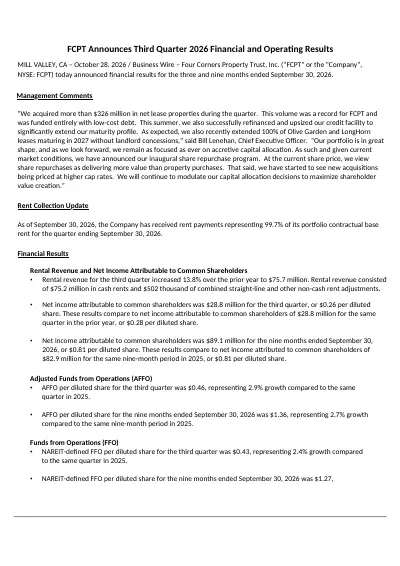
2026 has been a banner year for FCPT. Year to date, we have acquired a record volume of $410 million of properties at a blended 6.6% cash cap rate and 7.2% GAAP cap rate.
Over the past 12 months, we have acquired $505 million of properties. Despite the record volume for FCPT, we have remained highly consistent with the investment characteristics that have long defined FCPT's strategy, namely: low-basis properties, conservative rents, strong store-level profitability, and leading tenant operators.
We fully funded the volume this quarter with two recently closed term loans that feature coupons in the mid-4% to low-5% range, utilizing our debt capacity to generate spreads of over 200 basis points as compared to historic investment yields. We also updated our dividend policy to monthly payments beginning in August, and subsequently increased the dividend by 3.5% for the fourth quarter.
Finally, we were excited to announce a few weeks ago that Darden extended 100% of all Olive Garden and LongHorn leases maturing in 2027, along with the early extension of a handful of 2028 lease maturities. These properties represent the first extension decision by Darden since FCPT's spinoff back in 2015.
We note that the extensions do not require rent reductions or capital contributions from FCPT, and Darden's rents will continue to increase by 1.5% annually. To clarify, these are individual leases where the tenant made the decision in each and every case to extend under contractual terms.
We also note that we've continued to significantly diversify. Darden is now just 40% of cash rent, and 42% of our rents come from sectors outside of casual dining.
This includes medical retail now at 16%, automotive service at 13%, and quick service at 10%. Now turning to the current acquisition environment, which has changed a great deal in recent months.
Investors consistently ask us how this will impact our pipeline efforts. Our answer is that since inception, FCPT has been consistent in modulating acquisitions relative to our cost of capital.
This happened most recently when rates rose in 2023. At that point, rising rates made it difficult to invest accretively, and so we subsequently stopped nearly all acquisitions and aggressively moderated additions to our pipeline from late '23 through mid '24.
Basically, we didn't buy anything. Once our cost of capital improved, we hit the gas with vigor, and subsequently invested nearly a billion dollars in new accretive real estate investments from 2024 through today.
Capital allocation discipline is built into how we operate. We do not provide acquisition guidance; our team's incentives are not tied to volume.
This alignment lets us grow when it's accretive, and stay patient when it isn't. It's times like these when having clear mental frameworks designed in nonturbulent times makes all the difference to investors.
Other companies may say they will modulate guidance in the face of weakening spreads, but we actually have an established track record of pausing investments. Said simply, and to be clear: FCPT's management will not sacrifice our shareholders' interests to simply pursue scale.
As for the state of the company in this turbulent environment, we believe that we are very well positioned to weather continued macro headwinds. First, our granular acquisition strategy has created a highly fungible portfolio among the lowest per-property value at risk within our industry.
Our lease renewal rates are very high, occupancy remains well over 99%, and our rent coverage in Q3 was 5.3 times for the majority of our portfolio that reports this figure. Our rent coverage remains the best coverage within our industry, and what we believe is a reflection of our conservative and analytical underwriting.
Second, our three core restaurant brands—Olive Garden, LongHorn, and Chili's—continue to outperform their peers, and grew sales in the most recent quarter by 1%, 6.8%, and 10.1% respectively. The value proposition these restaurant brands offer their customers is tremendous, and they have shown through consistent historical growth through many different macroeconomic cycles.
Additionally, our Mission Pet Health properties have coverage levels above 6 times. This is the exact type of portfolio you would want in turbulent backdrop.
Third, we have very limited credit loss over our 11-year history. That result isn't an accident.
We are aligned with leading operators in our chosen sectors, and avoid experiential net lease sectors and over-rented properties. We try to keep it simple by acquiring low-basis, fungible properties in what we believe are e-commerce resistant sectors.
The last point I'd like to touch on is yesterday's announcement of our inaugural share repurchase program. I'm going to go into some detail here on how we are thinking about share repurchases.
One of our long-term mental models is our heat meter and the green, yellow, and red zones. In FCPT's history, there have just been a handful of times of short-lived red-zone windows over the last decade.
At the spin, during COVID, were the two prominent ones, where share repurchases would have made true economic sense. We believe the current landscape presents the best opportunity for FCPT share repurchases since our company was founded.
As such, our board has authorized a $100 million share repurchase program, and if conditions meet our thresholds, then we will seek to utilize it. Let me trace the steps of how we think about this, which is influenced by the writing of Michael Mauboussin on capital allocation.
The first decision is whether there are property acquisitions that clearly exceed our cost of capital. Because we are very analytical in assessing the quality of the properties we buy, we can do this step without quality creep.
This is where we have been as a company for a significant majority of our existence, but not today. Perhaps cap rates will follow interest rates with a lag, but as of today, we think external cap rates are generally too low, and in most instances, investment spreads would be thin to negative for the investments that meet our high-quality thresholds we hold ourselves to.
We next make sure we are conservatively levered. We want to make sure our balance sheet is in great shape.
Pat has done a terrific job here. We have few near-term maturities, a largely fixed-rate structure, and we remain within our modest target leverage range.
Then we make a determination of whether we believe our stock represents a compelling investment opportunity. By this, I mean below where we believe our intrinsic value is.
In the final check, we compare the risk-adjusted returns of new acquisitions, debt reduction, liquidity preservation, and share repurchases. FCPT has always been price-disciplined in where we issue new shares, and this is in the exact same vein we will seek to be very price-disciplined when we buy back shares.
We will run this analysis every time we repurchase stock in the market to confirm these conditions are met. It is also worth noting that our program does not require us to buy a certain number of shares, and allows us to suspend or terminate the program at any time—i.e., we will be valuation-sensitive.
Given the lack of tenant issues and our strong confidence in the portfolio, we view FCPT's current stock price as a very compelling investment today. I'd note that it is public that I personally purchased FCPT stock recently.
This is not a theoretical exercise for me. Before handing it back over to Pat, I want to offer sincere gratitude to Josh Ding for his contributions to FCPT.
Josh joined us way back in 2016 and was instrumental in building our platform. Josh will be leaving FCPT in Q4 to take a personal sabbatical before exploring an entrepreneurial opportunity.
He remains a big fan of FCPT, as we are of him, and is another proud member of our alumni base. We wish him the absolute best.
I know I speak for myself, Patrick, the rest of the company, and the board when I say it's been a pleasure getting to know him professionally and personally. Wherever he ends up, they'll be extremely lucky to have him.
Over to you, Patrick.
Patrick Wernig
Thanks, Bill. Very well said, and I couldn't agree more.
Josh has been a close colleague for a decade and left his imprint on FCPT. We are very grateful for his meaningful efforts, which helped us evolve from a startup to a seasoned net lease investment vehicle.
Now, a quick review of the Q3 acquisition activity before touching on our balance sheet. In Q3, we acquired 120 properties with a weighted average lease term of 10 years for $326 million at a blended 6.6% cash cap rate or 7.1% GAAP cap rate.
The quarter was weighted towards medical retail with the previously announced acquisition of 102 Mission Pet Health properties. We also continued to source and execute our regular-way investment pipeline spanning restaurants, automotive service, medical retail, and other sectors across 14 distinct transactions in Q3.
Those investments included newer subsectors for our platform, with acquisitions of a D&W grocery property and a Drilling Tools International light manufacturing facility. In both cases, we've been monitoring these sectors for years and have been waiting for the right opportunities with real estate, credit, and pricing quality to fit FCPT standards and investment profile.
We'll continue to evaluate investments in these subsectors and expect that over time we'll expand our opportunity set as we build domain expertise. I'd note that we did end up killing a handful of deals this quarter as we got more selective or ran into issues during due diligence that we thought would impact the long-term economics.
That resulted in dead deal costs of around $100,000, which hits AFFO. We don't love killing deals, but are more focused on avoiding long-term problems in deals that don't meet our return thresholds.
Before I move on from acquisitions, I'd like to commend our investment and legal teams, as well as our accounting and property management teams. They ran an effective and efficient diligence process and integrated more properties in Q3 than we have historically done in a full year.
It really speaks to the strength of the platform and the capacity we've built at FCPT. Now over to the balance sheet.
As Bill highlighted, since April we've closed on a total of $600 million in new term loans, which represents an incremental $410 million of debt, with nearly 40% of our balance sheet put in place or extended 5 to 7 years with 4% to low-5% coupons. $40 million remains undrawn on the $400 million term loan, which we intend to fund by the end of the year.
Additionally, we were able to lower term loan spreads by 5 to 10 basis points annually on $800 million of outstanding loans for annual savings of approximately $450,000. We're fully undrawn on our $350 million revolver, and leverage for the Q3 annualized period was 6 times.
Our stated leverage range remains 5 to 6 times, and on a run-rate basis we remain a dip below that 6 times upper bound of the range. On our debt maturity schedule, we just had a $50 million private note coming due in December, representing about 3% of our total outstanding debt.
We plan to repay that private note at the maturity date. We've earmarked the funds to do so.
Principally, we expect to address the maturity with the $40 million of remaining undrawn term loan and cash on hand. Excluding this December note, we have just $75 million, or less than 5% of our total debt, coming due prior to February 2028.
Our staggered debt maturity schedule is specifically designed to avoid facing a significant refinancing wall in any given year. Looking at the landscape today, it's a great benefit to have very minimal refinancing headwinds.
In the same vein, we have very little floating-rate exposure, with 85% of our debt balance fixed as of 9/30. We included a detailed hedging schedule in our supplemental that also has the locked rate on our term loan, which is currently 3.9%.
Now I'd like to go through a few earnings highlights for the quarter. Q3 cash rental income was $75.2 million, representing 13.7% growth versus prior year.
Annualized cash base rent for leases in place as of quarter-end was $292.8 million, and our weighted average 5-year annual cash rent escalator is 1.6%. Cash G&A expense was $4.7 million for the quarter, representing 6.3% of cash rental income, compared to 6.5% for the prior year.
This improvement in operating leverage illustrates our continued efforts at achieving efficient growth and the benefits of our rising scale. Overall, Q3 FFO per share was 46 cents, representing 2.9% growth versus prior year.
A bit of a noisy quarter versus our usual results because of the significant acquisition volume and debt refinancing. We also recognized a one-time catch-up charge from a disputed state tax item from several years ago and dead deal costs from several transactions that we killed during the quarter.
Our fixed charge coverage ratio remains a very healthy 4 times as of quarter-end. Following our Q3 results, we're reaffirming our cash G&A guidance for 2026 at $19.2 to $19.7 million, but noting we expect to be at the bottom of the range.
On the leasing front, the team continues to achieve remarkably strong results. We continue to make progress on the 2026 lease maturities, with 39 of the 43 leases already extended via option, release, or MTM.
The remaining 4 properties combine for less than 0.2% of ABR. We are actively negotiating with current and prospective tenants on the remaining properties in the normal course of managing our portfolio.
Our occupancy remains strong at 99.5% today. We collected 99.7% of base rent for Q3.
Finally, last quarter we did not see any material changes to our collectibility or credit reserves. Our disposition portfolio represents an opportunity for differentiated source of capital in the form of dispositions.
In the past, we've had periods where we were more active with dispositions, but not in recent years. There's a slide in our presentation posted yesterday that details our strong disposition track record.
We view this as another tool to unlock value not reflected in our public valuation. Depending on pricing and execution, dispositions could be another potential capital source.
We regularly receive strong reverse-inquiry offers for our properties, and in this environment, we plan to be more responsive to those opportunities. With that, we'll turn back over to Lucas for questions.
Operator
We will now begin the question-and-answer session. If you would like to ask a question, please press *1 to raise your hand.
To withdraw your question, press *1 again. We ask that you pick up your handset when asking a question to allow for optimum sound quality.
If you are muted locally, please remember to unmute your device. Please stand by while we compile the Q&A roster.
Your first question comes from the line of Jamie Feldman with Wells Fargo. Jamie, please go ahead.
Jamie Feldman
Great. Thanks for taking the question.
Congratulations on getting the first tranche of the Darden leases executed 100%. You had mentioned that those were all one-off negotiations or individual leases.
As we think about the future tranches, can you just talk about what kind of the negotiating points were to get all of those done? Is there anything, as we think about how they might play out for the next tranches, that were sticking points as you were negotiating?
Or does this give you confidence that it'll go pretty smoothly for the rest?
Bill Lenehan
I think negotiations is probably too strong of a word, Jamie. We had to help administer the paperwork on the extensions, but they were extended as contractually they notified us.
It's just working with them so it doesn't all happen the last minute, just managing the paperwork. These are very well-covered leases.
These buildings have been in operation since I was a child, by and large. That's very, very similar to all the rest of our portfolio.
Patrick Wernig
The point we made on the individual leases is that, because it's not a master lease, Darden had the opportunity to go through and evaluate each property. It makes us feel even better than you might think to say that they, in each and every one of those cases, affirmed that the stores were something that they wanted to remain committed to and continue to operate, because they're profitable.
Jamie Feldman
Thank you for that. Then with leverage close to the high end of your range, assuming that the cost of capital, at least the equity markets, doesn't cooperate anytime soon, how do you think about maybe getting that leverage lower to get yourself back in a position to acquire, or do you just wait this out?
Would you consider asset sales or anything else to raise capital?
Bill Lenehan
I think Patrick made the comments at the end of his remarks that we have very liquid currency in our buildings. There're a lot of demand for them.
We get reverse inquiries on essentially a daily basis. We have that.
We could do a joint venture to free up capital. Incremental free cash flows substantial at the scale of our business.
We have a lot of avenues to create cash to reduce leverage, keep it within the range, and still buy back shares.
Jamie Feldman
I guess in terms of timing, how patient would you be for things to come your way before you start taking action?
Bill Lenehan
If by taking action you're referring to buying back stock, I think we would be doing that in the near term.
Jamie Feldman
No, sorry, raising capital. You mentioned third-party asset— I think
Bill Lenehan
the process of selling buildings is a pretty well-worn path. We've shown you in our presentation we've done that a number of times.
That can be done in the near term.
Patrick Wernig
I think I'd just point out that, and I hope it's not lost, that the timing of when we raised that debt capital this summer was pretty fortuitous. Around a 5% or lower coupon rate.
That's close to where the US Treasury is today. I think we timed that well.
It was highly accretive at that point. When we think about the flexibility of having lower leverage, you have to make sure that the pricing of that debt today still makes sense, right?
If rates have moved significantly since then, it's to our benefit that we acted when we did and didn't hold on to that capacity.
Jamie Feldman
Okay. All right, great.
Thank you.
Operator
Your next question comes from the line of Spenser Glimcher with Green Street. Spenser, please go ahead.
Spenser Glimcher
Thank you. Look, on the transaction front, I know you guys have hit the brakes just given kind of the current environment and your cost of capital, but can you just talk about the makeup of deals you're seeing in terms of industries or credit looking to transact?
Then have you seen any capitulation from sellers in terms of just signs of willingness to move cap rates higher?
Bill Lenehan
We actively managed our pipeline down post the Mission Pet Health acquisition. We are seeing in the market that buyers are actively retreating in a substantial way.
The few remaining assets we had in our pipeline had attractive cap rates. What we're seeing today is cap rates going up, but not nearly as much as rates have moved and cost of debt has moved.
As Pat mentioned, we locked in a very substantial amount of debt before this move, which is very advantageous because incremental investments, if you're funding it with a typical mix of equity and debt, both your equity cost of capital is challenged across our industry as stock prices have gone down, and your debt cost is challenged. We are seeing higher cap rates.
There's some selective things to do which we're very active on, but by and large, it hasn't reacted enough to compensate where your sources of capital have repriced.
Spenser Glimcher
Okay. Thanks for that.
Then on the divestment front, it sounds like obviously you're in the early innings of this process. Can you provide some color on what types of assets would be kind of top of mind to sell, and would this be purely opportunistic or would there be any room for portfolio management just keeping in mind of how high rent coverage and how superior tenant health is in the portfolio?
Bill Lenehan
I think it's primarily driven by how attractive the use of capital is in share repurchase. That's very price dependent, as you might be aware.
I think the way we think about it, Spenser, is very similar to a report that Green Street did many years ago—I believe it was in 2014—on the arbitrage between the NAV of your company and the value of assets that you can sell. I think that you guys wrote the script to that game plan.
Spenser Glimcher
Thank you.
Operator
Your next question comes from the line of Michael Goldsmith with UBS. Michael, please go ahead.
Michael Goldsmith
Good afternoon. Thanks a lot for taking my questions.
Maybe we can dive a little bit deeper into just how you use what capital you do have, right? We're talking about share repurchases, you mentioned buying down debt, and then also it sounds like some deals were killed, it seems like you were also willing to transact in the market.
Can you just talk about at what levels do each of those look attractive and your thought process about approaching each of them? Thanks.
Bill Lenehan
We have seen some acquisitions that are highly strategic where we're adding an asset to an already existing master lease or we're getting very attractive pricing because we know a tenant. By and large, our focus going forward is going to be share repurchases.
For obvious reasons, we're not going to draw a line in the sand of what that value is, but we think where our stock price is right now is very attractive.
Michael Goldsmith
Got it. Then also you did mention the potential of doing joint ventures, just wanted to get a sense of what that looks like.
Is that selling assets into a venture with someone else and then freeing up some capital to do activity in the market, or just trying to get a sense of what you'd be looking to get out of a JV arrangement?
Bill Lenehan
I think you nailed that. We have a very well-developed acquisition apparatus.
We see a lot of deal flow, and there are parties that contact us weekly about partnering with us to buy net lease assets. On the private side, net lease is very, very popular right now, and a number of new platforms have started, and perhaps have raised more capital than they have acquisition opportunities.
I think our platform is very attractive there, and it's a very efficient way, as you mentioned, to free up capital to make accretive share repurchases.
Michael Goldsmith
Thank you very much. Good luck in the fourth quarter.
Bill Lenehan
Thank you.
Operator
Your next question comes from the line of Wes Golladay with Baird. Wes, please go ahead.
Wes Golladay
Hey, good morning everyone. Being that you have more liquid assets and equity price is more volatile than the private market, are you okay having a timing mismatch, buying shares first and going a little above your target leverage level?
Bill Lenehan
I'd rather not comment on that, Wes.
Wes Golladay
Okay. That's all for me.
Thanks.
Operator
Your next question comes from the line of Eric Borden with BMO Capital Markets. Eric, please go ahead.
Eric Borden
Great, thanks for taking the question. On the reverse inquiries that you're receiving, where are the bids relative to your view of the asset value?
Then are buyers still financing and closing at those levels, or are you kind of seeing the same retreating pressures you described on acquisitions?
Bill Lenehan
I would say that because we haven't sold assets for a couple years now, we have a number of people who are very specifically interested in an asset that might be in their local market, it might be where they have a second home. We're reassessing those opportunities first.
There's also a tax dynamic with bonus depreciation that may end on January 1st, there's a lot of activity in the market right now for assets like gas stations and car washes that benefit from bonus depreciation. We don't have a lot of those, but we do have some.
Eric Borden
Okay. Perfect.
Then one for Patrick, just could you quantify the state tax catch-up and any other nonrecurring items that affected the third quarter? Then as those costs fall away and the recent acquisitions contribute to a full quarter, how should we think about the underlying earnings run rate heading into 2027?
I know you
Patrick Wernig
[unclear]
Eric Borden
just curious if any.
Patrick Wernig
It's a very specific question, very granular. If there's a need to sync on it offline on modeling, happy to do that.
I would just say that the state tax issue was unique in that the dispute started during COVID. I think the state, the specific state, which was Oklahoma, just took several years to review the complaint that we had about what it was.
It wasn't a huge number, call it approximately $100,000. It's nonrecurring.
The only reason we mention it, frankly, is because we usually don't have anything out of the norm, and so it just felt like we should highlight that with moving part of the AFFO figure.
Bill Lenehan
There were costs related to our credit facility that, in some instances, people might assume are capitalized that were expensed. That also hit the quarter.
There were, as we mentioned, a handful of things that made it a little bit more noisy in the quarter than we would have anticipated.
Eric Borden
Great, thanks Bill.
Operator
Your next question comes from the line of Rich Hightower with Barclays. Rich, please go ahead.
Rich Hightower
Hey guys, good morning out there. One on the share repurchases, just help us understand the arithmetic on how you came up with the $100 million figure.
It's some combination obviously of free cash flow, a lot of other moving parts as well that you've kind of gone through, but just help us understand the buildup to get to that figure.
Bill Lenehan
I wouldn't overthink it. It's a number that is self-determined.
When used, we can reauthorize it with a simple email to our board, I wouldn't think too much about it at all.
Rich Hightower
I will not overthink it. Then secondly, back to the joint venture topic.
I know it's obviously very preliminary, but since it's kind of out there for discussion now, is this something where you envision it could be more of a one-off source of equity, is it programmatic? Are you having multiple conversations along those lines?
Obviously, we've seen different flavors of the same thing sort of up and down the sector, and even broadly across REITs, just curious for what the thought is there.
Bill Lenehan
I think at a high level, the demand for net lease in the private market is very strong, and the stock prices of the public companies are generally weak, ours included. I think it points that having the flexibility to invest both public and private capital, at least at this moment in time, is a valuable thing.
I think it's a good way to free up capital to buy back stock.
Rich Hightower
Thanks Bill.
Bill Lenehan
Yep.
Operator
Your next question comes from the line of Mitch Germain with Citizens Bank. Mitch, please go ahead.
Mitch Germain
Sorry about that. Lots of noise around Wendy's.
Is there any exposure in your portfolio with that tenant?
Patrick Wernig
Not meaningful. We have a handful of them.
I think, as Bill said, it's not a meaningful framework for us, too.
Bill Lenehan
I would also say, Mitch, and I would by no means expect Wendy's to be problematic, but that we have seen some very positive results with QSR brands migrating from Midland brands to very strong brands because the replacement cost and the drive-thru entitlements are super valuable.
Patrick Wernig
I'd point out that, to the extent it's useful to you, Mitch, we do have on our website a list of all the properties that we own in the portfolio published. Just a reminder to our investors about the resource and transparency that we're trying to provide them.
Mitch Germain
Super helpful. I think, last question.
Bill, I'm not asking for guidance, I want to say that, but you were pretty bullish on growth prospects last quarter, almost frustrating. You almost get the full-quarter benefit of that bigger Mission Pet Health transaction this quarter.
I recognize there's just a lot of noise in your numbers here throughout the quarter, but how should we think about kind of the growth prospects of kind of what you've just accomplished over the course of the year and what it could mean for you guys going forward?
Bill Lenehan
I really am looking out not quarter to quarter or Q3 in-quarter. I'm looking out for '27, '28.
I really believe that what we did with our balance sheet, what we did on Mission Pet Health, that our sort of ruthlessness on corporate overhead puts us in a really good position for '27 and '28. If the stock price remains low, our ability to create value by buying back stock makes that even more so.
Mitch Germain
Thank you.
Operator
Your next question comes from the line of Jamie Feldman with Wells Fargo. Jamie, please go ahead.
Jamie Feldman
Oh great, thanks for taking the follow-up. You had mentioned potentially JV as a source of capital.
I'm just curious if you could provide more color, given we're seeing more and more of that across REIT-land. How do you think about a potential size?
How do you think about the types of assets or types of tenants you'd want to put into those assets? I guess with some of the Darden extensions, would that make sense for a JV?
Any other color you could provide on what that might look like would be great.
Bill Lenehan
I'm not going to negotiate the terms of a JV on our conference call. I would just say that what I said before, which is there's lots of demand for our high-quality portfolio, and there's a lot of value in our platform, and there's a lot of capital swishing around in private markets, and we're attuned to that.
The market out there is pretty volatile, and we're certainly not at an advanced stage in those discussions. We will announce it when and if it's finalized.
Jamie Feldman
Okay. It sounds like it's not a high priority, it's just an option?
Bill Lenehan
I wouldn't say that. Next question, operator?
Operator
We have reached the end of the Q&A session. I will now turn the call back to Bill Lenehan for closing remarks.
Bill Lenehan
Thank you, Lucas. The first 9 months of 2026 have been unprecedented for FCPT.
We've exceeded our record annual investment volume by completing the largest acquisition in our history and accelerated the diversification of our portfolio. We also executed the first renewal tranche of the expiring Olive Garden and LongHorn properties at a 100% renewal rate, demonstrating the durability and strength of the portfolio, and we extended nearly 40% of our balance sheet at an approximately 5% or lower coupon.
Finally, we've activated our inaugural share repurchase program. Our portfolio is performing incredibly well, with occupancy, rent collections, tenant coverage, and leasing outcomes amongst the strongest in net lease.
Our consistency has set us up with the tools that we can help create value in any environment. Our team will be at the Nareit Atlanta conference in November and the Jefferies conference in December.
We welcome the opportunity to meet in person. Please reach out to either Patrick or myself to coordinate schedules.
Thank you.
Operator
This concludes today's call. Thank you for attending.
You may now disconnect.