FirstEnergy Corp.
Q3 FY2026 · Earnings Call TranscriptOctober 28, 2026
Operator
Hello, and welcome to FirstEnergy Corp.' s third quarter 2026 earnings call.
As a reminder, this conference call is being recorded. It is now my pleasure to introduce Karen Sagot, Vice President of Investor Relations.
Please go ahead, Karen.
Karen Sagot
Thank you. Good morning, everyone, and welcome to FirstEnergy's third quarter 2026 earnings review.
Our earnings release, presentation, and related financial information are available on our website at firstenergycorp.com/ir. Today's discussion will include the use of non-GAAP financial measures and forward-looking statements, which are subject to risks and uncertainties.
Actual results could differ materially from forward-looking statements discussed in our news release, during today's conference call, and in our SEC filings. The appendix of today's presentation includes supplemental information, along with the reconciliation of non-GAAP financial measures.
Please read our cautionary statement and discussion of non-GAAP financial measures on slides two and three of the presentation. Our Chairman, President, and Chief Executive Officer Brian Tierney will lead our call today, and he will be joined by Jon Taylor, our Senior Vice President and Chief Financial Officer.
Now, it's my pleasure to turn the call over to Brian.
Brian Tierney
Thank you, Karen, and good morning, everyone. We delivered another strong quarter and remain on track to meet our objectives for the year.
Our performance reflects strong capital deployment, financial discipline, and an improving customer experience. The team has done a great job executing against our plan to drive continuous improvement while focusing on affordability for our customers.
We've also made great progress advancing key regulatory strategies and business opportunities that will fundamentally change the trajectory for FirstEnergy. We continue to see strong interest from data center companies, with contracted and pipeline demand up nearly 60% since year-end, including a 90% increase in contracted demand.
West Virginia is a big part of that growth, with pipeline demand up approximately six times to nearly 6 gigawatts. Our proposed Maidsville energy generating facility will be a key investment to support this demand.
We expect an order from the West Virginia Public Service Commission in the fourth quarter. Given our confidence level and to protect the schedule, we have reserved the turbines with Siemens for delivery in 2030.
All other major contracts are on track to be signed shortly after we receive a commission order. Maidsville is an important project on its own, but we see it as the first of a broader set of opportunities in West Virginia.
Last November, I was at our Harrison Power Station with Governor Morrisey to announce our plans for new generation. He challenged FirstEnergy to do more.
My response to the governor was simple: challenge accepted. West Virginia's constructive legislative and regulatory environment are driving economic development, jobs, and businesses that will have a long-term positive impact in the state.
We are in active negotiations with large-load customers about locations within our West Virginia service territory. Those conversations are open and constructive around delivery schedules, pricing, risk mitigation, and frameworks for benefits to communities and existing customers.
To support these large-load customers, we've issued a request for proposal for an initial 3 gigawatts of additional combined-cycle turbines, and we expect to provide an update in early 2027. We are also exploring innovative bridge power options and temporary behind-the-meter solutions as we build out the grid to support these customers with permanent transmission and generation service.
This is a significant opportunity for FirstEnergy. These investments will support the state's goals and create meaningful value for our shareholders.
In addition to the opportunities in West Virginia, transmission and distribution remain the foundation of our business and investment strategy. Our transmission system sits at the heart of PJM, a region serving more than 65 million people.
Our network connects critical parts of the grid and helps deliver power where it's needed most. The need for transmission investment has never been more important.
We need a more flexible and resilient grid to support increasing demand and the economic development taking place in and around our service territory. Across our footprint, we now have 7.9 gigawatts of contracted data center demand.
We are in active negotiations with approximately 4 gigawatts of additional load. This demand and the critical infrastructure needed to support a more resilient and reliable regional grid will continue to require increasing transmission investments for the foreseeable future.
We expect this to drive at least a 25% increase in our current $19 billion transmission investment plan when we release our updated five-year plan. We are also seeing measurable progress in our distribution business, particularly in Pennsylvania and New Jersey, where we are investing to improve reliability.
Since 2024, our reliability has improved by 11% in Pennsylvania and 40% in New Jersey. This is solid proof that our investment plan is working.
I am pleased with our progress and believe that our customers, regulators, and policymakers are seeing value from the investments we are making. In the rate cases we have filed, we made the case for investments to meet or exceed our customers' expectations.
When we consistently demonstrate the value of our investments for customers, we expect a fair and constructive regulatory outcome. There's more to do, but we are making the right investments, improving performance, and delivering tangible value to our customers.
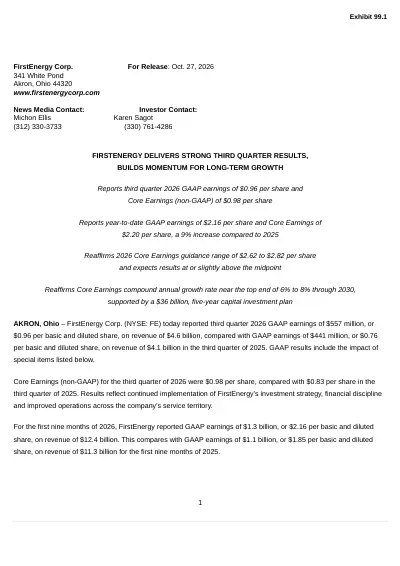
We are reaffirming our 2026 core EPS guidance range of $2.62 to $2.82 per share and expect to be at or slightly above the midpoint. We remain on track to deliver core earnings growth near the top end of our 6% to 8% range through 2030 and have meaningful opportunities to increase earnings growth over time.
Our experienced leadership team has the expertise to execute major projects while making the operational improvements our customers expect. We have the people, capability, and commitments to deliver for our customers and shareholders.
I'll now turn the call over to Jon to cover our financial performance and the progress we've made on key regulatory priorities. Jon?
Jon Taylor
Thank you, Brian, and good morning, everyone. Our financial results are on track for the year, and we've made solid progress on regulatory and strategic priorities.
Let me start with our third quarter results. For the quarter, we reported GAAP earnings of 96 cents per share, compared with 76 cents in the third quarter of 2025.
Core earnings were 98 cents per share, compared with 83 cents a year ago, largely reflecting growth from our rates and investment programs, increasing customer demand, strong financial discipline, and a slightly lower effective tax rate. Through the first nine months of the year, core earnings increased 9% at $2.20 per share, compared with $2.02 for the same period last year.
Through September, we've deployed $4.9 billion of investments to strengthen our electric system, a 23% increase from the same period of 2025. On a trailing 12-month basis, our financial performance resulted in a consolidated 9.5% return on equity, in line with our targeted returns.
Strong capital deployment continues to drive rate base growth, in line with plan, of 9.9% at the FirstEnergy level, supported by total transmission rate base growth of 14%, including 21% in our integrated transmission business. We also continue to see encouraging demand trends in our service territory.
Total weather-adjusted load increased 1.2% in the third quarter and has been positive in each of the last four quarters. This growth is led by the industrial class, which increased 3.3% in the third quarter and 2.1% over the last 12 months.
We're seeing broad strength in manufacturing activity, including metals, oil and gas, and chemical sectors, along with increasing data center demand. These promising trends give us confidence in the strength and durability of the growth we're seeing across our footprint.
As for our financing plan, we've completed our subsidiary debt financings for the year, issuing $2.6 billion at an average coupon of 4.7%. Our expected common equity needs in 2026 remain modest, and we continue to consider equity-like instruments to support our long-term financing plan.
Going forward, approximately 50% of our total long-term debt financing needs are supported by formula rate mechanisms that recover interest cost, providing meaningful protection from changes in interest rates. Transitioning to regulatory updates where we continue to make good progress.
Earlier this month, we submitted several low-voltage transmission solutions through PJM's open window process to address near-term reliability needs. We expect projects to be awarded in the first quarter of next year.
We've had a solid track record of success in open windows since 2022, with over $5 billion in awarded competitive transmission investments, including joint ventures with other major utilities to develop large, complex projects that cross state boundaries. Our track record positions us well to compete for additional investments as growing electricity demand and new generation drive the need for a stronger regional grid.
In New Jersey, we filed our base rate case in August, requesting a rate increase of $253 million, which reflects approximately $1 billion in rate base growth since our last increase was approved in February 2024. Those investments are delivering results for our customers.
Reliability improved 16% in 2025, followed by another 22% year-over-year improvement through September of this year. We developed a proposal that delays the impact of any rate increase until 2028 and engaged with the Sherrill administration, the Board of Public Utilities, and Rate Counsel throughout that process.
Our proposal balances the investments necessary to improve reliability with affordability for our customers. Even with the proposed increase associated with these important investments, we expect our rates to remain approximately 18% below the state average for investor-owned utilities.
In Maryland, we filed our base rate case in September, requesting a revenue increase of $53 million since our last rate increase was approved in October 2023. Hearings are scheduled for January, and we expect an outcome in April of next year.
In West Virginia, we received a regulatory decision on our base rate case, with the commission approving our $76 million inflation and investment adjustment filing as submitted. The first rate increase took effect August 1st, with a second scheduled for June 1st, 2027.
The order also provides for a stay-out through April 2028. We expect a regulatory order on the Maidsville CPCN in the fourth quarter, and as Brian discussed, that project represents another important opportunity for FirstEnergy, and we'll update our 2026 through 2030 financial plan to reflect this investment following an order.
As we pursue this opportunity, we remain focused on ensuring that this investment benefits all of our stakeholders. An important part of our approach is to appropriately allocate project and commercial risk to large-load offtakers, while providing a framework that benefits and protects existing customers.
We believe this will create meaningful value for shareholders and will provide the blueprint for future opportunities in West Virginia. Turning to our long-term financial outlook, as we've talked about before, our current five-year, $36 billion investment plan will be financed with up to $2 billion of equity or equity-like securities through 2030.
We will look to fund the additional investments that Brian talked about, including West Virginia generation and transmission, with up to 35% equity or equity-like securities. We're pleased with our results and progress on regulatory matters.
Our investment plan provides a solid foundation for continued growth, with additional potential beyond it. We'll provide a more comprehensive update with our full 2027 through 2031 capital investment and financial outlook on the fourth-quarter earnings call in February, reflecting the incremental transmission investments that Brian highlighted.
As we roll forward our plan with incremental investment opportunities, we will continue to maintain the financial discipline and balance sheet strength needed to pursue those investments while delivering value for customers and shareholders. With that, I'll turn the call back over to Brian.
Brian Tierney
Thanks, Jon. Let me close with three points.
First, we're executing on our commitments. Our financial performance remains on track, and the investments we're making are producing measurable improvements in reliability and customer service.
Second, growing electricity demand is expanding the opportunity across our business. Transmission and distribution remain the foundation of our strategy and an expanding runway for investment needs.
In West Virginia, Maidsville and the additional generation opportunities developing behind it offer another meaningful source of long-term growth. Third, we are pursuing growth with discipline.
We will invest where we have a constructive regulatory environment, where existing customers benefit and are protected, and where the expected returns create value for shareholders. We have a clear strategy, a compelling opportunity set, and the capabilities to execute.
Thank you for your continued interest in FirstEnergy. We look forward to seeing many of you at the EEI conference in a couple of weeks.
Now, we'll turn the call over for questions.
Operator
Thank you. If you would like to ask a question, please press star one on your telephone keypad.
A confirmation tone will indicate your line is in the question queue. You may press star two if you would like to remove your question from the queue.
For participants using speaker equipment, it may be necessary to pick up your handset before pressing the star keys. Our first question is from Nicholas Campanella with Barclays.
Please proceed.
Nicholas Campanella
Hey, good morning. Thanks for the time.
Brian Tierney
Morning, Nick.
Nicholas Campanella
Morning. Just thanks for all the updates on West Virginia.
My question is, if you were to kind of go beyond Maidsville here with the 3 gigawatts of additional discussions happening right now, any thoughts on continuing to kind of do that in a rate base solution or doing that through a Genco structure? How do those kind of returns compare, and would that change the 35% incremental equity need that you laid out at all?
Thanks.
Brian Tierney
Thanks, Nick. I think the most important thing is for us to get a clean order out of the commission on Maidsville, and that is certainly going to inform how we think about moving forward in West Virginia.
The Genco is absolutely still on the table, and we look at that as an opportunity to protect existing customers, yet still serve the new large-load customers. We're still exploring both opportunities there, and if we were to get the additional 3 gigawatts that we're talking about here, that would certainly include additional financing required to finance that.
Jon Taylor
Nick, I would say that the discussions that we're having today with offtakers, specifically related to Maidsville, there is an openness to fund some of the investment through a surcharge type of mechanism, and we would absolutely expect that to continue with generation investments beyond Maidsville.
Nicholas Campanella
Thanks for that. Then just to follow up on the 3 gigs, what type of bridge solutions are you looking for behind the meter?
Is it like fuel cells or smaller RICE units, if you could talk to that at all? Can you just remind us of the timing of the 3 gigawatts of incremental?
Is this kind of layered in to be '31-'32, or is it going to be a little bit further beyond that? Thanks.
Brian Tierney
Thanks, Nick. It's going to be beyond that, and so what we're seeing from customers is if they want a gigawatt-type campus, they're looking at seeing if they can start with a building that might be about 100 megawatts in the near term.
We're looking at solutions from everything from RICE to fuel cells to batteries to anything that can get us quicker to power than a long-term natural gas combined-cycle solution. Something that gets the campus up and started, and then transitions ultimately to a long-term grid-integrated solution.
Nicholas Campanella
Many thanks.
Brian Tierney
Thanks, Nick.
Operator
Our next question is from Jeremy Tonet with J.P. Morgan.
Please proceed.
Jeremy Tonet
Hi, good morning.
Brian Tierney
Morning, Jeremy.
Jeremy Tonet
Just want to dive into the large-load pipeline, as you laid out there. It seems like the opportunity set in West Virginia moved up a bunch quarter over quarter, and was wondering if you could talk about that a bit more.
It looks like at the same time, Maryland and New Jersey contracted a little. Just wondering how you see trends developing by state here.
Brian Tierney
I think you kind of got it. Maryland, Ohio, Pennsylvania, West Virginia, we're seeing sort of broad interest across the system.
It's real. We're talking to these customers and people are saying, does it end at 2030, 2031?
The answer is it doesn't. We're seeing it continue beyond that, and the 2030, 2031 is what I'd say the first wave.
The people who are serious, the large customers that you might think of, the hyperscalers, the legitimate developers, are looking well beyond that, and they're doing so across our service territory. I was out visiting what used to be called Quantum Loophole, I think they now call it the Catellus site, outside of Frederick, Maryland.
We had our board strategy meeting in Frederick this year. I was out there 3 years ago, and it was dirt.
Now there's multiple buildings up and running and construction continues as they continue to build out that facility. The idea that this stops at 2030, 2031 just isn't credible to us, and the people who are serious about this development are talking well beyond that.
Jeremy Tonet
Got it. That's very helpful.
Thank you for that. As we think about the transmission additions that could come into the plan here, just want to remind me, I guess, how much of this is of the capital plan gross versus net with partners out there, and just wondering if you could talk a bit more, I guess, on competitive processes out there and what potential upside that could bring.
Brian Tierney
Jeremy, I'll take the first part of that. If you look at our total transmission business, which would include the stand-alone transmission business plus the transmission in our integrated segment, our external partners' interest in that business is about 30% of that total transmission business, which I would expect to generally stay the same as we roll forward the new plan.
The 25% increase that we're talking about would have the same impact on our owned rate base as we move the plan forward. It's a significant driver, and if you actually did the math and rolled the plan forward, you would see a pretty significant increase in our owned rate base in 2031 versus what we have in 2030.
It's a material adjustment for the company. Then, Jeremy, you talk about the competitive processes.
Jon mentioned that in the last few years, we've got about $5 billion worth of awarded projects through the PJM competitive process. I think this year, it might be smaller than what we've seen in the prior years because they were looking for short-term solutions out to 5 years, I think they're going to be lower-voltage, more localized-type projects.
That means when they come back out next year for the longer-term solutions, we're going to have big opportunities once again. I think this thing is just going to continue, and the idea that you have an open window and it goes away isn't real.
I think these open windows are going to continue for the foreseeable future, as we're seeing load growth driven by large-load customers across the PJM footprint. I see this as far as I can look out continuing.
Jeremy Tonet
Got it. That's helpful.
I'll leave it there. Thank you.
Brian Tierney
Thank you, Jeremy.
Operator
Our next question is from Michael Sullivan with Wolfe Research. Please proceed.
Michael Sullivan
Hey, good morning. Hey, Brian.
Wanted to just ask a little more on the financing plan, and maybe how you think about the split between equity and equity-like, and just as you get ready to roll the plan forward and those needs potentially go up, how you're thinking about getting going on equity issuance.
Jon Taylor
I think we are open to equity-like instruments. You've seen us execute those types of transactions in the past.
I think for the time being, we've talked about common equity being 1% of market cap on an annual basis. I think that's kind of where we'll be for the foreseeable future, but we'll talk more about that as we roll forward the plan in February of next year.
That's generally how we think about it. We would explore those options.
We've done that before, we're used to that. We'll provide those details in February.
Michael Sullivan
Great. Very very helpful.
Then in terms of just New Jersey and the broader review going on there, can you just give us some insight into the latest and where and when we see that concluding?
Brian Tierney
Yeah. I think the big thing there is that we're talking about improving affordability without creating additional costs, regulatory lag, or unintended consequences.
There's sort of a menu that's out there right now, and
Jon Taylor
I think as clear heads prevail, those things will form around things like multi-year rate plans and performance-based rates. There's a menu out there.
A lot of the things on the menu make sense; a lot of them don't. I think we'll end up at the right place.
A lot of what Jersey Central Power & Light's comments were incorporated in the New Jersey Utilities Association's comments back to the plan. I think we'll end up at the right place there.
If it looks anything like Ohio, I think it'll be reasonable, it'll protect customers, and allow utilities to continue to invest to improve reliability.
Michael Sullivan
Great. Just any sense of when, and that was all for me.
Thanks.
Jon Taylor
We filed our comments May 29th and again September 25th. We provided additional comments to the working group.
I think later this year, early next year, we'll have some resolution to what's selected off the menu.
Michael Sullivan
Great. Thank you.
Jon Taylor
Thank you, Michael.
Operator
As a reminder, it is star one on your telephone keypad if you would like to ask a question. Our next question is from Carly Davenport with Goldman Sachs.
Please proceed.
Carly Davenport
Hey, good morning. Thanks so much for taking the questions.
Jon Taylor
Morning, Carly.
Carly Davenport
Morning. Just wanted to follow up on Jeremy's question earlier on transmission.
Anything that you can share on how much of that increase would be tied to the large load that is now in your plan versus RTO processes versus kind of regular-way maintenance investment? Just anything on how we should think about how front-end or back-end loaded that could be in the new plan?
Jon Taylor
Carly, I would say that if you think about what we've talked about before in terms of every gigawatt of contracted demand being about $250 million of transmission network upgrades, that's kind of how we think about it. That would be the math that you would put into the plan associated with contracted demand.
We don't put any uncontracted demand in our plan, it has to be fairly solid for us to put something in our plan. Most of the increase you'll see is from the work that we need to do on our existing system to stabilize, provide better reliability, provide better resiliency to the system, just given what we're seeing across our footprint in terms of the need to shore up transmission capacity given the demand across the region that we're seeing.
I would say very little would be associated with contracted demand; the large piece of it would be just reliability on our existing system, those types of investments.
Carly Davenport
Got it. That's really helpful.
Thank you. Then you highlighted in the slides negotiations with the data center customer at Maidsville are advancing.
Anything that you can provide there on outside of the CPCN approval, the key gating factors to finalizing that? Is there any sense on if customers you are in negotiations with could be interested in offtake from more than one facility, as you think about the go-forward opportunity in West Virginia?
Brian Tierney
Yeah. Carly, I think the big thing, as you mentioned, is getting the CPCN out of West Virginia.
In addition to that, other gating things are finalizing the gas supply and our EPC arrangement, and so that's on the we're buying side. On the we're selling side to customers, there's an enormous amount of interest from a number of, I'd say, creditworthy, known customers out there, and they're interested in both this first tranche, that I'd call it, of generation that we're putting together, and people are interested in the remaining 3 gigawatts as well.
These things just take time. I'll say it's kind of refreshing the negotiations that we're having.
People are very candid about what they want, when they want it, what the schedule they can have is, what we're willing to talk about in terms of bridge solutions, protections to our existing customers, even benefits to our existing customers. They're very candid, but I'd say fast-moving discussions.
As we get the next gigawatt, and the next gigawatt, and the next one lined up, we're going to be in active discussions with those customers who are lined up to take that service from us in West Virginia.
Carly Davenport
Great. Thank you so much for the color.
Jon Taylor
Thanks, Carly.
Operator
Our final question is from Andrew Weisel with Scotiabank. Please proceed.
Andrew Weisel
Hey, thanks. Good morning, everyone.
Hi. On the RFP for the 3 gigawatts, what's the targeted in-service date?
Brian Tierney
It'll likely be in the '31-'32 timeframe, just given where we are on time today, and where backlogs are. In between now and then, Andrew, we're going to be pursuing those bridge alternatives that we talk about, whether it's batteries, fuel cells, reciprocating engines, whatever it is.
People want some speed to power to get their campuses up and running, but for those longer-term solutions, it'll be in the '31, '32 and beyond timeframe.
Andrew Weisel
Makes sense. Then on the bridge stuff, you mentioned things like RICE units and batteries, etc.
Would the idea be that those assets are actually permanently on-site? You call that bridge, but what would happen to them physically and economically after the first few years?
Would they be permanently there?
Brian Tierney
That's a great question. I think as we're thinking about it today, it would be bridge for one solution today, and then as you get the long-term solution in place, that bridge could be used for future developments that aren't necessarily on-site.
We don't view those bridge solutions as being disposable; we view them as being reusable for multiple locations as we move forward in time.
Andrew Weisel
You would own them, or the customer, or is that TBD?
Brian Tierney
Any combination of that, and we're in conversations where we'd own them, where third parties would own them, where the customer would own them. We view them as being multiply reusable, whether we move them or not, and I don't think you need to move them.
Andrew Weisel
Interesting. Certainly adds flexibility.
Great. One last one, Jon.
Forgive me, maybe I misheard you, but did you say up to 35% on the equity? The slides just say 35, but I thought I heard you say up to.
Is there potential for that to come down?
Jon Taylor
I think on the Maidsville, assuming we get the surcharge, it's about a 35% equity requirement. If you roll forward the plan, it's up to 35%.
There's some flexibility there, but it's probably going to be in that neighborhood.
Andrew Weisel
Okay. Very good.
Thank you so much for clarifying.
Brian Tierney
Thank you, Andrew.
Operator
That will conclude today's conference. You may disconnect your lines at this time, and thank you for your participation.