Fulgent Genetics, Inc.
Q3 FY2026 · Earnings Call TranscriptNovember 5, 2026
Operator
Good afternoon, ladies and gentlemen, and welcome to the Fulgent Genetics Q3 2026 conference call and webcast call. At this time, all lines are in listen-only mode, and following the presentation, we will conduct a question-and-answer session.
If at any time during this call you require immediate assistance, please press star zero for the operator. This call is being recorded on Thursday, November 5th, 2026.
I would now like to turn the call over to Lauren Sloane. Please go ahead.
Lauren Sloane
Good afternoon, and welcome to Fulgent's third quarter 2026 financial results conference call. On the call are Ming Hsieh, Chief Executive Officer; Paul Kim, Chief Financial Officer; and Brandon Perthuis, Chief Commercial Officer.
The company's press release discussing the financial results is available on the Investor Relations section of the company's website, ir.fulgentgenetics.com. A replay of this call will be available shortly after the call concludes on the Investor Relations section of the company's website.
Management's prepared remarks and answers to your questions on today's call will contain forward-looking statements. These forward-looking statements represent management's estimates based on current views, expectations, and assumptions, which may prove to be incorrect.
As a result, matters discussed in any forward-looking statements are subject to risks, uncertainties, and changes in circumstances that may cause actual results to differ from those described in the forward-looking statements. The company assumes no obligation to update any of the forward-looking statements it may make today to reflect actual results or changes in expectations.
Listeners should not rely on any forward-looking statements as predictions of future events and should listen to management's remarks today with the understanding that actual events, including the company's actual future results, may be materially different from what is described in or implied by these forward-looking statements. Please review the more detailed discussions related to these forward-looking statements, including the discussions of some of the risk factors that may cause results to differ from those described in the forward-looking statements, contained in the company's filings with the Securities and Exchange Commission, including the previously filed 10-K for the year ended December 31st, 2025, and subsequently filed reports, which are available on the company's Investor Relations website.
Management's remarks, including discussions of non-GAAP profit, loss, operating expense, margin, earnings, and earnings per share, and adjusted EBITDA, contain financial measures not prepared in accordance with accounting principles generally accepted in the United States, or GAAP. Management has presented these non-GAAP financial measures because it believes they may be useful for investors for various reasons, but these measures should not be viewed as a substitute for or superior to the company's financial results in accordance with GAAP.
Please see the company's press release discussing its financial results for the third quarter of 2026 for more information, including the description of how the company calculates non-GAAP income and loss, non-GAAP earnings and loss per share, non-GAAP gross profit, non-GAAP gross margin, non-GAAP operating profit and loss and margin, and adjusted EBITDA, and a reconciliation of these financial measures to income and loss, earnings, loss per share, and operating margin, the most directly comparable GAAP financial measures. The company does not provide reconciliations of forward-looking non-GAAP measures to the most directly comparable GAAP measures because the information necessary to calculate such reconciliations, including equity-based compensation, tax effects, acquisition-related items, and potential impairments, any of which may be material, is unavailable on a forward-looking basis without unreasonable effort, and the probable significance of those items cannot be predicted.
With that, I'd now like to turn the call over to Ming. Please go ahead.
Ming Hsieh
Thank you, Lauren. I will start with some comments on our two business lines.
Then Brandon will review our product and go-to-market updates for our laboratory services business. Paul will conclude with the financials and outlook before we take your questions.
I am pleased with the momentum in our therapeutic development business as we progress on our clinical pipeline. We are seeing encouraged clinical data from our proprietary nanodrug delivery platform, which powers both FID-007 and FID-022.
Let me share the recent updates from FID-007, and then share the progress we have made with FID-022. As a reminder, Fulgent has taken a different approach with FID-007.
FID-007 is a nano-encapsulated paclitaxel developed under Fulgent's clean chemo platform. The platform is designed to reduce toxicity typically associated with conventional chemotherapy, while maintaining or improving efficacy, a profile Fulgent believes is preferable in combination oncology regimens.
Starting with FID-007: with the majority of Phase 2 complete, we held an end of Phase 2 meeting with the FDA in August. We look forward to sharing more with you later this year.
Our Phase 3 study is in preparation. We are encouraged by our clinical trial progress achieved so far, and we believe entering the Phase 3 registration trial is an important step towards the potential commercialization of FID-007 for the treatment of recurrent or metastatic head and neck squamous cell carcinoma patients, who currently have very few effective treatment options.
We continue to pursue conversations with partners who bring both resources and strategic alignment. In the third quarter, we were pleased with the momentum of our second clinical candidate, FID-022, with the Phase 1 dosing escalation at the fifth dosing level ongoing, where we expect to determine the maximum tolerated dose level in the first half of next year.
FID-022 is a nano-encapsulated SN-38 for treatment of solid tumor, including potentially colon, pancreatic, ovarian, and biliary duct cancers. Please note both FID-007 and FID-022 are derived from the same proprietary clean chemo delivery platform, patented and fully owned by Fulgent.
Similar to FID-007, FID-022 can also be used in various oncology drug combinations. In conclusion, we believe our common platform strategy is making meaningful progress.
We are seeing greater potential in commercializing FID-007 and FID-022 to address a large and growing market. In laboratory services business, we continue to see our AI and digital pathology solutions work at an accelerated pace, and are continued to expand our AI portfolios.
We are pleased with the progress we have made towards billing and revenue cycle management delays, which continue to affect our third-quarter results, and our team's ability to work effectively to deliver the improvements to our collection rates. I would like to thank our employees, partners, and stakeholders for your hard work and loyalty.
I will now turn over the call to Brandon Perthuis, our Chief Commercial Officer, to talk more about our laboratory services business. Brandon?
Brandon Perthuis
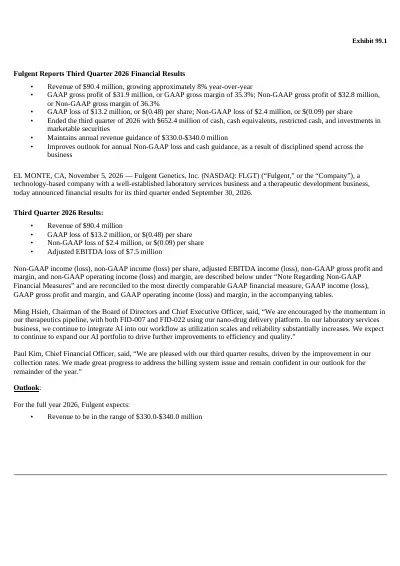
Thank you, Ming. We ended the quarter at $90.4 million, an increase of 8% year-over-year and 6% sequentially.
We continued integration efforts for Bako and StrataDx during the third quarter, which contributed to the overall performance. Breaking it down further, Precision Diagnostics ended at $41.8 million, a decrease of 18% year-over-year, but an increase of 1% sequentially.
Anatomic Pathology came in at $40.9 million, an increase of 57% year-over-year and 9% sequentially. Biopharma Services ended the quarter at $7.7 million, an increase of 5% year-over-year and 19% sequentially.
Last quarter, we discussed managing the final phase of the transition of our billing and revenue cycle management system. We originally undertook this transition to achieve greater consistency across our operations and to drive long-term efficiency.
While this transition continued to have a negative impact on the third quarter, we are pleased to announce we have made significant progress and have seen a positive sequential trend in reimbursement, which has contributed to improvements in our total revenue and gross margins as compared to the second quarter. While there is still additional effort needed to finalize the remaining customizations, and we cannot predict more precise timing for future improvements, we believe we have a clear line of sight into what is needed to return to historical collection rates.
We continue to monitor developments related to PAMA and any potential changes to the clinical lab fee schedule. Based on what we know today, we expect the impact to our business to be minimal.
Our primary CPT codes have limited exposure to the reimbursement reductions currently contemplated under PAMA. As a result, we do not currently view PAMA as a material headwind to our revenue or earnings outlook.
We'll remain engaged with the evolving reimbursement landscape, but at this point, we feel comfortable with our positioning. We continue to make significant progress integrating artificial intelligence into our pathology workflow.
During the third quarter, our AI platform analyzed approximately 255,000 slide images, representing a 23% increase from the second quarter. Importantly, as utilization has scaled, the technical reliability of the platform has improved substantially, with failed analysis declining to just .01% during the quarter.
We now have four AI modules in production, with our prostate cancer detection and engorging [grading?] module undergoing pathologist evaluations.
During the quarter, we also transitioned our production environment to a new AI analysis platform designed to improve speed, reliability, and scalability. The new architecture has meaningfully reduced processing times across several of our highest-volume applications and provides the infrastructure to efficiently support additional AI modules as they move into production.
We are particularly encouraged by the continued development of our prostate cancer application. In internal testing across 262 cases, the module identified 768 of 770 cancer-containing parts.
Looking ahead, we expect to continue expanding the platform, with five additional AI applications planned for deployment in the fourth quarter. We believe these investments can improve diagnostic consistency, enhance pathologist productivity, and create meaningful operating leverage as testing volumes grow.
Overall, we are pleased with our progress during the third quarter, especially around the improvements in revenue cycle management and the use of AI to scale our business. I'll now turn the call over to our Chief Financial Officer, Paul Kim.
Paul?
Paul Kim
Thank you, Brandon. Revenue in the third quarter of 2026 totaled $90.4 million, including $21.8 million from Bako Diagnostics and StrataDx, compared to $85.4 million in the second quarter of 2026, which included a $16.4 million from Bako Diagnostics and StrataDx.
The increase in our Q3 revenue was primarily due to the integration of Bako Diagnostics and StrataDx. GAAP gross margin was 35.3% and non-GAAP gross margin for the third quarter was 36.3%.
The increase sequentially in gross margin reflects fixed-cost spread over a higher revenue base, driven by better collection rates. We expect gross margins to normalize as our collection rate returns to historic norms and as revenue increases.
Now turning to operating expenses. Total GAAP operating expenses were $54.5 million for the third quarter, down from $61.8 million in the second quarter.
The decrease in operating expenses was driven by a $3.2 million of bad debt expense recoveries in the third quarter of 2026 and the absence of a one-time $2.2 million impairment charge recorded in the second quarter on a customer relationship intangible asset following the loss of our customer in our therapeutic development segment. Non-GAAP operating expenses were $44.8 million in the third quarter, down from $49.2 million in the second quarter.
GAAP operating margin improved to a -24.9% in Q3 compared to a -42.3% in Q2. Non-GAAP operating margin improved sequentially to a -13.2% in Q3 compared to a -26.2% in Q2.
Our GAAP loss in the current quarter was $13.2 million, a decrease from the prior quarter's GAAP loss of $29.5 million and a GAAP loss of 48 cents per share based on 27.7 million weighted average diluted shares outstanding. On a non-GAAP basis, and excluding equity-based compensation expense and intangible asset amortization, loss for the quarter was approximately $2.4 million, or 9 cents per share, based on 27.7 million weighted average diluted shares outstanding.
Adjusted EBITDA for the third quarter was a loss of approximately $7.5 million, compared to a loss of $17.1 million in the prior quarter. In the third quarter, we repurchased just over 15,000 shares under our stock repurchase program.
Since the inception of the stock repurchase program in March 2022, a total of over 7.5 million shares of common stock have been repurchased under our program, with approximately $75.6 million currently remaining available for future purchases of our common stock. Turning to the balance sheet, we ended the third quarter with approximately $652.4 million in cash, cash equivalents, restricted cash, and marketable securities.
A $100.9 million increase in cash from the previous quarter was primarily driven by receipt of a $112.3 million federal tax refund and related interest, partially offset by $11.4 million cash used in operations and capex. We are reaffirming our full-year revenue guidance and continue to expect total revenue to be in the range of $330 to $340 million for 2026, representing year-over-year growth of 2.3% to 5.4%.
We estimate Precision Diagnostics revenues of approximately $161 to $165 million, Anatomic Pathology of approximately $146 to $150 million, and Biopharma Services to be approximately $23 to $25 million. On margins, we expect full-year non-GAAP gross margins to be in the mid-30% range, reflecting product mix shifts tied to our changing customer composition and lower collection rates associated with the transition to our new revenue cycle management and billing system.
We expect non-GAAP operating margins to be in the low negative 20% range for the year, an improvement from our prior expectations of the mid negative 20% range. We continue to prioritize our investments across two key areas: R&D, where we're advancing both our laboratory testing capabilities and clinical study pipeline; and the integration of Bako Diagnostics and StrataDx, where we are aligning our expanded sales organization, cross-selling our broad testing menu, and consolidating operations to drive productivity and operating efficiency.
Our billing system transition is still underway, and we saw encouraging improvements in the third quarter that we expect will support more consistent collections. Along with targeted upgrades to our laboratory infrastructure, these investments are designed to strengthen our competitive position and enhance throughput capacity.
We believe our technology platform is highly scalable and positions us to drive operating leverage and margin expansion as volumes grow. Our clinical programs continue to progress, and we updated the timing of related spending accordingly.
We now expect approximately $21 million in therapeutic development investment in 2026 as we continue advancing trials for FID-022 and FID-007. We now expect the full-year 2026 non-GAAP loss of $1.65 to $1.75 per share, an improvement from our prior guidance of a loss of $2.22 to $2.35 per share.
This reflects disciplined spending across the business, which has lowered our operating expenses. This excludes stock-based compensation, impairment loss, acquisition-related costs, amortization of intangible assets, as well as other charges or gains that we believe are not representative of our operations.
Our per-share guidance reflects the 4.1 million shares repurchased year-to-date and assumes no further repurchases. Finally, our cash position remains strong.
During the third quarter, we received approximately $112.3 million in federal tax refunds and related interest that were delayed due to constrained resources at the IRS. For fiscal year 2026, assuming capital purchases of $13 million, spend in our therapeutic development business of $21 million, and excluding any future stock repurchases or other expenditures outside the ordinary course, which could include additional M&A, we're anticipating ending the year with approximately $630 million of cash, cash equivalents, restricted cash, and investments in marketable securities.
The increase from our prior forecast of $610 million is attributed to the improved operating outlook and lower therapeutic development spend. We are pleased with our results for the quarter and are encouraged by the operational progress we made executing against our strategic initiatives to drive AI and digital solutions across our laboratory services business, and are proud of the momentum on our pharmaceutical pipeline.
We believe we're well positioned for longer-term growth and strategic investments, innovations, and expanded offerings that deliver value. Thank you for joining our call today.
Operator, you may now open it up for questions.
Operator
Thank you. Ladies and gentlemen, we will now begin the question-and-answer session.
Should you have a question, please press the star followed by the one on your touchtone phone. You will then hear a prompt that your hand has been raised.
Should you wish to decline from the polling process, please press the star followed by the two. If you are using a speakerphone, please lift the handset before pressing any keys.
Just one moment, please, while we compile questions. Your first question comes from David Westenberg from Piper Sandler.
Please go ahead.
Karan Patel
Hey guys, this is Karan Patel on for David Westenberg. Thanks for taking the call.
Congrats on the sequential improvement here. To start off, I had a couple of questions on the billing transition.
Sounds like there is still some work to be done, but we have seen improvement. I guess could you maybe quantify what inning we may be in there, and what kind of sight we have into when that may be done and fully transitioned?
Also, can you parse out maybe collection rates today versus historical levels, and the step-up in revenue, is any of that from catch-up claims from prior periods or not? Thank you.
Brandon Perthuis
Hey, Karan, thanks for the question. This is Brandon—
Paul Kim
I'll let Brandon tee it up, and then I'll put some numbers around it. Go ahead, Brandon.
Brandon Perthuis
Thanks, Paul, and thanks, Karan, for the question. Interesting analogy to ask, kind of what inning it's in, using the baseball analogy, and perhaps a little bit hard to say, but I think we're pretty deep into the game.
I think as I addressed last quarter, we had challenges related to implementation of customizations that were needed in the new RCM system to maximize reimbursement. Since we've noticed that, we've made progress implementing a number of these required customizations, and we're seeing the impact of those customizations on our improved collection rate.
That was reflected in the third-quarter performance. We still have some fine-tuning to do, but we're pretty encouraged with the progress so far.
Paul Kim
Hi, Karan, this is Paul Kim. Yes, the uptick in the gross margins, aside from the higher revenues for Q3, we were pleased to see that.
Actually, the uptick in the gross margins, that happened quicker than we thought, and as Brandon indicated, we're not done yet. We've gotten started this quarter, but we did make it a priority for the company to have that to optimize the collection rates as much as possible.
We believe with additional work that we have in terms of policies and focus, that there's ample amount for gross margins to continue to grind higher. The other thing that I'd like to point out is, given the fact that it's the end of Q3, when we take a look at our overall forecast, the cash forecast for the year, it's actually coming in a lot more favorable than we thought.
We raised our ending cash forecast from $610 to $630 million, and the narrowing of the EPS as well. If you take a look at the operating expenses, particularly for the G&A, you'll see that is lower than our historical run rate.
That's because even on the operating expense side, we shored up a lot of bad debt that we had. We continue to go after some of the old balances, and we had favorable collections even on the bad debt side.
The last thing that I will comment on is the revenue range. The revenue range, we left it the same as how we had it last quarter, between $330 and $340 million, but we anticipate that Q4 should be a nice quarter for the company as well.
Just leaving the range from $330 to $340 gives us ample room for us to reach a target that we'll be satisfied with.
Karan Patel
That's very helpful, Paul. Thank you.
I guess maybe to ask one more here on the range. I think the guide held implies 4Q between the range of what, $82 to $92 million.
Maybe could you help us parse out puts and takes to the upside, downside there? Separately, this does imply sequential deceleration, if I'm not mistaken.
Maybe could you speak to that if it's in terms of timing of some orders, or seasonality, etc.? Thank you.
Paul Kim
Yeah. I will tee it up in terms of the numbers, we'll go in reverse order, and then I'll turn it over to Brandon.
If you take a look at our forecast, right, for Q4, if you look at the midpoint of the $330 to $340, if we came at the midpoint of that, which is $335, it says that Q4, if you back into that number, is about flat in terms of our revenues compared to Q3. We're not shooting for that, right?
We're shooting for a number that's higher than that. If you take a look at the upper end of the range, right, of the $330 to $340, that leaves us room to have a sequential increase from Q3 to Q4, and we always reserve the right to come in even higher than that.
I'll turn it over to Brandon, who can talk about the dynamics of what he sees in terms of orders and flow, right, in November and December to give you additional comfort that we're doing everything possible to expand our footprint. We're doing everything possible to continue to increase our revenues.
Then all in the meanwhile, improving our gross margins and our overall spend. Go ahead, Brandon.
Brandon Perthuis
Paul, I think you covered it really well. In addition to what Paul said, we still do have some fine-tuning to do on this RCM system, our revenue cycle management system.
Again, we're really proud of the progress and in what we've made so far, but still additional work to do there, taking a prudent approach to the range as we really get this system where we want it. In terms of seasonality, I think at this point with our diversified business across pathology, rare disease, women's health, our biopharma services, we see some seasonality, but we're becoming a little bit more sort of shielded from it.
As Paul mentioned, we're going to shoot for a good Q4. I think we have the opportunities we need hopefully to be at the higher end of that range.
Like I said, still some work to do in certain areas, but feeling pretty good about where we are from a business perspective.
Karan Patel
That is very helpful. Thank you.
Maybe one last one for me. I guess on Bako and AI, that was very good detail.
As we kind of think about I guess the modules that are already implemented, the ones that are planned for 4Q and future AI efforts, can you maybe speak to how this is maybe shown up in the P&L or any sort of KPI in terms of productivity or margin, turnaround time, etc.? In respect to Bako integration, if that's how that's going, and yeah, that'd be great.
Thank you.
Ming Hsieh
Thank you for the questions. I think with the AI definitely help us increase the efficiency, but more importantly, will be quality.
We have a second level of the quality assurance to assisting the pathologists, getting there more speed and less errors. I think we'll see the productive improvement and as well as the future gross margin improvements.
Karan Patel
Thanks, guys. That'll be it for me.
Brandon Perthuis
Operator, if we're not seeing any other questions, we can conclude the call.
Paul Kim
We appreciate everyone for joining our conference call. We look forward to updating you on our next-quarter results.
When we report next-quarter results, we also look forward to giving out our guidance for 2027. Thank you very much.