Shift4 Payments, Inc.
Q3 FY2026 · Earnings Call TranscriptNovember 5, 2026
Operator
Thank you for standing by, and welcome to the Shift4 third quarter 2026 earnings conference call. All lines have been placed on mute to prevent any background noise.
After the speakers' remarks, there will be a question-and-answer session. If you would like to ask a question during that time, simply press star then the number 1 on your telephone keypad.
I would now like to turn the call over to Paloma Pate, Vice President of Investor Relations. Please go ahead.
Paloma Pate
Thank you, operator. Good morning, everyone, and welcome to Shift4's third quarter 2026 earnings conference call.
With me on the call today are Taylor Lauber, our CEO, and Christopher Cruz, our Chief Financial Officer. This call is being webcast on the Investor Relations section of our website, which can be found at investors.shift4.com.
Today's call is also being simulcast on X Spaces, which can be accessed through our corporate X account, @Shift4. Our quarterly shareholder letter, quarterly financial results, and other materials related to our quarterly results have all been posted to our IR website.
Our call and earnings materials today include forward-looking statements. These statements are not guarantees of future performance, and our actual results could differ materially as a result of certain risks, uncertainties, and many important factors.
Additional information concerning those factors is available in our most recent reports on Form 10-K and 10-Q, which you can find on the SEC's website and the Investor Relations section of our corporate website. For any non-GAAP financial information discussed on this call, the related GAAP measures and reconciliations are available in today's quarterly shareholder letter.
With that, let me turn the call over to Taylor. Taylor?
Taylor Lauber
Thanks, Paloma. We'd also like to thank Tom McCrohan for the years he spent as our head of investor relations.
We wish him well. I'd like to start today's remarks by thanking the entire Shift4 team for delivering third quarter results in line with our guidance in the face of continued volatility.
I'm proud of our results this quarter and with what our team has achieved despite a challenging environment. Years of methodical diversification across the experience economy and a disciplined capital allocation continue to pay dividends throughout each quarter.
All of that being said, three themes will guide how we talk through the quarter. First, we continue to deliver durable and balanced growth.
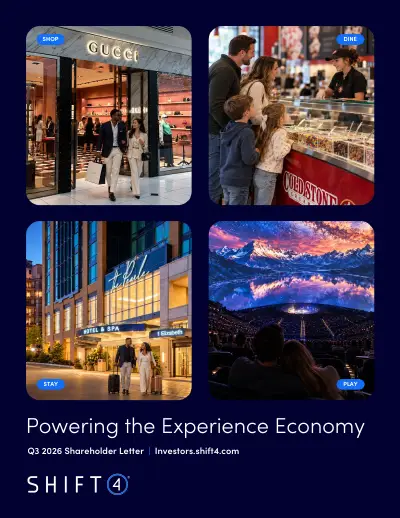
Our deliberate diversification across the experience economy in shop, dine, stay, and play is doing what it's supposed to do. Second, we continue to be efficient stewards of capital, applying a disciplined capital allocation approach to everything we do.
We're finding many attractive areas to invest in. Third, our international expansion remains on track, as evidenced by achieving our ambitious country expansion target ahead of schedule, our Global Blue synergies, and worldwide payments revenue growth ahead of our expectations.
Diving into Q3, we delivered results in line with our previously provided guidance across all major KPIs. We delivered 12% year-over-year growth in gross revenue, 10% year-over-year growth in gross revenue less network fees, 6% year-over-year growth in adjusted EBITDA, and a record $200 million of adjusted free cash flow.
We did and will continue to deliver durable growth. Our gross revenue less network fees grew 10%, or 9% on an organic constant currency basis, remaining steady over the past few quarters and in line with what we previewed.
Chris will elaborate on this later. We also continue to find opportunities to trade non-core revenue for higher and stickier payments-based revenue.
We are proud of the resilience in our numbers in the face of an incredibly volatile macro backdrop. Travel disruption remained a headwind on our tax-free shopping business throughout the quarter.
Chris will provide more detail when he reviews our guidance, but we continue to expect travel disruption through year-end. We also saw a modest softening in restaurant same-store sales relative to our other verticals, particularly towards the end of the quarter.
Despite these macro headwinds, we continue to deliver strong growth in our North Star, which is payments-based revenue. Year-to-date, both the Americas and worldwide are tracking in line or ahead of our growth algorithm, and our most mature market continues to grow double digits, with our growth markets growing faster still.
The bottom line regarding Q3: we delivered results in line with guidance, notably in our North Star of payments-based revenue, despite ongoing travel disruptions impacting tax-free shopping. Most importantly, we continued to win across the experience economy broadly.
In restaurants, we signed Kahala Brands, now our single largest restaurant customer with thousands of locations and many moving to Shift4 Dine. As a reminder, more than half of our restaurant software customers now run on Shift4 Dine, which is our most modern and flagship product.
We also added La Birreria Group, John Dady Restaurants, and the Gastronomy Group, Sardis, and many more. Notably, Alsea, one of our marquee customers, has already begun migrating their full-service restaurants to Shift4 Dine.
This is a further proof of our experience economy flywheel: success in one vertical brings trust with our customers and often leads to wins in another. We remain the number 1 provider for hotel payments in the United States, but are increasingly global, having added significant European and UK hospitality volume through our software integrations, including MGM Muthu Hotels, Pearl Hospitality, and the Danubius Hotel, just to name a few.
Hotels are also increasingly adopting our gift and loyalty solutions as they see the benefits that a single vendor across every guest touchpoint can provide. Our sports and entertainment capabilities remain unmatched.
We signed MSG Sphere for food, beverage, and retail, and we look forward to seeing their new locations as they open. You'll also continue to see us power in ticket sales for the LA 2028 Olympics.
The Buffalo Bills, a win we announced last quarter, is the first pro team to launch Shift4 Venues' new Apple and Google Wallet loyalty passes, which include geofence alerts and the ability for teams to implement tailored, segmented marketing campaigns. We view this as a burgeoning opportunity, and we're happy to announce that we've also recently gone live with the same program for the Orlando Magic.
In luxury retail, we're incredibly excited to welcome the Kering Group, whose brands include Gucci and many, many others, to Global Blue tax-free shopping. Kering is one of the largest luxury brand groups in the world, and we're proud of the confidence they placed in us to deliver an accelerated rollout, which we completed in Q3.
In unified commerce, we also added Designer Brands and Wine.com, and continued to grow our partnerships with non-profits across the globe. Our position across the experience economy truly compounds.
It's a flywheel of building brand loyalty, netting new wins, and entrenching us further into the fabric of the experience economy. We are the connective tissue behind the consumer experience, and the gap between us and our single-vertical-focused peers continues to show itself.
Moving on to capital allocation, our framework hasn't changed since our inception. We have a playbook of efficient and prudent capital allocation, with a build, buy, partner strategy that puts each and every dollar where we believe it earns the highest return.
On acquisitions, we expect to close on Paramount Commerce in the coming weeks, subject to a regulatory review. Bank rails carry the lion's share of payment volumes in many markets, and account-to-account fits transactions where cards run into limits.
It builds on the payouts capabilities we acquired with Bambora and Global Blue, and in Canada, it lets us offer one provider for card acquiring, EFT, Interac, and account-to-account. This is the kind of normal course tuck-in that fits right into the Shift4 playbook.
It's a good business at an upfront purchase price less than 8 times EBITDA, with further earnout incentives that, if achieved, will reduce our multiple further over time. This was, again, a record quarter of product and platform investment.
We continuously strive to improve our product suite. This quarter, we introduced enterprise loyalty for hospitality, a new unified analytics platform for Shift4 Dine, and further TFS enhancements, including QR code invoice capture and a new control center for merchants.
We've also returned meaningful capital to shareholders through repurchases, with our stock at levels too attractive to ignore while continuing to invest in the business, as I just described. On the third objective of international expansion, worldwide payments-based revenue continues to grow well ahead of our algorithm, up 44% year-to-date.
As we continue to scale outside of the Americas, we keep globalizing our products and the power of the experience economy across the world. Shift4 Dine continues to have strong receptivity with merchants throughout the world, where software-integrated payments are still very much in their infancy.
Shift4 One continues to resonate with retailers in Europe, and we're now live in 15 countries, which is ahead of our operational schedule. If you recall, this is a key indicator we were looking for in relation to Global Blue synergy potential in 2027.
As a reminder, Shift4 One combines payments, dynamic currency conversion, and tax-free shopping into a single device, and is a real differentiator in the market. With regard to Global Blue, we will be exiting the year at nearly $50 million in annualized synergies, which is in line with our original expectations at announcement and well on our way to the 2027 target in synergies.
To have this in the face of significant above-average travel disruption reinforces our enthusiasm. It's a great business with market-leading products that continues to win great global groups like Kering, while also beginning to cross-sell a much larger platform of services to their already stellar customer roster.
What gives me confidence is the pattern we've seen before. In the US, integrated payments took years to teach the partner channel to sell payments, and in Europe, that channel is still a new concept.
We're building direct first and adding partners second, and we think the first provider to mobilize that channel earns real loyalty in having done so. Let me close by pulling these themes together.
Our North Star of payments-based revenue remains strong despite a tough macro, softer restaurant same-store sales, and an intentionally moderated subscription and other revenues. We put our capital to work wisely in the vein of capability-enhancing strategic tuck-ins, returning capital to shareholders where appropriate, and record technology investment.
Shift4 One is in 15 countries, live and growing, and we continue to add TFS wins and grow our brand internationally. Our business has been tested in many different ways this year, forcing us to adapt the business and make challenging calls, especially in the fourth quarter, as Chris will elaborate on the guide discussion.
The diversification of our business, the durability of our growth, and the caliber of the team we've built continue to give me genuine confidence on the road ahead. I feel it important to acknowledge that the share price has clearly not reflected the durability, diversity, and outright caliber of our business and the optimism we feel inside the company.
I have a deep sympathy for shareholders who have endured far more pain than underlying performance warrants. As a reminder, between employees and our founder, we own over 40% of the total equity.
In that regard, shareholder returns are another way we measure ourselves. This piece is clearly not working as it should be.
In the meantime, we remain relatively aggressive in our repurchases, having bought back roughly 16% of the shares outstanding over the last year and 24% since our IPO. Our long-term numbers are the clearest evidence of why our model works and why we're so confident.
To remind you, gross revenue less network fees has compounded at over 35% annually, and adjusted EBITDA at over 43% annually since our IPO. All of this achieved with cumulative equity dilution of just 9%.
With that, let me turn it over to Chris.
Christopher Cruz
Thanks, Taylor. Our third quarter results reflect another set of consistent, in-line results across the board, reinforcing the financial durability of our business despite what has continued to be a challenging operating environment in a major integration and market expansion year.
We continue to deliver well above market growth, with high-single-digit constant currency organic growth, and our North Star of payments-based organic revenue growth is in the mid-teens, all while continuing to execute on a disciplined and balanced capital allocation framework. Our Q3 financial results consisted of gross revenues of $1.3 billion, growing 12% year-over-year; GRLNF of $648 million, growing 10% year-over-year, or 9% on a constant currency organic basis, both in line with guidance; adjusted EBITDA of $310 million grew 6% year-over-year, delivering a 48% margin and was also in line with guidance.
Adjusted free cash flow of $200 million was an all-time record quarterly adjusted free cash flow, and grew 42% year-over-year and resulted in a 65% conversion from adjusted EBITDA. Now let's unpack this further.
Volumes grew 11% year-over-year to $61 billion, while delivering blended spreads of 64 basis points, which remained above our full-year expectation of roughly 60 basis points. Turning to the disaggregated categories of revenue: payments-based revenue less network fees was $402 million, growing 18% year-over-year, or 14% on an organic basis.
The Americas region grew 13% year-over-year, led by strength in most of our experience economy verticals, but offset by some softness in restaurant industry SSS. The worldwide region grew 31% year-over-year, demonstrating the continued growth of all of our products in the many new markets we serve.
Subscription and other revenue was $107 million, down 10% year-over-year. Here we are making a deliberate choice to lean into our total cost of ownership advantage by creating incentives and deprecating legacy acquired revenues that are ultimately in support of our payments-based cross-sell and extend overall lifetime value of our customers.
It's noteworthy that year-to-date this category is up 2% year-over-year, and that we have consistently referred to this category as being volatile quarter-to-quarter. Tax-free shopping revenue was $139 million, growing 7% year-over-year.
Performance here remains consistent with prior quarters and in line with expectations, despite continuing to be impacted by travel disruptions. This performance demonstrates the resilience of the business, benefiting from having many global markets as a portfolio.
Our flight capacity and booking forecasting methodology remains predictive from last quarter, with the forecasted $25 million of travel disruption headwind coming in line with expectation. Before moving from the revenue unpack, I want to highlight that we've added constant currency disclosures this quarter and intend to continue them going forward.
The reconciliation tables in the shareholder letter now show constant currency organic growth comparables for Q1 through Q3, all in the high-single-digit to low-double-digit range. Adjusted EBITDA grew 6% year-over-year, delivering a margin of 48%.
We will discuss adjusted EBITDA margin more in the guidance. However, we are focused on getting margins back to delivering incrementals more akin to the historical levels as we completely move through this year of global integration and meaningful market expansion.
Non-GAAP EPS was $1.49 for the quarter. Adjusted free cash flow reflected a new quarterly record for our company at $200 million, up 42%, reflecting a 65% conversion of adjusted EBITDA.
This translates into an adjusted free cash flow per share of $2.26. This quarter benefited from approximately $20 million of net working capital timing benefit from Q4, and thus should be viewed as having delivered in line with our expectations of Q3 guidance.
We will comment on this dynamic further when discussing Q4 guidance. Now on to capital allocation.
Every allocable resource must compete for the best use and is subjected to a rigorous and consistent framework, with an output guided by return on invested capital and adjusted free cash flow per share. We continue to view the current environment as having amongst the highest bars for return that we have experienced.
Since Taylor discussed the organic investments in new markets, products, platform technology, as well as our investment in Paramount Commerce, I will jump directly to the part of capital allocation framework related to return of shareholder capital. In Q3, we repurchased approximately 4.2 million Class A shares at an average price of approximately $45.62, on invested capital of $190 million, and also repurchased 170,000 shares of our mandatory convertible preferred for about $10 million of invested capital, resulting in approximately $200 million of return of capital to shareholders in the quarter and continuing to actively manage dilution.
Under the $1 billion share repurchase authorization announced in November 2025, we have now returned capital of $825 million, with $175 million remaining authorized. We are also announcing that our Board of Directors has authorized the company to enter into a new $1 billion share repurchase program beginning on January 1st, 2027.
On our capital structure, pro forma net leverage was 3.7 times at the end of the quarter, with total debt of about $5.5 billion and cash of $1.2 billion, of which $633 million is earmarked for the August 2027 convertible notes, meaning that we have no notional debt maturities until 2032. We reiterate that we do not intend to exceed a pro forma net leverage of 3 and 3/4 times on a sustained basis.
Given the strength of Q3 free cash flow generation, we were able to use excess free cash flow to fund share repurchases, and as a result of those repurchases, we now expect year-end pro forma net leverage of about 3.6 times. This is inclusive of estimated capital needed to close on the acquisition of Paramount Commerce, but does not include additional share repurchases through year-end.
Now on to guidance. Of note, our guidance does not include any contribution from Paramount Commerce as it has not yet closed.
For the fourth quarter, we are updating our guidance ranges as follows: GRLNF of $625 million to $640 million; adjusted EBITDA of $285 million to $300 million; and adjusted free cash flow of $155 to $165 million, reflecting approximately 54% to 55% conversion from adjusted EBITDA. We're approaching this quarter with more deliberate cautiousness than earlier in the year, given the intensification of the aforementioned cross-currents from geopolitical, macroeconomic, and market risks.
There are three main factors on the guidance variance. First: embedded within this guidance is the forecasting of the travel disruption impact on tax-free shopping, using the consistent forward flight capacity and booking framework that we've used in prior quarters.
This accounts for $20 to $25 million of the midpoint variance, which, as a reminder, was not included in our previous guidance. Second: updating for FX rates, namely the continued US dollar strengthening, accounts for approximately $6 million of the midpoint variance.
Third: the remainder, or $25 to $30 million of the GRLNF variance, is associated with our strategy of trading non-core revenue for higher quality, payments-based revenue, and deferring planned commercial initiatives in Europe due to the intensifying travel disruptions. This third factor will be most pronounced in the subscription and other disaggregated revenue category, underscoring why this variable's tracking status for the year has been revised to below in the shareholder letter growth algorithm.
This translates into a full-year guidance range of: volume of $240 to $250 billion, tightening the upper end of the range; GRLNF of $2.45 to $2.46 billion; adjusted EBITDA of $1.11 to $1.13 billion, implying 45% to 46% adjusted EBITDA margins; and adjusted free cash flow of $465 to $475 million, which remains reaffirmed and unchanged from prior guidance; non-GAAP EPS of $5.05 to $5.15. The guidance updates flow through to adjusted EBITDA margins such that the FY 2026 adjusted EBITDA margin range is expected to be 45% to 46%, or an approximately 100 basis points variance to the original guidance at the start of the year of 46% to 47%.
As previously mentioned, the adjusted free cash flow guidance for the year is reaffirmed and unchanged, with the Q3 outperformance resulting from $20 million of net working capital timing between Q3 and Q4. The adjusted free cash flow conversion from adjusted EBITDA is now expected to be 42% for the year, an increase that realigns the original adjusted free cash flow conversion guidance from the beginning of the year.
Overall, we are seeing encouraging progress on working capital management in this year's integration of TFS. Although we always strive to achieve our ambitious targets, this year has seen one of the most dynamic sets of geopolitical, macroeconomic, and market cross-currents.
As we enter 2027 planning, we are pairing our internal financial ambitions with a methodology that leaves appropriate room for volatility factors. We believe a framework of mid- to high-single-digit organic GRLNF growth, consistent with our full-year 2026 expectations, is a reasonable way to think about 2027.
That said, we will provide formal guidance when we provide our fourth quarter results in the new year. Before I turn the call to Q&A, I want to thank Tom McCrohan for the foundational work he has provided in establishing our investor relations program over the years.
We wish him well in his next endeavors. With that, operator, we can open up the call to Q&A.
Operator
As a reminder, if you would like to ask a question, press star, then the number 1 on your telephone keypad. To withdraw your question, simply press star 1 again.
We kindly ask that you limit your questions to one and one follow-up for today's call. We will pause for just a moment to compile the Q&A roster.
Your first question comes from the line of Rayna Kumar with Oppenheimer. Your line is open.
Rayna Kumar
Good morning. Thanks for taking my question.
Chris, you gave us some idea of your 2020 2027 framework. Could you just provide us some more details as to what the drivers could be for the framework you just provided?
Thanks.
Christopher Cruz
Sure, thanks, Rayna. The 2027 GRLNF organic growth framework of mid- to high-single digits, I think is what you're referring to, which we just talked about towards the end of the call here, let's kind of take that into two parts.
First, let's start with, I think, the point that we were trying to make off the top, that there is a conservatism in the way we're looking at the variety of challenges this year, from the geopolitical to the macro, the market cross-currents. Right off the top, it's hard not to be influenced towards a more cautious approach to forward outlook.
Probably more important is really trying to get an understanding of the why. We're introducing the framework at this point in the year, obviously formal guidance will come out next quarter with Q4 results.
If you looked at the full-year 2026 kind of implied guidance, the Q4 GRLNF range would result in, call it, a 3% to 5% reported growth with an organic growth rate that's probably about 1 to 2 points inside of that. We just wanted to be very clear that this growth rate is being depressed by events and actions in Q4 that'll be isolated and not recur.
Namely, what we're talking about there is that we have headwinds that have intensified in travel disruption, we've made some deliberate choices to deprecate non-core subscription and other revenue in exchange for our higher quality, payments-based revenue, that's always been part of our playbook, and then the deliberate choice to defer commercial initiatives on our European merchants experiencing the aforementioned challenges from travel disruption events. Taking all of that into account, we're looking at something that is we acknowledge an isolated Q4.
When you think about the broader framework of how we think of growth in GRLNF organic terms, mid- to high-single digits is a good framework for the following year.
Rayna Kumar
That's very helpful. As a follow-up, do you anticipate same-store sales in 2027 to remain similar to 2026, or does your GRLNF of mid- to high-single digits assume things could also worsen?
Thank you.
Christopher Cruz
I think the approach as we entered this year is an approach where same-store sales as a backdrop should be viewed as a neutral variable, not a positive variable, not a negative variable, but a neutral variable. I think absent some incremental data that might guide us towards a different direction, I think neutral is probably the right going-in assumption.
Operator
Your next question comes from the line of Dan Dolev with Mizuho. Your line is open.
Dan Dolev
Thanks, guys, and thanks for the detail on unpacking 27. Maybe just could you elaborate a little bit more on Global Blue long-term trajectory?
Given this is a difficult year, is there a good chance that next year will be a better year? Then I have a quick follow-up.
Thank you.
Christopher Cruz
No, thanks for the question, Dan. I think we're not necessarily going to provide a long-term trajectory or a medium-term type of trajectory view on this call, but I think some of the observations that I'd make from the year that we've had in successfully integrating the Global tax-free shopping business is that as a portfolio, despite the fact that this business can be impacted by travel disruption events that can be acute on certain markets, namely the Middle East to Europe market or Southeast Asia to Europe market, you can have a counterbalancing force in the portfolio across other corridors.
We've talked that the US consumer in the European markets continues to perform well, continues to show up, and inter-Asia, we're continuing to see good sales results. That balancing act is what has translated into a performance in TFS that actually has been in line with the growth algorithm component that we had at the start of the year.
Admittedly, within the growth algorithm, the TFS component was probably the area that, relatively speaking, we were trying to be the most conservative on, acknowledging that this is our first year of ownership, and that as you go through any major global integration, you're naturally going to run into the unknowns. I think that the outlook for TFS is something we're very excited about despite the challenges this year, and it's because this business has actually demonstrated good durability in the face of a challenging geopolitical and macro.
Taylor Lauber
I just want to sort of double-click on that. Everything Chris said is right, but I think it's important to take a step back and realize this is kind of the first 18 months we've owned this business.
We had always anticipated 2026 to be a year of a lot of integration work, and quite frankly, a year that we were going to proceed with caution as we did that integration work. That was set up as early as our announcement of the transaction.
2026 was going to be an integration year. The fact that that integration year coincided with a lot of geopolitical conflict that caused above-average travel disruption, and yet the business continues to grow, I think, is a testament to what we saw 2 and 1/2 years ago when we decided to buy the business.
I think the best proof point that people sort of trying to understand what this piece is as part of a greater puzzle is Kering, right? The largest luxury brand group in the world, one of the few that wasn't already a customer of Global Blue, chose to roll out our services throughout this year.
I think that was as a result of the differentiation we provide despite of everything I just talked about and despite of the fact that it's been an integration year for the business. We are incredibly happy to have this asset despite what we've seen.
I think it's interesting that people sort of view these travel disruptions as an inconvenience. I actually view the growth through them and the fact that one of the best luxury brand customers in the world chose to move to us in this year as a testament to the quality of the business.
Dan Dolev
Got it. Really quick follow-up, guys, really helpful on this.
Just on the yields for 27, I think end-to-end stepped down, but the yields were up. How can we think about that going into 27, and how does that change relative to sort of the way you thought about the business prior?
Then how should we think about acquisitions fitting into that framework? Thanks again, and congrats on strong 3Q.
Christopher Cruz
Thanks for that. I think you're referring to net spreads.
As a reminder, the net spreads came in at 64 basis points, ahead of our 60 basis points kind of full-year sort of outlook around it, and that has been a trend that has continued throughout the year, such that even the year on a year-to-date basis we're ahead. Look, I think the spreads dynamic is something that is a result of the balance in our portfolio.
I think in years past, the theme of enterprise growth has weighed down on spreads. I think the mix shift back towards a portfolio that's now actually very well diversified is giving us a much more stable view around spreads, and overall, I think we're content with what we're seeing in the portfolio, being able to balance it, being able to manage spread and provide a performance that exceeds our expectations.
Taylor Lauber
Maybe we don't want to sort of set a guide here. I think it's just not appropriate at this time.
Those who have been with us since our IPO remember this journey well, right? Spreads in the 80s sort of blending down towards the 60s as we added a lot of enterprise customers for the first time.
In Europe, we're on the reverse trajectory of that, which is that we're adding SMB customers, and enterprise will take time over the next year, two, three. Enterprises start to adapt the value proposition and pay a lower spread, but give us a lot more volume.
To Chris's point, we're really happy with this mix. I think few companies can thread this needle of enterprise solutions and SMB well, and so the result is a stable spread, but we are unabashed to the extent we see enterprise opportunities that give us outsized volume, we'll go after it.
Christopher Cruz
At the same time, one other point I'd make is that when we think about spreads, that's not the only variable within our total cost of ownership equation. When we face merchants with a value proposition of the best total cost of ownership in the end markets that we serve, a full offering of software meets payments, meets hardware, meets services, and meets the value add around it, we look at it through the total cost of ownership perspective.
Having spreads that are a variable in our payments-based revenue that we think is the highest quality of revenue, we think is the best because it's usage-based in nature, you can't think of it completely separate from the fact that we will trade off the non-core revenues, the subscription revenues, the legacy acquired revenues, in order to keep delivering a better total cost of ownership proposition to the merchant, which we think in the long run extends their lifetime value and makes us very competitive.
Dan Dolev
Super helpful. Thank you.
Operator
Your next question comes from the line of Timothy Chiodo with UBS. Your line is open.
Timothy Chiodo
Great. Thanks a lot for taking this one.
I wanted to dig into the US versus international growth within the 9% organic constant currency GRLNF for the Q3, and then also similarly, when we look at the mid- to high-single-digit number for next year in the preliminary 2027 outlook, what the assumption is for US relative to international. If as part of that, you could just kind of recap the mix plus growth and effectively do the sum product, if you will, that'd be appreciated.
Thank you.
Christopher Cruz
Thanks for the question, Tim. Just to reiterate it, the year-to-date payments-based revenue less network fees in the Americas, year-to-date, we're running at 16%, mid-teens, in line with our growth algorithm kind of tracker.
In the worldwide, excluding Americas, year-to-date, we're at 44%, but our growth algorithm variable there, high-20s, so that's ahead, that's exceeding. I think inside of your question, though, is how do you connect those two variables in the growth algorithm back to this GRLNF organic framework?
I think maybe an unsatisfactory answer is that we will give the detail around the guidance in a more formal way for 27 at the upcoming quarter. I think the important part here, though, is to acknowledge the reasons that we gave that piece was I think it was pretty clear that it would have created a little bit of uncertainty and also lack of clarity if we hadn't been able to provide that given the Q4 implied in the full-year 26 guidance.
That's the real reason for it. will unpack it in all of the detail that we have been unpacking the business at the formal guidance in the coming quarter.
Timothy Chiodo
Thanks a lot, Chris. I really appreciate that.
For that number, though, just to confirm, that does include continued Middle East travel impact, meaning the mid- to high-single digits, investors should expect that should the conflict resolve, then we would see a slight bump above, and potentially back to the more close to the 9% to 13% range that you previously discussed? Is that a reasonable assumption?
Christopher Cruz
I think the way you can think about it is that as we look at the quarterly cadence that the conflict, the the Middle East geopolitical conflict, has created, you're talking about an event that really in Q1 of this year impacted the last month of the quarter, and then Qs 2, 3, and 4 obviously have been have been impacted. As you think about the year-over-year dynamics, the first quarter will still have, it's not fully anniversaried in the first quarter, you will still have some effect there, and and that's something that, we're anticipating.
For the most for the rest of the year, what you have is that it is anniversarying at a at a neutral level. Now, what you're describing, though, is a a far more complicated answer in terms of how do you think about how different scenarios of this travel disruption resolving itself, what are the different scenarios of how that could flow through, what are the different sensitivities?
That this is something that we're going to really want to unpack with with you all as we get into the formal guide, but that is but that is something that we definitely will do.
Timothy Chiodo
Great. Thank you so much.
Operator
Your next question comes from the line of Will Nance with Goldman Sachs. Your line is open.
Will Nance
Hey, thanks for taking the question. Appreciate some of the initial look into 2027.
Maybe if we can kind of zoom out and not talk about any individual year, talking about a mid- to high-single digits, I think, it's a little lower than what we were talking about a few months ago. I think it's lower than you guys have aspired to in the past.
Over time, how do you think about the underlying growth potential of the business, and where are the opportunities that you're most focused on executing to kind of restore the performance of the business to the levels that you guys have historically aspired to?
Taylor Lauber
It's a great question. We obviously believe the potential of the business to be far beyond that.
We also need to look at the broader market and recognize what's getting rewarded and what's not getting rewarded in terms of expectation setting. Acknowledge some of the challenges that we quite frankly didn't anticipate a year ago when we set out our guidance for this year, namely, the geopolitical conflict, and macro more broadly.
I think it's the right thing to do in terms of setting an expectation for the business that we think is highly achievable. It doesn't really impact how we think about execution in the business day-to-day.
What are we really focused on? We talked about being live in our materials in 15 countries.
That's just being live. That isn't escape velocity of a sales force that's paying for itself yet, right?
When they do, you've seen the results of that potential in the United States and what we've done there. We're incredibly excited about that, and there's entire new continents to unlock on top of a business that's already winning a lot of great customers.
As yet, I think, if we're being self-critical, to really deliver the full platform to every single one of them. We're talking about things like account-to-account capabilities.
We're talking about things like gift and loyalty. It's only been in the last quarter or two that our largest hospitality enterprises have really started to embrace the gift and loyalty offerings that we acquired 2 years ago.
There's a ton of potential inside the business, but we also need to look around at the market and say what's getting rewarded and what's not, and this doesn't seem like a time to set ambitious expectations, I think for a lot of obvious reasons when you look at multiples.
Will Nance
No, all makes sense. Appreciate that.
Then just maybe one for Chris. As you guys think about the framework for free cash flow, it's nice to see the progress on working capital this quarter.
Was wondering if you could just talk about some of the puts and takes on free cash flow on a go-forward basis and how you think about that, the puts and takes on conversion on EBITDA relative to EPS, and I know we talked a little bit about interest expense in the past, just how are you thinking about some of the below-the-line items?
Christopher Cruz
No, thanks for the question, Will. I think what this this free cash flow performance has allowed us to gain confi- this this free cash flow performance has allowed us to gain confidence in the framework that we laid out at the beginning of the year.
This idea that absent any capital structure changes, you should assume that the incremental free cash flow conversion will run at the 60% zone. As as relative to EBITDA, right?
As you have a dollar change in EBITDA, you should assume the 60 cents flows through to the adjusted free cash flow. I think there's room to improve that.
That is something that, we actually were able to achieve with some of the net working capital focus in the year. It's a very global business, and in particular within the TFS the TFS business model, it's something where I think there's optimization room, and we're focused on it.
At the same time, the business is just so much more scaled, so much more global than it ever has been, and more diversified. As we look at all the different functions and all of the different ways with which we can be both cost-conscious and cash-conscious inside of working capital and other, these are things that I think we we still have as as some low-hanging fruit.
I think from a framework standpoint, this year's ability to simply reaffirm the same kind of free cash flow as as the guidance here, despite the the guidance variance and the other variables, I think it affirms that our thinking is correct on the on the framework. All right,
Will Nance
appreciate you taking the questions.
Operator
Your next question comes from the line of Sanjay Sakhrani with KBW. Your line is open.
Sanjay Sakhrani
Thank you. I just wanted to go back to the slowdown in same-store sales in restaurant.
I guess could we just parse that apart a little bit more in terms of what you were seeing, specifically towards the tail end of the quarter, and what's built into 4Q? Thanks.
Christopher Cruz
Sure. At the start of the year, when we had given our neutral same-store sales variable, that's what would have been embedded in the guide, that consisted of a first half same-store sales that would have been low-single-digits negative, and a second half that was low-single-digits positive.
It's that second half that we just haven't seen the turn, despite the fact that restaurant, in particular, is anniversarying sort of softer comps as we move into the fourth quarter. As we look at the data, you're actually seeing in the first month here of the quarter, you've actually seen negative same-store sales comps in some of the weeks.
That is something that is weighing, and I think that it is something that, look, we're looking at, we're trying to see if there is a dynamic here where the market is now more interested and seems to be responding well to, I think, the lower total cost of ownership proposition, as they think about their own desires to be, I think, a bit more cost-conscious within their operations, in order to weather the storm here of what seems to be soft SSS.
Sanjay Sakhrani
Okay. In the fourth quarter, you're assuming is it stays sort of the tail end of what we saw in the third quarter?
Christopher Cruz
We are baking in the idea that there is risk to the SSS inside of our figures, as part of our overall kind of shift towards more caution.
Sanjay Sakhrani
Got it. One follow-up for Taylor.
Obviously, the stock has struggled given the volatility in some things that you can't control. I'm just curious, as you think about strategic options, what are they?
Can you maybe lever up, buy more stock, consider other options? Maybe you could just talk about some of the things that you guys are thinking about.
Thank you.
Taylor Lauber
Sure, it's a great question, and I hear it expressed often from the shareholder base. I think what we're doing is sort of an obvious nod towards what we think of the stock price, which is that we've repurchased 16% of the company, and we've got cash remaining on that authorization and a new authorization just announced today immediately behind it.
We intend to grow value per share in the company. We're 42% owners of the business when you consider our founder and the employees.
We don't like the price. We don't think the price reflects the underlying performance of the business, but we also acknowledge the market sentiment in both our business and the broader sector is one that is not rewarding much and is punishing any misgiving.
I think our attitude is probably best reflected in that repurchase, but as you can see from the rumors across the industry, I think people are starting to recognize the free cash flow generation of these businesses is something that can't be ignored. I'll kind of just leave it at that.
Christopher Cruz
I think just to add that the adjusted free cash flow per share growth, as one of the key variables that, simply put, we measure ourselves against, we measure the capital allocation framework against, like that, plus return on invested capital, like those are when you have those growing and going the right way, and you just put your head down and you keep focusing on compounding that adjusted free cash flow per share metric, there's going to be a lot of options. There's going to be a lot of options.
Then the other thing I would say is that if you looked at our capital allocation balance in the quarter, I think that is a good indication that we are investing in the business heavily, both within that market expansion, record product and platform investment. We're investing in our playbook of accelerating our strategic initiatives, enhancing our capabilities through acquisitions, like the Paramount Commerce announcement that we expect to close in the quarter.
Then we're doing share repurchases. This balance, it's a bit of a high-class problem to be able to have a high bar of high-return initiatives that you can allocate capital to, but we're balancing all of them.
Sanjay Sakhrani
Thank you.
Operator
Your next question comes from the line of Darrin Peller with Wolfe Research. Your line is open.
Darrin Peller
Thanks, guys. I know it's hard to sometimes disaggregate this, but can you help a bit with how much you see coming out of the deals you've already done, whether it's Smartpay or Bambora, and how much that's still sort of what inning you're in in terms of generating incremental revenue synergies out of those deals, combined now with what my bigger question on Global Blue would just be, Taylor, what's the targets you're looking for to say, success, and we've really achieved what we wanted to in terms of cross-selling potential?
I know you're in 15 markets, but how penetrated really are you there now? What do you want to see to consider that having succeeded so far?
Taylor Lauber
It's a great question, and I think every transaction we look at individually for a different set of purposes. If you recall, Smartpay was we have awesome Australian acquiring capabilities, we have products like Shift4 Dine and Shift4 One that are going to be highly applicable in those markets, not to mention all of our integrations to support hospitality, sports and entertainment, retail, etc.
We need a sales force, and Smartpay was a great sales force. That deal is achieving exactly what we wanted it to do, which is that it's a business that is adding hundreds of merchants a month in Australia, across a product suite that's much stickier than their traditional payment terminal they might have given to a customer, and they're starting to have success at higher quality customers.
That's awesome. That's exactly what we intended to do with it, and unlike some of our other acquisitions, the core business doesn't necessarily need to degrade.
We can upgrade those customers from terminals to much stickier products. Bambora, somewhat different, right?
There's a volume opportunity inside of it, but also a capability in one of the largest ACH providers in the world, and a customer base and great companies like Concur that we didn't have inside the company. There's a much more technical aspect to that integration and making sure that those critical pieces become part of a platform.
One thing that I think maybe lost on people who followed our story for a while is we are starting to become a really big payouts business in addition to a pay-in business. The entirety of what Global Blue does, for example, is payouts, and Bambora enhances that meaningfully.
That brings a different set of customers or even just a different set of capabilities to the customers we have. Those are achieving our objectives.
I feel really excited about Paramount. I know it raised a lot of skepticism in the last quarter.
Hopefully, that's being demystified. We're not runaway crazy.
We pay fair prices, we get good businesses, and we put the right framework around them growing inside of our franchise. Hopefully that's understood, all within the capital allocation framework that Chris laid out.
Now, with regard to Global Blue, I would sort of challenge everyone, it's not that hard these days to use AI to do it, go back and look at all the statements we made since February of 2025 about what we expected this business to do. We expected that we would close in the middle of 2025.
We expected that 2025 and 2026 would be a year about setting the foundation for the business, and so operationally, we have hit the milestones we want to hit. We've got live teams selling live products in 15 countries.
Now, to be fair, you need to have yield on that, and 2027 is the year that we told people, as far back as February of 2025, to expect that. Just to reiterate some of the comments made in our prepared remarks, we're already seeing or we expect to exit this year, it's probably better said, with $50 million of annualized synergies.
That's against a bogey of about 70 that we told the Street to expect. Clearly we feel good.
Then if you unpack Chris's remarks, there was more we planned to do that we didn't get done. I think that's the right level of expectation.
Operationally, we feel great. There could have been more, and we always sort of self-analyze that.
We're well on our way to what we described, and that, I think, is most important for shareholders in a payments environment that's super choppy. Just go look at the long track record of comments, and I think you'll find we're right on top of them.
Darrin Peller
All right, thanks, guys. Actually, Chris, just one quick follow-up would just be, you're still targeting low 3s leverage in the same timeframe, right?
Then just to be clear on free cash, your 60% conversion, does that incorporate incremental, possible hardware costs for anything on the chip side, or just to be clear with those two points. Thanks again, guys.
Christopher Cruz
Sure. What I talked about in the prepared remarks is that, as a result of the opportunity to deploy excess free cash flow at share repurchases in the third quarter, we now have rather than an outlook to the year that ends in the low 3s in line with sort of our long-term historical average, we're expecting to delever from 3.7 to 3.6.
That 3.6 would include within it the assumption that Paramount Commerce closes, and that the proceeds needed to close on that acquisition, that's embedded within the figure. Incremental share repurchases in the fourth quarter would not be included in that figure.
On your second part of your question around free cash flow conversion, the free cash flow conversion kind of framework that we introduced at the beginning of the year, 60% incremental free cash flow, that's, I think, still the right way to think about it. If anything, our ability to have reaffirmed our free cash flow guidance this quarter for the full year, that, if anything, has just kind of continued to confirm that 60% incremental is the right framework of how to think about modeling going forward.
Darrin Peller
Okay. All right, thanks, guys.
Operator
Your next question comes from the line of Madison Suhr with Raymond James. Your line is open.
Madison Suhr
Hey, good morning, guys. Thanks for taking the questions here.
I wanted to ask on the Japan tax-free shopping shift to refund-based. I know it's a key region for Global Blue.
Looks like you've already received some regulatory approvals there, but can you just help us understand how that change could impact Global Blue's business there? Are you expecting to have to make any changes around the business model?
Do you see incremental revenue opportunities? Just any color there.
Taylor Lauber
Sure. Chris should keep me grounded in this, but it is a monumental change in a country that has, as you pointed out, a lot of tax-free shopping, quite frankly, one of the largest in the world.
It is way too soon to predict the impact because what's going to happen here is that friction is going to be introduced to a process that largely didn't have a lot of it, and I think it's for the right reasons, right? It's a much more compliant process to make sure that anyone engaging in tax-free shopping leaves the country with the goods, is a foreigner, etc.
There's friction being introduced, and therefore, predicting the near-term results of that is probably not very wise. We've got to see it play out.
For those keeping score, the change happened this week overnight between Halloween and November 1st. We've had to staff the country quite meaningfully to be able to accommodate this.
We need booths in a lot of airports and a lot of department stores, but if you compare us to our peers in that country specifically, we're the only one that's done this throughout the world. I envision, over some period of time, our market share is going to grow dramatically, and that customers who are not used to this process are going to find that Global Blue does this better than anyone else in the world, as evidenced by kind of our 85%-plus market share throughout Europe and other places.
You've seen a bunch of brands join us in Japan. I think we referenced that in our last earnings call.
It's something we're excited about. It's a major priority for the business, but I also think you got to watch the consumer behavior play out, and that can be quite volatile before we kind of can comment on the longer-term trajectory.
Madison Suhr
Thanks for that. I know it's still very early days there.
Just a follow-up here, again, appreciate all the extra color on the 4Q guide. I wanted to ask just on the non-recurring revenue transition to some of the higher quality, the commercial deferments, should we really just think of that as more of a one-off 4Q event, or as you think about the portfolio and the pipeline more broadly, do you feel like there's going to be other actions you may need to take over the next few quarters?
Thanks, guys.
Christopher Cruz
It's definitely the right question to focus here. Look, I think the best operational decisions that we can make in a challenged geopolitical backdrop, a challenged macro backdrop, are decisions that put the customer first.
They're decisions that put the merchant first. We hear what is happening in restaurant with tough SSS.
We hear what is happening to our European retail customers given heightened levels of travel disruption and even unrest in the capital cities. We're choosing to take a decision to support them, and to meet them where they are on needs around having a better total cost of ownership, and deferring on commercial initiatives that would have otherwise been planned and would have been things that we would have otherwise actioned.
Now, those are things that I think are decisions that you make given the market backdrop, given the macro backdrop, but our ability to then defer those to a future point is very much still part of what we are capable of doing, and we've got to look at the market backdrop behind us. We've got to look at what the merchants and the customers need in the moment in time.
I think that is a good call-out from a question standpoint, and that'd be our plan.
Taylor Lauber
The only other color I'd add on that is we are constantly putting in front of customers reasons they should stop paying us for one feature and embrace the entire platform, which, as benefits the payments-based revenue line. We're sometimes, and I think Q4 is an example of that, at the whim of the customer simply saying yes, and us flushing what we view as lower quality revenue, maybe they just paid for gift card services or something like that, into a permanent payments-based customer where we're earning more on.
That trend is very different than what Chris just described. It's when the customer says yes, we're thrilled to do it, and hopefully balanced in our tone here, but somewhat unapologetic about the results of that because it yields payments-based growth in the quarters ahead.
Operator
Our final question comes from the line of Jason Kupferberg with Wells Fargo. Your line is open.
Jason Kupferberg
Thank you, guys. Just some of the newer headwinds you guys called out this quarter, the incentives, deprecating the legacy revenue, obviously the deferral of the EU initiatives we just hit on.
Can you just take us back to when those started to materialize, and as we try and quantify their impact on the top line for next year, should we just think about kind of annualizing the Q4 impacts that you outlined?
Christopher Cruz
Thanks, Jason, I can tackle that. The way to think about it is in the fourth quarter, approximately 25% to 30% of, call it, the midpoint variance change in guidance is a result of those two points that you just mentioned.
This idea that we made some decisions, some of them challenging, but the right decision given what our merchants are facing in this market and travel-disrupted backdrop. We think of those as point-in-time, moment-in-time.
Some of them are, I would call them not so much a headwind, but actually some of them are opportunistic and positive because the merchant is asking, if I take on more of your services, will you provide me an incentive to do so that then results in us translating non-core revenues to payments-based revenues? That's a good thing.
That's straight out of the playbook that we've had over many years. There are moments in time, such as a soft macro backdrop or a tough operating environment for restaurants, where there's an acceleration of that ask, and there's a good opportunity to go after it.
In the case of Europe, I think it'd be hard to ignore what we're seeing on some of the civil unrest in the capital cities disproportionately hitting some of the high-value retail, as well as the continuation and intensification of some of the travel disruption from geopolitical. You have to make challenging calls that meet your merchant where they are, and that was what happened there.
I would not be annualizing that. Hence, the importance of hearing us that the framework for FY 2027 GRLNF organic growth is a mid- to high-single digit.
It isn't take the Q4 and run it out.
Jason Kupferberg
That's helpful. Just a quick follow-up, can you just clarify the Global Blue synergy comments?
I know you talked about the $50 million. Is that just on the cost side so far, or is there a little bit of revenue as part of that?
Because I think we were going after an $80 million revenue synergy number for 2027, I just want to make sure we're thinking about it on an apples-to-apples basis for some of the synergy numbers you guys talked about today. Thank you.
Christopher Cruz
Sure. That's a total synergy number, and you can think of it as approximately two-thirds top-line, one-third cost.
Jason Kupferberg
Great. Thanks.
Operator
That concludes our question-and-answer session. Ladies and gentlemen, this concludes today's call.
We thank you all for joining. You may now disconnect.