Premier Foods plc
Q2 FY2027 · Earnings Call TranscriptNovember 12, 2026
Alex Whitehouse
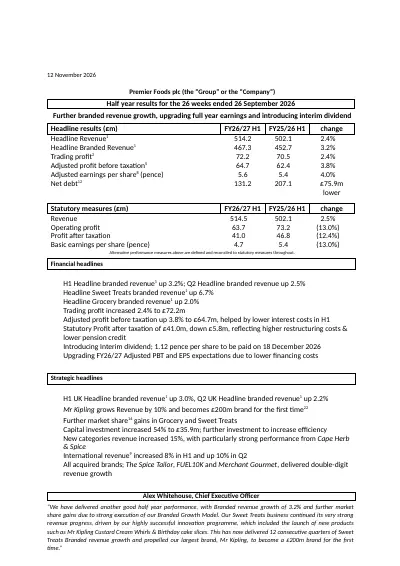
Morning, everybody, and welcome to Premier Foods' half-year results for the 26 weeks that ended on the 26th of September this year. As always, I'm joined by Duncan Leggett, our CFO, and together we'll take you through how the business has done in the first half of the year.
Some highlights from me, Duncan will run us through the financials, and then I'll come back and talk us through the progress that we've made against our five-pillar growth strategy. To kick off with the highlights then, I'm pleased to say we've had another good first half of the year with further branded revenue growth and market share gains.
Trading profit was up 2.4%, and adjusted EPS up 4%. Today we're also upgrading our adjusted PBT and adjusted EPS expectations, and that's due to lower than expected interest costs, which Duncan will talk about shortly.
Today we're also introducing an interim dividend. That's the first time that Premier Foods has had an interim dividend for 19 years.
If we also just look at how we've done across our strategic pillars, and I will come back to this in more detail shortly, but good progress against all the pillars. Growth from our UK core was +3%, and that was +2.2% in quarter two, and that was because of the impact of the hot weather on our core grocery business, and I will come back and talk about that more.
Infrastructure investment was £36 million, that's up 54% versus prior year as we invest behind some significant strategic projects in our manufacturing sites. Category expansion, our extensions into new categories, and the image on the chart there is our extensions with Cape Herb & Spice into the herbs and spice category, they were up 15%.
Our international business grew by 8%, and was actually up 10% in quarter two. Then if we look at our inorganic opportunities, so that's the brands we've bought, The Spice Tailor, FUEL10K, and Merchant Gourmet, they all grew strong double-digit in the first half of the year.
I think what's really interesting when you look at this is that you can start to see that the business is now significantly more resilient than it was historically. I think because of that resilience, we've been able to deliver a good branded revenue growth in the first half of the year despite that warm weather and the impact that we all know that that has on our grocery business, because our grocery business tends to have products in it that we all like to eat when the weather's a little bit cooler.
That resilience really comes from a diversity of both category presence and a diversity of geographical presence, and you see that when you look across the strategic pillars. We've got a bigger, stronger sweet treats business, which has grown very strongly compared to 7, 10 years ago.
We've got our category expansion experiments. We've got a bigger, stronger international business.
Of course, we've now got the three brands which we've acquired, all of which are actually not very seasonal and, in fact, quite temperature agnostic. All in all, a more diverse business, as I say, both in terms of category presence and in terms of geographical presence, and which makes the business more resilient.
As we go forward and deliver further against those strategic pillars, the business will become more resilient still. With that, I'll hand over to Duncan, who'll walk us through the financial progress.
Duncan Leggett
Thanks, Alex, and good morning, everyone. I'm going to talk us through some of the highlights from the financials from the first half, and I'll start by sort of three key takeaways from my perspective.
Firstly, as Alex has just mentioned, really pleased to be upgrading both adjusted PBT and adjusted EPS to the top end of expectations. That's driven by an updated, right-sized debt structure, which I'll talk about shortly.
Our strong balance sheet continues to give us a strong platform to invest, that's both within the manufacturing sites, but also in the acquisition of future-focused brands that will help step-change both the size and also the growth profile of the business. As Alex has just said, really pleased to be confirming the introduction of the interim dividend today.
Looking at the financials at a group level, you can see branded revenue is up 3.2% to £467 million. That's really good, strong performance from Sweet Treats, building on the momentum already gained.
Grocery performance, pretty strong and resilient, as Alex has just mentioned, despite the impact of the warmer weather. Total revenue is up 2.4% to £514 million, non-branded revenue is down overall, but a bit of a bit of a mixed picture across Grocery and Sweet Treats, which I'll talk to shortly.
Trading profit growing in line with revenue, so that's up 2.4% to £72 million. Margins very much in line with prior year.
We've dealt with the inflation we've seen in the first half. Then looking a little bit further ahead in terms of inflation, we'll continue to manage it in exactly the same way as we would typically do, we have hedges, we have forward contracts, and we fix contracts with suppliers where we can.
Looking further ahead, we'll obviously be keeping keeping a close eye on things. Clearly, things are quite volatile and we'll be monitoring during the second half.
Adjusted PBT is up 3.8%, so that's growing ahead of trading profit, and that's because we continue to reduce our interest costs as we continue to build cash on the balance sheet that earns a return and reduce leverage. Free cash flow, that's always been a strength of the business.
Good performance half half-year on half-year, so that's up nearly 44%. That's really through tight control of working capital.
As we know, most of our cash is generated in the second half, we'd expect to see much more coming through there. Net debt of £131 million, that is over £70 million lower than this time last year.
In terms of the build during the half, we have the typical stock build that I'll talk to you shortly, as well as, more CapEx and a high dividend during the first half. Then the dividend that we talked about declaring for the first time today in 19 years, in terms of monetary value, that is 1.12 pence.
Looking at the divisions in a bit more detail, the usual reminder that the Grocery business includes International. Branded revenue is up 2% to £344 million.
Again, we've got good examples of the innovation pipeline coming through and working really well for us. Alex will talk about some examples, particularly around Angel Delight and Oxo shortly.
Obviously, we have had the impact of the hot weather, which does impact the categories in which we operate, but looking at the the less seasonal, more future-focused acquired brands, they're all growing double-digit, really fulfilling their role in the portfolio. Non-branded revenue is down 12% to £28 £28 million.
We've got some contract exits you can see there. It's actually a better trajectory across the half, Q2 was an improving trend versus Q1, and we'd expect that trend to keep improving as we go through the second half.
All that leaves total revenue up 0.8% to £372 million. Then divisional contribution, you can see growing ahead of turnover, so that's up 3.2% to £96 million.
That's really our continued focus on efficiencies, both from a CapEx perspective, but also from our supply chain broader efficiency program. Really good control of costs and some of the benefits of the branded mix coming through.
Sweet Treats, top-line wise, another really good performance, really seeing the volume-led innovation growth coming through. We've got branded revenue up 6.7% to £123 million.
Within that, we've got Mr Kipling growing at over 10%, really, really good momentum continuing in the business. Non-branded revenue is up for the fourth successive quarter, so that's up 7.8% to £19 million.
We've got a bit of a tailwind of contract wins you can see there. That leaves total revenue up 6.9% to £142 million.
From a profit perspective, you'd normally expect to see the benefits of the branded mix and the volume flowing through to profit. That hasn't happened to the same extent this year this half as we'd expect, and that's really for a couple of reasons.
One is we spent a bit more marketing in the first half versus last year. That's purely phasing and that'll right itself over the full year.
What we have seen is, during the prolonged hot weather, we've had manufacturing inefficiencies, particularly at our Cadbury site. If you think trying to set chocolate on a Mini Roll in sustained sort of 30-degree heat, that's actually quite difficult.
We had to stop production for a period of time, which led to some inefficiencies. Then also some of our innovation is performing so well, we've had to put additional labor onto the manufacturing lines to service what's frankly been pretty exceptional demand.
We've got a plan in place for that. We've got some CapEx that we're going to lay down, but the benefits of that will probably be back into the back end of this year or start of next year, we'd expect to see some of that continuing during H2.
All that leaves divisional contribution down 16% to £12 million. In terms of debt, I've talked about the half-year net debt being over £70 million lower than this time last year.
In terms of the components of of the outflows compared to year-end, very much in line with our capital allocation framework, with the addition of the typical seasonal stock build that we see in advance of our peak season that we're in now. Taking through some of the the key movers, we've got CapEx at £36 million, we're guiding to £60 million for the full year.
Again, we've seen much more much more spent in the first half that would be typically, and as I've always said, that, that's a really good thing for us. The more the more we spend, the more we can put down, the quicker we can get the benefits, so that's very much in line with our plan.
Interest has had £7 million continues to be modest. You can see we're now guiding to £18 million reflecting the updated financing.
Then we've got dividends payment of the financial of the final dividends, and deferred consideration, we've paid one amount in the first half, we've got another amount that we're planning to pay in the second half. Then in terms of other, we've got some restructuring costs and some refinancing fees.
All that takes us to net debt of £131 million for the half and leverage of 0.6 times. Just a reminder, this is a 53-week year, what that means in terms of working capital is one of the month-end payment runs that would typically fall into FY28 comes into this year, so that means we've got a a working capital outflow we're expecting during the year.
In terms of that refinancing, I've referenced a couple of times, you'll be aware that we had a bond maturing mid-October, and what we've done is taken the opportunity to actually repay the bond through cash and addition of a term loan. At one point, we thought we might be refinancing it would be would be at a significantly higher interest rate, really good, you can see we've got over £200 million of cash on the balance sheet at the end of September.
We've used about £150 million of that, together with a £175 million term loan that we've agreed with our banking group to repay the bond. Really what that does is it it right-sizes our debt structure at a sensible cost of interest, trying to minimize it where we can, whilst maintaining flexibility to execute our strategy going forward.
Then on the right-hand side of the slide, you can see the trajectory in terms of interest over the last six or so years, so much more than halved from 39 down to £18 million, which is the expectation for this year. Pensions, we talked in May about the triennial valuation results showing a bit of a surplus on a buy-in basis.
That was really positive news because it's the first time that we'd seen it. We also took the opportunity, reflecting the the pension scheme strength, to remove the the company's requirement to pay administration fees into the scheme, and that really was the last cash payment that we were paying that has now been removed.
Now, there's no real formal update in terms of any formal valuations, but what I would say is, six months on, continuing to see the progression of the pension scheme and how things are moving, we've got a good degree and an increasing amount of confidence about the realization of that surplus in due course. From a capital allocation perspective, things playing out very much in line with our principles this half.
CapEx is up at £60 million we're guiding to for the full year, that's 15% higher year-on-year. I think this really is the the sort of rough go-forward position we'd expect on a BAU basis going forward.
Alex will talk about shortly, but very much not just investing in our in our strong payback projects, which continue to be the case, but also more strategically in terms of insourcing some production from outside and increasing capacity in certain areas of the business. From an M&A perspective, clearly no acquisitions during the half, but clearly the the acquired brands we do have, all growing really strong double-digit and really fulfilling their role in the portfolio as growth accelerators.
Then from a dividend, obviously we've announced the introduction of the interim dividend today, but also worth remembering that over the last five years since we came to the dividend list, we've returned about £100 million to shareholders. Then from a leverage perspective, looking forward, just a reminder we continue to expect within a range to operate within a range of about one to two times over the medium term.
Obviously, the timing of any M&A activity will depend where on that range we land. M&A, we haven't announced any any deals in the first in the first half, but what we can see is the three acquired brands that we have that we have bought so far, really performing their sort of growth-accelerating part and their role in the portfolio, with all three of them growing in double-digits.
Then dividend, we've obviously talked about introducing an interim dividend, but good to see that since we came on a dividend dividend list just over five years ago, we've returned about £100 million of cash to shareholders. Then just a reminder, we'd expect generally going forward to operate within an leverage leverage range of between one and two times.
Where does that leave us? Look, I think really pleased we managed to to right-size our debt structure, we've got a a decent amount of liquidity to deploy capital going forward and invest in the business, whilst minimizing the cost of that debt.
We know the business remains very cash-generative, a good performance in the first half. Last year, we generated over £100 million of free cash flow, and it's really that combined with our low leverage that enables us to invest in the business to drive shareholder return, and a good evidence of this is introduction of the interim dividend this morning.
That's all for me, and I'll pass back to Alex.
Alex Whitehouse
Thank you very much, Duncan. What I'd like to do now is just walk us through the progress we've made against our five-pillar growth strategy.
If you remember, this is really a blueprint of how we intend to scale up and grow the business based on the principles, of course, that we believe our core skill set is in building brands and growing brands in a sustainable and profitable way. Just to remind us of what those five pillars are, and the first pillar is about growing our core UK business and our brands in the UK, and that's important because that's where the majority of our revenues and profits are generated at the moment, and so keeping that working and ticking over on a day-to-day basis is really important.
The second pillar is supply chain investment, remember this is about investing back into our supply chain in order to make ourselves more efficient, which frees up investment in order to go into supporting our brands for further growth. The third pillar is expanding into new categories.
Great example of that, of course, would be when we took the Ambrosia brand into porridge, into breakfast, a totally new part of the day for us, and therefore all completely incremental revenue. The fourth pillar is building our international businesses to a point of critical mass.
Remember our three focused geographies, Australia and New Zealand, Europe, and North America. Clearly, all the generation of revenue in those markets is entirely incremental to what we deliver in the UK.
Then finally, the fifth pillar is buying new brands and bringing those into the business where we believe we can apply our branded growth model in order to generate more growth and more value. As I said, it's really underpinned by the fact that we believe our core skill set is in building brands and growing brands in a profitable and sustainable way.
Really what sits behind that is our branded growth model, this is how we go about generating that branded growth. There are four cornerstones to that branded growth model.
On the top left, in the UK, we start with a very fortunate position, which is we've got leading brands in our core categories that are well known by consumers with very high household penetration. Then we have to make them grow.
The way we do that is through the other pillars. Firstly, in the top right, insight-driven new products.
We work very hard understanding our consumers, how they're shopping, how they're cooking, how they're eating, and how those habits are changing over time, because that allows us to develop new products which fit with those changing lifestyles and which, therefore, are genuinely useful to consumers, but also generate incremental revenues for the business over the long term. Bottom left is sustained marketing investment.
It's great that we've got really well-known and well-loved brands, but to keep them that way, we continue to invest in marketing and advertising programs. It builds the brands, maintains awareness, and keeps the brands contemporary and relevant.
What we're doing now particularly is using digital channels to connect with younger audiences and bring younger consumers into the brands. Then bottom right, really importantly, is how we build relationships with our retailers, because what we look to do for our key retailers is build strategic partnerships where we're working together to generate category growth, which benefits both of us.
We find that we disproportionately benefit from that because of our strong brands and our leadership positions in many categories. This is really a case of where the output is greater than the sum of the parts.
When we get all of these right at the same time, that's when we can deliver some really great growth for our brands. How did we do against those pillars in the first half of the year?
As you've seen, we continue to build our branded revenue growth in the UK, 3% overall branded revenue growth in the UK and 6.7% driven by that really strong Sweet Treats performance. That was really a volume-driven growth and really underpinned by several new product developments which have worked really well for us, and I'll talk those through in a few moments.
That's now 12 successive quarters of strong branded revenue growth for our Sweet Treats business. As we mentioned earlier, Mr Kipling up 10% in the first half and now, on an annualized basis, a £200 million turnover brand.
Our UK grocery business grew by 1.6% despite that long, hot summer. What we've seen there is we've seen some really strong pockets of growth where we've had great new products under some of those grocery brands, and again we'll talk about those shortly.
On the right-hand side, you can see that we continue to increase our market share. In fact, we increased market share both with our grocery brands and also with our sweet treat brands, and that builds on the market share gains of previous years.
Then moving on to those new products that we've got in market, there's a series of really really strong new products. I mentioned actually earlier in the year that we've got a particularly strong lineup this year, and I think here are some of the examples of things that are working particularly well.
In grocery, we all know pasta and sauce from Batchelors, and that's something you cook up in a saucepan, takes a few minutes. What we've got here is a microwavable version of a ready-to-eat pasta and sauce, you pop in the microwave and it's ready in 90 seconds, and that's really generating some really nice incremental value.
We've got Loyd Grossman, which has extended into premium Italian and Mediterranean sauces. That's a similar format to The Spice Tailor, but obviously directed to a more Italian and, as I say, Mediterranean set of flavors.
Down at the bottom left, we're having great success with Oxo Bone Broth. I think it's really interesting that clearly Oxo is one of those brands which we would expect to suffer from the hot weather over the summer.
What's actually happened is Oxo grew, and Oxo grew because the declines on the core were offset by the great growth that we're getting from the innovation with bone broth. Angel Delight grew really strongly driven by the launch of Bubble Jelly, which goes from strength to strength and is building further distribution.
Then on Sweet Treats, we've got a series of new things under the Mr Kipling brand. The tubs of small cake bites that I've mentioned before that you see top left there, they've continued to perform really well and we continue to expand distribution, as well as introducing a series of new flavors as well.
The Mr Kipling Whirls that you can see top right, and I think this is one of those areas that Duncan mentioned where it's been so successful that we're now looking at how we automate and put more capacity in. What we've got is a series of new, more contemporary flavors, but also we're selling these in a pack of four now rather than a pack of six, which makes the price point more accessible to more consumers.
I think those two things together have really helped drive some really quite incremental large volumes. Bottom left, the Mr Kipling Breakfast Bakes continues to grow and continues to be really successful for us.
This is really interesting because it's eaten at a different time of day from the rest of the Mr Kipling range, and so the revenue that it's generating is entirely incremental. Then finally, bottom right, and now you may remember me talking a year or so ago and getting quite excited about the Birthday Cake flavor tarts.
If you remember, that was a flavor trend we brought from the States, birthday cake as a flavor applied to different products. Those birthday cake tarts were really successful and they're still in market and they're still doing really well, but what we've done now is taken that flavor trend into our slices range.
What we've got there is birthday cake flavored slices, and slices is actually our biggest product range within the Mr Kipling brand, so that's actually off to a really good start. We continue to develop more new products, and that's using the same consumer trends that you can see on the right, which we've spoken about before and I'll not go through again now.
Also as part of that branded growth model, we continue to support our brands with marketing investment. During the first half of the year, we supported both Ambrosia and Batchelors with TV advertising, and Batchelors with a new campaign.
We do that because it gives us mass market coverage very quickly, reach, as well as being a great vehicle for building long-term brand equity. We also used out of home, and we typically use this to highlight new products, but also to support some of our smaller brands, and typically you find this on bus stops and in the approach to supermarket entrances.
We used it in the first half of the year with Loyd Grossman new pasta sauce kits, as well as Batchelors microwavable pasta and sauce pouches. Then digital and social media, we've got widespread use across the brands, and we increasingly use this to highlight some of the new products as well, we use that to highlight Bubble Jelly from Angel Delight.
Also that bottom-right picture there is a new campaign we've got for Ambrosia called A Match Made in Devon, and this is a de-seasonalization campaign. What we're doing there is encouraging consumers to consider using Ambrosia on fruit during the summer where it's actually a much lower fat content to cream, which you might traditionally use.
In fact, sort of about a sixth of the level of fat as a single cream. Continued support using lots of different techniques across the brand portfolio.
Then that fourth cornerstone of our branded growth model is about our in-store execution and our retail partnerships. That continued at strength in the first half of the year, and I'm pleased to say that we further increased our share of distribution.
This is our share of products in store in our categories, a 19 basis points improvement in grocery, which we're really pleased with, but is obviously dwarfed by that fantastic 121 basis points improvement in Sweet Treats. In both cases, this was driven by the new products that we've launched going into store and taking up space on the shelves.
The other thing worth bearing in mind, of course, as well is that this increase in share of distribution comes on top of the previous years of increased distribution that we've had as well. Over on the right-hand side, you can see some of the great displays that we've been getting in store.
The one in the middle there, that blue display is a big, significant proportion of our Batchelors range all on the same big display as we partnered up with the Spider-Man movie that launched earlier in the year. Then on the right, that's a display where we've combined both Mr Kipling and Cadbury products on the same display at the same time, we're getting some great in-store theater and these things drive significant incremental volume for the business.
Then really just a reminder of what I said in May on what we're seeing from GLP-1, and we're still seeing this being more of an opportunity for us than a risk, definitely an upside for us. Why is that?
On our grocery portfolio, it's driven by two things. One of the things we see is that if a member of the family is on a weight-loss drug, they will tend to want to cook at home more, eat out less, and have less takeaways.
One thing we do know is that when the family eats at home rather than eats out, given the breadth of our product range, there's a decent chance that one or more of our products might get used in that meal that's cooked at home, we see that as an opportunity. The other opportunity is particularly around some of the brands we've acquired, because we know that GLP-1 users are looking for protein and fiber to supplement their diets.
Of course, FUEL10K is a protein-based brand and Merchant Gourmet delivers both protein and fiber, we see again opportunity in those areas as well. Then over on the right, Sweet Treats, now that's the one area where you might think we might see some risk.
Certainly current performance suggests that we're not seeing any negative effects, 10% growth from Mr Kipling in the first half of the year. Then if you look over the last 12 quarters, our Sweet Treats business has delivered consistent, strong branded growth.
When you look into the consumer usage occasions and the consumer usage habits, you get some clues as to why that's the case. We believe what's happening is our cakes are not bought for individual on-the-go consumption.
They're bought as part of the family shop, they're taken home, they're put on the countertop in the kitchen, and it might well be that one person in the family is on a weight-loss drug and therefore doesn't eat as many of them, but actually they'll get eaten by other members of the family, and we think that's why we're not feeling any impact on Sweet Treats. If I move on to the second pillar in the growth strategy then, so that's about investing into our supply chain, and there are three significant capital projects that I'd draw our attention to.
On the left-hand side, we've got the installation of a new UHT plant down in our Ambrosia dairy. This does two things.
It will expand capacity for our Ambrosia porridge pots as they continue to grow, and also gives the possibility of making a number of the new products that I can see are coming down the pipeline. It also will improve efficiency.
If I look in the middle, that's the replacement of one of our pie cake lines in Carlton. This is a really great project because it does two fantastic things.
It delivers improved efficiency, which is really important, but what it also will do is it will make a significantly better quality product more consistently for the consumer. It's a real win-win because the consumer gets a better quality pie, and we've been able to produce it more efficiently at a lower cost.
Then on the right there, you've got a picture of a half-finished extension in Worksop, and this is to house our new cooking sauces facility. What that will do is that will allow us to manufacture the Loyd Grossman cooking sauces ourselves rather than being made by a third party, with the obvious improvement in profitability that you would anticipate from that.
Then over on the right, you can see how our CapEx has grown over the last four or five years up to about 5% of sales now, which feels like it's at the right level in order to be able to fund these more significant line replacements and infrastructure projects, really good progress. Then I mentioned the Ambrosia porridge pots, this is our third strategic pillar and this is extending into new categories, which generate incremental revenue to what we get out of our core business.
Ambrosia porridge continued to grow in the first half, it continued to take share. This has really become a well-established business now and actually got quite reasonable size.
It's in all the major retailers, we've expanded the range to five different variants, and we support this as part of the Ambrosia brand media strategy. Cape Herb & Spice also continued to grow in the first half, in fact grew really strong double-digits, and continued to take market share.
That was for two reasons. It benefited from further distribution gains in the first half, but also we believe that it benefited actually from the hot weather.
We think people were using this on barbecues, that's on meat before it goes on the barbecue, and also into summer salads as well. Then down the bottom, our latest launch in new categories, which is into the yogurt category.
This is unusual for us because it's in the chiller in the store, and it's the FUEL10K protein yogurt with our best-selling chocolate granola on the top that you can then mix in. It's in one customer at the moment, is doing really, really well, and we're going to be looking to put that into more customers as we go through the second half and into next year.
Then if I just move on to our fourth pillar, this is our international business where we made further good progress, 8% growth for the half, 10 10% growth in quarter two. In Australia and New Zealand, you'll recall we've been working with some volatility in the shipment of our cakes down from the UK to Australia.
We've made really good progress in stabilizing those now, where we've actually got our own logistics person sitting in our team in Australia and he's been working really closely with the two big retailers in Australia to actually get to an understanding of what the optimum amount of stock that the retailers need in market at any one time. Now, obviously we can't directly control that, that is up to the retailer, but we've made really good progress in starting to stabilize that.
It'll never be completely flat. There'll always be some volatility in it simply because of the logistics of long-term shipping, but certainly it's a lot smoother now than it was before.
We just need to remember that obviously the year-ago base year is still quite volatile, so as we go over the top of that, we might see some odd percentages and notably in quarter three, which we're in now, where there was actually a spike in stock holding and shipments. The Spice Tailor grew really well actually in Australia in the first half of the year, and that was helped by the new larger family-size packs.
The normal Spice Tailor pack essentially serves two people, and so we've done a larger size pack now, which is really so that you can cook for the whole family with one pack. What's really interesting is that the sales of those have come almost entirely incrementally to the same flavors that we got in the normal size, clearly being bought by different consumers.
Then down the bottom there, you might remember a year ago I was talking about Bisto Best gravy going into Australia, but called Paxo Best gravy for trademark reasons, and that went into Coles and did really well over the last year, so much so that it's now gone into Woolworths as well as we start to build a position in the gravy category down there. What you can see happening here is obviously we're the leader in cake, we're a leader in Indian sauces, now we're extending the business outwards into different categories.
We've gone into Asian sauces with The Spice Tailor, we've now gone into gravy, and there's another category I'm going to talk about shortly when we look forward into the second half of the year. We move on to Europe very quickly.
Europe, it's now all about the drive of establishing FUEL10K granola. We've been really encouraged by what we've seen so far when we started to put it into the Netherlands, where we went into a key retailer in the Netherlands and supported with social media, and we've got more listings there coming on stream in quarter three, with now also launched in several customers in Germany, and we're also getting into France as well.
Really encouraged by the early start on that, and we'll be continuing to drive that really hard. In North America, we've seen some very strong sales of Mr Kipling.
We're encouraged by the performance of the lemon slices that you can see there in the picture in Walmart, and also we've seen an expansion of the range in Kroger as well, and then two further retailers coming on stream in the first half of the year, really good growth from our Mr Kipling range in North America. Then the last pillar, the fifth pillar, of course, is M&A, where we continue to look for what we call future-focused brands.
These are brands where we think are well-positioned for where the consumer is moving to, so long-term trends in how people cook and eat. I think that's exactly where The Spice Tailor, FUEL10K, and Merchant Gourmet sit.
Then, of course, we're looking for brands where we can then apply our branded growth model in order to deliver more growth and more value. Remember, we're very particular.
We are very fussy when we're looking at these things. We sort through a lot of brands that we choose not to pursue.
I think it's that particularness, that fussiness that's got us into a position where all three of the brands that we've purchased so far have worked so well for us. We continue to look for more.
We'll continue to have that fussiness, and we'll continue to apply strong financial discipline, particularly looking at return on invested capital. Then talking briefly about the brands that we've bought so far, as I said before, they've all grown double-digit in the first half of the year.
We look at what's driving them, it's very clearly the application of the branded growth model. What do we do?
We get more distribution, we execute promotionally better in store, and then we innovate and bring new products to market, whether it's The Spice Tailor moving into noodle kits, whether it's FUEL10K moving into yogurts, or the extensions of the Merchant Gourmet range. Then finally, we apply incremental media in order to generate more awareness, because the great thing about these brands is when people try them, they really like them and they come back and buy them again.
It's what we call a really high repeat rate. Investing in generating awareness and generating trial will give us a great return over time.
Really good progress continues on all three of those. I thought it was just worth pointing out just what's actually happening here with our M&A strategy and how that impacts the dynamics of our brand portfolio.
I think what we all understand very well is that we generate fantastic cash from our core UK business, and Duncan touched on that earlier, and we invest some of that back into our supply chain, but we're also using that to buy more brands. Now, the obvious thing there is that scales the business up and there's a compounding benefit in that, but the other thing is, if you think about the kinds of brands we're buying, those future-focused, high-growth brands when we apply our branded growth model, the more revenue we have from these new brands, what that's doing is it's moving the average growth rate of the group forward.
If you think about how that plays out over time as we buy more brands and we grow the brands that we've already purchased, what we're doing is we're evolving our brand portfolio and shifting ourselves towards higher levels of growth. That's one of the reasons why I've been able to say in the past that we believe over the medium term that Premier Foods will deliver relatively consistent mid-single-digit growth.
Now, we're not quite there yet, of course, and we've bought three brands. They make up about 8% of our turnover so far, but if we think about how that casts forward, you can see how we get to that mid-single-digit growth position.
Now if we change gear and just look forward to the second half of the year, lots happening. On the top left, new product launches, we've got several new products coming to market.
We've highlighted just a few of them here. Given the success of the Oxo Bone Broth, we've got some new flavors.
We're going into an Asian chicken flavor. Another successful range for us has been our Ambrosia Deluxe range, as a premium tier to the Ambrosia range, and so we've got new flavor there as well.
Then we've got several versions of Mr Kipling seasonal cakes, which obviously come to market this time of year over the seasonal period. Then on the right there, Merchant Gourmet, which has launched into a gourmet version of baked beans, which is relatively recently in market.
In terms of infrastructure investment, we'll continue to work on those major projects, so that work on the Worksop cooking sauces extension will continue, and we'll finish off the installation of the Lifton UHT plant. As we touched on earlier, what we're now working on is an automation of our Whirls line.
That'll do three things for us. It will give us more capacity, which we need given how successful this range has become.
It'll allow us to manufacture them more efficiently, and it will also deliver a more consistent, high-quality product for the consumer. Again, very similar to what we've achieved with the new pie line.
If you look down to the bottom left, we've got some new products coming in the new categories area, we've got an extension into marinades with Sharwood's. This is something that we've learned talking to consumers, particularly in the summer.
What they're looking for is, yes, a nice spicy Indian flavor, but a light coating for meat that they can then put on the barbecue. We've got a new range of marinades coming there.
We've got FUEL10K going into overnight oats, which I'm sure we're all aware is quite a trend at the moment. In terms of international business, we'll continue to drive those key things we talked about, North America continuing to drive the Mr Kipling range, including the launch of Mr Kipling lemon pies.
It's really all about driving that FUEL10K granola rollout. Then I mentioned in Australia, what we're doing is we're expanding the range beyond where we've already become market leader in a couple of categories, and we talked about gravy.
We've also just launched Angel Delight for the first time, and we've led with the new Bubble Jelly product. That's really across the pillars.
Then of course, what we'll do is we'll continue to look for more inorganic opportunities, more brands that we can buy that are future-focused and where we can apply our branded growth model to give good growth. Look, then, in summary from me, I think we've had a good first half, good branded revenue growth led by Sweet Treats, and that's been despite the warm weather, and therefore demonstrates, I think, the resilience that we've now built into Premier Foods through pursuing that five-pillar growth strategy.
A capital investment plan is well on track. We've got strong growth from new categories, further good progress in international, and all our acquired brands grew revenue in double-digits.
Then, of course, we're announcing today the introduction of that interim dividend. In terms of outlook, we're upgrading our expectations for EPS, as Duncan mentioned, and driven by the lower than planned interest costs.
We are monitoring the macroeconomic environment really closely, but I think we're well-positioned for a strong second half of the year, particularly when you see what I've just showed you in terms of the activity that we've got coming in the second half. Then we touched on having a strong balance sheet and the fact that that provides the platform to enhance the growth profile through further future-focused brands, not just scale, but also the growth profile.
That's why we're confident of further strategic progress over the medium term. Thank you very much for joining, and Duncan and I will be very happy now to take your questions.
Operator
[star one?] on your telephone keypad.
We'll pause for a brief moment. Thank you.
We will now take our first question from Charles Hall of Peel Hunt. Your line is open.
Please go ahead.
Charles Hall
Morning, Alex. Morning, Duncan.
Can I just ask a couple of questions? Firstly, on the Sweet Treats margins, Duncan, you talked about temporary headwinds there.
Can you just give a bit of color on what the outlook for the second half is, and what the long-term trends are with that volume growth? Then secondly, maybe more generally on input cost inflation, can you just talk a little bit about your level of cover on things like energy costs, and what your thoughts are on pricing going into next year?
Duncan Leggett
Perfect. Why don't I take the first one, certainly, and Alex and I can probably tag-team the second.
Look, I think Sweet Treats, I think what we've seen is really fantastic top-line growth, really volume-led innovation really driving it, and as I said just now, you'd expect to see that normally flowing through to profit. What we've seen this year is a couple of bits, as I pulled out.
One is purely the hot weather and our ability to set chocolate on a Cadbury's Mini Roll makes it a little bit harder, we did have to stop production. That's very much behind us.
Then the other bit, which is, in some ways is a good problem to have because our NPD is performing so, well that we're having to put some additional labor onto the line. Now, that's something we've got fixed going forward in terms of CapEx plans.
That will continue in the second half, but again, it's really because the innovation is performing so strongly, I think, feeling okay about that. That's typically the way we approach it with a low-cost approach, and if it's working really well, then we start to deploy capital, very much got a plan there.
I think if you think about the medium-term picture, Charles, we saw last year really exceptional profit flow-through for Sweet Treats. We've talked about over the medium term, starting to close a bit of that gap of the DC margin between Grocery and Sweet Treats, that very much remains the game plan.
We know in any one year, there'll be a bit of volatility for various reasons, and particularly, within half a year, you'd expect to see that, but very much continue to expect to improve Sweet Treats divisional contribution going forward.
Alex Whitehouse
Move on to input costs?
Duncan Leggett
Input costs, why don't I start? I suppose that we're planning to manage this current environment in the same way as we have done before, Charles.
As you'd expect, we've got forward cover, we've got hedges, we fix our pricing with our suppliers where we can, and clearly that buys us time. Things like energy, we've got a bit longer cover on than some of the other bits, and then always, as we go through the back half of the year, we always look at inflation ahead.
We look at what we can offset through costs, we look at what we might need to do with our prices, and that'll very much happen towards the end of the year to make sure that we go into next year with the right position.
Alex Whitehouse
Not much to add really. We're keeping a very close eye on it, of course, but at the moment, we're not expecting that we necessarily need to take any action ahead of that annual pricing review that comes at the end of the year, as Duncan mentioned.
Charles Hall
That's great. Thanks.
Operator
Thank you. We will now take our next question from Damian McNeela of Deutsche Bank.
Your line is open. Please go ahead.
Damian McNeela
Hey. Morning.
Thank you for taking the calls. First question is, I think some of your competitors have talked about seeing an uptick from consumer demand from the government's Be Ready campaign.
Just wondering if you can sort of see whether you'd seen similar and perhaps provide some context for where you see the consumer as it currently is, is the first question. Second question is a sort of a follow-up to Charles's question on input costs.
I heard what you said, Duncan, but are you able to sort of quantify for us what you see inflation running at the minute into next year as well, please? Then one final little question, if I may.
Is there any action that you can take on Cadbury's cakes to prevent a similar issue occurring next year if we have another hot summer? Thank you.
Alex Whitehouse
Thanks, Damian. I'll take the first one and the third one, and I'll let Duncan take the second one on input costs.
Are we seeing an uptick because of the Be Ready campaign? I think it's too early to tell, and the reason for that is, as you would expect as we go into our quarter three, we see significant increases in volumes versus the run rate during the summer, because obviously we know we've got more winter-focused brands, and as we run up into Christmas, it's our kind of key peak season.
That is happening as we would expect it to. I don't know whether any of that's due to Be Ready or just due to the fact that we're going into our key season.
I think it's one of those things we'll be able to look back on and maybe figure out, but at the moment, I couldn't tell you. On the Cadbury cakes, yes, it's a really good point and it's something we're looking at.
Historically, if we had a really hot peak in the weather, what we might do is stop production for a day and use that day for maintenance and cleaning and things, which is an entirely normal part of life. I think what changed this year, it was multiple days that we couldn't manufacture for.
That probably changes the economics on putting additional cooling in on that part of the line, so that's something we're going to be taking a look at. If this is something that we'll see again going forward, then the payback on that capital might make sense.
Something to be evaluated, and then I know the team are looking at the moment.
Duncan Leggett
Perfect. Then in terms of input costs, Damian, look, I think when we came into this year, we were working on a sort of low-single-digit inflation number.
Clearly, things have moved on a bit, haven't they? I think we are, as Alex said, we are monitoring closely.
I think then, in terms of putting exact number on what we're looking forward to next year, probably be a third, I think a lot of it will depend on where the oil price sort of settles down to, but clearly it will be higher than the low-single-digits that we were seeing coming into this year.
Damian McNeela
Thanks, Duncan, but in terms of for this year then, are you close to mid-single-digit on inflation, or are you still in the low-single-digit realm?
Alex Whitehouse
We've not adjusted our pricing since the pricing we came into the year with, we tend to work on an annual pricing cycle, as Duncan mentioned, and the pricing we have in market at the moment is the pricing we came into the year with. As Duncan also said, we're somewhat protected by those long-term contracts and the hedges we've got in place, we've not found it necessary to change anything, and my expectation is we won't until we get to again where the annual cycle kicks in at the back end of the year.
Did that answer that, Damian?
Damian McNeela
Very clear. Very clear.
Thank you.
Operator
Thank you. Once again, as a reminder, if you would like to ask a question, please press star-one on your telephone keypad.
Thank you. We'll now take our next question from Andrew Wade of Jefferies.
Your line is open. Please go ahead.
Andrew Wade
Hello there, chaps. A couple from me.
First one on sort of branded grocery revenue growth rate. A few people sort of stripping out Merchant Gourmet and the contribution from the double-digit growth in the other acquired businesses as well.
Clearly the core was slower than that. I guess the question we're being sort of asked is really what gives you confidence that that is going to return towards the mid-single-digit growth rate that you're targeting for the medium term?
Clearly, there's been a weather headwind through the first half, which we're aware of, but I guess it's what gives you that confidence that you're going to return to that sort of growth rate you're targeting in that division? That's the first one.
Shall I do the second one or hold fire?
Alex Whitehouse
Hold fire. Let me let me do that one, Andrew.
Look, I think, we've been very clear, haven't we, that acquisitions are absolutely mission-critical to the strategy. It's the fifth pillar.
It's really important within that overall plan to scale up the business. As I said in the presentation, it's not just scaling up the business, it's also about how it over time, acquiring these future-focused, higher-growth brands will move up the average growth rate of the business, and and we've been really open and transparent about that.
That is exactly the plan. Has that helped us in in the first half of the year?
Absolutely it has, and it it made it's made the business more resilient in the face of that in the face of that long, hot summer. You will see more of that.
We will buy more brands similar to the ones we've brought so far that are future-focused from a consumer trend point of view, that are going to grow faster, and that's what, over the medium term, will move us towards a a consistent, mid-single-digit top-line delivery. As I said, we're not there yet because we we have about what, 8% of our of our revenues coming coming from those acquired brands, but as we acquire more of them and as we scale up the ones we've got, that percentage, that proportion of our revenue coming from those high-growth brands will increase, and that's what moves you towards that mid-single-digit consistent delivery.
As I say, we're not we're not there today, are we?
Andrew Wade
I guess in terms of the core part, i.e. excluding the acquired businesses, that we should expect to see a step forward in Q3, assuming a sort of more normalized weather pattern, I suppose.
Alex Whitehouse
We would obviously expect to still deliver growth from the core range. Even despite the weather, we did see some of the brands actually deliver quite decent growth in the first half.
Again, that's a function of the branded growth model and a function of the new products that we launched. Absolutely, the core part of our grocery business is something we'd expect to grow.
It's just that international growth and growth from acquired brands will always deliver higher percentages and therefore complement the total and give you an overall group growth which is higher.
Andrew Wade
Makes perfect sense. Thanks.
Then the other one, obviously we've touched on acquisitions a few times, but you used the phrase "significant firepower" in this set of results. I don't remember that exact phrase being used before.
Is that sort of a change in tone, or is that sort of just development of the language being used and nothing we should particularly read into that? No,
Alex Whitehouse
I wouldn't read anything into that in terms of a change in the M&A strategy, Andrew, if that's what you're thinking about, because the M&A strategy is the same. We're looking for those future-focused, higher-growth brands where we can apply the branded growth model and deliver significant growth from them.
What we're saying really, I think, is that cash generation and resources is not a constraint in doing this. The main thing is, and I've said this many times, is we remain very fussy, and I'm absolutely convinced the reason why we're not having a conversation about the performance of the acquired brands, because they're all performing brilliantly, is because we were so fussy up front, and we've been very careful in what we've selected and we will continue to be very careful in what we select.
Andrew Wade
Okay. Thank you very much.
Very clear.
Alex Whitehouse
Thanks, Andrew.
Operator
Thank you. We'll now take our next question from Darren Shirley of Shore Capital.
Your line is open. Please go ahead.
Darren Shirley
Morning, gents. A couple for me if you don't mind.
Both Tesco and Sainsbury's, sort of over the last month, have talked about a sort of tougher UK grocery market and FMCG getting quite a bit more promotional. Is that something you guys would recognize, and how are you looking to sort of trade into that sort of more promotional market?
Then also on sort of the UK grocery market, a lot of the growth, if not all of the growth, now seems to be coming from sort of immediacy and sort of on-demand online. How do you think your portfolio fits with that sort of consumer activity?
Alex Whitehouse
Thanks, Darren. Two good questions.
I think, look, we recognize what both Tesco and Sainsbury's have said. I think it is a tougher marketplace out there, and the UK consumer is under a bit of pressure from what we can see.
However, we are, as I've said before, somewhat protected from that in the sense that we know that when the UK consumer is a bit under pressure, one of the things they'll do to save money is to eat out less and have less takeaways and cook at home. Once you decide to cook at home, given the breadth of our portfolio and the number of products we've got that sort of lock into some of those meals that you'll make, whether it's pasta and pasta sauce or whether you're having something you're going to put gravy on it, it just brings our brands more into play, we tend to get this compensating factor of more meals being eaten at home, which gives us a bit of protection, and I think that's probably what's playing out now.
In terms of a more promotional environment, I'm not really seeing that on our products. I don't think that's something we're seeing so much on branded goods.
I think it's probably more sort of fresh and non-branded, but we keep very close to that. As we are very analytical in our approach to how we promote our brands, the frequency, the price points, all that sort of stuff is analyzed within an inch of its life, and we take decisions based off the analytics, and that continues to be the case and we'll continue to track and monitor and make tweaks where we need to.
Then the immediacy and online thing, I think, look, online has been outstripping bricks-and-mortar sales for some time now, and we do have resource within the business that focuses on making sure that our products appear how we would want them to in that online environment, which is largely through our key retailers' websites, of course. I think we would argue that our shape of relative growth in bricks-and-mortar versus online is probably in line with what you're seeing in the major retailers, yeah, I think our brands fit very well into that.
Darren Shirley
Thanks. Then just going over to sort of acquisitions and inorganic activity, is there any sense that you've been spoiled somewhat by the performance of the three acquisitions you've made so far in terms of sustained double-digit growth year after year?
Does that leave you more fussy in terms of what you'd look for? Is there a change sort of at the hurdle rate you're looking for in deals?
It would be helpful if you could just give us a sort of structure in terms of what exactly are you looking for? Are you sticking by ambient?
Would you be happy to move outside that category? Would you be happy to move outside the UK?
Could you give us some guidelines on that, please?
Alex Whitehouse
Sure. No problem, Darren.
Look, do we think we've been spoiled by what we've done so far? I don't think so, no, because these brands have performed as well, if not actually slightly better than we anticipated they would.
I think what it's done is it's just confirmed that our acquisition strategy and the approach we take is the right one. Has it changed the hurdle rate and made it higher?
No, it hasn't. I think it's just confirmed that the hurdle rates we've got in place and what we're looking for in brands we acquire is the right thing to do, hence it's really a case of more of the same.
Have we got the firepower to do things that are a bit bigger? Yes, we have, but that doesn't necessarily mean that we're just looking for things that are bigger.
We're looking for things which, as I say, are where the consumer is moving to, and where we can apply our branded growth model to deliver great growth. As I say, we'll just continue to acquire more things in that vein, I think, Darren.
What are we looking for? Is it just ambient?
No, not necessarily. I think we're pretty open to different temperature regimes within the store, but it really depends what's available that we think fits with the model.
Is it just UK? No, it's not.
We're looking in the UK, but we're also looking overseas as well, but that would be within our target geographies. As we've said, it's Australia, New Zealand, it's Europe, it's North America.
Those are our focus overseas geographies and that's where we'll look, as well as the UK, of course. Pretty open.
The criteria are really about brand, consumer trend, and how we think things will play out when we apply the branded growth model to them. Did that answer that, Darren?
Oh,
Darren Shirley
very clear. Thanks, Alex.
Alex Whitehouse
Yeah.
Operator
Thank you. As a final reminder, if you would like to ask a question, please press star-one on your telephone keypad.
We'll pause for a further moment. Thank you.
With no further questions on the line, I will now hand it back to Alex for closing remarks.
Alex Whitehouse
Look, thanks, everyone, for joining again this morning. It's been another good first half for us with some good branded revenue growth, and that's despite that long, hot summer.
I think, as I said earlier, it really demonstrates the resilience we've built into the business now as we've built the Sweet Treats business, built on new categories, built a bigger business overseas, and obviously we've got those acquisitions which are somewhat temperature agnostic compared to the core UK grocery business. I think if you think about how that plays out going forward as we have more growth from new categories, build the overseas businesses even bigger, and acquire more brands, you're basically just dialing in more resilience over time, as well as obviously with those acquired brands moving us more and more towards a point where consistent, mid-single-digit turnover growth will be possible.
Then, of course, we're introducing the interim dividend today, so that was the new announcement today, as well as that upgrading PBT and EPS off the back of the lower financing costs than we'd originally anticipated. We're quite happy with where we are today.
Thanks, everyone, for joining the call today.