C&C Group Plc
Q2 FY2027 · Earnings Call TranscriptOctober 28, 2026
Operator
Hello everyone, and welcome to this C&C Group interim results 2027. Captions are enabled on Zoom, however, these are automatic and can sometimes contain errors.
You can use the raised hand function within Zoom to ask a question, and we will prompt you to unmute. I will now hand over to Roger White, Chief Executive Officer, and Adam Phillips, Chief Financial Officer.
Roger, over to you.
Roger White
Good morning, ladies and gentlemen, and welcome to the C&C Group H1 results. Firstly, from me, an apology, a bit of a late change of plans, entirely my fault.
A slight flare-up of an old disc injury for myself meant my travel was impacted, thank you for all joining us virtually today on this call. As you heard already, my name's Roger White, I'm the CEO at C&C Group, and I'm delighted to be joined today by Adam Phillips, our CFO.
We just turn to the agenda, I will kick off covering a short set of highlights before I hand over to Adam, who will go through the group's H1 financial performance. I will then come back in to give a brief update on strategy and operating performance before we open up to some questions.
If I can start with the half year highlights, we've delivered a solid financial performance across the first half of FY27, and I'm very pleased to report that we've also made considerable progress in defining our strategic direction and priorities. We've also strengthened our senior management team, and in addition to that, we've delivered one branded acquisition with Innis & Gunn, and one wholesale deal with the acquisition of Nectar from Asahi.
Both these deals, I believe, are fully aligned to our strategy, and focused on immediate value creation. Our financial performance in the period has been underpinned by continued delivery of excellent customer service, and strong, consistent cost control across the group.
We've seen margin progression, accompanied by improving free cash flow, and an operating profit increase of 4% in the period. Our core brands have delivered as they begin to respond to our evolving brand development and innovation approach, which I will cover in more detail later in the presentation.
Perhaps most encouragingly from my perspective is the growing level of general resilience we're beginning to develop across the group, allowing us to navigate more successfully through the opportunities and the challenges we all face. In the last few weeks, we were delighted to host a capital markets day at our Wellpark site in Glasgow.
At that session, we set out our medium-term strategy for the group, with the increasing focus on our two distinct business operating models, C&C Brands and Matthew Clark Bibendum, along with the building blocks associated to the improvement journey we're on. At this point, I'd like to take the opportunity to thank all the colleagues across the C&C Group who've worked extremely hard across this half year to deliver the business performance we are delighted to share with you today.
On that important point, I will now hand across to Adam, who will review the financial performance in the half year in more detail. Adam.
Adam Phillips
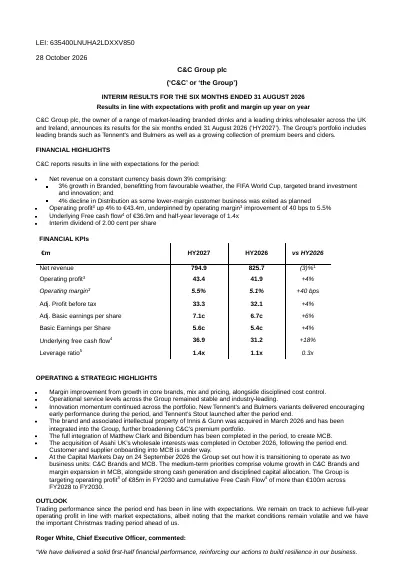
Thanks, Roger, and good morning, everyone. I'll begin with the headline financial performance for the first half, and the key message here being that despite lower group revenue, we delivered growth in earnings, margin, and free cash flow.
Starting at the top of the table, revenue declined 3% year-on-year on a constant currency basis, and that reflected branded growth of 3%, and distribution revenue decline of 4%, and I'll expand on those on the next slide. Operating profit of €43.4 million was an increase of 4% on the €41.9 million results for the first half of last year.
This increase reflected an improvement in operating margin driven by revenue growth in core brands, pricing, and positive mix impacts alongside disciplined cost control. From a cash perspective, the group generated €36.9 million of underlying free cash flow, which was up 18% year-on-year, and leverage ended the period at 1.4 times, which was down from 1.6 times at the February year-end, and compares to 1.1 times reported at the same point last year.
Turning to look at revenue in a bit more detail, and firstly a note on our reporting segments, and as we explained at the capital markets day, we're in the process of transitioning to operate as two businesses, C&C Brands and MCB. In the meantime, the reporting is on a consistent basis as previously, which is branded and distribution, which is what you'll see here in the revenue and profit numbers, and we'll transition to those new reporting segments in due course.
Looking at revenue in those two business units, branded revenue increased by 3% on a constant currency basis to €277 million. Growth there was led by Tennent's and Bulmers, supported by favorable weather, the FIFA World Cup, focused brand investment and innovation, together with a positive contribution from Innis & Gunn following its acquisition in March.
Distribution revenue declined 4% on a constant currency basis in the period to €618 million, principally driven by the planned exit of some lower-margin customer business, combined with the ongoing impact of market attrition across outlets and underperformance in some wine and spirits categories. Just turning over to look at operating profit, and these numbers are all before exceptional items, and the group delivered a €1.5 million increase in operating profit to €43.4 million.
Branded operating profit increased by €2.5 million to €29.2 million. Revenue growth, pricing, and positive mix drove an improvement in the branded gross margin that more than offset cost inflation, driving that operating profit increase.
Distribution operating profit declined by €1 million to €14.2 million. The impact of lower revenue and cost inflation was partly mitigated by cost savings and improved gross margin percentage.
An overall group operating margin increased by 40 basis points to 5.5%, and that reflected branded margin increasing by 80 basis points, whilst distribution margin was broadly unchanged year-on-year at 2.3%. I mentioned exceptionals at the start, these numbers are before exceptionals.
Those exceptional charges were €6.9 million before tax for the first half, broadly in line with last year, and there's more detail on those provided in Note 3 to today's interim results announcement, and we continue to expect full-year exceptional charges to be lower than last year. Before I move on to cash flow, a quick look at the outlook for costs, and on the left-hand side here, I've broken down our operating costs into its different components.
So 70% of the costs that go through the business are third-party goods for resale, and the remaining 30%, you can see here, comprise manufacturing input costs, distribution costs, and overheads. On the right-hand side of this table here, we show how that 30%, what the outlook is on costs for that 30% of costs, manufacturing input costs, distribution costs, and overheads, and the arrows showing the direction that these costs are moving in.
Now we're hedged for the rest of this financial year, and these arrows show the impact after those hedges, and for next year, we're partially hedged on price of materials, albeit we have contractually secured almost 100% of our expected volume requirements for next year. Moving on to cash flow, and as set out in the capital markets day, we've updated our definition of free cash flow so that it includes lease payments, we now have two free cash flow metrics that we will report consistently going forwards: underlying free cash flow, which is after lease payments, but before exceptionals; and free cash flow, which is after both lease payments and exceptionals.
This table breaks down the free cash flow in the period, starting at the top of the table with €60.5 million of adjusted EBITDA, which was up €2.4 million year-on-year, in line with the movement in operating profit as explained earlier. CapEx of €7 million was increased year-on-year due to investment in the dealcoholization plant and a new yeast room in Wellpark, alongside new equipment in Clonmel.
Payments of lease liabilities were broadly flat year-on-year at €10.1 million, and working capital movements were also broadly net neutral in the six months. The amount drawn down on the receivables facility was €136 million at the period-end, which was unchanged year-on-year.
That's the same amount we drew at the end of August last year, and as explained previously, the drawdown on this facility is not included in our reported net debt or leverage. Net finance costs paid of €9.5 million was slightly reduced year-on-year, and that just reflects timing rather than anything else.
All of that subtotals down to an underlying free cash flow of €36.9 million for the first half compared to €31.2 million last year, an increase of 18%. Exceptional cash outflows were €11.8 million and included €5.7 million of cash outflows incurred at the start of this year in respect of exceptional items that were charged to the P&L last year.
That leaves free cash flow at the bottom of the table here of €25.1 million, slightly up year-on-year. Net debt on the next slide then.
Net debt excluding leases ended the period at €113.7 million, that was a reduction of nearly €8 million in the six months since February. The group generated €25.1 million of free cash flow during the half, and this more than funded the ordinary dividends of €13.6 million, which represented the final dividend in respect of FY26, and also the acquisition expenditure of €5.1 million in respect of Innis & Gunn.
As a result, leverage reduced from 1.6 times at the February year-end to 1.4 times at the end of August on a pre-IFRS 16 basis. As a reminder, our financing is long-dated and provides significant headroom.
The group's revolving credit facility and term loan extend out to January 2030, with private placement notes maturing in 2030 and 2032, and therefore we have no near-term refinancing requirement. As Roger mentioned in the introduction, we set out our medium-term strategy at the capital markets day last month, and the targets associated with that are set out on this next slide for reference.
Firstly, operating profit of €85 million in FY30, and as I explained in September, we anticipate next year, FY28, to be flat on this year, with growth thereafter. Secondly, on the right-hand side there, free cash flow generation of over €100 million over the three years FY28 to FY30, and this is after both leases and exceptional costs, and therefore represents the true free cash flow available for ordinary dividends, M&A, or other shareholder returns.
Then finally, before I hand back to Roger, at the capital markets day, we set out our refreshed capital allocation priorities, and these are set out on this slide as a recap: Firstly, to maintain a strong balance sheet targeting leverage of 1 to 1.5 times on a pre-IFRS 16 basis. Secondly, organic investment to maintain the asset base and to deliver the plans underpinning the medium-term targets.
Thirdly, to pay a sustainable and progressive ordinary dividend, and the interim dividend for this year has been set at 2.0 cents per share, which is 4% lower than last year's interim dividend, and that's just due to the split between the interim and final dividends last year, and it's the board's intention to pay a progressive ordinary dividend for the full year, FY27. Then finally, on the right-hand side here, any surplus capital would then be deployed for growth or for return.
That's it from me for now. Happy to take questions at the end, back to Roger.
Roger White
Thank you very much, Adam. Now if I can take a few minutes, largely just to reiterate our strategic direction and supporting priorities.
If we can flick on to 14. I make no apologies for repeating a number of points that we made at our recent capital markets day.
The first of those is to emphasize the importance of resilience and momentum to the group. Resilience and momentum are the two key traits we need to deliver across the business to allow C&C Group to meet its undoubted potential.
As you'll all appreciate, we are on a recovery journey at C&C, and as such, our immediate job is to increase our level of business resilience. Increasing our resilience will afford us the stability necessary for us to be able to focus on building the momentum that is crucial to all successful consumer goods businesses.
The building of resilience sits in a number of areas of the business, but has a common thread running through it: planning for the longer term and not taking shortcuts, not flattering our immediate performance, fixing some difficult things that have been long overlooked, and building a positive challenger culture across the group, which will support our risk mitigation efforts and provide us with an increased opportunity to deliver our agreed priorities. Momentum, as you'll appreciate, is far more difficult to drive into an organization.
Momentum is essential for all successful consumer goods businesses. It provides confidence to employees and customers alike, and it fuels the virtuous funnel of growth that's required for success, where increased sales lead to more product distribution in the market and space in the outlet, which in turn leads to increased consumer awareness and participation, which leads to increased space, and so it goes on and on.
Our focus and aims are simply set on building our resilience and getting the flywheel of improvement going to build our momentum. I'm pleased to report good progress on this so far this year.
Turning to page 15, slide 15. Earlier in the year, we redefined who we are, what we're about, and how we show up.
It's captured simply on this slide: we're here to bring people together through remarkable brands and by building value-added partnerships. Operationally, simply aim to be great at the basics and do what we say, keep our promises, if you like.
As far as who we are is concerned, there are a number of areas we are trying to improve or develop. We're trying hard to become a simpler business.
We're increasingly thinking beyond beer and cider with a more multi-beverage outlook in our branded business, and we can see the benefits of further developing our capability and channels outside of our core hospitality expertise, which spans across the whole business. We approach all of this as a challenger business, seeking the positives in our geographic focus and deep consumer understanding at the same time as we leverage our scale and reach across our core markets of GB and Ireland.
As a challenger business, we seek to act with agility and pace without losing our operational focus on driving excellence in our execution across the group. All of this is done while we continue to put our sustainability commitments at the heart of our plans.
Our business approach is underpinned by a culture based on pragmatism and simplicity. We'll focus on building our capabilities in our make, move, sell businesses, following a simple path to business growth and improvement: selling more drinks to more people through more customers in more places more often.
Organizationally, some of the big steps have already been taken. The top team is in place and was introduced to you first-hand if you joined us for our CMD.
We've completed the alignment of Matthew Clark and Bibendum, and I'm pleased to report we've also completed on the acquisition of the Asahi wholesale business, and we are now supplying the Nectar customer base via MCB. We now look at the business in a slightly different way, and we're well-placed to get into next financial year with a clear focus on revenue and costs from a divisional perspective.
We expect to make more tweaks to our organization to align with our growth over time, also as part of our efficiency programs where we'll seek to further refine how we show up in each area of the business as we seek to drive waste and inefficiency out of our business. If I can now turn to slide 16.
As I mentioned a moment ago, we're starting to view everything we do through our updated business approach, moving towards two discrete business models coexisting within one group structure, both having clear priorities and approaches to the creation of value for the group. C&C Brands is the vertically integrated, asset-backed, brand-led model that includes the legacy businesses of Tennent Caledonian Breweries, Tennent's Northern Ireland, Bulmers Ireland, C&C International, and Bibendum off-trade wine agency business.
The business operates across the UK and Ireland, as well as in 50 countries around the globe, and is a true multi-channel business with leading positions in hospitality and a growing retail footprint. The business is a brand-led model that utilizes its considerable asset base to create value, including partnerships in brewing, packaging, and route-to-market services alongside brand development and route-to-market support for key partners.
Our powerful stable of brands is managed from here, and our focus is simply on volume growth. MCB is the wholesale business model that supports the hospitality channel primarily in England and Wales.
MCB is a scale operator which offers unrivaled service, choice, and value to its customers, at the same time as providing route-to-market access to the broadest hospitality channel across the market, significantly reducing complexity, bringing scale and expertise to brand owners big and small. This complementary model, supporting both customers and brands, is a necessary service which we believe has been devalued in recent years, and our objectives are to reinvigorate MCB with a clear focus on margin improvement, but importantly, without prejudicing core customer objectives of service, choice, and value.
In support of these two fundamental business operations, we have our central support functions, including people, data and tech, and finance, designed to effectively enable local success in our two business models whilst driving value at group level. Now turning to talk a little of what we have delivered during the reporting period on slide 17.
Since the last formal update in May, we've been busy across the group, delivering to customers across the busy summer months alongside getting on with the important, more strategic matters at hand. The long-overdue integration of Matthew Clark and Bibendum is now up and running.
The teams and the organization are redefined, and importantly, the transition phase of bedding this significant change in is now complete. Of the many steps in this integration, the update to our range has been one of the most important, especially the creation of a single wine list capable of providing the choice and value that customers need and expect, at the same time as we provide our wine brand supply partners the appropriate platform to grow and develop across the market.
The other big step in this process relates to people. It's been a tough year of significant change as we brought these two businesses together.
We have recut our territories, relooked at our skills, and reset our organization, and I'm pleased to say all of that is now complete and bedded in. In recent months, we've continued the work on what I would describe as the carve-in of the Matthew Clark Bibendum business, giving us the required visibility of performance at a granular level on a properly costed basis for MCB.
We start the margin recovery journey we are on with a clear understanding of the financials in the business and can make better decisions, whether they're difficult or easy decisions, they will definitely be significantly better-informed. We were pleased to acquire the Innis & Gunn business at what we consider was a very sensible valuation, and we've now fully integrated the business and the brand into our core portfolio.
This provides us with a significant opportunity for growth across a number of markets and geographies with a premium, authentic brand we already understand well. Having announced the intention to acquire the wholesale business of Asahi in September, as I mentioned earlier, I can confirm today that we've completed on that transaction in the past 10 days, and I have a small slide on that later in the presentation.
I've spoken previously about our expectations surrounding industry consolidation, and indeed, these two examples are evidence of our thesis playing out. Our strategy has been designed to take account of all possibilities and to look to benefits where possible.
Where in the example of Innis & Gunn, we've been able to strengthen our growth aspirations in our premium portfolio, and with the Asahi deal, bring in a sizable number of new, high-quality customers whilst improving our network utilization and efficiency across our MCB operating model. I believe these examples should give confidence in the deliverability of our plans.
Our drive to simplify the business to support our overall resilience has also made good progress in the period. Just picking out one or two highlights: we've completed our entity reduction project, dropping from over 100 formal entities in our group, yep, that's right, 100, to only 21, simplifying not only the corporate structure chart, but simplifying and reducing our reporting and admin burden.
We've also continued to develop our portfolio abilities via our range in MCB at the same time as we reduce our distribution platform and consolidate further to support increased efficiency and reduced cost. It would be remiss of me at this point not to mention our innovation in the period, with highlights such as Tennent's tops and Bulmers Flavours driving real brand growth, as well as significant brand excitement for customers and consumers alike.
We've had a busy time. Now if I can turn to slide 18 and our partnership activities.
Across the group, partnerships are critical to our success, but across the C&C Brands business, we are building real momentum in these value-added relationships. Our capacity, capability, flexibility, and scale in manufacturing, whether that's brewing or packaging, alongside our scale logistics operations, are providing value-added partnerships to industry-leading businesses, building for the long term.
These partnerships are utilizing our capabilities, our assets, our know-how, and benefiting from our capacity, our scale economics, and our position in our core markets, creating value for shareholders where value was previously allowed to go uncaptured or at least not fully exploited. We can see the current economic climate supporting further opportunities for us as we seek to create long-term value from our operating platform, our asset base, our skills, and our market positions, and we will update further in due course as we deliver more in this part of the business.
Now moving on to a short operating update on slide 20. The beer portfolio has undoubtedly benefited from the market conditions of the last few months, as Adam mentioned earlier: great summer weather and the halo of the Football World Cup in particular.
I'm pleased to report that we've grown in value terms ahead of the market, with Tennent's growing share in a competitive lager market in Scotland being a particular highlight. Innovation, as previously mentioned, is beginning to become an important part of the growth story for our brands, with Tennent's new products attracting new consumers to the category, and of course to the brand, something that will support our growth ambitions as we look forward.
Now turning to slide 21. Tennent's is without doubt famous for lager: the large yellow can, for some of us, the memory of T in the Park, and for anybody wandering round the streets of most Scottish towns, big red T on the wall outside many, if not most, pubs across the land.
Focus can definitely bring success. However, we believe Tennent's as a master brand can be more, much more.
We have in the last few weeks, after a year of development and planning, launched Tennent's Stout. This is an important launch.
We believe it could even have strategic value. Stout is a fast-growing category, increasing its penetration with younger consumers.
Is it a departure for the brand? Not really, as we've been brewing and selling stout for more than a century.
We believe we have a great product on our hands. We also believe that the proposition for the consumer and the trade is exactly what is needed in the market at this point.
Now it is early days, but the early signs are giving us great encouragement, and I look forward to updating you on the progress of Tennent's Stout at the end of the year. Just like beer, if we turn to slide 22, our cider portfolio is making good progress.
We were supported again by the summer weather, but we've continued to see strong portfolio performance, with Bulmers growing share, Outcider showing strong growth in Northern Ireland, and Magners maintaining its number one status in packaged apple cider in the GB on-trade. Turning to slide 23, innovation played its part in cider as much as in beer, with the launch of Bulmers Flavours taking a meaningful share of the market in the Republic and importantly driving excitement into the category where we are actually leaders.
We introduced the zero variants in both Magners and Bulmers, with Bulmers the number one low and no cider product in the Republic of Ireland, building once again on our market-leading position in the category. Now if I can turn briefly to the wholesale side of the business on slide 24.
As I said earlier, Matthew Clark Bibendum has had a very busy period with the combination of MC and B, followed by the acquisition of the Asahi wholesale business. This is primarily the Nectar wholesale business.
As I said earlier, this deal, we believe, is fully aligned with our strategy, and we remain focused on driving value from a number of potential ways from our MCB business. Our immediate focus is to improve margins, and this deal supports that element of the strategy well.
The deal was announced in September with a planned completion in October, and that transaction is now closed. We have in the last week commenced deliveries to the previous Nectar customers who have now been transitioned to the MCB business.
Included in the perimeter is one leased depot at Hindon, the relevant stock, and the team at Hindon. With the exception of the depot, however, the business is effectively being folded into MCB.
This creates the synergistic values on the transaction. The associated benefits will follow through when all the customers have been transferred, which is expected to be early in the new year.
Alongside the acquisition is the development of a longer-term partnership with Asahi. This will see us working collaboratively to grow the Asahi portfolio to our mutual advantage through the MCB wholesale platform.
We believe we now have the ingredients for improvement at MCB, and the plans to drive the margin back to an acceptable and, importantly, sustainable level, with this deal being the first of our steps. Now moving on to sustainability on slide 25.
For those of you staring at your slide, you will see a picture on there shows the visible progress we're making on our investment in our dealcoholization plant at Wellpark as the tanks get put up. We anticipate being in a significantly enhanced position for all our brands in relation to no and low in the months to come as we get this new technology up and running early in the new year.
In the period, C&C Group has made further progress in relation to sustainable procurement, aligning with ISO 20400, the internationally recognized framework associated with sustainable procurement. We've also been recognized as one of Europe's business climate leaders, earning a place on the prestigious Financial Times list for 2026, rising 154 places on the list in recognition of our success in sustainability, in particular around our strong progress in the reduction of carbon emissions.
We're proud that our team in Clonmel have also achieved Origin Green Gold Membership, recognizing the site's outstanding commitment to sustainability and continuous improvement, a real feather in their caps. We believe we continue to sharpen our focus across the group in terms of sustainability, and we are bringing real improvements to the business on the back of it, as well as meeting our reporting requirements, which we believe is critical to all our sustainability efforts.
If I turn to the final slide, in summary, we've delivered a solid financial performance in the first half of the year. We've sustained our improvement in service to our customers across what was a very busy summer period.
We've seen substantial improvements in cash generation, as Adam outlined. Our brand performance has begun to see the benefit of our new thinking and our new innovation, building confidence for the longer term.
Distribution, having dropped some lower-margin business, has delivered the long-overdue alignment of Matthew Clark and Bibendum, and is now digesting the next step in our structural margin improvement delivery with the Nectar consolidation. Our partnership development is beginning to build some real momentum.
All of these factors are building resilience into the group alongside our simplification roadmap. We remain fully committed to the delivery of our full-year expectations, and also fully committed to continuing to make strategic progress as outlined today.
Thank you all very much for your time today. Adam and I are very happy now to take any questions.
Operator
Thank you, Roger, and thank you, Adam, also. Just to reiterate, if you would like to ask a question, please use the raised hand function, and we will prompt you to unmute.
Our first question comes from Fintan Ryan of Goodbody. Fintan, if you could please unmute, go ahead, and ask your question.
Fintan Ryan
Good morning, Roger, Adam. Fintan Ryan here from Goodbody.
Two questions from me, please. Firstly, just in terms of the distribution sales delivery in the in the first half, could you break down what was within those sort of 4% constant currency sales decline, could you break down what was the sort of deliberate customer rationalization efforts and what was the underlying market?
Sort of as you think about the second half of the year, particularly into Christmas, what's your view of the market and as well as sort of the the customer rationalization? Then secondly, on the on the branded side of things, could you give us a sense of like the mid-term algorithm that you set out at the CMD was very much focused on delivering volume growth in that business.
Could you give us a sense of what the puts and takes were in the first half of the year for volumes specifically, and how you think of that ramping up into into the second half and next year, particularly with some of the really good innovations like the Tennent's the Tennent's Stout that you highlighted? Thank you.
Roger White
Morning, Fintan. I'll kick off with the first question.
The changes to our customer portfolio in terms of the relativity of it to the financial performance, I think it's about equal. It is broadly speaking if you stripped out the positive decisions we made not to chase volume that we've highlighted, then I think it relates to the 4% or so that we've declared.
Then so that would suggest the balance of the business, underlying business, is about flat. In terms of the run-in to Christmas, it's quite difficult to give you a specific steer on that other than to say we're well-prepared across our business, both in wholesale and in brands.
We've got strong branded program for Christmas, and on the wholesale side, we've just in the last couple of weeks had all our big trade events, which were really well-attended across the country. Really we are waiting to see how the consumer responds to Christmas.
Our expectations are for a pretty similar Christmas to last year, and we're ready to trade our way through that. The second question, I think, Adam feel free to jump in here, was around I think the volume question around the branded side of the business.
Look, I think we haven't really seen a huge impact from our innovation activity or our brand development activity yet. We've sort of set the team up, we've launched a couple of smaller things.
We're quite excited, as about stout and its early performance. Innovation should make a material contribution as we go forward, I'm not going to put a specific number on it, but to make it worth the effort, it needs to be reasonably material, and we think it can be.
In terms of the broad marketplace, we've got a strong market share with Tennent's in the on-trade, but we've got work to do in the off-trade, we think there is opportunities for us to grow both at a kind of core brand level and at a wider portfolio level in the off-trade as well. I think we can see that aspiration to get into volume growth, having been in a reasonably long period of value-driven growth, but with volume decline, that turning round, and even if we get into marginal volume growth, we'd be very happy because it will come with some value growth as well.
Fintan Ryan
Great. Thank you.
Operator
Thank you very much, Fintan. Our next question comes from Anubhav Malhotra of Panmure Liberum.
Anubhav, if you could please unmute, go ahead, and ask your question.
Anubhav Malhotra
Hi Roger, hi Adam. A couple from me, please.
First, on the Nectar on Asahi deal that you have struck, that business in itself was not making much money as far as I understand. Maybe you could describe to us what was the issue with that business.
Was it more a gross margin issue in terms of the contracts they had struck, or was it just a lack of scale, and hence when you are trying to fix that, it's just a case of bringing it into your system and leveraging the scale advantages, or did they need to renegotiate over time some of those contracts just like you're doing in your main MCB business? Then secondly, on the partnership development in the branded part of the business, how important a factor was that in the growth in the first half in the branded parts, and also maybe if you could quantify if it contributed to margin development as well?
Thank you.
Roger White
Hi, Anubhav. I'll take the first one, and I'll let Adam just gather his thoughts on the second.
Look, it's not for me to comment on other people's businesses. We looked at primarily the Nectar business as a consolidation opportunity, and what we've done is effectively take across the customer base, fold it into MCB, plus one one depot, which we needed to do to give us the service and execution that we needed.
In essence, we have taken out all the overheads. Why was it not making very much money as you suggested?
I think the main thing is subscale. I think it's quite hard in much smaller distribution businesses where you lack scale, whether that's in procurement, whether it's just in amortizing out cost, and the benefit for us is that we add it into our existing platform, and that's what creates the synergistic benefit.
Adam, do you want to give a view on the partnership impact?
Adam Phillips
Sure. There's kind of two two elements we do.
There's contract manufacturing, and then there's partnerships. They're kind of the same thing, but they can be slightly different, where you've got own label and contract, and then maybe some longer-term partnerships for perhaps brewing and bottling.
We have seen some growth overall in that. I think at the capital markets day, we talked about the overall volume output from our two sites, Wellpark and Clonmel, being kind of about a third is third-party manufacturing.
We have seen some growth from that in the first half of the year, and I expect that to be a feature over the years ahead, as we set out in the capital markets day. There's opportunities to do more of that, and I expect that to be part of the driver of the volume growth in the C&C Brands part of the business over the next few years.
Anubhav Malhotra
Thank you so much.
Operator
Thank you very much, Anubhav. Our next question comes from Damian McNeela of DB Numis.
Damian, please go ahead and unmute and ask your question.
Damian McNeela
Hey, morning, everybody. Thanks for taking the questions.
First question I think is for you, Roger. I'm just intrigued by your comments about trying to make the business simpler, but then looking beyond beer and cider into a more multi-beverage business.
Can you sort of expand a little bit more about what you're thinking there, is the first question? Then the second question is perhaps for you, Adam.
I know you're not reporting under the new structure yet, but can you sort of give us a sense of what the underlying Matthew Clark Bibendum operating margin was and movement in the first half, please?
Roger White
Morning, Damian. Look, I think it is absolutely not a contradiction to say we want to be simpler, but we also want to develop our portfolio.
The kind of portfolio side of it is about consumer, which is what we should be tracking. We know from what's widely available and also the bespoke research that we do, that consumers are changing their consumption habits, they're changing their occasions, they're changing their hospitality habits, and we need to move and ensure we're aligned with those consumers.
One one of my sort of few benefits is that I come from a wider beverage background, I'm keen on beer and cider, but I'm equally keen on many other liquids. We've got a lot of experience as a business driven by our wholesale side, we understand actually rather a lot about most of the categories.
We do have a head start in terms of developing or building business in a wider portfolio basis, and that's what we want to leverage. The simpler is very much about taking waste out of our business, taking effort that is not accretive out of the business.
There's been a lot for us to do to simplify the business and take whether it's duplicated effort, or whether it's effort that was historically valuable, but is currently no longer valuable, or whether it's things that have not been fixed historically, that we have now got on and fixed, it's right the way through the enterprise. We will, despite wanting to build our portfolio, definitely want to continue on our simplification journey.
I see these two things as being absolutely no problem. Building brands, putting liquid into packaging is not in itself adding complexity.
What adds complexity is administration and an organizational activity.
Damian McNeela
Quickly
Adam Phillips
distribution margin. On the distribution margin, the overall distribution business delivered a margin of 2.3% for the first half, that was flat year-on-year.
Obviously that includes the MCB wholesale business in England and Wales, it includes the Scottish and Irish wholesale businesses, C&C International, and the Bibendum off-trade. Within that, MCB itself was pretty much flat year-on-year, is around the 1% margin.
If you remember the capital markets day, we set out MCB on its own for FY26 was around €900 million of revenue and close to 1% margin. It's very similar, it's very consistent with that for the first half, about 1%, about flat year-on-year.
The planned exit of lower-margin business that we talk about is pretty much all focused in the MCB business, what you've seen in the P&L of the MCB business is that's where the revenue decline is focused from in the overall distribution segment. You've got gross margin percentage is up, because you've got favorable customer mix overall by coming out of that lower-margin business, gross margin percentage is up, but you've got cost percentage as a percentage of revenue is then offsetting it, because you've got lower revenue coming through, until we replace that revenue with, for example, the Nectar business that we've taken on.
Matthew Clark MCB, about 1%, flat year-on-year for the first half.
Damian McNeela
That's great. Thank you very much.
Operator
Thank you, Damian. Our next question comes from Clive Black.
Clive, if you could please go ahead, unmute, and ask your question.
Good morning, thank you. A few for me if I may.
I guess given the day, what would be a good or bad budget for you, Roger and Adam? Secondly, without sounding too flippant, we've noticed some buying surges in recent weeks around water and baked beans.
I just wonder if people around the country have stocked up on Tennent's for a blackout. Then I guess a little bit more substantively, we're a year away from DRS, almost to the month.
What steps are you taking now within your business? Then lastly, around the big questions of brewing capacity and distribution capacity outwith C&C, what are you anticipating in terms of brewing and distribution capacity that may help or hinder your strategic plans?
Thank you.
Roger White
Let me just try and kick these off in reverse order. I think from a capacity point of view, I obviously can speculate, but can only report what is visible.
What we've seen in recent times is a number of the larger industry players looking at their estates and taking capacity out. I think there's a lot of complexity in some of these sites, quite a lot of smaller runs.
People are under cost pressure in their operations, to drive efficiency, then reducing SKUs and taking stuff out is difficult, but can be a way of dealing with that. We see potentially more people taking more complex capacity out, from our point of view, that plays to the flexibility and geographic positioning that we have in our sites.
In terms of DRS, yeah, you're absolutely right, we're under a year away now. We had a little internal sort of powwow at the year mark.
It's interesting for us because we have the split business that we're describing this morning, we have a lot of work to do in terms of our packaging and getting the deposit onto all our packaging as a producer, and then working through the systems and process side of that, and we're well on with that. Interestingly, there's relatively little, in our view, understanding of what goes on in the hospitality sector from the kind of general DRS population, who are broadly driven by retail outlets.
We are trying to help our customer base plan for that, trying to help the DMO get that right, and to ensure that as a wholesaler into that specific sector, that we get ourselves well planned up, because we buy a lot of materials from a lot of suppliers, and we need to make that as trouble-free an implementation as possible. There's a lot of work to do on that, you're absolutely right.
I don't think we've particularly seen anybody stock-building Tennent's, although my cupboards are not bare. I'm not sure whether the Heinz or any of the water guys have seen a big surge, but, yeah, we haven't probably participated as some have in that.
On the budget, Adam can give you his view. Look, I guess we feel a little bit like this has been dribbled out over the past few days, and even this morning there's more coming out.
I'm personally a little worried that we're going to get lots and lots of little things, and the bigger issues associated with balancing the country's books are not going to get dealt with. I understand why the government wants to give everybody a little bit of help, but we have some quite big problems to deal with as well, and so I hope that the little bits of help don't come at the expense of dealing with the bigger issues.
Adam, any views?
Adam Phillips
Consistent with that. I think we've, as you say, a lot of it's been well-trailed, probably pretty consistent with some of our forecasting assumptions around cost inflation, wage inflation, etc.
Obviously, any bits that will help are more than welcome, aren't they, but I think we're expecting similar to what we've seen and been expecting around cost inflation, and at this stage, probably limited help for the sector, but let's see what comes out.
Just to finish on that sort of wider consolidation capacity piece, since your CMD, I think there's been an announcement of a major brewery closure in England. Do you sense that this should be, in aggregate, a tailwind for your business?
Roger White
Look, I think, as we said at the CMD and as we tried to show people, we have in our two large production operating sites, we have a lot of flexibility, we have a lot of capability, and we have a lot of scale, and we have capacity. By definition, we think that there is more we can do to develop and grow partnerships.
We're not really interested in just picking up random business, we want to be able to develop something that is longer-term and more structural or even strategic in terms of its relationships. Look, I guess when times are tough and people have to cut their cloth accordingly, then it tends to favor those with the largest capacity available, because we have no intention of going anywhere, and if we could go some way to filling our sites up, then it has a very positive gearing effect on our overall business.
No, that's really appreciated. Thank you.
Thank you both.
Roger White
Thanks, Clive.
Operator
Thank you very much, Clive. Our next question comes from Cathal Kenny.
Cathal, if you could please go ahead, unmute, and ask your question.
Morning, gents. Two questions from my side.
Firstly, on Tennent's Stout, clearly positive momentum, albeit it's early doors. Just thinking as that opportunity scales, do you need to post some capital or cost work to monetize the opportunity?
That's my first question. Second question is on distribution and pricing, and going back to the CMD and your ambitions around price optimization, price realization.
Can you remind us where we are in that journey, and have we seen any benefits accrue in the first six months of this year? Thank you.
Roger White
Morning, Cathal. Thanks for that.
Adam, why don't I take the first one, and you take the second? Look, there is in any brewing business, which is primarily focused, certainly at the minute, on the on-trade, there is installation costs associated with driving something new out into the market.
It's an incremental distribution point, it's what works within our financial algorithm. Whilst it's additional capital, it comes with the appropriate return, I don't see it as being in any way onerous.
I think depending on the scale and ambition, and it's too early to have a view on that just yet, there could be the opportunity to make this a little bit more strategic and invest significantly more behind it in terms of marketing and brand building. Then, there are undoubtedly some options we have associated with the take-home business as well to consider, which we're working through as we speak.
Adam, do you want to talk about the distribution?
Adam Phillips
Yeah. Pricing in the distribution side in MCB, as you say, it absolutely is a feature of the margin improvement plan over the next few years.
Has it had an impact or any benefit in H1? No.
H1 was more around planning of that, planning stages. We have brought some additional expertise in after the end of the first half, or around the end of the first half.
I'd see that more being something that we would bring in towards the end of this year, but more so next financial year when you start seeing the impact of that.
Thank you both.
Roger White
Thanks, Cathal.
Operator
Thank you, Cathal. Our next question comes from Douglas Jack.
Douglas, if you could please unmute, go ahead, and ask your question.
Yes, good morning. I've got a couple of quick questions, if that's all right.
The first one is just in terms of marketing spend. You touched on it a minute ago.
I was just wondering what we should be thinking in terms of the overall marketing spend in light of the new variants you're launching. Then I didn't make the capital markets day, but I think you said that 80% of profit comes from 20% of SKUs.
Just wondering where we are in terms of that rationalization program and what we should be thinking about it looking forward. Thanks.
Roger White
Morning, Douglas. Look, the marketing spend in the period is broadly flat.
The benefit that I think we have from our portfolio perspective is that Tennent's, Bulmers, Magners, a number of the bigger brands, they are effectively master brands. We believe we can advertise and market from a master brand perspective, we don't need to have necessarily individual separate sort of main campaigns.
What we have done in the case of stout, it's been a great lesson on the use of social and digital marketing. It's very exciting and very interesting to see the advocacy for the brand that the consumers have, and if you do a good job of providing them with the right materials, and the right products, the right environments, the right customer base, and some handy things like glassware and some light bits of marketing and advertising, then it's amazing how much bang for your buck you can get by the consumers doing a great job for you, and we've certainly found that with stout so far.
The second question around SKU rationalization, the big SKU change for us in the first half has been the creation of a single wine list. Previous to that, we had a set of separate wine lists for Matthew Clark and a separate set of wine lists for Bibendum.
Whilst there was some overlap, there was a lot of difference, and that is a big piece of work to review and then rationalize and then sell in to all the customers a new range. We've got good experience of that, and we've had some good, positive outcomes from that, and we've got work to do now across the balance of the MCB business to look at our significant range where there are quite a lot of opportunities for rationalization, and we're really at the start of that journey.
Thank you very much.
Operator
Thank you, Douglas. Our final question comes from Greg Johnson.
Greg, if you could please go ahead, unmute, and ask your question.
Morning, gents. A couple of questions from me on both sides of the business.
On branded, obviously you've had sort of full control now of Innis & Gunn for several months. What have you been able to add operationally to the brand post-acquisition, and where do you think the key opportunities lie over the medium term there?
Also on brands, intrigued by the comments of the strategic value from launching Tennent's. Can you maybe touch sort of on a high-level view of what you mean by that, Roger?
Then on distribution, I think from an answer from a prior question, can we take it from those comments that sort of the regional distribution side, i.e., in Ireland and Scotland, have been broadly flat over the period, performance-wise? Also with the MCB merger, how much synergies do you still have to realize, if any, post-integration?
Thank you.
Roger White
I'll take the first two, if you can take the second two, Adam. On Innis & Gunn, yes, look, we know the business well.
We've been working with Innis & Gunn as a brewing partner and a sales partner for many years now. The integration was relatively seamless.
I wouldn't say completely seamless, because when you buy a business from an administrator, it comes with some slightly different challenges than buying it as effectively a going concern. We had a few sort of lumps and bumps to overcome in the early days.
Look, I think we've got now some quite interesting portfolio choices to make about what we're going to do, how we're going to focus. The Innis & Gunn brand is an authentic beer brand that spans ales, it spans flavored ales, and it's obviously got its lager product as well.
We've got some choices to make. The initial first six months has all been about stabilizing what we took over.
It had had a few challenges in the months up until the sale, and we think we've stabilized that. It also has a reasonable amount of the portfolio is outside the UK, and in particular in Canada, we're just getting to grips with that as well.
The second question around the strategic value of Tennent's Stout, look, I guess the Tennent's brand is a phenomenal brand. It's effectively in a positive sense landlocked in Scotland.
There are not that many brands in the consumer goods world that operate like that. I'm sure you could point to some of them.
I certainly know one or two of them quite well. It's about finding the right way of growing outside your core market.
It's never an easy thing to do. It is a genuine strategic challenge to find a way of opening yourself up from being a very successful brand in a small geography to getting a foothold in a larger one.
We think that there is the possibility that as we broaden the portfolio for Tennent's, that super-local nature of it is specifically around the lager part of the portfolio, and perhaps there's more we could and should be able to do with it on a broader geographic footing. That's really what I'm alluding to.
Adam, do you want to cover the distribution?
Adam Phillips
Sure. Distribution segment that we presented today, about 75% of that is MCB.
The rest is then the wholesale businesses, I'm talking from a revenue point of view here, the rest is then the Scottish and Irish wholesale businesses, C&C International, etc. Yes, I think your question was can we infer that other than MCB, then the rest was pretty flat?
Yes, from a revenue and margin percent perspective, the other pieces other than MCB were pretty much flat. The factors we've talked about that drove the distribution performance in the period, those of revenue and operating profit, were pretty much all MCB-focused.
That's where the planned exit of the lower-margin customer business was. Then I think the final question was around any further synergies on integration MCB, I think that's largely done.
There are some residual bits to explore. The focus now moves on to looking at how we optimize the cost to serve, as we set out in the capital markets day.
Opportunities around the operating cost base through either matching the cost of what we're offering to the price that we're charging, or to make sure the quality service we're offering is reflected in price, but it's the optimizing the cost base going forward, the cost to serve, more so than synergies. There may be some small bits to finally explore, but they're pretty much done.
Understood. Thank you.
Operator
Thank you very much, Greg. That was our final question.
I will now hand back to Roger and Adam to close up the call.
Roger White
Thank you. Thank you all very much for your time today, and again apologies for the late change to online.
I hope that hasn't put anybody out. We are working hard on this recovery journey, and we hope that the progress that we were able to outline today will give confidence to people that we're moving in the right direction, at the right pace, and we look forward to updating you at the end of the year on how we've closed that out.
Once again, from Adam and I, thank you for your attendance today, thank you for your continued support, and we look forward to catching up with you in due course.