ICG plc
Q2 FY2027 · Earnings Call TranscriptNovember 11, 2026
Chris Hunt
Good morning. Thank you for joining this webcast covering ICG's results for the six months ending 30th of September 2026.
The slides are available on our website along with the accompanying results announcement. As a reminder, unless stated otherwise, all financial information disclosed today is based on alternative performance measures, which exclude the consolidation of some of our fund structures as required under IFRS.
I'm joined this morning by our CIO and CEO, Benoît Durteste, and our CFO, David Bicarregui, who are going to give an overview of our performance during the period, and we will then take questions. With that, I'll pass over to Benoît.
Benoît Durteste
Thank you, Chris. Good morning, everyone.
ICG is in an exciting period of inflection. Our clear focus on investment performance for institutional clients, which is now well recognized within the industry, is increasingly a positive differentiator compared to many peers in alternative asset management.
We are benefiting from this across our flagship and scaling strategies, continuing the organic diversification at scale we have been pursuing for many years now. Looking ahead, we have a lot of runway to grow almost all our strategies over multiple vintages, which gives us high conviction in the growth of our FRE per share, as well as cash generation.
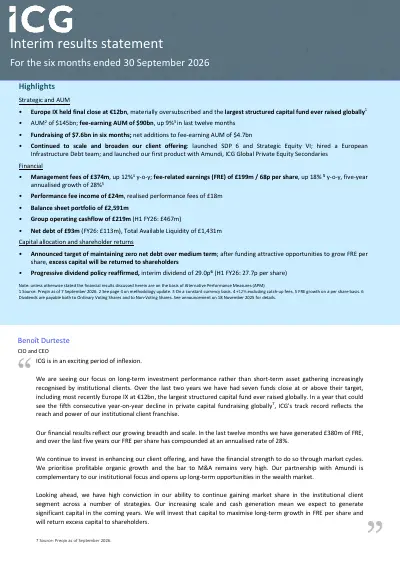
The development of ICG over the last decade has been remarkable, and we have done that entirely organically. Our fee-earning AUM has increased by nearly 5 times, and today stands at $90 billion.
Our management fees have grown well over 6 times, and we have diversified across many measures. To take just one, 10 years ago, fees from our largest fund represented almost a quarter of our total management fees.
Today, it's less than a fifth. I want to reinforce this point about organic growth.
It is not an accident that we have more than tripled our number of clients and increased our blended management fee rate from 88 bps to nearly 100 bps over the period. It has been deliberate.
We have hired teams in attractive, growing, and profitable market segments. We have invested in our marketing team and have used our balance sheet capital in a targeted way to build scaled and scalable businesses across multiple asset classes.
For a long-term shareholder, that is building substantial equity value with a highly attractive risk-adjusted return. If we dig into just one of those metrics in more detail, our fee-earning AUM, which, of course, leads directly to management fees and FRE, this has grown consistently over the last decade, increasing in dollar terms every year.
Shareholders are understandably asking how today's macroeconomic uncertainty could affect our performance. There are a number of layers to that answer, and my starting point is this very graph, which highlights our ability to grow fee-earning AUM in a range of environments and through cycles.
This has resulted in a platform today that is broad, scaled, and with multiple drivers of future growth. On the left-hand side of this slide, you can see how ICG has shifted over the last 5 years.
Structured Capital, Secondaries, and Real Assets have driven our growth, and it is precisely in these areas where we see the biggest long-term opportunity, both in deployment and capital raising. Today, our scaling strategies account for about $28 billion.
That's 31% of fee-earning AUM. If you roll forward 5 or 10 years, that number will likely be dramatically higher, compounding the growth we expect to see in our flagship strategies.
As I said at the beginning, we see a meaningful opportunity to reinforce our position as a partner of choice for institutional clients wanting differentiated and consistent investment returns. We are achieving this by staying the course and continuing to prioritize, as we always have, investment performance and, importantly, realized investment performance.
As you can see on this slide, we are delivering at least top-quartile and, in most instances, top-decile DPI metrics to our clients. This matters, and it shows in our fundraising success.
We have consciously opted not to pivot to an asset-gathering model. AUM growth matters, but not at all costs and certainly not to the detriment of investment performance.
In that light, incentives matter. Our investment professionals are never incentivized on AUM or management fees, always on realized investment performance for the funds.
This may sound obvious, it's alignment of interest with clients, but it is becoming the exception more than the rule in our industry. Clients recognize this.
We are being rewarded for having been consistent and deliberate in staying true to our principles. Most obviously, that client recognition is clear in our fundraising track record.
Over the last 2 years, we have closed seven funds at or above their target across all our asset classes and across scaling and flagship funds. These targets have not been easy.
Excluding Metropolitan in Real Estate, the average upsize compared to the prior vintage was 80%. In the current market environment, this is an exceptional track record of vintage-on-vintage upsize.
To put it into context, over the last 3 years, total fundraising globally across private markets has fallen by approximately 19%. One final observation on the left-hand side.
Globally, across private markets as a whole, about 80% of all capital raised in the first six months of this year has gone into funds over $1 billion in size. That compares to circa 60% 5 years ago.
Every final close on this page for our funds is well north of that figure. We have the scale across multiple strategies to be relevant to the largest clients globally, and that has positioned us well as clients have concentrated relationships with a smaller number of managers.
I want to touch on briefly the fundraise for Europe IX that closed in the period. The fund reached €12 billion and was significantly oversubscribed.
It is the largest ever dedicated Structured Capital fund to be raised globally, and we attracted capital from a geographically diverse institutional client base, including 35% coming from the Americas. As a reminder, this is a closed-end strategy with fees on committed on the full €12 billion.
There's no free co-invest. The blended fee rate is identical to the previous vintage despite the upsize.
Obviously, but it's worth reminding ourselves, there is no redemption risk here. This is significant fee generation anchored for the next 10 to 12 years.
It is also a clear example of investment performance translating into client commitments at greater scale, driving significant management fee growth. Stepping back, that strategy, Structured Capital, has nearly tripled in size over two vintages.
If you add in the mid-market fund which we launched in 2019, the fee-earning AUM of Structured Capital in Europe, which is our oldest, most mature strategy, has gone from $8 billion when we closed Europe VII to $27 billion today, a 3.5 times increase. Raising the money is only part of the story, of course.
Deploying it well is what secures future funds. Our view on deployment is the reason we capped Europe IX where we did, despite client demand being incredibly high.
In today's investment landscape, there are attractive investment opportunities, particularly for a Structured Capital product. Europe IX is already 25% committed, with deals in exclusivity taking it to well over 30% invested.
The environment remains incredibly complex to navigate. Between anemic economic growth, persistent inflation, political uncertainty across the board, AI disruption, investment decisions require increased diligence and care.
It's worth noting on AI, while it touches most if not all businesses in some way, we have stayed clear of investing directly in the space. The degree of uncertainty and risk in the eminently circular AI ecosystem, for all the reasons that have been well documented now, mean that unless you take a venture capital approach or at least invest purely in equity, which is not what we do, my view is that you are not being compensated enough for the risk and lack of visibility.
Another way of saying that is, should there be a further correction in the AI space, ICG and our funds would not be directly impacted. At a product level, this environment with higher-for-longer interest rates is not a particularly comfortable backdrop for private equity portfolios.
As a result, I expect the muted buyout activity to continue for some time as private equity sponsors struggle to justify and achieve high exit valuations. In contrast, debt strategies, Structured Capital, and more broadly, inflation-linked real assets are relatively attractive today.
The demand for liquidity solutions should also remain very high, which benefits our thriving Secondaries franchise. Within private debt, it's worth noting the rise of retail money in evergreen funds that take monthly subscription and offer quarterly windows of potential liquidity has created an interesting phenomenon of micro-cycles, depending on whether those funds are seeing inflows or outflows.
It is making the deployment environment for direct lending more dynamic. In recent quarters, as a number of evergreen private credit funds have experienced elevated redemption requests, we have seen positive net deployment in SDP, our own direct lending strategy.
Against that investment landscape, we are operating in a number of very large addressable markets, and we can afford to be measured and disciplined in how we deploy and realize our clients' capital. A steady, consistent approach has always served us well through cycles.
The financial results we are reporting for this period show how we are meeting client demand at scale, innovating where we see the opportunity, and delivering strong organic growth for shareholders. We are now including unrealized gains on invested capital in our AUM in line with market practice, taking it to $145 billion.
Fee-earning AUM, obviously not impacted by this change, was $90 billion at the end of September, up 9% year-on-year. During this period, we have also hired a team for European infrastructure debt and will look to launch a fund next year.
We've launched our first joint product with Amundi in LP secondaries, and we have made progress in raising our second CLO risk retention vehicle, which over time should make our CLO business materially less capital intensive. David will discuss the financial results in more detail, and I'm pleased to be reporting that we are delivering growth today alongside broadening the sources of growth for the years ahead.
To put these things together, our investment performance, our client franchise, and our financial position, that is what makes this an exciting period of inflection for ICG. This cycle will lead to momentous changes in our industry.
We are, I believe, only in the early stages of this transition. Clear leaders will emerge, and I believe ICG will be one of those.
Looking ahead, our organic growth path continues apace. We are likely to reach our 4-year fundraising target a year early.
We have a large, large number of flagship and scaling products in the market, and expect to launch further funds over the next 12 months. That is a great situation to be in at this point in the cycle, and our fortress balance sheet, which has taken us some time to reach, is not something we are going to squander.
The great change compared to even 5 years ago is that our choice is no longer between doing one thing or another. We can pursue multiple routes in parallel to generate long-term value and respond to the shifting market environment.
This will include continuing to invest in scaling and diversifying our business as well as returning excess capital to shareholders. With that, I will pass to David.
David Bicarregui
Thank you, Benoît, and good morning, everyone. You've seen the half-year snapshot already, and so now I want to take a step back to the last 12 months.
We have delivered £380 million of FRE, up 18% year-on-year, equating to 131p per share. We've generated £613 million of group operating cash flow and reduced net financial debt to £93 million.
I will take each of these in turn, but the message is clear: FRE is compounding, the business is highly cash generative, and our balance sheet is in its strongest position for many years. Turning back to the six-month period covered by today's results.
Management fees for the half were £374 million, up 12%. Over the last 5 years, we have compounded management fees at an annualized rate of 18%.
Costs grew 6% in the last six months, at the lower end of our medium-term range and well below the rate of management fee growth. As a result, FRE was £199 million for the half, up 18%.
FRE margin, excluding catch-up fees, was 47%, up 3 percentage points year-on-year. That is the clear operating leverage in our model: management fees growing faster than costs, translating into higher margins and strong growth in FRE per share.
Over the last 5 years, FRE per share has compounded at an annualized rate of 28%. Performance fee income was £24 million for the half.
Ex the £72 million one-off in the H1 of last year, that is broadly in line with both H1 and H2 of FY26. The balance sheet remains highly diversified, with no single investment accounting for more than 3%.
The P&L mirrors the performance of the underlying funds and the assets in which it invests. From a cash perspective, we received £18 million of performance fees in the first half of this financial year, and the balance sheet portfolio generated £97 million of net cash.
As we've said before, our balance sheet has a clear role within our business strategy to support management fee growth. We use it to co-invest in and alongside our funds and to seed new strategies and products.
Looking ahead, we expect to continue reducing the capital intensity of the business while growing management fees. Two things are accelerating that.
Firstly, we are reducing the size of co-investments in absolute terms where possible while raising more client capital. Secondly, our second CLO risk retention fund has had its first close, and we have visibility on getting north of $100 million, with scope to go larger.
Over time, this and future vehicles should enable us to reduce the balance sheet capital required to support new CLOs by about 80%. That matters, because although CLOs only contribute 5% of management fees, they account for about 10% of our balance sheet portfolio and, historically, have generated outsized income statement volatility.
As you can see on the right-hand side, the balance sheet is generating significant net cash. We said at our full-year results, and we reiterate here, we're in the early stages of a multi-year period where the co-investment portfolio could generate significant levels of cash.
Let's have a look at how we're reducing capital intensity in practice. To take the same funds Benoît spoke about earlier, the seven we have raised in the last 2 years at or above their target, combined, these funds have over 90% more management fee potential than their prior vintages, and total balance sheet commitments for those funds reduced in absolute terms by about £140 million, or 16%.
Specific example, Strategic Equity 5 was over twice the size of SE 4, while the balance sheet commitment halved from £200 million to £100 million. More fee potential with less balance sheet capital committed.
That is capital intensity reducing in practice. Turning to operating cash flow, which stood at £219 million in the last six months and more than £600 million over the last 12 months.
Within that, FRE-related cash flows are up 21% year-on-year. Our cash generation in recent years has strengthened our balance sheet, given us greater flexibility to invest for growth, and to return capital to shareholders.
In the last six months, we continued to reduce our net debt, which now stands at £93 million, paid our final dividend for FY26, and repurchased £60 million worth of stock into our EBT as part of our policy of neutralizing the dilutive impact for shareholders of stock-based compensation. Bringing all this together, our capital structure is incredibly robust.
We are well-positioned to continue growing our business. We are able to invest for growth across cycles, and we have flexibility to take advantage of opportunities.
We have less than £100 million of net debt and almost £1.5 billion of available liquidity. As a result, today we are announcing a target capital structure of zero net financial debt.
The absolute level will move around from period to period. You cannot be overly precise about that.
Zero net financial debt is the medium-term target we are managing to. Reaching this point has taken a number of years and a careful calibration of organic growth, investing in our business, and maintaining our progressive dividend policy.
Over the last 5 years, FRE has grown organically by 3.4 times, which translates into a compound annual growth rate of 28%. Cumulative operating cash flow has been almost £3 billion over the last 5 years, and over that period, the balance sheet portfolio has remained the same size.
We've invested in our business alongside paying out £1.3 billion of dividends to shareholders and reduced net debt by over £1 billion. That is the financial component behind the period of inflection that Benoît described earlier: growing FRE, a robust capital structure, and significant cash generation.
That gives us more choice in how we allocate capital to maximize total shareholder returns. Our progressive dividend policy remains very much in place, and taking a longer-term perspective, we have increased our ordinary dividend per share every year for the last 17 years.
In terms of how we use excess capital, we will continue to invest organically, as we have over the last decade, and explore M&A, although the bar remains very high. We assess those opportunities against a number of factors, including their ability to deliver long-term growth in FRE per share.
In the absence of alternative uses that would deliver superior growth, we expect to return excess capital to shareholders, which is likely to include a buyback in due course. That brings us to the broader framework for generating shareholder value.
The starting point is investing well, with the platform around that to attract and manage our clients' capital across an increasingly scaled and diversified business. That should lead us to strong growth in FRE per share, which can be accelerated by capital allocation decisions.
Alongside that, shareholders benefit from performance fees and the clear value of our balance sheet portfolio. More broadly, our market is large, exciting, and evolving in our favor.
We're growing our franchise in multiple asset classes. The financial opportunity ahead of us is clear: to keep compounding FRE per share with less incremental balance sheet capital and put that growing financial capacity to work for shareholders.
With that, I'll pass back to Chris for Q&A.
Chris Hunt
Thank you, Benoît. Thank you, David.
To keep things moving, we're asking that you please try to limit your questions to a maximum of two each. Analysts can ask verbal questions by using the raised hand function or pressing *9.
Alternatively, please feel free to submit your questions through the SparkLive platform. To start with, can we have some questions from Oliver Carruthers at Goldman Sachs.
Ollie, your line should be open.
Oliver Carruthers
Hi there, morning team. Thanks for the presentation, thanks for taking my questions.
I'll go with two. First question, could you give your latest thoughts on Strategic Equity 6?
I notice that KKR yesterday announced that they're launching their first GP-led secondary strategy, and next year clearly they wouldn't be doing this if there wasn't a sizable opportunity still to go for. Just keen to get your kind of framing around your next vintage there.
Second question on cash flow generation. Thanks for the incremental color you've given here in the presentation.
I think all very clear. You have this comment on slide 14, "we're in the early stages of a multi-year period of significant cash generation from our co-invest portfolio."
I wonder if you could put that comment in the context of the net cash generation you've done from this part of the balance sheet portfolio over the last 5 years that you've shown on the next slide. Thanks very much.
Benoît Durteste
Thanks, Oliver. I'll take the question on Strategic Equity, David.
David the cash flow aspect. One is for context, Strategic Equity, we are fortunate to have been first mover in that space.
We basically essentially created that asset class. As a result, to this day, we are still, by far, the largest player globally in Strategic Equity or GP-led secondaries.
The market opportunity it's always been very significant, because if you think about it, the market opportunity is the number of deals that private equity sponsors would really like to keep long-term because they are their best deals. If you present it that way, the size of the opportunity is huge, and the capital available is actually quite low.
Because if you look, the fact that ICG is still, by far, the largest tells you something about the amount of capacity available in the market. The opportunity set is very significant.
I think to temper that, we have to be mindful that we are at a point in the cycle for private market, specifically for private equity, where there's still an unresolved topic of valuations, which I believe remain too high for older vintages. As a result, you have to be careful into what you're investing in, and also what is the motivation for GPs to do a CV or a GP-led transaction.
What we find is many opportunities out there in the space are really GPs looking for liquidity in the secondary market that they cannot find at their NAV, right, their valuation in the primary market. Those deals you don't really want to be doing.
As a result, we've been incredibly selective. We're turning down most of the deals we see to focus purely on exactly those very few deals that the GPs really want to hold on to.
Fundamentally, the market opportunity is huge, and at the same time, we need to be careful that at this current point in the cycle, many transactions are not the ones you want to be focusing on. If you are looking for a number on a target size, this is not something we are publicly discussing.
Previous vintage was total $11 billion, as a reminder.
David Bicarregui
Good, shall I pick up on the second question, Ollie? You asked about the sort of cash flows and some of the historical contexts that we put on the slides.
I'd actually encourage you to read that slide and the next one together, because together they effectively form the basis this point we're making about inflection of the business from a financial perspective. I think it's very clear when you look at where we're allocating the capital to these successive vintages, we just don't need as much nominal capital in each new fund.
The consequence of that, mechanically, is that as we get realizations back from prior investments, we are picking up significant amounts of net cash. That's what you see on the page, coupled with the fact that we will always continue to seed new strategies and new engines of growth.
The seed portfolio itself is limited in terms of the amount of capital density required. You put all that together, you can see the positive net cash flow generation over time.
The other point I'll make, which is evident from the slide, it's also quite uneven. If you want to look at this over time, I think that's a good idea structurally, and we are in a structural position that you can take some comfort that, going forward, will continue to be that case.
It will be uneven, and I think you have to think about that in terms of timing, which is why, again, we don't give specifics in a short-term time horizon.
Chris Hunt
Benoît, on Ollie's first question, without putting words in his mouth, I think he may also be interested in commentary you may have on the timing of SE 6 as well.
Benoît Durteste
We've launched.
Chris Hunt
Yep.
Benoît Durteste
That's public information. We have launched.
Then timing is always uncertain as to when we're going to do a first close, because this is linked not so much to the ability to raise, but to the exact timing and when we will be finished investing the previous vintage. We always endeavor to fully invest vintages, push them to 90% invested or so, because we think that's the right thing to do.
As a result, it's dependent on doing that one last deal, and that's always difficult to predict. The first close will be sometime during '27.
I have to say.
Chris Hunt
Thank you very much. We'll turn to Angeliki from J.P.
Morgan. Angeliki, your line should be open.
Angeliki Bairaktari
Good morning, and thank you for taking my questions. Just two from me as well, please.
One on deployment, if my calculations are correct, when I look at Q2 '27 versus the first quarter, there seems to be a big slowdown in deployment, and actually most of the deployment in the second quarter was driven by debt, with very little in the Structured Equity and the Real Assets segments. Can you talk to us a little bit about what you saw in the previous quarter and what you are currently seeing in terms of sort of deployment, and what are your expectations for the pace of deployment in Structured Capital and Real Assets for the rest of the year?
Second question, with regards to the comment that you made, Benoît, on the muted buyout activity and how you expect that to continue. You have been saying that for a while now, I think over the past 4 years.
We haven't really seen the pickup that other players in the market had been hoping for. What really needs to change, in your opinion and based on your experience, to reactivate a pickup in buyout activity?
What motivates those high valuations, stubbornly high valuations, to come down eventually? Thank you.
Benoît Durteste
Thank you, Angeliki. On deployment, yes, you're right.
There are a number of factors. Some are cyclical, some are just purely the fact that the deal making tends to be lumpy.
If I take a step back, we don't have a single fund that is late in deployment, okay, so that's just the broad view. You just sometimes have a year where you have a jump in deal flow, and others where there's less.
Remember, it's not a volume play, right? Two deals would dramatically change the deployment perspective.
Having said that, it's true that this year the environment has been more difficult, one because there's greater uncertainty. If you think about it, the two largest markets in Europe, there's been a change in government in the UK, and there's significant political uncertainty in France.
Now that's not conducive to significant deal flow or risk-taking either from management teams, owners, or from investors like us. The context, that's temporary, but the context played a part into this as well.
I'm not reading too much into this. As I mentioned in the presentation, I believe, if I look at Structured Capital, you asked for Structured Capital going forward, actually we have quite a few deals in exclusivity, and that's despite the fact that we're being incredibly cautious on France, at least until the elections, and so we have visibility to be at least 30% deployed in the not-too-distant future, and as you know me, I have a tendency to underpromise.
It's not an area of concern that was behind your question. Nevertheless, this is an environment where we are being incredibly cautious.
That ties into your second question in some ways. Thanks for pointing out that I've been right for the past 4 years.
I'm sure I'm going to get it wrong at some point. Yes, listen, it's just that for the past 4 years, I just couldn't see the catalyst for buyout activity to resume at pace, essentially because the bid-ask on equity valuation was just too broad, and I don't think it's getting narrower.
The fact that interest rates have been going up is not helping. What would unlock that?
Valuations coming down. The difficulty is there aren't that many incentives for private equity sponsors to lower valuations and lower NAVs.
One because past vintages, particularly the whatever, '19 to '21 or '22 vintages are probably not going to be great vintages across the board for private equity, but they're not going to be atrocious. If you're a private equity fund and your view is you're going to hit hurdle and generate carried interest, your interest is to maximize money multiple, even if it is to the detriment of IRR.
You're going to be hanging on to assets, putting it differently. In our industry, certainly for private equity funds, you can hold on to assets for a very, very long time, right?
The only thing that creates an incentive is if your DPI numbers are really low and you need to go out fundraising and you're under pressure from LPs to realize assets. There is some of that, but not enough to create this significant catalyst for the market to properly reopen.
It will happen because people can't be sitting on an ever-increasing backlog of potential transactions, it will happen. That will be good news.
Our Structured Capital strategy is not really correlated to the buyout space, but direct lending is. That will be very good news for direct lending because direct lending has been deploying relatively well in a really difficult environment.
Should that space reopen, we would see much more deal flow, and therefore much greater deployment, which for direct lending, because it's fees on invested, would translate into greater fees. I wish I could tell you this is definitely going to happen in '27.
Unfortunately, I'm going to stick to my previous 4-year track record and say that I still don't see it.
Chris Hunt
Thank you. We still have a number of questions, I will keep moving through quickly.
Can we turn to Nick Herman at Citi, please? Nick, your line should be open.
Nick Herman
Thanks, Chris. Morning, gents.
Two questions from my side as well. One on M&A and one on value creation.
On M&A, presumably there are quite a few managers that would want to partner with you given you are taking share in a consolidating market. Could you talk about what areas are of particular interest to you, the availability of opportunities out there, and I guess also the feasibility of doing something more meaningful given your shares trade at relatively lower levels at least versus listed peers?
On value creation, not to take away from clearly strong performance by Strategic Equity over time, but there have also been some pretty notable markdowns across multiple vintages in the current period. Could you provide us with more detail around that, as well as I guess the outlook for value creation across Structured Capital and Secondaries more broadly given that was, as a whole, pretty muted over the last six months?
Thank you.
Benoît Durteste
On M&A, listen, the situation hasn't changed. We have a broad platform, but it's not so broad that there are no areas that we would be interested in.
There are plenty. Whether it's geographic expansion of existing strategies or new strategies, there are plenty of areas that we could be interested in.
As you rightly pointed out, there is a question of relative valuation. It's true that we've had this unfortunate tendency of trading below not just listed peers, actually if you look at where managers in private markets trade, and much smaller managers than we are, and I would argue with not quite the same performance, are trading at much higher valuations.
That is creating a difficulty, not necessarily unsurmountable, but it's something to take into account. We're always having discussions.
There are many people come knocking on our door. Those discussions are always ongoing.
Far, as you've seen, we've decided we thought we could do it better ourselves, and so we've been doing it organically. The latest recent example being infrastructure debt, where I think there's very significant potential in Europe, because there aren't that many players covering that space, and there's significant appetite from LPs.
We looked around, and in the end, we decided that we were better off doing it ourselves by putting a team together and going out to the market to launch a fund. Listen, it's more painful, takes more time, but in terms of value creation for shareholders, I think it's much more valuable.
Second point, I didn't quite catch, actually.
Chris Hunt
It's on value creation in Strategic Equity and also the outlook for value creation within European Corp. I'm
Benoît Durteste
not sure what that means.
Chris Hunt
Fund performance.
Benoît Durteste
Okay.
Chris Hunt
Underlying fund
Benoît Durteste
investments. I'm not sure what's underlying the question.
Structured Capital, a significant reason why there was so much appetite for Europe IX, actually the most appetite we've ever seen, and I've been doing this for a while now, is precisely because the performance of that strategy is quite consistent through cycles, because you have a significant contractual components. Even when we have an equity exposure, we tend to structure around the equity valuation difficulties.
We often have a put or a wrapper on the whole performance of our various financial instruments. It's a strategy that is designed to deliver pretty consistent performance.
Strategic Equity, yeah, make the same comment I just made. Strategic Equity, you're investing in private equity, effectively.
What's absolutely key is the discipline, because if you're investing at the same high valuations that I've just been mentioning, then yes, your performance is unlikely to be outstanding. That's not been our experience so far, mostly because if you select those deals that the GPs really want to keep and that they're really a buyer for, then you're completely aligned in interest, which means you tend to come into these deals at the lower end of the valuation spectrum, that tends to generate positive outcomes.
There's nothing there where I'm seeing particular specific risk at this point. You do have to be incredibly selective.
That's for sure.
Chris Hunt
Thank you. Mike Sanderson from Barclays, your line should be open.
Mike Sanderson
Good morning, Benoît. Good morning, Chris.
Good morning, David. A couple of questions, as always.
First one, seen a lot of peers, when they've been growing their fundraising, have been also offering a lot of co-invest. I don't think you are particularly doing this, and I'd just be interested in how you're thinking about this in the, I guess, the next fundraising cycle, how open you are to co-invest as a concept and a build-out.
Then the second one, I'll give Benoît a break. It's more of a David question.
The cost side of things. Obviously, you're coming in at the lower end of that 5% to 10% range, and I'm just interested from here as to what investment will be required that would mean that, sort of sustainably, you wouldn't remain at the lower end of that 5% to 10% range.
Thank you very much.
Benoît Durteste
Thanks, Michael. Listen, on the co-invest, co-invest can be incredibly useful, particularly when you are subscale in a new strategy, right?
It helps you do larger deals, go faster in a specific asset class, so that can be incredibly useful. Outside of that, basically it's a fee break for investors, that's what it is.
It's a way for LPs to average down their fee rate. It's always good to be nice to LPs, and we try to be a constructive partner, but fundamentally, we do not ignore what this is, which is you have to do more work for less fees.
Fundamentally, I'm not trying to maximize that variable. When we can, we don't.
As I pointed out, for Europe IX, we didn't, for any free co-invest. Now that doesn't mean that the strategy will not generate some co-invest for LPs, because maybe we'll do a very large deal.
In the previous vintage, there's a deal in Germany called Minimax, which is a huge deal, that generated a very significant co-invest opportunity for LPs, because it was much bigger than what the fund could do. This is not something I'm keen to commit to, for the reasons I've explained.
David Bicarregui
Morning, Mike. Pick up on your question about costs and our sort of guidance of 5% to 10% range.
Reminder, as three-quarters of the cost base is headcount, people-related expenses, you're really taking a view here on the number of people we need to run the business, front and back office. The teams themselves that are investing and the size and shape of those teams, I think it's suffice to say we've got teams in place already across the whole platform now that feel very sustainable in terms of driving the business forward organically.
It's why we've been able to shallow some of the cost growth. It's why the teams aren't growing dramatically to raise larger funds.
Obviously, there'll be some of that, but as we've said before, this will be selective and targeted. Also, they'll be making some more investments in technology here and there.
Again, nothing that dramatically changes the cost envelope, but that's in the interest of having a better client experience, being more efficient with the platform, those types of objectives. They're all wrapped up in the 5% to 10% range we give.
Chris Hunt
Thank you very much. James at Berenberg.
James Allen
Hi, morning, guys. Just one question for me.
You've obviously got a lot of dry powder now, I think it's almost $37 billion. I guess, how are you balancing the fact that you now have a lot of capital to invest, with being careful around deployment, and then actually making sure you can invest enough of the capital raised from investors to generate the desired returns for those investors?
Benoît Durteste
James, that's a very pertinent question. That's precisely why we're making sure that we're not getting over our skis on fundraising.
As you've seen in our fundraising number, fundraising hasn't been a constraint for us. That's not necessarily the same for everyone in the market, but that's not really been a constraint for us.
We are capping essentially all of our funds precisely to make sure that we can deploy in a reasonable period of time and we can preserve performance. Europe IX, we were vastly oversubscribed.
We turned off a number of LPs early on because we just couldn't absorb their demand. I think we could have easily raised $15 billion, I think, except that just wouldn't have been reasonable because I don't know that I can deploy in whatever it is, in 4 years or so, a $15 billion strategy in Structured Capital.
Maybe in the future, but going from 8 to 15 just wasn't reasonable. It's a question of not getting overexcited.
We're in the market with SDP right now. We've made it clear to LPs, we're not necessarily expecting to increase the size of the direct lending fund, because going back to a previous question from Angeliki, I think, until we see the buyout market reopen, then we're going to be cautious on direct lending.
It's key. As I'm sure you've heard in this presentation, and is something we kept telling our LPs for years and years and years, our top priority is always to preserve the track record and performance.
The rest follows.
Chris Hunt
Thank you very much. We have a couple of questions online as well.
Firstly, possibly for you, David, can you help us think about potential scale of excess capital returns to shareholders? Should we think about FRE-related cash flows as broadly covering dividends, and buybacks being covered by the net cash generations in the balance sheet portfolio and performance fees?
Is that sort of the model you encourage when we think about
David Bicarregui
it? Look, good question.
Obviously on scale and sizing, we put some numbers in the presentation deliberately to give a sense of what the balance sheet is actually doing in practice with real empirical data. As I said in the answer to the question earlier from Ollie, I think the exact timing and quantum is incredibly difficult, which links to the second point.
This is really a policy based on continuing with progressive dividends, your FRE cash flows to continue to support the progressive dividend. Everything else is then the balance sheet cash generation and the performance fee cash that we discussed earlier.
The timing of that is highly uncertain and uneven, but I think the structural message is clear, and so we'll let people do their own models around that. I think on a reasonable set of assumptions, you can think about 2027 as being a period of time when we reach our target capital structure, which was the main thing that we announced today.
Chris Hunt
Thank you very much. A latecomer for a call over the phone, Hubert Lam from BofA.
Hubert?
Hubert Lam
Hi, good morning. Just a couple of final questions.
Firstly, can you talk about the new product that you have with Amundi, the new evergreen product? I know it's early days still, but can you talk about the feedback you've gotten so far, the initial reception?
That's first question. Second question is on performance fees.
I know it's still a difficult environment for exits, realizations. The percent of performance fees is below the bottom end of your targeted range.
How should we think about this near term? Should we expect it to kind of stay where it is today?
When should we expect improvement? Thank you.
Benoît Durteste
Sure. Yes, you're right.
We've recently launched the first product jointly with Amundi, which is an evergreen LP secondaries product. It's really early days.
They've started raising for it, I don't want to get overexcited too soon. However, medium, long term, that is the one asset class where I think we could see very significant flows, because, as I've expressed before, I have some doubts, or at least I think there are some constraints around applying evergreen to the number of asset classes in our world, including credit.
I think it's possible, but you have to be very careful in how you're doing it. I'm not sure the industry has been doing it terribly well, in my mind.
LP secondaries is perfectly suitable for that space, because it has natural liquidity, because there's constant deal flow. One asset class that is perfectly suitable for an evergreen, wealth-targeted approach is LP secondaries, which for us is a growing area.
Our track record has been very good, so that should support the fundraising. I'm very confident that we will see over time significant flows, but I'm also very conscious that it takes time, right?
This wealth approach, it's a bit of a slow burn, right? They start building the relationship, and money starts trickling in, and then it starts to be more and more, and you keep ramping up.
Over time, I think it's going to be a meaningful contributor to profit generation and AUM, but we also have to be a bit patient.
David Bicarregui
Hubert, you asked about performance fees. A couple of things just to call out there.
If you look at performance fee mix over the last 5 years, about 12%, in the medium-term range that we quote. It's another of these items that over short-term guidance is not easy, and we don't give short-term guidance for that reason.
What I'd point you to is just the passage-of-time effect. We accrue these in over 12 years now per our new policy, these will come in over time.
If you look at the run rate, it's been about the mid-£20 million area both in H1, H2, and this period. I'd start with that.
Everything else is really a view on NAVs, which, again, is not something we take a view on in the short term.
Benoît Durteste
It's a bit lumpy as well, right? If you look at our DPI numbers, unlike many peers, we've had a really, really good run at exits in the past 2, 3 years.
Really good run. Which has driven performance fee as well.
There is a bit of a cyclical aspect to that as well, natural.
Chris Hunt
Then a couple of questions online. David, maybe a couple for you, first of all.
Firstly, do you expect any rating upgrade from S&P and or Fitch because of the financial target of zero net debt? Then second question, we have a bond maturing in February 2027.
Do you have any comments around rolling that or refinancing with
David Bicarregui
the next rotation? Look, on both, we're BBB+ now from two rating agencies.
I'll leave them to comment on what circumstances would lead to further upgrades. Clearly, we haven't got much net debt left on the balance sheet, and we have those conversations, at least annually with both agencies.
I won't today talk about bond maturities, but clearly we've got more than adequate cash, liquidity, robust balance sheet, we don't need the debt. We'll take a view on that as we get closer to the actual maturity.
Then
Chris Hunt
finally, Benoît, on AI. Benoît, you mentioned earlier ICG has stayed clear of AI due to the potential investment risks.
Do you think this approach will differentiate ICG from many of its competitors in the long term? What would you need to see before feeling more confident to push into the AI space?
Benoît Durteste
Yeah. It already does differentiate us, if only because a number of our LPs have a very significant exposure to AI, either directly, through funds, in debt, in infra, in real estate, and so generally they don't want more.
That's already differentiating us. Listen, we're very pragmatic.
I'm not expressing a view on the future contribution of AI. I'm just expressing a view on the level of risk and lack of visibility today.
Now this could change, and if it does, then we'll weigh in. Until then, I think it's much more of an equity play, and as I mentioned in the presentation, to some extent, maybe even more of a VC play than either a Structured Capital or debt approach, or even an infrastructure approach.
Now having said that, you can still approach it. There are still ways of approaching it indirectly.
For instance, in real estate, we have been making a play at investing in real estate which has very significant access to power, because then that becomes a very valuable piece of real estate potentially for data centers. This is upstream, but we're not going directly into an AI industry risk, if that makes sense.
Chris Hunt
Perfect. Thank you all very much.
There are no more questions, and so this concludes the presentation. Thank you.
Thank you all.
David Bicarregui
Thank you.